

Mengapa Startup Gagal Setelah Kemenangan Awal: Perangkap Penskalalan Prematur
Traksi awal bisa menipu. Pelajari mengapa penskalaan prematur merusak produk dan tim, tanda peringatan yang harus diperhatikan, dan cara melakukan penskalaan dengan aman.
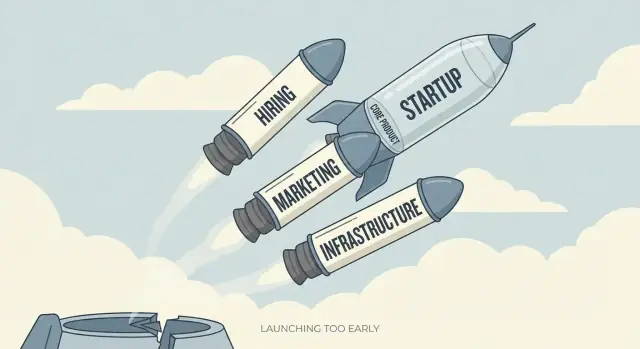
Early Success Can Be a Dangerous Signal
Early success feels like proof you’re on the right track—but it can also be a noisy, misleading signal. A startup can look like it’s “working” while the underlying engine is still fragile.
What “early success” usually looks like
Early success often shows up as exciting, high-visibility events that aren’t yet repeatable:
- A big press hit that drives a one-time spike in signups
- A viral moment on social media
- A single large customer deal (especially if it’s heavily customized)
- A conference launch or app store feature
- A pilot program that’s funded, but not renewed
None of these are bad. The risk is treating them like a growth system rather than what they often are: a one-off surge.
Repeatable growth is different
Repeatable growth means you can reliably acquire customers, deliver value, and keep them—without heroics.
If every “win” requires founders pushing every lever manually (custom onboarding, bespoke features, nonstop discounts), you’re not scaling a machine yet. You’re scaling effort.
Premature scaling, in plain terms
Premature scaling is when you act like you’ve found a predictable, profitable path—so you hire, spend, and expand—before you’ve proved that the path works consistently.
This article gives practical checks to reduce that risk:
- What to measure (retention, unit economics)
- What to delay (major headcount growth, complex expansion)
- What to fix first (the core customer experience)
The goal isn’t to “stay small.” It’s to protect momentum by making sure growth builds on truth, not on a temporary surge.
Traction vs. Product-Market Fit: Don’t Confuse the Two
Early traction feels like proof: numbers go up, people talk, a few customers pay. But traction is simply movement—often driven by a push.
Product-market fit (PMF) is stability: customers keep showing up, keep paying, and keep telling others even when you stop pushing so hard.
What “temporary traction” looks like
Some traction is real but not repeatable. Common traps include:
- Discount-driven spikes: a launch promo produces signups, then usage drops when prices normalize.
- Hype and novelty: press, a viral post, or “new feature” curiosity inflates trials without long-term intent.
- Big-name partnerships: a channel partner sends a wave of leads that never converts again—or converts only with heavy custom work.
These moments create confidence and urgency, which can trigger hiring, bigger spend, and more complexity before the core behavior is proven.
The “strong segment” illusion
Many startups find one pocket of users who love the product—then assume the rest of the market will behave the same way.
Example: a scheduling tool gets intense adoption among therapists because it matches their workflow perfectly. The team then targets “all service businesses,” only to learn that salons, tutors, and contractors have different needs, budgets, and switching costs.
A great segment is valuable, but it’s not automatically broad demand.
The repeatability test
PMF shows up when growth becomes predictable:
- Can you acquire customers through a consistent channel without heroics?
- Can you retain them without constant manual intervention?
- Can you forecast what happens if you spend $X or ship feature Y?
If you can’t reliably answer those questions, you may have traction—but you don’t yet have PMF.
Why Teams Scale Too Soon (Even When They Know Better)
Teams rarely scale because they’re careless. They scale because the signals around them make “going bigger” feel like the responsible move.
The triggers that push the gas pedal
A few common triggers show up again and again:
- Funding events: A new round creates an unspoken expectation to “deploy capital.”
- Competitor moves: A rival launches features or enters new markets, and panic sets in.
- Board and investor pressure: Reporting cycles reward visible activity—new hires, bigger pipeline, faster release cadence.
- Fear of missing out: Early momentum feels fragile, so leaders try to lock it in by expanding fast.
Why “more spend” feels like progress
Spending is concrete. You can point to ad budgets, agency contracts, conference booths, and new tools. It produces dashboards full of motion—traffic up, leads up, meetings up.
When the core model is still shaky, those numbers are comforting because they’re immediate and controllable.
The problem is that spend can mask the real questions:
- Are customers getting value quickly?
- Do they come back without reminders?
- Would they be upset if you disappeared?
Internal pressure is real (and rational)
Scaling is also an identity shift. Teams want headcount to relieve workload, better tooling to feel “grown up,” and bigger roadmaps to justify roles.
No one wants to be the person arguing for focus and repetition when excitement is high.
A simple rule that keeps you honest
Scale only what already works. If a channel, onboarding flow, or customer segment isn’t producing reliable results at small volume, increasing volume won’t fix it—it will only multiply the pain.
How Premature Scaling Breaks the Business Model
Premature scaling doesn’t just “cost more.” It changes the shape of your business model—often in ways that make the original win impossible to repeat.
The burn-rate chain reaction
When you add people, tools, offices, and paid acquisition before the product is truly pulling customers in, burn rate jumps fast.
Higher burn rate means less runway. Less runway creates urgency. Urgency leads to rushed decisions: discounting to hit revenue targets, chasing bigger contracts you’re not ready to deliver, or widening the roadmap to please every prospect.
Each shortcut adds more cost and more complexity—exactly when you can least afford it.
Complexity grows faster than you think
Headcount and customers don’t increase work in a straight line.
- Every new hire adds communication paths, handoffs, and coordination.
- Every new customer segment adds edge cases, support load, and “special” requirements.
You can double your team and still move slower because you’re spending more time aligning than building.
Process debt: invisible early, painful later
Early on, duct-tape processes feel efficient: “Just ask Alex,” “We’ll handle it manually,” “We’ll clean it up next quarter.” At small volume, that works.
At scale, those habits become process debt—tickets pile up, exceptions become standard, and quality drops. Then you’re forced to add layers (management, QA, ops) to stabilize something that was never designed to run at that speed.
Growing vs. getting heavier
Healthy growth increases value delivered per dollar spent. Premature scaling often does the opposite: more spending, more overhead, more coordination—without a matching increase in customer value or repeatable demand.
That’s not growth; it’s weight.
The Retention Reality Check: Are Users Actually Sticking?
Retention is simple: after someone tries your product, do they keep using it (or keep paying) without you having to constantly re-convince them?
Early on, retention matters more than acquisition because it tells you whether you’re solving a real problem. You can buy clicks and spike signups—but you can’t fake people coming back week after week.
What “good retention” looks like (in plain English)
You’re looking for signals that customers are choosing you again:
- Repeat usage: people return naturally because the product is part of their routine.
- Renewals / repeat purchases: customers pay again without a heavy discount.
- Low churn: fewer customers cancel, uninstall, or disappear after the first try.
- Strong referrals: customers bring others in because they genuinely want to share it.
If you’re seeing growth but most customers drift away quickly, your “success” may be a spike rather than a stable base.
A simple way to think about cohorts
Instead of mixing everyone together, group customers by when they started—say, “people who signed up in March” versus “people who signed up in April.” Each group is a cohort.
Then ask one clear question: What percentage of that cohort is still active (or paying) after 7 days, 30 days, 90 days?
Cohorts help you see whether the product is improving over time or whether you’re just adding new customers on top of the same leaky bucket.
The most dangerous warning sign
Growth that’s mostly replacing churned customers is a trap. It can look like progress—new signups, new revenue, bigger marketing spend—while the core problem stays untouched.
A quick check: if stopping acquisition would cause usage or revenue to collapse almost immediately, retention isn’t carrying the business yet.
Unit Economics: Scaling a Loss-Making Engine
Growth can hide a basic problem: every new customer might be costing you more than they’re worth.
That’s what “unit economics” is really about—what it costs to win and serve one customer versus what you earn from them over time.
What to measure (and why it matters)
At a minimum, track:
- CAC (Customer Acquisition Cost): sales + marketing spend needed to acquire one customer.
- Gross margin: revenue minus the direct costs of delivering the product (hosting, payments, fulfillment, support time).
- LTV (Lifetime Value): the total gross profit a typical customer generates before they churn.
If LTV isn’t comfortably higher than CAC, scaling just increases losses faster.
Common ways startups break unit economics
Early wins often depend on effort that doesn’t scale:
- Underpricing: you set a low price to get traction, but it can’t cover real delivery costs.
- Heavy onboarding costs: founders or specialists spend hours per account to get users activated.
- High support load: each new customer adds more tickets than your team can handle without adding headcount.
The trap is assuming these costs are temporary—until you realize they’re tied to the product.
Payback period: the fragility meter
Payback period is how long it takes to earn back CAC from gross profit.
If payback is long (e.g., 12+ months), scaling becomes fragile: you need more cash upfront, churn hits harder, and a small dip in conversion rates can force layoffs.
The warning sign to take seriously
If margins get worse as volume increases, it’s not “growing pains.” It’s a signal the engine is loss-making—more customers simply amplifies inefficiency.
Hiring Too Fast: When Headcount Slows You Down
Hiring feels like the most “responsible” response to early wins: more customers means you need more people. But adding headcount before the work is clearly understood often reduces speed instead of increasing it.
Why more people can make you slower
Every new hire creates an onboarding burden: documentation to write, context to transfer, decisions to revisit, tools to set up, and someone senior pulled away from execution to train.
Multiply that across several hires and you get a hidden tax: calendars fill up, meetings expand, and work fragments into handoffs.
Unclear ownership makes it worse. When the org grows faster than the operating model, you see duplicated efforts (“two people fixed the same bug”), abandoned work (“I thought you owned that”), and endless alignment.
The team is bigger, but throughput isn’t.
Common hiring mistakes during early growth
A frequent misstep is hiring roles before you truly understand the job.
- You add a “growth lead” before you’ve identified a repeatable acquisition channel.
- You add a “head of customer success” before you’ve defined what success means and what problems are solvable with product changes.
Another is leveling too senior too soon. Big-title hires can be valuable later, but early on they may expect stable roadmaps, large teams, and clear budgets.
If those inputs don’t exist, they create process to compensate—process that can smother learning.
Cultural drift happens quietly
Early culture is mostly behavior: how decisions get made, how conflict gets handled, how shipping actually happens.
Under pressure, those values get replaced by habits—especially if you hire quickly and inconsistently. The result is a company that looks larger but feels less aligned, where “how we do things” becomes a source of friction.
Guardrails that keep hiring productive
Tie your hiring plan to proven bottlenecks, not anxiety.
A good rule: don’t hire for “potential work”; hire for work that is already happening and measurably constrained.
- If support tickets are piling up with a clear pattern, hire support (and feed insights back into product).
- If releases are delayed because QA is the limiting step, hire there.
Before each hire, write a one-page role scorecard: the outcomes they will own, the metrics you expect to move, and what will be deprioritized if you don’t hire.
If you can’t answer those, you’re likely scaling uncertainty—not capacity.
Product Sprawl: Shipping More and Delivering Less
Early wins often create a dangerous incentive: “keep shipping.” The product starts to sprawl—more features, more integrations, more settings—while the core experience quietly gets worse.
Features multiply work (even when they look small)
Every new feature adds edge cases.
- An “easy” toggle becomes five different states when combined with other settings.
- A new plan tier changes permissions, billing, and onboarding.
Those edge cases expand QA time, increase regression bugs, and inflate support tickets.
Support load grows in a sneaky way: it’s not only “how do I use this?” but also “why doesn’t it work with the other thing you shipped last month?”
The team spends more time explaining, patching, and hotfixing—less time improving what customers actually rely on.
Roadmaps get hijacked
Once you’re growing, the roadmap is constantly under pressure.
- Loud customers demand bespoke additions.
- Sales promises “just one more” capability to close deals.
- Internally, assumptions like “enterprise means SSO” or “we need an AI feature” harden into commitments.
The result is a roadmap driven by urgency, not by learning. You ship more, but you learn less.
Focus debt: the hidden cost of saying yes
Think of every “yes” as taking on focus debt.
- The principal is maintenance: documentation, UI complexity, support scripts, analytics, bugs, and future compatibility.
- The interest is opportunity cost: each extra surface area makes it harder to improve the core value that created your early pull.
Scale clarity before you scale output
Before adding more, get clear on:
- Who the product is for (and who it isn’t)
- The one or two jobs it must do exceptionally well
- The metrics that define “better” (not “more”)
When clarity is high, shipping speeds up naturally—because teams stop building in five directions at once.
Operational Load: The Unseen Scaling Tax
Growth doesn’t just add customers—it adds work per customer in places most teams under-budget: reliability, internal tooling, and the everyday “keeping the lights on” tasks.
Early on, duct tape holds. At 10× usage, the duct tape becomes the product.
How early systems buckle
The first cracks usually show up in unglamorous systems:
- Uptime and performance: background jobs pile up, timeouts increase, and one noisy customer impacts everyone.
- Billing and entitlement logic: refunds, proration, failed payments, and “why was I charged twice?” tickets become constant.
- Data and permissions: reporting gets slow, migrations get risky, and role-based access turns from a checkbox into a security requirement.
- Integrations: every partner API change, webhook retry, and edge case multiplies maintenance.
These issues aren’t signs you “built it wrong.” They’re signs you’re now running a real operation.
Support and success: the cost curve you didn’t model
As customer count rises, support volume rises faster than expected—because complex accounts create disproportionately complex problems.
You also inherit customer success work: onboarding, training, and churn prevention. If you don’t staff for it, engineers become the backstop, pulling them away from product improvement.
Lightweight process that prevents chaos
You don’t need heavy bureaucracy, but you do need basics:
- A simple incident playbook (who triages, who communicates, how you write a postmortem)
- QA checks for high-risk areas (payments, permissions, migrations)
- Consistent release notes so support and customers aren’t surprised
The clearest warning sign
If your engineers spend more time firefighting than improving—responding to alerts, patching hotfixes, answering tickets—you’re paying the scaling tax with your future.
That’s the moment to slow down growth, harden operations, and earn the right to scale again.
Growth Channels: The Trap of Buying Growth
Early traction can be real—or it can be rented.
When a startup pours money into ads, sponsorships, affiliates, or incentives, it can manufacture “growth” that looks like demand, even if users wouldn’t choose the product without a push.
How performance marketing can mask weak product-market fit
Performance marketing is tempting because it’s measurable and fast. But spend can hide the real question: Would customers still show up if you turned the budget off?
If CAC rises every week, conversion rates are fragile, and retention doesn’t improve with product iterations, the channel isn’t “scaling”—it’s compensating.
A common warning sign: the team celebrates top-of-funnel metrics (clicks, sign-ups) while cohorts quietly decay. Paid acquisition can make dashboards look healthy while the business underneath stays unstable.
Channel risk: the “one lever” problem
Depending on a single platform, partner, or viral loop creates a single point of failure.
Algorithm changes, policy updates, pricing shifts, or one competitor outbidding you can wipe out growth overnight.
Diversification isn’t about doing everything at once; it’s about proving you have more than one repeatable path to customers.
Brand damage from pushing too hard
Aggressive campaigns, misleading promises, or heavy discounting can attract the wrong users—people who churn quickly and leave bad reviews.
That damage compounds: support tickets spike, ratings drop, and future conversion rates fall.
A safer test approach
Treat channels like experiments:
- Run small tests with a clear hypothesis (who, where, why now).
- Define success criteria upfront (CAC, payback, retention by cohort).
- Use stop-loss limits (time and budget) and shut down what doesn’t meet the bar.
Buying growth should validate demand—not substitute for it.
Metrics That Prevent Premature Scaling
Premature scaling rarely looks reckless from the inside. It looks like momentum: dashboards going up and teams “busy” shipping, selling, and hiring.
The trap is that you can grow activity without growing a business.
The common symptoms
Watch for these warning signs:
- Vanity metrics leading the narrative (sign-ups, downloads, impressions) while retention and payback are fuzzy.
- Incentives that reward volume over quality, like sales targets that ignore churn or marketing goals tied to “leads” instead of revenue.
- Perpetually “busy” teams where output rises but customer outcomes don’t—more features, more campaigns, more meetings.
A simple metrics stack (that keeps you honest)
Use a funnel that forces you to look past acquisition:
Acquisition → Activation → Retention → Revenue → Referrals
The point isn’t to track everything—it’s to track the minimum set that shows whether growth is compounding or leaking.
- Acquisition: Where users come from and what it costs.
- Activation: The moment users first get value (your “aha”).
- Retention: Do they return and keep using it?
- Revenue: Do you get paid, and does it scale profitably?
- Referrals: Do satisfied users bring others?
Define “must-not-break” metrics
Before you add spend or headcount, pick a few guardrails that protect the business. Examples:
- Churn / retention (whichever is most relevant to your model)
- Payback period (how long it takes to earn back CAC)
- NPS (as a directional signal, not a victory lap)
If these get worse while top-line activity grows, you’re not scaling—you’re widening the cracks.
Create decision rules (so you don’t negotiate with yourself)
Make growth conditional. Write rules like:
- “We increase paid spend by 20% only after payback improves for two consecutive cycles.”
- “We hire another sales rep only when retention holds steady for new cohorts and ramp time is predictable.”
- “We launch a new channel only if activation rate stays above X at higher volume.”
Decision rules reduce the temptation to chase momentum. They turn scaling into a series of earned upgrades—not a bet placed on hope.
A Safer Scaling Playbook: What to Do Instead
Scaling safely is less about “going big” and more about reducing uncertainty.
The goal is to turn a promising product into a predictable system—before you pour fuel on it.
A quick readiness checklist
Use this as a gate before you add headcount, expand channels, or raise spend:
- PMF signals: A clear “must-have” segment, strong word-of-mouth, and customers who complain when they can’t use your product.
- Retention baseline: Cohorts stabilize (not collapse) after onboarding. You can point to a repeatable activation moment and a time-to-value that keeps improving.
- Unit economics: You know your gross margin, payback period, and whether you can profitably acquire customers without heroic assumptions.
- Operational readiness: Support and delivery can handle 2–3× volume with the same quality, and your team has a documented “how we do this” for key workflows.
If you’re unsure about PMF, read /blog/product-market-fit-signals.
What to scale first (and what to postpone)
Scale the parts that already work—narrowly.
Start with:
- The best segment: The customers who activate fastest, retain longest, and complain least.
- The best channel: One acquisition source that delivers consistent leads with a known CAC range.
- The simplest offer: A focused package that’s easy to explain, buy, implement, and support.
Postpone: new segments, multiple channels at once, complex enterprise tiers, and custom one-off features that create permanent support drag.
“Slow down to speed up” actions
These moves often unlock more growth than hiring or ad spend:
- Pricing fixes: Remove confusing tiers, tighten your value metric, and raise prices where value is clear. If pricing is core to your model, review /pricing.
- Onboarding improvements: Reduce steps to first value, add clear defaults, and measure activation by behavior (not sign-ups).
- Product simplification: Cut low-usage features, consolidate flows, and focus the roadmap on the one outcome customers pay for.
Building faster without scaling chaos
One subtle driver of premature scaling is build latency: when shipping even a small experiment requires weeks of engineering, teams compensate by hiring early or over-committing to big roadmaps.
A way to counter this is to shorten the loop from “idea → prototype → cohort data.” Platforms like Koder.ai are designed for that kind of iteration: you can create web, backend, or mobile app versions through a chat interface, test onboarding and activation flows quickly, and keep change risk low with features like snapshots and rollback.
The point isn’t to replace product thinking—it’s to make learning cheaper. When experiments are faster, you’re less tempted to “bet the company” on early traction.
When the basics are stable, scaling becomes multiplication—not improvisation.
Pertanyaan umum
Why can early success be a misleading signal for startups?
Early success is often a one-time event (press spike, viral post, a single big deal) rather than a repeatable system.
Treat it as a data point, then ask: Can we reproduce this result on purpose—next week and next month—without founder heroics?
What’s the difference between traction and product-market fit (PMF)?
Traction is movement; PMF is stability.
A practical test: if you stop pushing (ads, discounts, founder-led sales) and customers still sign up, get value, and stick, you’re closer to PMF. If everything drops immediately, you likely have temporary traction.
What exactly is “premature scaling” in plain terms?
Premature scaling is hiring, spending, and expanding as if you’ve found a predictable growth path before it’s proven.
Common examples:
- Doubling the team after a launch spike
- Scaling paid acquisition while cohorts are decaying
- Expanding to new segments when one niche is the only one retaining
What are the most common sources of “temporary traction”?
Short-lived traction often comes from non-repeatable drivers like:
- Press or influencer spikes
- Discount-driven campaigns
- Partner lead bursts that don’t recur
- Big customers that require heavy customization
If results require constant manual effort to maintain, assume it’s not yet a system.
How do I avoid the “strong segment” illusion when expanding?
A strong niche can be real PMF for that niche—but it doesn’t automatically generalize.
Validate expansion by comparing segments on:
- Time-to-value / activation
- Retention by cohort
- Willingness to pay
- Support and customization load
If the next segment needs a different product, you’re not “scaling”—you’re rebuilding.
Why is retention the most important reality check before scaling?
Retention tells you whether customers choose you again without repeated convincing.
Quick checks:
- Cohorts stabilize (they don’t collapse after week 1)
- Revenue doesn’t disappear if acquisition slows
- Renewals happen without heavy discounting
If growth mainly replaces churn, your early wins are masking a leak.
Which unit-economics metrics matter most before increasing spend?
Track the basics and make them decision-grade:
- CAC: fully loaded sales + marketing cost per customer
- Gross margin: revenue minus direct delivery costs
- LTV: total gross profit before churn
- Payback period: months to earn back CAC
If LTV isn’t comfortably above CAC (and payback is long), scaling will amplify losses.
How can hiring too fast actually slow a startup down?
Hiring adds a coordination and onboarding tax. When the work isn’t well understood yet, more people create:
- Slower decisions
- More meetings and handoffs
- Duplicated or abandoned ownership
A guardrail: hire for proven bottlenecks, not “potential work,” and write a one-page scorecard with outcomes and metrics before opening a role.
What is product sprawl, and why does it get worse during early growth?
Product sprawl increases maintenance and confusion:
- Edge cases multiply
- QA and regression bugs rise
- Support tickets grow (“how does this interact with that?”)
A practical fix: define the one or two jobs the product must do exceptionally well, then cut or delay anything that doesn’t improve those outcomes.
What metrics and decision rules can prevent premature scaling?
Use guardrails + decision rules so you don’t negotiate with yourself.
Examples:
- Increase paid spend only if payback improves for two cycles
- Hire sales only when new-cohort retention holds and ramp time is predictable
- Expand segments only after the current best segment’s activation and support load are stable
This turns scaling into earned upgrades, not bets placed on momentum.