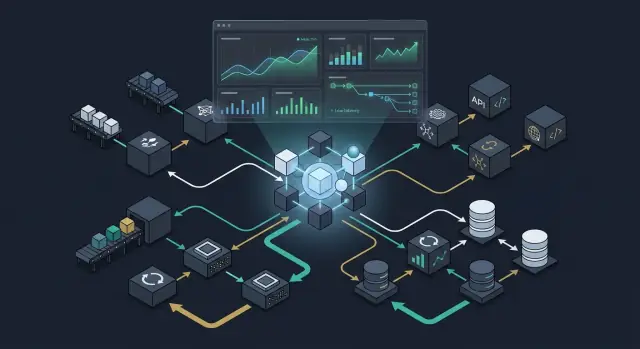
From impressive demos to fragile production agents
Agentic systems are applications where an LLM doesn’t just answer a prompt, but decides what to do next: which tools to call, which data to fetch, which steps to run, and when it is “done.” They combine a model, a set of tools (APIs, databases, services), a planning/execution loop, and infrastructure that glues everything together.
In a demo, this looks magical: an agent figures out a plan, calls a few tools, and returns a perfect result. The happy path is short, latency is low, and nothing fails at the same time.
Why demos work and production breaks
Under real workloads, the same agent is stressed in ways the demo never saw:
- APIs time out, return partial data, or change contracts.
- Multiple requests race for shared resources and corrupt state.
- Long-running conversations bloat memory and exceed context limits.
- Subtle model mistakes compound across many tool calls.
The result: flaky behavior that’s hard to reproduce, silent data corruption, and user flows that occasionally hang or spin forever.
The real business impact
Flaky agents don’t just hurt “delight.” They:
- Trigger incidents and on-call pages.
- Produce wrong answers that slip into downstream systems.
- Erode user trust: people quietly stop relying on the feature.
- Inflate cloud bills via retries and runaway loops.
What this guide focuses on
This article is about engineering patterns, not “better prompts.” We’ll look at state machines, explicit tool contracts, retry and failure-handling strategies, memory and concurrency control, and observability patterns that make agentic systems predictable under load—not just impressive on stage.
Why most agent architectures break at scale
Most agent systems look fine in a single happy-path demo. They fail when traffic, tools, and edge cases arrive together.
Fragile behaviors: loops, stalls, partial work, silent errors
Naive orchestration assumes the model will “do the right thing” in one or two calls. Under real usage, you see recurring patterns:
- Loops: the agent keeps re-planning or re-calling the same tool because it never recognizes completion or failure.
- Stalls: the agent waits on a tool or subtask with no timeout, leaving user sessions hanging.
- Partial work: the agent finishes half the workflow (e.g., drafts an email but never sends it, generates a plan but never executes steps).
- Silent errors: tools fail or schemas mismatch, but the agent confidently returns a plausible answer with missing or wrong data.
Without explicit states and end conditions, these behaviors are inevitable.
LLM sampling, latency variability, and tool timing create hidden non-determinism. The same input can traverse different branches, invoke different tools, or interpret tool results differently.
At scale, tool issues dominate:
- Timeouts and flakiness from upstream APIs and databases
- Schema drift between tool contracts and what services actually return
- Inconsistent error formats that the agent never learned to handle
Every one of these turns into spurious loops, retries, or incorrect final answers.
Concurrency amplifies edge cases and product mismatch
What breaks rarely at 10 RPS will break constantly at 1,000 RPS. Concurrency reveals:
- Race conditions on shared state or caches
- Exhausted rate limits causing cascading tool failures
- Thundering herds of retries triggered by a single dependency blip
Product teams often expect deterministic workflows, clear SLAs, and auditability. Agents, left unconstrained, offer probabilistic, best-effort behavior with weak guarantees.
When architectures ignore this mismatch—treating agents like traditional services instead of stochastic planners—systems behave unpredictably just when reliability matters most.
Design principles for production-grade agentic systems
Production-ready agents are less about “smart prompts” and more about disciplined systems design. A useful way to think about them is as small, predictable machines that occasionally call an LLM, not as mysterious LLM blobs that occasionally touch your systems.
What makes an agent production-ready?
Four properties matter most:
- Safety: The agent must respect constraints around data access, side effects, and user promises. That means explicit permissions, guardrails on tools, and careful handling of untrusted output.
- Predictability: Given the same inputs and state, the agent should behave within a narrow, expected band. You should be able to explain what it can and cannot do.
- Debuggability: When something goes wrong, you can trace the path: which state, which decision, which tool, which model call. No hidden loops, no opaque “thoughts” without structure.
- Change-tolerance: You can upgrade models, tools, or strategies without rewriting the entire system.
You don’t get these properties from prompts alone. You get them from structure.
The default pattern many teams start with is: “while not done, call the model, let it think, maybe call a tool, repeat”. This is easy to prototype and hard to operate.
A safer pattern is to represent the agent as an explicit workflow:
- Define a finite set of states (e.g.,
COLLECTING_INPUT, PLANNING, EXECUTING_STEP, WAITING_ON_HUMAN, DONE).
- Define which transitions are allowed between states.
- Use the LLM mainly for local decisions: choose the next state, select a tool, or fill in parameters.
This turns the agent into a state machine where every step is inspectable, testable, and replayable. Free-form loops feel flexible, but explicit workflows are what make incidents debuggable and behavior auditable.
Break the “god agent” into modular skills
Monolithic agents that “do everything” are appealing, but they create tight coupling between unrelated responsibilities: planning, retrieval, business logic, UI orchestration, and more.
Instead, compose small, well-scoped agents or skills:
- A planner that decomposes tasks.
- An executor that runs concrete steps.
- A specialist for each domain (billing, support, analytics, etc.).
Each skill can have its own state machine, tools, and safety rules. The composition logic then becomes a higher-level workflow, not an ever-growing prompt inside a single agent.
This modularity keeps each agent simple enough to reason about and lets you evolve one capability without destabilizing the rest.
A useful mental model is to split an agent into three layers:
- Decision policy (LLM prompts + model)
Encapsulates how the agent chooses next actions, interpreted under strict constraints. You should be able to swap the model, adjust temperature, or refine prompts without touching system wiring.
- State machine / workflow engine
Owns where you are in the process, which transitions are possible, and how to persist progress. The policy suggests a move; the state machine validates and applies it.
- Tooling layer
Implements what can actually happen in the world: APIs, databases, queues, external services. Tools expose narrow, well-typed contracts and enforce authorization, rate limits, and input validation.
By enforcing this separation, you avoid the trap of hiding business logic in prompts or tool descriptions. The LLM becomes a decision component inside a clear, deterministic shell, not the shell itself.
Design for smallness and clarity
The most reliable agentic systems are not the most impressive demos—they are the ones whose behavior you can explain on a whiteboard.
Concretely:
- Keep each agent focused on one job and one main success metric.
- Encode workflow and state transitions explicitly rather than in prose.
- Let LLMs choose between well-defined options, not invent entire procedures from scratch.
This bias toward small, composable, well-structured agents is what allows systems to grow in scope without collapsing under their own complexity.
Modeling agent workflows as explicit state machines
Most agent implementations start as a loop of "think, act, observe" wrapped around an LLM call. That’s fine for demos, but it quickly turns opaque and brittle. A better approach is to treat the agent as an explicit state machine: a finite set of states, with well-defined transitions triggered by events.
Representing agent flows as states and transitions
Instead of letting the model implicitly decide what to do next, define a small state diagram:
- PLAN – interpret the user request, decompose into steps, choose tools.
- CALL_TOOL – execute a single tool call (or batch) with validated inputs.
- VERIFY – check tool outputs against simple invariants or additional model checks.
- RECOVER – handle errors: retry, fall back, or escalate.
- DONE – return a final answer and close out the workflow.
- FAILED – terminal error with clear reason and context.
Transitions between these states are triggered by typed events such as UserRequestReceived, ToolCallSucceeded, ToolValidationFailed, TimeoutExceeded, or HumanOverride. Each event, plus the current state, determines the next state and actions.
This makes retries and timeouts straightforward: you attach policies to individual states (e.g., CALL_TOOL may retry 3 times with exponential backoff, PLAN might not retry at all) instead of scattering retry logic across the codebase.
Externalizing state for resilience and scale
Persist the current state and minimal context in an external store (database, queue, or workflow engine). The agent then becomes a pure function:
next_state, actions = transition(current_state, event, context)
This enables:
- Resilience – if a worker dies mid-run, another can resume from the last persisted state.
- Horizontal scaling – stateless workers consume events, update state, and emit next events.
- Replays and compensations – you can reconstruct a run, re-drive it from any state, or run compensating actions when a flow must be rolled back.
Benefits for reasoning and audits
With a state machine, every step of the agent’s behavior is explicit: which state it was in, what event occurred, which transition fired, and what side effects were produced. That clarity makes debugging faster, simplifies incident investigations, and creates a natural audit trail for compliance reviews. You can prove, from logs and state history, that certain risky actions are only taken from specific states and under defined conditions.
Agents behave much more predictably when tools look less like “APIs hidden in prose” and more like well‑designed interfaces with explicit guarantees.
Define the contract, not just the prompt
Each tool should have a contract that covers:
- Input schema: required fields, types, enums, constraints, defaults.
- Output schema: success payload, nullable fields, and what “no result” means.
- Error model: typed errors (e.g.,
InvalidInput, NotFound, RateLimited, TransientFailure) with clear semantics.
- SLAs: latency expectations, availability targets, and rate limits.
Expose this contract to the model as structured documentation, not as a wall of text. The agent planner should know which errors are retriable, which require user intervention, and which should stop the workflow.
Strict JSON, strict validation
Treat tool I/O like any other production API:
- Use strict JSON schemas (e.g., OpenAPI, JSON Schema) for inputs and outputs.
- Validate before the call (to catch model mistakes) and after (to catch tool regressions).
- Auto‑repair minor issues (e.g., type coercion) but log them for later tuning.
This lets you simplify prompts: instead of verbose instructions, rely on schema‑driven guidance. Clear constraints reduce hallucinated arguments and nonsensical tool sequences.
Versioning and compatibility
Tools evolve; agents should not break every time they do.
- Version tool contracts (
v1, v1.1, v2) and pin agents to a version.
- Deprecate fields gradually; keep old fields readable for a while.
- Add fields in a backward‑compatible way; avoid changing semantics silently.
Planning logic can then safely mix agents and tools at different maturity levels.
Handling failure and degraded modes
Design contracts with partial failure in mind:
- Allow partial results with per‑item error details.
- Define a degraded response (e.g., cached, approximate, or stale data) instead of hard failure.
- Mark which fields are “best effort” versus “must have”.
The agent can then adapt: continue a workflow with reduced functionality, ask the user for confirmation, or switch to a fallback tool.
Security and authorization boundaries
Tool contracts are a natural place to encode security limits:
- Scope what the tool is allowed to read or modify.
- Require explicit parameters for sensitive actions (e.g.,
confirm: true).
- Distinguish user‑scoped from system‑scoped operations.
Combine this with server‑side checks; never rely solely on the model to “behave”.
Why good contracts simplify agents
When tools have clear, validated, versioned contracts, prompts can be shorter, orchestration logic becomes simpler, and debugging is far easier. You move complexity from brittle natural‑language instructions into deterministic schemas and policies, cutting down on hallucinated tool calls and unexpected side effects.
Retries, idempotency, and failure-handling patterns
Put it on your domain
Launch your production agent under a custom domain when you are ready.
Reliable agentic systems assume that everything will fail eventually: models, tools, networks, even your own coordination layer. The goal is not to avoid failure, but to make it cheap and safe.
Idempotency: the foundation for safe retries
Idempotency means: repeating the same request has the same externally visible effect as doing it once. This is critical for LLM agents, which frequently re-issue tool calls after partial failures or ambiguous responses.
Make tools idempotent by design:
- Request IDs: Every tool call includes a stable
request_id. The tool stores this and returns the same result if it sees the ID again.
- Upserts instead of inserts: Use “create-or-update” semantics keyed by a natural or synthetic business key, not by an auto-increment ID.
- Checksums and versioning: Attach content hashes or version numbers so the tool can detect duplicates, stale writes, or conflicting updates.
Retry strategies that don’t explode costs
Use structured retries for transient failures (timeouts, rate limits, 5xx): exponential backoff, jitter to avoid thundering herds, and strict max attempts. Log every attempt with correlation IDs so you can trace agent behavior.
For permanent failures (4xx, validation errors, business rule violations), do not retry. Surface a structured error to the agent policy so it can revise the plan, ask the user, or choose a different tool.
Circuit breakers and fallbacks
Implement circuit breakers at both the agent and tool layers: after repeated failures, temporarily block calls to that tool and fail fast. Pair this with well-defined fallbacks: degraded modes, cached data, or alternative tools.
Avoid blind retries from the agent loop. Without idempotent tools and clear failure classes, you only multiply side effects, latency, and cost.
Managing memory, state, and data consistency for agents
Reliable agents start with clear thinking about what is state and where it lives.
Short-term state vs. long-term memory
Treat an agent like you would a service handling a request:
- Short-term state: everything needed to complete the current task or subtask. This includes the active goal, current step, tool outputs, partial decisions, and control variables (retries left, branch chosen, etc.). It should be tightly scoped and disposable once the workflow is done.
- Long-term memory: information that should survive across runs and sessions: user profiles, preferences, prior decisions, project history, and learned shortcuts.
Mixing these leads to confusion and bugs. For example, putting ephemeral tool results into “memory” makes agents reuse stale context in future conversations.
Where to store state
You have three main options:
- In-context (prompt-only) – Simple, low latency, but limited and not durable. Best for short-term state within a single run.
- External store – Database, cache, or vector store. Use this for long-term memory and any state that must survive restarts or coordinate across workers.
- Hybrid – Keep the authoritative state externally; load only what’s needed into context for the next step.
A good rule: the LLM is a stateless function over an explicit state object. Persist that object outside the model and regenerate prompts from it.
Avoiding the “logs as memory” anti-pattern
A common failure pattern is using conversation logs, traces, or raw prompts as de facto memory.
Problems:
- Retrieval becomes ad hoc and brittle.
- Important facts are buried in long text.
- Multiple runs may contradict each other with no clear “last write wins”.
Instead, define structured memory schemas: user_profile, project, task_history, etc. Derive logs from state, not the other way around.
When multiple tools or agents update the same entities (e.g., a CRM record or a task status), you need basic consistency controls:
- Use single sources of truth for key entities (e.g., order, ticket, document).
- Prefer idempotent tool contracts: tools should safely handle retries by using stable IDs and “upsert” semantics.
- Apply optimistic concurrency (version numbers, timestamps) when agents may race to update the same record.
For high-value operations, record a decision log separate from the conversational log: what changed, why, and based on which inputs.
Snapshots and resumable executions
To survive crashes, deploys, and rate limiting, workflows should be resumable:
- After each significant step, persist a state snapshot: current step, inputs, tool results, and pending actions.
- Make every transition in your state machine re-playable from the snapshot.
- On failure or restart, reload the last snapshot and continue instead of restarting from scratch.
This also enables time travel debugging: you can inspect and replay the exact state that led to a bad decision.
Privacy, retention, and minimal memory
Memory is a liability as much as an asset. For production agents:
- Explicitly model what should never be stored (e.g., secrets, raw documents, sensitive PII). Use redaction or hashing where appropriate.
- Define retention policies per memory type (session-level, 30 days, legal hold, etc.).
- Give users controls to view and delete their long-term memory.
- Avoid storing full prompts or tool inputs when a smaller, structured summary is enough.
Treat memory as a product surface: designed, versioned, and governed—not just an ever-growing text dump attached to your agent.
Concurrency, rate limits, and backpressure in agent systems
Agents look sequential on a whiteboard but behave like distributed systems under real load. As soon as you have many concurrent users, tools, and background jobs, you’re juggling race conditions, duplicate work, and ordering issues.
Concurrency hazards in agent workflows
Common failure modes:
- Race conditions: two agent executions update the same ticket, cart, or document concurrently, overwriting each other.
- Duplicate work: retried calls or misconfigured workers process the same task twice (e.g., double-charging a payment).
- Out-of-order effects: tool calls finish in an unexpected order, so an older result overwrites a newer state.
You mitigate these with idempotent tool contracts, explicit workflow state, and optimistic or pessimistic locking at the data layer.
Queues vs synchronous flows
Synchronous request–response flows are simple but fragile: every dependency must be up, within rate limits, and fast. Once agents fan out to many tools or parallel sub-tasks, move long-running or side-effectful steps behind a queue.
Queue-based orchestration lets you:
- Control concurrency with worker pools
- Centralize retries and deduplication
- Isolate slow or flaky tools from user-facing latency
Rate limits and backpressure
Agents typically hit three classes of limits:
- Models: tokens per minute, requests per minute, context size
- Tools: internal services with QPS or CPU constraints
- Upstream APIs: 3rd-party quotas and hard caps
You need an explicit rate-limit layer with per-user, per-tenant, and global throttles. Use token buckets or leaky buckets to enforce policies, and expose clear error types (e.g., RATE_LIMIT_SOFT, RATE_LIMIT_HARD) so agents can back off gracefully.
Backpressure is how the system protects itself under stress. Strategies include:
- Shedding non-critical traffic first
- Degrading features (smaller contexts, fewer tool calls)
- Pausing low-priority queues while keeping critical flows moving
Monitor saturation signals: queue depth, worker utilization, model/tool error rates, and latency percentiles. Rising queues combined with increasing latency or 429/503 errors are your early warning that agents are overrunning their environment.
Observability: tracing, metrics, and logs for agent behavior
Modernize your build process
Replace slow handoffs with chat-driven development for your next agent service.
You can’t make an agent reliable if you can’t answer two questions quickly: what did it do? and why did it do that? Observability for agentic systems is about making those answers cheap and precise.
What you need to see
Design observability so a single task has a trace that threads through:
- Every agent step and state transition
- Every tool call and response
- Every model invocation and prompt variant
Within that trace, attach structured logs for key decisions (routing choice, plan revision, guardrail triggers) and metrics for volume and health.
A useful trace usually includes:
- Task metadata: tenant, user, channel, priority
- Agent state: current state name, next state, retry count
- Tool I/O: inputs, outputs, latency, errors, circuit-breaker status
- Model calls: prompt template ID, model name, token counts, latency
Logging and redaction
Log prompts, tool inputs, and outputs in structured form, but pass them through a redaction layer first:
- Mask PII and secrets
- Truncate oversized payloads with hashes for correlation
- Mark fields with sensitivity levels to control retention and access
Keep raw content behind feature flags in lower environments; production should default to redacted views.
Metrics that actually matter
At minimum, track:
- Task success / failure rate by agent and use case
- Average and P95 step count per task
- Latency: end-to-end and per tool / model
- Cost per task (tokens, tool spend) and per successful outcome
When incidents happen, good traces and metrics let you move from “the agent feels flaky” to a precise statement like: “P95 tasks failing in ToolSelection after 2 retries due to new schema in billing_service,” cutting diagnosis from hours to minutes and giving you concrete levers for tuning behavior.
Testing and evaluation strategies for agentic systems
Testing agents means testing both the tools they call and the flows that stitch everything together. Treat it like distributed systems testing, not just prompt tinkering.
Start with unit tests at the tool boundary:
- Validate schemas: required fields, enums, ranges, and invariants.
- Check idempotency and error semantics (what errors, what codes, what retryability).
- Assert that tools handle malformed inputs gracefully and return structured failures.
These tests never depend on the LLM. You call the tool directly with synthetic inputs and assert the exact output or error contract.
Integration tests: flows and multi-step behavior
Integration tests exercise the agent workflow end-to-end: LLM + tools + orchestration.
Model these as scenario-based tests:
- Happy paths for key user journeys (booking, refund, escalation, etc.).
- Edge cases: missing data, partial tool failures, timeouts, rate limits.
- Cross-tool interactions: when tool A’s output feeds tool B.
These tests assert state transitions and tool calls, not every token of the LLM’s wording. Check: which tools were called, with what arguments, in what order, and what final state/result the agent reached.
To keep tests repeatable, fixture both LLM responses and tool outputs.
- Record LLM responses once (per prompt + model + config) and store them as JSON fixtures.
- Mock external systems behind tools so tests don’t hit live services.
- Use explicit seeds and fixed-temperature configs in tests.
A typical pattern:
with mocked_llm(fixtures_dir="fixtures/llm"), mocked_tools():
    result = run_agent_scenario(input_case)
    assert result.state == "COMPLETED"
Regression suites for prompts and schemas
Every prompt or schema change should trigger a non-negotiable regression run:
- Keep a curated corpus of inputs plus expected states, tool traces, or classifications.
- Lock these as golden files; diffs highlight behavioral changes.
- Explicitly approve or roll back any drift in critical flows.
Schema evolution (adding fields, tightening types) gets its own regression cases to catch agents or tools that still assume the old contract.
Offline evaluation before rollout
Never ship a new model, policy, or routing strategy straight to production traffic.
Instead:
- Re-run your regression corpus offline against the new configuration.
- Run replay tests on sampled historical interactions.
- Compute automatic metrics (task success, tool error rates, latency, cost) and, where needed, human ratings on a sample.
Only after passing offline gates should a new variant hit production, ideally behind feature flags and gradual rollout.
Test data management and anonymization
Agent logs often contain sensitive user data. Testing must respect that.
- Build test datasets from anonymized or synthetic inputs.
- Strip or hash identifiers, free-text PII, and secrets before storing logs or fixtures.
- Segment access: engineers can see behavior traces, but not raw user secrets.
Codify these rules as part of your CI pipeline so no test artifact can be generated or stored without anonymization checks.
Operating, monitoring, and evolving agents in production
Prototype a workflow agent
Describe your agent flow in chat and generate a React and Go app fast.
Operating agents in production is closer to running a distributed system than shipping a static model. You need controls for rollout, clear reliability targets, and disciplined change management.
Safe rollout strategies
Introduce new agents or behaviors gradually:
- Shadow mode: Run the agent alongside an existing system, log its decisions, but don’t let it affect users. Compare outputs offline.
- Canaries: Expose a small, well-defined portion of traffic (e.g., 1–5%) to the new agent version. Watch error rates, latency, and quality before scaling up.
- A/B tests: For user-facing flows, compare new vs. old agents on business KPIs, not just model metrics.
Back all of this with feature flags and config-driven policies: routing rules, enabled tools, temperature, safety settings. Changes should be deployable by config, not code, and instantly reversible.
SLOs and incident workflows
Define SLOs that reflect both system health and user value:
- Reliability: success rate of tasks, tool calls, and end-to-end workflows.
- Latency: p50/p95 for critical paths.
- Quality: auto-eval scores, human rating distributions, or task-specific success metrics.
Wire these into alerts and run incidents like you would for any production service: clear ownership, runbooks for triage, and standard mitigation steps (rollback flag, traffic drain, safe-mode behavior).
Continuous improvement and change control
Use logs, traces, and conversation transcripts to refine prompts, tools, and policies. Treat each change as a versioned artifact with review, approval, and rollback capability.
Avoid silent prompt or tool changes. Without change control, you cannot correlate regressions to specific edits, and incident response turns into guesswork instead of engineering.
A reference architecture for reliable agentic systems
A production-ready agentic system benefits from a clear separation of concerns. The goal is to keep the agent smart at decisions, but dumb at infrastructure.
Core components
1. Gateway / API edge
Single entry point for clients (apps, services, UIs). It handles:
- Authentication and authorization (user, service, tenant)
- Rate limits and quotas
- Request shaping (schemas, size limits, basic validation)
2. Orchestrator
The orchestrator is the “brainstem,” not the brain. It coordinates:
- Planner: translates user intent into a workflow or state machine
- State orchestrator: executes that workflow, tracks state, handles retries and timeouts
- Policy engine: enforces safety, compliance, allowed tools, PII rules, and cost budgets
The LLM(s) live behind the orchestrator, used by the planner and by specific tools that need language understanding.
3. Tooling and storage layer
Business logic remains in existing microservices, queues, and data systems. Tools are thin wrappers around:
- Internal HTTP/gRPC services
- Databases, vector stores, caches
- External APIs
The orchestrator invokes tools via strict contracts, while storage systems remain the source of truth.
Integration, controls, and telemetry
Enforce auth and quotas at the gateway; enforce safety, data access, and policy in the orchestrator. All calls (LLM and tools) emit structured telemetry to a pipeline that feeds:
- Traces for step‑by‑step behavior
- Metrics for SLOs and rate limits
- Audit logs for security and compliance
- Cost accounting by user, project, and tool
A simpler architecture (gateway → single orchestrator → tools) is easier to operate; adding separate planners, policy engines, and model gateways increases flexibility, at the price of more coordination, latency, and operational complexity.
Putting it all together and next steps for your team
You now have the core ingredients for agents that behave predictably under real load: explicit state machines, clear tool contracts, disciplined retries, and deep observability. The final step is turning those ideas into a repeatable practice for your team.
The core patterns, in one picture
Think of each agent as a stateful workflow:
- A state machine defines the legal steps (plan → gather → act → summarize, etc.) and the transitions between them.
- Tool contracts define what each action can do, with strict schemas, timeouts, and error surfaces.
- Retries and idempotency protect every external interaction so that replays are safe and side effects do not double-apply.
- Observability (traces, metrics, logs) makes every decision and tool call explainable and debuggable.
When these pieces align, you get systems that degrade gracefully instead of collapsing under edge cases.
A lightweight checklist for productionizing an agent
Before shipping a prototype agent to real users, confirm:
- Workflow: States and transitions are explicit; no hidden loops, no unbounded chains of tools.
- Contracts: Every tool has typed inputs/outputs, clear failure modes, and timeouts.
- Safety: Guardrails on inputs, outputs, and actions (rate limits, allowlists, quotas).
- Retries: Policies are defined per tool; idempotency keys exist for all side-effecting calls.
- State: Memory and persistent state are scoped, versioned, and recoverable.
- Observability: You can answer “what happened?” for any user session in a single trace.
- Testing: You have scenario-based tests plus regression suites for prompts, tools, and policies.
If any item is missing, you are still in prototype mode.
How teams can split ownership
A sustainable setup usually separates:
- Product teams: Own agent behavior, prompts, tools specific to their feature area, and evaluation datasets.
- Platform / infra teams: Own the state-machine framework, common tool SDKs, logging and tracing, policy enforcement, and shared evaluation infrastructure.
This lets product teams move fast while platform teams enforce reliability, security, and cost controls.
Future extensions and safe iteration
Once you have stable foundations, you can explore:
- Learning-based policies: Using logged traces to improve routing, tool selection, and fallback strategies.
- Reinforcement learning: Optimizing for long-horizon outcomes like task completion or revenue, not just single responses.
- Self-tuning workflows: Automatically adjusting temperatures, tools, or sub-flows based on observed performance.
Progress here should be incremental: introduce new learning components behind feature flags, with offline evaluation and strong guardrails.
The theme through all of this is the same: design for failure, favor clarity over cleverness, and iterate where you can observe and roll back safely. With those constraints in place, agentic systems stop being scary prototypes and become infrastructure your organization can depend on.