

Xây startup xoay quanh vấn đề gây đau đầu, chứ không phải ý tưởng “ngầu”
Học cách xây dựng startup bằng cách bắt đầu từ những vấn đề gây đau đầu, không phải những ý tưởng bóng bẩy. Tìm nhu cầu thực, xác thực nhanh và chiến thắng bằng giá trị rõ ràng.
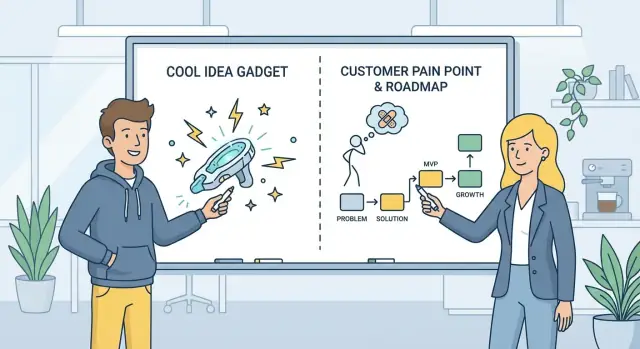
Pain vs. Cool Ideas: The Core Difference
A painful problem is something people already feel in their day-to-day life or work—something that reliably costs them time, money, revenue, sleep, reputation, or compliance risk. They’re not “interested” in fixing it; they’re already trying to reduce it, even if their current solution is messy (spreadsheets, manual workarounds, hiring temps, or just enduring it).
A cool idea is the opposite: it’s novel, clever, or exciting—but it isn’t tied to a strong, frequent, costly problem. People might say it’s “neat” or “I’d use that,” but they aren’t changing behavior or allocating budget to get it.
Why pain beats novelty
Pain creates urgency. If the problem is expensive or risky enough, people pay attention quickly: they reply to your emails, take meetings, and trial alternatives. Pain also creates budget: companies fund problems that threaten revenue, burn payroll hours, or increase exposure. Individuals spend on problems that save time, reduce stress, or prevent something worse.
Cool ideas usually compete with “maybe later.” When there’s no immediate consequence for ignoring it, it loses to everything else on the priority list.
How this guide approaches it
This guide follows a repeatable path:
- Pick a specific customer and setting.
- Run customer discovery to uncover real constraints.
- Measure the intensity of the pain.
- Validate demand before you build.
- Design an MVP that delivers relief fast.
- Position it around the problem and outcome.
- Sell early to learn.
The expectation to set now
You’re not here to bet months on a big build. You’ll run small tests—short conversations, lightweight prototypes, pre-sales, and narrow MVPs—to prove there’s a painful problem with real willingness to pay. If the pain isn’t there, you’ll know early and can pivot, narrow, or walk away without regret.
Why Cool Ideas Often Lose
A “cool idea” is easy to love and hard to sell. It gets compliments, upvotes, and “you should totally build this” energy—but that admiration doesn’t translate into a problem-first startup with real willingness to pay.
The most common failure patterns
When an idea isn’t tied to a sharp startup pain point, the same symptoms appear repeatedly:
- Nice-to-have products: people agree it’s interesting, but they can live without it.
- Low retention: curiosity drives the first try, then usage fades because the product doesn’t remove a daily or costly frustration.
- Slow sales cycles: prospects stall, compare endlessly, and ask for discounts—because the problem isn’t urgent.
The “no deadline” problem
Mild pain creates infinite procrastination. If your product helps with something that’s “annoying” rather than “costly,” buyers postpone forever: “Let’s revisit next quarter.” That’s deadly for go-to-market basics, because urgency is what turns conversations into decisions.
This is why customer discovery should focus less on what people like and more on what they’ve already tried to fix—especially where time, money, or reputation is at stake. In jobs-to-be-done terms: what job is failing, and what’s the cost of failure?
Novelty can hide weak demand signals
Novel features can temporarily mask weak demand. Early users may play with it, share it, and praise the design—while refusing to integrate it into workflows or pay for it. Novelty boosts attention, not commitment.
The goal when you validate a startup idea isn’t admiration. It’s measurable relief: shorter cycle times, fewer errors, less manual work, lower risk, faster revenue. If you can’t name the relief and measure it, your MVP based on pain will struggle to earn adoption.
A Simple Framework to Measure Pain
Cool ideas feel exciting, but painful problems have gravity. To stay honest, use a quick “pain score” before you fall in love with a solution.
Step 1: Score the pain (Frequency × Severity × Cost)
Give each dimension a 1–5 score, then multiply.
- Frequency: How often does it happen? (daily beats yearly)
- Severity: How bad is it when it happens? (minor annoyance vs. work stops)
- Cost: What does it cost in money or time? Include hidden costs like context switching, rework, and missed opportunities.
A problem that’s weekly (4), blocks work (5), and costs $2k/month (4) scores 80. A rare, mild annoyance usually can’t compete.
Step 2: Identify who owns the pain
Write down three roles:
- User: feels the pain directly
- Buyer: controls budget
- Approver: needs to sign off (security, finance, legal)
High pain with no clear buyer often turns into “everyone agrees, nobody pays.” The best opportunities have the pain and budget aligned—or a strong internal champion who can translate user pain into a business case.
Step 3: Look for deadlines that force action
Pain becomes urgent when there’s a clock attached:
- compliance dates and audits
- revenue loss (missed leads, failed conversions)
- churn risk and renewals
- outages, incidents, and on-call escalations
If a customer says “we’ll deal with it next quarter,” your pain score is probably inflated.
Step 4: Find workarounds (proof of pain)
Workarounds are evidence someone is already paying—just not with your product yet. Watch for:
- spreadsheets, manual copying, Zapier chains
- custom scripts held together by one person
- “process” meetings that exist only to patch a gap
The more effort people spend to avoid the problem, the more likely they’ll pay for relief.
Pick a Specific Customer and Setting
A painful problem only turns into a business when it belongs to a real someone, in a real situation, with real constraints (time, budget, tools, approvals). “Small businesses” or “creators” is too broad—pain gets diluted, and your learning slows to a crawl.
Start narrow to learn fast
Picking a specific customer and setting lets you:
- Reach people quickly (you already know where they hang out)
- Hear the same problem repeated (signal beats variety)
- Test one clear promise (“reduce X pain in Y workflow”) instead of vague value
When you start broad, every conversation sounds different, and you end up building a flexible product that fits nobody well.
How to spot concentrated pain
Look for places where people complain with urgency and detail—especially where the same issue keeps showing up:
- Forums and communities: threads with lots of replies, workarounds, and people asking for alternatives
- Reviews of competing products: 2–3 star reviews are gold because they explain what failed and what users hoped for
- Support tickets / help docs (if you have access): repeated “how do I…?” and “this is blocking me” requests
- Job posts and agency pitches: when companies pay for help, the pain is already budgeted
Concentrated pain looks like repeated scenarios, strong emotions (“this is killing us”), and people already spending time or money to patch the issue.
A simple ICP template (copy/paste)
Use this to define your first target customer:
- Role/title:
- Company type/size:
- Industry/niche:
- Setting/workflow where pain happens:
- Trigger event (when it becomes urgent):
- Current workaround/tools:
- Cost of the pain (time, money, risk):
- Who feels it vs. who pays:
- Where to reach them this week (exact channel):
If you can’t fill in “where to reach them this week,” the audience is still too vague.
Customer Discovery That Finds Real Problems
Customer discovery isn’t about asking people whether your idea is “good.” It’s about uncovering what they already do today to deal with a painful situation—and what it costs them.
Ask about behavior, not opinions
Opinion questions (“Would you use…?” “Do you like…?”) produce polite, inaccurate answers. Behavior questions surface reality.
Try prompts like:
- “Walk me through how you do this today, step by step.”
- “What triggers the need for this?”
- “What do you do right after it goes wrong?”
Force specificity with recent examples
Cut through vague answers by asking for a specific, recent incident:
- “Tell me about the last time this happened.”
- “When was that exactly?”
- “What tools did you use?”
- “Who else was involved?”
If they can’t recall a recent example, the pain may be occasional—or not important.
Capture the full cost of the pain
Pain is measurable. During the story, listen for (and ask about) costs:
- Time: “How long did it take?” “How often does this happen?”
- Money: “What did you spend?” “Any vendor costs or refunds?”
- Risk: “What could go wrong if this isn’t fixed?”
- Stress: “How does this affect your day or team?”
- Missed revenue: “Did it delay sales, churn a customer, or block shipping?”
Don’t pitch—hunt for patterns
Avoid describing your solution or asking for validation. Collect multiple stories, then look for repeated triggers, workarounds, and consequences.
A useful close: “If you could wave a magic wand and change one thing about this process, what would it be—and why?”
From Notes to a Problem Worth Solving
After a handful of customer conversations, you’ll have pages of quotes and anecdotes. The goal now is to turn that mess into a clear, ranked set of problems—so you don’t build around the most entertaining story instead of the most painful one.
Turn interviews into a ranked list of problems
Extract problems, not feature requests. Highlight moments where the person describes friction, delay, risk, embarrassment, extra work, or lost money. Group similar moments under one problem label.
Create a simple table with columns like: Problem, Who said it, Frequency, Severity, Current workaround, Cost of workaround. Rank problems using a quick score (for example 1–5 for frequency and 1–5 for severity). Multiply them. You’ll quickly see what’s consistently painful.
Look for repeated language and repeated consequences
Pay attention to exact phrases customers repeat: “I hate…”, “It always breaks when…”, “I’m stuck waiting for…”. Repeated language is a signal that the problem is top-of-mind.
Also look for repeated consequences—these are often stronger than complaints:
- “We miss deadlines.”
- “We refund customers.”
- “I spend my Sundays catching up.”
Define a clear problem statement
Write one sentence that forces clarity:
For [specific customer] in [specific setting], [problem] happens when [trigger], causing [painful consequence] because [root cause].
If you can’t fill in each bracket from real quotes, you’re not done.
Decide what to ignore (even if it sounds exciting)
Some problems will feel “bigger” or more fun. Ignore anything that:
- only one person mentioned,
- has weak consequences (“mildly annoying”),
- is easily solved with a simple habit change,
- depends on a future trend rather than a current struggle.
What remains is your best candidate for a problem worth solving.
Validate Demand Before You Build
Validation isn’t “Do people like this?” It’s “Will someone commit time, reputation, or money to get this fixed?” Before you write code, look for concrete proof that the pain is strong enough to trigger action.
Proof that demand is real
The best signals involve commitment:
- Pre-orders (money now for delivery later). Even a refundable pre-order counts, because it forces a decision.
- LOIs (Letters of Intent) that include a clear scope and expected price range. Treat vague “we’re interested” as noise.
- Pilots with defined timeline, success criteria, and access to data/workflows.
- Paid trials (small, time-boxed, and priced). Free trials can validate usage, but paid trials validate urgency.
Run a landing page + outreach test
Create a simple landing page with one specific offer: who it’s for, the painful situation, the promised outcome, and a clear call to action (book a call, join a pilot, place a deposit). Then do targeted outreach to people who fit the exact context.
Your goal isn’t traffic. Your goal is conversations with qualified buyers. A dozen high-quality outreaches can beat a thousand random clicks.
Ask pricing questions the right way
Avoid “What would you pay?” Instead, anchor pricing to current alternatives:
- “What do you use today, and what does it cost (tools, labor, delays)?”
- “If we removed this problem, which budget would it come from?”
- “Would you replace X at $Y/month, or add this as a new line item?”
Define success metrics before the test
Decide upfront what “pass” looks like: number of qualified calls booked, pilot commitments, deposit amount, or conversion rate from outreach to next step. If you can’t set a threshold, you’re not testing—you’re hoping.
Design an MVP That Delivers Relief Fast
An MVP isn’t a smaller version of your dream product. It’s the smallest way to produce a real, noticeable drop in the customer’s pain.
Define the “smallest relieving outcome”
Start by writing the outcome in plain language:
- “After using this, the customer no longer has to…” or
- “This cuts the time/cost/risk of X by…”
Keep it measurable and immediate.
Examples:
- “Get the monthly report done in 30 minutes instead of 4 hours.”
- “Stop missing follow-ups with leads for the next 14 days.”
- “Reduce refund requests by 20% this week.”
That outcome becomes your MVP target. Everything else is optional.
Prioritize speed-to-relief over feature lists
If a feature doesn’t shorten time-to-relief, lower effort, or reduce risk, it’s not MVP. Early customers forgive rough edges when the pain drops quickly; they won’t forgive “nice-to-have” extras that delay relief.
A useful rule: ship the first version that can deliver the outcome at least once for a real customer, end-to-end.
Use manual steps (on purpose)
To learn faster, replace software with humans where needed:
- concierge onboarding (you set it up for them)
- done-with-you implementation calls
- manual data cleanup or imports
- a service workflow behind a simple form
Manual work is not failure; it’s how you discover what must be automated later.
Build just enough to test the workflow
When speed matters, use tooling that lets you prototype the workflow and iterate in days, not weeks. For example, a vibe-coding platform like Koder.ai can be useful here: you can describe the workflow in chat, generate a working web app (often React on the front end with a Go + PostgreSQL backend under the hood), and then refine it as you learn from pilots. If the test works, you can export the source code and keep building; if it doesn’t, you’ve minimized sunk cost.
Features like planning mode, snapshots, and rollback can also help you run controlled MVP experiments without turning every change into a risky rebuild.
Be explicit about what the MVP is not
Write this down and share it with early customers:
- not a full product
- not scalable yet
- not optimized for every customer type
The goal is relief, proof of demand, and clarity on what to build next—not perfection.
Positioning: Describe the Pain and the Outcome
Positioning is not “what the product does.” It’s a clear promise to a specific person in a specific situation: you have this painful problem, and we help you get this result. If your positioning sounds like a feature list, you’re forcing customers to do the translation work.
Start with a one-line positioning statement
Use a simple structure and keep it concrete:
“For X, who struggle with Y, we provide Z outcome.”
Examples:
- “For clinic managers, who struggle with no-shows and chaotic scheduling, we provide a predictable calendar and fewer empty slots.”
- “For sales ops teams, who struggle with dirty CRM data, we provide weekly auto-fixes that keep pipelines accurate.”
Notice the outcome is what they want, not what you built.
Turn pain into measurable benefits
Customers don’t buy “better.” They buy less risk, less time, more money, fewer mistakes. Translate pain into results you can point to:
- “Cut time spent on X from 6 hours/week to 1 hour/week.”
- “Reduce chargebacks by 30%.”
- “Ship approvals in 2 days instead of 2 weeks.”
If you can’t measure it yet, pick a proxy (“fewer handoffs,” “one source of truth,” “same-day turnaround”) and refine after real usage.
Use customer wording in copy and demos
Your best copy is often a direct quote from discovery calls. Keep a swipe file of exact phrases customers use (“I’m constantly chasing…”, “We’re blind until month-end…”).
Mirror those words:
- Website headline: the pain they said, not your internal label.
- Demo flow: start with the moment the pain hits, then show the “after.”
Prepare objection answers based on real alternatives
Objections are usually comparisons to what they already do. List the true alternatives (spreadsheets, a general tool, an agency, “do nothing”) and answer them directly:
- “Why not spreadsheets?” → “Because the cost is missed follow-ups and inconsistent data. We automate the checks and keep an audit trail.”
- “Why not [big tool]?” → “You only need the part that fixes this bottleneck. Setup takes 30 minutes, not 3 months.”
Strong positioning makes buying feel like relief, not a gamble.
Early Go-to-Market: Sell to Learn
Early go-to-market isn’t a growth hack. It’s a truth-finding mission. Your goal is to confirm (or disprove) that the pain is real, frequent, and expensive enough that people will change behavior and pay for relief.
Pick one simple first channel
Choose a channel that puts you in direct contact with buyers fast:
- Direct outreach: 30–50 highly targeted messages to people who match your customer and setting.
- Communities: niche Slack groups, LinkedIn groups, forums, industry meetups.
- Partners: agencies, consultants, or tools already serving your buyer (offer a referral or co-sell).
Don’t spread across five channels. One is enough until you can consistently book conversations.
Sales now = learning, not scale
Treat every pitch like an interview with a price tag. You’re testing:
- Is this pain a “nice to fix” or a “must fix now”?
- What do they already do to cope (spreadsheets, hiring, manual workarounds)?
- What triggers urgency (deadlines, compliance, revenue loss, customer churn)?
- What outcome do they actually want (time saved, fewer errors, faster approvals)?
If people won’t take the next step—trial, pilot, paid test—you’ve learned something important.
Track a basic funnel (and improve it)
Keep it simple and measurable:
- Conversations (qualified calls)
- Trials/Pilots (hands-on usage)
- Paid conversions (even small amounts count)
Watch where you leak. If calls convert to pilots but pilots don’t convert to paid, your MVP may not deliver relief fast enough—or you’re selling to the wrong buyer.
Collect “no” like gold
Every “no” should produce a reason. Capture it verbatim and tag it (timing, price, trust, missing feature, wrong persona, unclear value). Then feed it back into:
- your positioning (“for X who struggle with Y…")
- your MVP scope (remove distractions, add the one thing blocking payment)
- your targeting (narrow to the segment that says “yes” faster)
The point of early selling is not to win arguments—it’s to compress learning into weeks, not months.
Metrics That Prove You’re Solving a Painful Problem
A “cool idea” can get sign-ups. A painful problem gets people to change behavior, stick around, and pay. The goal of metrics here is simple: prove users are getting a real outcome—not just clicking around.
Start with leading indicators (before revenue)
Early on, focus on signals that your product delivers relief quickly:
- Activation: the moment a new user reaches the first meaningful outcome (not “created an account”). Define it clearly, like “sent first invoice and got paid” or “resolved first support ticket.”
- Repeat usage: do they come back to do the job again within a natural cycle (daily/weekly/monthly)?
- Time-to-value (TTV): how long from sign-up to that first outcome. Shorter TTV usually means sharper pain and better onboarding.
If activation is high but repeat usage is low, you may be solving a “nice-to-have” task, not an urgent pain.
Retention and expansion: the pain test
Retention is the clearest proof that the problem is persistent.
Track cohort retention (week 1 → week 4, month 1 → month 3) and pair it with expansion signals:
- more seats added
- higher usage depth (more projects, more workflows completed)
- upgrades to paid tiers
When the pain is real, customers naturally widen usage because the product is tied to critical work.
Spot “polite usage” early
Watch for users who log in but don’t finish the job:
- logins without key actions
- dashboards viewed, few exports/sends/completions
- lots of “looking around,” little output
This often means your value is unclear, the workflow is too hard, or the outcome isn’t compelling.
Use churn interviews as a diagnostic tool
Churn and stalled trials are data. Run short interviews to learn:
- what they hoped would change
- what blocked the outcome (timing, missing feature, trust, switching costs)
- what they did instead
Use those answers to refine your ICP and tighten the problem statement. If churn is random and reasons are vague, you’re likely not anchored to a specific painful problem yet.
When to Pivot, Narrow, or Walk Away
Most early startup “failures” aren’t because the product is bad—they’re because the pain isn’t strong enough, or you’re solving it for the wrong buyer. The goal isn’t to persist forever; it’s to learn quickly and make a clean decision.
Signals you should pivot
Pivot when you see consistent effort from you but inconsistent pull from customers. Common red flags:
- Weak urgency: people agree it’s a problem, but it never reaches the top of the list.
- No clear budget owner: users like it, but nobody can approve spending (or even explain how purchasing works).
- Low repeat use: trials happen, but usage doesn’t become habitual or tied to a recurring workflow.
If these patterns show up across multiple conversations, you’re likely not sitting on a painful problem—at least not in the way you framed it.
Pivot the audience vs. pivot the solution
There are two different moves:
- Pivot the audience when the pain is real but only for a narrower group (e.g., the problem is intense for team leads, not individual contributors).
- Pivot the solution when the buyer and pain are correct, but your approach doesn’t deliver relief fast enough (wrong workflow, wrong integration, wrong packaging).
Don’t change both at once. Otherwise you won’t know what caused results to improve.
Keep what worked—and time-box the rest
Even when outcomes are weak, preserve evidence: a message that got replies, a channel that produced qualified calls, or a use case where urgency spiked. Treat those as anchors while you test changes.
Set a time-boxed decision rule to avoid endless tweaking: for example, “In the next 3 weeks, run 15 discovery calls and try to close 3 paid pilots. If we can’t identify a budget owner and a repeatable trigger for urgency, we walk away.”
Walking away isn’t failure; it’s protecting your time for a problem that actually hurts.
Câu hỏi thường gặp
Sự khác biệt giữa vấn đề gây đau và một ý tưởng hay ho là gì?
Một vấn đề gây đau thực sự làm ai đó chịu tổn thất về thời gian, tiền bạc, doanh thu, danh tiếng, giấc ngủ hoặc rủi ro tuân thủ, và họ đã cố gắng giảm nó (thậm chí bằng các giải pháp tạm, lộn xộn).
Một ý tưởng “ngầu” nhận được sự quan tâm và khen ngợi, nhưng nó không buộc phải hành động—nên sẽ cạnh tranh với tâm lý “có lẽ để sau.”
Tại sao nỗi đau thắng sự mới lạ khi xác thực ý tưởng startup?
Nỗi đau tạo ra tính khẩn cấp và ngân sách. Khi một vấn đề đe doạ doanh thu, lãng phí tiền lương hoặc tăng rủi ro, mọi người:
- trả lời nhanh hơn
- nhận cuộc họp
- ưu tiên thử nghiệm/pilot
- biện minh cho chi tiêu nội bộ
Sự mới lạ có thể thu hút chú ý, nhưng chính tính khẩn cấp mới thúc đẩy quyết định.
Làm sao tôi nhanh đánh giá một vấn đề có "đau đủ" hay không?
Dùng một điểm số đơn giản: Tần suất × Mức độ nghiêm trọng × Chi phí (mỗi mục 1–5), rồi nhân.
- Tần suất: hàng ngày/tuần tốt hơn hàng năm
- Mức độ: chặn công việc tốt hơn “khó chịu”
- Chi phí: gồm tiền, giờ, làm lại, chuyển đổi ngữ cảnh, cơ hội bị bỏ lỡ
Nếu bạn không thể định lượng ít nhất một trong những yếu tố này bằng ví dụ thực, rất có thể đó chỉ là “nice-to-have”.
Tôi nên nói chuyện với ai: người dùng, người mua hay người phê duyệt?
Xác định ba vai trò:
- Người dùng (User): cảm nhận trực tiếp nỗi đau
- Người mua (Buyer): kiểm soát ngân sách
- Người phê duyệt (Approver): ký duyệt (bảo mật, tài chính, pháp lý)
Nếu người dùng chịu đau nhưng không có người mua rõ ràng, bạn dễ rơi vào tình trạng “mọi người đồng ý, nhưng chẳng ai trả tiền.” Hướng tới việc nỗi đau và ngân sách phải trùng nhau — hoặc có một người nội bộ mạnh đủ dựng luận kinh doanh.
Những deadline nào khiến một điểm đau thực sự khẩn cấp?
Tìm một chiếc đồng hồ buộc phải hành động, ví dụ:
- thời hạn tuân thủ / kiểm toán
- gia hạn hoặc rủi ro churn
- mất doanh thu (leads mất, chuyển đổi thất bại)
- sự cố / outage và cảnh báo on-call
Nếu phản ứng phổ biến là “để quý tới,” hãy coi đó là cảnh báo rằng tính khẩn cấp (và willingness to pay) có thể yếu.
Tại sao các giải pháp tạm lại là tín hiệu mạnh của nhu cầu thực?
Workaround là bằng chứng họ đã trả chi phí—chỉ là không phải cho sản phẩm của bạn. Ví dụ:
- bảng tính và copy/paste thủ công
- chuỗi Zapier và automations dễ vỡ
- script tuỳ chỉnh do một người giữ
- các cuộc họp “quy trình” lặp để vá lỗi
Càng tốn nhiều nỗ lực và phối hợp để vá, cơ hội bán được giải pháp cứu trợ càng cao.
Câu hỏi khám phá khách hàng nào hiệu quả để phát hiện nỗi đau thật?
Hỏi về hành vi và sự cố gần đây, không hỏi ý kiến:
- “Điều này bạn làm thế nào ngày hôm nay, từng bước một.”
- “Kể về lần gần nhất chuyện này xảy ra—khi nào xảy ra?”
- “Xảy ra xong bạn làm gì tiếp theo?”
- “Nó tiêu tốn bao nhiêu (thời gian, tiền, rủi ro, doanh thu bị mất)?”
Tránh câu kiểu “Bạn có dùng… không?” vì thường nhận được câu trả lời lịch sự nhưng không chính xác.
Trước khi viết code, đâu là bằng chứng xác thực thực tế?
Dùng các tín hiệu cam kết trước khi viết code:
- pre-orders/deposit (dù hoàn tiền) thúc ép quyết định
- LOI có phạm vi + khoảng giá mong đợi
- pilot với timeline, tiêu chí thành công và truy cập dữ liệu/quy trình
- thử nghiệm có trả phí (nhỏ, giới hạn thời gian)
Thích thú mà không cam kết là nhiễu; cam kết là bằng chứng.
Làm sao thiết kế MVP xoay quanh nỗi đau thay vì tính năng?
Xác định kết quả giảm đau nhỏ nhất: “Sau khi dùng, khách hàng không còn phải…” và làm cho nó đo được.
Rồi ra mắt phiên bản nhỏ nhất có thể đạt kết quả đó end-to-end ít nhất một lần, ngay cả khi dùng bước thủ công (concierge setup, làm cùng khách hàng, nhập dữ liệu thủ công). Tốc độ đến kết quả quan trọng hơn danh sách tính năng.
Khi nào nên pivot, thu hẹp ICP, hay dừng dự án?
Pivot khi bạn cố gắng nhiều nhưng khách hàng không kéo theo:
- thiếu tính khẩn cấp (“cool nhưng chưa phải bây giờ”)
- không có người nắm ngân sách hoặc quy trình mua
- trial không chuyển thành sử dụng lặp lại hoặc trả phí
Chia hai kiểu điều chỉnh:
- Pivot audience nếu nỗi đau có thật nhưng chỉ ở nhóm hẹp hơn
- Pivot solution nếu buyer và nỗi đau đúng nhưng cách giải không mang lại cứu trợ nhanh
Thời hạn thử nghiệm (ví dụ X cuộc gọi, Y pilot) giúp bạn không sa lầy vào tinh chỉnh vô tận.