

คู่มือ Meituan: แปลงความหนาแน่นท้องถิ่นให้กลายเป็นกำไร
สรุปวิธีที่ Meituan แปลงความหนาแน่นในเมืองให้เป็นกำไร—โดยใช้ประสิทธิภาพการส่ง การค้นหาในท้องถิ่น โฆษณา และเครื่องมือสำหรับผู้ค้าเพื่อยกระดับเศรษฐศาสตร์หน่วย
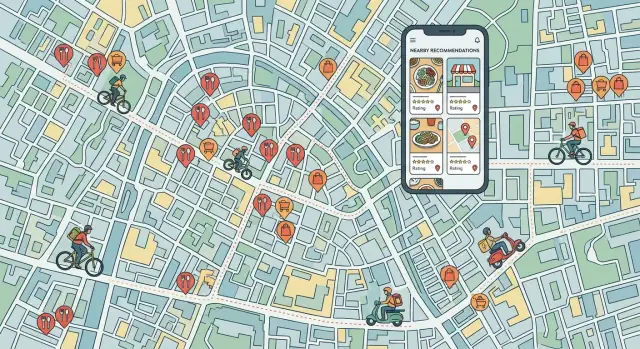
What Meituan Is Solving: Density, Convenience, and Trust
A local services marketplace is a platform that helps people find and buy nearby goods and services—meals, groceries, pharmacy items, flowers, and everyday services—while coordinating payment, delivery, and customer support.
What makes these marketplaces different from national e-commerce is the distance constraint: most orders must be fulfilled within a few kilometers and within minutes, not days. That’s why density matters.
Why density is the whole game
In local delivery, “density” means many orders, merchants, and couriers concentrated in the same small area and time window. When enough activity piles up on the same streets:
- couriers spend less time traveling empty between pickups
- merchants see more predictable demand
- customers get faster ETAs and more choices
Those benefits feel like convenience, but they’re also the building blocks for lower cost per order and higher reliability.
The core question this article answers
Plenty of platforms can create growth by subsidizing delivery or promotions. The harder question is: how does density translate into profit—not just more orders?
Meituan’s playbook is useful because it treats density as something you can convert into economics through two connected engines.
Two engines: delivery and discovery
- Delivery (fulfillment): getting the order from a nearby merchant to a customer efficiently—routing, batching, courier supply, and service quality.
- Discovery (demand): helping customers decide what to buy locally—search, recommendations, rankings, and local ads.
What’s in scope here
We’ll focus on categories where Meituan is strongest—food delivery, local retail (groceries, convenience, pharmacy), and everyday services—and how density, convenience, and trust reinforce each other across them.
Marketplace Basics: Two Sides, One Neighborhood
Meituan is a classic two-sided marketplace with a local twist: demand (consumers) and supply (merchants) are matched within a tight radius where time, reliability, and habits matter more than “global scale.” A user opens the app expecting something nearby, fast, and predictable; a merchant joins expecting incremental orders without chaos in the kitchen.
The two-sided loop in plain terms
More consumers placing orders makes the platform attractive to merchants, because the “new customer” opportunity is immediate and measurable. More merchants (and more items on their menus) makes the app more useful to consumers, because there’s always a relevant option—cheap lunch, late-night snacks, or groceries.
That loop strengthens when the platform reduces friction: clear menus, accurate ETAs, reliable delivery, and fewer cancellations. Each improvement increases the odds a user orders again next week—which is what really powers local marketplaces.
Multi-category expansion as a density amplifier
Meituan’s advantage isn’t only more restaurants. Adding adjacent categories—groceries, pharmacy, convenience items, coffee, and local services—gives the same neighborhood more reasons to open the app daily. That boosts order frequency without needing to “find” new users.
For merchants, multi-category traffic matters because it smooths demand across the day: breakfast, lunch, dinner, and replenishment runs. For consumers, it turns one app into a default habit.
Repeat behavior is the hidden engine
In local markets, one-time acquisition is expensive and fragile. Profitability depends on repeat: users returning because delivery is dependable and selection stays relevant, and merchants staying because the platform consistently fills idle capacity with paid orders.
What “Density” Means in Local Delivery
When Meituan talks about density, it’s not a vague “lots of users” idea. In local delivery, density is:
orders per small area per unit of time (for example, “how many deliveries happen within a 1–2 km radius every 15 minutes”).
That definition matters because delivery is a physics-and-scheduling business. If orders are scattered across a city and arrive randomly, each courier spends more time traveling and waiting. If orders cluster tightly in both location and time, the same courier can complete more deliveries per hour.
Why short distances change cost and speed
Shorter trips reduce the two biggest cost drivers: travel time and empty time (minutes when a courier isn’t carrying anything). With high density, couriers can move from one pickup to the next quickly, and the platform can promise faster ETAs without paying extra incentives.
Speed also becomes more predictable. When most deliveries are within a compact neighborhood, the “unknowns” (traffic, detours, hard-to-reach addresses) shrink.
Peak vs off-peak: density isn’t constant
Density spikes at peaks (lunch, dinner, rainy evenings, big events) and drops off-peak (mid-afternoon, late night in some districts). Peaks create pressure: more orders, more time sensitivity, and higher risk of delays.
Off-peak is the opposite problem: couriers may be available, but there aren’t enough orders nearby to keep them productive—raising cost per order.
Batching and route efficiency
With dense demand, platforms can batch: one courier picks up multiple orders from the same or nearby merchants and delivers them along an efficient route. Good batching turns density into real margin—because you’re not just delivering more, you’re delivering smarter.
Delivery Flywheel: From More Orders to Lower Cost per Order
A local delivery business looks expensive when volume is low. But once orders concentrate in the same neighborhoods and time windows, every additional order can make the network cheaper to run. That’s the delivery flywheel: more orders enable lower cost per order, which supports better pricing and faster ETAs, which attracts even more orders.
The real cost drivers in last‑mile delivery
Delivery cost isn’t just “paying riders.” It’s the sum of a few predictable frictions:
- Rider time (wages/incentives per minute on the road)
- Distance (longer routes burn more paid minutes)
- Waiting time at pickup (kitchens running late, queues, parking)
- Idle time between jobs (low demand leaves riders underutilized)
- Re-delivery/support when orders are late, wrong, or canceled
When density increases, the platform attacks the biggest variable: paid minutes that don’t produce a completed order.
Why order clustering is the cheat code
High order volume creates clusters: multiple orders from nearby merchants going to nearby customers around the same time. That enables batching (one rider carries two or more orders) and chaining (a rider drops off one order and immediately picks up the next nearby).
Instead of paying for deadhead travel and gaps between jobs, the same rider-hour yields more deliveries. Cost per order drops even if rider pay stays fair.
Dispatching gets smarter when the queue is full
With steady volume, dispatching can optimize more aggressively:
- Better matching: assign riders based on direction, current load, and predicted prep time
- Tighter timing: reduce early arrivals (waiting) and late arrivals (refund risk)
- Dynamic routing: adjust sequences as new orders enter the same micro-area
The key is optionality. A full pipeline of orders gives the system choices; a thin pipeline forces bad assignments.
Reliability feeds conversion—and repeats
Lower cost per order is only half the flywheel. Density also improves the customer experience: faster delivery, fewer cancellations, and more consistent ETAs. Reliability builds trust, and trust increases conversion at checkout and repeat purchases.
Those extra repeat orders reinforce density, keeping riders busier, clusters tighter, and unit costs trending down city by city.
Discovery Flywheel: Turning Proximity Into Demand
Density doesn’t automatically translate into orders. People still need to find something they want, trust it, and feel confident it will arrive quickly. Meituan’s discovery loop turns “many nearby options” into demand by making the nearby choice feel obvious.
The consumer journey: from search to reorder
A typical flow looks simple—search, browse, decide, reorder—but each step is a chance to reduce friction:
- Search: “Bubble tea,” “lunch,” or “pharmacy” is often vague. Good discovery interprets the intent and surfaces a short, relevant set.
- Browse: Users compare menus, delivery times, fees, ratings, and promos. Clear, consistent information prevents drop-off.
- Decide: The winning listing usually minimizes uncertainty: fast ETA, predictable pricing, and credible reviews.
- Reorder: Once a user has a “default” merchant, ordering becomes a habit—less browsing, more frequency.
Why proximity-based ranking boosts conversion
Proximity is not just convenience; it’s a proxy for reliability. Ranking closer merchants higher (when quality is acceptable) typically improves:
- ETA confidence (shorter routes mean fewer surprises)
- Order completion (fewer cancellations and delays)
- User satisfaction (the order arrives as expected)
When users repeatedly get what they expected, they stop “shopping around” and start ordering.
Personalization: intent signals that create momentum
Meituan-like discovery systems lean on lightweight signals: past orders, time of day (breakfast vs. late-night), weekday patterns, cart size, and category affinity. The result is a feed that feels locally curated—more “your usual nearby picks,” less endless scrolling.
Better discovery increases conversion today, which increases order frequency, which strengthens retention—feeding the flywheel with more data and more repeat behavior.
Monetization Mix: Fees, Commissions, and Local Ads
Meituan doesn’t rely on a single “take rate.” It stacks revenue streams that match different moments in the customer journey—ordering, fulfillment, and discovery—so it can grow profit without pricing itself out of everyday use.
The core revenue streams
The basics look familiar for a local services marketplace:
- Commissions (merchant take rate): a percentage of the order value, aligned with how much incremental demand the platform delivers.
- Delivery fees: paid by users, merchants, or shared—often dynamically adjusted by distance, time, and courier supply.
- Local advertising: paid placement and performance-based ads that influence what users see when they search, browse, or open the app.
Why ads are powerful in local
Ads monetize existing intent. When a user is already searching for “noodles near me,” sponsored listings can capture value without increasing fulfillment cost—no extra courier minutes, no additional support load, and no added variable cost per delivery. That makes ads a high-leverage layer: the same delivery network can support more revenue per session.
The trust trade-off
Monetization can backfire if it erodes the product’s credibility:
- Too many sponsored results can make discovery feel “pay-to-win.”
- Over-aggressive commissions can push merchants to raise prices or reduce portion size.
- Delivery fee inflation can reduce order frequency.
The long game is protecting trust: users must believe top results are relevant, and merchants must feel that paid tools complement (not replace) organic demand.
More categories, better ads
Adding categories—groceries, pharmacies, flowers, errands—doesn’t just add orders. It expands ad inventory and improves relevance: a user browsing “cold medicine” can be shown nearby convenience stores, while a restaurant can promote lunch deals to office workers. More varied intent creates more monetizable moments, without forcing higher fees on every transaction.
Merchant Value: Tools That Make the Platform Sticky
For merchants, a marketplace isn’t “just another sales channel” when it consistently delivers four things: more demand, more predictable demand, less operational chaos, and clearer proof that the fees are worth it.
What merchants actually value
First is demand: incremental orders they wouldn’t have captured on their own. Second is predictability: knowing that lunchtime peaks and weekend surges will show up often enough to staff correctly and prep inventory. Third is operational help: fewer missed orders, fewer disputes, faster handoffs. Finally, trust and measurement: confidence that promotions and ad spend translate into real sales.
The tool stack that creates lock-in
Meituan-style platforms typically win stickiness by bundling software-like tools into the marketplace relationship:
- Menu/catalog management to keep items, pricing, availability, and photos accurate (which reduces cancellations and bad reviews).
- Promotions and campaign tools (discounts, bundles, free-delivery thresholds) that merchants can run without building their own marketing engine.
- Lightweight CRM such as coupons for repeat buyers, reactivation offers, and messaging that nudges second and third purchases.
- Analytics dashboards that show peak hours, best-selling items, delivery times, funnel drop-offs, and promo ROI.
Why tools support higher take rates
When the platform improves conversion, repeat rate, and operational efficiency—not just “brings traffic”—it can justify a higher commission or sell add-ons (promoted placement, category ads, paid insights). The key is that merchants can see a direct link between spend and outcomes.
Better merchants improve the consumer side
More accurate menus, faster prep times, and smarter promos make the consumer experience smoother. That lifts ratings and repeat orders, which feeds back into merchant revenue. In a dense local market, small quality improvements compound into a meaningful advantage.
Operational Control: Managing the Supply of Couriers
A local marketplace can list thousands of restaurants, but customers judge it on a simpler question: “Will it arrive when you said it would?” That’s why Meituan’s dedicated delivery network is more than logistics—it’s a service moat. When the platform can reliably deliver within tight time promises, it protects demand, keeps merchants loyal, and makes the whole system harder to copy than a purely “listings + payment” product.
Why a delivery network becomes a moat
Owning (or tightly coordinating) courier supply lets the platform standardize the experience: pickup behavior, handoff quality, delivery timing, and customer support. Over time, that consistency creates trust—customers order more often, and merchants accept higher volumes because they don’t have to build their own rider operations.
A dedicated network also improves predictability. Better predictability lowers cancellations, reduces refunds, and increases repeat use—advantages that compound over thousands of daily orders.
Time windows, scheduling, and service-level expectations
Service in local delivery isn’t “fast” in general; it’s fast relative to an expectation. Platforms win by defining clear delivery windows (for example, 30–45 minutes), then meeting them consistently. That requires planning around peaks: lunch, dinner, weekends, weather, and local events.
Scheduling is the quiet lever. If you can forecast demand by neighborhood and time slot, you can position couriers ahead of spikes instead of reacting after delays begin. That reduces late orders and keeps ETAs stable, which directly improves checkout conversion.
Incentives without overspending
Couriers respond to incentives, but the goal isn’t to pay the most—it’s to pay just enough, in the right places, at the right times. Smart incentive design targets gaps: a specific district during a 90-minute rush, rainy evenings, or areas with long pickup times.
The best programs combine:
- Availability nudges (bonuses for being online during critical windows)
- Efficiency rewards (for completed deliveries, not just hours logged)
- Quality controls (penalties for excessive cancellations or chronic lateness)
Service quality drives conversion and pricing power
Reliable delivery raises conversion because customers trust the ETA and worry less about wasted time. It also supports pricing power: when service is dependable, customers are less price-sensitive to delivery fees, and merchants are more willing to pay for access because orders actually get fulfilled. Operational control turns “density” into a customer experience—and that experience turns into profit.
Unit Economics: How Profit Emerges at City Level
Profitability in a local services marketplace usually doesn’t arrive at the company level first—it shows up city by city, then zone by zone. That’s because demand, courier supply, and merchant mix vary by neighborhood.
The three unit-economics terms that matter
Contribution margin is what’s left from an order after paying the direct, order-level costs—in plain language, money kept per order to cover salaries, product, marketing, and profit.
CAC (Customer Acquisition Cost) is how much you spend to get a new customer to place their first order.
LTV (Lifetime Value) is how much contribution margin a customer generates over time. If LTV is comfortably higher than CAC, growth can be profitable.
Why density changes the math
Higher density tends to lift contribution margin in two ways:
-
Lower cost per order: couriers spend less time waiting and traveling between pickups and drop-offs, so the same courier hours produce more completed orders.
-
Higher repeat rate: when users see more nearby options, faster ETAs, and consistent service, they reorder more often. More repeat means CAC is “spread out” over many orders, pushing LTV up.
Promos: helpful signal or retention mask?
Promotions help when they bridge a real hurdle—for example, getting first-time users to try delivery, or nudging demand into off-peak hours so couriers stay utilized.
They hide problems when orders collapse the moment discounts stop. If promo-driven customers don’t convert into regulars, CAC effectively becomes “rent,” not an investment.
City/zone profitability checklist
Use this quick test before declaring a city “working”:
- Contribution margin per order is positive without heavy promos
- Repeat rate is rising (cohorts reorder after week 1 and week 4)
- Courier utilization is healthy (less idle time, fewer long deadhead trips)
- Merchant quality is strong (reliable prep times, low cancellations)
- CAC is stable or falling as organic/direct traffic grows
- Peak demand doesn’t break service levels (ETAs and refunds under control)
When most boxes are checked in the core zones, expansion to adjacent zones becomes a scaling decision—not a gamble.
Competition and Differentiation in Local Marketplaces
Local services marketplaces rarely “win” because users can easily install a second app, and merchants can list inventory in multiple places. This multi-homing is the default: customers compare delivery times and prices across apps, while restaurants and stores spread risk by distributing orders.
Multi-homing is rational—until an app feels like the obvious choice
If two platforms have similar merchants and similar courier coverage, a user’s decision becomes a quick scan: “Who can deliver faster right now?” That’s why density isn’t just a scale metric—it’s a differentiation lever. When one platform consistently shows shorter ETAs and more available items, it becomes the first app people open.
Switching costs built from speed, selection, and habit
Marketplace switching costs don’t have to be contractual. They can be behavioral:
- Speed: predictable ETAs reduce the temptation to check competitors.
- Selection: deeper local inventory (more nearby options, more SKUs, more open stores) makes “just use this app” feel safe.
- Habit: repeated successful orders create a default routine—especially for everyday needs like lunch, groceries, and late-night convenience.
Over time, the cost of switching becomes the mental effort of searching elsewhere, not a cancellation fee.
Quality control turns usage into trust
Differentiation also depends on whether orders arrive correctly and on time. Platforms can enforce quality with:
- Reviews and ratings that surface reliable merchants and couriers.
- Refund flows that resolve issues quickly without long disputes.
- Delivery guarantees (ETA commitments, compensation rules) that make outcomes feel less risky.
Why trust boosts conversion and lowers support cost
Trust changes behavior: users complete checkout more often, try new merchants, and complain less because expectations are clear and remedies are consistent. Fewer “where is my order?” tickets and fewer chargebacks reduce support load—so the platform improves unit economics while looking better than rivals at the same time.
What Can Go Wrong: When Density Doesn’t Convert
Density is a powerful advantage—until it isn’t. Local marketplaces can look busy on the surface (lots of merchants, lots of couriers) while the economics quietly deteriorate.
Demand that’s “dense” but not efficient
Common failure modes tend to show up together:
- Low effective density: orders are scattered across neighborhoods, so batching drops and couriers spend more time traveling than delivering.
- Long delivery distances: customers stretch the radius for choice or discounts, pushing up time, cancellations, and cold food.
- High refunds and after-sales costs: late deliveries, missing items, and inconsistent prep times increase compensation, support workload, and churn.
When these stack, the platform can end up buying growth through subsidies while never reaching a stable cost per order.
When monetization hurts conversion
Local discovery is sensitive: if search results feel “pay-to-play,” people lose trust. Over-monetizing with too many sponsored slots can:
- lower conversion on high-intent searches,
- push customers toward habit-based competitors,
- create a merchant arms race where only the highest bidders are visible.
The short-term revenue lift can be outweighed by weaker retention and lower organic demand.
Operational risks that break the flywheel
Even with demand, operations can fail at the edges: rider churn (unpredictable earnings), regulatory pressure (employment classification, working-hour rules), and safety incidents (traffic accidents, food handling). Any of these can raise costs or reduce available courier supply during peak times.
Mitigation ideas that actually help
Phased expansion beats blanket coverage: start where trips are short and repeat demand is high. Track quality metrics (on-time rate, refund rate, prep-time variance) as growth gates, not afterthoughts. Keep incentives balanced—reward reliability and batching efficiency, not only speed—so the system doesn’t optimize into complaints and refunds.
Practical Takeaways: Applying Meituan’s Lessons
Meituan’s core lesson is simple: density only becomes profit when it reduces friction for all sides at the same time. More nearby demand makes deliveries faster and cheaper; better discovery makes that demand more predictable; and merchant tools make supply more reliable—so the whole system wastes less time and money.
The mechanisms to copy (without copying Meituan)
1) Turn proximity into conversion. Density isn’t “lots of users,” it’s “enough users close enough to buy today.” Improve search, ranking, and category pages so nearby options feel obvious, not hidden.
2) Use operations to protect service quality. Faster ETAs and fewer cancellations create repeat behavior, which creates steadier demand. Steadier demand is what allows you to schedule couriers (or partners) more efficiently and lower cost per order.
3) Monetize last. Fees and ads work best when merchants can already see incremental orders. If ROI is unclear, monetization feels like a tax.
Founder/operator takeaways
Pick one city (or zone) and aim for local depth, not national breadth. A smaller area with reliable ETAs and high repeat beats a wide map with inconsistent service.
Treat merchants as long-term partners: stickiness comes from tools that reduce their daily workload (menu/inventory sync, promotions, CRM, lightweight analytics), not from a slightly lower commission.
If you’re building a local marketplace and want to move fast on the product side, a vibe-coding workflow can help: for example, Koder.ai can prototype a React web app plus a Go/PostgreSQL backend from a chat-driven spec, then iterate with snapshots and rollback as you tune dispatch, discovery, and merchant tooling.
A simple 30-day action plan
-
Measure density: orders per km² per day, average courier idle time, median ETA, repeat rate.
-
Improve discovery: fix broken search, highlight “near you,” reduce choice overload, test ranking by likelihood-to-convert (not just lowest price).
-
Add one merchant tool: start with something that saves time (auto-pausing items, simpler promos, customer re-order nudges).
If you want templates for these metrics and experiments, see /blog. If you’re packaging tools and billing, keep pricing simple and transparent on /pricing.
คำถามที่พบบ่อย
What does “density” mean in a local services marketplace like Meituan?
In local delivery, density is orders per small area per unit of time—for example, deliveries within a 1–2 km radius every 15 minutes.
That specific definition matters because it determines whether couriers can avoid idle time and whether the platform can reliably batch and route orders efficiently.
How does density actually lower delivery cost per order?
Higher density reduces paid minutes that don’t produce completed orders:
- less empty travel between jobs
- more batching/chaining opportunities
- fewer long detours, more predictable ETAs
When couriers complete more drops per hour, cost per order falls even if pay rates stay the same, which is how density can translate into margin.
What is batching, and why is it such a big deal for profitability?
Batching is when one courier picks up multiple orders from the same or nearby merchants and delivers them on a single route.
It works best when orders cluster in the same place and time window. Done well, batching increases deliveries per rider-hour without proportionally increasing distance or support costs.
Why do peak and off-peak hours matter so much in local delivery economics?
Peaks (lunch/dinner, weather spikes, events) bring too many orders at once, risking delays and refunds. Off-peak has the opposite problem: too few nearby orders, so couriers sit idle.
A practical approach is to use forecasting + targeted incentives so supply is positioned before peaks, while off-peak demand is nudged with light promos or cross-category use (e.g., convenience/pharmacy).
What is the “discovery flywheel,” and what does it do?
Discovery converts “lots of nearby options” into actual orders by reducing uncertainty:
- relevant search results for vague intent (e.g., “lunch”)
- clear info (ETA, fees, ratings, menus)
- personalization from simple signals (past orders, time of day)
Better discovery increases conversion and repeat ordering, which strengthens density and makes operations cheaper.
Why does proximity-based ranking improve conversion and retention?
Proximity is often a proxy for reliability: shorter routes usually mean fewer surprises.
Ranking closer merchants higher (when quality is acceptable) tends to improve:
- ETA confidence
- completion rates (fewer cancellations)
- customer satisfaction
Over time, reliable outcomes create habits—users stop comparing apps and reorder from defaults.
How can local advertising boost revenue without hurting trust?
Local ads monetize existing intent (e.g., someone searching “noodles near me”) without adding delivery cost. But they can damage trust if discovery feels pay-to-win.
Guardrails that help:
- limit sponsored slots on high-intent pages
- label ads clearly
- measure long-term impact on repeat rate, not just ad revenue
What makes merchants “stick” to a local marketplace platform?
Merchants stay when the platform reduces daily friction and proves ROI. Common “sticky” tools include:
- menu/catalog accuracy tools (reduces cancellations)
- promotions/bundles/free-delivery thresholds
- lightweight CRM (repeat-buyer coupons, reactivation)
- analytics (peak hours, prep-time variance, promo ROI)
When tools improve conversion and ops—not just traffic—higher take rates feel justified.
How should a platform design courier incentives without overspending?
The goal isn’t paying the most—it’s paying just enough, in the right places, at the right times.
Effective programs typically combine:
- bonuses for being online during critical windows
- rewards for completed deliveries (efficiency)
- quality controls (cancellation/lateness penalties)
This supports service levels while avoiding blanket subsidies that inflate unit costs.
What’s a practical checklist to know if a city is profitable (or close)?
Look city/zone by city/zone and validate fundamentals:
- positive contribution margin without heavy promos
- rising repeat rate (week 1 and week 4 cohorts)
- healthy courier utilization (low idle time)
- strong merchant quality (prep times, low cancellations)
- stable or falling CAC as organic traffic grows
If you want metric templates and experiments, start with the measurement ideas in /blog and keep packaging/pricing simple (see /pricing).