

Ada Lovelace’s First Algorithm and What It Teaches Us Today
Ada Lovelace’s notes on the Analytical Engine described a repeatable algorithm. See how her early ideas map to modern program design and thinking.
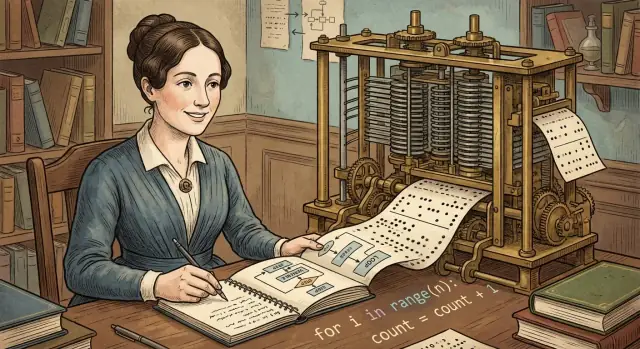
What This Story Is Really About
You’ve probably heard the headline version: Ada Lovelace wrote “the first algorithm,” a set of instructions intended for Charles Babbage’s Analytical Engine. People still cite it because it’s an early, surprisingly clear example of what we now call programming—separating a goal into precise steps a machine could follow.
This article isn’t trying to recreate the Engine’s gears or prove every historical claim beyond dispute. Instead, it focuses on the programming ideas inside Lovelace’s work: how you turn a math problem into something executable, how you represent data, and how you communicate a procedure so someone else (or something else) can run it.
Why it still matters
Lovelace’s famous “Notes” read like a bridge between mathematics and software design. Even though the machine was largely hypothetical, the thinking is familiar to anyone who has ever tried to make a computer do something reliable.
Here’s what we’ll keep an eye on as we go:
- Steps and structure: breaking work into ordered operations instead of vague intentions.
- Data and notation: deciding what values exist, how they’re named, and how they move through the process.
- Repetition: identifying patterns and reusing them rather than rewriting the same actions.
- Checking your work: designing procedures that can be verified, not just admired.
- Documentation: writing explanations that make the program understandable to another reader.
By the end, the goal is simple: see Lovelace’s “first algorithm” less as a museum piece and more as an early template for computational thinking that still mirrors how we design programs today.
Ada Lovelace, Babbage, and the Analytical Engine
Augusta Ada King, Countess of Lovelace—better known as Ada Lovelace—grew up at a crossroads of poetry and mathematics. Her mother encouraged rigorous study, and Ada quickly became part of a small circle of prominent scientists and thinkers. She wasn’t a lone genius working in isolation; she was a gifted collaborator who asked unusually clear questions about what machines could mean, not just what they could do.
How Ada and Babbage connected
Charles Babbage was already famous for his plans for mechanical calculation when Ada met him. Babbage could design hardware in his head: gears, shafts, and number wheels arranged into a system. Ada, meanwhile, had a talent for explanation—taking complex technical ideas and translating them into structured, communicable concepts.
Their relationship worked because their strengths were different. Babbage pushed the engineering vision forward; Ada pushed the conceptual vision forward, especially the idea that a machine could follow a sequence of operations that someone designs in advance.
Where the Analytical Engine fits
Babbage’s Analytical Engine was not just a better calculator. On paper, it described a general-purpose machine: one that could store values, perform operations, and run a planned procedure step by step. Think of it as an early blueprint for what we now call a programmable computer—even though it was never completed in their lifetime.
Why the 1840s mattered
The 1840s were a moment when mathematics, industry, and automation were starting to overlap. People were hungry for reliable methods—tables, formulas, and repeatable procedures—because errors were expensive and science was accelerating. In that context, Ada’s interest in “how to instruct a machine” wasn’t a curiosity. It was a timely response to a growing need: turning human reasoning into repeatable, checkable processes.
A Simple View of the Analytical Engine
Before Ada Lovelace could describe an algorithm, there had to be a machine worth “programming.” Charles Babbage’s Analytical Engine was conceived as a general-purpose calculator: not a device for one specific formula, but a machine that could be set up to carry out many different sequences of operations.
What it was meant to do
The core idea was straightforward: if you can break a problem into small arithmetic steps (add, subtract, multiply, divide), a machine should be able to perform those steps reliably, in the right order, as many times as needed.
That’s the leap from a one-off calculation to a reusable method.
The plain-language parts: memory, operations, input/output
Babbage described two main components:
- The “store” (memory): a place to hold numbers while the work is in progress. Think of this like keeping intermediate results on a notepad so you can reuse them later.
- The “mill” (operations): the part that performs calculations on numbers taken from the store, then puts results back. This is the workbench where arithmetic happens.
For input and output, the Engine was designed to take instructions and data using punched cards (inspired by weaving looms), and to produce results in a human-usable form—printed or otherwise recorded.
A modern analogy that helps
If you map those ideas to today:
- Mill ≈ CPU: executes operations.
- Store ≈ RAM: holds data you’re currently working with.
- Cards ≈ programs and data files: tell the machine what to do and what to do it with.
This is why the Analytical Engine matters: it sketches the same separation we still rely on—hardware that can execute steps, and programs that define which steps to execute.
The Notes That Changed How We Think About Machines
When people talk about Ada Lovelace and the first algorithm, they’re often pointing to a specific set of add-ons: the “Notes” she appended to her English translation of Luigi Menabrea’s paper about Charles Babbage’s Analytical Engine.
Menabrea described the machine’s concept. Lovelace went further: she treated the Engine as something you could instruct—not just admire. That shift is why these Notes matter so much in programming history. They read like early computational thinking: breaking a goal into precise steps, choosing representations, and anticipating how a mechanism will follow them.
More than commentary: a manual for giving instructions
Lovelace’s Notes explain what we’d now call program design. She describes the Engine’s parts (like a memory store and a processing “mill”) in terms of how operations could be sequenced and controlled. The central idea is simple but profound: if the Analytical Engine can perform operations in a defined order on defined symbols, then the “how” must be written down in a form the machine can execute.
This is where her work starts to resemble modern programming. It’s not just theory; it’s method.
The step-by-step table that makes it concrete
Most importantly, the Notes include a worked example presented as a table of steps. It lays out, line by line, what the machine should do—what values are in which locations, what operation happens next, and where results are stored.
That table format is an ancestor of today’s pseudocode, flowcharts, and instruction schedules: an explicit, checkable plan you can follow without guessing. Whether or not you ever build an Analytical Engine, the habit it teaches—turning an idea into an executable sequence—is still the heart of writing software.
The Bernoulli Numbers Algorithm, Explained Simply
An algorithm, in everyday language, is a repeatable method: a set of clear steps that reliably takes you from a starting point to an answer. It’s like a recipe that doesn’t depend on intuition—if you follow the steps, you should get the same result every time.
Ada Lovelace’s famous example algorithm aimed to calculate Bernoulli numbers—a sequence of values that shows up in many areas of mathematics (for example, formulas for sums like 1 + 2 + … + n, and in parts of calculus). You don’t need to know the theory behind them to appreciate why they’re a great “test case” for an early computing machine.
Why Bernoulli numbers are a good example
They’re challenging in the right way:
- Each new Bernoulli number depends on earlier ones, so you can’t just do one quick calculation and stop.
- The computation involves multiple operations (addition, subtraction, multiplication, division), not a single trick.
- There’s a known correct sequence, so results can be checked.
In other words, it’s complex enough to prove the machine can follow a structured method, but still orderly enough to be written down as steps.
The shape of the method: inputs → working values → result
At its core, the algorithm has a familiar structure we still use in programs:
- Inputs: fixed constants and the previously computed Bernoulli numbers needed for the next step.
- Intermediate values: temporary results produced along the way—partial sums, products, and fractions that must be kept around until they’re reused.
- Final result: the next Bernoulli number in the sequence.
Seen this way, Lovelace wasn’t just pointing to a number being computed—she was showing how to organize a multi-step calculation so a machine could execute it without guessing.
Decomposition and Control Flow: The Hidden Design Work
When people talk about Lovelace’s Bernoulli numbers algorithm, they often focus on the result (“an early program”) rather than the design work that makes the steps reliable. The real achievement isn’t just listing operations—it’s shaping them so a machine can follow them without improvising.
Decomposition: turning a big goal into small duties
Instead of treating “compute Bernoulli numbers” as one task, the Notes break it into smaller parts that can be repeated and checked: compute intermediate values, combine them in a specific formula, record results, and then move on to the next case.
That decomposition matters because each subtask can be validated in isolation. If an output looks wrong, you don’t debug “the whole algorithm”; you inspect one piece.
State and memory: what must be remembered
A mechanical computer doesn’t “keep things in mind.” Every value that will be needed later must be stored somewhere, and the Notes are careful about that. Some numbers are temporary working values; others are final results that must persist for later steps.
This is an early form of thinking about program state:
- Which values must survive into the next stage?
- Which can be overwritten safely?
- Which should be kept untouched because later steps depend on them?
Control flow: ordering as error prevention
The order of operations is a safety feature. Certain calculations must happen before others, not for elegance, but to avoid using an unprepared value or accidentally overwriting something still needed.
In modern terms, Lovelace is designing control flow so the program has a clear path: do A, then B, then C—because doing B first would silently produce the wrong answer.
Loops, Repetition, and the Idea of Iteration
One of the most “modern” ideas hiding in Lovelace’s step table is repetition: the ability to do the same set of instructions again and again, not because you’re stuck, but because repeating is the fastest path to a result.
Repetition without mystery
Repetition in a program means: follow a small recipe of steps, check whether you’re done, and if not, run the same recipe again. The key is that something changes each time—often a counter, a position in a table, or the value you’re building up—so the program moves toward a finish line.
In Lovelace’s notation, you can see this as a structured return to earlier steps. Rather than rewriting identical instructions many times, she describes a pattern and indicates when to cycle back. That’s the seed of what we now call iteration.
How her step table maps to modern loops
If you’ve written code, you’ve seen this pattern as a for loop (“repeat this N times”) or a while loop (“repeat until a condition is true”). Her table also implies familiar loop ingredients:
- A counter (which pass are we on?)
- A changing value (the partial result so far)
- A stop condition (when the counter reaches the end)
A friendly example: summing numbers
Imagine you want the sum of 1 through 5.
- Start with
total = 0 - Start with
i = 1 - Add
itototal - Increase
iby 1 - If
iis still 5 or less, repeat the add-and-increase steps
This is iteration in plain terms: a small loop that updates a counter and accumulates a result. Lovelace’s contribution wasn’t only what she computed—it was showing that repeating structure can be written down clearly enough for a machine (and future humans) to execute reliably.
Variables and Notation: Making Ideas Executable
A procedure can be perfectly logical in your head and still be impossible for a machine—or another person—to follow without a way to refer to changing quantities. That’s where variables and notation matter.
Variables as labeled boxes
Think of a variable as a labeled box on a desk. The label stays the same, but what’s inside can change as you work.
If you’re computing a sequence, you might have:
- a box for the current result
- a box for the next input value
- a box for a temporary intermediate value you’ll throw away after a step
Without those boxes, you’re forced to describe everything in long sentences (“take the number you just computed two steps ago…”), which quickly turns into a tangle.
Notation is not decoration
In Lovelace’s Notes, the symbols and labels aren’t there to look formal—they’re there to make the process executable. Clear notation answers practical questions:
- Which value is being updated right now?
- Which values must be kept for later steps?
- Which values are temporary and can be overwritten?
When procedures get long, these small clarifications prevent the most common error: mixing up similar-looking quantities.
The modern echo: names and types
Good variable naming is still one of the cheapest ways to reduce bugs. Compare x1, x2, x3 with current_sum, term_index, and next_term: the second set tells you what the boxes are for.
Types add another layer of safety. Deciding whether something is an integer, a decimal, a list, or a record is like choosing the right kind of container—some mistakes become impossible, or at least easier to catch early.
Variables and notation turn “a clever idea” into steps that can be repeated correctly, by anyone (including a machine).
Abstraction and Reuse: From Step Tables to Functions
Abstraction means focusing on what matters and intentionally hiding the details that don’t. It’s the difference between saying “sort this list” and describing every swap and comparison by hand. Lovelace’s Notes show this instinct early: they aim to communicate a method clearly, without forcing the reader to get stuck in the engine’s mechanical specifics.
Separating the method from the mechanics
A striking feature of the Notes is how they keep the core idea independent from the machine’s physical actions. The Analytical Engine has its own “how” (gears, store, mill), but the Notes emphasize the “what”: the sequence of operations needed to reach a result.
That separation is the seed of what we now call software design:
- The algorithm describes intent (compute Bernoulli numbers).
- The machine (or implementation) handles execution details (where values live, how operations are carried out).
When you can describe the method without re-explaining the machine, you’re already treating computation as something portable—capable of being re-implemented on different hardware, or by different people.
From step tables to reusable components
The step-by-step tables in the Notes resemble early “procedures”: a defined set of steps that can be followed again and again. Modern code formalizes this as functions, modules, and reusable components.
A good function does what Lovelace’s presentation does:
- names an operation so you don’t repeat the explanation everywhere,
- takes inputs (values) and produces outputs (results),
- hides internal steps unless you truly need to inspect them.
This is why abstraction isn’t about being vague—it’s about being usable. Reuse follows naturally: once a method is expressed cleanly, you can call it again in a new context, combine it with other methods, and build larger systems without drowning in details.
Documentation as a Feature, Not an Afterthought
Ada Lovelace didn’t just describe what the Analytical Engine could do—she showed how to make a procedure unambiguous for another person (or machine) to follow. That’s the quiet power of her Notes: they treat explanation as part of the work, not decoration.
Step-by-step tables as “pseudocode you can’t wiggle out of”
One reason her presentation still feels modern is the use of structured, step-by-step tables. A table forces decisions that vague prose can hide:
- What happens first, second, and third
- What intermediate values exist at each step
- When a value is updated vs. merely referenced
- Where repetition begins and ends
That reduces ambiguity in the same way pseudocode does today. You can read a paragraph and think you understand it—until you try to execute it. A step table makes the “execution path” visible, which is exactly what good program documentation aims to do.
Notes then, READMEs now
Lovelace’s Notes mix three things we still try to keep together:
-
What the program is for (intent)
-
How it works (the procedure)
-
How to interpret the notation (the interface—names, symbols, assumptions)
That maps neatly to modern comments, docstrings, and READMEs. A README explains the goal and context. Inline comments clarify tricky steps. Docstrings define inputs/outputs and edge cases. When any one of these is missing, users are left guessing—and guessing is where bugs breed.
Practical takeaway: documenting a procedure so others can run it
When you document a process (code or not), write as if someone will reproduce it without you:
- State inputs and outputs in plain terms (“Given X, produce Y”).
- List assumptions (units, ordering, rounding rules).
- Write the steps in a numbered sequence or a small table of states.
- Name intermediate values and keep the names consistent.
- Include a tiny worked example that someone can check by hand.
That’s not extra work—it’s how a method becomes reusable.
Myths, Debates, and What We Can Say Confidently
Ada Lovelace is often introduced with a bold label: “the first programmer.” It’s a useful shorthand, but it can also flatten a more interesting truth. The debate isn’t just about pride of place—it’s about what we mean by program, computer, and authorship.
What “first programmer” really means (and why people argue)
If “programmer” means someone who wrote instructions intended for a general-purpose machine, Lovelace has a strong claim. In her Notes on the Analytical Engine, she described a step-by-step method for generating Bernoulli numbers—essentially a plan for how the Engine could carry out a non-trivial calculation.
But historians debate the label because:
- The Analytical Engine was not completed, so the program couldn’t be executed and verified.
- Some parts of the method may reflect collaboration with Charles Babbage, who had been thinking about machine procedures for years.
- Earlier automated calculation existed (like the Jacquard loom’s punch cards and various calculating machines), though not in the same general-purpose sense.
Idea vs. working machine
It’s important to separate inventing a computing idea from building a working computer. Babbage’s major contribution was architectural: a proposed machine with memory (“store”), a processor (“mill”), and control via punched cards. Lovelace’s contribution was interpretive and expressive: she clarified what such a machine could represent and how a procedure could be written down so the machine could follow it.
A program doesn’t stop being a program because the hardware never shipped. In modern terms, it’s like writing software for a platform that’s still theoretical—or specifying an algorithm before the chip exists.
Giving credit without turning history into a contest
A respectful way to talk about this era is to treat it as a collaboration across roles:
- Babbage: machine design, mathematical ambition, and long-term iterative development.
- Lovelace: translation, expansion, explanation, and a rare ability to connect abstract procedures to a general-purpose machine.
- Menabrea (and others): earlier descriptions that Lovelace translated and transformed into something much more detailed.
What we can say confidently: Lovelace’s Notes helped define what programming is—not merely calculation, but the careful expression of a process that a machine could carry out.
Practical Takeaways for Designing Programs Today
Lovelace’s Notes matter because they show how to think when turning an idea into a machine-executable plan. Even if you never touch punch cards or mechanical gears, the core lessons still map neatly to modern program design: give the work a clear structure, name things carefully, use repetition intentionally, and build reusable pieces.
The lasting lessons (still surprisingly modern)
Structure beats cleverness. A program is easier to build and maintain when it’s broken into steps that have a clear purpose. Lovelace’s approach encourages you to design the shape of the solution before obsessing over details.
Clarity is a feature. Her tables and explanations weren’t decoration—they were part of the program. When future-you (or a teammate) can follow the logic quickly, the program becomes more reliable.
Iteration is a tool, not a trick. Repetition (loops) is how you scale a method. The key is to define what repeats, what changes each time, and when it stops.
Abstraction enables reuse. If a sequence of steps works once, you should be able to reuse it with different inputs. That’s the seed of functions, modules, and libraries.
Where this shows up in modern tooling
If you’ve ever used a “build it by describing it” workflow—writing requirements, iterating on a plan, then generating working software—you’ve already reenacted the spirit of Lovelace’s Notes: make the procedure explicit, keep state clear, and document assumptions so execution is repeatable.
That’s one reason vibe-coding platforms like Koder.ai fit naturally into this story. Koder.ai lets you create web, backend, and mobile applications through a chat interface, but the same fundamentals apply: you still get better results when you specify inputs/outputs, name things consistently, and ask for step-by-step structure (planning mode can help you lock down the “Notes” before you generate or change code). The tooling is new; the discipline is not.
A simple checklist for any program you design
Use this quick pass before you start coding—or when you’re debugging something that feels messy:
- Goal: Can you say what the program produces in one sentence?
- Inputs/outputs: What goes in, what comes out, and in what format?
- Decompose: What are the 3–7 major steps? (If it’s 20, group them.)
- Name the things: What are the key values? Give them consistent names.
- Find repetition: Which step repeats? What changes each iteration?
- Stop conditions: What ends each loop or process? How do you avoid infinite work?
- Reusable blocks: Which step could become a function used elsewhere?
- Explain it: Could a reader understand the plan from your comments or doc without running it?
Keep learning (next reads)
If you want to strengthen the “notes-first” style of program design, these will help:
- /blog/how-to-write-better-requirements
- /blog/pseudocode-examples
Taken together, these habits turn programming from “make it work” into “make it understandable”—the same shift Lovelace’s Notes were already pointing toward.
FAQ
What is Ada Lovelace’s “first algorithm,” in simple terms?
Ada Lovelace’s “first algorithm” is a step-by-step procedure (presented in her Notes) intended to be executed by Charles Babbage’s Analytical Engine. It’s famous because it treats computation as a planned sequence of operations on stored values, which closely resembles modern programming even though the machine wasn’t completed.
What is this article trying to explain (and not explain)?
The post focuses on the programming ideas in Lovelace’s work—how to express a method so it’s executable, checkable, and understandable—rather than trying to reconstruct the Engine’s hardware or settle every historical dispute.
What was the Analytical Engine, and why does it matter for programming?
The Analytical Engine was a proposed general-purpose machine designed to:
- store numbers (“the store,” like memory)
- perform operations (“the mill,” like a CPU)
- accept instructions and data via punched cards
That architecture matters because it separates hardware that executes from programs that specify steps—the same split modern computers rely on.
Why did Lovelace use Bernoulli numbers as her example?
Bernoulli numbers are a sequence that shows up in several mathematical formulas. They’re a good demonstration problem because each new value depends on earlier ones, requiring multiple operations, intermediate storage, and repeatable steps—exactly the kind of structured work you want to test on a programmable machine.
What’s the big deal about Lovelace’s step-by-step table?
A step table forces precision. It makes you specify:
- what happens first, second, third
- where each intermediate value is stored
- when values are updated vs. reused
- where repetition starts and stops
That’s why it resembles modern pseudocode and helps others “run” the procedure without guessing.
How does Lovelace’s algorithm connect to loops and iteration?
Repetition is the early form of iteration: you define a small set of steps, change something each pass (like a counter or partial sum), and stop when a condition is met. In modern code, that maps to for/while loops with:
- a counter
- a changing state
- a stop condition
Why do variables and careful notation matter so much in her approach?
Because a machine can’t rely on context or memory the way humans do. Clear variable-like labels let you track:
- which quantity is being updated
- which values must persist for later steps
- which temporary values can be overwritten
This reduces the most common long-procedure error: mixing up similar-looking quantities.
What does the post mean by “abstraction and reuse” in Lovelace’s Notes?
Abstraction separates the method (the algorithm) from the mechanics (how the machine carries it out). That’s the seed of reusable components:
- name a repeated operation once
- accept inputs, produce outputs
- hide internal details unless needed
In modern terms, that’s how functions and modules make systems scalable.
Was Ada Lovelace really the first programmer, or is that a myth?
The label is debated because:
- the Analytical Engine wasn’t completed, so the program couldn’t be executed then
- Lovelace and Babbage collaborated, and authorship boundaries are complex
- earlier automation existed, though not in the same general-purpose sense
A safe takeaway is that her Notes clearly articulate what programming is: writing an unambiguous procedure a machine could follow.
What practical checklist can I use from this article when designing programs today?
Use a quick design pass before coding:
- State the goal in one sentence.
- Define inputs/outputs and formats.
- Decompose into a small set of major steps.
- Name key values consistently.
- Identify repetition and what changes each iteration.
- Define stop conditions.
- Extract reusable blocks.
- Document so someone else can follow.
For related guides, see /blog/how-to-write-better-requirements and /blog/pseudocode-examples.