

Alphabet’s Engine: Search, Ads, and AI as the Internet Default
How Alphabet connected Search, ads auctions, and AI infrastructure to shape how people find information and how the web gets paid—and what it means today.
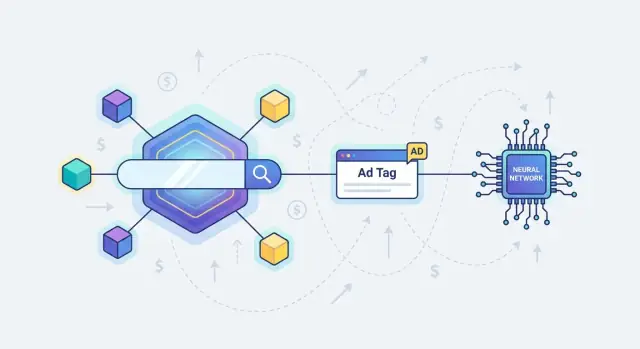
Why Alphabet Became the Web’s Default Middle Layer
The modern web runs on two constant needs: discovery and monetization. Discovery is the act of finding what you’re looking for—an answer, a product, a local service, a video, a definition. Monetization is how all of that gets paid for—funding websites, apps, creators, and the infrastructure that keeps services running.
Alphabet (through Google) became a “middle layer” because it sits between three groups that depend on each other but rarely coordinate well: users who want relevant results quickly, publishers who need traffic and revenue to justify making content, and advertisers who want measurable ways to reach people at the moment they’re interested.
A broker of attention (not the whole internet)
Google doesn’t create most of what you read or buy online. It routes attention: it helps people decide which page to visit, which app to open, or which business to call. For publishers, that routing can be the difference between an audience and obscurity. For advertisers, it turns “someone is looking for this” into a practical way to fund the web.
The three pillars we’ll follow
This article focuses on three connected systems:
- Search as the default interface for discovery.
- Ads as the primary monetization method that scales across the open web.
- AI infrastructure as the behind-the-scenes engine that improves relevance, targeting, and efficiency.
Scope and tone
We’ll look at products, incentives, and second-order effects—why the system works, where it strains, and what it enables. The goal isn’t hype or conspiracy; it’s a clear map of how Search, Ads, and compute turned Alphabet into a central clearinghouse for online intent.
Search: Turning the Open Web Into a Usable Map
The early web was a giant library with missing labels. Pages appeared and disappeared constantly, anyone could publish anything, and there was no central catalog. Finding a trustworthy answer wasn’t just inconvenient—it was uncertain.
Why early web search was hard
Three problems stacked up quickly:
- Scale: millions of pages became billions, far beyond what hand-built directories could keep up with.
- Spam: people learned to trick search engines with hidden text, keyword stuffing, and link farms.
- Relevance: even honest pages weren’t easy to rank; matching words on a page didn’t mean it answered your question.
Google’s breakthrough was treating the web itself as a signal system, not just a pile of text.
Links as votes (PageRank-style signals)
A simple way to picture PageRank-style thinking: a link is a vote, and votes from respected pages count more. If many credible sites point to a page, it’s more likely to be worth showing near the top.
This didn’t “solve” quality on its own—spammers tried to fake votes too—but it raised the baseline. It also shifted incentives: earning genuine links by being useful became a workable strategy.
Speed, simplicity, and habit
Relevance mattered, but so did feel. Google’s clean homepage, fast results, and consistent experience reduced friction to almost zero. When “best answer fast” works a few times, it becomes muscle memory.
That daily behavior—type a question, get a clear list, click—turned the open web into something navigable. Search stopped being a special tool and became the default starting point for learning, shopping, troubleshooting, and planning.
The Intent Advantage: Why Queries Power Everything Else
Search has a uniquely valuable raw material: intent. A query is often a plain-language description of what someone wants right now—“best noise-canceling headphones,” “symptoms of strep throat,” “how to file an LLC,” “flights to Tokyo.” That immediacy makes queries different from most other signals on the internet.
Queries aren’t just attention—they’re direction
Social feeds and display ads typically start with passive consumption: you scroll, you browse, you see what’s next. Search flips the order. The user supplies a goal first, and the system’s job is to match it.
That difference matters because:
- A query compresses context into a few words (need, urgency, constraints).
- It’s closer to a decision point than a like, a view, or a follow.
- It creates a natural “top of funnel → next action” path without having to manufacture interest.
Relevance and trust compound usage
When results feel reliable, people return to search for more categories of problems: trivial questions, serious purchases, local services, technical troubleshooting. Each successful search teaches users that asking is efficient—and teaches the system what “good” looks like.
This trust is fragile. If results are cluttered, spammy, or misleading, users adapt quickly: they add “reddit” to queries, switch engines, or rely on apps. Keeping relevance high isn’t a nice-to-have; it protects the habit.
The feedback loop that powers everything else
Search improves through repetition:
Better results → more searches → more signals about satisfaction → better results.
Those signals include clicks, reformulated queries, time to return, and patterns across similar searches. Over time, the system learns what people meant, not just what they typed—turning intent into a compounding advantage that supports both discovery and monetization.
Ads: The Auction Model That Financed the Modern Web
Search ads work less like buying a billboard and more like bidding for a moment of attention. When someone types a query, multiple advertisers may want to appear for that intent (“running shoes,” “accounting software,” “emergency plumber”). Google runs a rapid auction to decide which ads show, in which order, and roughly what they’ll cost.
Auctions, in plain terms
Each advertiser sets a maximum bid: the most they’re willing to pay for a click from that search. But the highest bid doesn’t automatically win.
Google also considers quality and relevance—signals that estimate whether an ad is likely to help the searcher. If your ad and landing page closely match the query and people tend to click and find what they need, you can often beat a higher bidder with a worse match. This pushes the system toward usefulness: advertisers can’t simply “buy” their way into a terrible result and expect it to stick.
Pay-per-click: paying for outcomes, not exposure
Unlike traditional advertising where you pay mainly for impressions (people who might have seen it), search ads popularized pay-per-click (PPC): you’re charged when someone actually clicks.
That structure aligned costs with outcomes. A small business could start with a modest budget, test a few keywords, and stop spending on terms that didn’t produce customers. Meanwhile, high-intent searches—where the user is closer to taking action—naturally became more valuable.
Measurement moved budgets toward search
The real accelerator was measurement. By tracking what happened after the click—calls, form fills, purchases—advertisers could calculate a rough “did this pay off?” number.
As conversion tracking improved, marketing budgets shifted toward search because it was legible: you could see which queries and ads produced results, then reinvest accordingly. That feedback loop rewarded relevance, improved targeting, and helped finance the free services people came to expect across the web.
AdSense and the Publisher Economy: Monetizing at Scale
AdSense took Google’s advertiser demand and made it usable for everyone else on the web. Instead of negotiating direct sponsorships or building a sales team, a small blog, a niche forum, or a local news site could paste a snippet of code and start earning money from the same pool of ads that appeared on Google Search.
How AdSense scaled monetization
At its core, AdSense connected three things: publisher pages (supply), advertiser budgets (demand), and Google’s targeting and auction systems (matching + pricing). That matching didn’t require a publisher to “sell” anything—just to create pages that attracted visitors and gave the system enough context to place relevant ads.
The result was a shared incentive loop:
- Publishers create content that ranks or gets shared
- Search and other channels send traffic
- Ads monetize that traffic, funding more content
That loop helped grow the open web’s long tail: millions of sites that could be financially viable even with modest audiences.
The trade-offs: incentives shape the web
Monetization at scale also shaped behavior. When revenue is tied to clicks and impressions, publishers feel pressure to chase volume—sometimes at the expense of quality. It encouraged SEO-first content, clickbait headlines, heavier ad layouts, and a worse page experience (slow loads, clutter, intrusive placements). Google tried to counterbalance this with policy enforcement and page-quality signals, but the core incentives never fully went away.
Dependency: referral traffic and RPMs
Over time, many publishers became dependent on Google-driven referral traffic and on RPM (revenue per thousand pageviews). That dependence made business planning fragile: a ranking change, a shift in user behavior, or a policy update could swing earnings overnight. AdSense didn’t just monetize publishers—it tied their fortunes to the same discovery engine that sent them visitors.
Infrastructure: Data Centers, Indexes, and Speed as Moats
Google Search isn’t “a website” so much as an always-on industrial system. The promise is simple—type anything, get useful results instantly—but delivering that experience requires turning the open web into a constantly refreshed, queryable asset.
Crawling and indexing at industrial scale
Crawling starts as a basic idea: fetch pages and follow links. At Google’s size, it becomes a production line with scheduling, prioritization, and quality control. The system has to decide what to fetch, how often, and how to avoid wasting effort on duplicates, spam, or pages that change every minute.
Indexing is where the transformation happens. Instead of “a pile of pages,” Google builds structured representations: terms, entities, links, freshness signals, language features, and many other features that can be retrieved quickly. This index has to be updated continuously without breaking query performance, which means careful engineering around incremental updates, storage layout, and fault tolerance.
Data centers are strategy, not just IT
When search volume is measured in billions of daily queries, infrastructure decisions become product decisions. Data centers, networking, and storage determine what’s feasible:
- More compute and better networks allow richer ranking features without slowing results.
- Better storage and replication keep indexes available even when machines fail.
- Internal efficiency determines how cheaply Google can serve each query—and how much it can invest in improving quality.
Speed and reliability users can feel
Latency is a competitive advantage because it shapes behavior. If results are fast, people search more, refine more, and trust the tool for higher-stakes tasks. Reliability matters the same way: an outage isn’t just downtime; it’s a broken habit.
Scale lowers unit cost—and accelerates iteration
Operating at massive scale can reduce per-query cost through optimized hardware utilization, custom systems, and smarter scheduling. Lower unit cost then funds faster iteration: more experiments, more model updates, and more frequent index refreshes. Over time, that compounding loop makes “speed” and “freshness” hard for smaller competitors to match.
Distribution: Android and Chrome as the On-Ramp to Search
Alphabet didn’t only win by having a great search engine. It also secured the “front door” to the web: the places where people start browsing and where default choices quietly shape what happens next.
Android: defaults, bundling, and the path to a query
Android powers a large share of the world’s phones, and that matters because the first search box most people see is often baked into the device experience. Pre-installed apps, home-screen widgets, and default settings reduce friction: if Search is one swipe away, it becomes the habit.
Android’s services bundling is equally important. When core apps (Search, Chrome, Maps, YouTube, Play services) work seamlessly together, switching any one piece can feel like breaking the phone—despite the fact that alternatives exist. This is why “default search placement” isn’t a minor checkbox; it’s a behavioral nudge repeated dozens of times a day.
Chrome: standards, performance, and a quieter form of influence
Chrome sits between users and the open web. By prioritizing speed, security, and certain APIs, it steers what websites optimize for—and what “good” web experiences look like. Faster pages and smoother logins also increase how often people search, click, and continue.
Chrome also creates a feedback channel: browser-level signals about performance and usability can influence how sites are built and, indirectly, how they’re discovered.
The ecosystem effect
Once Android and Chrome become the common path to users, partners align around them: developers test on Chrome first, publishers optimize for performance metrics, and businesses treat Google as the default distribution partner. This network effect makes the on-ramp itself a moat—less about locking doors, more about making one entrance far more convenient than the rest.
Measurement and Data: The Business Feedback Loop
Search and ads don’t just connect buyers and sellers—they generate continuous feedback about what worked. That feedback is what lets Alphabet tune both the product (Search) and the business model (ads) without guessing.
What “ads measurement” actually means
“Measurement” answers a basic question: Did this ad lead to a valuable action? In practice, it usually includes:
- Attribution: deciding which touchpoints get credit (a search ad, a YouTube view, an email, a later branded query).
- Tracking: observing signals that connect an ad interaction to later behavior (clicks, visits, sign-ups).
- Conversions: the business outcomes advertisers care about—purchases, leads, app installs, calls, subscriptions.
Even when measurement is imperfect, it provides a shared scoreboard. Advertisers can compare campaigns, keywords, audiences, and creatives, and shift budget toward what performs.
Why better measurement makes advertisers spend more
Advertising becomes easier to justify when it looks less like “marketing” and more like an investment. If an advertiser can reliably estimate return (or at least directionally track it), they can:
- Increase bids with confidence on high-performing queries
- Expand into new categories because results are visible quickly
- Automate decisions (smart bidding) without feeling blind
That willingness to spend feeds the auction: more competition, more data, and stronger incentives to improve relevance so users keep clicking.
Privacy changes and the move to first-party data
As browsers and platforms reduce cross-site identifiers (cookies, mobile ad IDs), measurement shifts from third-party tracking toward first-party data—signals a business collects directly (logged-in sessions, purchases, CRM lists, on-site behavior). That pushes products toward aggregated and modeled reporting, and toward tools that work “on the advertiser’s side” (for example, server-to-server conversion uploads).
Trust and regulation as product constraints
Measurement choices now sit under constant scrutiny—from regulators, platforms, and users. Pressure around consent, data minimization, and transparency shapes what can be measured, how long data is kept, and how clearly controls are presented. The result is a feedback loop with guardrails: maximize performance, but within rules designed to maintain trust and legal compliance.
AI in the Core: From Ranking Signals to Machine Learning
Search started as a big set of rules: count links, read text on the page, and apply hand-tuned signals to guess what a person wanted. That worked surprisingly well—until the web exploded in size, languages, formats, and outright manipulation. The shift to machine learning wasn’t about hype; it was about keeping results useful when simple rules stopped scaling.
From “signals” to learned relevance
Modern ranking still uses many signals (freshness, location, page quality, and more), but ML helps decide how those signals should matter for a specific query. Instead of one global recipe, models can learn patterns from aggregated behavior and evaluator feedback: when people quickly return to results, when they refine queries, and which pages tend to satisfy certain intents.
The outcome is practical: fewer obviously wrong results, better handling of ambiguous searches (“jaguar” the animal vs. the car), and improved understanding of longer, more natural queries.
AI across the system (not just rankings)
ML is woven into the plumbing of search and ads:
- Spam fighting: models spot link schemes, scraped content, and other manipulation tactics that are hard to catch with fixed rules alone.
- Language and understanding: translation and semantic modeling help connect queries to pages that don’t share the exact same wording—critical for multilingual searches and niche topics.
- Ads matching: models predict which ad is likely to be relevant for a query and a person’s context, improving click quality and reducing wasted impressions.
This matters because relevance is the product. Better relevance increases trust, which increases usage, which supplies more feedback for improvement.
What “AI infrastructure” actually means
Behind the scenes, “AI” is an operations stack: specialized chips, trained models, and pipelines that deploy updates safely.
- Chips and accelerators: hardware (including custom chips) that makes training and serving models cheaper and faster.
- Models: large and small systems tuned for ranking, safety, translation, and ad prediction.
- Pipelines: data processing, evaluation, and monitoring so improvements ship continuously without breaking quality.
When this works, users see faster answers and fewer junk results—and advertisers get more efficient matching—without needing to think about the machinery.
Compute as Strategy: TPUs, Models, and the Cost Curve
Alphabet’s advantage isn’t only “better algorithms.” It’s the ability to run those algorithms cheaply, quickly, and everywhere—at a scale most companies can’t touch. Compute becomes a product feature when milliseconds and pennies decide which results you see, which ad wins, and whether an AI model is practical to deploy.
Why custom hardware (TPUs) changes the math
Training and serving modern AI models is expensive. General-purpose chips can do the job, but they’re not always cost-efficient for the specific operations that machine learning relies on.
TPUs (Tensor Processing Units) are purpose-built to run those workloads with better performance per dollar. That matters in four ways:
- Cost: Lower unit costs mean Alphabet can run more experiments, train larger models, and serve richer AI features without breaking margins.
- Speed: Faster training shortens the cycle from idea → model → improvement, so products evolve more quickly.
- Scale: When a feature moves from a lab demo to billions of users, custom hardware helps it survive the jump.
- Predictability: Owning more of the stack (chips, networking, data centers) reduces dependence on external supply and pricing swings.
One shared engine across products
Alphabet doesn’t build separate compute stacks for Search, YouTube, Ads, Maps, and Cloud. Much of the underlying infrastructure—data centers, networking, storage, and ML platforms—is shared.
That shared base creates efficiencies: improvements in model tooling, chip utilization, or data-center power management can benefit multiple products at once. It also lets teams reuse proven components rather than reinventing them.
The compounding loop: usage funds compute, compute improves usage
More usage generates more revenue (especially via ads). Revenue funds more compute capacity and better infrastructure. Better infrastructure enables better models and faster products. Those improvements attract more usage.
This is a compounding effect: each turn of the loop makes the next turn easier.
Where users actually feel AI infrastructure
AI infrastructure isn’t just an internal bragging right—it shows up in everyday experiences:
- Better answers and ranking: more sophisticated models can interpret intent, language, and context with fewer obvious misses.
- More relevant ads (and fewer wasted impressions): improved prediction helps match ads to people more likely to care, which can increase value for advertisers and reduce noise for users.
- Smoother, faster interfaces: serving models quickly keeps Search, Maps, and YouTube feeling instant, even as the underlying intelligence becomes more complex.
Compute is strategy because it turns AI from an occasional feature into a default capability—one that can be delivered reliably, at scale, and at a cost that competitors struggle to match.
Search + Ads Together: The Discovery-to-Checkout Pipeline
Search and ads aren’t two separate products sitting side by side—they’re a single pipeline that moves people from “I’m curious” to “I’m buying,” often in just a few minutes. The key is that both organic results and paid listings answer the same intent, on the same page, at the same moment.
One results page, two kinds of competition
On a typical query, organic results and ads compete for attention with the same scarce resource: above-the-fold space and user trust. Ads can win on placement and clear offers (price, shipping, promotions). Organic can win on authority, depth, and perceived neutrality.
In practice, the “winner” is often the result that best matches the user’s urgency—shopping ads for “buy,” organic guides for “how,” local packs for “near me.”
Features that reroute traffic
Modern results pages are less “ten blue links” and more a set of modules: featured snippets, map packs, product grids, “People also ask,” and rich results. These features change traffic flows in two ways:
- They can keep users on the results page longer, reducing clicks to publishers.
- They can accelerate decision-making by surfacing comparisons, reviews, and availability immediately.
For businesses, this means ranking #1 is no longer the whole story. Visibility now includes being present in the right module (local listings, Merchant Center feeds, structured data) and having a compelling offer when the user is ready.
Visibility vs. dependency for small businesses and creators
For small businesses, the upside is immediate demand capture: you can show up the day you launch via ads, then build longer-term organic credibility. The risk is dependency—if a large share of revenue relies on a single set of keywords or a single platform’s layout, any change (prices, policies, new features) can hit overnight.
Creators face a similar tension: search can deliver consistent discovery, but on-page answers and snippets can shrink click-through. A practical mindset is to treat search as a channel, not a home.
A practical mindset: diversify and measure incrementality
Diversify acquisition (email list, referrals, social, partnerships, local communities) so search is additive, not existential. And measure incrementality: run controlled tests (geo splits, time-based holdouts, brand vs. non-brand separation) to learn what ads truly create versus what they merely capture from organic demand. That habit keeps the discovery-to-checkout pipeline profitable—not just busy.
Tensions and the Next Chapter: Regulation and AI Answers
Alphabet’s role as the default route to information and customers is also what makes it a frequent target. The same system that efficiently matches intent to results can concentrate power—and that raises questions about who gets visibility, on what terms, and with what oversight.
Where the criticisms land
A common critique is market power: when one company intermediates so much discovery, small changes in ranking, UI, or ad formats can reshape entire industries. That’s why self-preferencing allegations matter—whether Google steers users toward its own properties (shopping, local, travel, video) even when alternatives might be better.
There’s also the practical issue of ad load. If more queries show more paid placements, publishers and merchants can feel like they’re renting access to audiences they once reached organically.
What regulators focus on
Regulatory pressure tends to cluster around three themes:
- Competition: defaults, distribution deals, and bundling (e.g., which services ship first).
- Privacy: what data is collected, how it’s combined, and how consent is handled.
- Transparency: why an ad won, why a result ranked, and how disputes can be resolved.
Outcomes could range from new disclosure requirements to limits on default agreements, or changes in how ad and measurement systems operate.
AI answers: fewer clicks, different economics
As AI-generated summaries move higher on the page, some queries may end without a click. That could reduce traffic to publishers, weaken the traditional “search → site → monetize” chain, and push more value into on-page units the platform controls.
The open question isn’t whether answers get more “direct,” but how value gets redistributed when the interface becomes the destination.
What to watch next
Pay attention to default settings battles, measurement changes (especially around cookies and attribution), and shifting discovery habits—more conversational queries, more in-app search, and more answer-first experiences.
What This Means for Builders
If Google is the web’s default middle layer for intent, then products increasingly win or lose based on how efficiently they translate intent into outcomes: clear pages, fast experiences, measurable conversions, and systems that can adapt as discovery shifts from links to summaries.
This is also where modern “AI-assisted building” fits. Platforms like Koder.ai apply a similar idea—turning plain-language intent into working software—by letting teams create web, backend, and mobile applications through a chat interface (React on the web, Go + PostgreSQL on the backend, Flutter for mobile). In a world shaped by feedback loops (measure → iterate → deploy), tooling that shortens the cycle from idea to implementation becomes a competitive advantage, especially when paired with practical controls like planning mode, snapshots, rollback, and source code export.
FAQ
Why does the post describe Alphabet as the web’s “default middle layer”?
Alphabet (via Google) sits between three groups that need each other but don’t coordinate well: users seeking fast, relevant answers; publishers needing traffic and revenue; and advertisers wanting measurable demand capture. Search routes attention, ads monetize intent, and infrastructure/AI keeps relevance and speed high at massive scale.
What makes search queries more valuable than typical social or display signals?
Because queries express active intent (“flights to Tokyo,” “emergency plumber”) rather than passive interest. That makes search valuable near decision points and creates a natural path from discovery to action, which is ideal for both relevance (users) and monetization (advertisers).
What problems made early web search difficult, and how did Google improve it?
Early web search struggled with:
- Scale: too many pages for hand-curated directories.
- Spam: manipulation like keyword stuffing and link farms.
- Relevance: keyword matches didn’t guarantee good answers.
Google’s approach treated the web’s structure and behavior as signals, raising the baseline for finding useful pages.
How do “links as votes” (PageRank-style signals) affect ranking?
PageRank-style logic treats links as credibility signals: a link is a “vote,” and votes from trusted sites count more. It doesn’t guarantee quality (spam can imitate links), but it helps separate broadly referenced resources from isolated or low-trust pages—especially when combined with other signals.
Why do speed and a clean interface matter so much for search dominance?
Speed and simplicity reduce friction to near zero, so searching becomes habitual. When “type a question → get useful results” works repeatedly, users return for more categories of tasks, which generates more feedback signals that further improve results.
How does the search ad auction work, and why doesn’t the highest bid always win?
Search ads run as real-time auctions where advertisers set max bids, but placement also depends on quality/relevance signals (often described as a “quality score” concept). Practically: you can’t reliably win just by outbidding everyone if your ad and landing page don’t satisfy the query.
Why was pay-per-click (PPC) such a big shift for online advertising?
PPC aligns cost with outcomes: you pay when someone clicks, not just when an ad is shown. That lets small budgets test keywords, measure results, and cut losers quickly—pulling more spend into search because performance is easier to see and justify.
What did AdSense change for publishers, and what were the downsides?
AdSense plugged publishers into the same advertiser demand used in search, without requiring a direct sales team. It scaled monetization, but also created trade-offs:
- Incentives for volume (SEO-first content, clickbait).
- Heavier ad layouts and worse UX.
- Dependency on Google traffic and RPM swings after updates.
How do Android and Chrome strengthen Google’s position in discovery?
Android and Chrome reduce friction through defaults and “front door” placement—search boxes, preinstalled apps, and seamless integration. When the easiest path to a query is Google, the behavior repeats daily, creating a distribution moat even if alternatives technically exist.
How could AI-generated answers and regulation change the search-and-publisher ecosystem?
AI increases on-page “answer-first” experiences, which can end sessions without clicks—reducing publisher traffic and shifting value to units Google controls. Combined with regulation (defaults, privacy, transparency), this can reshape incentives and force businesses to diversify acquisition and measure incrementality rather than assuming search will remain stable.