

AMD’s Comeback: Execution, Chiplets, and Key Partnerships
How AMD combined disciplined execution, chiplet design, and platform partnerships to grow from an underdog into a leader in servers and PCs.
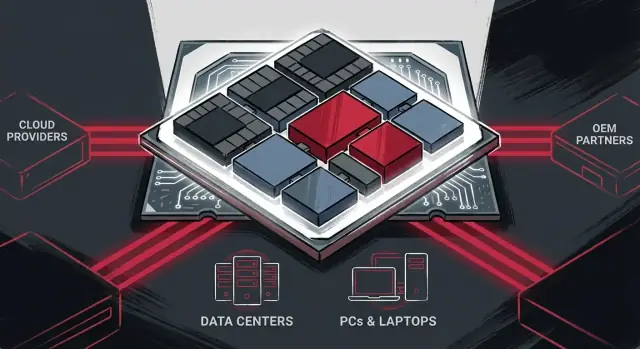
From Catch-Up to Leadership: The Core Thesis
AMD’s comeback wasn’t a single “breakthrough chip” moment—it was a reset in how the company built, delivered, and supported products over multiple years. A decade ago, AMD needed to move from reacting to competitors to setting its own cadence: predictable roadmaps, competitive performance per dollar, and—crucially—confidence that what was announced could be purchased in meaningful volume.
“Great silicon” vs. winning in the real world
It’s easy to confuse technical excellence with market success. A CPU can benchmark well and still fail if it ships late, ships in small quantities, or arrives without the platform pieces that customers depend on (validated motherboards, stable firmware, OEM systems, long-term support, and clear upgrade paths). Success for AMD meant turning engineering wins into repeatable, on-time product cycles that partners could plan around.
The three pillars behind the turnaround
This article argues AMD rebuilt itself on three reinforcing pillars:
- Execution: consistent delivery, clear segmentation, and steady iteration—less drama, more dependable releases.
- Chiplets: a practical design approach that improved yields, scaled core counts, and let AMD refresh products faster without redesigning everything at once.
- Partnerships: tight coordination with foundries, packaging providers, OEMs, and data center platforms so products arrived as complete solutions—not just standalone chips.
Why this matters to buyers
For server teams, these pillars translate into capacity planning you can trust, performance that scales across SKUs, and platforms that integrate cleanly into data center ecosystems.
For PC buyers, it shows up as better availability, stronger OEM lineups, and clearer upgrade paths—meaning your next purchase can fit into a longer-term plan, not a one-off deal.
Execution as a Competitive Advantage
“Execution” sounds like corporate jargon, but it’s simple: make clear plans, ship on time, and keep the product experience consistent. For AMD’s comeback, execution wasn’t a tagline—it was the discipline of turning a roadmap into real chips that buyers could count on.
What “execution” means in plain terms
At a practical level, execution is:
- Roadmaps that hold up: public timelines that don’t constantly slip or get redefined.
- Deadlines that matter: launches that arrive close to when partners are planning their own releases.
- Consistent delivery: each generation improves the basics (performance, efficiency, features) without drama.
Predictability builds trust (especially with OEMs and enterprises)
PC makers and enterprise IT teams don’t buy a benchmark chart—they buy a plan. OEMs need to align CPUs with chassis designs, thermals, firmware, and regional availability. Enterprises need to validate platforms, negotiate contracts, and schedule rollouts. When releases are predictable, partners invest more confidently: more designs, broader configurations, and longer-term commitments.
This is why a steady cadence can be more persuasive than a flashy launch. Predictable releases reduce the risk that a product line will stall or that a “one-off” winner won’t be followed up.
Execution also includes quality and supply planning
Execution isn’t only “shipping something.” It includes validation, reliability testing, BIOS and driver maturity, and the unglamorous work of making sure systems behave the same way in real deployments as they do in labs.
Supply planning is part of this, too. If customers can’t get volume, momentum breaks—partners hesitate, and buyers delay decisions. Consistency in availability supports consistency in adoption.
You can see execution in cadence and platform stability—not marketing
Marketing can promise anything. Execution shows up in the pattern: on-time generations, fewer surprises, stable platforms, and products that feel like a coherent family rather than disconnected experiments.
Chiplets, Explained Without the Jargon
Think of a traditional “monolithic” processor like a single, giant LEGO model molded as one piece. If a tiny corner has a defect, the whole thing is unusable. A chiplet-based processor is closer to building the same model from multiple smaller, tested blocks. You can swap a block, reuse a block, or create new variants without redesigning the entire set.
Monolithic vs. chiplet: what changes?
With monolithic designs, CPU cores, caches, and I/O features often live on one big slab of silicon. Chiplets split those functions into separate dies (small chips) that are packaged together to behave like one processor.
Practical benefits you can feel
Better manufacturing yield: Smaller dies are easier to produce consistently. If one chiplet fails testing, you discard only that piece—not an entire large chip.
Flexibility: Need more cores? Use more core chiplets. Need a different I/O configuration? Pair the same compute chiplets with a different I/O die.
Product variety from shared parts: The same building blocks can show up across multiple products, helping AMD cover desktops, laptops, and servers efficiently without bespoke silicon for every niche.
The trade-offs (it’s not “free”)
Chiplets increase packaging complexity: you’re assembling a multi-part system inside a tiny footprint, and that demands advanced packaging and careful validation.
They also add interconnect considerations: chiplets must communicate quickly and predictably. If that internal “conversation” is slow or power-hungry, it can erode the benefits.
Why this mattered strategically
By standardizing on reusable chiplet building blocks, AMD could scale a single architectural direction into many market segments faster—iterating compute pieces while mixing and matching I/O and packaging choices to fit different performance and cost targets.
Zen and the Power of Iteration
Zen wasn’t a one-off “big bang” redesign—it became AMD’s multi-generation commitment to improving CPU cores, power efficiency, and the ability to scale from laptops to servers. That continuity matters because it turns product development into a repeatable process: build a strong base, ship it broadly, learn from real deployments, then refine.
Why iteration beats dramatic reinvention
With each Zen generation, AMD could focus on a set of practical, compounding upgrades: better instructions-per-clock, smarter boosting behavior, improved memory handling, stronger security features, and more efficient power management. None of these needs to be a headline-grabber on its own. The point is that small, consistent improvements stack—year after year—into a noticeably better platform for users.
Iteration also lowers risk. When you keep the architectural direction consistent, teams can validate changes faster, reuse proven building blocks, and avoid breaking the ecosystem. That makes release schedules more predictable and helps partners plan products with fewer surprises.
Consistency that helps software and system planning
Architectural consistency isn’t just an engineering preference—it’s a planning advantage for everyone else. Software vendors can tune compilers and performance-critical code against a stable set of CPU behaviors and expect those optimizations to remain valuable across future releases.
For system builders and IT teams, a steady Zen roadmap makes it easier to standardize on configurations, qualifying hardware once and extending those choices over time. The pattern you see in adoption follows naturally: as each generation arrives with incremental gains and familiar platform characteristics, it becomes easier for buyers to upgrade with confidence rather than re-evaluate from scratch.
Foundry and Packaging Partnerships That Enabled Scale
AMD’s modern product cadence wasn’t just about better designs—it also depended on access to leading-edge manufacturing and advanced packaging. Unlike companies that own their own fabs, AMD relies on outside partners to turn a blueprint into millions of shippable chips. That makes relationships with foundries and packaging providers a practical requirement, not a nice-to-have.
Why the foundry relationship matters
As process nodes shrink (7nm, 5nm, and beyond), fewer manufacturers can produce at high volume with good yields. Working closely with a foundry like TSMC helps align on what’s feasible, when capacity will be available, and how a new node’s quirks affect performance and power. It doesn’t guarantee success—but it improves the odds that a design can be manufactured on schedule and at competitive cost.
Nodes and packaging shape the calendar
With chiplet design, packaging is not an afterthought; it’s part of the product. Combining multiple dies—CPU chiplets plus an I/O die—requires high-quality substrates, reliable interconnects, and consistent assembly. Advances in 2.5D/3D-style packaging and higher-density interconnects can expand what a product can do, but they also add dependencies: substrate supply, assembly capacity, and qualification time all influence launch timing.
Capacity planning and risk management
Scaling a successful CPU isn’t only about demand. It’s about reserving wafer starts months in advance, securing packaging lines, and having contingency plans for shortages or yield swings. Strong partnerships enable access and scale; they don’t eliminate supply risk. What they can do is make AMD’s roadmap more predictable—and that predictability becomes a competitive advantage.
Data Center Partnerships: More Than Just a CPU
A “platform partnership” in servers is the long chain of companies that turns a processor into something you can actually deploy: OEMs (Dell, HPE, Lenovo-style vendors), cloud providers, and integrators/MSPs who rack, cable, and operate fleets. In data centers, CPUs don’t win alone—platform readiness does.
Why qualification and long-term support matter
Server buying cycles are slow and risk-averse. Before a new CPU generation is approved, it has to pass qualification: compatibility with specific motherboards, memory configurations, NICs, storage controllers, and power/thermal limits. Just as important is firmware and ongoing support—BIOS/UEFI stability, microcode updates, BMC/IPMI behavior, and security patch cadence.
Long-term availability matters because enterprises standardize. If a platform is qualified for a regulated workload, buyers want confidence they can purchase the same system (or a compatible refresh) for years, not months.
Reference designs and joint testing programs
Partnerships often start with reference designs—known-good blueprints for motherboards and platform components. These cut time-to-market for OEMs and reduce surprises for customers.
Joint testing programs take it further: vendor labs validating performance, reliability, and interoperability under real workload conditions. This is where “it benchmarks well” turns into “it runs my stack reliably.”
Software ecosystem alignment (the quiet multiplier)
Even at a high level, aligning the software ecosystem is crucial: compilers and math libraries tuned for the architecture, virtualization support, container platforms, and cloud images that are first-class on day one. When hardware partners and software partners move in sync, adoption friction drops—and the CPU becomes a complete, deployable server platform.
Why EPYC Fit Data Center Needs
EPYC landed at a moment when data centers were optimizing for “work done per rack,” not just peak benchmark scores. Enterprise buyers tend to weigh performance per watt, achievable density (how many useful cores you can fit in a chassis), and total cost over time—power, cooling, software licensing, and operational overhead.
The consolidation math: cores, memory, and I/O
More cores per socket can reduce the number of servers needed for the same workload. That matters for consolidation plans because fewer physical boxes can mean fewer network ports, fewer top-of-rack switch connections, and simpler fleet management.
Memory and I/O options also shape consolidation outcomes. If a CPU platform supports higher memory capacity and ample bandwidth, teams can keep more data “close” to compute, which benefits virtualization, databases, and analytics. Strong I/O (especially PCIe lanes) helps when you’re attaching fast storage or multiple accelerators—key for modern mixed workloads.
Where chiplets helped the server portfolio
Chiplet-based design made it easier to build a broad server family from common building blocks. Instead of designing many monolithic dies for every price point, a vendor can:
- Offer different SKUs with varying core counts using similar underlying components
- Balance yield and cost by mixing “known good” chiplets
- Refresh parts of the design on a predictable cadence without redesigning everything
For buyers, that typically translates into clearer segmentation (from mainstream to high-core-count) while keeping a consistent platform story.
A neutral evaluation checklist for enterprise teams
When evaluating CPUs for a data center refresh, teams often ask:
- What is the performance per watt at our target utilization, not just at peak?
- How many VMs/containers per host can we run before hitting memory or I/O limits?
- Do we have enough PCIe lanes for GPUs, NVMe, and networking without compromises?
- What are the platform’s upgrade options within the same socket generation?
- How do licensing models (per-core, per-socket) change TCO as core counts rise?
- What does availability look like across the SKUs we’d standardize on?
EPYC fit because it aligned with these practical constraints—density, efficiency, and scalable configurations—rather than forcing buyers into one “best at everything” SKU.
Client Growth: Ryzen, OEM Design Wins, and Availability
Ryzen’s client resurgence wasn’t only about hitting higher benchmark numbers. OEMs choose laptop and desktop parts based on what they can ship at scale, with predictable behavior in real products.
What actually drives OEM adoption
For laptops, thermals and battery life often decide whether a CPU makes it into a thin-and-light design. If a chip can hold performance without forcing louder fans or thicker heatpipes, it opens up more chassis options. Battery life matters just as much: consistent efficiency under everyday workloads (browser, video calls, office apps) is what reduces returns and improves reviews.
Cost and supply are the other big levers. OEMs build a yearly portfolio with tight price bands. A compelling CPU is only “real” to them if it can be sourced reliably across regions and for months, not just in a short launch window.
Platform features customers notice indirectly
Standards like USB generations, PCIe lanes, and DDR memory support sound abstract, but they show up as “this laptop has fast storage,” “this model supports more RAM,” or “the ports match the docking station we already use.” When the CPU platform enables modern I/O and memory without complex trade-offs, OEMs can reuse designs across multiple SKUs and keep validation costs down.
Roadmaps and the mainstream visibility loop
Predictable roadmaps help OEMs plan board layouts, cooling, and driver validation well ahead of launch. That planning discipline translates into broader availability in mainstream systems. And consumer perception follows that availability: most buyers meet Ryzen through a best-selling laptop line or a shelf-ready desktop, not through limited enthusiast parts or custom builds.
Gaming and Semi-Custom: A Platform Credibility Builder
Gaming can look like the “fun” side of a chip company, but AMD’s semi-custom work (most visibly in game consoles) has also been a credibility engine. Not because it magically makes every future product better, but because high-volume, long-lived platforms create practical feedback loops that are hard to replicate in smaller, shorter PC refresh cycles.
Why consoles and semi-custom volume matters
Console programs tend to ship for years, not months. That consistency can provide three things partnerships typically deliver:
- Predictable volume: sustained production runs help refine manufacturing, test, and logistics processes.
- Real-world learning: millions of identical systems in homes surface edge cases in power, thermals, memory behavior, and driver interactions.
- Deep relationships: platform holders demand disciplined schedules, clear documentation, and reliable support—habits that carry over into other customer conversations.
None of this guarantees a breakthrough, but it builds operational muscle: shipping at scale, supporting at scale, and making incremental fixes without breaking compatibility.
Platform credibility is CPU + GPU + software, not a spec sheet
Semi-custom platforms also force coordination across CPU cores, graphics, memory controllers, media blocks, and the software stack. For partners, that coordination signals that a roadmap is more than a set of isolated chips—it’s an ecosystem with drivers, firmware, and validation behind it.
That matters when AMD sits down with PC OEMs, server vendors, or cloud operators: confidence often comes from seeing consistent execution across product lines, not just peak benchmark results.
Long lifecycle products demand stable support
Consoles, embedded-like designs, and other semi-custom programs live long enough that “launch day” is only the start. Over time, platforms need:
- Firmware and driver updates that don’t disrupt existing titles
- Security and stability patches
- Predictable tooling and documentation for developers
Maintaining that steadiness is a quiet form of differentiation. It’s also a preview of what enterprise customers expect: long-term support, disciplined change management, and clear communication when updates happen.
If you want the practical mirror image of this thinking, see how AMD applies platform longevity in PCs and servers in the next sections on sockets and upgrade paths.
Platform Strategy: Sockets, Longevity, and Upgrade Paths
A CPU isn’t a standalone purchase; it’s a commitment to a socket, a chipset, and the board maker’s BIOS policy. That “platform” layer often decides whether an upgrade is a simple swap or a full rebuild.
Why sockets, chipsets, and BIOS support matter
The socket determines physical compatibility, but the chipset and BIOS decide practical compatibility. Even if a newer processor fits the socket, your motherboard may need a BIOS update to recognize it, and some older boards may not get that update at all. Chipsets also affect what you can actually use day-to-day—PCIe version, number of high-speed lanes, USB options, storage support, and sometimes memory features.
How long-lived platforms reduce friction
When a platform stays compatible across multiple CPU generations, upgrades become cheaper and less disruptive:
- Consumers can extend the life of a PC with a CPU refresh instead of replacing the whole system.
- IT teams can standardize on fewer motherboard models, reducing validation time, spare parts variety, and downtime.
This is part of why AMD’s platform messaging has mattered: a clearer upgrade story makes the buying decision feel safer.
What “platform longevity” can—and can’t—guarantee
Longevity usually means compatibility, not unlimited access to new features. You might be able to drop in a newer CPU, but you may not get every capability that newer motherboards offer (for example, newer PCIe generations, additional M.2 slots, or faster USB). Also, power delivery and cooling on older boards can limit high-end chips.
A practical pre-upgrade checklist
Before planning an upgrade, verify:
- Exact motherboard model and revision (not just the brand).
- CPU support list on the vendor site.
- Required BIOS version and update instructions.
- Memory compatibility and any speed limitations.
- PSU and cooling headroom for the target CPU.
If you’re choosing between “upgrade later” and “replace later,” platform details often matter as much as the processor itself.
Competition and the Moving Targets in Semiconductors
Semiconductor leadership is never “won” once. Even when a product line is strong, competitors adjust quickly—sometimes in visible ways (price cuts, faster refresh cycles), sometimes through platform moves that take a year to show up in shipping systems.
How competitors typically respond
When one vendor gains share, the usual counterpunches look familiar:
- Pricing and bundling: aggressive discounts, better OEM margins, or bundle programs that make a competing CPU “good enough” at a lower total cost.
- Cadence pressure: tighter launch schedules and rapid “plus” refreshes to narrow gaps in single-thread, power efficiency, or core-count tiers.
- Platform features: adding I/O options, memory support, security features, or manageability that matter to IT buyers—even if raw performance is close.
For readers tracking AMD strategy, it’s useful to interpret these moves as signals of where the competitive stress is highest: data center sockets, OEM premium laptops, or gaming desktops.
Why leadership can shift quickly
Two things can move the goalposts overnight: execution slips and supply constraints.
Execution slips show up as delayed launches, uneven early BIOS/firmware maturity, or OEM systems that arrive months after a chip announcement. Supply constraints are broader: wafer availability, packaging capacity, and priority allocation across data center and client products. If any link tightens, share gains can stall even when reviews are strong.
Strengths, gaps, and what to watch (without guessing)
AMD’s strengths often show in performance-per-watt and clear product segmentation, but buyers should also watch for gaps: limited availability in specific OEM lines, slower rollout of certain enterprise platform features, or fewer “default” design wins in some regions.
Practical signals you can monitor:
- Roadmap clarity and follow-through (official announcements plus shipping dates)
- OEM launches: how many models, in which price bands, and how soon after launch
- Cloud instances: new VM families, regions, and sustained availability over time
If those signals stay consistent, the competitive picture is stable. If they wobble, the rankings can change fast.
Key Takeaways for Buyers and Product Teams
AMD’s comeback is easiest to understand as three reinforcing pillars: execution, chiplet-driven product design, and partnerships (foundry, packaging, OEMs, hyperscalers). Execution turns a roadmap into predictable launches and stable platforms. Chiplets make that roadmap easier to scale across price points and segments without reinventing everything. Partnerships ensure AMD can actually manufacture, package, validate, and ship those designs at the volumes—and with the platform support—customers need.
For product teams, there’s a useful parallel: turning strategy into outcomes is mostly an execution problem. Whether you’re building internal benchmarking dashboards, capacity-planning tools, or “SKU comparison” configurators, platforms like Koder.ai can help you move from idea to working web or backend apps quickly via chat—useful when the goal is iteration and predictable delivery rather than a long, fragile build pipeline.
A simple decision guide (server vs. PC)
For servers, prioritize what lowers risk and improves total cost over time:
- Platform fit: memory capacity/bandwidth, I/O (PCIe lanes), and power efficiency at sustained load.
- Ecosystem readiness: certified systems, BIOS/firmware maturity, and software/vendor support.
- Supply and lifecycle: availability, long-term platform plans, and support commitments.
For PCs, prioritize what you’ll feel day-to-day:
- Performance per dollar for your primary apps (gaming vs. content creation vs. office).
- Upgrade path: socket longevity, motherboard features, and RAM compatibility.
- Real-world thermals and noise (cooling, chassis, sustained boost behavior).
Questions to ask vendors
Enterprises (IT/procurement):
- What are the validated server configurations and reference architectures?
- What’s the platform roadmap (socket, firmware cadence, security update policy)?
- How do you handle supply guarantees, lead times, and spare parts?
Consumers (DIY/OEM buyers):
- Which motherboard/BIOS versions are required for this CPU?
- What cooling is recommended for sustained performance?
- What’s the upgrade path over the next 2–3 years (CPU, RAM, GPU fit)?
The closing point
Specs matter, but strategy and partnerships determine whether specs translate into products you can buy, deploy, and support. AMD’s story is a reminder: the winners aren’t just the fastest on a slide—they’re the ones who execute repeatedly, scale intelligently, and build platforms customers can trust.
FAQ
What’s the simplest explanation for AMD’s comeback?
AMD’s turnaround was less about one “miracle chip” and more about making product development repeatable:
- Execution: predictable roadmaps, on-time launches, and stable platforms.
- Chiplets: modular dies that improve yield and enable faster product variation.
- Partnerships: foundry, packaging, OEM, and data-center ecosystem alignment so products ship in real volume with full platform support.
Why isn’t “great silicon” enough to win market share?
Because buyers don’t purchase a benchmark—they purchase a deployable plan.
A CPU can be fast and still lose if it’s late, scarce, or lacks mature BIOS/firmware, validated boards, OEM systems, and long-term support. Reliable delivery and platform readiness reduce risk for OEMs and enterprises, which directly drives adoption.
What does “execution” mean for PC makers and enterprise teams?
In practical terms, execution means you can bet your schedule on the roadmap:
- Launches happen close to the announced window.
- Each generation improves predictably (performance, efficiency, features) without major regressions.
- Platform basics are solid early: BIOS/UEFI maturity, drivers, validation, and consistent behavior across SKUs.
For OEMs and IT teams, that predictability is often more valuable than a single flashy release.
What is a chiplet CPU, in plain English?
A chiplet design splits a processor into multiple smaller dies packaged together to act like one chip.
Instead of one large monolithic die (where a small defect can ruin the whole thing), you can combine tested “building blocks” (compute chiplets plus an I/O die) to create different products more efficiently.
How do chiplets translate into real benefits for buyers?
Chiplets typically help in three concrete ways:
- Better yield and cost control: smaller dies are easier to manufacture reliably.
- Faster portfolio scaling: you can offer more core-count tiers and SKUs from shared parts.
- Quicker refresh cycles: update one block (e.g., compute) without redesigning everything.
The trade-off is more packaging and validation complexity, so success depends on strong packaging tech and testing discipline.
Why do foundry and packaging partnerships matter so much to AMD?
Because modern nodes and advanced packaging are capacity-constrained and schedule-sensitive.
AMD relies on external partners to secure:
- Wafer capacity months in advance.
- Packaging/substrate availability to assemble chiplets at scale.
- Qualification throughput so launches aren’t delayed by platform readiness.
Strong partnerships don’t remove risk, but they improve roadmap predictability and availability.
What do data-center buyers mean by “platform readiness”?
A server CPU “wins” when the whole platform is ready:
- Qualification: compatibility across boards, memory, NICs, storage, thermals, and power limits.
- Operational stability: BIOS/microcode cadence, BMC/IPMI behavior, security patching.
- Lifecycle commitments: you can buy consistent systems (and spares) over years.
That’s why data-center partnerships are about validation, support, and ecosystem alignment—not just raw CPU specs.
What’s a practical checklist for evaluating EPYC (or any server CPU)?
When comparing CPU platforms for refresh cycles, focus on constraints that affect real deployments:
- Performance per watt at your utilization levels.
- VM/container density before hitting memory or I/O bottlenecks.
- PCIe lane needs for NVMe, networking, and accelerators.
- Upgrade options within the same socket/platform generation.
- Licensing effects (per-core/per-socket) as core counts rise.
- Availability across the exact SKUs you’ll standardize on.
This keeps the decision tied to operational outcomes, not just peak benchmarks.
Why did Ryzen growth depend so much on OEMs and availability?
OEM adoption depends on shippable, supportable systems:
- Thermals and efficiency that fit real laptop/desktop designs.
- Stable platform behavior (firmware, drivers, consistent boost behavior).
- Supply continuity across regions and months, not just launch-week availability.
- Modern I/O and memory support that simplifies OEM validation and SKU planning.
When those are in place, CPUs show up in mainstream models people can actually buy.
How can I check whether a socket/platform will give me a good upgrade path?
Before you buy with an “upgrade later” plan, verify the platform details:
- Exact motherboard model and revision.
- CPU support list from the board vendor.
- Required BIOS version and update path.
- Memory compatibility and any speed limits.
- Power delivery and cooling headroom.
Even if a CPU fits the socket, you may not get every new feature (e.g., newer PCIe/USB), and older boards may not receive BIOS updates.