

Apple’s Vertical Integration: From Devices to a Consumer Platform
See how Apple links hardware, software, and services to create a cohesive ecosystem that improves retention, raises switching costs, and supports premium margins.
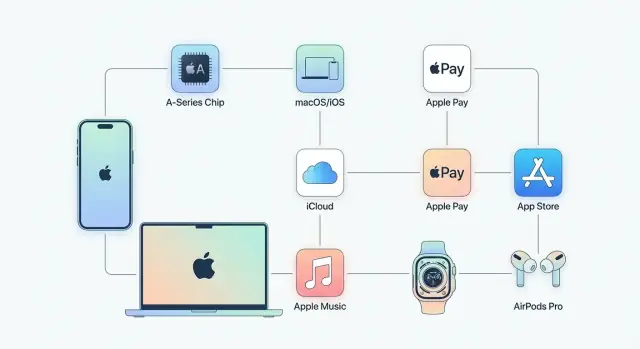
What Vertical Integration Means at Apple
Vertical integration means one company controls more of the steps that turn an idea into what you buy and use—design, key components, software, distribution, and ongoing services. Instead of relying on many separate vendors (each optimizing for their own goals), Apple tries to make the major pieces work as one system.
This matters especially in consumer electronics because the “product” isn’t just the device. It’s the setup experience, the feel of the interface, battery life, performance over time, privacy defaults, repairs, payments, and how well everything connects with what you already own. In markets where products are simpler or standards are tighter, mixing and matching suppliers can work fine. With phones, watches, laptops, and earbuds, small decisions across the stack add up to the difference between “good enough” and “I don’t want to switch.”
Product vs. platform (a simple example)
A product is a single thing you buy—say, a pair of wireless earbuds.
A platform is when that product becomes a hub for many interactions: it pairs instantly with your phone, switches between devices, supports subscriptions, enables third-party apps, and ties into your account. The value grows as more pieces connect.
The layers Apple integrates
Apple’s vertical integration is easiest to understand as a few layers working together:
- Hardware: devices and critical components (like custom silicon) designed around Apple’s goals.
- Software: operating systems and built-in apps tuned to the hardware for a consistent experience.
- Services: subscriptions, support, payments, and add-ons that continue after the sale.
- Account/identity: Apple ID and iCloud tying devices, purchases, and settings together.
The thesis of this article: Apple sells great products, but the durable advantage is how those products are engineered to behave like a single consumer platform.
The Hardware Layer: Chips, Devices, and Differentiation
Apple’s vertical integration starts with hardware decisions that most consumers never see, but feel every day: what the device is optimized for, which components get priority, and how tightly everything is packaged together. When one company sets priorities across chips, sensors, radios, and enclosure design, it can tune the product for a specific experience rather than for “good enough” compatibility.
Custom chips as a product decision (not just a component)
Custom silicon is one of the clearest examples. Apple doesn’t just buy a processor; it defines what the chip should be great at—fast everyday responsiveness, long battery life, and on-device features that rely on specialized blocks (like media engines, secure enclaves, and neural processing).
The result is less about peak benchmark scores and more about real-world behavior: smoother animations, better thermal control, and fewer trade-offs between performance and endurance.
Device design that removes friction
Owning the full device design also reduces small points of friction that add up. Pairing accessories can be quicker because hardware identifiers, radios, and software flows are designed together. Sensors (camera, biometrics, motion) can be positioned and calibrated with specific software behavior in mind. Even mundane details—button feel, haptics, speaker placement—benefit when the team designing the physical product and the team building system features are aiming at the same target.
Supply chain implications (without the hype)
This approach has operational consequences. Custom parts and tighter tolerances can increase upfront investment and require deeper coordination with manufacturing partners. It can also improve consistency across product lines, since Apple can standardize around its own components and long-term roadmaps.
The trade-off is reduced flexibility: when you commit to your own chip and design choices, changing course quickly is harder, and supply disruptions can ripple across multiple devices.
The Software Layer: OS Control and User Experience
Apple’s vertical integration becomes most visible in the operating systems: iOS, iPadOS, macOS, watchOS, and tvOS. Because Apple controls the OS (and the hardware it runs on), it can design features once and deliver them with predictable behavior across millions of devices. That control reduces the “it works on my phone but not on yours” problem—and it lets Apple prioritize consistency over endless configuration.
Consistency you can feel: updates, security, and reliability
OS control means Apple can push new features and security patches directly, on a schedule it controls, without waiting on carriers or device makers. The practical outcome is fewer versions in the wild, faster fixes, and a smoother experience for mainstream users.
Security is also easier to productize when the OS owner sets the rules: app sandboxing, permissions, and system-wide protections are built into the platform rather than bolted on. Users don’t have to understand the details to benefit; they mostly experience it as trust and stability.
OS-level features that make other devices more valuable
Apple uses the OS to create “continuity” features that reward owning multiple Apple products: Handoff between iPhone and Mac, AirDrop, Universal Clipboard, iMessage and FaceTime across devices, and paired features like Apple Watch unlock. These aren’t just conveniences—they turn individual devices into components of a larger experience.
Default apps, system APIs, and habit formation
Default apps (like Safari, Messages, Photos, and Maps) shape everyday routines because they’re already there, deeply integrated, and work well with system features. At the same time, system APIs (for payments, health, home automation, and privacy controls) encourage developers to build within Apple’s rules—making Apple’s way of doing things feel “normal” to users.
Long-term software support as retention
A quieter advantage is longevity. When a phone keeps getting major updates for years, switching feels less urgent. Long-term support reduces buyer remorse, increases resale value, and builds loyalty—because the product keeps improving after purchase.
The Services Layer: Subscriptions, Payments, and Support
Apple’s “services” aren’t a single product—they’re a portfolio that sits on top of the device base and turns one-time hardware sales into ongoing relationships. In Apple’s context, services include cloud (iCloud storage, backups, device syncing), media (Apple Music, TV+, Arcade, Fitness+), payments (Apple Pay, Apple Card in some markets, in-app purchases), and support (AppleCare, extended warranties, repairs, and priority support). Bundles like Apple One package several of these into a simpler monthly plan.
Why services scale with the installed base
Services grow as the number of active devices grows, because distribution is built into products people already use every day. A new iPhone doesn’t just add a customer—it adds recurring capacity for:
- paid storage as photos and backups expand
- subscriptions that follow users across iPhone, iPad, Mac, and Apple TV
- transaction volume through Apple Pay and the App Store
This creates a model where incremental revenue can rise without needing the same level of physical manufacturing and inventory as hardware.
Subscriptions: smoother revenue and higher lifetime value
Subscriptions reduce the “spiky” nature of device upgrade cycles. Monthly billing can stabilize revenue, improve forecasting, and lift lifetime value by keeping customers engaged between upgrades. When users pay for iCloud storage, Apple Music, or an Apple One bundle, switching costs become practical (moving libraries, changing family plans, retraining habits) rather than just contractual.
Service strength depends on hardware + OS integration
Apple’s service advantage is often the result of tight integration: Apple Pay relies on secure hardware elements and biometrics; iCloud backup is woven into iOS setup; AppleCare ties directly into device diagnostics and repair channels. The services layer works best when hardware and the OS make usage effortless—and hard to replicate elsewhere.
The Account Layer: Apple ID and iCloud as the Glue
Apple’s account layer is less visible than chips or operating systems, but it’s often what makes the whole experience feel “continuous.” Apple ID is the key that connects your purchases, settings, messages, and devices into a single relationship that Apple manages end to end.
Apple ID: one identity across everything
With Apple ID, a user isn’t just buying a device—they’re joining a profile that spans the App Store, subscriptions, Apple Pay, Find My, FaceTime, and more. It’s the mechanism that keeps entitlements (what you’ve paid for) and preferences (how you want things to work) attached to you, not a single piece of hardware.
Strategically, this matters because upgrades don’t feel like starting over. You sign back into the same account and “rehydrate” your digital life.
iCloud: backup, sync, and fast replacement
iCloud turns identity into practical value. It backs up the essentials and syncs what you use every day—photos, contacts, calendars, passwords, notes, device settings—so a lost or broken device is an interruption, not a reset.
Setup flows that reduce friction (inside the ecosystem)
Apple’s setup flows—sign-in prompts, Quick Start device-to-device transfer, and iCloud restore—compress the time between “new device” and “feels like mine.” The smoothest path is typically Apple-to-Apple.
Privacy and security as part of the account relationship
Apple also frames the account layer as a trust layer: on-device security, encryption, and protections like two-factor authentication support a privacy-forward narrative. That positioning strengthens the customer relationship because the account isn’t only convenient—it’s presented as safer, too.
Ecosystem Flywheel: How Devices Reinforce Each Other
Apple’s integration creates a straightforward flywheel: more devices → smoother everyday experiences → more services usage → stronger reason to buy the next device.
A simple flywheel you can feel
Start with one product—say, an iPhone. It works well on its own, but the experience gets noticeably better when you add another Apple device. That improvement isn’t abstract; it shows up in small moments that reduce friction.
When the experience feels effortless, people naturally lean into Apple’s services (storage, subscriptions, payments) because they’re already signed in, already set up, and already working across devices. That increases switching costs without anyone making a formal “lock-in decision.”
Cross-device features in plain language
Some of Apple’s strongest reinforcements are features that disappear into daily routines:
- Handoff: start an email or note on your phone and continue on your Mac or iPad.
- Messaging and calls across devices: texts and calls show up on the device that’s in front of you, not just the phone in your pocket.
- Audio switching: AirPods can jump from your Mac meeting to your iPhone podcast with minimal effort.
Each one saves seconds, but together they save attention—and that’s what users notice.
“Attach” products that deepen commitment
Wearables and accessories are powerful “attach” products: Apple Watch for fitness and notifications, AirPods for calls and media, HomePod for home audio, and accessories like MagSafe chargers. They aren’t just add-ons; they become habit-forming touchpoints that keep the core device at the center of your day.
Why this drives upgrades and repeat purchases
Once multiple devices and services are working together, the next purchase is often the easiest path to keep everything consistent (battery life, compatibility, new features, better cameras, faster chips). Upgrades feel less like starting over and more like refreshing a system you already rely on.
Distribution and Ownership of the Customer Relationship
Apple’s vertical integration isn’t only about what’s inside the device—it’s also about where you buy it, how it’s set up, and who you call when something breaks. Distribution is the point where the company can turn a one-time purchase into an ongoing relationship.
Why first‑party retail stores matter
Apple Stores are designed to remove friction at the exact moment customers decide whether a premium product feels “worth it.” Hands-on demos let people feel the screen, camera, speakers, and accessories in a controlled environment, with staff trained to guide comparisons. That experience reduces uncertainty—and uncertainty is the enemy of premium pricing.
Stores also combine sales and service. Genius Bar appointments, quick diagnostics, and clear repair flows keep customers from bouncing to third parties who might deliver a worse experience (and blame the product). That post-sale support—repairs, warranties, and AppleCare—reinforces trust and increases retention, because the device feels safer to own.
Online store control: merchandising, trade‑ins, and financing
Apple’s online store plays the same role at scale. Because Apple controls the storefront, it controls the narrative: which models are featured, how storage upgrades are framed, how accessories are bundled, and how services are introduced during checkout.
Trade-ins and financing options reframe the purchase decision. Instead of “This costs $999,” the customer sees “This is $X/month after trade-in,” which can expand the pool of buyers without discounting the headline price.
Distribution shapes brand perception—and pricing power
Owning the primary customer touchpoints means Apple can keep pricing consistent, present products in a curated setting, and avoid the “race to the bottom” that can happen in crowded third-party channels. When the buying experience feels high-end and the after-sales experience feels reliable, customers are more willing to pay for the next upgrade—and more likely to stay within the ecosystem.
The Developer Layer: App Store, Tools, and Platform Rules
Apple’s vertical integration isn’t only about what Apple builds—it’s also about what it convinces everyone else to build on top of its devices. The developer layer is where iPhone, iPad, Mac, Watch, and Apple TV become “more than the box,” because third‑party apps turn hardware features into everyday value.
How the App Store expands device utility
A great camera becomes a content studio through editing apps. A health sensor becomes a daily habit through fitness coaching apps. A tablet becomes a point-of-sale terminal through retail apps. This is the platform effect: Apple ships a baseline experience, and developers fill thousands of specific needs Apple would never prioritize.
Platform rules as economic levers
The App Store is also a rulebook. App Review, privacy requirements, and technical guidelines shape what products can exist—and how they make money. Payment policies influence subscription pricing and margins. Ranking, featuring, and search behavior affect discoverability, which can decide whether an app becomes a business at all.
These levers matter because they don’t just “protect users”; they set the commercial terms of participating in Apple’s ecosystem.
Tools that make building for Apple attractive
Apple invests heavily in developer tooling and frameworks that reduce friction: Xcode, Swift/SwiftUI, TestFlight, and APIs like HealthKit, ARKit, and Core ML. Tight hardware–software alignment (e.g., camera pipelines, sensors, custom silicon performance) means developers can build experiences that feel fast and polished—often a selling point for premium apps.
The tension: fees, policy shifts, dependence
Developers benefit from distribution, trust, and global payments—but they also face dependency. Fees, policy changes, and enforcement decisions can alter a business overnight. That push-and-pull is inherent to a tightly controlled platform: the same control that creates consistency also concentrates power.
Where High Margins Can Come From (Without Guesswork)
“Margin” is simply what’s left after you pay the costs to deliver a product or service. High margins don’t require secret numbers; they usually come from repeatable advantages: pricing power, lower unit costs, and revenue that scales faster than expenses.
Hardware: pricing power plus efficiency
Hardware margins tend to be driven by a mix of what customers are willing to pay and what it costs to build and ship the device.
Premium pricing is easier when the product is clearly different. Apple’s vertical integration (especially custom silicon, tight OS features, and consistent build quality) can make devices feel meaningfully better at the same “spec sheet” level.
Efficiency also matters. When the chip, operating system, and key apps are designed together, you can often hit performance and battery targets with fewer compromises. That can reduce cost and complexity in manufacturing, testing, and supporting the product.
Services: scale and recurring revenue
Services margins usually come from scale. Once you’ve built the core platform—billing, identity, storage, support workflows, content delivery—adding another subscriber often costs far less than selling another physical device.
Subscriptions and usage-based services also spread revenue over time. Instead of a single purchase every few years, you get smaller payments that can continue month after month, which can increase margin per customer over the long run.
Switching costs: the practical reason customers stay
High margins are easier to sustain when customers don’t treat your product as interchangeable. Switching costs aren’t just about money—they’re about friction:
- Data: photos, messages, backups, and shared family libraries
- Habits: shortcuts, settings, and learned workflows
- Purchases: apps, subscriptions, and in-app history
- Accessories: watches, earbuds, cases, chargers, and smart-home gear
When leaving means rebuilding all of that, many customers choose to stay—and staying makes services more likely to grow.
Customer Value and Trade-offs of Tight Integration
Apple’s tight integration is easiest to understand from the customer’s point of view: it reduces the number of decisions you have to make, and increases the odds that everything works together the first time.
What users get
The biggest benefit is convenience. Pairing AirPods, switching from iPhone to Mac, or setting up a new device with a single account feels less like “configuring tech” and more like continuing your day.
Performance is another: when hardware and software are designed together, features can be tuned end-to-end (battery life, responsiveness, camera processing). Security also tends to improve because Apple can harden the system across the chip, operating system, and core services—and ship updates broadly.
Support is part of the value, too. A tightly controlled set of devices and software versions makes troubleshooting simpler—both for Apple and for users—so issues are more likely to have clear, consistent fixes.
The trade-offs customers accept
The same control that simplifies life can limit choice. You’ll see fewer customization options, stricter platform rules (especially around apps and payments), and less flexibility to mix-and-match hardware.
Price is a common trade-off. Integrated products often cost more upfront, and switching costs can be higher if your devices, apps, and subscriptions are designed to work best together.
Why “it just works” is a strategy
“It just works” isn’t only a slogan—it’s a product promise that can justify premium pricing, reduce returns and support friction, and build trust that encourages customers to buy the next device in the family.
This ecosystem fits best for people who value reliability, privacy defaults, and time saved over tinkering. It’s a weaker fit for those who want maximum customization, open file systems, or the lowest-cost hardware.
Risks and Constraints: Regulation, Supply Chain, and Lock-in
Vertical integration gives Apple unusually tight control—over devices, operating systems, distribution, and monetization. That same control also concentrates risk. The constraints aren’t abstract; they show up as policy changes, dependency shocks, and public trust questions that can force trade-offs in product and business design.
Regulation: distribution, payments, and competition
The pressure point regulators return to is the “gatekeeper” role of the App Store. Scrutiny often focuses on:
- App distribution rules: limits on alternative app stores or sideloading, review policies, and enforcement consistency.
- Payments and fees: requirements to use Apple’s in-app purchase system, restrictions on steering users to external checkout, and commission structures.
- Preferencing and platform power: claims that first-party apps or services get advantages (placement, APIs, defaults) that third parties can’t match.
If rules shift around payment choice or distribution, Apple may need to balance security and privacy framing with more open commercial pathways, while keeping the experience coherent across devices.
Supply chain concentration and dependency
Vertical integration reduces reliance on external software platforms, but it doesn’t remove hardware dependencies. Apple’s approach leans on a globally distributed manufacturing and component network that can be concentrated in a few critical areas:
- Leading-edge chip production (where only a small number of fabs can deliver at scale)
- Assembly partners and regional manufacturing clusters
- Specialized components (camera modules, displays, memory) with limited qualified suppliers
When supply is constrained—by geopolitics, capacity, logistics, or quality issues—roadmaps and margins can be pressured, and product launch timing becomes a strategic variable rather than a simple execution detail.
Lock-in criticism and platform control
Apple’s ecosystem strength is frequently described by critics as lock-in: switching costs created by iMessage/social friction, device-to-device features, subscriptions, and data syncing through Apple ID and iCloud. Even when users like the integration, the perception of “closed” choices can create reputational risk and invite regulatory attention.
The ongoing constraint is clear: keep integration tight enough to feel magical, while demonstrating that users and developers still have meaningful choice.
Lessons for Product Teams: Turning a Product into a Platform
Apple’s biggest takeaway for most teams isn’t “build everything yourself.” It’s that platforms are designed—by aligning identity, data, services, and support so the product gets better the more it’s used.
A practical platform checklist (what to integrate)
Use this as a quick audit of where platform leverage can realistically come from:
- Identity: one account that works everywhere (sign-in, permissions, settings).
- Data: clear data model and sync rules (what’s stored, where, and why).
- Services: a few repeatable services that apply across products (billing, backup, notifications, recommendations).
- Support: consistent help flows, warranty/returns, diagnostics, status pages.
- Policy: simple rules for quality, privacy, and compatibility—applied consistently.
If you can’t explain these in one page, you don’t have an integrated platform yet—you have a collection of features.
How to integrate without copying Apple
Vertical integration is one path, not the only one. Many teams can get much of the benefit with:
- Partnerships for commodity layers (payments, fulfillment, identity providers) while keeping UX control.
- APIs and webhooks so your product connects cleanly to the customer’s existing stack.
- A shared design system that makes every touchpoint feel like “one product,” even across teams.
- A single source of truth for customer data (even if some services are outsourced).
One practical way to test “platform thinking” without committing to Apple-level ownership is to prototype an integrated flow end-to-end before you scale it. For example, teams using vibe-coding platforms like Koder.ai can quickly spin up a working web app (often with a React front end and a Go/PostgreSQL backend), iterate in a planning mode, and validate the account + data + service thread before investing in a full pipeline. The key is the same: reduce handoffs, keep the experience coherent, and ship the cross-layer integration as a single unit.
Don’t over-integrate in ways that break trust
Tight integration becomes a liability when it restricts user choice, hides data portability, or creates surprise lock-in. Build escape hatches (export tools, clear defaults, transparent pricing) before regulators—or angry customers—force you to.
First steps for the next quarter
Pick one cross-product thread and ship it end-to-end:
- Consolidate sign-in and account settings.
- Launch one shared service (e.g., unified billing or backup).
- Standardize support: one help center, one ticket flow, one diagnostics path.
- Define two platform metrics (activation-to-retention, cross-feature adoption) and review weekly.
Do that, and you’ll start earning platform advantages without needing Apple-sized budgets.
FAQ
What does “vertical integration” mean in Apple’s context?
Vertical integration is when one company controls more of the stack that turns an idea into a shipped experience—device design, key components, the operating system, distribution, and ongoing services.
In Apple’s case, the goal isn’t just “own more,” it’s to make the major pieces behave like one coordinated system so the user feels less friction day to day.
Why do Apple’s custom chips matter beyond benchmark performance?
Because Apple can define what the chip should optimize for (battery life, responsiveness, on-device media and AI features), not just buy a generic part.
That often shows up as:
- smoother everyday performance (not only peak benchmarks)
- better thermals and sustained speed
- hardware-backed security (e.g., secure elements) that services and the OS can rely on
How does OS control translate into a better user experience?
When Apple controls both OS and hardware, it can ship updates directly and design features against a known set of devices.
Practically, this tends to mean fewer “it works on this model but not that one” issues, faster security patch rollout, and longer support windows that improve resale value and reduce upgrade pressure.
What are “continuity” features, and why do they increase ecosystem value?
They turn separate products into a single workflow, so owning multiple devices feels like one continuous environment.
Examples include:
- Handoff and Universal Clipboard between iPhone, iPad, and Mac
- iMessage/FaceTime across devices
- AirDrop and fast accessory pairing
Each saves small amounts of time, but together they reduce cognitive overhead and make switching ecosystems feel costly.
Why are Apple’s services a key part of its platform advantage?
Services scale with the installed base because distribution (setup screens, default integrations, billing) is built into devices people already use daily.
Over time, services can:
- stabilize revenue between hardware upgrade cycles
- increase customer lifetime value via subscriptions (iCloud, Music, bundles)
- raise practical switching costs (moving libraries, family plans, backups)
How do Apple ID and iCloud act as the “glue” of the ecosystem?
Apple ID is the identity layer that keeps purchases, subscriptions, settings, and device trust tied to a person instead of a single device.
iCloud turns that identity into convenience: backup, sync, and fast replacement. If a new device restores quickly and “feels like yours” immediately, staying in-ecosystem becomes the path of least resistance.
How do Apple Stores and Apple’s online store support vertical integration?
First-party stores and the online store let Apple control the buying and support experience end to end—demos, trade-ins, financing, setup help, and repairs.
That matters because it reduces uncertainty for premium purchases and keeps post-sale support consistent (warranties, diagnostics, repair flows), which reinforces trust and retention.
How does the App Store function as both a platform benefit and a control point?
The App Store provides distribution, payments, and trust, but also lets Apple set platform rules that shape what apps can do and how they monetize.
For developers, the upside is reach and tooling (APIs, frameworks, device consistency). The downside is dependency: policy shifts, fees, and enforcement decisions can materially change a business model.
Where can higher margins come from in an integrated Apple-like model?
High margins typically come from repeatable advantages like pricing power, operational efficiency, and revenue that scales faster than costs.
In this framework:
- hardware differentiation (chips + OS + build quality) can support premium pricing
- tight integration can reduce complexity in testing/support and improve efficiency
- services add recurring revenue with lower marginal cost per additional user
What are the main trade-offs and risks of tight integration?
For customers: less choice and customization, stricter platform rules (especially around apps and payments), and higher friction to mix-and-match with non-Apple gear.
For Apple: concentrated risk—regulatory pressure on distribution/payment rules, supply-chain dependencies for advanced manufacturing, and reputational risk around perceived lock-in.