

Arm’s Licensing Model: Scaling CPU IP via Ecosystem Fit
How Arm scaled by licensing CPU IP across mobile and embedded—and why software, tools, and compatibility can matter more than owning fabs.
What This Post Explains (and Why It Matters)
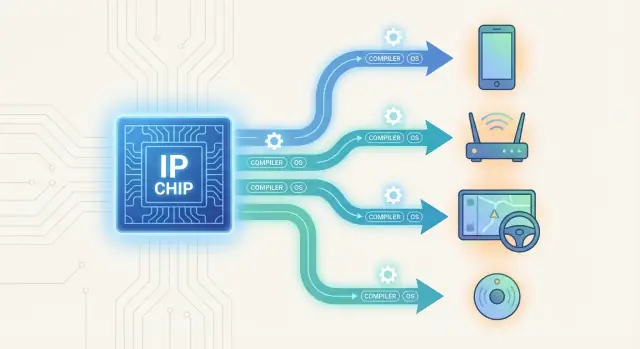
Arm didn’t become influential by shipping boxes of finished chips. Instead, it scaled by selling CPU designs and compatibility—the pieces other companies can build into their own processors, in their own products, on their own manufacturing timelines.
Arm’s core product: CPU IP licensing (plain-English)
“CPU IP licensing” is essentially selling a proven set of blueprints plus the legal right to use them. A partner pays Arm to use a particular CPU design (and related technology), then integrates it into a larger chip that might also include graphics, AI blocks, connectivity, security features, and more.
The division of labor looks like this:
- Arm focuses on CPU architectures and cores, plus the standards, documentation, and support that make them widely usable.
- Partners focus on product-specific choices: performance vs. power, cost targets, extra features, and how the chip fits into a phone, router, car system, or sensor.
Why this matters: ecosystems can beat manufacturing advantages
In semiconductors, “better manufacturing” can be a strong advantage—but it’s often temporary, expensive, and hard to extend across many markets. Compatibility, on the other hand, compounds. When lots of devices share a common foundation (instruction set, tools, operating system support), developers, manufacturers, and customers benefit from predictable behavior and a growing pool of software.
Arm is a clear example of how ecosystem fit—shared standards, toolchains, and a large partner network—can become more valuable than owning factories.
What to expect in the rest of the post
We’ll keep the history high-level, explain what Arm actually licenses, and show how this model spread across mobile and embedded products. Then we’ll break down the economics in plain terms, the trade-offs and risks, and end with practical platform lessons you can apply even outside chips.
For a quick preview of the business mechanics, jump to /blog/the-licensing-economics-plain-english-version.
What Arm Actually Licenses
Arm doesn’t “sell chips” in the usual sense. What it sells is permission—through licenses—to use Arm intellectual property (IP) in chips that other companies design and manufacture.
ISA vs CPU core vs full chip: three different things
It helps to separate three layers that often get mixed up:
- Instruction Set Architecture (ISA): the contract between software and hardware. It defines what instructions the CPU understands (the “language” machine code is written in).
- CPU cores (microarchitecture): a specific implementation of that ISA—how the CPU is built to execute those instructions efficiently.
- Complete chip (SoC): the finished product that includes CPU cores plus many other blocks (GPU, memory controllers, radios, security, I/O, etc.).
Arm’s licensing mostly lives in the first two layers: the rules (ISA) and/or a ready-to-integrate CPU design (core). The licensee builds the full SoC around it.
Common license types (high level)
Most discussions boil down to two broad models:
- Core license: you license an Arm-designed CPU core to integrate into your chip.
- Architecture license: you license the Arm ISA so you can design your own CPU core that still runs Arm-compatible software.
What licensees actually receive (and what they don’t)
Depending on the agreement, licensees typically get RTL (hardware design code), reference configurations, documentation, validation collateral, and engineering support—the ingredients needed to integrate and ship a product.
What Arm typically does not do is manufacture chips. That part is handled by the licensee and their chosen foundry plus packaging/test partners.
Why Licensing Scales Better Than One-Company Chip Making
Chipmaking is expensive, slow, and full of “unknown unknowns.” A licensing model scales because it lets many companies reuse a CPU design that’s already been validated—functionally, electrically, and often in silicon. Reuse reduces risk (fewer surprises late in the schedule) and cuts time to market (less design from scratch, fewer bugs to chase).
Reuse the hard part, focus on what’s unique
A modern CPU core is one of the hardest blocks to get right. When a proven core is available as IP, partners can concentrate effort on differentiation:
- integrating the CPU with their own GPU, modem, NPU, or security block
- tailoring cache sizes, memory controllers, power management, and packaging
- tuning for specific goals: battery life, real-time behavior, cost, or peak performance
This creates parallel innovation: dozens of teams can build distinct products on top of the same foundation, instead of waiting on one company’s roadmap.
Contrast: vertical integration has a single bottleneck
In a vertically integrated approach, one company designs the CPU, designs the SoC, validates it, and ships the final chip (and sometimes the devices too). That can produce great results—but scaling is constrained by one organization’s engineering bandwidth, manufacturing access, and ability to serve many niches at once.
Licensing flips that. Arm focuses on the reusable “core” problems, while partners compete and specialize around it.
The network effect: adoption attracts software (and vice versa)
As more companies ship compatible CPU designs, developers and tool vendors invest more heavily in compilers, debuggers, operating systems, libraries, and optimizations. Better tools make it easier to ship the next device, which increases adoption again—an ecosystem flywheel that a single chipmaker struggles to match alone.
Mobile: How Arm Became the Default Choice
Mobile chips grew up under harsh constraints: tiny devices, no fans, limited surface area to shed heat, and a battery users expect to last all day. That combination forces CPU designers to treat power and thermals as first-class requirements, not afterthoughts. A phone can’t “borrow” extra watts for long without getting hot, throttling performance, and draining the battery.
“Good enough performance per watt” beats peak speed
In that environment, the winning metric isn’t raw benchmark glory—it’s performance per watt. A CPU that is slightly slower on paper but sips power can deliver a better real user experience because it sustains speed without overheating.
That’s a big reason Arm licensing took off in smartphones: Arm’s instruction set architecture (ISA) and core designs aligned with the idea that efficiency is the product.
Competition without breaking compatibility
Arm’s CPU IP licensing also solved a market problem: phone makers wanted variety and competition among chip suppliers, but they couldn’t afford a fragmented software world.
With Arm, multiple chip design partners could build different mobile processors—adding their own GPUs, modems, AI blocks, memory controllers, or power-management techniques—while staying compatible at the CPU level.
That compatibility mattered to everyone: app developers, OS vendors, and tool makers. When the underlying target stays consistent, toolchains, debuggers, profilers, and libraries improve faster—and cost less to support.
Smartphone volume reinforced the standard
Smartphones shipped in massive volumes, which amplified the benefits of standardization. High volume justified deeper optimization for Arm-based chips, encouraged broader software and tools support, and made Arm licensing the “safe default” for mobile.
Over time, that feedback loop helped CPU IP licensing outcompete approaches that relied mostly on a single company’s manufacturing advantage instead of ecosystem compatibility.
Embedded: Same Compatibility, Many Different Products
“Embedded” isn’t one market—it’s a catch‑all for products where the computer is inside something else: home appliances, industrial controllers, networking gear, automotive systems, medical devices, and a huge range of IoT hardware.
What these categories share is less about features and more about constraints: tight power budgets, fixed costs, and systems that have to behave predictably.
Long lifecycles make compatibility unusually valuable
Embedded products often ship for many years, sometimes a decade or more. That means reliability, security patching, and supply continuity matter as much as peak performance.
A CPU foundation that stays compatible across generations reduces churn. Teams can keep the same core software architecture, reuse libraries, and backport fixes without rewriting everything for each new chip.
When a product line must be maintained long after launch, “it still runs the same code” becomes a business advantage.
One CPU foundation simplifies people and process
Using a widely adopted Arm instruction set across many devices makes staffing and operations easier:
- Hiring is simpler because engineers are more likely to have relevant experience.
- Training is faster because tools, debuggers, and performance concepts transfer.
- Maintenance is cheaper because common build systems and test suites can be shared across projects.
This is especially helpful for companies shipping multiple embedded products at once—each team doesn’t need to reinvent a platform from scratch.
Scaling across performance tiers enables product families
Embedded portfolios rarely have a single “best” device. They have tiers: low-cost sensors, midrange controllers, and high-end gateways or automotive compute units.
Arm’s ecosystem lets partners pick cores (or design their own) that fit different power and performance targets while keeping familiar software foundations.
The result is a coherent product family: different price points and capabilities, but compatible development workflows and a smoother upgrade path.
Why Ecosystem Compatibility Can Beat Manufacturing
A great factory can make chips cheaper. A great ecosystem can make products cheaper to build, ship, and maintain.
When many devices share a compatible CPU foundation, the advantage isn’t just performance-per-watt—it’s that apps, operating systems, and developer skills transfer across products. That transferability becomes a business asset: less time rewriting, fewer surprise bugs, and a bigger hiring pool of engineers who already know the tools.
Compatibility = lower “rewrite tax”
Arm’s long-term ISA and ABI stability means software written for one Arm-based device often keeps working—sometimes with only a recompile—on newer chips and different vendors’ silicon.
That stability reduces hidden costs that pile up across generations:
- OS support: Linux distributions, Android builds, and RTOS ports don’t need to start from scratch for every new chip.
- Apps and middleware: common runtimes and frameworks can be reused.
- Developer skills: teams keep the same mental model, debuggers, and build systems.
Even small changes matter. If a company can move from “Chip A” to “Chip B” without rewriting drivers, revalidating the whole codebase, or retraining the team, it can switch suppliers faster and ship on schedule.
Third-party libraries and vendor SDKs compound the advantage
Compatibility isn’t only about the CPU core—it’s about everything that surrounds it.
Because Arm is widely targeted, many third-party components arrive “already done”: crypto libraries, video codecs, ML runtimes, networking stacks, and cloud agent SDKs. Silicon vendors also ship SDKs, BSPs, and reference code designed to feel familiar to developers who’ve worked on other Arm platforms.
Simple examples of portability
- An embedded team moves a sensor-processing app from a low-power microprocessor to a higher-end module to add connectivity—most of the application logic stays the same.
- A mobile app compiled for one Arm-based phone runs across many others because the OS, toolchains, and common libraries already expect Arm.
Manufacturing scale can reduce unit cost. Ecosystem compatibility reduces total cost—engineering time, risk, and time-to-market—often by even more.
Tools and Software Support: The Quiet Growth Engine
Arm licensing isn’t only about getting a CPU core or an instruction set architecture. For most teams, the make-or-break factor is whether they can build, debug, and ship software quickly on day one. That’s where ecosystem tooling depth quietly compounds over time.
What developers actually need
A new chip vendor can have a great microarchitecture, but developers still ask basic questions: Can I compile my code? Can I debug crashes? Can I measure performance? Can I test without hardware?
For Arm-based platforms, the answer is usually “yes” out of the box because the tooling is widely standardized:
- Compilers (GCC, LLVM/Clang, and vendor toolchains) with mature Arm backends
- Debuggers (GDB and IDE integrations) that already understand Arm cores and common debug probes
- Profilers and performance tools to spot bottlenecks and validate power/performance trade-offs
- Simulators and emulators that let teams start software bring-up before final silicon arrives
Standard tooling lowers the barrier for new chip vendors
With CPU IP licensing, many different companies ship Arm-compatible chips. If each required a unique toolchain, every new vendor would feel like a fresh platform port.
Instead, Arm compatibility means developers can often reuse existing build systems, CI pipelines, and debugging workflows. That reduces “platform tax” and makes it easier for a new licensee to win design slots—especially in mobile processors and embedded systems where time-to-market matters.
OS and runtime support accelerates adoption
Tooling works best when the software stack is already there. Arm benefits from broad support across Linux, Android, and a wide range of RTOS options, plus common runtimes and libraries.
For many products, that turns chip bring-up from a research project into a repeatable engineering task.
Tool maturity shortens product cycles
When compilers are stable, debuggers are familiar, and OS ports are proven, licensees iterate faster: earlier prototypes, fewer integration surprises, and quicker releases.
In practice, that speed is a major part of why the Arm licensing model scales—CPU IP is the foundation, but tools and software toolchains make it usable at scale.
How Partners Differentiate on a Shared CPU Foundation
Arm’s model doesn’t mean every chip looks the same. It means partners start from a CPU foundation that already “fits” the existing software world, then compete in how they build everything around it.
The “standard core + unique extras” pattern
Many products use a broadly compatible Arm CPU core (or CPU cluster) as the general-purpose engine, then add specialized blocks that define the product:
- GPU choices for graphics and UI performance (or to hit a specific power budget)
- AI / ML accelerators for on-device inference, camera pipelines, voice, or industrial vision
- Connectivity blocks (5G, Wi‑Fi, Bluetooth, UWB, Ethernet, CAN, Thread) tailored to the device category
- Security and safety features like secure enclaves, hardware roots of trust, and functional-safety mechanisms
The result is a chip that runs familiar operating systems, compilers, and middleware, while still standing out on performance-per-watt, features, or bill of materials.
Differentiation through integration, not just raw CPU specs
Even when two vendors license similar CPU IP, they can diverge through system-on-chip (SoC) integration: memory controllers, cache sizes, power management, camera/ISP blocks, audio DSPs, and the way everything is connected on-die.
These choices affect real-world behavior—battery life, latency, thermals, and cost—often more than a small CPU speed difference.
Why OEMs like vendor choice
For phone makers, appliance brands, and industrial OEMs, a shared Arm software baseline reduces lock-in. They can switch suppliers (or dual-source) while keeping much of the same OS, apps, drivers, and development tools—avoiding a “rewrite the product” scenario when supply, pricing, or performance needs change.
Reference designs and validation shorten schedules
Partners also differentiate by shipping reference designs, validated software stacks, and proven board designs. That reduces risk for OEMs, speeds regulatory and reliability work, and compresses time-to-market—sometimes becoming the deciding factor over a slightly faster benchmark score.
Foundries vs IP: Two Different Kinds of Scale
Arm scales by shipping design blueprints (CPU IP), while foundries scale by shipping physical capacity (wafers). Both enable lots of chips, but they compound value in different ways.
The supply chain, in plain roles
A modern chip typically passes through four distinct players:
- IP provider (Arm): creates reusable CPU designs and the rules for how software talks to them (the instruction set).
- Chip designer (partner): builds a full chip around that CPU (adding graphics, AI blocks, connectivity, security, power features, etc.).
- Foundry: manufactures the chip design on silicon using a chosen process.
- OEM (device maker): buys the finished chips to build phones, appliances, cars, industrial devices, and more.
Arm’s scale is horizontal: one CPU foundation can serve many chip designers, across many product categories.
Process choice without owning a fab
Because Arm doesn’t manufacture, its partners aren’t locked into a single manufacturing strategy. A chip designer can choose a foundry and process that fits the job—balancing cost, power, availability, packaging options, and timing—without needing the IP provider to “retool” a factory.
That separation also encourages experimentation. Partners can target different price points or markets while still building on a shared CPU base.
Flexibility: switching capacity vs switching IP
Foundry scale is constrained by physical build-out and long planning cycles. If demand shifts, adding capacity isn’t instant.
IP scale is different: once a CPU design is available, many partners can implement it and manufacture where it makes sense. Designers may be able to shift production between foundries (depending on design choices and agreements) rather than being tied to a single owned-fab roadmap. That flexibility can help manage supply risk—even when manufacturing conditions change.
The Licensing Economics (Plain-English Version)
Arm mostly makes money in two ways: upfront license fees and ongoing royalties.
1) Upfront license fees (the “ticket to build”)
A company pays Arm for the right to use Arm’s CPU designs (or parts of them) in a chip. This fee helps cover the work Arm already did—designing the CPU core, validating it, documenting it, and making it usable by many different chip teams.
Think of it like paying for a proven engine design before you start building cars.
2) Royalties (the “paid when it ships” part)
Once chips go into real products—phones, routers, sensors, appliances—Arm can receive a small fee per chip (or per device, depending on the agreement). This is where the model scales: if a partner’s product becomes popular, Arm benefits too.
Royalties also align incentives in a practical way:
- Arm is motivated to keep the CPU designs widely adoptable and well-supported.
- Partners are motivated to ship lots of devices because the core technology is validated and familiar.
Why recurring royalties fit an ecosystem model
Royalties reward broad adoption, not just a single big deal. That pushes Arm to invest in the unglamorous things that make adoption easier—compatibility, reference designs, and long-lived support.
Compatibility builds long-term relationships
If customers know that software and tools will keep working across multiple chip generations, they can plan product roadmaps with less risk. That predictability reduces porting costs, shortens testing cycles, and makes it easier to support products for years—especially in embedded systems.
Diagram idea (optional)
A simple flow diagram could show:
Arm → (license) → Chip designer → (chips) → Device maker → (devices sold) → Royalties flow back to Arm
Trade-Offs and Risks of the Ecosystem Model
A licensing-led ecosystem can scale faster than a single company building every chip itself—but it also means giving up some control. When your technology becomes a foundation used by many partners, your success depends on their execution, their product decisions, and how consistently the overall platform behaves in the real world.
Less end-to-end control
Arm doesn’t ship the final phone or the final microcontroller. Partners choose process nodes, cache sizes, memory controllers, security features, and power-management schemes. That freedom is the point—but it can make quality and user experience uneven.
If a device feels slow, overheats, or has poor battery life, users rarely blame a specific “core.” They blame the product. Over time, inconsistent outcomes can dilute the perceived value of the underlying IP.
Fragmentation and compatibility risks
The more partners customize, the more the ecosystem risks drifting into “same-but-different” implementations. Most software portability still holds, but developers can run into edge cases:
- Performance that varies widely across chips that “sound” similar
- Vendor-specific features that create soft lock-in
- Slower rollout of new capabilities if key partners delay adoption
Fragmentation often shows up not at the instruction-set level but in drivers, firmware behavior, and platform features around the CPU.
Competitive pressure never stops
An ecosystem model competes on two fronts: alternative architectures and partners’ in-house designs. If a large customer decides to build its own CPU core, the licensing business can lose volume quickly. Likewise, credible competitors can attract new projects by offering simpler pricing, tighter integration, or a faster path to differentiation.
Governance, trust, and roadmaps
Partners bet years of planning on a stable platform. Clear roadmaps, predictable licensing terms, and consistent compatibility rules are essential. Trust also depends on good stewardship: partners want confidence that the platform owner won’t unexpectedly change direction, restrict access, or undermine their ability to differentiate.
Practical Lessons for Building a Scalable Platform
Arm’s story is a reminder that scale doesn’t always mean “own more factories.” It can mean making it easy for many others to build compatible products that still compete in their own way.
Transferable lessons (product + platform)
First, standardize the layer that creates the most reuse. For Arm, that’s the CPU instruction set and core IP—stable enough to attract software and tools, but evolving in controlled steps.
Second, make adoption cheaper than switching. Clear terms, predictable roadmaps, and strong documentation reduce friction for new partners.
Third, invest early in the “boring” enablers: compilers, debuggers, reference designs, and validation programs. These are the hidden multipliers that turn a technical spec into a usable platform.
Fourth, let partners differentiate above the shared foundation. When the base is compatible, competition moves to integration, power efficiency, security features, packaging, and price—where many companies can win.
A useful software analogy: Koder.ai applies a similar platform lesson to application development. By standardizing the “foundation layer” (a chat-driven workflow backed by LLMs and an agent architecture) while still allowing teams to export source code, deploy/host, use custom domains, and roll back via snapshots, it reduces the platform tax of shipping web/mobile/backend apps—much like Arm reduces the platform tax of building chips on a shared ISA.
Quick checklist: licensing + ecosystem vs vertical integration
Licensing and ecosystem-building is often the better bet when:
- Your technology can become a standard interface others rely on
- The market is fragmented (many devices, many niches) and needs variety
- Time-to-market matters more than owning every step
- Developers and third-party tools are critical to product value
- Partners can add meaningful differentiation without breaking compatibility
Vertical integration is often stronger when you need tight control over supply, yield, or a tightly-coupled hardware/software experience.
Next step
If you’re thinking about platform strategy—APIs, SDKs, partner programs, or pricing models—browse more examples in /blog.
Compatibility is powerful, but it’s not automatic. It has to be earned through consistent decisions, careful versioning, and ongoing support—otherwise the ecosystem fragments and the advantage disappears.
FAQ
Does Arm sell chips or something else?
Arm usually licenses CPU intellectual property (IP)—either the instruction set architecture (ISA), a ready-to-integrate CPU core design, or both. The license gives you legal rights plus technical deliverables (like RTL and documentation) so you can build your own chip around it.
What’s the difference between an ISA, a CPU core, and a full chip (SoC)?
The ISA is the software/hardware contract: the instruction “language” machine code uses. A CPU core is one concrete implementation of that ISA (the microarchitecture). An SoC (system-on-chip) is the full product that includes CPU cores plus GPU, memory controllers, I/O, radios, security blocks, and more.
What’s the difference between a core license and an architecture license?
A core license lets you integrate an Arm-designed CPU core into your SoC. You’re mostly doing integration, verification, and system-level design around a proven CPU block.
An architecture license lets you design your own CPU core that implements the Arm ISA, so it stays Arm-compatible while giving you more control over microarchitecture decisions.
What do licensees actually receive from Arm in a licensing deal?
Common deliverables include:
- RTL / hardware description for the CPU core (when licensing a core)
- Reference configurations and integration guidance
- Documentation and programming/technical manuals
- Validation collateral and test/verification assets
- Engineering support for bring-up and integration
You typically don’t get a manufactured chip—manufacturing is handled by the licensee and their foundry.
Why does licensing scale better than one company building every chip itself?
Because CPU IP is reusable: once a core design is validated, many partners can integrate it in parallel across different products. That reuse lowers risk (fewer late surprises), speeds schedules, and lets each partner focus effort on what’s unique—like power management, cache sizing, or custom accelerators.
How can ecosystem compatibility be more valuable than better manufacturing?
Manufacturing advantages help with unit cost and sometimes performance, but they’re expensive, cyclical, and hard to apply across every niche.
Ecosystem compatibility reduces total product cost (engineering time, porting, tooling, maintenance) because software, skills, and third-party components transfer across devices. Over multiple generations, that “rewrite tax” often dominates.
Why did Arm become so dominant in smartphones?
Mobile devices are power- and thermal-limited: sustained performance matters more than short peak bursts. Arm’s model also enabled competition without software chaos—multiple vendors could ship different chips (GPU/modem/NPU choices, integration strategies) while keeping a compatible CPU/software baseline.
Why is Arm compatibility especially valuable in embedded systems?
Embedded products often have long lifecycles (years) and need stable maintenance, security patching, and supply continuity.
A consistent CPU/software foundation helps teams:
- reuse code and libraries across product generations
- keep the same tooling and workflows
- hire/train more easily because skills transfer
That’s valuable when you’re supporting devices long after launch.
What role do tools and OS support play in Arm’s ecosystem advantage?
Mature tooling reduces the “platform tax.” For Arm targets, teams can usually rely on established compilers (GCC/Clang), debuggers (GDB/IDE integrations), profilers, and OS support (Linux/Android/RTOS). That means faster bring-up, fewer custom toolchain surprises, and quicker iteration even before final silicon arrives.
How does Arm make money from licensing (fees vs royalties)?
Typically with two revenue streams:
- Upfront license fees: pay for the right to use specific IP (the “ticket to build”).
- Royalties: ongoing per-chip (or per-device) payments once products ship.
If you want a focused breakdown, see /blog/the-licensing-economics-plain-english-version.