

Beauty product page template to cut "will it work" anxiety
Use this beauty product page template to explain ingredients, concerns, routines, and disclaimers clearly, reducing tickets and returns.
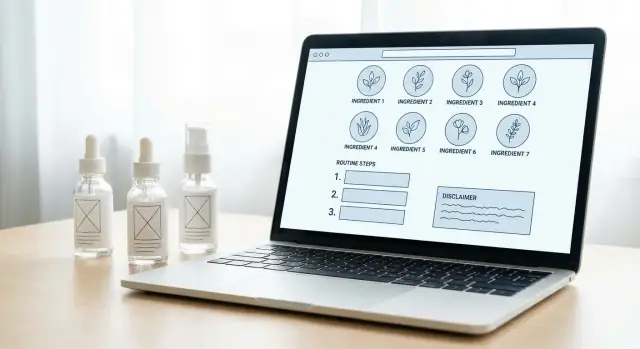
Why shoppers ask "will this work for me?"
Most beauty shoppers are not just buying a product. They are buying a hope: clearer skin, fewer dark spots, calmer redness, a shade that finally matches. The risk feels personal, so the question becomes: “Will this work for me, or will I regret it?”
The worries are usually predictable:
- Irritation or stinging, especially with acids, retinoids, fragrance, or essential oils
- Breakouts or clogged pores, even if the product is labeled “non-comedogenic”
- Wrong shade or undertone (and looking different in real life than in photos)
- Wasted money and time if results take longer than expected
- Bad layering with other products (pilling, dryness, or sensitivity)
When a page is vague, shoppers fill the gaps with worst-case guesses. That shows up as “quick questions” to support (Is this safe for sensitive skin? Can I use this with vitamin C? Is it oily? Does it smell strong?). If they buy anyway, unclear expectations turn into returns: “too drying,” “made me purge,” “not what I thought,” “color is off,” or “smaller than expected.”
A good beauty product page template reduces anxiety by being specific about what the product does, who it tends to suit, and what the experience is like. The goal is not to convince everyone. The goal is to help the right shopper feel confident, and help the wrong shopper self-select out before checkout.
That means guiding, not diagnosing. Avoid medical language, and avoid promises like “clears acne” or “works for all skin types.” Instead, set practical expectations: what you may notice in week 1 versus week 4, common adjustment periods, and the simplest “if this sounds like you, consider something else.”
Example: someone with oily, acne-prone skin sees “hydrating cream” and worries it will feel greasy. If the page clearly says “gel-cream texture, absorbs in 30-60 seconds, dewy not oily, best for dehydrated-oily skin,” you prevent a support ticket and a likely return.
A simple product page structure that reduces uncertainty
A good beauty product page answers one question fast: “Is this a match for my skin, my routine, and my comfort level?” If shoppers can decide in 20 seconds, you’ll see fewer “Will this work?” tickets and fewer returns.
Here’s a simple beauty product page template you can repeat across your catalog. Keep the same headings every time so shoppers learn where to look.
Recommended page order (scan-friendly)
Start with fit, then benefits, then usage, then proof, then the fine print. A clean order looks like this:
- Who it’s for (skin types, concerns, and goals)
- What it does (top 3 benefits, in plain language)
- How to use (AM/PM, frequency, and where it fits in a routine)
- Proof (reviews, testing notes, clinical or consumer results if you have them)
- Disclaimers (safety, patch test, realistic timelines)
- FAQ (the 5 questions support hears most)
Above the fold, include a “fit snapshot” so shoppers don’t hunt. One tight row of micro-facts often does more than a long intro: skin type, main concern, texture/finish, and 1 hero ingredient (with a simple reason it’s there).
Add a short “Before you buy” note
This is where you prevent mismatches without sounding negative. Keep it calm and specific, like:
- “Best if you want hydration without heaviness.”
- “Not ideal if you dislike fragrance or prefer unscented.”
- “If your skin is very reactive, start 2-3 times per week.”
- “Results are usually noticed in 2-4 weeks of consistent use.”
Use the same headings on every product page. Consistency reduces mental effort, makes comparisons easier, and quietly builds trust because shoppers know exactly what they’ll learn next.
Ingredient highlights template (copy you can reuse)
Your ingredient block is where shoppers decide if the product fits them. Keep it plain, specific, and honest. One strong ingredient highlight beats a long list of names.
Use this repeatable mini-template for each “hero” ingredient (2 to 4 max). It works well in a beauty product page template because it answers the same questions people ask support.
Copy template (fill in the brackets)
- Ingredient: [Name]
- What it is (plain words): [“A form of…”, “A plant extract that…”, “A gentle acid that…”]
- Why it is here: Helps with [visible concern] by [simple mechanism in everyday words].
- Best for: [Skin type or concern]
- Not ideal if: [Allergy, very reactive skin, pregnancy guidance if applicable, or “avoid if you’ve reacted to…”]
- What it feels like: [Lightweight, rich, tacky, silky] and [finish: dewy, matte, etc.]
- What it cannot do: [Set a clear limit, no promises]
- When you may notice changes: [Typical range, varies by person]
Write “what it is” like you’re explaining it to a friend. If you must use a technical term, add a 3 to 6 word translation right after it.
Example (ready to paste)
Ingredient: Niacinamide (Vitamin B3)
What it is: A vitamin your skin uses to stay balanced.
Why it is here: Helps with the look of uneven tone and visible pores by supporting the skin barrier.
Not ideal if: You’ve reacted to niacinamide before, or your skin stings easily with new actives (start slow and patch test).
What it cannot do: It will not erase deep acne scars or change your natural pore size.
When you may notice changes: Some people see less oiliness in 1 to 2 weeks; tone can take 4 to 8 weeks.
Keep the tone calm: “may help,” “often,” and “varies” builds trust, and trust reduces returns.
Skin concerns and fit: Best for, Not ideal if, and sensitivity
This is the part of your beauty product page template that answers the silent question: “Am I the right person for this?” Use tight wording, not big promises. The goal is to help the right shopper feel confident, and help the wrong shopper self-select out before checkout.
Best for (clear match)
Write this like a match list, not a marketing list. Include skin type plus 1 to 3 concerns you truly target.
- Skin type: normal to oily, combination
- Concerns: clogged pores, blackheads, uneven texture
- Also helps: post-breakout marks (appearance), shine
- Routine stage: treatment step after cleansing
- Experience level: used to active products
Add one plain sentence under it that narrows further, such as: “Best if you want a smoother feel within 2 to 4 weeks of consistent use.”
Not ideal if (common mismatch cases)
This reduces returns because it stops “hope purchases.” Keep it specific and common.
- Very dry or compromised barrier (flaking, tightness, stinging most days)
- Currently using multiple strong actives (for example, daily retinoid plus exfoliating acids)
- Need a fragrance-free routine and the formula contains fragrance
- Recent procedure or irritation (peels, waxing, sunburn)
- Expect instant results after 1 to 2 uses
Now add a short sensitivity note that feels calm, not scary. Example copy: “Contains exfoliating acids. If you are sensitive, start 2 nights per week and increase slowly. Do a patch test and stop if irritation lasts.”
To make strength easy to understand, label it in tiers and define them in one line each: Gentle = safe for most, low chance of tingling; Moderate = may tingle, introduce slowly; Strong = higher irritation risk, not for beginners or reactive skin.
Call out specific triggers clearly: fragrance, essential oils, retinoids, exfoliating acids, high-vitamin C, or high-niacinamide. Shoppers do not mind actives, they mind surprises.
How to use it: a routine block with step-by-step guidance
A clear routine block is where a beauty product page template earns its keep. Shoppers stop guessing when they see exactly when to use it, how much to apply, and what not to mix.
Routine (copy-and-fill)
When: AM / PM / both (choose one)
Order in routine: Cleanser -> (Toner) -> [Product Name] -> Moisturizer -> SPF (AM)
How much: [pea-size / 2-3 drops / 1 pump] for [face / face and neck]
How often: Start [2-3x/week], then increase to [every other night / daily] if skin stays comfortable.
Use a simple step list so it scans fast:
- Apply to clean, dry skin (wait 1-2 minutes after cleansing if skin is easily irritated).
- Spread a thin, even layer and avoid the eye corners and lips.
- Follow with moisturizer. In the morning, finish with SPF 30+.
- If you miss a day, just continue. Do not double up.
If you are new, start like this: Week 1: [2 nights]. Week 2: [every other night]. Week 3+: [as directed above]. If dryness shows up, drop back a step.
Compatibility (what to pair, alternate, avoid)
Spell this out to prevent irritation and returns.
- Pairs well with: [hydrating serum], [ceramides], [gentle moisturizer].
- Alternate with: [strong exfoliating acids], [retinoids] (use on different nights).
- Avoid stacking the same night: [AHA/BHA + retinoid + this product] (choose one “active” night).
- Makeup friendly? Yes/no. If yes: wait [5-10 minutes] before makeup.
What to expect: A mild tingle for up to [1-2 minutes] can be normal. Burning, swelling, or hives is not. With acne-focused products, some people see a short “purge” (more small breakouts in usual areas) for [2-4 weeks]. If breakouts are painful, widespread, or in new areas, stop and reassess.
Example: Someone with sensitive cheeks can use [Product Name] only on the T-zone at first, every third night, then expand if there’s no stinging or flaking.
Set expectations: texture, scent, shade, and packaging
Small surprises cause big returns. A clear “what it feels like and what you’ll receive” block reduces the mental load and helps shoppers decide fast. In a beauty product page template, this is often the highest-impact section after benefits.
Texture and finish (use everyday words)
Don’t describe texture like a lab report. Use familiar terms, then add the finish and how it behaves during the day.
Use this copy structure:
- Texture: (gel, cream, oil, balm, lotion, serum) + one sensory cue (silky, cushiony, watery, rich)
- Finish: (dewy, natural, matte, glowy) + “after it sets” timing
- Feel on skin: (lightweight, breathable, velvety, tacky for 30 seconds) + who might like it
- Layering note: “Plays well under sunscreen/makeup” or “Best as the last step”
Example: “Texture: lightweight gel-cream that spreads fast. Finish: natural-dewy after 2 minutes. Feel: slightly tacky at first, then smooth. Layering: works under sunscreen once fully absorbed.”
Scent and “fragrance-free” (say what you mean)
State scent plainly, even if it’s subtle. If you use “fragrance-free,” define it in one line, because shoppers interpret it differently.
Example: “Scent: no added fragrance. You may notice a faint ingredient scent for 10-20 seconds.” If it is scented, add the style (citrus, floral, vanilla) and intensity (light/medium/strong).
Shade and packaging (remove the last doubts)
For color products, give undertone guidance and a screen disclaimer: “Swatches vary by lighting and device settings; your result can look different in daylight vs indoor light.” Include one realistic fit note, like: “If you tan easily, consider the warmer shade.”
For packaging, be specific so no one imagines a pump and receives a jar:
- Type: pump, dropper, squeeze tube, jar, airless
- Size: both oz and ml
- Portability: travel-friendly yes/no
- Hygiene note: “Use clean fingers/spatula” or “Twist-lock cap”
Disclaimers that calm shoppers (without sounding scary)
Keep disclaimers separate from your marketing copy. Shoppers get anxious when safety notes are mixed into bold claims. Use two distinct blocks: one for what the product is meant to do, and one for safety and suitability.
Block 1: Results expectations (non-medical) Write this like a friendly heads-up, not a warning label. Avoid guarantees and exact timelines.
Example copy:
- “Most people notice smoother-feeling skin with consistent use. Results vary by skin type and routine.”
- “Designed to support a healthy-looking glow, not to treat medical skin conditions.”
Block 2: Safety and suitability (clear, calm, specific) Use plain language and tell shoppers exactly what to do if something feels off.
Include these essentials:
- Patch test: “Patch test on a small area for 24 hours before first full use.”
- Stop use: “Stop using and rinse with water if you get burning, swelling, or a rash. If symptoms persist, get medical advice.”
- Eye area: “Avoid direct contact with eyes.”
- Layering caution: “If you use strong actives (retinoids, exfoliating acids), introduce slowly and alternate nights.”
If you do not have a verified pregnancy or nursing policy, keep it general. Example: “If you are pregnant, nursing, or under medical care, check with your healthcare professional before introducing new skincare.”
Finally, be precise with claims. Avoid “works for everyone,” “clinically proven” (unless you can back it up), and promises like “clears acne in 7 days.” The more honest your wording is, the fewer returns and support tickets you will see.
FAQ section designed to prevent support tickets
A good FAQ is part of your beauty product page template: it answers the same worries people type into the support form. Use the exact words shoppers use, and keep each answer short.
Will this irritate my skin? If you have sensitive skin, patch test first. Start with 2-3 uses per week, then increase only if your skin stays calm. Stop use if you get swelling, hives, or persistent burning.
I feel stinging. Is that normal? A mild tingle for 30-60 seconds can happen with active ingredients. Strong stinging, heat, or redness that lasts more than 10 minutes is not expected. Rinse, moisturize, and pause use.
Can I layer this with retinol or vitamin C? If you use retinol or a strong vitamin C, avoid using both in the same routine at first. Alternate nights for 1-2 weeks and watch for dryness. If you do layer, put the thinner texture first.
Will this cause breakouts or purging? Some exfoliating or cell-turnover products can cause a short purge that looks like small bumps in usual breakout areas. New deep, painful pimples or breakouts in new areas may be irritation or a mismatch. Reduce frequency or stop and reassess.
How soon will I see results? Comfort and hydration can show up the same day. Tone, texture, or acne changes often take 2-6 weeks with consistent use. Taking before photos helps you notice small changes.
What skin types is this best for? If your skin feels tight, flaky, or reactive, start slow and pair with a simple moisturizer. If you are oily or acne-prone, use light layers and avoid piling on multiple actives.
Is it safe during pregnancy or breastfeeding? If you are pregnant or breastfeeding, check with your clinician before starting new skincare. Avoid products with ingredients your provider has told you to skip.
How do I choose the right shade? Match to your neck or jawline in natural light. If you sit between two shades, choose the one that matches your undertone (cool, neutral, warm) and can be sheered out.
My product arrived damaged or leaking. What should I do? Keep the box and take clear photos of the outer box, inner packaging, and the item. Don’t use a broken container if glass or sharp edges are involved. Contact support with your order details.
Why does the texture or color look slightly different? Natural variation can happen between batches, especially with plant-based ingredients. Temperature during shipping can also change thickness, but it should return to normal after resting at room temp.
If this happens (quick fixes)
| If this happens | Try this first | When to stop and contact support |
|---|---|---|
| Dryness or tightness | Use every other day, add moisturizer after | Cracking, severe flaking, or worsening after 7 days |
| Peeling or pilling | Use less product, wait 60 seconds between layers | Peeling with redness or burning |
| Stinging | Rinse, moisturize, restart 1-2x/week | Strong burning, swelling, or rash |
If they still contact support, ask for: skin type, top 5 products in their routine, how often they used the product, when symptoms started, and photos of irritation or shipping damage (if relevant).
Quick pre-publish checklist (copy and QA)
Before you hit publish, do one fast pass for shopper anxiety: can someone decide in 30 seconds if this fits them, and what to expect if they buy it? This is the moment where a good beauty product page template earns its keep.
Copy clarity check (shopper can self-qualify)
- Fit in plain words: “Best for” includes 2-4 skin types or situations, not vague labels.
- Skip signals are upfront: “Not ideal if” covers common mismatch risks (very dry, very oily, acne-prone, fragrance-sensitive, etc.).
- Starting plan is specific: first week guidance (how often, how much, where in the routine).
- Time expectations are realistic: when people might feel a change, and when to reassess.
- What to expect is concrete: texture feel, finish, scent level, and any normal early reactions.
Now do a second pass for completeness and internal consistency. Most returns and tickets come from missing basics or small contradictions.
QA check (completeness, trust, and return prevention)
- Ingredient highlights match the claims: if you say “barrier support,” the featured ingredients and benefit bullets line up.
- Routine block covers order and conflicts: where it goes (cleanser, serum, moisturizer), and what not to pair on the same night if relevant.
- Units and sizes are consistent everywhere: ml/oz, count, and how long it typically lasts with the suggested usage.
- Warnings are calm and clear: patch test note, external use only, eye area guidance, and who should ask a clinician.
- Shade or finish risks are called out early: undertone guidance, sheerness, oxidation risk, and how it looks in different lighting.
If you use a tool like Koder.ai to generate or update product pages, keep this checklist as a final review step after any change. One edited sentence can quietly break trust if it contradicts another section.
Common product page mistakes that drive returns
Most returns happen because the page created a picture in someone’s head that the product could not match. The fix is rarely more hype. It’s clearer boundaries, plain-language benefits, and simple guidance so people can self-select.
The most common problems (and why they backfire)
Here are the patterns that quietly push shoppers toward disappointment:
- Big promises with exact timelines ("erase dark spots in 7 days") set a hard deadline. If their skin moves slower, they assume the product failed.
- “Not ideal if” notes buried in fine print or far below the fold mean the wrong people buy it, then feel misled.
- Ingredient buzzwords without a job description ("powered by peptides") sounds fancy but doesn’t answer “what will it help me notice?”
- No beginner guidance for strong actives. People overuse, get irritation, and blame the product instead of the routine.
- Medical-sounding claims (treats eczema, heals acne, anti-inflammatory) can confuse shoppers and raise trust issues when results vary.
A simple beauty product page template prevents most of this by forcing you to write the “fit” and “how to use” blocks as clearly as the benefits.
A quick example of how this shows up
Someone buys a retinol serum after reading “visible results in one week,” but the page never says to start 2-3 nights a week or what mild dryness can look like. They use it nightly, get flaking, and return it as “too harsh.”
If the page had: (1) a realistic timeline (“4-8 weeks for tone, sooner for texture”), (2) a “not ideal if your barrier is compromised” note, and (3) a simple ramp-up plan, they would either buy a gentler option or use it correctly.
The goal is not to scare people. It’s to help the right customers feel confident, and help everyone else choose a better match before checkout.
Example scenario and next steps for rolling this out
A shopper has sensitive, acne-prone skin and is choosing between two serums: Serum A (2% salicylic acid + niacinamide) and Serum B (azelaic acid + centella). Their anxiety is simple: “Will this break me out, sting, or do nothing?”
Using your beauty product page template, you answer their questions in the order they think.
First, the “Best for / Not ideal if / Sensitivity notes” block makes the fit obvious. Serum A can say it targets clogged pores and oily breakouts, but flags that daily use may be too much for easily irritated skin. Serum B can say it supports redness and post-breakout marks, and notes it is often better tolerated, but results can be slower.
Next, the ingredient highlights explain what each ingredient does in plain language and what to expect. “Niacinamide: helps with oil and the look of pores over time.” “Salicylic acid: clears inside pores, may cause a brief purge.” That one sentence often prevents a return.
Then the routine block tells them how to use it without guesswork: where it fits, how often to start, and what not to pair on the same night. Finally, the expectations block sets texture, scent, and timeline (“2-4 weeks for fewer active breakouts, 6-8 weeks for marks”). Disclaimers calm them by giving control: patch test steps, what mild tingling feels like, and when to stop.
Here’s a reusable “choose between” snippet you can drop onto similar product pairs:
Choose between these two
- Pick Serum A if: you get frequent clogged pores and tolerate actives well.
- Pick Serum B if: you break out easily AND get redness or stinging from strong acids.
If you're unsure: start with the gentler option 3x/week, then increase.
Next steps to roll this out without risk:
- Standardize the blocks (fit, ingredients, routine, expectations, disclaimers) and lock the wording rules.
- Update 10-20 high-return SKUs first, not the whole catalog.
- QA for clarity (especially “not ideal if” and timeline), then publish.
- Measure returns, support tickets, and conversion for 2-4 weeks.
- Expand in batches, keeping notes on which phrases reduce confusion.
Optional build path: if your storefront is in React, you can use Koder.ai to draft page variants from a chat prompt, generate the storefront sections, and ship updates with snapshots and rollback if results dip.
FAQ
What should a beauty product page say first?
Use a fit snapshot near the top: skin type, main concern, texture, finish, and one main ingredient. Shoppers should quickly see whether the product matches their routine before they read the full page.
How do I explain who a product is for?
Name the skin types and concerns the formula suits, then add a plain “not ideal if” note for common mismatches. Specific limits help shoppers choose with fewer surprises.
What belongs in an ingredient highlight?
State the ingredient name, what it is in everyday language, why it is in the formula, who may like it, and what it cannot do. Keep the focus on visible, realistic expectations.
How detailed should product usage instructions be?
Tell shoppers when to apply it, how much to use, how often to start, and where it sits between cleanser, moisturizer, and SPF. For stronger formulas, include a gradual first-week schedule.
Should I explain what customers can layer with the product?
List products or ingredient types that pair well, then say which strong actives shoppers should use on alternate nights. This helps people avoid dryness, pilling, and unnecessary irritation.
How can I prevent texture-related returns?
Describe the texture, finish, absorption time, and any temporary tackiness or richness. Say whether it layers well under sunscreen or makeup so shoppers know what daily use feels like.
Do I need to mention scent if it is very light?
Say whether the product has no added fragrance or describe the scent and its strength. A subtle ingredient smell can still matter to someone who avoids scented skincare.
How soon should customers expect skincare results?
Give a realistic range based on the concern. Hydration may feel noticeable quickly, while texture or uneven tone often takes several weeks of consistent use.
What safety guidance should every skincare page include?
Ask shoppers to patch test before full use, start slowly if they have sensitive skin, and stop if burning, swelling, hives, or a lasting rash occurs. Keep safety language separate from benefit claims.
How should I explain purging versus a bad reaction?
Explain that small bumps in usual breakout areas may occur for some people using exfoliating products, but painful breakouts, widespread irritation, or new-area breakouts call for stopping and reassessing the product.