

The Best Framework Is the One That Fits Your Constraints
A practical guide to choosing frameworks based on your real constraints—team skills, deadlines, budget, compliance, and maintainability—so you ship reliably.
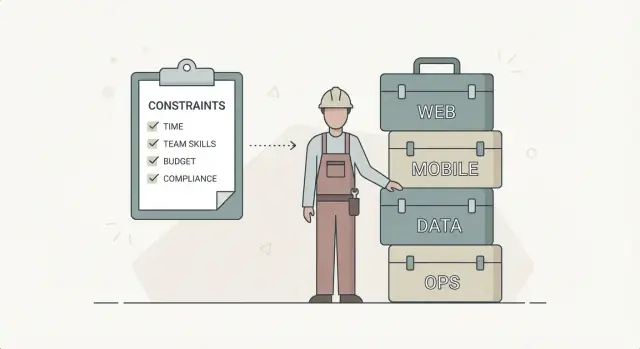
Start With a Clear Definition of “Best”
“Best framework” is meaningless until you say: best for what, for whom, and under which constraints. The internet’s “best” often assumes a different team size, budget, risk tolerance, or product stage than yours.
Define “best” for your product (not the internet)
Start by writing a one-sentence definition that ties directly to your goals. Examples:
- “Best means we can ship the MVP in 8 weeks with our current team and keep iteration speed high.”
- “Best means predictable performance under peak traffic with minimal operational burden.”
- “Best means compliance-ready and auditable, even if development is slower.”
These definitions will pull you toward different options—and that’s the point.
Why “best” changes by context
A framework can be ideal for a company with dedicated DevOps, but a poor fit for a small team that needs managed hosting and simple deployment. A framework with a large ecosystem can reduce build time, while a newer one might require more custom work (and more risk). “Best” shifts with timeline, staffing, and the cost of getting it wrong.
Set expectations: this is a decision framework, not a ranking
This article won’t crown a universal winner. Instead, you’ll use a repeatable way to make a defensible tech stack decision—one you can explain to stakeholders and revisit later.
What counts as a “framework” here
We’re using “framework” broadly: UI frameworks (web), backend frameworks, mobile frameworks, and even data/ML frameworks—anything that sets conventions, structure, and trade-offs for how you build and operate a product.
List Your Non-Negotiable Outcomes
Before you compare frameworks, decide what you must get out of the choice. “Best” only makes sense when you know what you’re optimizing for—and what you’re willing to trade.
Separate goals by audience
Start by listing outcomes in three buckets:
- User-facing goals: speed, usability, reliability, accessibility.
- Business goals: revenue impact, cost, time-to-market, ability to pivot.
- Engineering goals: maintainability, testability, observability, developer productivity.
This keeps the conversation grounded. A framework that delights engineers but slows releases may fail your business goals. A framework that ships fast but is painful to operate may hurt reliability and on-call load.
Turn “preferences” into measurable outcomes
Write 3–5 outcomes that are specific enough to evaluate options against. Examples:
- Time-to-market: “Ship the first version in 8 weeks with a team of 3.”
- Performance: “Core pages load in <2.5s on mid-range mobile on 4G.”
- Reliability: “Support 99.9% uptime with clear rollback and monitoring.”
- Accessibility: “Meet WCAG 2.1 AA for all public flows.”
- Maintainability: “New engineers can ship changes within their first 2 weeks; 80%+ unit test coverage for core logic.”
Make them truly non-negotiable
If everything is a “must,” nothing is. For each outcome, ask: Would we still consider a framework that misses this? If the answer is yes, it’s a preference—not a constraint.
These outcomes become your decision filter, scoring rubric, and the baseline for a proof of concept later.
Map the Constraints That Actually Limit You
Many “framework debates” are really constraint debates in disguise. Once you write your constraints down, a lot of options eliminate themselves—and the discussion gets calmer, faster.
Time constraints
Start with your calendar, not your preferences. Do you have a fixed release date? How often do you need to ship updates? What support window are you committing to (for customers, internal teams, or contracts)?
A framework that’s ideal for long-term elegance can still be the wrong choice if your iteration cadence demands quick onboarding, abundant examples, and predictable delivery. Time constraints also include how quickly you can debug and recover from issues—if a framework is harder to troubleshoot, it effectively slows every release.
People constraints
Be honest about who will build and maintain the product. Team size and experience matter more than “what’s popular.” A small team often benefits from conventions and strong defaults; a large team may handle more abstraction and customization.
Also factor in hiring reality. If you’ll need to add developers later, choosing a framework with a deep talent pool can be a strategic advantage. If your current team already has strong expertise in one ecosystem, switching frameworks has a real cost in ramp-up time and mistakes.
Money constraints
Costs aren’t just licenses. Hosting, managed services, monitoring, CI/CD minutes, and third-party integrations add up.
The biggest hidden expense is opportunity cost: every week spent learning a new framework, fighting tooling, or rewriting patterns is a week not spent improving product requirements or customer value. A “free” framework can still be expensive if it drives slower delivery or more production incidents.
If you’re weighing buy vs. build, include acceleration tools in the cost model. For example, a vibe-coding platform like Koder.ai can reduce the “first version” cost (web, backend, or mobile) by generating a working baseline from chat—useful when your biggest constraint is calendar time rather than long-term framework purity.
Process constraints
Some constraints come from how your organization operates: approvals, security reviews, procurement, and stakeholder expectations.
If your process requires formal security sign-off, you may need mature documentation, well-understood deployment models, and clear patching practices. If stakeholders expect demos every two weeks, you need a framework that supports steady progress with minimal ceremony. These process constraints can be the deciding factor, even when multiple options look similar on paper.
Match the Framework to the Product Lifecycle
A framework choice is easier when you stop treating it as permanent. Different phases of a product reward different trade-offs, so align your pick to how long this thing must live, how fast it will change, and how you expect to evolve it.
MVP: Optimize for learning speed
For a short-lived MVP, prioritize time to market and developer throughput over long-term elegance. A framework with strong conventions, great scaffolding, and lots of ready-made components can help you ship and learn quickly.
The key question: if you throw this away in 3–6 months, will you regret spending extra weeks on a “future-proof” setup?
Multi-year platform: Optimize for change and stewardship
If you’re building a platform you’ll run for years, maintenance is the main cost. Choose a framework that supports clear boundaries (modules, packages, or services), predictable upgrade paths, and a boring, well-documented way of doing common tasks.
Be honest about staffing: maintaining a large system with two engineers is different from maintaining it with a dedicated team. The more you expect turnover, the more you should value readability, conventions, and a large hiring pool.
Expected change rate: Stable vs pivot-heavy
Stable requirements favor frameworks that optimize correctness and consistency. Frequent pivots favor frameworks that allow quick refactors, simple composition, and low ceremony. If you expect weekly product changes, pick tooling that makes renaming, moving, and deleting code painless.
Plan an exit strategy
Decide upfront how this ends:
- Rewrite: acceptable for an MVP—document the boundaries so you can replace it cleanly.
- Modular replacement: design seams where you can swap parts without a full restart.
- Long-term evolution: choose a framework with a strong release cadence and migration guides.
Write this down now—your future self will thank you when priorities shift.
Understand the Cost of Complexity
Choosing a framework isn’t just picking features—it’s accepting an ongoing complexity bill. A “powerful” stack can be the right move, but only if your team can afford the extra moving parts it introduces.
When a simple stack beats an advanced one
If your product needs to ship quickly, stay stable, and be easy to staff, a simpler framework often wins. The fastest teams aren’t always using the fanciest tools; they’re using tools that minimize surprises, reduce decision overhead, and let developers focus on product work instead of infrastructure work.
Total complexity is more than code
Framework complexity shows up across the whole workflow:
- Tooling: extra CLIs, generators, plugins, and configuration formats
- Build steps: longer pipelines, more caching, more “it works on my machine” issues
- Deployment: special runtime requirements, edge cases in hosting, version pinning
- Debugging: deeper abstraction layers, less obvious stack traces, harder reproduction
A framework that saves you 20% of code can cost you 2× in debugging time if failures become harder to reason about.
Hidden costs: onboarding, CI/CD, upgrades
Complexity compounds over time. New hires need longer ramp-up and more senior support. CI/CD setups get stricter and more fragile. Upgrades can become mini-projects—especially if the ecosystem moves quickly and introduces breaking changes.
Ask practical questions: How often does the framework ship major releases? How painful are migrations? Do you rely on third-party libraries that lag behind? Are there stable patterns for testing and deployment?
Prefer boring solutions when predictability matters
If your constraints prioritize reliability, hiring ease, and steady iteration, favor “boring” frameworks with mature tooling and conservative release practices. Predictability is a feature—one that directly protects time to market and long-term maintenance.
Evaluate Team Skills and Hiring Constraints
A framework can be “perfect” on paper and still be a bad choice if your team can’t build and run it confidently. The fastest way to miss deadlines is to bet on a stack that only one person truly understands.
Start with what your team can ship
Look at current strengths and gaps honestly. If your delivery depends on a single expert (“the hero”), you’re accepting a hidden risk: vacation, burnout, or a job change becomes a production incident.
Write down:
- What the team already uses in production (and can debug under pressure)
- What’s familiar but unproven at scale
- What nobody has used beyond tutorials
Hiring reality is part of the architecture
Framework selection is also a talent-market decision. Check hiring availability in your region (or remote time zones you can support), typical salary bands, and how long similar roles take to fill. A niche framework may raise compensation, extend time-to-hire, or force you into contractors—fine if intentional, painful if accidental.
Learning curve vs deadline
People can learn quickly, but not everything is safe to learn while shipping critical features. Ask: what can we learn within the project timeline without putting delivery at risk? Prefer tools with strong documentation, mature community support, and enough internal mentors to spread knowledge.
Use a simple skills matrix
Create a lightweight skills matrix (team members × required skills: framework, testing, deployment, observability). Then choose the lowest-risk path: the option that minimizes “single points of expertise” and maximizes your ability to hire, onboard, and maintain momentum.
Performance and Scaling: Right-Sizing the Choice
Performance is rarely a single number. “Fast enough” depends on what users do, where they are, and what “slow” costs you (abandoned carts, support tickets, churn). Before comparing frameworks, write down the targets that actually matter.
Set concrete performance targets
Define a small set of measurable goals such as:
- Load time: e.g., first meaningful render under 2 seconds on mid-range mobile
- Latency: e.g., API responses under 150 ms at the 95th percentile
- Throughput: e.g., X requests per second during normal operation and peak
These numbers become your baseline. Also define a ceiling (the most you realistically need within the next 12–18 months). That helps you avoid choosing an overly complex framework “just in case.”
Estimate scale based on real patterns
Scale isn’t only “how many users.” It’s also:
- Data volume and growth rate
- Peak traffic patterns (launch days, end-of-month billing runs, seasonal spikes)
- Background workloads (imports, reports, notifications)
A framework that shines in steady traffic may struggle with bursty peaks unless you design for it.
Operational constraints matter as much as raw speed
Ask what your team can reliably run:
- Hosting model (serverless, containers, managed platforms)
- Monitoring and alerting maturity
- On-call and incident response expectations
A slightly slower framework that is easier to observe and operate can outperform a “faster” one in real life because downtime and firefighting are the true performance killers.
When you do evaluate candidates, benchmark the critical path you care about—not synthetic demos—and prefer the simplest option that meets the baseline with room to grow.
Security, Compliance, and Risk Management
Security isn’t a feature you “add later.” Your framework choice can either reduce risk through safe defaults—or create ongoing exposure through weak tooling, slow patches, and hard-to-audit behavior.
Start with your real security needs
Be specific about what must be protected and how. Common requirements include authentication and authorization (roles, permissions, SSO), data protection (encryption in transit and at rest), and dependency hygiene (knowing what third-party code you ship).
A practical test: can you implement least-privilege access without inventing your own patterns? If the “standard way” in the framework is unclear or inconsistent, you’ll end up with security differences across teams and services.
Compliance isn’t just paperwork
If SOC 2, HIPAA, or GDPR applies, the framework must support the controls you’ll be audited against: access logging, change tracking, incident response, data retention, and deletion workflows.
Also consider data boundaries. Frameworks that encourage clear separation of concerns (API vs. data layer, background jobs, secrets management) usually make it easier to document and prove controls.
Ecosystem maturity: patches, CVEs, and support
Look at patch cadence and the community’s track record with CVEs. Is there an active security team? Are release notes clear? Do major dependencies get updated quickly, or do you routinely get stuck on old versions?
If you already use security scanning (SCA, SAST), confirm the framework and its package ecosystem integrate cleanly with your tools.
Secure defaults and auditability
Prefer frameworks that default to secure headers, CSRF protection where relevant, safe cookie settings, and clear input validation patterns. Equally important: can you audit configuration and runtime behavior consistently across environments?
If you can’t explain how you’ll secure, monitor, and patch the app for the next two years, it’s not the right “best” framework—no matter how popular it is.
Maintainability and Operability Over Time
A framework choice is rarely “forever,” but it will shape your day-to-day work for years. Maintainability isn’t just about clean code—it’s about how predictable changes are, how easy it is to verify behavior, and how quickly you can diagnose issues in production.
Upgrade paths you can live with
Look at the project’s version cadence and how often breaking changes appear. Frequent releases can be good, but only if upgrades are manageable. Check for:
- Clear migration guides and automated codemods
- Backward-compatibility policies (or at least honest deprecation timelines)
- Dependency churn (how often core plugins break when the framework bumps)
If the “normal” upgrade requires a multi-week rewrite, you’re effectively locking in an old version—along with its bugs and security risks.
Testing support that matches reality
Maintainable systems have high-confidence tests that are practical to run.
Prioritize frameworks with strong first-class support for unit, integration, and end-to-end testing, plus sane mocking patterns. Also consider how well common tools fit: local test runners, CI pipelines, snapshot testing (if relevant), and test data management.
Operability: can you debug production quickly?
A framework should make observability easy, not an afterthought. Confirm you can add:
- Structured logs with request correlation
- Metrics and dashboards for key user flows
- Tracing to pinpoint slow dependencies
- Error reporting with readable stack traces and source maps
Long-term developer experience
Great docs and stable community patterns reduce “tribal knowledge.” Favor frameworks with strong tooling (linters, formatters, type support), consistent conventions, and active maintainers. Over time, this lowers onboarding costs and keeps delivery predictable.
Ecosystem Fit and Integration Requirements
A framework isn’t chosen in a vacuum—it has to live inside your company’s existing tools, vendors, and data flows. If the framework makes common integrations awkward, you’ll pay that cost every sprint.
Start from the integration map
List your real integration points early: payments, analytics, CRM, and the data warehouse. For each, note whether you need an official SDK, a community library, or a thin HTTP client is enough.
For example, payment providers often require specific signing flows, webhook verification, and idempotency patterns. If your framework fights those conventions, your “simple integration” becomes a permanent maintenance project.
Respect API style constraints
Your framework should fit the API style you’ve committed to:
- REST: routing, validation, pagination patterns, and OpenAPI tooling matter.
- GraphQL: schema-first support, batching, caching, and auth directives become central.
- Event-driven: background workers, retries, dead-letter queues, and observability are non-negotiable.
If you already run a message bus or rely on webhooks heavily, prioritize frameworks with mature job/worker ecosystems and clear failure-handling conventions.
Don’t ignore platform constraints
Web, mobile, desktop, and embedded environments impose different requirements. A framework that’s perfect for a server-rendered web app may be a poor fit for a mobile-first product that needs offline support, background sync, and strict bundle-size limits.
Check maturity and vendor neutrality
Look beyond star counts. Check release cadence, compatibility guarantees, and the number of maintainers. Favor libraries that don’t lock you into a single vendor unless that’s a deliberate trade-off.
If you’re unsure, add an “integration confidence” line item to your shortlist scoring and link the assumptions in your decision doc (see /blog/avoid-common-pitfalls-and-document-the-decision).
Create a Shortlist and Score It Transparently
Once you’ve defined outcomes and constraints, stop debating “the best” framework in the abstract. Build a shortlist of 2–4 options that look viable on paper. If a framework clearly fails a hard constraint (e.g., required hosting model, licensing, or a critical integration), don’t keep it around “just in case.”
Build a tight shortlist
A good shortlist is diverse enough to compare trade-offs, but small enough to evaluate honestly. For each candidate, write one sentence on why it might win and one sentence on why it might fail. This keeps the evaluation grounded in reality, not hype.
Score against non-negotiables and risks
Use a simple weighted decision matrix so your reasoning is visible. Keep the criteria tied to what you already agreed matters: time to market, team skills, performance needs, security requirements, ecosystem compatibility, and long-term maintenance.
Example (scores 1–5, higher is better):
| Criteria | Weight | Framework A | Framework B | Framework C |
|---|---|---|---|---|
| Time to market | 5 | 4 | 3 | 5 |
| Team familiarity | 4 | 5 | 2 | 3 |
| Integration fit | 3 | 3 | 5 | 4 |
| Operability/maintenance | 4 | 3 | 4 | 3 |
| Risk (vendor/community) | 2 | 4 | 3 | 2 |
Compute Weighted Score = Weight × Score and sum per framework. The point isn’t math “truth”—it’s a disciplined way to expose disagreements (e.g., someone thinks integration fit is a 5, someone else thinks it’s a 2).
Document assumptions so it stays explainable
Next to the matrix, capture key assumptions (traffic expectations, deployment constraints, hiring plan, must-have integrations). When priorities shift later, you can update the inputs and re-score instead of re-litigating the entire decision.
Validate With a Time-Boxed Proof of Concept
A framework decision shouldn’t be a belief system. Before you commit, run a small, strict proof of concept (PoC) that reduces the biggest unknowns—fast.
Set a hard time box (2–5 days)
Keep it short enough that you don’t “fall in love” with the prototype, but long enough to hit real integration points. Define what must be learned by the end of the spike (not what must be built).
If your biggest risk is speed rather than deep technical unknowns, consider parallelizing: one engineer spikes the framework, while another uses a rapid builder (for example, Koder.ai) to generate a functional baseline app from chat. Comparing both outputs against the same constraints can clarify whether you should build traditionally, accelerate, or mix approaches.
Prototype the riskiest requirement
Don’t build the easiest demo page. Build the thing most likely to break your plan, such as:
- Auth + role-based access with your real identity provider
- A critical page flow with server rendering, caching, and data fetching
- A key integration (payments, CRM, analytics) that drives your business logic
If the framework can’t handle the risky part cleanly, the rest doesn’t matter.
Measure what will hurt later
Capture concrete signals while the work is fresh:
- Build time (local and CI)
- Bundle size and its impact on page load
- API latency (end-to-end, not just function speed)
- DX friction: setup time, debugging clarity, test ergonomics, quality of docs
Write down numbers, not impressions.
Decide: commit, switch, or narrow scope
End the PoC with a decision memo: what worked, what failed, and what you’d change. The result should be one of three outcomes: commit to the framework, switch to a better candidate, or narrow the product scope to fit constraints.
If a paid tool or tier affects feasibility, confirm costs early (see /pricing). For example, Koder.ai offers Free, Pro, Business, and Enterprise tiers, which can change the economics of rapid prototyping versus staffing up.
Avoid Common Pitfalls and Document the Decision
Good framework choices fail more often from process than from technology. The fix is simple: make the trade-offs explicit, and record why you chose what you chose.
Common traps to avoid
- Chasing trends: “Everyone’s using it” isn’t a requirement. If the new tool doesn’t remove a real constraint (time, hiring, integration, reliability), it’s a distraction.
- Overfitting to one engineer’s preference: A framework that only one person can use confidently is a delivery risk, not a speed boost.
- Ignoring exit costs: Migration effort, retraining, new operational tooling, and rewrites of integration points are part of the price.
- Letting edge cases drive the whole choice: Optimize for the 80% path, then address the remaining 20% with targeted patterns.
When you should switch frameworks (and when you shouldn’t)
Switch when the current framework blocks critical outcomes: missing security/compliance capabilities, persistent reliability issues you can’t mitigate, inability to hire/retain skills, or platform constraints that force ongoing workarounds.
Don’t switch just because performance “might” be better elsewhere, the UI feels dated, or you want to modernize for its own sake. If you can meet product requirements with incremental upgrades, switching usually adds risk without clear payoff.
Capture the decision with an ADR
Use a lightweight Architecture Decision Record so future teams understand the “why”:
# ADR: Framework Selection for <Product>

## Status
Proposed | Accepted | Superseded

## Context
What problem are we solving? What constraints matter (timeline, team skills, integrations, compliance)?

## Decision
We will use <Framework> for <Scope>.

## Options Considered
- Option A: <...>
- Option B: <...>

## Rationale
Top reasons, with evidence (benchmarks, PoC notes, team feedback).

## Consequences
What gets easier/harder? Risks and mitigations. Migration/rollback plan.

## Review Date
When we will revisit this decision.
Reusable checklist
Before finalizing, confirm: requirements met, constraints acknowledged, team can support it, integration needs covered, security reviewed, exit path documented, and the ADR approved by engineering + product stakeholders.
FAQ
What does “best framework” actually mean in practice?
It’s “best” only relative to your goals, team, and constraints. Start by writing a one-sentence definition (e.g., ship an MVP in 8 weeks, meet compliance requirements, or minimize operational burden) and evaluate frameworks against that definition rather than popularity.
How do I separate user, business, and engineering goals when choosing a framework?
Use three buckets:
- User-facing: speed, reliability, accessibility.
- Business: time-to-market, cost, ability to pivot.
- Engineering: maintainability, testability, observability, developer productivity.
This prevents optimizing for one group (e.g., engineering) while accidentally hurting another (e.g., release cadence).
How do I turn “preferences” into true non-negotiable outcomes?
Turn vague preferences into measurable targets you can verify. For example:
- Ship v1 in 8 weeks with a team of 3.
- Core pages load in <2.5s on mid-range mobile.
- Support 99.9% uptime with rollback + monitoring.
If you’d still consider a framework that misses a target, it’s a preference—not a non-negotiable.
Which constraints eliminate frameworks fastest?
Document constraints explicitly before comparing options:
- Time: fixed launch date, release cadence, recovery/debug speed.
- People: team size, existing expertise, on-call capability, hiring realities.
- Money: hosting, managed services, CI/CD, monitoring, opportunity cost.
- Process: security reviews, procurement, stakeholder demo expectations.
Many “framework debates” resolve quickly once these are written down.
Should I pick a different framework for an MVP versus a long-term product?
Yes. Different phases reward different trade-offs:
- MVP: optimize for learning speed and time-to-market.
- Multi-year platform: prioritize maintainability, upgrades, and clear boundaries.
- Pivot-heavy products: choose low-ceremony tooling that supports frequent refactors.
Also decide an exit strategy early (rewrite, modular replacement, or long-term evolution).
What are the hidden costs of choosing a “powerful” or complex framework?
Complexity shows up beyond code:
- Tooling and configuration sprawl
- Longer, more fragile builds and CI
- Deployment edge cases and runtime requirements
- Harder debugging due to deeper abstraction layers
A framework that saves code can still cost more if it increases incident time, onboarding time, or upgrade pain.
How should team skills and hiring influence the framework choice?
Pick the lowest-risk option your team can ship and operate confidently. Watch for “hero risk” (only one expert). A simple approach is a skills matrix (team members × needed skills like framework, testing, deployment, observability) and choosing the option that minimizes single points of failure and maximizes hiring/onboarding viability.
How do I evaluate performance and scaling without over-engineering?
Define targets and a realistic ceiling for the next 12–18 months, such as:
- Load time (e.g., first meaningful render <2s on mid-range mobile)
- API latency (e.g., p95 <150ms)
- Throughput under normal and peak traffic
Then benchmark the critical path you care about, and include operability (monitoring, alerting, incident response) in the evaluation.
What should I look for in security and compliance support?
Start from concrete requirements (authn/authz, encryption, dependency hygiene, audit needs). Prefer frameworks with:
- Secure defaults (headers, CSRF where relevant, safe cookies)
- Clear, standard patterns for least-privilege authorization
- Mature patch cadence and transparent CVE handling
- Easy integration with your scanning tools (SCA/SAST)
If you can’t explain how you’ll patch, monitor, and audit for the next two years, it’s not a good fit.
What’s a practical process for making and documenting the final decision?
Use a transparent shortlist + PoC workflow:
- Shortlist 2–4 viable options.
- Score them with a weighted matrix against agreed non-negotiables.
- Run a time-boxed PoC (2–5 days) focused on the riskiest requirement.
- Write an ADR capturing assumptions, rationale, risks, and a review date.
Keep links to internal references relative (e.g., /blog/avoid-common-pitfalls-and-document-the-decision, /pricing).