

Why the Best Language Is the One Your Team Ships Fast
Choosing a programming language is rarely about “best on paper.” Learn a practical framework to pick what your team can deliver with quickly and safely.
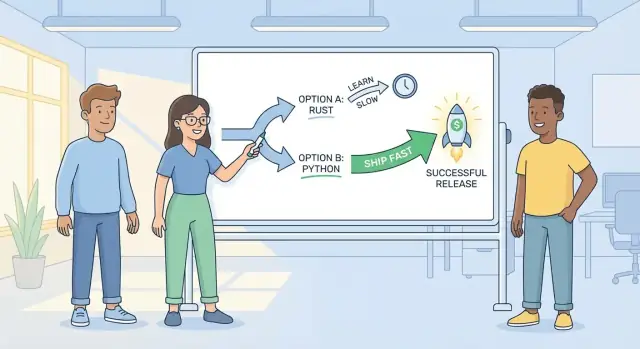
Why “Best” Often Means “Fast to Deliver”
“Best language” debates usually stall because they’re framed like a universal ranking: which language is fastest, cleanest, most modern, or most loved. But teams don’t ship in a vacuum. They ship with specific people, specific deadlines, and a pile of existing systems that must keep working.
When your goal is to deliver customer value, “best” usually collapses into a more practical question: which option helps this team deliver safely and repeatedly with the least friction? A language that’s theoretically superior but slows delivery by weeks—because of unfamiliar tooling, missing libraries, or scarce hiring—won’t feel “best” for very long.
Constraints Decide More Than Opinions
Constraints aren’t a compromise; they’re the real problem statement. Your team’s experience, current codebase, deployment setup, compliance needs, and integration points all shape what will ship fastest.
A few examples:
- If most developers already know the language, code reviews are quicker and bugs are caught earlier.
- If your systems already run on a certain platform (e.g., JVM, .NET, Node), switching may add extra infrastructure and operational work.
- If your deadline is fixed, the safest choice is often the one with predictable delivery—not the one with the most exciting features.
“Ship Fast” Means Speed and Confidence
Shipping fast isn’t just writing code quickly. It’s the full cycle: picking up work, implementing it, testing it, deploying it, and monitoring it without anxiety.
A language supports “ship fast” when it improves cycle time and keeps quality stable—fewer regressions, simpler debugging, and reliable releases. The best language is the one that helps your team move quickly today while staying confident they can do it again next week.
Start With Your Team’s Reality
Choosing a language isn’t an abstract “best tool” debate—it’s a bet on the people who will build, operate, and extend the product. Before comparing benchmarks or trendy stacks, take a clear-eyed snapshot of your team as it actually exists (not as you hope it will look in six months).
Map strengths, gaps, and constraints
Start by listing what your team is already good at and where you routinely struggle.
- Current strengths and gaps: Who’s comfortable designing APIs, debugging production issues, writing tests, and reviewing code in the candidate languages? Where do you see repeated slowdowns—type errors, async complexity, build tooling, unclear idioms, or lack of observability?
- Part-time contributors: If you rely on data scientists, contractors, designers who occasionally code, or “helpful” execs who commit once a quarter, favor a language and conventions that stay readable after weeks away. Consistency beats cleverness.
- Turnover risk: Assume someone will leave mid-project. Can a new hire become productive in weeks, not quarters? Are there enough experienced reviewers to keep quality high, or will you end up with one gatekeeper and a queue?
Don’t ignore the work after shipping
Shipping “fast” includes keeping things running.
If your team carries an on-call rotation, factor that into the language choice. A stack that requires deep expertise to diagnose memory issues, concurrency bugs, or dependency conflicts can quietly tax the same few people every week.
Also include support responsibilities: customer-reported bugs, compliance requests, migrations, and internal tooling. If the language makes it hard to write reliable tests, build small scripts, or add telemetry, the speed you gain early often gets repaid with interest later.
A practical rule: pick the option that makes your median engineer effective, not just your strongest engineer impressive.
Define “Ship Fast” With Clear Metrics
“Ship fast” sounds obvious until two people mean two different things: one means merge code quickly, another means deliver reliable value to customers. Before you compare languages, define what “fast” looks like for your team and your product.
Three dimensions: speed, quality, sustainability
Use a simple, shared scorecard that reflects the outcomes you care about:
- Speed: build features with fewer surprises. Practical signals: lead time from first commit to production, deployment frequency, and how often work gets blocked by tooling or build issues.
- Quality: reduce defects and rollback risk. Track change failure rate (how often a deploy causes an incident), escaped bugs, and how often you need hotfixes.
- Sustainability: keep velocity after the first release. Watch on-call load, developer churn/transfer requests, and whether cycle time increases as the codebase grows.
Pick metrics you can measure next week
A good metric is one you can collect with minimal debate. For example:
- Lead time: median time from PR opened → deployed.
- Review + CI time: median hours a PR waits for review, plus CI duration and failure rate.
- Rework rate: percent of tickets reopened or reverted within two weeks.
If you already track DORA metrics, use them. If not, start small with two or three numbers that match your goals.
Set targets and guard against “gaming”
Targets should reflect your context (team size, release cadence, compliance). Pair speed metrics with quality metrics so you don’t “ship fast” by shipping breakage.
Once you agree on the scoreboard, you can evaluate language options by asking: Which choice improves these numbers for our team in the next 3–6 months—and keeps them stable a year from now?
Inventory What You Already Have
Before debating what language is “best,” take a clear inventory of what your team already owns—code, tooling, and constraints. This isn’t about clinging to the past; it’s about spotting hidden work that will slow delivery if you ignore it.
Map the systems you must live with
List the existing codebase and services your new work must integrate with. Pay attention to:
- Which APIs are stable vs. frequently changing
- Where the “source of truth” data lives
- Any shared libraries or internal SDKs other teams rely on
If most of your critical systems are already in one ecosystem (for example, JVM services, .NET services, or a Node backend), choosing a language that fits that ecosystem can remove months of glue code and operational headaches.
Audit the toolchain you already trust
Your build, test, and deployment tooling is part of your effective “language.” A language that looks productive on paper can become slow if it doesn’t fit your CI, testing strategy, or release process.
Check what’s already in place:
- Build and packaging (CI pipelines, container patterns, artifact repos)
- Testing (unit/integration/e2e frameworks, test data setup)
- Deployment (Kubernetes, serverless, mobile stores, internal release gates)
If adopting a new language means rebuilding these from scratch, be honest about that cost.
Respect runtime constraints
Runtime environment constraints can narrow your options quickly: hosting limitations, edge execution, mobile requirements, or embedded hardware. Validate what’s allowed and supported (and by whom) before you get excited about a new stack.
A good inventory turns “language choice” into a practical decision: minimize new infrastructure, maximize reuse, and keep the path to shipping short.
Evaluate Developer Experience (DX) Honestly
Developer Experience (DX) is the daily friction (or lack of it) your team feels while building, testing, and shipping. Two languages can be equally “capable” on paper, but one will let you move faster because the tools, conventions, and ecosystem reduce decision fatigue.
Learning curve: time to first confident delivery
Don’t ask “Is it easy to learn?” Ask “How long until our team can deliver production-quality work without constant review?”
A practical way to gauge this is to define a short onboarding target (for example, a new engineer can ship a small feature in week one, fix a bug in week two, and own a service by month two). Then compare languages by what your team already knows, how consistent the language is, and how opinionated the common frameworks are. “Flexible” can mean “endless choices,” which often slows teams down.
Libraries and frameworks: are the essentials mature?
Speed depends on whether the boring parts are solved. Check for mature, well-supported options for:
- Web/API basics (routing, auth, validation)
- Data access (ORM/query tools, migrations)
- Testing (unit + integration)
- Background jobs, scheduling, and queues
- Observability (logging, metrics, tracing)
Look for signs of maturity: stable releases, good docs, active maintainers, and a clear upgrade path. A popular package with messy breaking changes can cost more time than building a small piece yourself.
Debugging and profiling: how quickly you can find issues
Shipping fast isn’t just writing code—it’s resolving surprises. Compare how easy it is to:
- Reproduce bugs locally
- Get useful error messages and stack traces
- Inspect running systems with debuggers
- Profile performance without specialist knowledge
If diagnosing a slowdown requires deep expertise or custom tooling, your “fast” language may turn into slow incident recovery. Pick the option where your team can confidently answer: “What broke, why, and how do we fix it today?”
Consider Hiring and Onboarding Costs
Speed to ship isn’t only about how quickly your current team can write code. It’s also about how quickly you can add capacity when priorities shift, someone leaves, or you need a specialist for a quarter.
Hiring: pool size vs. price
Every language has a talent market, and that market has a real cost in time and money.
- Hiring pool in your region: A “great” language is less helpful if qualified candidates are rare where you operate (or only available at inconvenient time zones).
- Salary expectations: Some stacks attract senior specialists with higher compensation bands. That may be worth it—just make it an explicit trade-off.
A practical test: ask your recruiter (or do a quick scan of job boards) how many candidates you can reasonably interview in two weeks for each stack.
Onboarding: time-to-first-meaningful-PR
Onboarding cost is often the hidden tax that slows delivery for months.
Track (or estimate) time-to-first-meaningful-PR: how long it takes a new developer to ship a safe, reviewed change that matters. Languages with familiar syntax, strong tooling, and common conventions tend to shorten this.
Also consider your documentation and local patterns: a “popular” language still onboards slowly if your codebase relies on niche frameworks or heavy internal abstractions.
Maintainability: will you have help in 3 years?
Look beyond today’s team.
- Long-term maintainers: Will you be able to hire replacement maintainers without a long search?
- Community support: Active ecosystems, good libraries, and frequent updates reduce the burden on your team.
If you want a simple decision rule: prefer the language that minimizes time-to-hire + time-to-onboard, unless you have a clear performance or domain requirement that justifies the premium.
Reduce Risk With Guardrails, Not Heroics
Shipping fast doesn’t mean gambling. It means setting up guardrails so ordinary days produce reliable outcomes—without relying on one senior engineer to “save the release” at midnight.
Prefer safety you can actually use
A stronger type system, strict compiler checks, or memory safety features can prevent whole classes of bugs. But the benefit only shows up if the team understands the rules and uses the tools consistently.
If adopting a safer language (or stricter mode) would slow day‑to‑day work because people fight the type checker, you may trade visible speed for hidden risk: workarounds, copy‑pasted patterns, and fragile code.
A practical middle path is to pick the language your team can work in confidently, then turn on the safety features you can sustain: strict null checks, conservative lint rules, or typed boundaries at APIs.
Standardize the “shape” of a project
Most risk comes from inconsistency, not incompetence. Languages and ecosystems that encourage a default project structure (folders, naming, dependency layout, config conventions) make it easier to:
- review code quickly
- onboard new hires without custom guides
- avoid “every service is different” drift
If the language’s ecosystem doesn’t provide strong conventions, you can still create your own template repo and enforce it with checks in CI.
Make the right thing the easy thing
Guardrails work when they’re automatic:
- Formatting runs on save and in CI so style debates disappear.
- Linting catches risky patterns early (and stays fast).
- Tests are trivial to run locally, and CI feedback arrives in minutes, not hours.
When choosing a language, look closely at how easy it is to set up these basics for a new repo. If “hello world” takes a day of build tooling and scripts, you’re setting the team up for heroics.
If you already have internal standards, document them once and link them from your engineering playbook (e.g., /blog/engineering-standards) so every new project starts protected.
Match the Language to Performance Needs
Speed matters—but usually not the way engineering debates make it seem. The goal isn’t “the fastest language on a benchmark.” The goal is “fast enough” performance for the parts users actually feel, while keeping delivery speed high.
Performance requirements that actually matter to users
Start by naming the user-facing moments where performance is visible:
- Page/app start time
- Time to first meaningful result (search results, dashboard load)
- Latency for key actions (checkout, save, message send)
- Consistency under load (fewer slow spikes)
If you can’t point to a user story that improves with more performance, you probably don’t have a performance requirement—you have a preference.
When “fast enough” is the correct target
Many products win by shipping improvements weekly, not by shaving milliseconds off endpoints that are already acceptable. A “fast enough” target might look like:
- “90% of requests under 300ms” for a critical API
- “Largest page loads in under 2 seconds on mid-range devices”
- “No noticeable lag when typing or filtering a list of 1,000 items”
Once you’ve set targets, choose the language that helps you meet them reliably with your current team. Often, performance bottlenecks come from databases, network calls, third-party services, or inefficient queries—areas where language choice is secondary.
Avoiding premature optimization that slows delivery
Picking a lower-level language “just in case” can backfire if it increases implementation time, reduces hiring options, or makes debugging harder. A practical pattern is:
- Build in the language your team ships fastest.
- Measure real bottlenecks in production.
- Optimize the hot paths (sometimes with caching, indexing, or a specialized service) without rewriting everything.
That approach protects time to market while still leaving room for serious performance work when it’s truly needed.
Plan for Integration and Growth
Shipping fast today is only useful if your code can keep shipping fast next quarter—when new products, partners, and teams show up. When choosing a language, look beyond “Can we build it?” and ask “Can we keep integrating without slowing down?”
Can you split work cleanly?
A language that supports clear boundaries makes it easier to scale delivery. This can be a modular monolith (well-defined packages/modules) or multiple services. What matters is whether teams can work in parallel without constant merge conflicts or shared “god” components.
Check for:
- First-class module/package conventions and tooling
- Simple ways to publish internal libraries
- Common patterns for dependency management and testing across modules
Interoperability when you need it
No stack stays pure. You may need to reuse an existing library, call into a platform SDK, or embed a high-performance component.
Practical questions:
- Does the language have stable foreign-function interfaces (FFI) or easy interop (e.g., JVM/.NET ecosystems)?
- Is calling into other languages supported in production tooling (build, deploy, debug), not just in theory?
- Are there good client libraries for the systems you already run (databases, queues, observability)?
API stability and versioning discipline
Growth increases the number of callers. That’s when sloppy APIs turn into slowdowns.
Prefer languages and ecosystems that encourage:
- Explicit interface contracts (schemas, typed SDKs, clear error models)
- Backward-compatible change habits
- Mature versioning and dependency tools (lockfiles, semantic versioning norms, deprecation support)
If you standardize on a few integration patterns early—internal modules, service boundaries, and versioning rules—you protect shipping speed as the org scales.
Common Trade-Offs to Make Explicit
Teams rarely disagree on goals (ship faster, fewer incidents, easier hiring). They disagree because trade-offs stay implicit. Before you pick a language—or justify sticking with one—write down what you’re intentionally optimizing for, and what you’re accepting as a cost.
Where the language shines (and where it hurts)
Every language has “easy mode” and “hard mode.” Easy mode might be quick CRUD work, strong web frameworks, or great data tooling. Hard mode might be low-latency systems, mobile clients, or long-running background jobs.
Make this concrete by listing your top 3 product workloads (e.g., API + queue workers + reporting). For each workload, note:
- What’s fast to build in this language today (given your team’s skills)
- What gets messy at scale (performance tuning, concurrency, memory, debugging)
- What you’ll outsource to libraries or services (and whether those are mature)
Operational complexity: packaging, deploys, monitoring
“Shipping fast” includes everything after code is written. Languages differ a lot in operational friction:
- Packaging and artifacts: single binary vs. container with a runtime vs. serverless bundle
- Deploy speed and reliability: rollbacks, startup time, configuration management
- Monitoring and debugging: quality of logs, stack traces, profiling tools, error reporting
A language that’s pleasant locally but painful in production can slow delivery more than a slower syntax ever will.
Hidden costs: build times, dependency churn, security fixes
These costs sneak into every sprint:
- Build and test times that stretch feedback loops (especially in CI)
- Dependency churn: frequent breaking changes, abandoned packages, version conflicts
- Security maintenance: how often you patch, how hard upgrades are, and how good the ecosystem’s tooling is
If you make these trade-offs explicit, you can choose intentionally: maybe you accept slower builds for better hiring, or accept a smaller ecosystem for simpler deploys. The key is deciding as a team, not discovering by accident.
Run a Short “Shipping” Pilot Before Committing
A language debate is easy to win on a whiteboard and hard to validate in production. The fastest way to cut through opinions is to run a short pilot where the only goal is to ship something real.
Pick a small, real feature
Choose one feature that looks like your normal work: touches a database, has a UI or API surface, needs tests, and must be deployed. Avoid “toy” examples that skip the boring parts.
Good pilot candidates include:
- A new endpoint plus one screen to consume it
- A background job that processes real input and writes results
- A small integration with a third-party service you already use
Keep it small enough to finish in days, not weeks. If it can’t ship quickly, it won’t teach you what “shipping” feels like.
Measure the full path to production
Track time and friction across the whole workflow, not just coding.
Measure:
- Setup time (local dev, dependencies, environment parity)
- Coding time (including time spent “fighting the framework”)
- Testing time (writing, running, debugging, CI stability)
- Deploying time (build, release steps, rollbacks)
- Integration effort (logging, monitoring, auth, data access)
Write down surprises: missing libraries, confusing tooling, slow feedback loops, unclear error messages.
If you want to shorten the pilot loop even further, consider using a vibe-coding platform like Koder.ai to prototype the same feature via chat, then export the source code for review. It can be a useful way to test “time to first working slice” (UI + API + database) while still keeping your normal engineering standards around tests, CI, and deployment.
Decide with results, not opinions
At the end, do a short review: what shipped, how long it took, and what blocked progress. If possible, compare the pilot to a similar feature you shipped recently in your current stack.
Capture the decision in a lightweight doc: what you tested, the numbers you observed, and the trade-offs you’re accepting. That way the choice is traceable later—and easier to revisit if reality changes.
Make the Decision Reversible and Documented
Choosing a language doesn’t have to feel permanent. Treat it like a business decision with an expiration date, not a lifelong commitment. The goal is to unlock shipping speed now while keeping your options open if reality changes.
Write down what “good” means (and when you’ll re-check)
Capture your decision criteria in a short doc: what you’re optimizing for, what you’re explicitly not optimizing for, and what would trigger a change. Include a revisit date (for example, 90 days after the first production release, then every 6–12 months).
Keep it concrete:
- Decision criteria (e.g., time to first PR, production incident rate, hiring pipeline, build times)
- Assumptions (team experience, expected traffic, integrations)
- Revisit dates and owners (who updates the doc, who approves changes)
Standardize the “happy path”
Reversibility is easier when your day-to-day work is consistent. Document conventions and bake them into templates so new code looks like existing code.
Create and maintain:
- Conventions: project structure, error handling, logging, naming, testing levels
- Templates: service/module scaffolding, CI defaults, linting/formatting config
- Starter repos: “new service” repo with sensible defaults and a short /docs/README
This reduces the number of hidden decisions developers make and makes later migration less chaotic.
Design an exit ramp
You don’t need a full migration plan, but you do need a path.
Prefer boundaries that can be moved later: stable APIs between services, well-defined modules, and data access behind interfaces. Document what would make you migrate (e.g., performance requirements, vendor lock-in, hiring constraints) and the likely destination options. Even a one-page “if X happens, we do Y” plan will keep future debates focused and faster.
FAQ
What does “best language” mean in the context of shipping fast?
It’s the language and ecosystem that help your specific team deliver value safely and repeatedly with the least friction.
That usually means familiar tooling, predictable delivery, and fewer surprises across the whole cycle: build → test → deploy → monitor.
Why do “best language” debates often go nowhere?
Because you don’t ship in a vacuum—you ship with existing people, systems, deadlines, and operational constraints.
A “better on paper” language can still lose if it adds weeks of onboarding, missing libraries, or operational complexity.
What does “ship fast” actually include beyond coding speed?
Shipping fast includes confidence, not just typing speed.
It’s the full loop: picking up work, implementing, testing, deploying, and monitoring with low anxiety and low rollback risk.
How do we evaluate our team’s “reality” before choosing a language?
Start with a realistic snapshot:
- What your median engineer can deliver confidently
- Where you routinely slow down (tooling, async/concurrency, testing, debugging)
- Whether part-time contributors can stay productive after time away
- What happens if someone leaves mid-project
What metrics should we use to define “shipping fast”?
Use a simple scorecard across speed, quality, and sustainability.
Practical metrics you can measure quickly:
- Lead time: median PR opened → deployed
- Review + CI time: wait time + CI duration/failure rate
- Rework rate: % of tickets reopened/reverted within two weeks
- Change failure rate: deploys that cause incidents/rollbacks
Why should we inventory existing systems and tooling before switching languages?
Because the hidden work is usually in what you already own: existing services, internal SDKs, CI/CD patterns, deployment gates, observability, and runtime constraints.
If a new language forces you to rebuild your toolchain and ops practices, delivery speed often drops for months.
What DX factors matter most for faster delivery?
Focus on the “boring essentials” and daily workflow:
- Mature libraries for routing/auth/validation, data access, migrations
- Testing support (unit + integration) and easy local runs
- Observability (logs, metrics, tracing) that works in production
- Debugging/profiling that your team can use without specialist knowledge
How do hiring and onboarding costs affect language choice?
Two big ones:
- Time-to-hire: how many qualified candidates you can interview quickly in your region/time zones
- Time-to-first-meaningful-PR: how fast a new dev can ship a safe change
A practical rule: prefer the option that minimizes time-to-hire + time-to-onboard unless you have a clear domain/performance reason to pay the premium.
How can we reduce risk without slowing down delivery?
Use guardrails that make the right thing automatic:
- Formatter on save + in CI
- Fast lint rules that catch risky patterns early
- Tests that are trivial to run locally and quick in CI
- A standard project template so every repo has the same “shape”
This reduces reliance on heroics and keeps releases predictable.
What’s the best way to decide between languages without endless debate?
Run a short pilot that ships a real slice to production (not a toy): an endpoint + DB + tests + deploy + monitoring.
Track friction end-to-end:
- Setup time
- Coding time (including “fighting the framework”)
- Test/CI reliability
- Deploy/rollback steps
- Integration effort (auth, logging, metrics)
Then decide based on observed results and document the trade-offs and revisit date.