

Booking Holdings: SEO, Demand Capture, and Marketplace Flywheels
Learn how Booking Holdings-style marketplaces compound growth through SEO, demand capture, reviews, and partner supply—plus takeaways for travel-tech teams.
Why Booking Holdings is a useful travel-tech case study
Booking Holdings is a strong travel-tech case study because it sits at the intersection of three forces that shape category winners: search behavior, marketplaces, and trust. You don’t need to be a travel insider to learn from it—you just need to understand how travelers decide and how platforms position themselves at the decision point.
Demand capture vs. demand generation (in travel)
Demand generation creates interest that wasn’t there yet: inspiring someone to take a trip, promoting a new destination, or persuading a customer to try a new brand.
Demand capture is different. It’s about showing up when someone already has intent—“hotel in Barcelona next weekend,” “pet-friendly apartment,” “late checkout.” Travel intent is high value but often short-lived, so the winner is frequently the company that appears at the right moment with the right inventory.
Two-sided marketplaces, explained simply
Booking’s core advantage is that it operates a two-sided marketplace:
- Travelers want choice, trustworthy reviews, clear policies, and a smooth booking flow.
- Partners (hotels, apartments, hosts) want demand, tools to manage listings, and predictable revenue.
More partners create more choice. More choice attracts more travelers. That reinforcing loop is the marketplace engine.
What “compounding” means in growth loops
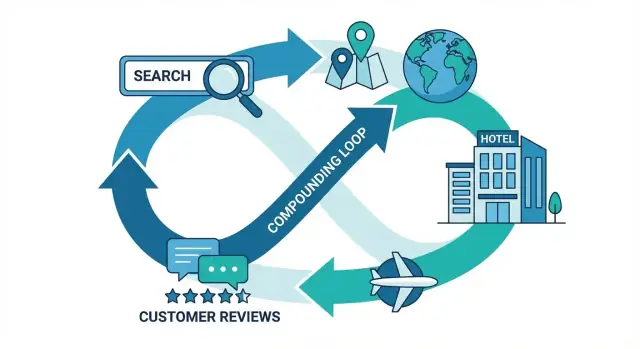
Compounding is when today’s work makes tomorrow’s growth easier. Add more structured listings → improve search visibility. More bookings → produce more reviews. More reviews → increase conversion. Higher conversion → justifies reinvesting in acquisition. Each step strengthens the next, rather than resetting to zero every campaign.
A note on what this article is (and isn’t)
This is a framework, not inside information. We’ll focus on observable patterns—SEO at scale, intent capture, marketplace incentives, and trust signals—so you can apply the lessons to your own product, even outside travel.
Travel demand: intent is fragmented and time-sensitive
Travel isn’t one search problem—it’s a chain of “missions” that start vague and end painfully specific. The same person can move from dreaming (“where to go in April?”) to comparing (“Lisbon vs Porto 4 days”) to committing (“hotel in Lisbon Baixa May 12–15”) in a matter of days—or minutes.
The four missions behind most travel searches
A useful way to understand demand is to map queries to the job the traveler is trying to do:
- Inspiration: broad, open-ended discovery.
- Planning: narrowing choices, building confidence, understanding tradeoffs.
- Booking: selecting a property, dates, cancellation terms, and price.
- Managing: changes, late check-in, confirmations, support—often under time pressure.
Each mission comes with different intent signals, different content needs, and a different “best” outcome.
How intent changes by query type
Compare these two searches:
- “Hotels in Barcelona May 10–13” is booking-mode. Dates (and often party size) imply readiness. The best experience is fast filtering, clear availability, and trustworthy pricing.
- “Best area to stay in Barcelona” is planning-mode. The traveler is still choosing neighborhoods and priorities (walkability, nightlife, family-friendly). Here, guides, maps, and explanations convert curiosity into confidence.
A marketplace that only optimizes for booking-mode misses the top of funnel. A marketplace that only serves inspiration risks losing the moment the traveler becomes decisive.
Mobile and last-minute make capture harder—and more valuable
On mobile, sessions are shorter and more fragmented. People search while commuting, already en route, or standing outside a hotel. Last-minute behavior also changes what matters: same-day availability, flexible check-in, reliable policies, and quick customer support. That time pressure raises the value of being present when intent spikes.
Seasonality and events create predictable demand spikes
Travel demand isn’t evenly distributed. School holidays, long weekends, weather patterns, and major events (festivals, conferences, sports) create repeatable surges by city and date. Teams that model these spikes can prepare pages, inventory coverage, and messaging ahead of time—so when demand arrives, they’re not scrambling to catch it.
Demand capture: meeting customers at the moment of intent
Demand capture isn’t about convincing someone to travel. It’s about showing up when they’ve already decided what they want next—a hotel in a specific neighborhood, a weekend in a specific city, a refundable room under a budget.
That intent is explicit, time-sensitive, and easy to lose. If a traveler is comparing options right now, being one click away from a bookable result is the whole game.
What “capture” looks like in practice
Capture means your product is present at the decision point:
- A search result that matches the exact query (date + destination + property type)
- A paid listing that appears when competition is highest
- A metasearch price that’s accurate and leads to a fast checkout
- A returning user opening your app because it remembers preferences and payment
- A triggered email that revives an abandoned search with the same dates and filters
The channel stack: where Booking can intercept intent
Demand capture isn’t one channel—it’s a portfolio:
- SEO: intercepts intent at scale with long-tail queries and destination/property pages.
- Paid search: buys visibility on high-value, high-competition keywords.
- Metasearch: competes where travelers compare prices across sites.
- App: reduces friction and increases repeat bookings through saved data and alerts.
- Email / push: reactivates known users at low marginal cost.
- Direct: brand-led visits that bypass auction-based traffic.
The trade-offs: cost, control, repeatability, learning
Each channel trades something off. Paid search is fast but expensive and exposed to auction volatility. SEO is slower but can be more repeatable once it works. Metasearch can scale, but you’re competing in a price-first environment. Owned channels (app, email) offer more control, but require prior acquisition.
The unifying advantage: capture scales faster than “creating demand” because you’re harvesting existing intent. You don’t need to change someone’s mind—you need to be the best, quickest path from “I want this trip” to “booked.”
SEO at marketplace scale: winning with structured inventory
Travel is one of the rare categories where having millions of indexable pages is normal—and even desirable. Every destination, date pattern, traveler preference, and property combination creates a distinct query. A marketplace like Booking can map that messy demand to structured inventory, then publish pages that match what people actually search.
Why travel sites can support massive page counts
Unlike a typical SaaS site, a travel marketplace has continuously changing inventory (properties, room types, availability signals) across a near-infinite set of places. That naturally produces a long tail of searches—from “hotels in Lisbon” to “pet-friendly aparthotels near X.” If your content is structured, you can create landing pages that are genuinely useful rather than generic.
Common page types that earn organic traffic
At scale, most organic growth comes from a handful of repeatable templates:
- Destination pages (countries, cities, neighborhoods)
- Property pages (a single hotel/apartment with details)
- Category pages (family-friendly, budget, beach, boutique)
- Deals pages (last-minute, seasonal, member rates)
- FAQ pages that answer intent-adjacent questions and reduce uncertainty
The trick isn’t inventing new content every time—it’s ensuring each template reliably produces unique, complete pages.
Internal linking: helping both users and crawlers
Structured internal linking turns a huge site into a navigable system:
- Hubs (e.g., a city page linking out to top neighborhoods and categories)
- Breadcrumbs that reflect the location hierarchy (Country → City → Area → Property)
- Related locations (nearby cities, airport areas, adjacent neighborhoods)
This concentrates authority on important hubs and distributes it to long-tail pages without relying on external links.
The big risk: index bloat
Scale cuts both ways. If templates generate near-duplicate variations, empty filters, or thin pages with little differentiation, search engines can treat the site as low-quality. Managing duplicates, faceted navigation, and low-value pages is essential—otherwise millions of URLs become a crawling and ranking liability instead of an asset.
Reviews and UGC: trust + content that keeps growing
Ratings and reviews are more than social proof. For a travel marketplace, they’re a continuously expanding layer of unique content that both search engines and travelers value.
Why reviews create defensible, unique pages
Hotel descriptions are often similar across the web (and sometimes sourced from the same suppliers). Reviews break that sameness by adding:
- Specific, experience-based language (“quiet rooms on the courtyard side”, “15-minute walk to the old town”) that’s hard to copy at scale.
- Natural coverage of long-tail queries and edge cases (accessibility, parking, air conditioning, noise, family friendliness).
- Trust signals that make a listing feel real rather than templated.
This matters in travel because perceived risk is high and the product can’t be tested before purchase.
Freshness: UGC keeps relevance from decaying
Travel inventory changes constantly—renovations, management swaps, seasonal issues, new transit links, even construction next door. User-generated content updates organically, which can help a listing stay accurate and relevant without rewriting the core page every week.
Fresh reviews can also shift what’s emphasized. A property might become “great for remote work” as guests start mentioning Wi‑Fi quality and desk space. That ongoing update cycle is difficult for competitors to match with static copy.
Moderation and spam: quality is the moat
UGC only helps if users believe it. Marketplaces protect review integrity by combining:
- Verification signals (e.g., reviews tied to completed stays)
- Automated detection (duplicates, unusual patterns, incentivized language)
- Human review for edge cases and appeals
The goal isn’t perfection—it’s keeping the content trustworthy enough that customers rely on it.
Reviews drive conversion—not just rankings
More review volume reduces uncertainty. A 4.7 rating based on 2,000 stays answers a different question than a 4.7 based on 12. The outcome is measurable: higher confidence leads to fewer bounces, more “reserve” clicks, and better conversion rates.
That conversion lift feeds the marketplace loop: more bookings → more verified reviews → stronger pages → more bookings.
Supply acquisition: the other half of the marketplace
Demand capture gets the click, but supply acquisition determines whether that click turns into a booked night. In travel marketplaces like Booking Holdings, the supply-side fundamentals are simple to describe and hard to execute: more partners create more availability, which usually yields better prices (or better value at the same price). Broader, more competitive inventory makes the site more useful—especially when a traveler has specific dates, a tight budget, or unusual preferences.
Onboarding is a growth lever, not admin work
Signing up properties isn’t just sales; it’s product. The fastest-growing marketplaces treat onboarding like a funnel:
- Clear setup steps (rooms, rates, policies, photos) that reduce time-to-first-booking
- Partner tools that make daily operations easier (rate calendars, promotions, messaging, availability controls)
- Guidance that improves listing quality so properties show up in more searches
If partners can confidently manage their listing, they’re more likely to keep inventory accurate—and accurate inventory prevents bad customer experiences.
Better supply improves UX and conversion
More and better supply changes what the customer sees:
- Fewer “sold out” pages for popular dates
- More comparable options in one place (location, amenities, cancellation terms)
- Pricing that feels fair because there are real alternatives
That translates into higher conversion rates and fewer abandoned searches. It also strengthens SEO indirectly: pages with strong engagement and low bounce are more likely to keep earning visibility over time.
The balance: partner value must stay obvious
Supply-side growth can stall if partners don’t see a clear, ongoing payoff. If fees feel high, rules feel unpredictable, or bookings aren’t consistent, churn rises—and churn is expensive because it resets trust and onboarding effort.
The marketplace has to keep reinforcing the partner’s “why”: incremental demand, tools that save time, and enough control to run their business without feeling boxed in.
Two-sided flywheels: how marketplaces compound over time
A travel marketplace compounds when it improves both sides at once: more places to stay attracts more travelers, and more travelers attracts more places to stay. That’s the classic network effect—and it’s why Booking-style businesses can keep getting stronger even when competitors copy features.
The flywheel is about quality, not just quantity
More supply only helps if it’s the right supply: accurate availability, fair pricing, consistent policies, and reliable hosts/hotels. If travelers repeatedly hit sold-out rooms, surprise fees, or misleading photos, the flywheel reverses: trust drops, conversion drops, partners churn, and acquisition costs rise.
Quality is what turns “more inventory” into “more booked nights,” which then funds better tools, better support, and better partner terms.
Matching is the engine: how demand meets supply
Compounding depends on matching travelers to the best option quickly. Marketplace UX does heavy lifting here:
- Filters that reflect real intent (free cancellation, breakfast, parking, family rooms)
- Sorting that balances price, value, review score, and availability
- Personalization that remembers preferences and past behavior
- Map UX that translates neighborhood intent into decision-making
Good matching reduces time-to-book and increases satisfaction, which drives repeat usage and more direct demand over time.
“Quality loops” that reinforce trust
Small operational improvements create feedback loops:
- Fewer cancellations → fewer bad experiences → better reviews → higher conversion
- Better review volume and recency → more confidence → more bookings → more reviews
- Clearer policies and verified details → fewer support issues → happier partners and guests
The result is a marketplace that doesn’t just grow—it gets easier to choose, safer to trust, and more likely to be used again.
Performance marketing: capturing demand you don’t own
Paid channels are attractive in travel because they let you buy your way into high-intent moments. When someone searches “hotel near Heathrow tonight” or filters a metasearch site to specific dates and a budget, they’re shopping. Ads, sponsored listings, and metasearch placements can put your inventory in front of that decision.
Why it works (and why it gets expensive)
Travel demand is valuable and perishable: a room night that isn’t booked today can’t be sold tomorrow. That makes bidding aggressive. Everyone is chasing the same terms, often on the same few platforms, so auctions get crowded fast.
The catch is margin. Online travel can carry thin unit economics once you account for:
- supplier commissions and partner payouts
- payment costs, fraud, and customer support
- cancellations, refunds, and chargebacks
If your contribution margin is small, it doesn’t take much bidding pressure to turn “growth” into paid volume that looks good in a dashboard but doesn’t create profit.
How SEO and paid can complement each other
SEO and paid aren’t either/or. Teams often use paid to:
- test messaging, offers, and landing pages quickly (then scale winners in SEO)
- cover new geos or seasonal spikes before organic pages mature
- fill inventory gaps where organic rankings are weak (certain cities, dates, or property types)
- defend brand and competitor conquesting where it makes sense
Measurement basics: look for incremental lift
The main pitfall is trusting attributed ROAS (especially last-click). Many travel clicks would have happened anyway through direct or organic.
Better basics: run geo tests, holdouts, or time-based experiments to estimate incremental bookings and incremental profit, then bid to marginal returns—not to what attribution claims you “earned.”
Brand and direct demand: the compounding cost advantage
“Direct” traffic is often treated like a vanity metric, but in travel it’s a real cost advantage that compounds over time.
What “direct” actually means
Direct demand isn’t just typing a URL. For a company like Booking Holdings, it typically shows up as:
- Brand search (e.g., people searching “Booking.com hotel in Paris”)
- App opens (habitual behavior, notifications, home-screen shortcuts)
- Email sessions (clicked itineraries, promos, abandoned-booking nudges)
- Logged-in repeat sessions (returning users who skip discovery steps)
These visits are different from generic SEO or paid clicks because the user already has a preferred destination for their intent: your product.
Why the booking experience creates repeat behavior
Travel is stressful: dates change, plans shift, and people worry about getting scammed. If the experience reliably reduces that anxiety—clear cancellation rules, transparent pricing, fast confirmation, responsive support—customers learn that returning is the safest shortcut.
The payoff is subtle but powerful: repeat users search less, compare fewer sites, and convert faster. That increases lifetime value and makes every earlier acquisition channel (SEO, affiliates, paid) more profitable.
Simple retention levers that build direct demand
You don’t need complex loyalty mechanics to earn repeat visits. A few high-frequency features do most of the work:
- Saved lists (shortlists for “next trip” thinking)
- Price alerts (a reason to come back without re-searching)
- Trip reminders (check-in info, refund deadlines, “complete your booking” prompts)
The reduced-dependency effect
As direct sessions rise, you can rely less on paid channels for the same booking volume. That lowers blended acquisition costs, softens the impact of auction price spikes, and frees budget to invest in product improvements that create even more direct demand—a flywheel built on trust and habit.
Conversion and trust: turning traffic into booked nights
Traffic is only valuable if it turns into completed bookings—and in travel, conversion is largely a trust problem. People are committing money to a future experience with uncertainty: plans might change, rooms can sell out, and fees can surprise them.
Price, availability, and “can I change my mind?”
Rate parity matters because customers compare across tabs. If a hotel is cheaper elsewhere (or looks cheaper once taxes appear), users hesitate or abandon.
Just as important is availability accuracy: showing rooms that can’t actually be booked creates a dead-end that trains customers not to trust the site.
Cancellation policies are the third leg of conversion. Flexible cancellation reduces perceived risk, especially for long-lead trips. Clear, standardized policy language (e.g., “free cancellation until…”) helps users decide quickly instead of decoding fine print.
Trust signals that remove friction
Verified reviews act like social proof and risk reduction in one. They work best when paired with transparency:
- Clear fees and total price (including taxes)
- Up-front policy summaries (payment timing, deposit rules, cancellation)
- Consistent room and property details to avoid “bait-and-switch” anxiety
When customers feel informed, they don’t need to “think twice”—and fewer people drop off at checkout.
Support is part of the product
Customer support isn’t an afterthought in travel marketplaces; it’s a conversion feature. Easy-to-find help, fast resolution, and proactive messaging (confirmations, policy reminders, self-serve changes) reduce booking issues.
That reduction compounds: fewer disputes means fewer refunds and chargebacks, fewer negative reviews, and fewer support-heavy edge cases—protecting both marketplace reputation and future conversion rates.
What can break the machine: quality, SEO, and marketplace risks
Compounding growth loops aren’t self-sustaining. In travel marketplaces, small quality leaks can become big losses because they affect rankings, trust, and conversion at the same time.
SEO risks that quietly kill scale
Travel inventory creates millions of near-similar URLs, which can confuse crawlers and dilute authority. Common failure modes include:
- Duplicate or near-duplicate pages (same hotel surfaced under multiple routes, currencies, languages, or partner feeds)
- Faceted navigation traps that generate infinite crawl paths (filters for price, stars, neighborhoods, amenities)
- Slow pages from heavy scripts, personalization bloat, or unoptimized assets—hurting both rankings and conversion
Mitigations: strict canonical rules, indexation policies for filters, parameter handling, and performance budgets tied to revenue pages (not just “core web vitals” vanity targets).
Marketplace risks: trust can decay faster than it grows
Two-sided marketplaces are vulnerable to adversarial behavior:
- Fraud and payment abuse (stolen cards, chargeback loops)
- Fake or low-quality listings that waste user time and damage brand trust
- Review manipulation (incentivized reviews, competitor attacks, coordinated spam)
Mitigations: clear listing standards, KYB/KYC where needed, anomaly detection, and visible enforcement. Reviews need governance: verified-stay bias, spam classifiers, audit trails, and human escalation paths.
Channel concentration risk
If growth depends too heavily on a single channel (often organic search or one paid platform), policy changes or algorithm shifts can reset unit economics overnight.
Mitigations: diversify acquisition (email/app, partnerships, brand demand), monitor channel mix weekly, and build “early warning” dashboards for ranking volatility, crawl/index coverage, and complaint rates.
Practical takeaways: build your own compounding travel flywheel
You don’t need Booking’s scale to borrow the mechanics. The goal is to design one loop where each booking makes the next booking easier—then layer loops over time.
A step-by-step checklist (capture → convert → retain → expand supply)
1) Capture (be present at intent)
- Pick 20–50 high-intent queries/pages you can win (e.g., “hotels near X”, “family-friendly in Y”).
- Build one reusable page template with structured inventory (filters, price ranges, map, availability cues).
- Ensure every page has a clear “reason to exist” (unique inventory, policies, or local context).
2) Convert (reduce uncertainty fast)
- Put trust elements above the fold: cancellation policy, total price clarity, verified reviews, customer support cues.
- Standardize the booking flow: fewer steps, fewer surprises, consistent room naming.
- Create a “decision helper” module: best value, best location, best rating.
3) Retain (turn one trip into a habit)
- Collect preferences after booking (budget, neighborhood, trip type) and personalize return visits.
- Build post-stay triggers: review request, rebook reminders, and “similar trips” recommendations.
4) Expand supply (unlock more pages you can rank and convert)
- Prioritize supply that fills gaps: missing neighborhoods, price bands, or property types.
- Make it easy to join: fast onboarding, clear photography checklist, policy templates.
Where Koder.ai fits if you’re building this kind of product
If you’re a small team trying to ship the first version of these loops, the bottleneck is often building and iterating fast enough (templates, filters, partner onboarding tools, dashboards, and notification flows).
Koder.ai is designed for that “marketplace MVP → iteration” phase: you can describe pages and workflows in a chat interface, use Planning Mode to map the loop (capture → convert → retain → supply), and generate a real app stack (typically React web, Go backend with PostgreSQL, and Flutter for mobile). It also supports source-code export, deployment/hosting, and snapshots with rollback—useful when you’re experimenting with SEO templates or checkout steps and want quick reversibility.
A simple “flywheel map” exercise
In a 45-minute workshop, draw four boxes: Demand → Conversion → Supply → Trust/Content. Under each, write (a) one metric, (b) one lever you control, (c) one bottleneck. Then connect them with arrows and label the handoffs (e.g., “more reviews → higher conversion → more bookings → more reviews”). Keep only the strongest loop.
KPI groupings to keep you honest
- Acquisition: indexed pages, non-brand organic clicks, paid CAC, share of top queries.
- Marketplace health: supply coverage by destination, availability rate, review volume/recency, cancellation rate.
- Unit economics: contribution margin per booking, LTV by cohort, payback period, repeat rate.
Realistic next steps for smaller teams
Start with one loop: choose either “SEO pages → conversion → reviews” or “supply coverage → better pages → better conversion.” Ship one template, instrument the funnel, and run weekly iterations until the numbers move—then add the next loop.
FAQ
What’s the difference between demand capture and demand generation in travel-tech?
Demand generation creates new interest (e.g., inspiring a destination or trip type). Demand capture wins existing intent (e.g., “hotel in Lisbon May 12–15”) by being the fastest path to a bookable result.
In travel, intent is often time-sensitive, so capture tends to monetize more immediately—if you have the right inventory and a low-friction checkout.
How does a two-sided marketplace like Booking create an advantage?
A two-sided marketplace serves two groups at once:
- Travelers: want choice, accurate availability, clear policies, and trusted reviews.
- Partners (hotels/hosts): want demand, predictable revenue, and tools to manage listings.
When it works, more supply improves the shopper experience, which increases bookings, which attracts more supply—creating a reinforcing loop.
What are the four travel “missions,” and why do they matter?
Most travel searches map to four “missions”:
- Inspiration: broad discovery.
- Planning: comparing areas and tradeoffs.
- Booking: choosing dates, price, and policies.
- Managing: confirmations, changes, late check-in, support.
Designing pages and flows around the mission (not just the keyword) helps you match content, UX, and trust signals to what the user is actually trying to do.
Why is SEO at marketplace scale so powerful for travel sites?
Travel demand creates a huge long tail (destinations × neighborhoods × property types × preferences). If your inventory is structured, you can publish useful, repeatable templates like destination pages, property pages, and category pages.
The goal isn’t “more pages” by itself—it’s consistent templates that produce unique, complete pages that match real queries and lead to booking.
What is “index bloat,” and how can it hurt travel marketplace SEO?
Index bloat happens when a site creates大量 near-duplicate or low-value URLs (empty filters, infinite faceted combinations, duplicate routes/currencies/languages). Search engines may waste crawl budget and dilute ranking signals.
Practical mitigations include:
- Canonicalization rules for duplicates
- Noindex / blocked parameter patterns for thin facets
- Strong internal linking to “hub” pages you want indexed
- Performance budgets for high-revenue templates
Why are reviews (UGC) such a big growth lever in travel marketplaces?
Reviews add defensible, unique content that standard hotel descriptions can’t provide. They also reduce perceived risk because travelers can’t “test” the product before purchase.
Operationally, reviews can compound:
- More bookings → more verified reviews
- More reviews → higher confidence → better conversion
- Better conversion → more bookings
That loop can improve both rankings (fresh, unique text) and revenue (less uncertainty).
How do marketplaces keep reviews trustworthy and reduce spam?
UGC only helps if users trust it. Marketplaces typically protect integrity with a mix of:
- Verification (e.g., reviews tied to completed stays)
- Automated detection (spam patterns, duplicates, abnormal behavior)
- Human escalation for edge cases and appeals
You don’t need perfect moderation, but you do need consistent enforcement so reviews remain a decision input—not background noise.
Why is supply onboarding treated as a product problem (not just sales)?
Onboarding isn’t just admin—it’s a conversion and retention lever for the supply side. Better onboarding improves listing quality (photos, policies, room/rate setup), which increases visibility and reduces customer issues.
Good partner tools (rate calendars, availability controls, messaging, promotions) keep inventory accurate—preventing “sold out” dead-ends and trust-eroding booking failures.
How should travel companies balance SEO, paid search, and metasearch?
Paid search and metasearch can place you in front of high-intent shoppers quickly, but auctions get expensive and margins can be thin after support, refunds, fraud, and payment costs.
A practical way to combine channels:
- Use paid to test offers and landing pages fast
- Use SEO to scale winners sustainably
- Measure incrementality with holdouts/geo tests (not just last-click ROAS)
The target is incremental profit, not attributed volume.
What are the highest-impact trust and conversion improvements for a travel booking flow?
Trust is the main conversion bottleneck in travel. You can reduce uncertainty by making key decision info obvious:
- Total price transparency (including taxes/fees)
- Accurate, real-time availability
- Clear cancellation/payment terms (“free cancellation until…”)
- Verified reviews and consistent property details
- Easy-to-find support and proactive trip messaging
When fewer bookings go wrong, you also reduce refunds, disputes, and negative reviews—protecting future conversion.