

How to Build a Web App for Vendor Scoring and Reviews
Learn how to plan, design, and build a web app for vendor scorecards and reviews, with data models, workflows, permissions, and reporting tips.
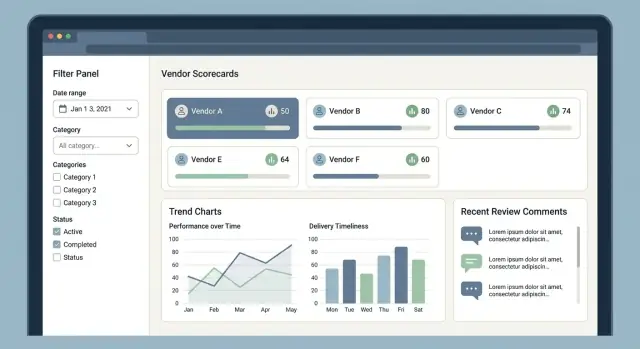
Before you sketch screens or pick a database, get crisp on what the app is for, who will rely on it, and what “good” looks like. Vendor scoring apps fail most often when they try to satisfy everyone at once—or when they can’t answer basic questions like “Which vendor are we actually reviewing?”
Goals, users, and scope
Who uses it (and what they need)
Start by naming your primary user groups and their day-to-day decisions:
- Procurement needs a consistent supplier scorecard, comparison views across vendors, and a defensible audit trail for sourcing decisions.
- Finance cares about cost variance, payment terms adherence, and risk signals that affect forecasts.
- Operations wants fast issue resolution: tracking incidents, documenting corrective actions, and seeing whether performance is improving.
- Vendors (optional portal) want visibility into feedback, a way to respond, and clarity on how scores are calculated.
A useful trick: pick one “core user” (often procurement) and design the first release around their workflow. Then add the next group only when you can explain what new capability it unlocks.
Key outcomes you’re aiming for
Write outcomes as measurable changes, not features. Common outcomes include:
- Better supplier decisions (e.g., preferred vendor lists based on evidence, not anecdotes)
- Faster issue resolution (clear ownership, deadlines, and follow-ups)
- More consistent evaluation (less variation between reviewers or sites)
These outcomes will later drive your KPI tracking and reporting choices.
Define what “vendor” means in your system
“Vendor” can mean different things depending on your org structure and contracts. Decide early whether a vendor is:
- a legal entity (parent company)
- a site/location (useful when quality varies by plant or region)
- a service line (e.g., logistics vs. packaging from the same supplier)
Your choice affects everything: scoring rollups, permissions, and even whether one bad facility should impact the overall relationship.
Choose the scoring approach
There are three common patterns:
- Weighted KPIs: numeric inputs (on-time delivery %, defect rate) multiplied by weights. Great for transparency and automation.
- Rubrics: reviewers select levels (e.g., “Excellent/Good/Fair/Poor”) with guidance text. Great when data is qualitative.
- Hybrid: KPIs for measurable areas + rubric for collaboration, responsiveness, or strategic fit.
Make the scoring method understandable enough that a vendor (and an internal auditor) can follow it.
Define success metrics for the app
Finally, pick a few app-level success metrics to validate adoption and value:
- Adoption: % of active vendors with at least one review in the last quarter
- Review completeness: required fields filled, evidence attached, KPIs provided
- Cycle time: time from review opened → approved → shared with vendor (if applicable)
With goals, users, and scope defined, you’ll have a stable foundation for the scoring model and workflow design that follow.
Scoring model and KPI design
A vendor scoring app lives or dies by whether the score matches people’s lived experience. Before you build screens, write down the exact KPIs, scales, and rules so procurement, operations, and finance all interpret results the same way.
Pick a small, defensible KPI set
Start with a core set that most teams recognize:
- On-time delivery (e.g., % of shipments within the agreed window)
- Quality (defect rate, return rate, or inspection pass %)
- SLA adherence (tickets resolved within target time, uptime if relevant)
- Cost variance (invoice vs PO variance, unplanned charges)
- Responsiveness (time to first reply, time to resolution for escalations)
Keep definitions measurable and tie each KPI to a data source or a review question.
Define rating scales people can explain
Choose either 1–5 (easy for humans) or 0–100 (more granular), then define what each level means. For example, “On-time delivery: 5 = ≥ 98%, 3 = 92–95%, 1 = < 85%.” Clear thresholds reduce arguments and make reviews comparable across teams.
Weights, missing data, and fairness rules
Assign category weights (e.g., Delivery 30%, Quality 30%, SLA 20%, Cost 10%, Responsiveness 10%) and document when weights change (different contract types may prioritize different outcomes).
Decide how to handle missing data:
- Exclude the KPI from the denominator for that period, or
- Apply a neutral default, or
- Mark the score as “insufficient data” and block ranking.
Whatever you choose, apply it consistently and make it visible in drill-down views so teams don’t misread “missing” as “good.”
Multiple scorecards per vendor
Support more than one scorecard per vendor so teams can compare performance by contract, region, or time period. This avoids averaging away issues that are isolated to a specific site or project.
Disputes and corrections
Document how disputes affect scores: whether a metric can be corrected retroactively, whether a dispute temporarily flags the score, and which version is considered “official.” Even a simple rule like “scores recalculate when a correction is approved, with a note explaining the change” prevents confusion later.
Data model and schema basics
A clean data model is what keeps scoring fair, reviews traceable, and reports believable. You want to answer simple questions reliably—“Why did this vendor get a 72 this month?” and “What changed since last quarter?”—without hand-waving or manual spreadsheets.
Core entities (what you store)
At minimum, define these entities:
- Vendor: the supplier profile (name, status, category, contacts)
- Contract: commercial agreement details and validity windows
- Order/Invoice (or a unified Transaction): the operational facts that drive KPIs
- KPI Metric: definitions like on-time delivery %, defect rate, response time
- Score: the calculated result for a vendor in a period (overall and/or per metric)
- Review: qualitative feedback, ratings, and narrative evidence
- Attachment: files linked to reviews or disputes (emails, photos, PDFs)
This set supports both “hard” measured performance and “soft” user feedback, which typically need different workflows.
Relationships (how the data connects)
Model the relationships explicitly:
- Vendor → Contracts: one vendor can have multiple contracts over time.
- Vendor → Orders/Invoices: transactions are usually many-to-one to vendor.
- Score → Metric: scores should be traceable back to the metric definition and calculation version.
- Review → Period: reviews need a clear time bucket (month/quarter) so they don’t float without context.
A common approach is:
scorecard_period(e.g., 2025-10)vendor_period_score(overall)vendor_period_metric_score(per metric, includes numerator/denominator if applicable)
Fields you’ll be glad you added later
Add consistency fields across most tables:
- Timestamps:
created_at,updated_at, and for approvalssubmitted_at,approved_at - Author and actor:
created_by_user_id, plusapproved_by_user_idwhere relevant - Source system:
source_systemand external identifiers likeerp_vendor_id,crm_account_id,erp_invoice_id - Confidence/quality: a
confidencescore ordata_quality_flagto mark incomplete feeds or estimates
These power audit trails, dispute handling, and trustworthy procurement analytics.
Retention, versioning, and “what changed?”
Scores change because data arrives late, formulas evolve, or someone corrects a mapping. Instead of overwriting history, store versions:
- Keep a score version (or
calculation_run_id) on each score row. - Record reason codes for recalculation (late invoice, KPI definition update, manual correction).
- Consider an append-only audit trail for important tables (scores, reviews, approvals) so you can show who changed what and when.
For retention, define how long you keep raw transactions vs. derived scores. Often you retain derived scores longer (smaller storage, high reporting value) and keep raw ERP extracts for a shorter policy window.
Identifier strategy for ERP/CRM matching
Treat external IDs as first-class fields, not notes:
- Store both external ID and system name (ERP_A vs ERP_B).
- Enforce uniqueness per source system (e.g.,
unique(source_system, external_id)). - Add lightweight mapping tables when vendors merge/split so historical scores remain accurate.
This groundwork makes later sections—integrations, KPI tracking, review moderation, and auditability—much easier to implement and explain.
Data ingestion and integrations
A vendor scoring app is only as good as the inputs feeding it. Plan for multiple ingestion paths from day one, even if you start with one. Most teams end up needing a mix of manual entry for edge cases, bulk uploads for historical data, and API sync for ongoing updates.
Common data sources
Manual entry is useful for small suppliers, one-off incidents, or when a team needs to log a review immediately.
CSV upload helps you bootstrap the system with past performance, invoices, tickets, or delivery records. Make uploads predictable: publish a template and version it so changes don’t silently break imports.
API sync typically connects to ERP/procurement tools (POs, receipts, invoices) and service systems like helpdesks (tickets, SLA breaches). Prefer incremental sync (since last cursor) to avoid pulling everything every time.
Validation that prevents garbage in
Set clear validation rules at import time:
- Required fields (vendor ID, date, metric name/value)
- Numeric ranges (e.g., 0–100 scores, non-negative quantities)
- Duplicate detection (same vendor + metric + time period + source record ID)
Store invalid rows with error messages so admins can fix and re-upload without losing context.
Corrections, backfills, and recalculation logs
Imports will be wrong sometimes. Support re-runs (idempotent by source IDs), backfills (historical periods), and recalculation logs that record what changed, when, and why. This is critical for trust when a supplier’s score shifts.
Scheduling and transparency
Most teams do fine with daily/weekly imports for finance and delivery metrics, plus near-real-time events for critical incidents.
Expose an admin-friendly import page (e.g., /admin/imports) showing status, row counts, warnings, and the exact errors—so issues are visible and fixable without developer help.
Roles, permissions, and approval workflow
Clear roles and a predictable approval path prevent “scorecard chaos”: conflicting edits, surprise rating changes, and uncertainty about what a vendor can see. Define access rules early, then enforce them consistently in the UI and API.
Role types (and what they’re for)
A practical starting set of roles:
- Admin: manages organization settings, role assignments, scoring templates, and moderation rules.
- Internal Reviewer: submits reviews, evidence, and draft score updates.
- Approver: validates sensitive actions (publishing reviews, locking periods, approving score changes).
- Vendor User: views their own scorecard, responds to reviews, uploads clarifications (if allowed).
- Read-only: can view dashboards and vendor profiles but can’t edit.
Permissions that map to real actions
Avoid vague permissions like “can manage vendors.” Instead, control specific capabilities:
- Viewing: who can see reviews, reviewer names, attachments, and historical scores.
- Editing: who can create/edit drafts, change KPI values, or adjust weights.
- Publishing: who can move content from draft to visible.
- Exporting: who can download reports (CSV/PDF) and at what scope (single vendor vs. all vendors).
Consider splitting “export” into “export own vendors” vs. “export all,” especially for procurement analytics.
Vendor visibility rules
Vendor Users should typically see only their own data: their scores, published reviews, and the status of open items. Limit reviewer identity details by default (e.g., show department or role rather than a full name) to reduce interpersonal friction. If you allow vendor replies, keep them threaded and clearly labeled as vendor-provided.
Approval flows for trust and consistency
Treat reviews and score changes as proposals until approved:
- Internal Reviewer submits a draft review/score update.
- Approver reviews evidence, checks policy, and either approves, requests changes, or rejects.
- Only approved items affect the “current” score and become visible to Vendor Users.
Time-bound workflows help: for example, score changes may require approval only during monthly/quarterly close.
Audit trail requirements
For compliance and accountability, log every meaningful event: who did what, when, from where, and what changed (before/after values). Audit entries should cover permissions changes, review edits, approvals, publishing, exports, and deletions. Make the audit trail searchable, exportable for audits, and protected from tampering (append-only storage or immutable logs).
UX and core screens
A vendor scoring app succeeds or fails on whether busy users can find the right supplier fast, understand the score at a glance, and leave trustworthy feedback without friction. Start with a small set of “home base” screens and make every number explainable.
1) Vendor list (the command center)
This is where most sessions begin. Keep the layout simple: vendor name, category, region, current score band, status, and last activity.
Filtering and search should feel instant and predictable:
- Category, region, status (active/on hold/blocked)
- Date range (e.g., last review, last delivery incident)
- Score band (A/B/C or 0–100 ranges)
Save common views (e.g., “Critical vendors in EMEA below 70”) so procurement teams don’t rebuild filters every day.
2) Vendor profile (one page, many answers)
The vendor profile should summarize “who they are” and “how they’re doing,” without forcing users into tabs too early. Put contact details and contract metadata next to a clear score summary.
3) Scorecard with drill-down “why”
Show the overall score and the KPI breakdown (quality, delivery, cost, compliance). Every KPI needs a visible source: the underlying reviews, issues, or metrics that produced it.
A good pattern is:
- KPI → formula/weight → contributing items → evidence (comments, attachments, timestamps)
4) Reviews and issues (fast entry, strong context)
Make review entry mobile-friendly: big touch targets, short fields, and quick commenting. Always attach reviews to a timeframe and (if relevant) a purchase order, site, or project so feedback stays actionable.
5) Reports (decision-ready)
Reports should answer common questions: “Which suppliers are trending down?” and “What changed this month?” Use readable charts, clear labels, and keyboard navigation for accessibility.
Reviews, comments, and moderation
Reviews are where a vendor scoring app becomes genuinely useful: they capture context, evidence, and the “why” behind the numbers. To keep them consistent (and defensible), treat reviews as structured records first, free-form text second.
Review types you should support
Different moments call for different review templates. A simple starting set:
- Periodic reviews (monthly/quarterly): steady cadence for performance and trend tracking.
- Incident-based reviews: tied to a late delivery, quality defect, or compliance issue.
- Project closeout reviews: end-of-engagement summary with lessons learned.
Each type can share common fields but allow type-specific questions, so teams don’t force-fit an incident into a quarterly form.
Structured fields: make reviews searchable
Alongside a narrative comment, include structured inputs that drive filtering and reporting:
- Tags and categories (e.g., Logistics, Quality, Communication)
- Strengths and gaps (separate fields to avoid one-sided feedback)
- Action items with owner, due date, and status
This structure turns “feedback” into trackable work, not just text in a box.
Evidence handling (without making it painful)
Allow reviewers to attach proof in the same place they write the review:
- File attachments (photos, PDFs)
- Links to shared docs
- References to tickets / POs / orders (ideally selectable from a list)
Store metadata (who uploaded, when, what it relates to) so audits don’t become a scavenger hunt.
Moderation and edit history
Even internal tools need moderation. Add:
- Basic profanity/spam checks
- Escalation rules for serious claims (e.g., safety, fraud)
- An edit history that records what changed and by whom (including redactions)
Avoid silent edits—transparency protects both reviewers and vendors.
Notifications, reminders, and response SLAs
Define notification rules upfront:
- Alert vendors when a review is published (or when vendor response is requested)
- Send internal reminders for overdue action items
- Set an SLA for responses (e.g., 5 business days) with escalation after missed deadlines
Done well, reviews become a closed-loop feedback workflow instead of a one-time complaint.
Architecture and tech stack choices
Your first architectural decision is less about “latest tech” and more about how quickly you can ship a reliable vendor scoring and reviews platform without creating a maintenance burden.
If your goal is to move fast, consider prototyping the workflow (vendors → scorecards → reviews → approvals → reports) in a platform that can generate a working app from a clear spec. For example, Koder.ai is a vibe-coding platform where you can build web, backend, and mobile apps through a chat interface, then export source code when you’re ready to take it further. It’s a practical way to validate the scoring model and roles/permissions before investing heavily in custom UI and integration work.
Monolith vs. modular services (keep it simple)
For most teams, a modular monolith is the sweet spot: one deployable app, but organized into clear modules (Vendors, Scorecards, Reviews, Reporting, Admin). You get straightforward development and debugging, plus simpler security and deployments.
Move toward separate services only when you have a strong reason—e.g., heavy reporting workloads, multiple product teams, or strict isolation requirements. A common evolution path is: monolith now, then split out “imports/reporting” later if needed.
API design (REST that maps to real work)
A REST API is typically the easiest to reason about and integrate with procurement tools. Aim for predictable resources and a few “task” endpoints where the system does real work.
Examples:
/api/vendors(create/update vendors, status)/api/vendors/{id}/scores(current score, historical breakdown)/api/vendors/{id}/reviews(list/create reviews)/api/reviews/{id}(update, moderate actions)/api/exports(request exports; returns job id)
Keep heavy operations (exports, bulk recalcs) async so the UI stays responsive.
Background jobs (imports, recalculations, notifications)
Use a job queue for:
- importing supplier data (CSV/SFTP/API)
- recalculating scores when KPIs, weights, or reviews change
- sending notifications (review requested, score changed, approval needed)
This also helps you retry failures without manual firefighting.
Caching for dashboards and heavy reports
Dashboards can be expensive. Cache aggregated metrics (by date range, category, business unit) and invalidate on meaningful changes, or refresh on a schedule. This keeps “open dashboard” fast while preserving accurate drill-down data.
Documentation (for developers and admins)
Write API docs (OpenAPI/Swagger is fine) and maintain an internal, admin-friendly guide in a /blog-style format—e.g., “How scoring works,” “How to handle disputed reviews,” “How to run exports”—and link it from your app to /blog so it’s easy to find and keep updated.
Security, privacy, and reliability
Vendor scoring data can influence contracts and reputations, so you need security controls that are predictable, auditable, and easy for non-technical users to follow.
Authentication and access control
Start with the right sign-in options:
- Email/password for smaller teams (use strong password rules and MFA where possible).
- SSO for enterprises via SAML or OIDC, so access can be managed centrally and revoked quickly.
Pair authentication with role-based access control (RBAC): procurement admins, reviewers, approvers, and read-only stakeholders. Keep permissions granular (e.g., “view scores” vs “view review text”). Maintain an audit trail for score changes, approvals, and edits.
Protect sensitive data
Encrypt data in transit (TLS) and at rest (database + backups). Treat secrets (DB passwords, API keys, SSO certificates) as first-class:
- Store them in a managed secrets vault
- Rotate regularly
- Never commit them to the repo
Abuse prevention and safe endpoints
Even if your app is “internal,” public-facing endpoints (password reset, invite links, review submission forms) can be abused. Add rate limiting and bot protection (CAPTCHA or risk scoring) where it makes sense, and lock down APIs with scoped tokens.
Privacy by design
Reviews often contain names, emails, or incident details. Minimize personal data by default (structured fields over free text), define retention rules, and provide tools to redact or delete content when required.
Reliable operations without leaking data
Log enough to troubleshoot (request IDs, latency, error codes), but avoid capturing confidential review text or attachments. Use monitoring and alerts for failed imports, scoring job errors, and unusual access patterns—without turning your logs into a second database of sensitive content.
Reporting, dashboards, and explainability
A vendor scoring app is only as useful as the decisions it enables. Reporting should answer three questions quickly: Who is doing well, compared to what, and why?
Dashboard views that work for busy stakeholders
Start with an executive dashboard that summarizes overall score, score changes over time, and a category breakdown (quality, delivery, compliance, cost, service, etc.). Trend lines are critical: a vendor with a slightly lower score but improving fast may be a better bet than a high scorer that’s slipping.
Make dashboards filterable by time period, business unit/site, vendor category, and contract. Use consistent defaults (e.g., “last 90 days”) so two people looking at the same screen get comparable answers.
Benchmarking with access controls
Benchmarking is powerful—and sensitive. Let users compare vendors within the same category (e.g., “Packaging suppliers”) while enforcing permissions:
- Procurement leadership might see named comparisons.
- Site managers might see only vendors they own.
- General stakeholders might see anonymized ranks or quartiles.
This avoids accidental disclosure while still supporting selection decisions.
Drill-down reports: from score to source
Dashboards should link to drill-down reports that explain score movement:
- Per period: monthly/quarterly rollups with KPI deltas.
- Per site: highlight location-specific issues (late deliveries in one plant).
- Per contract: show whether performance aligns with SLAs and commercial terms.
A good drill-down ends with “what happened” evidence: related reviews, incidents, tickets, or shipment records.
Exports for internal sharing
Support CSV for analysis and PDF for sharing. Exports should mirror on-screen filters, include a timestamp, and optionally add an internal-use watermark (and viewer identity) to discourage forwarding outside the organization.
Explainability: show how the score was built
Avoid “black box” scores. Each vendor score should have a clear breakdown:
- KPI contributions (weights, raw values, normalization)
- Penalties/bonuses applied (e.g., critical compliance issue)
- Calculation notes and version (so changes in formulas are auditable)
When users can see the calculation details, disputes become faster to resolve—and improvement plans become easier to agree on.
Testing and quality checks
Testing a vendor scoring and reviews platform isn’t just about catching bugs—it’s about protecting trust. Procurement teams need confidence that a score is correct, and vendors need assurance that reviews and approvals are handled consistently.
Build test data that reflects real-life messiness
Start by creating small, reusable test datasets that intentionally include edge cases: missing KPIs, late submissions, conflicting values across imports, and disputes (e.g., a vendor challenges a delivery SLA result). Include cases where a vendor has no activity for a period, or where KPIs exist but should be excluded due to invalid dates.
Verify the scoring logic with unit tests
Your scoring calculations are the heart of the product, so test them like a financial formula:
- Weighting rules (including weights that don’t sum to 100% and how you handle that)
- Rounding behavior and ties in ranking
- Thresholds (e.g., when a KPI changes from “good” to “needs attention”)
- Regression tests for any change to KPI definitions
Unit tests should assert not only final scores, but intermediate components (per-KPI scores, normalization, penalties/bonuses) to make failures easy to debug.
Cover imports, permissions, and workflow with integration tests
Integration tests should simulate end-to-end flows: importing a supplier scorecard, applying permissions, and ensuring only the right roles can view, comment, approve, or escalate a dispute. Include tests for audit trail entries and for blocked actions (e.g., a vendor attempting to edit an approved review).
Validate with UAT and performance checks
Run user acceptance tests with procurement and a pilot vendor group. Track confusing moments and update UI text, validation, and help hints.
Finally, run performance tests for peak reporting periods (month-end/quarter-end), focusing on dashboard load times, bulk exports, and concurrent scoring recalculation jobs.
Launch plan and iteration roadmap
A vendor scoring app succeeds when people actually use it. That usually means shipping in phases, replacing spreadsheets carefully, and setting expectations about what will change (and when).
Phased launch that builds trust
Start with the smallest version that still produces useful scorecards.
Phase 1: Internal-only scorecards. Give procurement and stakeholder teams a clean place to record KPI values, generate a supplier scorecard, and leave internal notes. Keep the workflow simple and focus on consistency.
Phase 2: Vendor access. Once internal scoring feels stable, invite vendors to view their own scorecards, respond to feedback, and add context (for example, “shipment delay caused by port closure”). This is where permissioning and an audit trail matter.
Phase 3: Automation. Add integrations and scheduled recalculation once you trust the scoring model. Automating too early can amplify bad data or unclear definitions.
If you want to shorten time-to-pilot, this is another spot where Koder.ai can help: you can stand up the core workflow (roles, review approval, scorecards, exports) quickly, iterate with procurement stakeholders in “planning mode,” and then export the codebase when you’re ready to harden integrations and compliance controls.
Migration plan (goodbye spreadsheets, safely)
If you’re replacing spreadsheets, plan for a transition period rather than a big-bang cutover.
Provide import templates that mirror existing columns (vendor name, period, KPI values, reviewer, notes). Add import helpers such as validation errors (“unknown vendor”), previews, and a dry-run mode.
Also decide whether to migrate historical data fully or only bring in recent periods. Often, importing the last 4–8 quarters is enough to enable trend reporting without turning migration into a data archaeology project.
Training materials that people will actually read
Keep training short and role-specific:
- One-page quick guides for reviewers, approvers, and admins
- In-app tips on first use (how to score, where to leave context, what “submit” means)
- An admin checklist: create categories, set KPI definitions, configure review cycles, and verify access
Ongoing maintenance and iteration
Treat scoring definitions as a product. KPIs change, categories expand, and weighting evolves.
Set a recalculation policy up front: what happens if a KPI definition changes? Do you recalculate historical scores or preserve the original calculation for auditability? Many teams keep historical results and recalculate only from an effective date.
Next steps: pricing and packaging
As you move beyond the pilot, decide what’s included in each tier (number of vendors, review cycles, integrations, advanced reporting, vendor portal access). If you’re formalizing a commercial plan, outline packages and link to /pricing for details.
If you’re evaluating build vs. buy vs. accelerate, you can also treat “how fast can we ship a trustworthy MVP?” as a packaging input. Platforms like Koder.ai (with tiers from free to enterprise) can be a practical bridge: build and iterate quickly, deploy and host, and still keep the option to export and own the full source when your vendor scoring program matures.
FAQ
How do I define the scope so the vendor scoring app doesn’t try to satisfy everyone at once?
Start by naming one “core user” and optimizing the first release for their workflow (often procurement). Write down:
- The decision they make (e.g., renew vs. replace a vendor)
- The inputs they trust (KPIs, incidents, invoices, reviews)
- The outputs they need (scorecard, comparison view, audit trail)
Add finance/operations features only when you can clearly explain what new decision they enable.
What should “vendor” mean in the system—company, site, or service line?
Pick one definition early and design your data model around it:
- Legal entity: best for contract-level decisions and consolidated reporting.
- Site/location: best when quality or delivery performance varies by plant/region.
- Service line: best when one supplier provides different services with different outcomes.
If you’re unsure, model a vendor as a parent with child “vendor units” (sites/service lines) so you can roll up or drill down later.
Should we use weighted KPIs, rubric scoring, or a hybrid model?
Use Weighted KPIs when you have reliable operational data and want automation and transparency. Use Rubrics when performance is mostly qualitative or inconsistent across teams.
A practical default is Hybrid:
- KPIs for delivery/quality/cost/SLA
- Rubric questions for collaboration, responsiveness, and strategic fit
Whichever you choose, make the method explainable enough for auditors and vendors to follow.
What’s a good “starter” KPI set for vendor performance scoring?
Start with a small set that most stakeholders recognize and can measure consistently:
- On-time delivery
- Quality (defect/return/inspection pass rate)
- SLA adherence (tickets within target)
- Cost variance (invoice vs PO)
- Responsiveness (time to first reply/resolution)
For each KPI, document the definition, scale, and data source before building UI or reports.
How do we design rating scales that different teams interpret the same way?
Pick a scale people can describe out loud (commonly 1–5 or 0–100) and define thresholds in plain language.
Example:
- On-time delivery: 5 = ≥ 98%, 3 = 92–95%, 1 = < 85%
Avoid “vibes-based” numbers. Clear thresholds reduce reviewer disagreement and make comparisons fair across teams and sites.
How should we handle missing KPI data without making scoring unfair?
Choose and document one policy per KPI (and apply it consistently):
- Exclude from denominator for that period (common when data is genuinely unavailable)
- Neutral default (use carefully—can hide real gaps)
- Insufficient data flag and block ranking/benchmarking
Also store a data-quality indicator (e.g., data_quality_flag) so reports can distinguish “bad performance” from “unknown performance.”
What’s the best way to handle disputes and score corrections?
Treat disputes as a workflow with traceable outcomes:
- Mark the metric/review as disputed without silently changing history
- Allow a correction to be proposed with evidence
- Recalculate only after approval, and store a note explaining the change
Keep a version identifier (e.g., calculation_run_id) so you can answer “what changed since last quarter?” reliably.
What core entities should the database include for a vendor scoring app?
A solid minimum schema typically includes:
- Vendor, Contract, Transaction (orders/invoices), KPI Metric definition
- Review (qualitative), Score (overall), Metric Score (per KPI)
- Attachment (evidence)
Add fields you’ll need for traceability: timestamps, actor IDs, source system + external IDs, and a score/version reference so every number can be explained and reproduced.
How do we prevent “garbage in” when importing from ERP/CSV/API sources?
Plan for multiple ingestion paths even if you start with one:
- Manual entry for edge cases
- CSV uploads for historical bootstrap
- API sync for ongoing updates
At import time, enforce required fields, numeric ranges, and duplicate detection. Keep invalid rows with clear error messages so admins can fix and re-run without losing context.
What roles, permissions, and audit trail features are essential—especially with a vendor portal?
Use role-based access and treat changes as proposals:
- Reviewers create drafts (reviews, KPI updates)
- Approvers publish/lock periods so scores are stable
- Vendor users see only their own published scorecards and threaded responses
Log every meaningful event (edits, approvals, exports, permission changes) with before/after values. This protects trust and makes audits straightforward—especially once vendors can view or respond.