

Canon’s Precision Manufacturing: Building Durable Imaging Businesses
How Canon-style precision manufacturing supports reliable cameras, industrial printers, and optics—turning tight tolerances into durable, serviceable businesses.
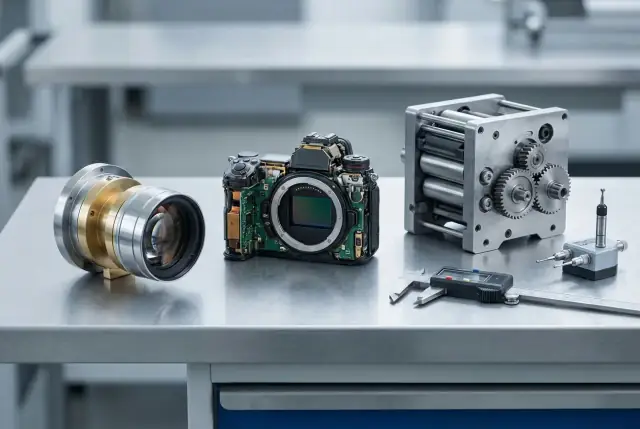
Why Precision Manufacturing Creates Durable Tech Businesses
A durable tech business is one that customers can depend on for years: the product works day after day, failures are rare and predictable, maintenance is planned (not emergency), and total ownership cost stays stable over a long lifecycle. In plain terms, durability isn’t only “it doesn’t break”—it’s reliability + long life + predictable upkeep.
Why imaging and printing are different
Imaging and printing systems aren’t purely “software products.” They’re physical machines that must position light, sensors, paper, ink/toner, and moving parts with repeatable accuracy. If the build is slightly off, the customer feels it immediately:
- A camera or inspection system shows soft focus, uneven sharpness, or misaligned stabilization.
- A production printer drifts in color, banding appears, or registration shifts across a long run.
- An optical module delivers inconsistent results even if the software is excellent.
Precision manufacturing turns that fragility into predictability. Tight tolerances, stable assembly processes, and consistent calibration reduce variation—so performance remains steady across units, batches, and years of service.
What this article will (and won’t) do
This is about principles and real-world examples, not inside-company secrets. The goal is to explain how an imaging business can become durable by investing in manufacturing discipline: measurement, process control, and design choices that make quality repeatable.
The three pillars we’ll use throughout
- Imaging hardware: mechanically stable builds that keep alignment and calibration over time.
- Industrial printing: precision as an uptime strategy—less drift, fewer stoppages, easier maintenance.
- Optics: glass, coatings, and alignment treated as a system where small errors compound quickly.
Taken together, precision manufacturing is less about perfection for its own sake—and more about creating products that stay “in spec” long enough to support warranties, service plans, and long customer relationships.
Imaging Hardware: Where Reliability Starts in the Build
Reliable imaging products don’t begin with software features—they begin with how the physical system is built, aligned, and protected from the real world. In Canon-class precision manufacturing, “hardware reliability” is the outcome of hundreds of small decisions that keep optical, mechanical, and electronic parts behaving the same way for years.
The components that quietly decide longevity
A camera (or imaging module) is a stack of interdependent parts:
- Sensors must sit flat and square to the optical axis; even tiny tilt can produce edge softness or uneven focus.
- Shutters and actuators rely on repeatable motion; wear, friction, and inconsistent clearances can trigger timing drift or premature failure.
- Image processors and boards need stable power, thermal paths, and vibration-safe connectors.
- Stabilization units (IBIS/OIS) demand precise centering and low-friction movement—misalignment can create blur, noise, or rattling failures.
- Lens mounts and chassis set the reference geometry. If the mount face isn’t flat or the fasteners relax, the whole system’s calibration degrades.
How “small errors” become big customer problems
Microns of misalignment can show up as focus inconsistency, decentering, increased stabilization workload, or accelerated mechanical wear. Those same errors can raise return rates because the defect looks “random” to users: sometimes sharp, sometimes not.
Design-for-Assembly (DfA): making consistency normal
DfA focuses on locating features, foolproof orientation, controlled torque, and repeatable shimming—so assembly doesn’t depend on technician intuition. Consistent assembly is what enables consistent performance.
Built to survive the environment
Drops, vibration, temperature swings, dust, and moisture don’t just threaten seals. They stress solder joints, shift alignment, change lubricants’ behavior, and loosen fasteners. Precision builds anticipate these stresses so image quality and reliability stay stable over the product’s life.
Tolerances, Alignment, and Repeatability—The Hidden Differentiators
Precision manufacturing often gets reduced to “tight tolerances,” but the business impact shows up as something customers actually notice: every unit performs the same.
Tolerances, in plain language
A tolerance is the allowed wiggle room between “perfect” and “acceptable.” If you’re aligning two door hinges, a millimeter gap might be fine. In imaging and industrial printing, you’re often working in microns—thousandths of a millimeter. That’s closer to the scale of a dust particle than a sheet of paper.
Alignment is where parts sit relative to each other (a lens element, a sensor, a printhead). Repeatability is whether the factory can hit that same alignment thousands of times, across shifts, machines, and suppliers.
Why “close enough” breaks in optics and printing
Optics and printing are unforgiving because small errors compound. One part may be within tolerance, and the next part is also within tolerance—but together they create a bigger error than either part alone. This is stack-up error.
In a lens assembly, tiny tilt or decenter can soften corners or create uneven sharpness that only appears at certain zoom positions. In industrial printing, small positional drift can show up as banding, color misregistration, or inconsistent dot placement—issues that reduce throughput because operators slow down, recalibrate, or rerun jobs.
The business trade-off: cost vs. warranty risk
Tighter tolerances can raise cost: better tooling, more inspection, more time. But controlled tolerances can reduce field failures, warranty claims, and costly service visits. For durable imaging businesses, the real differentiator is often not peak specs—it’s consistent performance across every shipped unit, year after year.
Quality Control and Metrology in Real Production
Precision manufacturing only pays off when you can measure what you’re making—consistently, quickly, and in a way that production teams can act on. In imaging hardware and industrial printing, tiny shifts in position, flatness, or optical alignment can show up as blur, banding, or unexpected wear months later.
The measurement toolbox (and what it’s good for)
Factories typically use a mix of tools because no single method catches everything:
- CMM (Coordinate Measuring Machines) for high-accuracy checks of critical dimensions and geometry on mechanical parts.
- Interferometry to verify optical surfaces and alignment with extreme sensitivity—useful when “looks fine” isn’t fine enough.
- Optical inspection (microscopes, surface scanners) for scratches, coating defects, and edge quality.
- Automated vision checks on the line to spot missing components, orientation errors, or cosmetic defects at speed.
Calibration and traceability—without the jargon
A measurement is only trustworthy if the tool is trustworthy. Calibration is simply regularly proving the tool still measures correctly using known references. Traceability means those references link back through a documented chain to recognized standards. Practically, it prevents a quiet drift—like a fixture slowly wearing—turning into a “mystery defect” that wastes weeks.
In-process checks vs. end-of-line tests
In-process checks catch issues while parts are still adjustable: a misaligned subassembly, a torque that’s trending high, a coating thickness starting to shift.
End-of-line testing verifies the final product behaves as intended under real conditions. Both matter: in-process prevents scrap and rework; end-of-line protects customers from rare combinations of small errors that only appear when everything is assembled.
SPC: preventing defects, not just detecting them
Statistical process control (SPC) is watching the process signals—not waiting for failures. If measurements start trending toward a limit, teams can intervene early (replace a tool, tune a machine, retrain a step) before defects appear. That’s how quality becomes an everyday routine, not a last-minute rescue.
Industrial Printing: Precision as an Uptime Strategy
Industrial printing isn’t “office printing, but bigger.” It’s closer to running a production line: customers measure value in uptime, predictable throughput, and consistent output across long shifts and multiple sites. If a system drifts, clogs, or mis-registers, the cost shows up immediately as scrap, rework, missed delivery windows, and operator time.
What industrial printing demands (and why precision matters)
Industrial environments push machines harder—higher duty cycles, faster media speeds, tighter color tolerances, and more frequent changeovers. Precision manufacturing turns these demands into a repeatable, controllable process. When core mechanical and fluidic parts are built to tight tolerances, the system can hold calibration longer, recover faster after maintenance, and produce the same result on day 1, day 100, and across an installed fleet.
Critical subsystems where build quality decides uptime
Precision shows up most in a few subsystems that quietly determine whether a press runs smoothly or becomes a constant intervention project.
- Printheads and mounting geometry: The flatness, stiffness, and alignment of the printhead assembly affect nozzle-to-media distance and angle. Small variations can create visible banding or inconsistent dot placement, especially at high speeds.
- Ink delivery and fluid control: Stable flow depends on accurate pump performance, well-controlled pressure, clean seals, and consistent internal channel dimensions. Tiny manufacturing inconsistencies can amplify into air ingestion, pulsation, or uneven ink laydown.
- Media handling and registration: Rollers, guides, tension control, and encoders must work as a unit. Precision in roundness, concentricity, and sensor placement is what keeps registration tight and reduces skew, wrinkles, and stretching.
- Curing/drying: Whether UV, heat, or other methods, curing requires consistent energy delivery and predictable distance to the substrate. Mechanical precision helps prevent under-cure (durability issues) or over-cure (warping, discoloration).
From tolerances to visible defects: banding, drift, waste
Most “quality problems” in production printing are really repeatability problems.
- Banding often traces back to slight variations in head alignment, carriage motion, or media advance—issues that become obvious only at speed.
- Color drift can come from temperature variation, inconsistent ink flow, or mechanical shifts that alter laydown. Precision helps keep the system in a stable operating window.
- Registration errors grow when multiple stations or passes don’t track the media in exactly the same way every time.
When output is inconsistent, operators compensate by slowing down, running extra checks, or increasing purge/clean cycles—each one a hidden tax on throughput and consumables.
Maintainability is part of the manufacturing strategy
Uptime isn’t just about fewer failures; it’s also about faster, safer recovery.
Design choices like modular assemblies, accessible service points, and clear consumables pathways reduce the time to swap a printhead, clear a jam, or service pumps and filters. Precision manufacturing supports this by ensuring replacement parts fit and perform predictably—so maintenance restores the press to spec instead of introducing new variation.
For businesses built around industrial printing, that’s the real uptime strategy: precision that prevents drift, and serviceability that makes recovery routine rather than disruptive.
Optics: Turning Glass, Coatings, and Alignment into Advantage
Optical quality isn’t a single “sharpness” score—it’s the sum of many tiny manufacturing decisions that stay invisible until they fail. For imaging brands like Canon, precision optics become a durable business advantage because they protect real professional workflows: predictable focus, consistent color, and repeatable results across years of daily use.
What really drives lens performance
At the core is element geometry and how accurately each surface matches its intended shape. Small deviations in curvature or aspheric profiles can introduce aberrations that software can’t fully undo.
Equally important is how well each element is centered and spaced. If centering is off, you can see decentering effects (one side of the frame softer than the other). If spacing drifts, focus behavior and aberration correction change—sometimes only at certain zoom positions or apertures, which makes the issue harder to diagnose.
Coatings and cleanliness: contrast is manufactured
High-end optics rely on coating uniformity to control reflections. Even if a lens resolves fine detail, uneven coatings can reduce contrast or cause flare and ghosting in backlit scenes—exactly where pros need reliability.
Cleanliness is part of “optical design” in practice. Dust, film residue, or micro-particles trapped during assembly can create bright artifacts and lower black levels. Contamination control therefore isn’t just a factory nicety; it’s a repeatable way to protect contrast and color over the product’s life.
Assembly and alignment: precision you can’t see
Optical performance depends on disciplined assembly steps: shimming to hit exact spacing, bonding processes that don’t shift elements over time, and torque control so mechanical stress doesn’t warp barrels or introduce tilt.
Alignment is also about preventing future drift. If components are assembled with variable torque or inconsistent adhesives, a lens that passes initial inspection can slowly lose calibration with temperature cycles, vibration, or transport.
Why this builds long-term trust
When optics are consistent unit-to-unit, teams can standardize settings, match cameras across shoots, and plan maintenance confidently. That predictability is what turns “good glass” into brand trust—supporting long product lifecycles, smoother service, and fewer workflow surprises for professionals.
Design for Manufacturing and Service (DFM/DFS) to Reduce Failures
Precision manufacturing doesn’t start on the factory floor—it starts in the CAD model. DFx (“design for X”) is the discipline of shaping a product so it’s easy to build, easy to test, easy to service, and more likely to be reliable in real use. Common DFx lenses include design for manufacturability (DFM), serviceability (DFS), testability (DFT), and reliability (DFR).
Practical design choices that prevent downtime
Small, early decisions often determine whether imaging hardware stays consistent over years or becomes a service headache. Examples that routinely cut field failures and service time:
- Fewer unique fasteners (standard lengths/heads): reduces assembly errors, speeds repair, and simplifies spares.
- Self-aligning features (dowels, lead-ins, keyed brackets): lets parts “find home” without technician finesse, protecting optical/mechanical alignment.
- Error-proof connectors (keyed, color-coded, strain-relieved): prevents miswiring and intermittent faults after vibration or repeated service.
- Modular subassemblies (swap-friendly units): shortens mean time to repair because you replace a known-good module instead of troubleshooting deep inside the system.
Reliability is cheaper when it’s designed in
When tolerances stack up in an imaging path, a product can pass final inspection yet drift in the field. DFM/DFS reduces that risk by removing adjustment points, minimizing rework, and ensuring calibration procedures are repeatable. The result: fewer “mystery” failures, faster service visits, and less performance variation between units.
Documentation is part of manufacturing precision
Work instructions, torque specs, calibration steps, and inspection criteria are not paperwork—they’re process controls. Clear documentation (with version control and feedback from the line and service teams) keeps assembly consistent across shifts and sites, and ensures repairs restore the product to its intended performance, not just “working again.”
Scaling from Lab to Factory Without Losing Consistency
A lab prototype can “work” and still be a long way from a product that works the same way thousands of times in a row. In imaging hardware—where tiny alignment shifts can affect sharpness, color, or registration—consistency is the real milestone. The goal of scaling is not just higher volume; it’s repeatable performance across every unit, every shift, and every site.
From prototype wins to process discipline
Prototypes often rely on expert hands, custom fixtures, and parts that were hand-selected. Factory builds can’t depend on any of that. Scaling means translating tacit know-how into defined steps: calibrated tools, documented work instructions, controlled environments, and measurement points that catch drift early.
Pilot builds, validation, and ramp planning
Before full production, teams typically run pilot builds to prove the process—not just the design. This includes process validation (can the line consistently hit spec?), stress testing of assembly variation (what happens at tolerance limits?), and ramp planning (how output increases without skipping checks). Done well, pilots reveal where automation helps, where training needs tightening, and which steps require additional inspection.
Supplier qualification and incoming inspection
High-precision systems are only as consistent as their critical parts. Supplier qualification focuses on capability (can they hold tolerances reliably?) and stability (can they do it month after month?). Incoming inspection then verifies what matters most—often a small set of “must-not-fail” dimensions or optical characteristics—so issues are contained before they enter assembly.
Change control to prevent regressions
Even small revisions—new coatings, alternate adhesives, swapped fasteners—can change performance. Strong change control treats every tweak as a hypothesis to validate, with clear approvals, traceability, and targeted re-testing so improvements don’t accidentally reintroduce old failure modes.
Supply Chain and Supplier Quality for High-Precision Parts
Precision manufacturing doesn’t stop at your factory door. For imaging hardware and industrial printing, the supply chain is effectively part of the product—because tiny variations in incoming parts can show up as banding, drift, focus errors, or premature wear.
Why specialized suppliers matter
Many critical components require niche processes and deep know-how: optical glass melting and grinding, multi-layer coatings, image sensors and microlenses, precision bearings, encoders, and ultra-consistent motors. These aren’t “commodity” parts where any vendor can swap in. A coating supplier’s process window, a sensor fab’s yield characteristics, or a motor builder’s winding consistency can directly affect calibration time, defect rates, and long-term stability.
Dual sourcing vs. single sourcing
Single sourcing can improve consistency: one qualified process, one set of incoming inspection limits, and fewer variables to chase when issues appear. The downside is continuity risk—capacity constraints, geopolitical events, or a supplier quality slip can stop shipments.
Dual sourcing reduces outage risk but raises the quality bar for your engineering team. You must define tight specifications and acceptance tests that capture real-world performance (not just dimensions), and you often need separate calibration profiles or firmware parameters per source. The key is to dual-source by design, not as a late emergency move.
Inventory for long-life products
Durable product lines need a spares plan: service parts, repair kits, and consumables that match the installed base for years. That often means end-of-life buys for parts likely to be discontinued, documented substitutions (with requalification rules), and clear change-control with suppliers.
Logistics risks and mitigation
Shipping delays, customs holds, and fragile components (optics, coated parts) create hidden downtime risk. Standardized packaging, common part families across models, and disciplined forecasting help reduce surprises—so the factory keeps building and the field keeps running.
Reliability Engineering, Testing, and Feedback Loops
Durability isn’t only “built in” at the factory—it’s maintained through a loop between real-world use and the next production run. For imaging hardware and industrial printing systems, the fastest way to improve reliability is to treat every field issue as structured data, not a one-off problem.
Turning field failures into better builds
When a unit fails on site, the most valuable output is the diagnosis: what failed, how it failed, and under which conditions. A mature reliability program typically runs a tight cycle of failure analysis → root cause → corrective action:
- Failure analysis: tear-downs, part inspection, log extraction, and correlation with usage history.
- Root cause: separating the triggering event (e.g., contamination) from the underlying weakness (e.g., seal tolerance, material choice, assembly method).
- Corrective actions: updating work instructions, tightening a tolerance, changing a supplier process, adjusting firmware safeguards, and verifying with repeat tests.
Over time, this turns “service tickets” into manufacturing improvements—fewer repeat incidents and more predictable uptime.
Reliability tests that mimic real life
Common qualification and production-representative tests include:
- Thermal cycling to expose expansion, contraction, and drift in alignment.
- Vibration and shock to simulate transport, installation, and daily operation.
- Dust and particulate exposure to validate sealing, airflow paths, and cleaning intervals.
- High duty-cycle endurance to uncover wear mechanisms in motors, rollers, shutters, and moving optical assemblies.
Serviceability as a business lever
Designing products to be serviced quickly can be as important as preventing failures. Maintenance kits standardize replacement of known-wear items, firmware updates fix edge cases and improve diagnostics, and training helps customers and partners avoid preventable errors. Together, these reduce downtime—and keep customers renewing service contracts, buying consumables, and staying within the ecosystem.
A practical (often overlooked) enabler here is internal software: service portals, parts/RMA workflows, calibration record systems, and field diagnostics dashboards. Teams that need to ship these tools quickly—without pulling core engineering away from hardware—often use a vibe-coding approach. For example, Koder.ai can help build internal web apps (and companion mobile tools) through a chat interface, with source-code export and rollback-friendly snapshots, which is useful when service processes evolve alongside the product.
Business Model: Uptime, Total Cost, and Long Product Lifecycles
A durable imaging business isn’t built on the sticker price of a device—it’s built on how predictably that device performs for years. For customers buying cameras, copiers, or industrial printing systems, the real decision is often total cost of ownership (TCO), and precision manufacturing quietly shapes most of it.
TCO: what customers actually pay for
TCO usually concentrates in a few buckets:
- Downtime: missed production runs, idle staff, delayed shipments, or failed shoots.
- Consumables and waste: ink/toner yield, head or drum life, calibration waste, spoiled media.
- Service and parts: technician visits, shipping, spare modules, and the time to restore spec.
- Energy and operating stability: warm-up behavior, rework due to drift, and repeat setups.
Precision parts, consistent assemblies, and stable alignment reduce the “hidden tax” of re-calibration, retries, and unpredictable output—especially in print environments where minutes of stoppage can cost more than a component.
Pricing models that reward durability
Durable hardware companies (Canon included) often mix revenue streams:
- Hardware margin to fund R&D and manufacturing capability.
- Service contracts that price risk—lower failure rates can be a competitive advantage.
- Parts and consumables where reliability protects reputation (nobody wants “cheap” ink that causes jams).
- Upgrades and refresh cycles that extend useful life via replaceable modules or firmware improvements.
A key point: when precision reduces variability, companies can offer stronger uptime commitments, tighter service-level agreements, and more predictable maintenance intervals—without gambling on warranty exposure.
Precision manufacturing lowers warranty cost (and friction)
Better build consistency means fewer early-life failures, fewer returns, and less time spent diagnosing “non-reproducible” issues. That cuts warranty reserves and also improves customer trust—an underappreciated driver of repeat purchases and long-term contracts.
Sustainability, handled realistically
Longer product lifecycles can reduce replacement frequency and the emissions tied to manufacturing and shipping new units. The sustainability benefit is strongest when durability is paired with repairability—keeping high-value hardware in service rather than pushing premature replacements.
Key Takeaways: A Practical Checklist for Durable Imaging Tech
Durable imaging businesses aren’t built on one “breakthrough” part—they’re built on repeatable manufacturing habits that keep performance consistent across thousands (or millions) of units.
The repeatable principles to look for
Precision manufacturing translates into business durability when a company is disciplined about:
- Tolerance control: critical dimensions are specified, measured, and protected through the full process (not just in CAD).
- Metrology in production: measurement is integrated into the line so drift is caught early, not after returns.
- DFM/DFS (design for manufacturing/service): products are designed to be assembled, calibrated, and serviced reliably.
- Supplier quality: incoming parts meet spec consistently, with traceability and clear corrective actions.
- Service model readiness: maintenance intervals, spare parts, and calibration procedures are engineered from day one.
A quick vendor evaluation checklist
Use this when comparing imaging hardware vendors (industrial printers, cameras, scanners, optics modules):
- Can they name the top 3 tolerance drivers (alignment, flatness, runout, etc.) and explain how each is controlled?
- Do they show real measurement capability (e.g., Cp/Cpk, gauge R&R, calibration schedule) rather than “we inspect everything”?
- Is there a documented build + calibration flow with pass/fail criteria and traceable records?
- Do suppliers have clear acceptance specs and a plan for containment when issues appear?
- Is service designed in (access, modular replacement, diagnostic logs), and are lifecycle parts guaranteed?
Where to go next
If you’re building or buying durable imaging systems, explore more practical guidance in /blog. If uptime, support, and total cost matter in your decision, compare options on /pricing.
For buyers: ask for evidence of process control, not promises. For product teams: treat metrology, DFx, and serviceability as core features—not afterthoughts.
FAQ
What does “durable tech business” mean in imaging and printing?
A durable tech business delivers products that stay reliable over years, not just impressive on day one. In practice that means:
- Low and predictable failure rates
- Planned maintenance (not surprise downtime)
- Stable performance across the installed base
- Lower total cost of ownership (TCO) through fewer returns, service visits, and re-calibration cycles
Why are imaging and industrial printing less forgiving than “software-first” products?
Because imaging and printing are physical precision systems. Small build variation can show up immediately as soft focus, decentering, banding, color drift, or registration errors—even if the software is excellent. Precision manufacturing reduces unit-to-unit variation so customers get consistent results across time, batches, and sites.
What’s the difference between tolerances, alignment, and repeatability?
A tolerance is the allowed range from “perfect” to “acceptable” for a dimension or position. Alignment is how parts sit relative to each other (sensor-to-lens, printhead-to-media). Repeatability is whether the factory can hit that same result thousands of times.
If tolerances are loose or alignment isn’t repeatable, performance will vary across units and drift faster in the field.
What is stack-up error, and why does it matter so much in optics and printing?
Stack-up error is when multiple parts are each “within tolerance,” but their combined variation creates a larger system-level error.
Examples:
- A lens element slightly decentered plus a barrel slightly tilted can produce uneven sharpness.
- Several small positioning errors in media handling plus printhead geometry variation can create visible banding or misregistration at speed.
Which metrology and inspection methods are most useful in real production?
Common production measurement tools include:
- CMM for critical mechanical geometry
- Interferometry for optical surfaces and alignment sensitivity
- Optical inspection/vision systems for defects, orientation, and surface issues
The key is not the tool list—it’s using measurement fast enough and often enough that teams can correct drift before it becomes scrap or field failures.
When should you use in-process checks versus end-of-line testing?
End-of-line testing confirms the finished unit works, but it’s late—problems may already be “baked in.” In-process checks catch issues while assemblies are still adjustable (torque trends, subassembly alignment, coating thickness drift).
A practical rule: use in-process checks to prevent rework/scrap, and end-of-line tests to protect customers from rare combinations of small errors.
How does SPC prevent defects instead of just detecting them?
SPC (statistical process control) monitors process measurements over time to detect drift early. Instead of waiting for parts to fail inspection, SPC flags trends so you can intervene (replace a worn tool, re-tune a machine, correct a training gap).
Done well, SPC turns quality from “detect defects” into “prevent defects.”
What design-for-manufacturing/service choices most reduce field failures?
DFM/DFS (design for manufacturing/service) reduces variability and shortens repair time by making assembly and service less dependent on technician “feel.” Common high-impact choices include:
- Self-aligning features (dowels, lead-ins)
- Fewer fastener types and controlled torque strategy
- Keyed/strain-relieved connectors
- Modular subassemblies that swap back to spec
This typically lowers warranty risk and makes uptime more predictable.
What usually breaks when scaling from prototype to factory, and how do you avoid it?
Scaling requires turning prototype know-how into controlled processes:
- Pilot builds to validate the process, not just the design
- Defined work instructions, fixtures, calibrated tools
- Incoming inspection for “must-not-fail” characteristics
- Change control so small revisions don’t reintroduce old failure modes
The goal is consistent performance across every unit, shift, and site.
How can buyers evaluate a vendor’s “precision manufacturing” claims without secrets or hype?
Start with evidence of process control and lifecycle support. Practical questions to ask:
- What are the top tolerance drivers, and how are they measured and controlled?
- Do you have documented build + calibration flows with pass/fail criteria and traceable records?
- What reliability tests mirror real usage (thermal cycling, vibration/shock, dust, endurance)?
- How are field failures converted into corrective actions?
- Are service parts and maintenance procedures guaranteed for the product lifecycle?
For more guidance, see /blog and /pricing.