

How to Choose the Right Backend Programming Language in 2026
Compare Node.js, Python, Java, Go, .NET, and Ruby for backend work. Learn trade-offs in performance, hiring, tooling, scaling, and long-term maintenance.
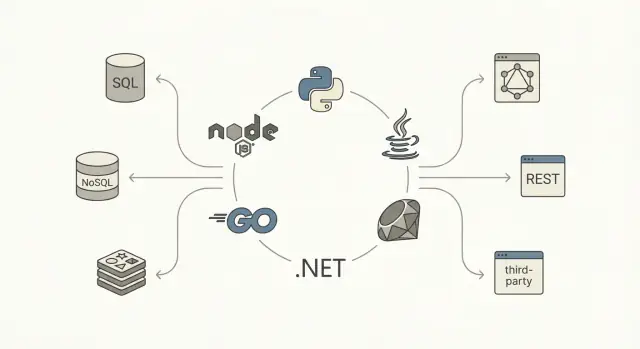
What “Best Backend Language” Really Means
“Best backend language” is usually shorthand for “best fit for what I’m building, with the people and constraints I have.” A language can be perfect for one backend workload and a poor match for another—even if it’s popular, fast, or loved by your team.
Start by defining the real goal
Before you compare Node.js backend vs Python backend vs Java backend (and so on), name the job your backend must do:
- APIs for mobile/web: predictable latency, clean API development patterns, good observability
- Web apps: rapid iteration, templating, background jobs, integrations
- Microservices: operational consistency, deploy tooling, strong contracts between services
- Data-heavy services: batching, streaming, memory behavior, database and queue integrations
- Real-time systems: concurrency model, backpressure, WebSockets, event-driven design
Different goals shift the weighting between performance vs productivity. A language that accelerates feature delivery for a CRUD API might slow you down for high-throughput streaming or low-latency systems.
Clarify constraints that can outweigh “technical best”
Choosing a backend programming language is often decided by constraints more than features:
- Timeline: Can you ship in weeks, or is this a multi-year platform?
- Team skills: Are you staffed for Go backend/.NET backend today, or would it be a learning project?
- Hosting and ops: Container-first? Serverless? Windows-only environments? Cost limits?
- Compliance and security: Auditing needs, dependency policies, patch cadence
- Existing codebase: Reuse libraries, shared models, monorepo practices, and integration points
Set the right expectation
There is no single best backend language in 2026—only trade-offs. Ruby on Rails might win for speed of building a product, Go might win for operational simplicity, Java might win for mature ecosystems and enterprise tooling, and Node.js might win for real-time and full-stack JavaScript alignment.
By the end of this guide, you should be able to pick a language with confidence by matching it to your workload, constraints, and long-term ownership—not by hype or rankings.
The Core Criteria to Use Before Comparing Languages
Picking a backend programming language is less about “what’s best” and more about what optimizes your specific outcomes. Before you compare a Node.js backend to a Python backend, or Java backend to Go backend, make the criteria explicit—otherwise you’ll debate preferences instead of making a decision.
A practical set of decision criteria
Start with a short list you can actually score:
- Time-to-market: how quickly your team can ship a stable API, iterate, and fix bugs.
- Runtime performance: latency and throughput under your expected load—not micro-benchmarks.
- Concurrency model: how the language handles many simultaneous requests, background jobs, streaming, and I/O.
- Stability and maturity: release cadence, backward compatibility, and how often “minor upgrades” become projects.
Add any domain-specific requirements (e.g., real-time features, heavy data processing, or strict compliance) as additional criteria.
Total cost of ownership (TCO) beats “developer speed” alone
TCO is the combined price of building and owning the system:
- Development speed: scaffolding, frameworks, and how much boilerplate your team must maintain.
- Operations: observability, deployment complexity, runtime footprint, and on-call burden.
- Hiring and ramp-up: availability of talent for .NET backend, Go backend, Ruby on Rails, etc.
- Maintenance: readability, testability, safety features, and the cost of refactors over years.
A language that’s fast to prototype can become expensive if it leads to frequent incidents or hard-to-change code.
Hidden constraints that quietly decide for you
Some constraints are non-negotiable, and it’s better to surface them early:
- Vendor/cloud services: first-class SDKs, authentication stacks, managed queues, and serverless runtimes.
- Enterprise standards: approved runtimes, security policies, and audit requirements.
- Legacy systems: existing libraries, JVM/.NET dependencies, or shared code with other teams.
Weight criteria based on business priorities
Don’t treat every criterion equally. If you’re validating a market, weight time-to-market higher. If you’re building a long-lived internal platform, weight maintainability and operational stability more. A simple weighted scorecard keeps the conversation grounded and makes trade-offs explicit for API development and beyond.
Start With Your Backend Workload and Architecture
Before you compare syntax or benchmarks, write down what your backend must do and how it will be shaped. Languages look “best” when they match the workload and the architecture you’re actually building.
Map your workload types
Most backends are a mix, but the dominant work matters:
- CRUD APIs (typical product apps): request/response, validations, auth, database reads/writes.
- CPU-bound tasks: image/video processing, heavy transforms, encryption, recommendation logic, complex reporting.
- I/O-bound services: chat, gateways, aggregation services, webhooks, lots of waiting on databases and third-party calls.
- Streaming and real-time: event ingestion, log pipelines, websocket services, near-real-time analytics.
If your system is mostly I/O-bound, concurrency primitives, async tooling, and ergonomics often matter more than raw speed. If it’s CPU-bound, predictable performance and easy parallelism rise to the top.
Understand traffic and reliability needs
Traffic shape changes language pressure:
- Spiky traffic (marketing launches, ticket drops): fast cold starts, autoscaling behavior, and resource efficiency.
- Steady high throughput: sustained performance, memory behavior, and observability maturity.
Also note global latency expectations and the SLA you’re targeting. A 99.9% API SLA with tight p95 latency requirements pushes you toward mature runtimes, strong tooling, and proven deployment patterns.
Get specific about data and integration
Document your data path:
- SQL vs NoSQL, transaction requirements, and consistency needs.
- Caching layers (Redis/memcached), read replicas, and analytics pipelines.
Finally, list integrations: third-party APIs, messaging/queues (Kafka, RabbitMQ, SQS), and background jobs. If async work and queue consumers are central, pick a language/ecosystem where workers, retries, idempotency patterns, and monitoring are first-class—not afterthoughts.
Performance and Concurrency: What Matters in Practice
Performance isn’t a single number. For backends, it usually breaks down into latency (how fast one request completes), throughput (how many requests you can serve per second), and resource usage (CPU, memory, and sometimes network/IO). The language and runtime affect all three—mostly through how they schedule work, manage memory, and handle blocking operations.
Latency vs. throughput (and why your p95 matters)
A language that looks fast in microbenchmarks can still produce poor tail latency (p95/p99) under load—often due to contention, blocking calls, or memory pressure. If your service is IO-heavy (DB, cache, HTTP calls), the biggest wins often come from reducing waiting and improving concurrency, not from shaving nanoseconds off pure compute.
Concurrency models you’ll actually feel
Different ecosystems push different approaches:
- Async I/O (event loop): Common in Node.js and increasingly in Python/.NET/Java. Great for high-concurrency IO workloads, but mixing in CPU-heavy work can stall the loop unless you offload it.
- Threads / thread pools: Classic in Java and .NET (also available elsewhere). Straightforward mental model, but you need to watch thread pool saturation, blocking calls, and context switching overhead.
- Goroutines: Go’s lightweight concurrency can make it easy to spawn many concurrent tasks, but you still need to understand blocking points, shared state, and backpressure.
- Actors / message passing: Seen with Akka (JVM), Orleans (.NET), and similar patterns. Helps isolate state and simplify concurrency, at the cost of more architectural ceremony.
Garbage collection and memory behavior
GC-managed runtimes can boost developer productivity, but allocation rate and heap growth can impact tail latency via pauses or increased CPU work for collection. You don’t need to be a GC expert—just know that “more allocations” and “bigger objects” can become performance problems, especially at scale.
Practical takeaway: benchmark your critical paths
Before deciding, implement (or prototype) a few representative endpoints and measure:
- p50/p95/p99 latency under realistic load
- throughput at acceptable error rates
- CPU/memory profiles during peak
Treat this as an engineering experiment, not a guess. Your workload’s mix of IO, compute, and concurrency will make the “fastest” backend programming language look different in practice.
Ecosystem, Frameworks, and Tooling Fit
A backend language rarely succeeds on syntax alone. The day-to-day experience is shaped by its ecosystem: how quickly you can scaffold services, evolve schemas, secure endpoints, test changes, and ship safely.
Frameworks and “standard paths”
Look for frameworks that match your preferred style (minimal vs batteries-included) and your architecture (monolith, modular monolith, microservices). A healthy ecosystem usually has at least one widely adopted “default” option plus solid alternatives.
Pay attention to the unglamorous parts: mature ORMs or query builders, reliable migrations, authentication/authorization libraries, input validation, and background job tooling. If these pieces are fragmented or outdated, teams tend to re-implement basics and accumulate inconsistent patterns across services.
Dependency management and release cadence
The best package manager is the one your team can operate predictably. Evaluate:
- How dependencies are pinned and locked (repeatable builds)
- Security advisories and audit tooling
- SemVer discipline in popular libraries
- Upgrade ergonomics (breaking changes, deprecations, migration guides)
Also check the language and framework release cadence. Fast releases can be great—if your organization can keep up. If you’re in a regulated environment or run many services, a slower, long-term-support rhythm may reduce operational risk.
Observability and debugging in production
Modern backends need first-class observability. Ensure the ecosystem has mature options for structured logging, metrics (Prometheus/OpenTelemetry), distributed tracing, and profiling.
A practical test: can you go from “p95 latency spiked” to a specific endpoint, query, or dependency call within minutes? Languages with strong profiling and tracing integrations can save significant engineering time over a year.
Operational fit: containers, serverless, and long-running services
Operational constraints should influence language choice. Some runtimes shine in containers with small images and fast startup; others excel for long-running services with predictable memory behavior. If serverless is on the table, cold-start characteristics, packaging limits, and connection management patterns matter.
Before committing, build a thin vertical slice and deploy it the way you intend to run it (e.g., in Kubernetes or a function platform). It’s often more revealing than reading framework feature lists.
Maintainability, Safety, and Developer Experience
Maintainability is less about “beautiful code” and more about how quickly a team can change behavior without breaking production. Language choice influences that through type systems, tooling, and the norms of the ecosystem.
Static vs dynamic typing: refactoring and reliability
Strongly typed languages (Java, Go, C#/.NET) tend to make large refactors safer because the compiler becomes a second reviewer. Rename a field, change a function signature, or split a module, and you get immediate feedback across the codebase.
Dynamically typed languages (Python, Ruby, vanilla JavaScript) can be very productive, but correctness relies more on conventions, test coverage, and runtime checks. If you go this route, “gradual typing” often helps: TypeScript for Node.js, or type hints plus a checker (e.g., mypy/pyright) for Python. The key is consistency—half-typed code can be worse than either extreme.
API contracts: DTOs, schemas, and OpenAPI
Backend systems fail at the boundaries: request/response formats, event payloads, and database mappings. A maintainable stack makes contracts explicit.
OpenAPI/Swagger is the common baseline for HTTP APIs. Many teams pair it with schema validation and DTOs to prevent “stringly-typed” APIs. Examples you’ll see in practice:
- Node.js: OpenAPI + Zod/Joi for validation; DTOs via TypeScript types
- Python: FastAPI + Pydantic models
- Java: Bean Validation + generated DTOs from OpenAPI
- .NET: FluentValidation + strong DTOs + OpenAPI generation
Code generation support matters: generating clients/servers/DTOs reduces drift and improves onboarding.
Testing culture and tooling
Ecosystems differ in how naturally testing fits into the workflow. Node commonly uses Jest/Vitest with fast feedback. Python’s pytest is expressive and excels at fixtures. Java’s JUnit/Testcontainers is strong for integration tests. Go’s built-in testing package encourages straightforward tests, while .NET’s xUnit/NUnit integrates tightly with IDEs and CI. Ruby’s RSpec culture is opinionated and readable.
A practical rule: choose the ecosystem where it’s easiest for your team to run tests locally, mock dependencies cleanly, and write integration tests without ceremony.
Team Skills, Hiring Market, and Long-Term Ownership
Picking a backend programming language is also a staffing decision. A language that’s “best” on paper can become expensive if you can’t hire, onboard, and retain people who can operate it confidently.
Match the language to the team you actually have
Inventory current strengths: not just who can write code, but who can debug production issues, tune performance, set up CI, handle incidents, and review PRs at speed.
A simple rule that holds up well: prefer languages the team can operate well, not just write. If your on-call rotation already struggles with observability, deployments, or concurrency bugs, adding a new runtime or paradigm may amplify risk.
Hiring availability: region and seniority matter
Hiring markets vary sharply by geography and experience level. For example, you may find plenty of junior Node.js or Python candidates locally, but fewer senior engineers with deep JVM tuning or Go concurrency experience—or the opposite, depending on your region.
When evaluating “availability,” look at:
- Local vs remote reality: Can you hire remotely in your time zones, or does collaboration require co-location?
- Seniority distribution: Are you hiring seniors to lead design and mentoring, or mostly mid-level engineers to scale delivery?
- Competing demand: If every nearby company is hiring the same profile, expect longer time-to-fill and higher compensation pressure.
Learning curve and onboarding time
Even strong engineers need time to become effective in a new ecosystem: idioms, frameworks, testing practices, dependency management, and deployment tooling. Estimate onboarding in weeks, not days.
Practical questions:
- Can a new hire ship a safe, reviewed change in the first two weeks?
- Do you have internal templates (service skeletons, logging, auth, CI) that reduce variance?
- Are there enough experienced reviewers to keep quality high while people ramp up?
Long-term ownership (2–3 years from now)
Optimizing for initial velocity can backfire if the team dislikes maintaining the stack. Consider upgrade cadence, framework churn, and how pleasant the language is for writing tests, refactoring, and tracing bugs.
If you expect turnover, prioritize readability, predictable tooling, and a deep bench of maintainers—because “ownership” lasts longer than the first release.
Quick Comparison: Node.js, Python, Java, Go, .NET, Ruby
Node.js
Node.js shines for I/O-heavy APIs, chat, collaboration tools, and real-time features (WebSockets, streaming). A common stack is TypeScript + Express/Fastify/NestJS, often paired with PostgreSQL/Redis and queues.
The usual pitfalls are CPU-bound work blocking the event loop, dependency sprawl, and inconsistent typing if you stay on plain JavaScript. When performance matters, push heavy compute to workers/services and keep strict TypeScript + linting.
Python
Python is a productivity leader, especially for data-heavy backends that touch analytics, ML, ETL, and automation. Framework choices typically split between Django (batteries-included) and FastAPI (modern, typed, API-first).
Performance is usually “good enough” for many CRUD systems, but hot paths can become costly at scale. Common strategies: async I/O for concurrency, caching, moving compute to specialized services, or using faster runtimes/extensions where justified.
Java
Java remains a strong default for enterprise systems: mature JVM tooling, predictable performance, and a deep ecosystem (Spring Boot, Quarkus, Kafka, observability tooling). Ops maturity is a key advantage—teams know how to deploy and run it.
Typical use cases include high-throughput APIs, complex domains, and regulated environments where stability and long-term support matter.
Go
Go fits microservices and network services where concurrency and simplicity are priorities. Goroutines make “many things at once” straightforward, and the standard library is practical.
Trade-offs: fewer batteries-included web frameworks than Java/.NET, and you may write more plumbing yourself (though that can be a feature).
.NET
Modern .NET (ASP.NET Core) is excellent for enterprise APIs, with strong tooling (Visual Studio, Rider), great performance, and solid Windows/Linux parity. A common stack is ASP.NET Core + EF Core + SQL Server/PostgreSQL.
Ruby
Ruby on Rails is still one of the fastest ways to ship a polished web product. Scaling is often achieved by extracting heavy workloads into background jobs and services.
The trade-off is raw throughput per instance; you typically scale horizontally and invest earlier in caching and job queues.
Common Scenarios and Which Languages Often Fit
There’s rarely a single “best” backend programming language—only a best fit for a specific workload, team, and risk profile. Here are common patterns and the languages that tend to match them.
Startups shipping fast (MVP → product-market fit)
If speed of iteration and hiring generalists matter most, Node.js and Python are frequent picks. Node.js shines when the same team wants to share TypeScript across frontend and backend, and when API development is primarily I/O-bound. Python is strong for data-heavy products, scripting, and teams that expect to integrate analytics or ML early.
Ruby on Rails is still a great “feature factory” when the team is Rails-experienced and you’re building a conventional web app with lots of CRUD and admin workflows.
High-throughput APIs and concurrency-heavy services
For services where latency, throughput, and predictable resource use dominate, Go is a common default: fast startup, simple concurrency model, and easy containerization. Java and .NET are also excellent choices here, especially when you need mature profiling, JVM/CLR tuning, and battle-tested libraries for distributed systems.
If you expect long-running connections (streaming, websockets) or high fan-out, prioritize runtime behavior under load and operational tooling over raw micro-benchmarks.
Internal tools and business automation
For internal tools, developer time often costs more than compute. Python, Node.js, and .NET (particularly in Microsoft-heavy orgs) typically win due to rapid delivery, strong libraries, and easy integration with existing systems.
Regulated and enterprise environments
In compliance-heavy settings (auditability, access controls, long support cycles), Java and .NET tend to be safest: mature security practices, established governance patterns, and predictable LTS options. This matters when “Who can approve a dependency?” is as important as performance vs productivity.
Monolith vs microservices (and language choice)
A monolith usually benefits from a single primary language to keep onboarding and maintenance simple. Microservices can justify more diversity—but only when teams are truly autonomous and platform tooling (CI/CD, observability, standards) is strong.
Polyglot reality: when two languages are reasonable
A pragmatic split is common: e.g., Java/.NET/Go for core APIs and Python for data pipelines. Avoid polyglot “for preference” early; each new language multiplies incident response, security review, and ownership overhead.
A Practical Decision Framework and Scoring Matrix
Picking a backend programming language is easier when you treat it like a product decision: define constraints, score options, then validate with a small proof-of-concept (PoC). The goal isn’t a “perfect” choice—it’s a defensible one you can explain to your team and future hires.
Step 1: Separate must-haves from nice-to-haves
Start with two lists:
- Must-have requirements (non-negotiable): e.g., specific cloud/runtime constraints, required compliance, team needs to ship in 8 weeks, must support gRPC, must run within a memory limit.
- Nice-to-have requirements (tradeable): e.g., “best-in-class DX,” “largest ecosystem,” “most elegant syntax.”
If a language fails a must-have, it’s out—no scoring debate. This prevents analysis paralysis.
Step 2: Use a simple scorecard (weights + 1–5 scoring)
Create a short matrix and keep it consistent across candidates.
| Criterion | Weight (%) | Score (1–5) | Weighted score |
|---|---|---|---|
| Performance & concurrency fit | 20 | ||
| Ecosystem & libraries (DB, auth, queues) | 20 | ||
| Developer productivity | 15 | ||
| Hiring & long-term maintainability | 15 | ||
| Operational fit (deploy, observability) | 15 | ||
| Safety & correctness (typing, tooling) | 15 |
How to calculate: Weighted score = Weight × Score. Sum totals per language. Keep weights to ~5–7 criteria so the numbers stay meaningful.
Step 3: Run a PoC that mirrors real work
PoC checklist (time-box it to 1–3 days per language):
- One API endpoint (validation + error handling)
- Auth (JWT/session/OAuth—whatever you’ll actually use)
- Database CRUD + migration
- Background job/queue task
- Basic logging, metrics, and a trace
- Deploy to your target environment (container/serverless/VM)
Step 4: Define PoC success metrics
Decide upfront what “good” means:
- Latency target: e.g., p95 < 150ms for a representative endpoint
- Deploy time: e.g., < 10 minutes from clean checkout to production deploy
- Error rate: e.g., < 0.1% in a small load test with realistic failures
- Dev velocity: time to implement the PoC checklist + number of sharp edges encountered
Score the PoC results back into the matrix, then choose the option with the best total and the fewest must-have risks.
Pitfalls to Avoid and How to Future-Proof the Choice
Choosing a backend programming language is easiest to get wrong when the decision is made from the outside in—what’s trending, what a conference talk praised, or what won a single benchmark.
Don’t optimize for hype (or one chart)
A micro-benchmark rarely reflects your real bottlenecks: database queries, third‑party APIs, serialization, or network latency. Treat “fastest” claims as a starting question, not a verdict. Validate with a thin proof-of-concept that mirrors your workload: data access patterns, payload sizes, and concurrency profile.
Watch for operational mismatches
Many teams pick a language that looks productive in code, then pay the price in production:
- Async complexity: some stacks make non-blocking code easy; others require stricter discipline to avoid deadlocks, thread starvation, or callback/async sprawl.
- GC tuning and memory behavior: managed runtimes can be excellent, but you must be comfortable with heap sizing, pause behavior, and observability.
- Deployment constraints: containers, cold starts, ARM vs x86, minimal base images, and build tooling can make “simple” deployments surprisingly expensive.
If your org can’t support the operational model, the language choice won’t save you.
Plan migration as a product, not a rewrite
Future-proofing often means not betting everything at once. Favor incremental migration:
- Start new features as small services (or modules) while keeping the core stable.
- Use the strangler pattern: route specific endpoints or flows to the new implementation, expand gradually.
- Keep shared contracts (OpenAPI/JSON Schema/Protobuf) as the source of truth to reduce cross-language drift.
Checklist and next steps
- Define the top 3 constraints (latency, throughput, cost, compliance, hiring).
- Prototype with real data paths, then load-test.
- Verify ops readiness: CI/CD, monitoring, incident response, runtime tuning.
- Choose a migration path (incremental > rewrite) and lock API contracts.
- Run a 60–90 day pilot, then standardize on conventions and tooling.
FAQ
Is there a single “best backend language” in 2026?
It means best fit for your workload, team, and constraints, not a universal winner. A language can be great for a CRUD API and a poor fit for low-latency streaming or CPU-heavy processing. Make the choice based on measurable needs (latency, throughput, ops, hiring), not rankings.
What should I define before comparing Node.js vs Python vs Java vs Go vs .NET?
Start by writing down the dominant workload:
- CRUD APIs (auth + validation + DB)
- I/O-bound services (webhooks, gateways, lots of external calls)
- CPU-bound tasks (image/video, encryption, heavy transforms)
- Real-time/streaming (WebSockets, ingestion pipelines)
Then pick languages whose concurrency model and ecosystem match that workload, and validate with a small PoC.
What decision criteria matter most when picking a backend language?
Use a short, scoreable list:
- Time-to-market (how fast you can ship and iterate)
- Performance under real load (p95/p99 latency, not microbenchmarks)
- Concurrency model (async I/O, threads, goroutines, actors)
- Stability/maturity (upgrade cadence, backward compatibility)
Add any hard requirements like compliance, serverless constraints, or required SDKs.
Why does total cost of ownership (TCO) matter more than raw developer speed?
TCO includes building and owning the system:
- Dev speed (frameworks, boilerplate, test ergonomics)
- Ops burden (deploy complexity, observability, runtime footprint)
- Hiring and onboarding time
- Maintenance cost (refactors, upgrades, incident frequency)
A language that prototypes quickly can still be expensive if it increases incidents or makes changes risky.
How does the concurrency model affect backend performance in practice?
Concurrency determines how well your service handles many simultaneous requests and long waits on DB/HTTP/queues:
- Event loop / async I/O: great for high-concurrency I/O (but CPU work can stall the loop)
- Threads / pools: simple model, but watch saturation and blocking
- Goroutines: lightweight concurrency, still needs backpressure discipline
- Actors: isolates state, adds architectural overhead
Match the model to your dominant workload and your team’s operational maturity.
Why should I care about garbage collection and tail latency (p95/p99)?
Because what hurts in production is often tail latency (p95/p99), not average speed. GC-managed runtimes can see latency spikes if allocation rate and heap growth are high. The practical approach is to measure your real critical paths and watch CPU/memory under load, rather than trusting microbenchmarks.
What should a proof-of-concept (PoC) include before committing to a language?
Do a thin vertical slice that matches real work:
- One endpoint with validation + error handling
- Real auth (JWT/session/OAuth)
- DB CRUD + a migration
- A background job/queue consumer
- Logging + metrics + trace (OpenTelemetry/Prometheus)
- Deploy to your real target (Kubernetes/serverless/VM)
Time-box it (1–3 days per language) and compare results against pre-set targets.
How do I decide between static typing and dynamic typing for a backend?
It depends on how you want correctness enforced:
- Static typing helps large refactors: the compiler catches breakage early.
- Dynamic typing can be fast, but relies more on tests and runtime checks.
If you choose a dynamic language, use gradual typing consistently (e.g., TypeScript or Python type hints + mypy/pyright) to avoid “half-typed” drift.
How should team skills and hiring market influence the backend language choice?
Because production ownership is as important as writing code. Ask:
- Who can debug incidents, tune performance, and review PRs quickly?
- Can you hire the right seniority in your region/time zones?
- How long until a new hire can ship a safe change (weeks, not days)?
Prefer the language your team can operate well, not just implement features in.
What are the biggest pitfalls to avoid when choosing a backend language?
Common pitfalls:
- Choosing based on hype or a single benchmark
- Ignoring operational constraints (cold starts, containers, ARM/x86, memory limits)
- Underestimating async/GC complexity and observability needs
- Going polyglot too early “for preference”
Future-proof by keeping contracts explicit (OpenAPI/JSON Schema/Protobuf), validating with PoCs, and migrating incrementally (e.g., strangler pattern) instead of rewriting everything at once.