

Claude Code for CI failures: prompts for small fixes + tests
Claude Code for CI failures: prompt it to quote the failing output, suggest the smallest fix, and add a regression test to stop repeats.
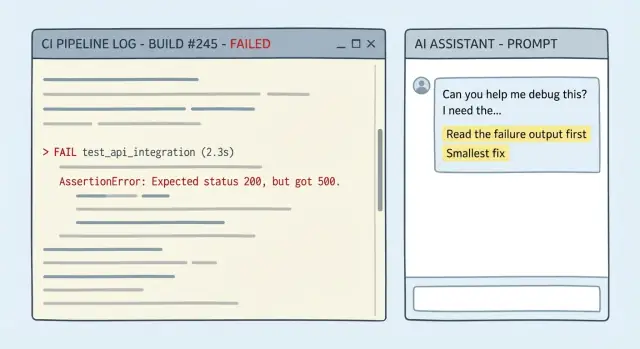
What goes wrong when CI fails and AI guesses
A CI failure usually isn't mysterious. The log tells you where it stopped, what command failed, and the error message. A good run includes a stack trace, a compiler error with a file and line number, or a test report showing which assertion failed. Sometimes you even get a diff-style clue like "expected X, got Y" or a clear failing step like "lint", "build", or "migrate database".
The real problem is that people (and AI) often treat the log as background noise. If you paste a long log and ask for "a fix", many models jump to a familiar explanation instead of reading the last meaningful lines. The guessing gets worse when the error looks common ("module not found", "timeout", "permission denied"). You end up with a big rewrite, a new dependency, or a "try updating everything" answer that doesn't match the actual failure.
The goal isn't "make it pass somehow". It's simpler:
- Read the failing output.
- Identify the smallest change that makes the failing step succeed.
- Keep everything else the same.
In practice, the "smallest fix" is usually one of these: a few-line code change in one place, a missing import or wrong path, a config value that's clearly wrong for the CI environment, or reverting an accidental breaking change instead of redesigning the code.
A follow-up test matters, too. Passing CI once isn't the same as preventing repeats. If the failure came from an edge case (null input, timezone, rounding, permissions), add a regression test that fails before the fix and passes after. That turns a one-time rescue into a guardrail.
What to gather before you ask for help
Most bad fixes start with missing context. If you only paste the last red line, the model has to guess what happened earlier, and guesses often turn into rewrites.
Aim to provide enough detail that someone can follow the failure from the first real error to the end, then change as little as possible.
Copy these into your message (verbatim when you can):
- The full failing log from the first error line through the end (not just the final stack trace).
- The exact command CI ran (for example,
go test ./...,npm test,flutter test,golangci-lint run). - The file paths mentioned in the error, plus any relevant config (test config, linter config, build scripts).
- What changed recently: PR diff summary, dependency bumps, CI config edits.
- Whether it is flaky: two or three failing runs and one passing run if you have them.
Add constraints in plain words. If you want a tiny fix, say so: no refactors, no behavior changes unless necessary, keep the patch limited to the failing area.
A simple example: CI fails on a lint step after a dependency bump. Paste the lint output starting from the first warning, include the command CI used, and mention the single package version change. That's enough to suggest a one-line config tweak or a small code change, instead of reformatting half the repo.
If you want something copy-pasteable, this structure is usually enough:
CI command:

Failing output (full):

Recent changes:

Constraints (smallest fix, no refactor):

Flaky? (runs attached):
Prompt rules that force it to read the failing output
When a model misses the mark on a CI break, it's usually because your prompt lets it guess. Your job is to make it show its work using the exact failing output, then commit to the smallest change that could make the job pass.
Rules that keep the model honest
Require evidence and a tiny plan. A good prompt forces five things:
- Quote the exact failing lines from the CI log (errors, stack trace, file:line) and explicitly say "I'm using these lines."
- Give a one-sentence diagnosis, no hedging.
- Propose a minimal patch plan with 1-3 edits, naming the exact files it will touch.
- Avoid unrelated changes (no formatting, renames, refactors, dependency bumps) unless you approve.
- List what it's unsure about and the single piece of info that would confirm it.
Uncertainty is fine. Hidden uncertainty is what wastes time.
Copy-ready prompt fragment
Paste this at the top of your CI question:
Use ONLY the evidence in the CI output below.
1) Quote the exact failing lines you are using.
2) Give ONE sentence: the most likely cause.
3) Propose the smallest fix: 1-3 edits, with file paths.
4) Do NOT do formatting/renames/refactors or "cleanup".
5) List uncertainties + the one extra detail that would confirm the diagnosis.
If the log says "expected 200, got 500" plus a stack trace into user_service.go:142, this structure pushes the response toward that function and a small guard or error handling change, not a redesign of the endpoint.
A copy-paste prompt template for CI failures
The fastest wins come from a prompt that forces quoting the logs, stays inside constraints, and stops when something is missing.
You are helping me fix a CI failure.

Repo context (short):
- Language/framework:
- Test/build command that failed: <PASTE THE EXACT COMMAND>
- CI environment (OS, Node/Go/Python versions, etc.):

Failing output (verbatim, include the first error and 20 lines above it):
<PASTE LOG>

Constraints:
- Propose the smallest possible code change that makes CI pass.
- Do NOT rewrite/refactor unrelated code.
- Do NOT touch files you do not need for the fix.
- If behavior changes, make it explicit and justify why it is correct.

Stop rule (no guessing):
- If the log is incomplete or you need more info (missing stack trace, config, versions, failing test name), STOP and ask only the minimum questions needed.

Your response format (follow exactly):
1) Evidence: Quote the exact log lines that matter.
2) Hypothesis: Explain the most likely cause in 2-4 sentences.
3) Smallest fix: Describe the minimal change and why it addresses the evidence.
4) Patch: Provide a unified diff.
5) Follow-up: Tell me the exact command(s) to rerun locally to confirm.

Then, write ONE regression test (or tweak an existing one) that would fail before this fix and pass after it, to prevent the same failure class.
- Keep the test focused. No broad test suites.
- If a test is not feasible, explain why and propose the next-best guardrail (lint rule, type check, assertion).
Two details that reduce back-and-forth:
- Include the exact failing command and the first error (not just the final summary).
- If there are multiple failures, say which one to fix first (usually the earliest real failure in the log).
How to push for the smallest fix, not a rewrite
The quickest way to lose time is to accept a "cleanup" change set that modifies five things at once. Define "minimal" up front: the smallest diff that makes the failing job pass, with the lowest risk and the fastest way to verify.
A simple rule works well: fix the symptom first, then decide if a broader refactor is worth it. If the log points to one file, one function, one missing import, or one edge case, aim there. Avoid "while we're here" edits.
If you truly need alternatives, ask for two and only two: "safest minimal fix" vs "fastest minimal fix." You want tradeoffs, not a menu.
Also require local verification that matches CI. Ask for the same command the pipeline runs (or the closest equivalent), so you can confirm in minutes:
# run the same unit test target CI runs
make test
# or the exact script used in CI
npm test
If the response suggests a large change, push back with: "Show the smallest patch that fixes the failing assertion, with no unrelated formatting or renames."
Prompting for a follow-up test that prevents repeats
A fix without a test is a bet you won't hit the same problem again. Always ask for a follow-up test that fails before the fix and passes after.
Be specific about what "good" looks like:
- If the failure was a unit test crash, you probably want a new test or a stronger assertion.
- If the failure was a build, lint, or formatting rule, you want a check that enforces the rule so the same class of mistake can't sneak back in.
A useful pattern is to require four things: where to put the test, what to name it, what behavior it should cover, and a short note explaining why it prevents future regressions.
Copy-ready add-on:
- Write one regression test that fails on the current main branch and passes after your fix.
- Make it target the same failure class, not just the exact line that broke.
- Put the test in: <path or folder>. Follow naming: <your convention>.
- If this is a lint/build rule, add or adjust a check that enforces the rule.
- Add 2-3 sentences: why this test would catch a similar bug later.
Example: CI shows a panic when an API handler receives an empty string ID. Don't ask for "a test for this line." Ask for a test that covers invalid IDs (empty, whitespace, wrong format). The smallest fix might be a guard clause that returns a 400 response. The follow-up test should assert behavior for multiple invalid inputs, so the next time someone refactors parsing, CI fails fast.
If your project already has test conventions, spell them out. If you don't, ask it to mirror nearby tests in the same package or folder, and keep the new test minimal and readable.
A step-by-step workflow you can reuse
1) Give it the failure as-is
Paste the CI log section that includes the error and 20-40 lines above it. Also paste the exact failing command CI ran and key environment details (OS, runtime versions, important flags).
Then ask it to restate what failed in plain English and point to the line(s) in the output that prove it. If it can't quote the log, it hasn't really read it.
2) Demand the smallest patch first
Ask for the smallest possible code change that makes the failing command pass. Push back on refactors. Before you apply anything, have it list:
- The file(s) it will touch
- The exact behavior that will change
- What it is not changing
3) Re-run the same command, keep the loop tight
Apply the patch and re-run the exact failing command locally (or in the same CI job if that's your only option). If it still fails, paste only the new failing output and repeat. Keeping context small helps keep the response focused.
4) Add a regression test for the failure class
Once green, add one follow-up test that would have failed before the patch and now passes. Keep it targeted: one test, one reason.
Re-run the command again with the new test included to confirm you didn't just silence the error.
5) Finish with a clean PR packet
Ask for a short commit message and a PR description that includes what failed, what changed, how you verified it, and what test prevents a repeat. Reviewers move faster when the reasoning is spelled out.
A realistic example: from failing output to fix and test
A common failure: everything worked locally, then a small change makes tests fail on the CI runner. Here's a simple one from a Go API where a handler started accepting a date-only value (2026-01-09) but the code still parses only full RFC3339 timestamps.
This is the kind of snippet to paste (keep it short, but include the error line):
--- FAIL: TestCreateInvoice_DueDate (0.01s)
    invoice_test.go:48: expected 201, got 400
    invoice_test.go:49: response: {"error":"invalid due_date: parsing time \"2026-01-09\" as \"2006-01-02T15:04:05Z07:00\": cannot parse \"\" as \"T\""}
FAIL
exit status 1
FAIL	app/api	0.243s
Now use a prompt that forces evidence, a minimal fix, and a test:
You are fixing a CI failure. You MUST use the log to justify every claim.

Context:
- Language: Go
- Failing test: TestCreateInvoice_DueDate
- Log snippet:
<PASTE LOG>

Task:
1) Quote the exact failing line(s) from the log and explain the root cause in 1-2 sentences.
2) Propose the smallest possible code change (one function, one file) to accept both RFC3339 and YYYY-MM-DD.
3) Show the exact patch.
4) Add one regression test that fails before the fix and passes after.
Return your answer with headings: Evidence, Minimal Fix, Patch, Regression Test.
A good response will point to the parsing layout mismatch, then make a small change in one function (for example, parseDueDate in invoice.go) to try RFC3339 first and fall back to 2006-01-02. No refactor, no new packages.
The regression test is the guardrail: send due_date: "2026-01-09" and expect 201. If someone later "cleans up" parsing and removes the fallback, CI breaks immediately with the same failure class.
Common mistakes that waste time (and how to avoid them)
The fastest way to lose an hour is to give a cropped view of the problem. CI logs are noisy, but the useful part is often 20 lines above the final error.
One trap is pasting only the last red line (for example, "exit 1") while hiding the real cause earlier (a missing env var, a failing snapshot, or the first test that crashed). Fix: include the failing command plus the log window where the first real error appears.
Another time sink is letting the model "tidy up" along the way. Extra formatting, dependency bumps, or refactors make it harder to review and easier to break something else. Fix: lock the scope to the smallest possible code change and reject anything unrelated.
A few patterns to watch for:
- Only pasting the last error line: include the failing command and the first error.
- Letting it change dependencies or unrelated files: require a minimal diff and a reason for every file touched.
- Accepting a fix that's not verified against the CI command: rerun the exact same command and confirm.
- Writing a test that still passes when the bug returns: require a test that fails on old code and passes on the fix.
- Mixing flaky tests with real regressions: decide whether it's nondeterministic (timing, network, order) or stable logic, then handle it appropriately.
If you suspect flakiness, don't paper over it with retries. Remove the randomness (fixed time, seeded RNG, isolated temp dirs) so the signal is clear.
Quick checks before you push the fix
Before you push, do a short sanity pass. The goal is to make sure the change is real, minimal, and repeatable, not a lucky run.
- Evidence: does the explanation quote the exact failing lines?
- Scope: are changes limited to what's needed to stop this failure?
- Causality: does it explain why this change flips the failing condition to passing?
- Repro: did you rerun the exact CI command (same flags, same working directory)?
- Regression: does the new test fail before the fix and pass after?
Finally, run a slightly wider set than the single failing job (for example, lint plus unit tests). A common trap is a fix that passes the original job but breaks another target.
Next steps: make this workflow a habit
If you want this to save time week after week, treat your prompt and response format like team process. The goal is repeatable inputs, repeatable outputs, and fewer "mystery fixes" that break something else.
Turn your best prompt into a shared snippet with a standard response structure: (1) evidence, (2) one-line cause, (3) smallest change, (4) follow-up test, (5) how to verify locally. When everyone uses the same format, reviews get faster because reviewers know where to look.
A lightweight habit loop that works in most teams:
- Save the prompt as a repo snippet and pin it in team chat.
- Label CI failures by type (lint, unit, integration, packaging, deploy).
- When a label repeats, add one test or check that would have caught it earlier.
- Keep risky experiments reversible so you can back out fast.
If you prefer a chat-first workflow for building and iterating on apps, you can run the same fix-and-test loop inside Koder.ai, use snapshots while experimenting, and export the source code when you're ready to merge it back into your usual repo.
FAQ
Where in a CI log should I look first when a job fails?
Start with the first real error, not the final exit 1.
- Find the earliest line that shows what failed (test name, file:line, command).
- Read ~20–40 lines above it for setup/context.
- Ignore downstream “cascade” errors until the first failure is fixed.
How do I stop an AI from guessing and giving a generic fix?
Ask it to prove it read the log.
Use a constraint like:
- “Quote the exact failing lines you’re using.”
- “One-sentence diagnosis.”
- “Smallest fix: 1–3 edits with exact file paths.”
- “Stop and ask questions if the log is incomplete.”
What does “smallest fix” actually mean for a CI failure?
Default to the smallest patch that makes the failing step succeed.
That usually means:
- One targeted code change (guard clause, correct import/path).
- One config tweak specific to CI.
- Reverting a breaking change instead of redesigning.
Avoid “cleanup” changes until CI is green again.
What should I include when I ask for help with a failing CI run?
Paste enough context to recreate the failure, not just the last red line.
Include:
- The exact CI command (
go test ./...,npm test,flutter test, etc.). - Log from the first error line through the end.
- The file paths mentioned in errors.
- What changed recently (dependency bump, CI config edit, PR summary).
- Whether it’s flaky (a couple failing runs + one passing run).
Can I explicitly tell the model not to refactor or reformat anything?
Yes—state constraints in plain language and repeat them.
Example constraints:
- “No refactors, renames, formatting, or dependency bumps.”
- “Touch only files required for the fix.”
- “If behavior changes, say exactly what changes and why it’s correct.”
This keeps the response focused and reviewable.
If CI shows multiple failures, which one do I fix first?
Fix the earliest real failure first.
- Later failures are often caused by the first one (for example, build fails → tests/lint never run correctly).
- If errors are independent, pick the one closest to blocking (often build/lint before integration).
When in doubt, ask the model to identify the first failing step in the log and stick to that.
How can I tell if a CI failure is flaky, and what should I do?
Treat flakiness as a signal to remove randomness, not to add retries.
Common stabilizers:
- Freeze time (inject a clock, use fixed timestamps).
- Seed RNG.
- Avoid network calls (mock/stub).
- Use isolated temp dirs and unique ports.
Once it’s deterministic, the “smallest fix” becomes obvious.
What’s the best way to verify the fix matches CI and isn’t a lucky pass?
Ask for the exact command CI ran, then run that locally.
- Same command and flags as CI.
- Match key environment versions when possible (Go/Node/Flutter versions, OS).
If local reproduction is hard, ask for a minimal repro inside the repo (a single test or target) that triggers the same error.
What makes a good follow-up test after fixing a CI failure?
Write one focused regression test that fails before the fix and passes after.
Good targets include:
- The edge case that caused the failure (null input, timezone, rounding, permissions).
- A slightly broader “failure class” (for example, multiple invalid IDs, not just one).
If it’s a lint/build failure, the equivalent “test” may be tightening a lint rule or adding a check that prevents the same mistake.
How do I iterate quickly without turning my repo into a mess while debugging CI?
Use snapshots/rollback to keep experiments reversible.
A practical loop:
- Make the smallest change.
- Run the exact failing command.
- If it still fails, revert or roll back to the last snapshot and try a different minimal patch.
If you build in Koder.ai, snapshots help you iterate quickly without mixing experimental edits into the final patch you’ll export.