

Claude Code for documentation drift: keep docs aligned
Learn Claude Code for documentation drift to keep READMEs, API docs, and runbooks aligned with code by generating diffs and flagging contradictions.
What documentation drift is (and why it keeps happening)
Documentation drift is the slow separation between what your docs say and what your code actually does. It starts as small mismatches, then turns into "we swear this worked last month" confusion.
On a real team, drift looks like this: the README says you can run a service with one command, but a new environment variable is now required. The API docs show an endpoint with a field that was renamed. A runbook tells on-call to restart "worker-a", but the process is now split into two services.
Drift happens even with good intentions because software changes faster than documentation habits. People ship fixes under pressure, copy old examples, or assume someone else will update the docs later. It also grows when you have too many places that look like "the source of truth": README files, API references, internal wiki pages, tickets, and tribal knowledge.
The costs are concrete:
- Onboarding breaks (new hires lose days to setup issues).
- Deploys fail (steps don't match current config).
- Support load rises (users follow outdated instructions).
- Incidents drag out (runbooks send responders down the wrong path).
Polishing the writing doesn't fix drift if the facts are wrong. What helps is treating docs like something you can verify: compare them to the current code, configs, and real outputs, then call out contradictions where the docs promise behavior the code no longer has.
Where drift shows up: README, API docs, and runbooks
Drift usually shows up in documents people treat as "quick reference". They get updated once, then the code keeps moving. Start with these three because they contain concrete promises you can check.
README: the first place users feel pain
READMEs drift when everyday commands change. A new flag gets added, an old one is removed, or an environment variable is renamed, but the setup section still shows the old reality. New teammates copy-paste instructions, hit errors, and assume the project is broken.
The worst version is "almost right". One missing environment variable can waste more time than a totally outdated README, because people keep retrying small variations instead of questioning the doc.
API docs: mismatched shapes and misleading examples
API docs drift when request or response fields change. Even small shifts (renamed keys, different defaults, new required headers) can break clients. Often the endpoint list is correct while the examples are wrong, which is exactly what users copy.
Typical signals:
- Example payloads include fields the server no longer accepts.
- Response samples show old error formats or status codes.
- Parameter tables call fields optional that are now required.
- Auth notes mention headers or scopes that no longer work.
- Pagination, sorting, or filtering rules don't match reality.
Runbooks: quiet drift that causes loud incidents
Runbooks drift when deployment, rollback, or operational steps change. One outdated command, wrong service name, or missing prerequisite can turn a routine fix into downtime.
They can also be "accurate but incomplete": the steps still work, but they skip a new migration, a cache clear, or a feature flag toggle. That's when responders follow the runbook perfectly and still get surprised.
How to use Claude Code: diffs and contradiction callouts
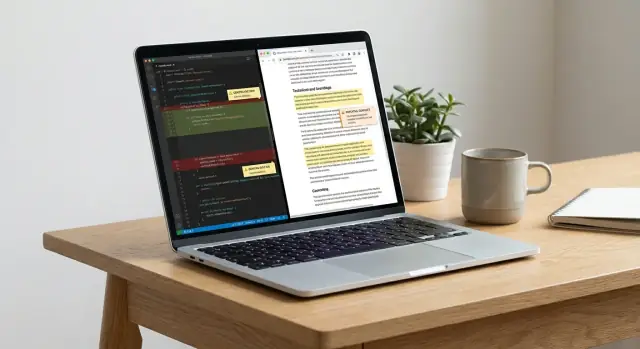
Claude Code for documentation drift works best when you treat docs like code: propose a small, reviewable patch and explain why. Instead of asking it to "update the README", ask it to generate a diff against specific files. Reviewers get a clear before/after and can spot unintended changes quickly.
A good drift check produces two things:
- A minimal diff
- A contradiction report that stays blunt and specific: "Doc says X, repo shows Y."
Ask for evidence, not opinions
When you prompt, require proof from the repo: file paths and details like routes, config values, or tests that demonstrate the current behavior.
Here's a prompt pattern that keeps it grounded:
Check these docs for drift: README.md, docs/api.md, runbooks/deploy.md.
Compare them to the current repo.
Output:
1) Contradictions list (doc claim -> repo evidence with file path and line range)
2) Unified diffs for the smallest safe edits
Rules: do not rewrite sections that are still accurate.
If Claude says "the API uses /v2", make it back that up by pointing to the router, OpenAPI spec, or an integration test. If it can't find evidence, it should say so.
Scope the change before editing
Drift usually starts with one code change that quietly affects multiple docs. Have Claude scope impact first: what changed, where it changed, which docs it likely breaks, and what user actions are affected.
Example: you rename an environment variable from API_KEY to SERVICE_TOKEN. A useful report finds every place the old name appears (README setup, API examples, runbook secrets section), then produces a tight diff that updates only those lines and any example commands that would now fail.
Set up a simple workflow before you prompt anything
If you point a model at "all docs" with no rules, you often get rewritten prose that still contains wrong facts. A simple workflow keeps changes small, repeatable, and easy to review.
Start with one doc set: the README, the API reference, or one runbook that people actually use. Fixing one area end to end teaches you what signals to trust before scaling up.
Decide what counts as the source of truth
Write down, in plain words, where facts should come from for that doc set.
- For a README: CLI help output and a working example app.
- For API docs: router definitions plus integration tests.
- For runbooks: deployment config and the alerts that trigger the procedure.
Once you've named those sources, prompts get sharper: "Compare the README to the current CLI output and config defaults, then generate a patch."
Pick an output that reviewers can validate fast
Agree on an output format before anyone runs the first check. Mixing formats makes it harder to see what changed and why.
A simple rule set:
- Require a diff for every doc change, plus a one-sentence reason.
- Allow a short contradiction list only when the tool can't safely propose wording.
- Keep diffs scoped to one doc file per change when possible.
- Treat failing examples (commands, requests, code snippets) as higher priority than general wording.
One practical habit: add a small note to each doc PR like "Source of truth checked: routes + tests" so reviewers know what was compared. That turns doc updates from "looks fine" into "verified against something real".
Step by step: keep docs aligned with code on each change
Treat each code change as a small docs investigation. The point is to catch contradictions early and produce a minimal patch reviewers can trust.
Start by choosing the exact files to check and a clear drift question. For example: "Did we change any environment variables, CLI flags, HTTP routes, or error codes that the docs still mention?" Being specific keeps the model from rewriting whole sections.
Next, have Claude Code extract hard facts from the code first. Ask it to list concrete items only: commands users run, endpoints and methods, request and response fields, config keys, required environment variables, and operational steps referenced by scripts or configs. If something isn't found in code, it should say "not found" rather than guessing.
Then ask for a simple comparison table: doc claim, what the code shows, and a status (match, mismatch, missing, unclear). That keeps discussion grounded.
After that, request a unified diff with minimal edits. Tell it to change only the lines needed to resolve mismatches, keep the doc's existing style, and avoid adding promises that aren't backed by code.
Finish with a short reviewer summary: what changed, why it changed, and what to double-check (like a renamed environment variable or a new required header).
API docs: a practical way to verify endpoints and examples
API docs drift when the code changes quietly: a route gets renamed, a field becomes required, or an error shape changes. The result is broken client integrations and wasted debugging time.
With Claude Code for documentation drift, the job is to prove what the API does from the repo, then point to mismatches in the docs. Ask it to extract an inventory from routing and handlers (paths, methods, request and response models) and compare that to what the API reference claims.
Focus on what people actually copy-paste: curl commands, headers, sample payloads, status codes, and field names. In a single prompt, make it check:
- Auth requirements (headers, token type, public endpoints)
- Pagination params and defaults
- Error status codes and JSON format
- Versioning behavior (v1 vs v2)
- Whether examples match current validation rules
When it finds a mismatch, only accept diffs where it can cite evidence from the code (the exact route definition, handler behavior, or schema). That keeps patches small and reviewable.
Example: the code now returns 201 on POST /widgets and adds a required name field. The docs still show 200 and omit name. A good output calls out both contradictions and updates only that endpoint's status code and example JSON, leaving the rest untouched.
Runbooks: reduce outages caused by stale procedures
Runbooks fail in the most expensive way: they look complete, but the steps no longer match what the system does today. A small change like a renamed environment variable or a new deploy command can stretch an incident because responders follow instructions that can't work.
Treat the runbook like code: ask for a diff against the current repo and require contradiction callouts. Compare it to what the system uses now: scripts, config defaults, and your current tooling.
Focus on failure points that cause the most thrash during incidents:
- Do the listed commands match current scripts and flags?
- Do the "default" config values match what the app ships with now?
- Are required environment variables and secrets referenced by code and deploy config?
- Do deploy and rollback steps match your current release tooling and naming?
- Do "known good" values (ports, regions, timeouts) still match reality?
Also add quick prechecks and expected outputs so responders can tell if they're on the right track. "Verify it works" isn't enough; include the exact signal you expect (a status line, a version string, or a health check response).
If you build and deploy apps on platforms like Koder.ai, this matters even more because snapshots and rollback are only useful when the runbook names the correct action and reflects the current recovery path.
Common mistakes that make drift worse
The fastest way to create documentation drift is to treat docs as "nice prose" instead of a set of claims that must match the code.
Mistakes that quietly break alignment
A common misstep is asking for a rewrite first. When you skip contradiction checking, you can end up with smoother wording that still describes the wrong behavior. Always start by asking what the docs claim, what the code does, and where they disagree.
Another mistake is letting the model guess. If a behavior isn't visible in code, tests, or configs, treat it as unknown. "Probably" is how README promises get invented and runbooks turn into fiction.
These problems show up a lot in day-to-day updates:
- Updating a section but leaving examples, error messages, and edge cases untouched
- Renaming a concept in one place (README) but not in API docs, config keys, or runbooks
- Fixing endpoint descriptions but forgetting request and response samples
- Changing behavior but not updating defaults or limitations notes
- Merging doc edits without a short "why it changed" note in the diff summary
A small example
A handler changes from returning 401 to 403 for expired tokens, and the header name switches from X-Token to Authorization. If you only rewrite the auth section, you might miss that the API doc example still shows the old header, and the runbook still tells on-call to look for 401 spikes.
When you generate diffs, add a short decision line like: "Auth failures now return 403 to distinguish invalid vs missing credentials." That prevents the next person from "fixing" the docs back to the old behavior.
Quick checklist before you merge doc updates
Treat every doc update like a small audit. The goal is fewer surprises when someone follows the instructions next week.
Five checks that catch most drift
Before you hit merge, scan the README, API docs, and runbook for concrete claims and verify them one by one:
- Highlight every claim with a command, endpoint, config key, environment variable, port, or example payload.
- For each claim, note the exact file that proves it (source, config, schema, migration, test, or CLI help output). If you can't find proof quickly, mark it unknown instead of guessing.
- Ask for a minimal diff only where proof exists. If a claim is unknown, the change should become a question or a TODO, not a confident statement.
- Sanity-check examples: do the inputs still match what the code accepts today (parameter names, required fields, headers, default values)? Long examples are drift magnets.
- For runbooks, confirm the steps cover likely failures, safe rollback, and how to verify recovery.
A quick stop rule
If you find two or more unknown claims in the same doc, pause the merge. Either add evidence (file paths and function names) or trim the doc back to what is certain.
Example scenario: one feature change, three docs drift
A small team updates auth: instead of sending an API key as X-API-Key, clients now send a short-lived token as Authorization: Bearer <token>. The code ships, tests pass, and the team moves on.
Two days later, a new developer follows the README. It still says "set X-API-Key in your environment" and shows a curl example with the old header. They can't get a local run working and assume the service is down.
Meanwhile, the API docs are stale too. They describe the old header and still show a response field named user_id, even though the API now returns userId. Nothing is wrong with the writing, but it contradicts the code, so readers copy the wrong thing.
Then an incident hits. On-call follows the runbook step "rotate the API key and restart workers". That doesn't help because the real issue is token verification failing after a config change. The runbook sends them in the wrong direction for 20 minutes.
This is where Claude Code for documentation drift is useful when it produces diffs and contradiction callouts, not a full rewrite. You can ask it to compare the auth middleware and route handlers against README snippets, API examples, and runbook steps, then propose minimal patches:
- Header: X-API-Key: <key>
+ Header: Authorization: Bearer <token>

- { "user_id": "..." }
+ { "userId": "..." }
The important part is that it flags the mismatches, points to the exact places, and only changes what the repo proves is outdated.
Next steps: turn drift checks into a routine
Documentation stays accurate when checking it is boring and repeatable. Pick a cadence that matches how risky your changes are. For fast-moving code, do it on every PR. For stable services, a weekly sweep plus a pre-release check is often enough.
Treat doc drift like a test failure, not a writing task. Use Claude Code for documentation drift to generate a small diff and a short list of contradictions, then fix the smallest thing that makes the docs true again.
A routine that stays lightweight:
- Per PR: run a drift check on the files the change can affect (README, API docs, runbooks).
- Save the diff summary in your PR description or review notes so reviewers see what changed and why.
- Prefer small edits you can revert easily over big rewrites.
- Before releases: re-check anything users will copy-paste (curl examples, environment variables, deployment steps).
- Weekly: sample one or two older runbooks and confirm they still match today's commands and dashboards.
Make those diff summaries easy to find later. A short note like "Docs updated to match new /v2 endpoint, removed deprecated header, updated example response" helps when someone asks months later why a doc changed.
Apply "snapshots and rollback" thinking to docs too. If an instruction is uncertain, change it in one place, verify it quickly, then copy the confirmed version elsewhere.
If you're building quickly, it can help to generate the app and a first pass of its docs together in Koder.ai (koder.ai), then export the source code and keep changes reviewable in your normal workflow. The goal isn't perfect prose. It's keeping what people do (commands, endpoints, steps) aligned with what the code actually does.
FAQ
What is documentation drift in plain terms?
Documentation drift is when your docs slowly stop matching what the code actually does. It usually starts with tiny changes (a renamed env var, a new required field, a different status code) that never get reflected in the README, API examples, or runbooks.
Why does documentation drift keep happening even on good teams?
Because code changes under pressure and docs don’t get the same enforcement.
Common causes:
- People ship fixes and assume “someone will update the docs later.”
- Examples get copy-pasted forward even after behavior changes.
- There are too many “sources of truth” (README, wiki, tickets, old runbooks).
Which docs should I check first for drift?
Start with the docs people actually execute, not the ones that are “nice to have.” A practical order is:
- README setup and run commands (onboarding pain)
- API docs examples (integration breakage)
- Runbooks (incident risk)
Fixing those first removes the highest-cost failures.
Why doesn’t “rewriting the docs” fix drift?
Because polished prose can still be wrong. Drift is mostly about incorrect claims.
A better approach is to treat docs as testable statements: “run this command,” “call this endpoint,” “set this variable,” then verify those claims against the current repo, configs, and real outputs.
What should I ask Claude Code to produce when checking for drift?
Ask for two outputs:
- A contradiction list: doc claim → repo evidence (with file paths and line ranges)
- A minimal unified diff: the smallest safe edits to make the doc true again
Also require: if it can’t find evidence in the repo, it must say “not found” rather than guessing.
Why are diffs better than asking for a full updated document?
Because reviewers can validate diffs quickly. A diff shows exactly what changed, and it discourages “helpful” rewrites that introduce new promises.
A good default is: one file per diff when possible, and each change gets a one-sentence reason tied to repo evidence.
How do I stop the model from inventing details?
Require it to cite proof.
Practical rules:
- Every claim must be backed by a repo source (router, tests, config defaults, CLI help output).
- If evidence isn’t found, the output should be marked unclear or unknown.
- Prefer changing the doc to match verified behavior, not “what seems right.”
What are the most common drift problems in API documentation?
Check the parts people copy-paste:
- Headers and auth format (token type, required scopes)
- Example request/response JSON (field names, required fields)
- Status codes and error shapes
- Pagination/filter defaults
- Versioning (v1 vs v2)
If the endpoint list is right but examples are wrong, users still fail—so treat examples as high priority.
How do I keep runbooks from causing outages when they get stale?
Runbooks drift when operational reality changes.
High-impact checks:
- Commands and flags match current scripts/tooling
- Service names match what actually runs today
- Required env vars/secrets match deploy config and code
- Rollback steps match the current release process
- Each step includes a quick verification signal (expected output, health check result)
If responders can’t verify progress, they’ll waste time during incidents.
What’s a lightweight workflow to prevent drift from returning?
Use a simple “source of truth” rule per doc type:
- README: current CLI help output + a working setup path
- API docs: router definitions + integration tests
- Runbooks: deploy configs + scripts + the alerts that trigger the procedure
Then bake it into workflow: run drift checks on affected docs per PR, and keep edits small and reviewable.