

Claude Code style guide prompts for consistent code reviews
Learn how to write Claude Code style guide prompts that enforce naming, layering, error handling, and logging, and spot violations early with simple checks.
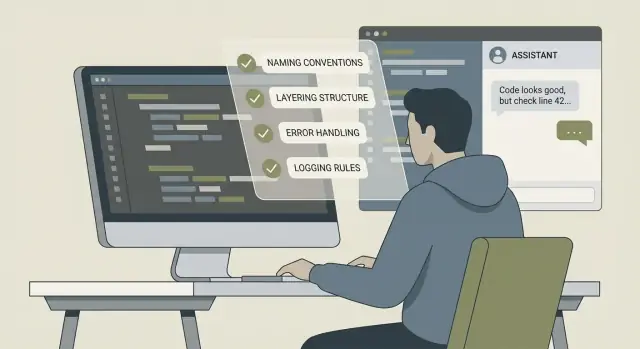
Why style guide violations spread so quickly
Style guide violations rarely show up as one big mistake. They start as tiny “close enough” choices that look harmless in a pull request, then pile up until the codebase feels uneven and harder to read.
Style drift often looks like this: one file uses userID, another uses userId, a third uses uid. One handler returns { error: "..." }, another throws, another logs and returns null. Each change is small, but together they create a repo where patterns stop being predictable.
Fast iteration and multiple contributors make it worse. People copy what they see, especially under time pressure. If the most recent code in the repo used a shortcut, that shortcut becomes the template for the next change. After a few weeks, the “default style” isn’t your written guide. It’s whatever happened last.
That’s why the goal has to be consistent conventions, not personal preferences. The question isn’t “Do I like this name?” It’s “Does this match the rules we agreed on so the next person can follow it without thinking?”
Catching violations early means stopping bad patterns before they become copy-paste fuel. Focus on new and edited code, fix the first appearance of a new inconsistency, and block merges that introduce new drift. When you do flag an issue, add a short preferred example people can mimic next time.
One realistic example: a developer adds a new API endpoint and logs raw request bodies “just for debugging.” If that lands, the next endpoint copies it, and soon sensitive data shows up in logs. Catching it in the first PR is cheap. Catching it after it spreads is painful and risky.
Turn your style guide into clear, testable rules
A style guide only works in reviews if it reads like a checklist, not a set of preferences. Rewrite each guideline as a rule that can be checked on a diff.
Organize rules into four buckets so they’re hard to miss: naming, layering, error handling, and logging. For each bucket, write two things: what must be true and what is forbidden.
Decide the strength of each rule up front:
- Mandatory: failing it blocks the change.
- Recommended: fix it unless there’s a clear reason not to.
- Optional: nice to have, never blocking.
Set scope so reviews don’t turn into endless refactors. A simple rule works well: “new and modified code must comply; existing untouched code isn’t rewritten unless it blocks the fix.” If you want cleanup, timebox it as a separate task.
Also define the output you want from a review so it’s easy to act on: a pass/fail verdict, a violations list with file and line references, suggested fixes written as concrete edits, and a brief risk note when something could cause bugs or leaks.
Example: if a PR logs raw user tokens, the review should fail under “logging: never log secrets” and suggest logging a request ID instead.
Prompt structure that enforces rules instead of opinions
Style prompts fail when they sound like preferences. A good review prompt reads like a contract: clear non-negotiables, clearly named exceptions, and a predictable output.
Start with two short blocks: what must be true and what can be bent. Then add a decision rule: “If unclear, mark as Needs Clarification. Do not guess.”
Force evidence. When the tool flags a violation, require it to quote the exact identifier and file path, not a vague description. That single constraint removes a lot of back-and-forth.
Keep the scope tight: comment on changed lines and directly impacted code paths only. If you allow unrelated refactors, style enforcement turns into “rewrite the file,” and people stop trusting the feedback.
Here’s a structure you can reuse:
Role: strict style guide reviewer.
Input: diff (or files changed) + style guide rules.
Non-negotiables: [list].
Allowed exceptions: [list].
Scope: ONLY comment on changed lines and directly impacted code paths. No unrelated refactors.
Evidence: Every finding MUST include (a) file path, (b) exact identifier(s), (c) short quote.
Output: structured compliance report with pass/fail per category + minimal fixes.
Require the report to keep the same sections every time, even if some are “No issues found”: Naming, Layering, Error handling, Logging.
If it says “service layer leaking DB details,” it must cite something like internal/orders/service/order_service.go and the exact call (for example db.QueryContext) so you can fix the leak without debating what it meant.
Step by step: build a style-check prompt workflow
A style guide sticks when the process is repeatable. The goal is to make the model check rules, not argue taste, and to do it the same way every time.
Use a simple two-pass workflow:
- Paste your standards as a compact, numbered rule list (10-25 lines). Keep each rule testable.
- Add context for the change: the diff, the touched files, and one sentence about intent.
- Ask for a violations report first. Require file and line references, a short reason, and the exact rule number.
- Only after the report, ask for the smallest possible patch to reach compliance.
- Re-run the exact same prompt on the updated code to confirm nothing remains.
Example: a PR adds a new endpoint. Pass 1 flags that the handler talks to PostgreSQL directly (layering), uses mixed naming for request structs (naming), and logs full emails (logging). Pass 2 makes minimal fixes: move the DB call into a service or repository, rename the struct, and mask the email in logs. Nothing else changes.
Naming conventions: prompts that catch the small stuff
Naming issues feel minor, but they create real cost: people misread intent, search gets harder, and “almost the same” names multiply.
State the naming rules the reviewer must enforce across the whole change: file names, exported types, functions, variables, constants, and tests. Be explicit about casing (camelCase, PascalCase, snake_case) and choose one acronym rule (for example APIClient vs ApiClient). Then require it everywhere.
Also standardize shared vocabulary: error types, log fields, and config keys. If logs use request_id, don’t allow reqId in one file and requestId in another.
A reviewer instruction that stays practical:
Check every new or renamed identifier. Enforce casing + acronym rules.
Flag vague names (data, info, handler), near-duplicates (userId vs userID), and names that contradict behavior.
Prefer domain language: business terms over generic tech words.
Ask for a short report: the three most confusing names, any near-duplicates and which one to keep, plus any log/config/error names that don’t match the standard.
Layering rules: keep responsibilities from getting mixed
Layering rules work best in plain language: handlers talk HTTP, services hold business rules, repositories talk to the database.
Lock dependency direction. Handlers may call services. Services may call repositories. Repositories should not call services or handlers. Handlers should not import database code, SQL helpers, or ORM models. If you use shared packages (config, time, IDs), keep them free of app logic.
Pin cross-cutting work to a home. Validation usually belongs at the boundary for request shape and in the service for business rules. Authorization often starts in the handler (identity, scopes), but the service should enforce the final decision. Mapping belongs at layer edges: handler maps HTTP to domain input, repository maps DB rows to domain types.
Drop this into a prompt to keep reviews concrete:
Check layering: handler -> service -> repository only.
Report any leaks:
- DB types/queries in handlers or services
- HTTP request/response types inside services or repositories
- repository returning DB models instead of domain objects
- auth/validation mixed into repository
For each leak, propose the smallest fix: move function, add interface, or rename package.
Make the report explicit: name the file, the layer it belongs to, the import or call that breaks the rule, and the minimal change that prevents the pattern from spreading.
Error handling conventions: consistency under pressure
Most style debates get loud when something breaks in production. A clear error handling policy keeps fixes calm because everyone knows what “good” looks like.
Write down the philosophy and enforce it. For example: “Wrap errors to add context; create a new error only when changing meaning or mapping to a user message. Return raw errors only at the system boundary.” That one sentence prevents random patterns from spreading.
Separate user-facing text from internal detail. User messages should be short and safe. Internal errors can include the operation name and key identifiers, but not secrets.
In reviews, check for a few recurring failures: swallowed errors (logged but not returned), ambiguous returns (nil value with nil error after a failure), and user-facing messages that leak stack traces, query text, tokens, or PII. If you support retries or timeouts, require them to be explicit.
Example: a checkout call times out. The user sees “Payment service is taking too long.” Internally, wrap the timeout and include op=checkout.charge and the order ID so it’s searchable and actionable.
Logging conventions: readable, searchable, and safe
Logs only help when everyone writes them the same way. If each developer picks their own wording, level, and fields, search turns into guesswork.
Make log levels non-negotiable: debug for development detail, info for normal milestones, warn for unexpected but handled situations, and error when the user-facing action fails or needs attention. Keep “fatal” or “panic” rare and tied to a clear crash policy.
Structured logs matter more than perfect sentences. Require stable key names so dashboards and alerts don’t break. Decide a small core set (for example event, component, action, status, duration_ms) and keep it consistent.
Treat sensitive data as a hard stop. Be explicit about what must never be logged: passwords, auth tokens, full credit cards, secrets, and raw personal data. Call out things that look harmless but aren’t, like password reset links, session IDs, and full request bodies.
Correlation IDs make debugging possible across layers. Require a request_id in every log line within a request. If you log user_id, define when it’s allowed and how to represent missing or anonymous users.
A prompt block you can reuse:
Review the changes for logging conventions:
- Check level usage (debug/info/warn/error). Flag any level that does not match impact.
- Verify structured fields: require stable keys and avoid free-form context in the message.
- Confirm correlation identifiers: request_id on all request-bound logs; user_id only when allowed.
- Flag any sensitive data risk (tokens, secrets, personal data, request/response bodies).
- Identify noisy logs (in loops, per-item logs, repeated success messages) and missing context.
Return: (1) violations with file/line, (2) suggested rewrite examples, (3) what to add or remove.
Before merging, do a fast “safety pass”: any new log missing request_id for request work, any new keys that change existing names (userId vs user_id), any error logs missing what failed (operation, resource, status), any high-volume logs that will fire on every request, and any chance of secrets or personal data appearing in fields or messages.
How to catch violations before they spread
Treat style drift like a build break, not a suggestion. Add a strict gate that runs before merge and returns a clear pass or fail. If a mandatory rule is broken (naming, layer boundaries, logging safety, error handling), it fails and points to exact files and lines.
Keep the gate short. One practical trick is to require a YES/NO checklist per rule, and refuse approval if any item is NO.
A PR-sized checklist that catches most problems:
- Naming: matches the approved pattern for files, types, and functions
- Layering: no direct calls that skip layers (for example handlers calling the DB)
- Errors: returned consistently with context, nothing silently dropped
- Logging: consistent fields, no secrets, and level matches impact
- Tests/docs: updated when behavior or public APIs change
When the tool suggests fixes, require a small compliant snippet for each rule it touches. That prevents vague feedback like “rename for clarity.”
Common traps when using prompts for style enforcement
The fastest way for a style guide to fail is leaving room for interpretation. If two reviewers can read the same rule and reach different conclusions, the tool will enforce taste, not standards.
Naming is a common example. “Use clear names” isn’t testable. Tighten it into something you can verify: “functions are verbs (e.g., createInvoice), booleans start with is/has/can, exported types are PascalCase.”
Another trap is asking for everything at once. When one prompt tries to cover naming, layering, errors, logging, tests, and performance, the feedback gets shallow. Split reviews into focused passes when you need depth, or keep the gate prompt limited to mandatory rules.
The problems that most often cause enforcement to drift:
- Vague rules: replace “clean” and “consistent” with measurable language.
- Mixing style fixes with redesign: don’t let a style prompt propose a new architecture.
- No quoted evidence: require every comment to quote the exact identifier or snippet.
- Silent exceptions: if you allow an exception, require a short note explaining why and when it should be removed.
If you treat prompts like tests, you get predictable enforcement. If you treat them like advice, violations sneak in and multiply.
Quick checklist you can run on every change
Run a fast pass over the diff (not the whole repo) and confirm:
- Naming: new identifiers follow your pattern (case, prefixes, suffixes). One concept is named one way across files.
- Layering: dependencies only go in the allowed direction. Lower layers never import higher layers.
- Errors: failures are returned with context. Nothing is silently ignored.
- Logging: correct level, stable fields, and no secrets or personal data.
- Final pass: reviewer states exactly: “no mandatory violations found”, or lists the violations that must be fixed before merge.
Keep a tiny prompt template and paste it with each change:
Review ONLY the changed code against our rules for naming, layering, errors, and logging.
List mandatory violations first (with file + line if available). Then list optional suggestions.
End with either: “no mandatory violations found” or “mandatory violations found”.
Example: a new function procUsr() in a handler that writes to PostgreSQL directly should fail naming and layering even if the feature works. Catching it here prevents copy-paste from spreading the mistake.
Example: a realistic review that fixes issues early
A teammate adds a new endpoint: POST /v1/invoices/{id}/send. It touches a handler, a service, and storage.
On the first pass, you want a report, not a rewrite:
Pass 1 (report only)
You are a strict style checker. Read the patch.
Rules: naming must match our guide, handlers call services only, services call storage only, no SQL in handlers,
errors must be wrapped with context, logs must be structured and not leak PII.
Output: a numbered list of violations with file:line, rule name, and one-sentence impact. Do not propose fixes.
If a rule might be intentionally broken, ask one clarification question.
Typical findings: SendInvoiceNow() vs SendInvoice naming mismatch, the handler calling db.QueryRow directly, returning raw err with no context, and noisy logs like log.Printf("sending invoice %v", invoice) that dump full objects.
Second pass asks for minimal, safe changes:
Pass 2 (minimal fix suggestions)
Using the violations list, propose the smallest code edits to comply.
Constraints: keep behavior the same, no refactors beyond what is needed, show suggested function names and where code should move.
For each fix, include 1-2 lines of example code.
If breaking a rule is allowed, say it up front: “Exceptions are permitted only if you add a short comment explaining why, and you add a follow-up task to remove the exception.”
After the fix, the handler becomes a thin adapter, the service owns the workflow, storage owns the query, errors become fmt.Errorf("send invoice: %w", err), and logs become one clean line with safe fields (invoice ID, not the full invoice).
Next steps: make it routine without slowing down
Pick one team-approved prompt and treat it like a shared tool. Start with what keeps hurting you in reviews (naming drift, leaking layers, inconsistent errors, unsafe logs). Update the prompt only when you see a real violation in real code.
Keep a small rules block at the top of the prompt and paste it into every review unchanged. If everyone edits the rules each time, you don’t have a standard. You have a debate.
A simple cadence helps: one person collects the top few style misses from the week, and you add exactly one clearer rule or one better example.
If you work in a chat-driven build flow like Koder.ai (koder.ai), it’s worth running the same gate checks during changes, not just at the end. Features like planning, snapshots, and rollback can help you keep style fixes small and reversible before you export source code.
FAQ
Why do small style guide violations spread so fast?
Style violations spread because developers copy nearby code, especially when they are moving quickly. Treat the first inconsistent pattern as a review issue so it does not become the next person's example.
How can I make a style guide rule testable?
Write rules that someone can check against a diff. For example, say "handlers call services only" or "never log tokens," rather than asking for clean or consistent code.
Which style rules should block a pull request?
Use three levels: mandatory rules block a merge, recommended rules need a reason to skip, and optional rules never block. This keeps reviewers from treating every preference as equally urgent.
What should a Claude Code style review prompt include?
Include the changed diff, a compact numbered rule list, the change intent, and a fixed report format. Require every finding to name the file, exact identifier or code quote, rule number, and smallest compliant fix.
How do I keep style reviews from turning into full rewrites?
Limit the review to changed lines and directly affected paths. Ask for a violations report first, then request a minimal patch only after you agree with the findings.
What naming issues should the review catch?
Pick one casing rule and one acronym rule, then apply them to files, types, functions, variables, tests, log fields, and config keys. Also reject near-duplicates such as userID, userId, and uid for the same concept.
How should a review enforce layer boundaries?
State the allowed direction plainly: handler to service to repository. Flag database queries in handlers, HTTP types in services or repositories, and repositories that return database models instead of domain objects.
What should an error handling review look for?
Require errors to carry useful operation context, but keep internal details out of user messages. Flag swallowed errors, ambiguous success returns after failures, and messages that expose queries, tokens, stack traces, or personal data.
What logging rules should be mandatory?
Use stable structured fields and match the level to the impact: debug for development detail, info for normal milestones, warn for handled surprises, and error for failed user actions. Every request-bound log should include request_id, and logs must never include secrets, tokens, full request bodies, or raw personal data.
How can I catch violations before they become normal?
Run the same short gate before every merge and return a clear pass or fail. Check naming, allowed dependencies, error handling, logging safety, and any tests or docs affected by a public behavior change.