

Claude Shannon’s Information Theory in Modern Digital Tech
Learn Claude Shannon’s core ideas—bits, entropy, and channel capacity—and how they power compression, error correction, reliable networks, and modern digital media.
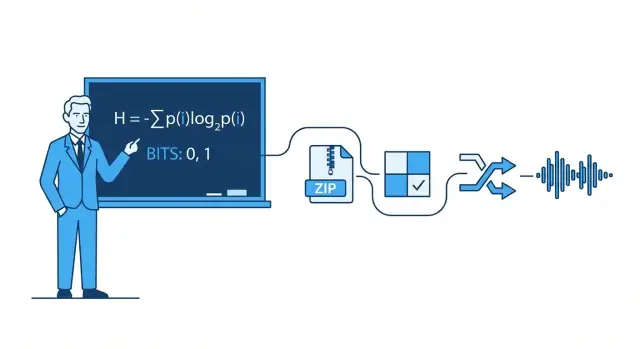
Why Shannon Still Matters for Everyday Technology
You use Claude Shannon’s ideas every time you send a text, watch a video, or join Wi‑Fi. Not because your phone “knows Shannon,” but because modern digital systems are built around a simple promise: we can turn messy real‑world messages into bits, move those bits through imperfect channels, and still recover the original content with high reliability.
Information theory, in plain terms
Information theory is the math of messages: how much choice (uncertainty) a message contains, how efficiently it can be represented, and how reliably it can be transmitted when noise, interference, and congestion get in the way.
There is math behind it, but you don’t need to be a mathematician to get the practical intuition. We’ll use everyday examples—like why some photos compress better than others, or why your call can sound fine even when the signal is weak—to explain the ideas without heavy formulas.
The four pillars you’ll see everywhere
This article revolves around four Shannon-inspired pillars that show up across modern tech:
- Compression: shrinking data (audio, video, files) without losing what matters.
- Error correction: adding just enough extra bits so mistakes can be detected and fixed.
- Networking reliability: coping with dropped packets using retries, ordering, and throughput tradeoffs.
- End-to-end digital communication: seeing the whole chain from source (your message) to channel (Wi‑Fi, cellular, fiber) and back again.
What you’ll be able to reason about afterward
By the end, you should be able to think clearly about real tradeoffs: why higher video quality needs more bandwidth, why “more bars” doesn’t always mean faster internet, why some apps feel instant while others buffer, and why every system hits limits—especially the famous Shannon limit on how much reliable data a channel can carry.
Claude Shannon in One Page: The Big Idea
In 1948, mathematician and engineer Claude Shannon published a paper with an unassuming title—A Mathematical Theory of Communication—that quietly rewired how we think about sending data. Instead of treating communication as an art, he treated it as an engineering problem: a source produces messages, a channel carries them, noise corrupts them, and a receiver tries to reconstruct what was sent.
Information is “uncertainty reduced,” not “meaning”
Shannon’s key move was to define information in a way that’s measurable and useful for machines. In his framework, information isn’t about how important a message feels, what it means, or whether it’s true. It’s about how surprising it is—how much uncertainty gets removed when you learn the outcome.
If you already know what’s going to happen, the message carries almost no information. If you’re genuinely unsure, learning the result carries more.
The bit: the simplest unit you can count
To measure information, Shannon popularized the bit (short for binary digit). A bit is the amount of information needed to resolve a simple yes/no uncertainty.
Example: If I ask “Is the light on?” and you have no idea beforehand, the answer (yes or no) can be thought of as delivering 1 bit of information. Many real messages can be broken into long sequences of these binary choices, which is why everything from text to photos to audio can be stored and transmitted as bits.
What this post will (and won’t) do
This article focuses on the practical intuition behind Shannon’s ideas and why they show up everywhere: compression (making files smaller), error correction (fixing corruption), network reliability (retries and throughput), and channel capacity (how fast you can send data over a noisy link).
What it won’t do is walk through heavy proofs. You don’t need advanced math to understand the punchline: once you can measure information, you can design systems that approach the best possible efficiency—often surprisingly close to the theoretical limits Shannon described.
Bits, Symbols, and Codes: A Practical Vocabulary
Before talking about entropy, compression, or error correction, it helps to pin down a few everyday terms. Shannon’s ideas are easier when you can name the pieces.
Symbols, alphabets, and messages
A symbol is one “token” from a set you’ve agreed on. That set is the alphabet. In English text, the alphabet might be letters (plus space and punctuation). In a computer file, the alphabet could be byte values 0–255.
A message is a sequence of symbols from that alphabet: a word, a sentence, a photo file, or a stream of audio samples.
To keep things concrete, imagine a tiny alphabet: {A, B, C}. A message could be:
A A B C A B A ...
Bits and codes
A bit is a binary digit: 0 or 1. Computers store and transmit bits because hardware can reliably distinguish two states.
A code is a rule for representing symbols using bits (or other symbols). For example, with our {A, B, C} alphabet, one possible binary code is:
- A → 0
- B → 10
- C → 11
Now any message made of A/B/C can be turned into a stream of bits.
Encoding vs. compression vs. encryption
These terms are often mixed up:
- Encoding: translating data into a chosen format so it can be stored/transmitted/processed (like mapping A/B/C into bits, or converting text into UTF‑8).
- Compression: encoding that uses fewer bits on average by exploiting patterns and unequal frequencies.
- Encryption: scrambling data with a key so outsiders can’t read it; it’s about secrecy, not size.
A quick probability intuition
Real messages aren’t random: some symbols appear more often than others. Suppose A happens 70% of the time, B 20%, C 10%. A good compression scheme will typically give shorter bit patterns to common symbols (A) and longer ones to rare symbols (C). That “unevenness” is what later sections will quantify with entropy.
Entropy: Measuring Surprise (and Why It Predicts Compressibility)
Shannon’s most famous idea is entropy: a way to measure how much “surprise” is in a source of information. Not surprise as emotion—surprise as unpredictability. The more unpredictable the next symbol is, the more information it carries when it arrives.
Entropy as “average surprise”
Imagine you’re watching coin flips.
- Fair coin (50/50 heads or tails): Each flip is hard to predict. Heads is just as likely as tails, so you’re regularly “surprised” either way. That high unpredictability means higher entropy.
- Loaded coin (say 95% heads, 5% tails): Most flips are heads. After a few flips you start expecting heads, so seeing heads carries little new information. Only the rare tails is surprising. On average, the sequence is lower entropy.
This “average surprise” framing matches everyday patterns: a text file with repeated spaces and common words is easier to predict than a file of random characters.
Why predictability implies compressibility
Compression works by assigning shorter codes to common symbols and longer codes to rare ones. If the source is predictable (low entropy), you can lean heavily on short codes most of the time and save space. If it’s close to random (high entropy), there’s less room to shrink it because nothing shows up often enough to exploit.
Entropy and the best possible average code length
Shannon showed that entropy sets a conceptual benchmark: it’s the best possible lower bound on the average number of bits per symbol you can achieve when encoding data from that source.
Important: entropy is not a compression algorithm. It doesn’t tell you exactly how to compress a file. It tells you what’s theoretically possible—and when you’re already close to the limit.
Compression: Turning Entropy Into Smaller Files
Compression is what happens when you take a message that could be described in fewer bits, and you actually do it. Shannon’s key insight is that data with lower entropy (more predictability) has “room” to shrink, while high-entropy data (close to random) doesn’t.
Why patterns and uneven frequencies compress well
Repeated patterns are the obvious win: if a file contains the same sequences over and over, you can store the sequence once and reference it many times. But even without clear repeats, skewed symbol frequencies help.
If a text uses “e” far more often than “z,” or a log file repeats the same timestamps and keywords, you don’t need to spend the same number of bits on every character. The more uneven the frequencies, the more predictable the source—and the more compressible it is.
Variable-length coding (the core intuition)
A practical way to exploit skewed frequencies is variable-length coding:
- Frequent symbols get short codes
- Rare symbols get long codes
Done carefully, this reduces the average bits per symbol without losing information.
Real-world lossless compressors often mix multiple ideas, but you’ll commonly hear these families:
- Huffman coding: builds an efficient “short-for-common” codebook
- Arithmetic coding: packs symbols into a fractional range, often squeezing closer to the entropy limit
- LZ (Lempel–Ziv) methods: find repeated substrings and replace them with references (used in many ZIP-style formats)
Lossless vs. lossy (ZIP vs. JPEG/MP3)
Lossless compression reproduces the original perfectly (e.g., ZIP, PNG). It’s essential for software, documents, and anything where a single wrong bit matters.
Lossy compression deliberately discards information people usually don’t notice (e.g., JPEG photos, MP3/AAC audio). The goal shifts from “same bits back” to “same experience,” often achieving much smaller files by removing perceptually minor details.
Errors Happen: Why Redundancy Is Useful
Every digital system rests on a fragile assumption: a 0 stays a 0, and a 1 stays a 1. In reality, bits can flip.
Where errors come from
In transmission, electrical interference, weak Wi‑Fi signals, or radio noise can nudge a signal over a threshold so a receiver interprets it incorrectly. In storage, tiny physical effects—wear in flash memory, scratches on optical media, even stray radiation—can change a stored charge or magnetic state.
Because errors are inevitable, engineers intentionally add redundancy: extra bits that don’t carry “new” information, but help you detect or repair damage.
Simple redundancy you’ve already used
Parity bit (quick detection). Add one extra bit so the total number of 1s is even (even parity) or odd (odd parity). If a single bit flips, the parity check fails.
- Strength: cheap and fast.
- Limit: it usually can’t tell which bit is wrong, and two flips can cancel out and look “fine.”
Checksum (better detection for chunks). Instead of one bit, compute a small summary number from a packet or file (e.g., additive checksum, CRC). The receiver recomputes and compares.
- Strength: catches many multi-bit errors across a block.
- Limit: still detection-only; if it fails, you typically need a retry or a backup copy.
Repetition code (simple correction). Send each bit three times: 0 becomes 000, 1 becomes 111. The receiver uses majority vote.
- Strength: can correct a single flipped bit in each group of three.
- Limit: extremely inefficient—triples the data.
Detection vs. correction (and when you use each)
Error detection answers: “Did anything go wrong?” It’s common when retries are cheap—like network packets that can be resent.
Error correction answers: “What were the original bits?” It’s used when retries are expensive or impossible—like streaming audio over a noisy link, deep-space communication, or reading data from storage where re-reading might still produce errors.
Redundancy feels wasteful, but it’s the reason modern systems can be fast and trustworthy despite imperfect hardware and noisy channels.
Channel Capacity and the Shannon Limit (No Heavy Math)
When you send data over a real channel—Wi‑Fi, cellular, a USB cable, even a hard drive—noise and interference can flip bits or blur symbols. Shannon’s big promise was surprising: reliable communication is possible, even over noisy channels, as long as you don’t try to push too much information through.
Channel capacity in plain terms
Channel capacity is the channel’s “speed limit” for information: the maximum rate (bits per second) you can transmit with errors driven arbitrarily close to zero, given the channel’s noise level and constraints like bandwidth and power.
It’s not the same as the raw symbol rate (how fast you toggle a signal). It’s about how much meaningful information survives after noise—once you include smart encoding, redundancy, and decoding.
The Shannon limit: a boundary engineers chase
The Shannon limit is the practical name people give to this boundary: below it, you can (in theory) make communication as reliable as you want; above it, you can’t—errors remain no matter how clever your design is.
Engineers spend a lot of effort getting closer to the limit with better modulation and error-correcting codes. Modern systems like LTE/5G and Wi‑Fi use advanced coding so they can operate near this boundary instead of wasting huge amounts of signal power or bandwidth.
The key tradeoff (rate vs. error probability)
Think of it like packing items into a moving truck on a bumpy road:
- Pack too tightly (rate above capacity), and some items will always break (a nonzero error floor).
- Pack with room and padding (rate below capacity), and you can make breakage as rare as you like—at the cost of lower throughput or more redundancy.
Shannon didn’t hand us a single “best code,” but he proved the limit exists—and that striving toward it is worth it.
Error-Correcting Codes in Real Systems
Shannon’s noisy-channel theorem is often summarized as a promise: if you send data below a channel’s capacity, there exist codes that can make errors arbitrarily rare. Real engineering is about turning that “existence proof” into practical schemes that fit into chips, batteries, and deadlines.
The practical toolkit: blocks, interleaving, and better guesses
Most real systems use block codes (protect a chunk of bits at a time) or stream-oriented codes (protect an ongoing sequence).
With block codes, you add carefully designed redundancy to each block so the receiver can detect and correct mistakes. With interleaving, you reshuffle the order of transmitted bits/symbols so that a burst of noise (many errors in a row) is spread out into smaller, correctable errors across multiple blocks—crucial for wireless and storage.
Another big divider is how the receiver “decides” what it heard:
- Hard decisions: each received signal becomes a 0 or 1 right away.
- Soft decisions: the receiver also keeps confidence (e.g., “this is probably a 1, but I’m not sure”).
Soft decisions feed more information into the decoder and can significantly improve reliability, especially in Wi‑Fi and cellular.
Codes you’ve already used
- Reed–Solomon codes: work on symbols (not individual bits) and are excellent against bursts. They’re used in QR codes, CD/DVD, and some broadcast/storage systems.
- Convolutional codes: classic choice for continuous streams; historically common in satellite links.
- Turbo codes: a major leap in the 1990s, widely used in 3G/4G.
- LDPC (Low-Density Parity-Check) codes: highly efficient modern block codes used in Wi‑Fi, 5G, and many high-throughput systems.
Where they matter
From deep-space communication (where retransmission is expensive or impossible) to satellites, Wi‑Fi, and 5G, error-correcting codes are the practical bridge between Shannon’s theory and the reality of noisy channels—trading extra bits and computation for fewer dropped calls, faster downloads, and more reliable links.
Networking Reliability: Packets, Retries, and Throughput
The internet works even though individual links are imperfect. Wi‑Fi fades, mobile signals get blocked, and copper and fiber still suffer noise, interference, and occasional hardware glitches. Shannon’s core message—noise is inevitable, but reliability is still achievable—shows up in networking as a careful mix of error detection/correction and retransmission.
Packets: small bets instead of one big one
Data is split into packets so the network can route around trouble and recover from losses without resending everything. Each packet carries extra bits (headers and checks) that help the receiver decide whether what arrived is trustworthy.
A common pattern is ARQ (Automatic Repeat reQuest):
- The receiver checks a packet (typically with a checksum/CRC).
- If it looks good, it sends an acknowledgment (ACK).
- If it’s missing or corrupted, the sender retransmits after a timeout (or upon a negative acknowledgment).
Correct vs. retransmit: the latency tradeoff
When a packet is wrong, you have two main choices:
- Correct it now using forward error correction (FEC): add enough redundancy that the receiver can fix some errors without asking again.
- Retransmit using ARQ: send less redundancy up front, but pay extra time when something goes wrong.
FEC can reduce delays on links where retransmissions are expensive (high latency, intermittent loss). ARQ can be efficient when losses are rare, because you don’t “tax” every packet with heavy redundancy.
Throughput, congestion, and why reliability isn’t free
Reliability mechanisms consume capacity: extra bits, extra packets, and extra waiting. Retransmissions increase load, which can worsen congestion; congestion in turn increases delay and loss, triggering even more retries.
Good networking design aims for a balance: enough reliability to deliver correct data, while keeping overhead low so the network can maintain healthy throughput under varying conditions.
Digital Communication End-to-End: From Source to Channel
A useful way to understand modern digital systems is as a pipeline with two jobs: make the message smaller and make the message survive the journey. Shannon’s key insight was that you can often think about these as separate layers—even if real products sometimes blur them.
Step 1: Source coding (compression)
You start with a “source”: text, audio, video, sensor readings. Source coding removes predictable structure so you don’t waste bits. That could be ZIP for files, AAC/Opus for audio, or H.264/AV1 for video.
Compression is where entropy shows up in practice: the more predictable the content, the fewer bits you need on average.
Step 2: Channel coding (error correction)
Then the compressed bits must cross a noisy channel: Wi‑Fi, cellular, fiber, a USB cable. Channel coding adds carefully designed redundancy so the receiver can detect and correct errors. This is the world of CRCs, Reed–Solomon, LDPC, and other forward error correction (FEC) methods.
Shannon’s “separation” idea (a helpful mental model)
Shannon showed that, in theory, you can design source coding to approach the best possible compression, and channel coding to approach the best possible reliability up to channel capacity—independently.
In practice, this separation is still a great way to debug systems: if performance is bad, you can ask whether you’re losing efficiency in compression (source coding), losing reliability on the link (channel coding), or paying too much latency with retries and buffering.
Concrete example: streaming video over Wi‑Fi
When you stream video, the app uses a codec to compress frames. Over Wi‑Fi, packets may be lost or corrupted, so the system adds error detection, sometimes FEC, and then uses retries (ARQ) when needed. If the connection worsens, the player may switch to a lower bitrate stream.
Real systems blur the separation because time matters: waiting for retries can cause buffering, and wireless conditions can change quickly. That’s why streaming stacks combine compression choices, redundancy, and adaptation together—not perfectly separated, but still guided by Shannon’s model.
Common Misconceptions and Practical Tradeoffs
Information theory gets quoted a lot, and a few ideas get oversimplified along the way. Here are common misunderstandings—and the real tradeoffs engineers make when building compression, storage, and networking systems.
Misconception 1: “Entropy means randomness”
In everyday speech, “random” can mean “messy” or “unpredictable.” Shannon entropy is narrower: it measures surprise given a probability model.
- A perfectly predictable stream (like all zeros) has low entropy.
- A stream that’s hard to predict given what you know has higher entropy.
So entropy isn’t a vibe; it’s a number tied to assumptions about how the source behaves.
Misconception 2: “More compression is always better”
Compression removes redundancy. Error correction often adds redundancy on purpose so the receiver can fix mistakes.
That creates a practical tension:
- If you compress aggressively and then send data over a noisy channel, you may have less “wiggle room” to recover from damage.
- Well-designed systems usually compress first (remove predictable patterns), then add structured redundancy (error-correcting codes) for the channel.
Misconception 3: “We can be perfectly reliable at any speed”
Shannon’s channel capacity says every channel has a maximum reliable throughput under given noise conditions. Below that limit, error rates can be made extremely small with the right coding; above it, errors become unavoidable no matter how clever you are.
This is why “perfectly reliable at any speed” isn’t possible: pushing speed up usually means accepting higher error probability, higher latency (more retransmissions), or more overhead (stronger coding).
A simple checklist for real systems
When evaluating a product or architecture, ask:
- Source stats: Is the data predictable (text, logs) or already close to random (encrypted, compressed)?
- Noise: What can corrupt it—wireless interference, bit rot, packet loss?
- Latency budget: Can you afford retries and buffering, or must it be real-time?
- Overhead choice: Are you spending bits on compression savings, error correction, retransmissions, or some mix?
Getting these four right matters more than memorizing formulas.
Key Takeaways and Where to Go Next
Shannon’s core message is that information can be measured, moved, protected, and compressed using a small set of ideas.
- A bit is the common currency that lets text, audio, video, and sensor data be treated the same once they’re encoded.
- Entropy measures how unpredictable a source is, and that unpredictability predicts how well the data can be compressed.
- Noise and loss are unavoidable, so reliable systems add redundancy through error detection and error-correcting codes.
- Channel capacity sets a real ceiling: past a certain rate, you can’t “try harder” and still be reliable; you must lower the rate, improve the channel, or change the coding.
Modern networks and storage systems are essentially constant tradeoffs among rate, reliability, latency, and compute.
A practical note for builders
If you’re building real products—APIs, streaming features, mobile apps, telemetry pipelines—Shannon’s framework is a useful design checklist: compress what you can, protect what you must, and be explicit about the latency/throughput budget. One place this shows up immediately is when you prototype end-to-end systems quickly and then iterate: with a vibe-coding platform like Koder.ai, teams can spin up a React web app, a Go backend with PostgreSQL, and even a Flutter mobile client from a chat-driven spec, then test real-world tradeoffs (payload size, retries, buffering behavior) early. Features like planning mode, snapshots, and rollback make it easier to experiment with “stronger reliability vs. lower overhead” changes without losing momentum.
Who should dig deeper
Deeper reading pays off for:
- Students who want a clean mental model that connects probability to compression and coding
- Product managers making tradeoffs between quality, latency, bandwidth, and cost
- Engineers working on networking, media codecs, storage, telemetry, or ML data pipelines
To keep going, browse related explainers in /blog, then check /docs for how our product exposes communication and compression-related settings and APIs. If you’re comparing plans or throughput limits, /pricing is the next stop.
FAQ
What did Claude Shannon actually change about how we think about communication?
Shannon’s key move was defining information as uncertainty reduced, not as meaning or importance. That makes information measurable, which lets engineers design systems that:
- represent messages efficiently (compression)
- survive noise and interference (error detection/correction)
- respect hard physical limits (channel capacity / the Shannon limit)
What is a “bit” in practical terms, and why is it so universal?
A bit is the amount of information needed to resolve a yes/no uncertainty. Digital hardware can reliably distinguish two states, so many different kinds of data can be turned into long sequences of 0s and 1s (bits) and treated uniformly for storage and transmission.
What is entropy, and what does it tell me about compression?
Entropy is a measure of average unpredictability in a source. It matters because unpredictability predicts compressibility:
- Low entropy (predictable, repetitive data) usually compresses well.
- High entropy (already “random-looking” data) has little room to shrink.
Entropy is not a compressor; it’s a benchmark for what’s possible on average.
Why do some files compress a lot while others barely shrink?
Compression reduces size by exploiting patterns and uneven symbol frequencies.
- If some symbols/phrases occur a lot, they can get shorter representations.
- If repeated substrings appear, they can be replaced with references.
Text, logs, and simple graphics often compress well; encrypted or already-compressed data often doesn’t.
What’s the difference between encoding, compression, and encryption?
Encoding is just converting data into a chosen representation (e.g., UTF-8, mapping symbols to bits).
Compression is encoding that reduces the average number of bits by exploiting predictability.
Encryption is scrambling data with a key for secrecy; it typically makes data look random, which usually makes it harder to compress.
Why do we add redundancy if the goal is efficiency?
Because real channels and storage are imperfect. Interference, weak signals, hardware wear, and other effects can flip bits. Engineers add redundancy so receivers can:
- detect corruption (e.g., parity, CRC)
- correct some errors without needing a resend (FEC codes)
That “extra” data is what buys reliability.
What’s the difference between error detection and error correction, and when do we use each?
Error detection tells you something is wrong (common when resending is possible, like packets on the internet).
Error correction tells you what the original data was (useful when resending is expensive or impossible, like streaming links, satellites, or storage).
Many systems combine them: detect most issues quickly, correct some locally, and retransmit when needed.
What are channel capacity and the Shannon limit in everyday terms?
Channel capacity is the maximum rate (bits/sec) you can send with error rates driven arbitrarily low, given noise and constraints.
The Shannon limit is the practical “speed limit” implication:
- below capacity: reliability can be made extremely high with the right coding
- above capacity: some errors are unavoidable no matter what you do
So better “signal bars” don’t automatically mean higher throughput if you’re already near other limits (congestion, interference, coding choices).
How does the internet stay reliable if packets get lost or corrupted?
Networks split data into packets and use a mix of:
- checksums/CRCs to detect corrupted packets
- ACKs and retransmissions (ARQ) to recover losses
- sometimes FEC to avoid retransmits when latency is costly
Reliability isn’t free: retries and extra bits reduce usable throughput, especially under congestion or poor wireless conditions.
Why do streaming apps buffer, and how is that related to Shannon’s ideas?
Because you’re trading among rate, reliability, latency, and overhead:
- Higher quality (more bits) needs more bandwidth.
- Stronger protection (more redundancy) reduces errors but costs throughput.
- Retries improve correctness but can add delay and buffering.
Streaming systems often adapt bitrate and protection based on changing Wi‑Fi/cellular conditions to stay on the best point of that tradeoff.