

Content-for-credits program workflow for fast, fair approvals
Learn a content-for-credits program workflow to review posts and videos, verify attribution, prevent fraud, and issue credits with minimal manual work.
What problem you're solving (and what "good" looks like)
A content-for-credits program usually breaks in two places: approvals slow down, and decisions stop feeling fair. When each submission gets handled differently, creators get mixed answers, your team re-checks the same details, and credits go out late. Late credits reduce trust, and trust is the whole program.
Fraud shows up in predictable patterns. The common ones are fake posts (never published, set to private, or deleted right after), edited screenshots, reposts of someone else’s work, and "mentions" that hide the product name in tiny text or only inside an image where it’s hard to verify. If you rely on vibes instead of a consistent proof standard, you’ll either miss fraud or reject honest creators.
"Good enough" proof for a small team is proof you can verify quickly and the creator can reproduce. That usually means a live post you can open, plus one or two simple attribution signals (like a spoken mention, on-screen product name, or a clear text mention). If you’re reviewing content about Koder.ai, you also want to confirm the post is actually about the product, not just a generic "AI coding" video.
Good looks like this:
- Approvals are fast, with a clear target like 24-48 hours.
- Similar submissions get the same outcome, regardless of who reviews them.
- Every approval leaves a clean record (what was checked, when, and why).
- Disputes are rare because reasons are specific and easy to understand.
- Fraud gets caught without making honest creators jump through hoops.
Hit speed, consistency, and clean records, and the program scales without hiring reviewers every time submissions spike.
Set clear rules before you automate anything
A content-for-credits program only stays fair when the rules are boring, specific, and written down before you build forms, bots, or dashboards. If creators don’t know what counts, every approval turns into a debate.
Start with eligibility. Decide whether the program is open to new users only, existing users, or both. If you have pricing tiers (free, pro, business, enterprise), be explicit about any limits per tier and whether regions matter for compliance or payout rules. Creators should be able to read the rules once and know if they qualify.
Define "eligible content" in plain words. Stick to a short set of allowed formats (public post, short video, long review, recap clip) and a minimum quality bar. Simple beats complex: "original and public" beats a long checklist. "Shows real use" (screens, a demo, or a real outcome) beats generic hype.
Write a reward table that avoids surprises. A base amount, a small bonus for high-effort work, and a monthly cap is usually enough. For example: short post = base credits; detailed tutorial = base + bonus; nobody can earn beyond the monthly cap.
Make disqualifiers unambiguous:
- Stolen or re-uploaded content
- Private, paywalled, or quickly deleted posts
- Hidden ads or undisclosed sponsorships
- Hate speech or harassment
- Misleading claims (for example, inventing features Koder.ai does not offer)
If you can explain a rejection in one sentence, you’re ready to automate.
What to collect in a submission (keep it short)
A good workflow starts with a form that takes under 2 minutes. If creators have to hunt for details, they’ll quit or send messy submissions that slow review.
Collect only what you need to (1) confirm the creator, (2) open the content fast, (3) verify attribution, and (4) deliver credits to the right place.
The 5 fields that cover most cases
Ask for these items in this order so reviewers can scan top to bottom:
- Creator identity: email plus public handle and platform (YouTube, X, TikTok, blog). Collect country only if you actually have region rules.
- Content details: content URL, publish date, language, and a simple format pick (video, short, post, article).
- Attribution proof: a checkbox for what they included (spoken mention, on-screen text, pinned comment, description). Ask for the exact wording or tag used.
- Ownership signal: the creator’s channel or profile URL, plus one quick proof if needed (for example, a screenshot showing the pinned comment from their own account).
- Credit destination + consent: where credits should land (Koder.ai account email or account ID), plus explicit consent to receive credits and allow basic fraud checks.
Keep topic as a dropdown, not an essay. For Koder.ai, options might include: vibe-coding demo, React app build, Flutter mobile app, Go backend, or comparison to other tools.
Make attribution proof easy to verify
Instead of asking for an explanation, ask creators to paste the exact line as it appears (for example: "Built with Koder.ai") and where it appears (description line number, timestamp, or pinned comment). That one detail saves reviewers from scrubbing a 12-minute video.
If you want one extra field, keep it optional: "Anything we should know?" It catches edge cases without turning every submission into a support ticket.
Attribution rules that are easy to verify
Attribution is where most creator programs get slow and messy. Keep it simple: require only two things, and make them checkable in seconds. A solid default is (1) a clear mention of Koder.ai and (2) one verifiable pointer (a tag or a link, depending on the platform).
Pick two required actions (and stop there)
Use one of these pairs across all platforms:
- Mention + tag (best for X, TikTok, Instagram)
- Mention + link (best for YouTube descriptions, blogs, newsletters)
Publish copy-and-paste examples so creators don’t guess. For example:
"Koder.ai lets you build web, backend, and mobile apps from chat. I used it to generate a React UI and a Go API faster than my usual setup."
If you want extra clarity, add one short required phrase like "Built with Koder.ai" that can appear in text, a caption, or spoken on video.
Make video attribution unambiguous
For videos, require a timestamp where Koder.ai is mentioned or shown. That single field saves reviewers from scrubbing a long video.
Define what counts:
- Spoken mention of "Koder.ai" is valid even if the caption is short.
- If the description has character limits, a pinned comment with the mention and pointer is acceptable.
- If a platform removes clickable links, accept a tag or the plain text domain name.
Add a fix window (so honest creators don’t get rejected)
Most misses are accidental. Give a simple fix window, like 48 hours after your first review note, to correct missing attribution (add a tag, update the description, pin a comment, or provide the timestamp). After the fix, recheck and approve without restarting the submission.
Automations that remove most of the manual work
Programs slow down when every submission becomes a mini investigation. Automate checks that are objective and repeatable, then route only the gray areas to a person.
Start with basic link validation. When someone submits a URL, confirm it loads, is public, and is still available. Detect the platform type (YouTube, TikTok, X, blog, etc.) so you apply the right rules automatically.
Next, auto-verify attribution signals you can reliably parse. Where possible, scan title and description for required phrases (for example, "Koder.ai" and a short disclosure like "sponsored" or "earned credits"). When platforms don’t expose text reliably, fall back to manual checks only for those cases.
Duplicate detection saves time and blocks obvious fraud. Use multiple signals so you don’t reject honest creators by accident:
- Same URL submitted before (hard block)
- Same creator handle submitting many near-identical items (soft flag)
- Same media fingerprint when possible (soft flag)
- Same text copied across multiple posts (soft flag)
Add lightweight risk scoring. You don’t need deep background checks; simple signals catch most abuse, like brand-new accounts, no posting history, or sudden bursts of submissions.
Finally, route by confidence:
- Auto-approve: passes all checks and low risk
- Needs review: missing one requirement or medium risk
- Hold: duplicates, unreachable content, or high-risk patterns
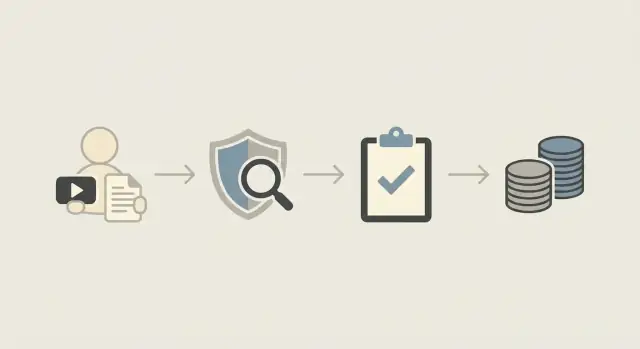
Step-by-step workflow: from submission to credits
A good workflow feels simple for creators and predictable for your team: one form, quick decisions, and a clean record you can audit later.
-
Creator submits one form. Collect the content URL, platform handle, the email tied to their Koder.ai account, and the tier they use (free, pro, business, enterprise). Include one optional field: "Anything we should know?"
After submission, show a confirmation message with the expected review time and what "approved" means.
-
Automatic checks run and a risk score is set. Confirm the link is public, the post is recent, and the creator handle matches the submission. Check required attribution (mention of Koder.ai plus a visible tag or description note). Flag repeats like the same video reused across submissions, or multiple accounts submitting the same URL.
-
Reviewer sees a short decision screen. Show only what supports a fast call: content preview, attribution status, risk score, and prior history. The reviewer chooses: approve, request a fix (one clear change), or reject (one clear reason).
-
Credits are issued and logged with a receipt. On approval, credits are added automatically and you store a receipt record: submission ID, content URL, creator account, decision, credit amount, reviewer (or auto-approve), timestamp, and any notes.
-
Creator gets a clear status update. Send the decision and the next action. For fix requests, include the exact edit needed and a resubmit option that keeps the same submission ID.
Human review that stays fast and consistent
Automation gives you speed, but a light human pass keeps quality high and stops obvious abuse. The goal isn’t perfect moderation. It’s repeatable decisions that feel fair and keep submissions moving.
Use a single review page that shows everything in one place: the content preview (video/post), creator handle, claimed reward tier, and proof of attribution (screenshot or timestamp). Add simple risk flags like new account, edited screenshots, reused captions, or many submissions in a short time.
To stay consistent, reviewers should pick a reason from a dropdown instead of writing a paragraph. A short list is enough:
- Approved: attribution is clear and correct
- Needs fixes: attribution missing or unclear
- Rejected: content does not match program rules
- Rejected: suspected fraud (evidence required)
- Escalated: high value or high risk
Time-box reviews to 2-3 minutes. If it can’t be approved quickly, it should become "needs fixes" or "escalated," not a long back-and-forth.
What to check fast (and what to ignore):
- Check the brand mention is correct (for example, "Koder.ai") and matches your naming rules.
- Check the attribution is visible where it should be (description, pinned comment, on-screen).
- Check the content is original and publicly accessible.
- Check the submission matches the tier (length, format, platform).
- Ignore small style issues, accents, or minor editing quality.
Use two-level approval only when it matters: high credit payouts, first-time creators above a threshold, or submissions with multiple risk flags. Everyone else should be one review, one click.
Request fixes when the creator can correct it in minutes. Reject only when the core requirement is missing (copied content, private content, fake proof, or repeated rule-breaking).
Fraud controls that don’t punish honest creators
Fraud controls work best when they’re quiet. Most creators never notice them, while obvious abuse gets slowed down or stopped. The goal is to protect your budget without turning approval into a suspicion-first process.
Start with simple limits that reduce farming. Set credit caps per creator per week or month, and make the cap visible in the rules. Predictable caps also make edge cases easier to review.
Add gentle friction where it matters. If someone re-submits the same post repeatedly (tiny edits, new thumbnail, re-upload), apply a cooldown before it can be reviewed again. That stops "try until it slips through" behavior without blocking legit fixes.
Use a hold period only for riskier situations, not everyone. New accounts, brand-new referral codes, or unusually high payouts in a short window can go into a short pending state while you verify the content stays live and attribution stays intact.
A few low-effort checks catch a lot of abuse:
- Random spot checks on already-approved items (small weekly sample)
- Suspicious engagement patterns (bot comments, sudden bought views)
- Stolen clips (the same video under different accounts)
- Repeated template posts that don’t mention real Koder.ai features
- Creators splitting one piece into many near-duplicates to farm credits
When you reject, be specific and calm. "Attribution missing" or "Duplicate submission" is better than calling it fraud.
Disputes, removals, and edge cases
Disputes happen when creators feel a rejection was unfair, or when content changes after approval. Treat disputes as part of the workflow, not as a one-off exception.
Set a dispute window and define what’s appealable. For example: "Appeals are allowed within 14 days of the decision, and only for rule interpretation, missing proof, or mistaken identity." If the creator just disagrees with your quality bar, that’s a resubmission, not a dispute.
Keep a small evidence pack for every decision so you can resolve issues quickly later:
- Content URL or platform ID
- 2-3 screenshots (attribution shown, key claims, publish date)
- Timestamps for where Koder.ai is mentioned (for video)
- Reviewer decision and 1-sentence reason
- Any messages from the creator (optional)
Plan for removals after payout. If a creator deletes or edits the post so attribution disappears, use a simple policy: first time gets a warning and a chance to restore within 72 hours; repeated cases trigger a clawback (credit balance goes negative or future earnings are withheld until repaid). State this upfront so it doesn’t feel random.
For edge cases, use an escalation path instead of long debates. Route situations like "reposted by a third party," "brand mention is in a pinned comment," or "multiple creators collaborated" to a single owner who follows a short internal playbook. Include 5-10 examples with the correct decision so reviewers stay consistent over time and across people.
Quick checklist for each submission
Use this quick check to keep approvals fair and fast. The goal is simple: the content is real, properly attributed, and eligible for the reward you promise.
Before you open the content, scan the form. If anything essential is missing (URL, handle, platform, date posted), send it back once with a single "missing info" template.
60-second eligibility check
- Confirm the content is public and loads without logging in (or it matches your "private allowed" policy).
- Verify attribution is clearly visible. For videos, jump to the timestamp; for posts, check the first screenful or pinned comment based on your rules.
- Match identity: the submitted channel/handle should be the same account that published the content.
- Check originality: not a repost, compilation, or duplicate of a previously rewarded submission.
- Calculate the reward: match your payout table and confirm caps (per creator, per week/month, per content type).
Record keeping that prevents repeat work
Log one decision reason in plain words (for example, "Approved: attribution at 0:42" or "Rejected: content removed"). Then log the credit issuance with a unique ID, the amount, and the exact content URL.
If creators are reviewing something they built inside Koder.ai, noting the project name and any relevant snapshot can help you trace what they actually showed, without re-litigating the submission later.
Example: approving a YouTube review in 10 minutes
A creator submits a YouTube review of Koder.ai through your form. They include the public video URL, the exact timestamp where they mention the product, and confirm the required attribution in the description (for example, "Built with Koder.ai" plus their referral code if your rules allow it).
Your system runs quick checks first: the video is public, the title/description contains the required phrase, the channel is not on a deny list, and the URL hasn’t been submitted before. If any check fails, it returns the submission with one short reason and what to fix.
When the submission passes, the reviewer’s flow can stay tight:
- 0-2 min: Open the video and jump to the provided timestamp. Confirm the spoken mention is clear and matches naming rules.
- 2-5 min: Check the description for the required attribution text and any required tags.
- 5-8 min: Verify channel ownership if needed (for example, a short code word added in a pinned comment or description update).
- 8-10 min: Approve. Credits are issued automatically and a templated confirmation message is sent.
After approval, store an audit record so you can do later spot checks without re-watching the full video. Capture the video ID, timestamp verified, a screenshot or short note of what was said, the ownership proof method, and the credit amount issued.
Next steps: pilot the workflow and scale it safely
Start small on purpose. A pilot that’s too wide makes every edge case feel urgent, and reviewers start guessing. Pick one platform (for example, YouTube), one simple reward table, and one reviewer who owns decisions end to end.
Define what done means for the pilot: a repeatable workflow creators understand, and your team can run without heroics.
Track a few metrics from day one and review them weekly:
- Median approval time (submission to credits)
- Top rejection reasons (exactly as you send them to creators)
- Dispute rate (and how often you reverse a decision)
- Fraud flag rate (how many were true positives)
- Reviewer time per submission
After two or three review cycles, turn repeated decisions into rules. If you keep writing the same comment, turn it into a preset. If you keep checking the same proof, make it a required field. If a platform reliably exposes the signals you need, automate the check.
If you want to build the submission and review portal quickly, Koder.ai can be a practical fit since it’s designed to create web, backend, and mobile apps from a chat-driven workflow. Planning mode can help you agree on the flow before you generate anything, and snapshots with rollback make it easier to ship weekly changes without breaking the process.
Add higher-tier controls only when the data says you need them. Common triggers are higher rewards, rising disputes, or repeat offenders. Tighten rules in ways that stay visible and predictable, then expand one axis at a time: add a second platform, then a second reviewer, then a higher reward tier.
FAQ
What’s a realistic approval time target for a content-for-credits program?
Default: aim for 24–48 hours from submission to decision.
If you can’t hit that consistently, add auto-checks + “needs fixes” instead of long back-and-forth. Speed matters because late credits erode trust.
What are the minimum fields I should collect in the submission form?
Keep it under 2 minutes by collecting only what reviewers need:
- Content URL
- Creator handle + profile/channel URL
- Publish date + platform
- Where the Koder.ai mention appears (timestamp, description line, pinned comment)
- Koder.ai account email/ID to receive credits + consent for basic checks
What attribution rule is easiest to verify across platforms?
Require two checkable signals:
- A clear mention of “Koder.ai” (spoken or written)
- One pointer you can verify fast: tag or link (or a pinned comment if links aren’t practical)
Ask creators to paste the exact wording and the location (timestamp or line number).
How do I handle video submissions without watching the whole thing?
Ask for a timestamp where Koder.ai is mentioned or shown.
If they can’t do that, request a fix instead of rejecting: “Add a timestamp in your submission and ensure the mention is audible/on-screen.”
What should be auto-approved vs sent to human review?
Use a simple three-bucket outcome:
- Auto-approve: URL loads, public, attribution detected, low risk
- Needs review: one requirement unclear or medium risk
- Hold: duplicates, unreachable content, or high-risk patterns
Most programs get faster when only the middle bucket goes to humans.
What are the most common fraud patterns in creator credit programs?
Start with predictable patterns:
- URL never existed, is private, or gets deleted right after
- Edited screenshots used as “proof” instead of a live post
- Re-uploads or reposts of someone else’s content
- “Mentions” hidden in tiny text or only inside an image
- Near-identical posts submitted repeatedly to farm credits
Design rules around verifiable, repeatable proof, not reviewer intuition.
How do I set a reward table that feels fair but doesn’t get abused?
Keep it boring and clear:
- A base credit amount per format
- A small bonus for high-effort work (like a detailed tutorial)
- A visible monthly cap per creator
This prevents surprises and makes edge cases easier to review without renegotiating every submission.
How do I keep human review consistent when multiple people approve submissions?
Use one review page and enforce 2–3 minute decisions:
- Show content preview + attribution status + risk flags
- Use a dropdown for reasons (Approved / Needs fixes / Rejected / Escalated)
- If it can’t be approved quickly, choose Needs fixes or Escalated, not a long discussion
Should I let creators fix missing attribution instead of rejecting them?
Yes—use a fix window (for example, 48 hours).
Send one specific change request (like “Add ‘Built with Koder.ai’ to the description and paste the updated line here”). After the fix, recheck the same submission ID and approve without restarting.
What do I do if a creator disputes a rejection or deletes content after getting credits?
Set clear policies upfront:
- Appeals window: e.g., 14 days, only for mistaken identity, missing proof, or rule interpretation
- Evidence pack: URL/ID, 2–3 screenshots, timestamp, decision reason, date
- Post-removal policy: warning + restore window (e.g., 72 hours); repeat cases can trigger a clawback (negative balance or withheld future credits)
This keeps disputes short and decisions defensible.