

How to Build a Marketplace Landing Page Without Complex Logic
Learn how to build a marketplace landing page that validates demand without complex marketplace features. Includes structure, tools, SEO, and lead capture.
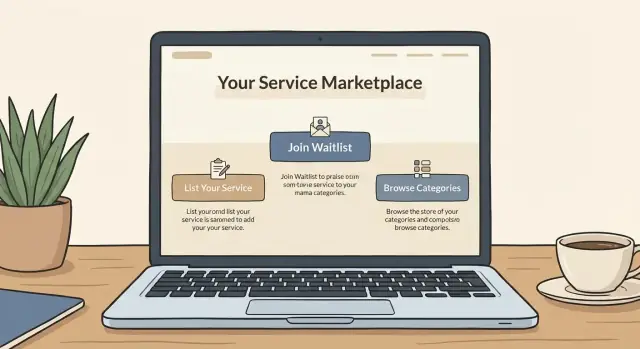
What “without full marketplace logic” really means
Building a marketplace landing page “without full marketplace logic” means you’re creating the story, positioning, and conversion path of a marketplace—without building the software features that make a marketplace run end-to-end.
You’re not aiming for automation yet. You’re aiming for clear signals.
The goal isn’t automation—it’s validation
Before you invest in accounts, profiles, search, messaging, payouts, and admin panels, decide what you’re trying to prove:
- Validate demand: Do enough buyers want this?
- Collect leads: Can you attract the right people consistently?
- Pre-sell: Will people put money down (or book a call) before the full product exists?
A “no-logic” version is successful if it produces a clear signal, not if it feels feature-complete.
Define your sides (and keep the promise simple)
Most marketplaces have two audiences:
- Buyers (people seeking a service/product)
- Sellers (people offering it)
Your landing page should make a straightforward promise to each side—even if you handle the matching manually behind the scenes.
Pick success metrics you can measure this week
Choose one or two primary metrics:
- Email sign-ups / waitlist joins
- Qualified inquiries (form submissions)
- Calls booked
- Deposits paid (if you’re testing willingness to pay)
What you’re not building yet
“No marketplace logic” typically means no accounts, no automated matching, no in-app messaging, no inventory sync, and no seller onboarding flow.
Instead, your site captures intent and you deliver the outcome manually (for now).
Pick a narrow offer and a single conversion goal
A marketplace-style landing page works best when it makes one clear promise and asks for one clear action. If you try to “serve everyone,” visitors won’t know whether they’re in the right place—and you won’t know what to measure.
Choose one core promise + one primary CTA
Start with a single outcome you can deliver in the next 2–4 weeks. Examples:
- “Get matched with 3 vetted freelance bookkeepers within 48 hours.”
- “List your studio space and get your first inquiry this week.”
Then pick one primary call-to-action (CTA) that aligns with that outcome: Request matches, Join the waitlist, or Apply to list. Keep everything else secondary.
Write a simple positioning statement
Use this format:
For [specific audience], we help you [specific outcome] without [common pain].
Example: “For early-stage founders, we help you find pre-vetted fractional CFOs without weeks of interviews.”
List 3–5 differentiators you can deliver now
Avoid aspirational claims that require automation you don’t have yet. Strong launch-ready differentiators include:
- Hand-vetted listings (with clear criteria)
- Guaranteed response time
- Human matching (intro in 24–48 hours)
- Clear pricing ranges or minimums
- Local focus or niche expertise
Decide: supply-first or demand-first
If buyers are the bottleneck (they need trust), start demand-first and collect requests. If sellers are scarce or quality varies, start supply-first and curate a tight set of providers.
Pick one side to prioritize so your page tells a single story—and has a single conversion goal.
Plan the site structure for a marketplace-style landing page
A marketplace-style landing page works best when it feels browseable even if nothing is searchable yet. Your goal is to give visitors enough structure to understand what’s available, who it’s for, and what to do next—without building profiles, accounts, or complex filters.
A simple sitemap that feels like a marketplace
Start with a small, deliberate sitemap:
- Homepage (your main “marketplace front door”)
- 3–8 category pages (to show breadth and create browse paths)
- One “How it works” page or section (covering both sides)
- About / Trust page (optional but useful)
- Contact (or support)
- Pricing / Fees (only if you can state it clearly)
A clean starting point:
- / (homepage)
- /categories (optional index)
- /category/[category-name] (3–8 pages)
- /how-it-works (or a homepage section)
- /contact
Homepage sections to include (in this order)
Structure the homepage like a guided tour:
- Hero: one sentence on the promise + one primary CTA (e.g., “Request a match” or “Join as a provider”).
- Problem: what’s hard today, stated plainly.
- Solution: what you do differently (curated matches, vetted providers, faster turnaround).
- Categories: 3–8 tiles that link to category pages.
- Social proof: quotes, logos, small stats, or “as seen in” (only if true).
- FAQ: answer the top objections (timing, quality, pricing, and what happens after submitting).
- CTA: repeat the primary action with a short reassurance.
“How it works” for both sides
Even without accounts, clarity builds trust. Include a short split explanation:
- For customers: submit request → get intros → pick one → schedule.
- For providers: apply → get vetted → receive leads → respond fast.
Pricing/fees: include only if you can be precise
If your model is still changing, avoid vague pricing. If it’s simple, state it directly (e.g., “Free to request; providers pay a referral fee” or “Flat monthly listing”). If not, say “Pricing varies by category—request a quote.”
Design the homepage to feel like a marketplace—without building one
A marketplace homepage doesn’t need real-time inventory or user accounts to feel like a marketplace. Your job is to help visitors instantly understand:
- What’s here
- Who it’s for
- What to do next
Nail the above-the-fold message
Within the first screen, be explicit about:
- Who it’s for: “For startups hiring fractional finance leaders” or “For homeowners booking vetted cleaners.”
- The outcome: speed, quality, price clarity, vetting, guarantees—pick the top 1–2.
- One primary CTA: “Request matches” or “Get recommendations.”
If you have two distinct audiences, use two CTAs (side-by-side, equal weight): “Join as a buyer” and “Apply as a seller.” Each should go to a short form, not a login.
Use visuals that mimic browsing
Even without a database, you can simulate inventory with:
- Example listing cards (3–9) showing a name/category, location, starting price or range, and a short “best for” line.
- Category tiles (“Brand design,” “Bookkeeping,” “Dog walking”) that lead to anchored sections or simple pages.
- Screenshots of what the buyer receives (sample shortlist, email intro, calendar booking screen).
Add trust—carefully
Trust elements should be real and verifiable: short testimonials, clear vetting criteria, and only genuine partner/customer logos.
If you have numbers, qualify them (“12 providers vetted so far,” “48 requests processed”). When you don’t, replace hype with process: “Reviewed within 24 hours” and “Hand-matched by a human.”
Use curated listings or examples instead of dynamic inventory
A marketplace-style landing page doesn’t need a real-time database on day one. You can create the feeling of choice and credibility with a small set of curated listings—or clearly labeled examples—that you add manually.
Create a simple listing template
Keep every card consistent so it’s easy to scan:
- Title (what it is)
- Short description (1–2 sentences)
- Location (or service area)
- Price range (even a rough band builds trust)
- Photos (1–3 is enough)
- Contact CTA (one clear button)
If you’re using Webflow, WordPress, Carrd, or Notion, these can be static blocks. You can always move them into a CMS later—don’t let “dynamic inventory” be the reason you delay launch.
Keep listings static (manually added)
Start with 6–15 listings you can confidently describe. This can be:
- real providers you’ve pre-vetted
- partners who agreed to be featured
- curated examples that show the type of supply you plan to onboard
Accuracy matters. If something is an example, label it clearly.
Add a status label to set expectations
Place a small badge on every listing: “Example”, “New”, “Accepting requests”, or “Waitlist.” This reduces confusion and prevents mismatched leads.
Provide one inquiry path
Avoid multiple competing CTAs. Pick one: a short form, a single email link, or a booking link. Route everything through one page like /request so you can track conversion cleanly.
Capture demand and supply with simple forms (no accounts needed)
If you’re skipping full marketplace logic, your “signup” flow should feel effortless. Accounts, passwords, and profiles add friction and support work—forms don’t.
Create two clear paths: buyers and sellers
Don’t force everyone into one generic form. Use two buttons (e.g., “I’m looking for help” and “I offer this service”) that lead to separate forms. This removes confusion and helps you ask only what matters for that side.
Ask for the minimum data that enables action
Keep each form to the smallest set of fields needed to fulfill the request.
For buyers: what they need, location/timezone, budget range (optional), and how to contact them.
For sellers: what they offer, availability, starting price (optional), and a link to proof (portfolio/LinkedIn).
Long applications can wait until you’ve validated demand.
Route everything to a spreadsheet/CRM + auto-reply
Send submissions to a Google Sheet, Airtable, Notion database, or a lightweight CRM. Set up an automatic email response that confirms receipt and explains the next step (“We’ll reply within 24 hours with 1–3 matches” or “We’ll review and request details if needed”).
If you have a short screening step, include a scheduling link in the auto-reply.
Spam protection and consent you can’t skip
Add CAPTCHA (or equivalent), and use double opt-in for email lists when appropriate. Include clear consent language near the submit button (e.g., permission to contact them about matches) and link to /privacy.
Deliver the core value manually: requests, intros, and scheduling
You don’t need profiles, messaging, or matching algorithms to deliver the “marketplace” experience. Your first job is to create a reliable request → intro → next step pipeline that you can run by hand.
Build a simple “Request an intro” flow
On each listing (or on a general “Get matched” section), add one primary CTA: Request an intro.
Keep the form short: who they are, what they need, budget/range (optional), timeline, and contact email. Once it’s submitted, you manually match them to one or two suitable providers and introduce them via email.
Add scheduling for calls or demos
Instead of building availability logic, route qualified requests to a scheduling link (Calendly-style). Use two links:
- Discovery call (15 min) for ambiguous requests
- Intro call (30 min) when you already know the best match
This reduces back-and-forth and makes the experience feel immediate.
Use email templates to move fast
Templates keep your tone consistent and help set expectations. Here are two you can copy:
Subject: Got it — we’re matching you with the right fit

Hi {{Name}},

Thanks for the request. We’ll review it and email you 1–2 recommended options within {{time_window}}.

If anything is urgent or you have constraints (budget, dates, location), reply here and we’ll factor it in.

— {{YourName}}
Subject: Intro: {{Buyer}} ↔ {{Provider}}

Hi {{Provider}}, hi {{Buyer}},

Connecting you both based on {{one-line reason}}.

{{Buyer}} is looking for: {{summary}}.
Next step: book a quick call here: {{link}}.

— {{YourName}}
Set clear boundaries (and stick to them)
A lightweight marketplace runs on trust. Be explicit on the page and in confirmations:
- Typical response time (e.g., “within 24–48 hours”)
- What happens after submission (review → match → intro)
- What you don’t do yet (e.g., “No in-app chat; intros happen via email”)
- How you handle no-match cases (refund/alternative/waitlist)
These constraints prevent confusion and keep your manual ops sustainable.
Optional: validate pricing with simple payments (no checkout build)
You don’t need carts, subscriptions, or a full buyer-account flow to learn what people will pay. A simple payment step can validate pricing faster than surveys—if you’re clear about what buyers get and when.
Pre-sell with Stripe Payment Links (or a deposit)
Use Stripe Payment Links to collect a one-time payment for an initial package (for example: “3 curated introductions” or “one week of sourcing”). Keep the offer narrow and time-bound so you can fulfill it manually.
If you’re not ready to take full payment, offer a refundable deposit. Deposits work well when the service depends on availability and you want to filter for serious buyers.
Try paid “priority access” or concierge matching
A paid “priority access” tier can be a strong signal—only if it changes the experience in a real way you can deliver (faster response, higher-touch matching). Avoid vague perks like “VIP benefits” unless they’re defined.
If charging sellers, start with application + invoice
Instead of building seller checkout, collect applications via a form, approve manually, then send an invoice (Stripe Invoice or a simple payment link). This keeps control in your hands while you learn who’s willing to pay and why.
Make refunds and fulfillment unmissable
Place a short policy directly next to the payment button:
- What’s included (and what isn’t)
- Delivery timeline (e.g., “within 48 hours”)
- Refund rules (full/partial, and conditions)
Clarity here reduces disputes and protects trust while you experiment with pricing.
Tool choices: no-code and lightweight stacks that work
You don’t need “marketplace software” to launch a convincing marketplace landing page. You need a fast builder, a simple way to collect leads, and a place to review them.
Fast builders for a polished first version
Pick a tool that matches your comfort level and how often you’ll update content:
- Webflow: Great design control and a built-in CMS if you want categories and listing-style pages.
- WordPress: Best when you want lots of plugins (SEO, forms) and don’t mind occasional maintenance.
- Framer: Very quick for modern landing pages; ideal if you’re prioritizing speed and visuals.
- Carrd: Cheapest and fastest for a single-page site + form capture (perfect for a waitlist-style MVP).
Do you actually need a CMS?
Use a CMS only if you’ll update categories or curated listings weekly (or at least a few times a month). If you’re not updating regularly, a static “Examples” section is often clearer and faster.
Rule of thumb: if you’re going to publish more than ~15 items and keep them fresh, a CMS helps. Otherwise, keep it simple.
Lightweight integrations that don’t turn into a project
Keep the workflow boring:
Form → email → spreadsheet.
For example: Webflow Forms / Tally / Typeform → notifications in Gmail → rows in Google Sheets (via Zapier/Make). This gives you an inbox alert plus a sortable “pipeline” without building accounts or dashboards.
When you’re ready to build beyond no-code
Once you’ve validated demand, you may want to ship a real MVP without rebuilding everything from scratch. A vibe-coding platform like Koder.ai can help you turn the same flow (categories, listing pages, lead capture, and manual matching) into a working web app via chat—then export the source code or deploy/host it. It’s a practical next step when you’re ready for features like snapshots/rollback, planning mode, and a React + Go + PostgreSQL foundation without committing to a full legacy development pipeline too early.
Accessibility basics worth doing on day one
Small choices build trust and improve conversions:
- Use clear headings (H2/H3) and logical sections
- Ensure strong color contrast and readable font sizes
- Make buttons look clickable and large enough on mobile
- Add descriptive labels to form fields (not just placeholder text)
SEO basics for a marketplace landing page
SEO is how your “marketplace-style” site gets found before you have a real inventory system. The goal is to publish a few pages that match high-intent searches and make it easy for Google (and people) to understand what you offer.
Create a small set of intent pages
Start with one page per category (e.g., “Dog walkers,” “Bookkeepers,” “Wedding photographers”) and one “best for” page that targets decision queries (e.g., “Best dog walkers for busy professionals”). These pages can be curated and static—you’re optimizing for search intent, not dynamic listings.
Link them from your homepage and keep the URLs clean, like /categories/dog-walkers and /best-for/busy-professionals.
Write titles and meta descriptions people actually search
Use plain-language titles that mirror queries:
- Title: “Dog Walkers in Austin — Vetted Options + Fast Introductions”
- Meta description: “Tell us what you need. We’ll match you with 2–3 dog walkers in Austin based on schedule, budget, and neighborhood.”
Aim for one primary phrase per page (category + location, or “best for” + use case) and keep the rest supporting.
Add an FAQ that removes friction
Add an FAQ section to category and “best for” pages that answers:
- Pricing ranges
- Availability and response times
- Coverage areas / neighborhoods
- What happens after someone submits the form
Use internal links to guide both users and crawlers
Create clear pathways: link from the homepage to /how-it-works, then to each category page, and cross-link between related categories and “best for” pages. A simple footer nav that repeats these links helps too.
Measure traction and iterate on what converts
A marketplace-style landing page is only useful if you can tell what’s working. Set up measurement on day one, then change one thing at a time so improvements are real—not guesswork.
Track the actions that signal intent
Start with a small set of analytics events tied to your conversion goal:
- Form submit (your primary “lead captured” moment)
- Button clicks on your main CTA (e.g., “Request matches” / “Join the waitlist”)
- Booking starts if you link to Calendly or a scheduler
Tools like GA4, Plausible, or PostHog can handle this without heavy setup.
Find where people drop off
Don’t just count conversions—look for friction. Track:
- Scroll depth to see whether visitors reach your listings/examples
- Time on page to spot “bounces with interest” (reading but not acting)
- Form completion rate (starts vs. submits) to identify fields that slow people down
If you use session recordings/heatmaps, treat them as directional—then validate with event data.
Run small A/B tests
Test high-impact elements first:
- Headline (clear promise vs. niche-specific promise)
- CTA text (“Get matched” vs. “See providers”)
- Form length (email-only vs. email + 2–3 qualifying questions)
Keep each test focused and run it until you have enough traffic to see a consistent trend.
Add one qualitative question
In your main form, include a short prompt like: “What are you looking for?” This often reveals missing categories, unclear wording, or the real job-to-be-done—and it gives you copy for future iterations.
Legal, privacy, and trust essentials
A marketplace-style landing page asks people to share real needs (and sometimes money). Even if you’re running the “marketplace” manually, you still need basic legal pages and clear trust signals so visitors feel safe taking the next step.
Terms and Privacy: keep it simple, but real
Create /terms and /privacy pages and include a short plain-language summary at the top of each.
In your Privacy summary, state:
- What data you collect (e.g., name, email, request details, company, budget)
- Why you collect it (e.g., to match people, send updates, schedule calls)
- Who can see it (e.g., your team, vetted providers you introduce—only with permission)
- How long you keep it, and how to opt out
Also include a clear note on data deletion: explain how users can request deletion and provide a direct email (e.g., [email protected]) for those requests.
Set expectations (and reduce risk)
If you’re making introductions or sharing curated options, be explicit that you’re not guaranteeing outcomes—for example: results, availability, pricing accuracy, or that a match will be found.
Say what you will do (review requests, respond within X days, make introductions where possible).
Trust signals that cost nothing
Add a visible footer with:
- A support email and, if relevant, a business address or company name
- Links to /terms and /privacy
- A short “How it works” blurb that matches your actual process
Small clarity upgrades can increase form submissions while preventing misunderstandings later.
How to evolve from landing page to real marketplace later
Your landing page proves people want the match. The next step is turning the manual concierge work into software—only in the order that reduces risk.
Add features only when they remove real friction
Start with the smallest upgrades that increase successful matches or reduce time spent per match:
- Accounts and profiles when repeat users need to track requests, updates, or history.
- Search and filters when you have enough supply that browsing beats curation.
- Messaging when email threads become the bottleneck (but consider keeping first contact moderated).
A simple rule: if a feature doesn’t clearly improve conversion, trust, or fulfillment speed, postpone it.
Decide if you truly need a database (and moderation)
If your inventory changes often, you’ll want a real database (or at least a structured CMS) so listings aren’t stuck in static page edits.
At the same time, define a lightweight moderation workflow:
- Who can publish a listing?
- What gets verified (identity, credentials, availability, pricing)?
- How do you handle spam, duplicates, and disputes?
If you can’t answer these, adding user-generated listings too early can create more work than it saves.
Turn your manual ops into a product roadmap
Document what you’re doing right now—intake, vetting, matching, introductions, scheduling, follow-ups. For each step, note:
- What data you collect
- Where decisions happen (rules vs. judgment)
- What “good” looks like (response time, match rate, refund rate)
Those notes become your automation spec.
Next steps
If you want a structured plan, see /blog/marketplace-mvp-checklist. If you’re comparing approaches and costs for the next build stage, start at /pricing.
FAQ
What does “without full marketplace logic” actually mean?
It means you’re building the positioning + conversion path of a marketplace (what it is, who it’s for, why trust you, and how to take the next step) without building the software that automates the marketplace.
You typically skip accounts, profiles, search/filters, in-app messaging, payouts, and admin tooling—and you fulfill matches manually via email and spreadsheets.
What should I measure to know if my marketplace landing page is working?
Pick one primary signal you can measure in 7 days:
- Waitlist/email sign-ups
- Qualified request form submissions
- Calls booked
- Deposits paid (willingness to pay)
Track it with a single source of truth (e.g., form → sheet/CRM) so you can see volume and quality, not just traffic.
How do I choose the right offer and CTA for a marketplace-style landing page?
Start with one core promise you can reliably deliver in 2–4 weeks, then pair it with one primary CTA.
Examples:
- Promise: “Get matched with 3 vetted options in 48 hours.” → CTA: “Request matches”
- Promise: “Get your first inquiry this week.” → CTA: “Apply to list”
Keep everything else secondary (links below the fold) so visitors aren’t split across multiple actions.
How do I write positioning that feels credible without a real marketplace product?
Use this template:
For [specific audience], we help you [specific outcome] without [common pain].
Then add 3–5 differentiators you can deliver now, like:
- Hand-vetted providers (with stated criteria)
- Response time guarantee (e.g., 24–48 hours)
- Human matching + warm introductions
- Clear price ranges/minimums
- Niche or local focus
Avoid claims that require automation you haven’t built yet.
Should I start demand-first or supply-first?
If you have two audiences (buyers and sellers), you can include both—but prioritize one side so the page has a single story.
A practical rule:
- Go demand-first if buyers are the bottleneck and you need proof of demand.
- Go supply-first if quality/availability is the risk and you need a curated baseline.
Even with two CTAs, ensure one is clearly the “primary” action you’re optimizing.
What pages do I need for a marketplace landing page MVP?
A simple structure that feels like a marketplace:
/(homepage)/categories(optional index)/category/[name](3–8 category pages)/how-it-works(or a homepage section)/contact
On the homepage, keep the flow tight: hero + CTA → problem → solution → categories → trust → FAQ → repeat CTA.
How can I show listings if I don’t have dynamic inventory yet?
Use static listing cards to simulate inventory and choice.
Keep each card consistent:
- Title + 1–2 line description
- Location/service area
- Price range (even rough bands)
- “Best for” line
- One CTA (e.g., “Request an intro”)
If a listing is only illustrative, label it clearly as “Example” to avoid mismatched expectations.
How do I capture buyers and sellers without accounts or logins?
Create two separate paths with minimal fields:
- Buyer form: need, location/timezone, timeline, budget range (optional), contact
- Seller form: service, availability, starting price (optional), proof link (portfolio/LinkedIn)
Route submissions to a sheet/CRM and send an auto-reply that states the next step and response time. Keep everything going through one route like /request so tracking stays clean.
How do I deliver the marketplace experience manually behind the scenes?
Run a simple pipeline: request → manual match → email intro → scheduling.
To make it feel “real” without building messaging/availability:
- Use a scheduling link (e.g., discovery vs intro call)
- Send consistent email templates for confirmation and introductions
- Set clear boundaries: response time, what happens next, and what you don’t support yet (e.g., no in-app chat)
This reduces confusion and keeps manual ops sustainable.
Can I validate pricing or take payments without building checkout or subscriptions?
Yes—if you keep it narrow and explicit.
Good lightweight options:
- A one-time Stripe Payment Link for a defined package (e.g., “3 curated introductions”)
- A refundable deposit to filter for serious buyers
- Seller charging via application → approval → invoice/payment link
Place fulfillment timing and refund terms right next to the payment button to reduce disputes and protect trust.