

How to Build a Web App for Multi‑Brand E‑Commerce Backoffice
Learn how to design, build, and launch a web app that unifies orders, inventory, returns, and reporting across multiple e‑commerce brands.
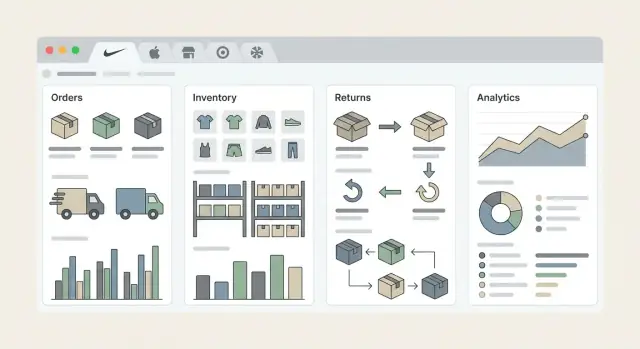
Clarify Scope and Goals for Multi‑Brand Operations
Before you talk frameworks, databases, or integrations, define what “multi‑brand” actually means inside your business. Two companies can both sell “multiple brands” and still need completely different backoffice tools.
What “multi‑brand” means in practice
Start by writing down your operating model. Common patterns include:
- Separate storefronts, shared warehouse: brands look different to customers, but inventory and fulfillment are centralized.
- Separate storefronts, separate warehouses: each brand runs its own stock and shipping rules.
- Shared team vs. dedicated teams: the same ops and support people handle all brands, or you have brand specialists.
These choices drive everything: your data model, permission boundaries, workflows, and even how you measure performance.
List the jobs your backoffice must support
A multi‑brand backoffice is less about “features” and more about the daily jobs teams must complete without juggling spreadsheets. Outline the minimum set of workflows you need on day one:
- Orders: view, edit, cancel, split/merge (if relevant), re-ship, exception handling
- Inventory: adjustments, transfers, cycle counts, inventory synchronization rules
- Catalog: product setup, catalog and SKU mapping, pricing, channel availability
- Purchasing: POs, inbound shipments, supplier tracking (if you manage replenishment)
- Returns: returns and refunds workflow, exchanges, restocking rules by brand
- Customer support: order lookup, status updates, partial refunds, customer notes
- Finance: settlements, fees, taxes, exports to accounting
If you’re unsure where to start, walk through a normal day with each team and capture where work currently “falls out” into manual exports.
Identify your users (and how they work)
Multi‑brand operations usually involve the same few roles, but with different access needs:
- Ops managers: need cross-brand visibility, performance reporting, and override powers
- Warehouse staff: fast picking/packing flows, barcode-first screens, minimal brand switching
- Customer support: search across brands, safe refund controls, customer communication history
- Finance: clean exports, reconciliation, audit trails
- Admins: configuration, integrations, user management
Document which roles need cross-brand access and which should be restricted to a single brand.
Define success metrics and constraints
Pick measurable outcomes so you can say “this is working” after launch:
- Shorter order processing time
- Higher order accuracy (fewer wrong items/addresses)
- Better stock accuracy (fewer oversells)
- Fewer manual exports and copy/paste steps
Finally, capture constraints upfront: budget, timeline, existing tools you must keep, compliance needs (tax, audit logs, data retention), and any “no‑go” rules (e.g., finance data must stay in a specific system). This becomes your decision filter for every technical choice later.
Audit Your Current Backoffice Workflows and Data Sources
Before you design screens or pick tools, get a clear picture of how work actually moves today. Multi‑brand backoffice projects usually fail when they assume “orders are just orders” and ignore channel differences, hidden spreadsheets, and brand‑specific exceptions.
Map where orders come from (and how they break)
Start by listing each brand and every sales channel it uses—Shopify stores, marketplaces, a DTC site, wholesale portals—and document how orders arrive (API import, CSV upload, email, manual entry). Capture what metadata you get (tax, shipping method, line‑item options) and what’s missing.
This is also where you spot practical issues like:
- Duplicate order creation when two systems import the same transaction
- Delays where marketplace orders arrive hours later and stock is already sold elsewhere
Document pain points with real examples
Don’t keep this abstract. Collect 10–20 recent “messy” cases and write down the steps staff took to resolve them:
- Duplicate data entry between systems
- Mismatched stock counts and oversells
- Manual refunds, partial refunds, and split shipments handled outside the main system
Quantify the cost where possible: minutes per order, number of refunds per week, or how often support needs to intervene.
Identify sources of truth (and gaps)
For each data type, decide what system is authoritative:
- Inventory: ERP, WMS/3PL, or Shopify?
- Product data: PIM, ERP, or spreadsheets?
- Financials: accounting system vs. platform reports
List gaps clearly (e.g., “return reasons only tracked in Zendesk” or “carrier tracking stored only in ShipStation”). These gaps will shape what your web app must store vs. fetch.
Capture brand-specific rules that change workflows
Multi‑brand operations differ on the details. Record rules like packaging slip formats, return windows, preferred carriers, tax settings, and any approval steps for high‑value refunds.
Finally, prioritize workflows by frequency and business impact. High‑volume order ingestion and inventory sync usually beat edge‑case tooling, even if the edge cases are loud.
Design the Product Modules and Shared vs. Brand‑Specific Rules
A multi‑brand backoffice gets messy when “brand differences” are handled ad hoc. The goal here is to define a small set of product modules, then decide what data and rules are global versus configurable per brand.
Start with a clear module map
Most teams need a predictable core:
- Order Management: order intake, edits, status changes, fulfillment, cancellations
- Inventory: stock on hand, reservations/holds, adjustments, transfer movements
- Catalog: product/SKU mapping, attributes, bundles/kits, channel listings
- Purchasing: suppliers, POs, inbound shipments, receiving
- Returns: RMAs, inspection outcomes, refunds/exchanges
- Reporting: operational dashboards + exportable datasets
Treat these as modules with clean boundaries. If a feature doesn’t clearly belong to one module, it’s a warning sign it may be “v2.”
Define shared vs. brand-specific rules (write it down)
A practical default is shared data model, brand‑specific configuration. Common splits:
- SKUs & catalog: shared internal SKU IDs, brand‑specific external SKU codes and naming
- Warehouses: often shared physical locations, but brand‑specific fulfillment eligibility rules
- Customers: shared customer record, brand‑specific marketing preferences and tax handling
- Pricing: usually brand‑ and channel‑specific, with shared price types (MSRP, sale, cost)
- Templates: brand‑specific emails, packing slips, return labels
Plan automation points early
Identify where the system should make consistent decisions:
- Auto‑routing orders to warehouses (based on stock, SLA, hazmat, region)
- Fraud checks (rules or third‑party flags) with review queues
- Stock holds/reservations during payment, picking, and returns inspection
- Refund rules (partial refunds, restocking fees, non‑returnable categories)
Non‑functional requirements and a v1/v2 list
Set baseline targets for performance (page load and bulk actions), uptime expectations, audit logs (who changed what), and data retention policies.
Finally, publish a simple v1 vs. v2 list. Example: v1 supports returns + refunds; v2 adds exchanges with cross‑brand swaps and advanced credit logic. This single document prevents scope creep more than any meeting will.
Pick an Architecture That Fits Your Team and Timeline
Architecture isn’t a trophy decision—it’s a way to keep your backoffice shippable while brands, channels, and operational edge cases pile up. The right choice depends less on “best practice” and more on your team size, deployment maturity, and how quickly requirements change.
Modular monolith first, microservices later (often the winning path)
If you have a small‑to‑mid team, start with a modular monolith: one deployable app with clear internal boundaries (orders, catalog, inventory, returns, reporting). You get simpler debugging, fewer moving parts, and faster iteration.
Move to microservices only when you feel real pain: independent scaling needs, multiple teams blocked by each other, or long release cycles caused by shared deployments. If you do go there, split by business capability (e.g., “Orders Service”), not by technical layers.
Major components to plan from day one
A practical multi‑brand backoffice usually includes:
- Web UI for operations teams (queues, search, bulk actions, approvals)
- API (REST/GraphQL) consumed by the UI and integrations
- Database with strong tenant/brand boundaries and auditability
- Background jobs for imports, sync, retries, and scheduled reports
- Integrations layer to isolate external APIs (stores, shipping, payments, ERP)
Keeping integrations behind a stable interface prevents “channel‑specific logic” from leaking into your core workflows.
Environments and configuration per brand/channel
Use dev → staging → production with production‑like staging data where possible. Make brand/channel behavior configurable (shipping rules, return windows, tax display, notification templates) using environment variables plus a database‑backed configuration table. Avoid hardcoding brand rules in the UI.
Tech stack: optimize for maintainability
Pick boring, well‑supported tools your team can hire for and maintain: a mainstream web framework, a relational database (often PostgreSQL), a queue system for jobs, and an error/logging stack. Favor typed APIs and automated migrations.
If your main risk is speed-to-first-shippable rather than raw engineering complexity, it can also be worth prototyping the admin UI and workflows in a faster build loop before committing to months of custom work. For example, teams sometimes use Koder.ai (a vibe‑coding platform) to generate a working React + Go + PostgreSQL foundation from a planning conversation, then iterate on queues, role-based access, and integrations while keeping the option to export source code, deploy, and roll back via snapshots.
File storage: invoices, labels, and return photos
Treat files as first‑class operational artifacts. Store them in object storage (e.g., S3‑compatible), keep only metadata in your DB (brand, order, type, checksum), and generate time‑limited access URLs. Add retention rules and permissions so brand teams only see their own documents.
Build a Data Model for Orders, SKUs, and Inventory Across Brands
A multi‑brand backoffice succeeds or fails on its data model. If the “truth” about SKUs, stock, and order status is split across ad‑hoc tables, every new brand or channel will add friction.
Start with the core entities (and keep them explicit)
Model the business exactly as it operates:
- Brand: the commercial identity (policies, tax profile, currency defaults)
- Channel: where orders originate (Shopify, Amazon, wholesale portal)
- Storefront: the specific selling surface within a channel (e.g., one Shopify store per brand)
- Warehouse: physical or 3PL locations that hold stock
- Product and SKU: product is what customers see; SKU is what ops picks/ships
- Order, Shipment, Return: operational records with clear lifecycles
This separation avoids “Brand = Store” assumptions that break as soon as one brand sells on multiple channels.
Plan SKU mapping for real‑world catalogs
Use an internal SKU as your anchor, then map it outward.
A common pattern is:
sku(internal)channel_sku(external identifier) with fields:channel_id,storefront_id,external_sku,external_product_id, status, and effective dates
This supports one internal SKU → many channel SKUs. Add first‑class support for bundles/kits via a bill‑of‑materials table (e.g., bundle SKU → component SKU + quantity). That way inventory reservation can decrement components correctly.
Model inventory as a set of quantities, not one number
Inventory needs multiple “buckets” per warehouse (and sometimes per brand for ownership/accounting):
- on_hand (physically present)
- reserved (allocated to orders)
- available (sellable now; typically on_hand − reserved − safety_stock)
- inbound (expected via purchase orders or transfers)
- safety_stock (buffer)
Keep calculations consistent and auditable; don’t overwrite history.
Build auditability into every lifecycle
Multi‑team operations require clear answers to “what changed, when, and who did it.” Add:
- Status history tables for orders/shipments/returns
- An event log for integrations and workflow actions
created_by,updated_by, and immutable change records for critical fields (addresses, refunds, inventory adjustments)
Don’t forget currency and tax fields
If brands sell internationally, store monetary values with currency codes, exchange rates (if needed), and tax breakdowns (tax included/excluded, VAT/GST amounts). Design this early so reporting and refunds don’t become a rewrite later.
Plan Integrations and Data Sync (APIs, Webhooks, and Jobs)
Integrations are where multi‑brand backoffice apps either stay clean—or turn into a pile of one‑off scripts. Start by listing every system you must talk to and what “source of truth” each one owns.
Map the systems you need to connect
At minimum, most teams integrate:
- Storefront APIs (Shopify, Magento, custom stores)
- Marketplaces (Amazon, eBay, Zalando, etc.)
- Shipping carriers and label providers
- 3PL/WMS tools for fulfillment and inventory
- Accounting (QuickBooks, Xero, NetSuite)
Document for each: what you pull (orders, products, inventory), what you push (fulfillment updates, cancellations, refunds), and required SLAs (minutes vs. hours).
Choose the right sync patterns
Use webhooks for near real‑time signals (new order, fulfillment update) because they reduce delay and API calls. Add scheduled jobs as a safety net: polling for missed events, nightly reconciliation, and re‑sync after outages.
Build retries into both. A good rule: retry transient failures automatically, but route “bad data” to a human‑review queue.
Normalize events internally
Different platforms name and structure events differently. Create a normalized internal format like:
order_createdshipment_updatedrefund_issued
This lets your UI, workflows, and reporting react to one event stream instead of dozens of vendor‑specific payloads.
Idempotency and deduplication
Assume duplicates will happen (webhook redelivery, job reruns). Require an idempotency key per external record (e.g., channel + external_id + event_type + version), and store processed keys so you don’t double‑import or double‑trigger actions.
Monitoring and recovery tools
Treat integrations as a product feature: an ops dashboard, alerts on failure rates, an error queue with reasons, and a replay tool to reprocess events after fixes. This will save hours every week once volume grows.
Implement User Roles, Permissions, and Approval Flows
A multi‑brand backoffice fails quickly if everyone can “just access everything.” Start by defining a small set of roles, then refine with permissions that match how your teams actually work.
Define clear roles (then extend with permissions)
Common baseline roles:
- Admin: manages users, global settings, integrations
- Brand Manager: controls brand catalog rules, pricing, brand‑level configurations
- Ops: handles orders, exceptions, manual edits within policy
- Warehouse: picking, packing, inventory movements, shipment confirmation
- Support: customer‑facing actions (order notes, address corrections, returns initiation)
- Finance: refunds, reconciliation exports, tax‑related reports
- Read‑only: analytics and audits without write access
Permission granularity that matters
Avoid a single “can edit orders” switch. In multi‑brand operations, permissions often need to be scoped by:
- Brand (Brand A vs. Brand B)
- Warehouse or location (regional fulfillment centers)
- Channel (Shopify, Amazon, retail POS)
- Data type / action (refunds, stock adjustments, price changes, export access)
A practical approach is role‑based access control with scopes (brand/channel/warehouse) and capabilities (view, edit, approve, export).
Brand switching and “default context”
Decide whether users operate in:
- Single‑brand mode (default brand context; safest for most users), or
- Cross‑brand mode (for admins and shared services like Finance)
Make the current brand context visible at all times, and when a user switches brands, reset filters and warn before cross‑brand bulk actions.
Add approvals where money or stock can change
Approval flows reduce costly mistakes without slowing everyday work. Typical approvals:
- High‑value refunds (threshold‑based; e.g., > $200 requires Finance approval)
- Stock adjustments (especially negative adjustments or large deltas)
Log who requested, who approved, the reason, and before/after values.
Compliance basics you shouldn’t skip
Apply least privilege, enforce session timeouts, and keep access logs for sensitive actions (refunds, exports, permission changes). These logs become essential during disputes, audits, and internal investigations.
Create the Core Backoffice UI and Operational Workflows
A multi‑brand backoffice succeeds or fails on day‑to‑day usability. Your goal is a UI that helps ops teams move quickly, spot exceptions early, and take the same actions no matter where an order originated.
Key screens to design first
Start with a small set of “always‑open” screens that cover 80% of work:
- Unified order inbox: one list for all brands and channels, with clear indicators for payment, fulfillment, and risk
- Brand + channel filters: fast toggles so a team can work “Brand A only” or “Marketplace orders only” without losing context
- Exceptions queue: a separate view for orders that need human attention (address issues, inventory shortfalls, failed captures, fraud holds)
- Order detail page: a single place for customer info, line items, shipments, status timeline, payment/refund history, and integrations (carrier tracking, warehouse)
Workflows you should support end‑to‑end
Model operational reality instead of forcing teams into workarounds:
- Split shipments (some items ship now, others later)
- Backorders with clear customer communication triggers
- Cancellations (before and after fulfillment)
- Address changes with audit trail and cutoffs (e.g., “before label purchase”)
- Re‑shipments for lost/damaged packages, linked to the original order
Bulk actions and status normalization
Bulk actions are where you win back hours. Make common actions safe and obvious: print labels, mark packed/shipped, assign to warehouse, add tags, export selected rows.
To keep the UI consistent across channels, normalize statuses into a small set of states (e.g., Paid / Authorized / Fulfilled / Partially Fulfilled / Refunded / Partially Refunded) and display the original channel status as a reference.
Notes and internal communication
Add order and return notes that support @mentions, timestamps, and visibility rules (team‑only vs. brand‑only). A lightweight activity feed prevents repeated work and makes handoffs cleaner—especially when multiple brands share a single ops team.
If you need a single entry point for teams, link the inbox as the default route (e.g., /orders) and treat everything else as drill‑down.
Design Returns, Refunds, and Exchanges for Multiple Brands
Returns are where multi‑brand operations get messy fast: each brand has its own promises, packaging rules, and finance expectations. The key is to model returns as a consistent lifecycle, while letting policies vary by brand through configuration—not custom code.
A clear returns lifecycle (that everyone can understand)
Define a single set of states and required data at each step, so support, warehouse, and finance see the same truth:
- Request created (items, reason codes, photos if needed)
- Approved / rejected (policy checks + human overrides)
- Label issued (carrier, service level, RMA number)
- Received (scan‑in, discrepancies logged)
- Inspected (restockable, damaged, missing parts)
- Outcome applied: refund, exchange, or store credit
Keep transitions explicit. “Received” should not imply “refunded,” and “approved” should not imply “label created.”
Brand-specific rules without hardcoding
Use config‑driven policies per brand (and sometimes per category): return window, allowed reasons, final‑sale exclusions, who pays shipping, inspection requirements, and restocking fees. Store these rules in a versioned policy table so you can answer “what rules were active when this return was approved?”
Inventory adjustments that match reality
When items come back, don’t automatically put them back into sellable stock. Classify into:
- Restockable → increments available inventory
- Quarantine → pending QA, not sellable
- Damaged/unsellable → write‑off or vendor claim path
For exchanges, reserve the replacement SKU early, and release it if the return is rejected or times out.
Refunds, credits, exchanges—and audit trails
Support partial refunds (discount allocation, shipping/tax rules), store credit (expiry, brand restrictions), and exchanges (price differences, one‑way swaps). Every action should create an immutable audit record: who approved, what changed, timestamps, original payment reference, and ledger‑friendly export fields for finance.
Reporting, Dashboards, and Exports That Teams Actually Use
A multi‑brand backoffice lives or dies by whether people can answer simple questions quickly: “What’s stuck?”, “What will break today?”, and “What needs to be sent to finance?” Reports should support daily decisions first, and long‑term analysis second.
Start with operational dashboards (not vanity metrics)
Your home screen should help operators clear work, not admire charts. Prioritize views like:
- Orders by status (new, paid, picking, shipped, exception)
- SLA breaches and “at risk” orders (e.g., due to ship within 24h)
- Late shipments by warehouse/carrier
- Cancellations and failure reasons (payment, stockout, address, fraud)
Make each number clickable into a filtered list so teams can act immediately. If you show “32 late shipments,” the next click should show those 32 orders.
Inventory views that prevent emergencies
Inventory reporting is most useful when it highlights risk early. Add focused views for:
- Low stock by brand and by fulfillment location
- Oversold risk (orders allocated beyond available)
- Inbound ETA (what’s coming, when, and to where)
- Stock accuracy checks (big deltas between channel stock vs. internal stock)
These don’t need complex forecasting to be valuable—just clear thresholds, filters, and ownership.
Brand comparisons that drive better decisions
Multi‑brand teams need apples‑to‑apples comparisons:
- Revenue and order volume by brand and channel
- Fulfillment speed (order‑to‑ship time) and on‑time rate
- Return rate and refund speed
- Top SKUs and “problem SKUs” (high return, high cancellation)
Standardize definitions (e.g., what counts as “shipped”) so comparisons don’t turn into debates.
Exports for finance and ops (with consistent fields)
CSV exports are still the bridge to accounting tools and ad‑hoc analysis. Provide ready‑made exports for payouts, refunds, taxes, and order lines—and keep field names consistent across brands and channels (e.g., order_id, channel_order_id, brand, currency, subtotal, tax, shipping, discount, refund_amount, sku, quantity). Version your export formats so changes don’t break spreadsheets.
Set expectations for data freshness
Every dashboard should show the last sync time per channel (and per integration). If some data updates hourly and other data is real time, say so clearly—operators will trust the system more when it’s honest about freshness.
Testing, Deployment, and Operational Reliability
When your backoffice spans multiple brands, failures aren’t isolated—they ripple across order processing, inventory updates, and customer support. Treat reliability as a product feature, not an afterthought.
Logging and tracing you can actually use
Standardize how you log API calls, background jobs, and integration events. Make logs searchable and consistent: include brand, channel, correlation ID, entity IDs (order_id, sku_id), and outcome.
Add tracing around:
- Inbound webhooks (what arrived, what you accepted/rejected)
- Sync jobs (what changed, what was skipped, why)
- External dependencies (carrier APIs, marketplaces, PSPs)
This turns “inventory is wrong” from a guessing game into a timeline you can follow.
Automated tests for the flows that cost money
Prioritize tests around high‑impact paths:
- Order import → allocation → fulfillment request
- Inventory write‑backs to channels
- Returns/refunds status transitions
- Permission boundaries (who can approve, edit, export)
Use a layered approach: unit tests for rules, integration tests for your DB and queue, and end‑to‑end tests for “happy path” operations. For third‑party APIs, prefer contract‑style tests with recorded fixtures so failures are predictable.
Deployment plan: safe by default
Set up CI/CD with repeatable builds, automated checks, and environment parity. Plan for:
- Database migrations that are backward‑compatible (expand/contract)
- Feature flags to ship changes without instantly exposing them to every brand
- A clear rollback strategy (including how to roll back jobs already enqueued)
If you need structure, document your release process alongside internal docs (e.g., /docs/releasing).
Security basics that prevent painful incidents
Cover the fundamentals: input validation, strict webhook signature verification, secrets management (no secrets in logs), and encryption in transit/at rest. Audit admin actions and exports, especially anything that touches PII.
Runbooks for common incidents
Write short runbooks for: failed syncs, stuck jobs, webhook storms, carrier outages, and “partial success” scenarios. Include how to detect, how to mitigate, and how to communicate impact per brand.
Launch Plan and Roadmap for Scaling to More Brands and Channels
A multi‑brand backoffice is only successful when it survives real operations: peak order spikes, partial shipments, missing stock, and last‑minute rule changes. Treat launch as a controlled rollout, not a “big bang.”
Ship a minimal v1 that teams can trust
Start with a v1 that solves the daily pain without introducing new complexity:
- Unify orders into one queue with consistent statuses and search
- Basic inventory synchronization (even if it’s not real time yet)
- Role‑based access and a simple approval step for risky actions (refunds, cancellations)
- Basic reporting: order volume, fulfillment SLA, stock on hand, and export to CSV
If anything is shaky, prioritize accuracy over fancy automation. Ops will forgive slower workflows; they won’t forgive wrong stock or missing orders.
Pilot first: one brand, one channel
Pick a brand with average complexity and a single sales channel (e.g., Shopify or Amazon). Run the new backoffice in parallel with the old process for a short period so you can compare outcomes (counts, revenue, refunds, stock deltas).
Define “go/no‑go” metrics up front: mismatch rate, time‑to‑ship, support tickets, and the number of manual corrections.
Daily feedback loop with ops and warehouse
For the first 2–3 weeks, collect feedback every day. Focus on workflow friction first: confusing labels, too many clicks, missing filters, and unclear exceptions. Small UI fixes often unlock more value than new features.
Plan v2 features based on proven needs
Once v1 is stable, schedule v2 work that reduces cost and errors:
- Demand forecasting and replenishment suggestions
- Purchasing automation and supplier workflows
- PIM/catalog enrichment and better catalog‑to‑SKU mapping
- Advanced fraud and payment risk rules
Document a scaling plan
Write down what changes when you add more brands, warehouses, channels, and order volume: onboarding checklist, data mapping rules, performance targets, and required support coverage. Keep it in a living runbook (linkable internally, e.g., /blog/backoffice-runbook-template).
If you’re moving fast and need a repeatable way to spin up workflows for the next brand (new roles, dashboards, and configuration screens), consider using a platform like Koder.ai to accelerate “ops tooling” builds. It’s designed to create web/server/mobile apps from a chat-driven planning flow, supports deployment and hosting with custom domains, and lets you export the source code when you’re ready to own the stack long-term.
FAQ
What should I define first before building a multi-brand backoffice web app?
Start by documenting your operating model:
- Separate storefronts with shared vs. separate warehouses
- Shared ops/support team vs. dedicated brand teams
- Brand differences that change workflows (returns window, packaging slips, carriers, tax)
Then define which data must be global (e.g., internal SKUs) vs. configurable per brand (templates, policies, routing rules).
Which workflows are essential for a v1 multi-brand backoffice?
Write down the “day-one” jobs each team must complete without spreadsheets:
- Orders: search, edits, cancellations, split shipments, exceptions
- Inventory: adjustments, transfers, sync rules, cycle counts
- Catalog: SKU mapping, pricing, channel availability
- Returns/refunds: RMA lifecycle, restocking rules, partial refunds
- Finance: settlements, fees, taxes, exports
If a workflow isn’t frequent or high-impact, park it as v2.
How do I decide the “source of truth” across orders, inventory, and finance?
Pick an owner per data type and be explicit:
- Inventory: ERP/WMS/3PL vs. platform stock
- Product/SKU data: PIM/ERP vs. spreadsheets
- Financials: accounting system vs. channel reports
Then list gaps (e.g., “return reasons only in Zendesk”) so you know what your app must store vs. fetch.
How should I model SKUs across brands and channels?
Use an internal SKU as the anchor and map outward per channel/storefront:
- Keep
sku(internal) stable - Add a mapping table (e.g.,
channel_sku) withchannel_id,storefront_id,external_sku, and effective dates - Model bundles/kits with a bill-of-materials table so reservations decrement components
This prevents “Brand = Store” assumptions that break as you add channels.
What’s the right way to represent inventory to prevent oversells?
Avoid a single stock number. Track buckets per warehouse (and optionally ownership/brand):
on_handreservedavailable(derived)inboundsafety_stock
Store changes as events or immutable adjustments so you can audit how a number changed over time.
Should integrations use webhooks, polling jobs, or both?
Use a hybrid approach:
- Webhooks for near real-time events (new order, fulfillment updates)
- Scheduled jobs as a backstop (polling, reconciliation, re-sync)
Make every import idempotent (store processed keys) and route “bad data” to a review queue instead of retrying forever.
How do I set up permissions and approvals for multi-brand teams?
Start with RBAC plus scopes:
- Capabilities (view/edit/approve/export)
- Scopes by brand, warehouse, and channel
Add approvals for actions that move money or stock (high-value refunds, large/negative adjustments), and log requester/approver plus before/after values.
What UI screens matter most for day-to-day multi-brand operations?
Design around speed and consistency:
- Unified order inbox with brand/channel filters
- Exceptions queue for failures (address issues, stockouts, fraud holds)
- Order detail page with status timeline, shipment/refund history, and integration events
- Safe bulk actions (labels, mark shipped, export)
Normalize statuses (Paid/Fulfilled/Refunded, etc.) while still showing the original channel status for reference.
How can I handle returns and refunds when each brand has different policies?
Use one shared lifecycle with brand-configurable rules:
- States: requested → approved/rejected → label issued → received → inspected → outcome applied
- Policies per brand/category: return window, exclusions, restocking fees, who pays shipping
- Inventory outcomes: restockable vs. quarantine vs. write-off
Keep refunds/exchanges auditable, including partial refunds with tax/discount allocation.
What’s a safe launch plan for rolling out a new multi-brand backoffice app?
Pilot a controlled rollout:
- Start with one brand and one channel
- Run in parallel briefly and compare counts (orders, refunds, stock deltas)
- Define go/no-go metrics (mismatch rate, time-to-ship, manual corrections)
For reliability, prioritize:
- Searchable logs with brand/channel/correlation IDs
- Retry + replay tools for integrations
- Backward-compatible migrations and feature flags for safe releases