

CrowdStrike: Telemetry + Cloud Analytics as a Data Platform
How CrowdStrike turns endpoint telemetry and cloud analytics into a scalable data platform business—improving detection, workflows, and product expansion.
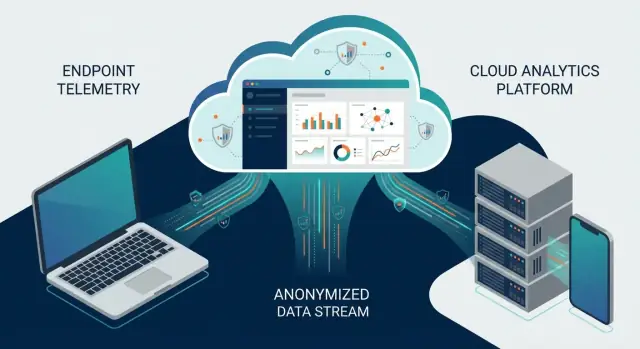
Why endpoint telemetry matters for modern security
Endpoint telemetry is the stream of small “facts” a device can report about what’s happening on it. Think of it as activity breadcrumbs: which processes started, what files were touched, which user logged in, what commands were run, and where the device tried to connect on the network.
What “endpoint telemetry” means (in plain terms)
A laptop or server can record and send events such as:
- Process activity: a new program launching, a script spawning another script, unusual parent/child process chains
- Logins and identity signals: successful and failed sign-ins, privilege changes, new accounts, remote access attempts
- File and registry changes: new executables appearing, sensitive files being accessed, persistence mechanisms being created
- Network behavior: outbound connections, DNS lookups, connections to rare domains or IPs
On their own, many of these events look normal. Telemetry matters because it preserves the sequence and context that often reveals an attack.
Why endpoints are such valuable sensors
Most real intrusions eventually touch endpoints: phishing delivers a payload to a user device, attackers run commands to move laterally, dump credentials, or disable defenses. Network-only visibility can miss “inside the host” details (like which process initiated a connection). Endpoint telemetry helps answer practical questions fast: What ran? Who ran it? What did it change? Where did it talk to?
What the cloud analytics layer does (vs. on-device tools)
On-device tools can block known-bad activity locally, but cloud analytics aggregates telemetry across many machines and across time. That enables correlation (linking related events), anomaly detection, and rapid updates based on new threat intelligence.
What this article is—and isn’t
This article explains the conceptual product and business model behind telemetry + cloud analytics as a security data platform. It does not describe proprietary vendor internals.
From endpoint sensor to cloud brain: a simple architecture
CrowdStrike’s core idea is straightforward: put a small “sensor” on each endpoint, stream useful security signals to the cloud, and let centralized analytics decide what matters. Instead of relying on heavy local scanning, the endpoint focuses on collecting telemetry and enforcing a small set of real-time protections.
The Falcon sensor (lightweight, always-on)
At a high level, the Falcon sensor is designed to be unobtrusive. It watches for security-relevant activity—like process launches, command-line arguments, file operations, authentication events, and network connections—then packages those events as telemetry.
The goal isn’t to do all analysis on the laptop or server. It’s to capture enough context, consistently, so the cloud can correlate and interpret behavior across many machines.
The flow: endpoint → cloud → detections
A simplified pipeline looks like this:
- Endpoint generates events (telemetry) as activity happens.
- Secure transport sends the data to the vendor’s cloud services.
- Cloud processing normalizes, enriches, and correlates events (often with threat intelligence).
- Detections and alerts are produced and sent back to the console—and, when needed, to the endpoint for response actions.
Why centralize the “brain” in the cloud?
Central analytics means detection logic can be updated quickly and applied consistently everywhere—without waiting for each endpoint to download large updates or run complex local checks. It also enables cross-environment pattern recognition and faster tuning of rules, scoring, and behavioral models.
Trade-offs to keep in mind
Streaming telemetry has costs: bandwidth, data volume (and storage/retention decisions), and privacy/governance considerations—especially when events might include user, device, or command context. Evaluating what’s collected, how it’s protected, and how long it’s retained should be part of any platform review.
What telemetry is collected, and what it enables
Endpoint telemetry is the “activity trail” a device leaves behind: what ran, what changed, who did it, and what the device talked to. A single event can look harmless; a sequence of events creates context that helps security teams decide what’s normal and what needs attention.
Common telemetry categories (and why they matter)
Most endpoint sensors focus on a handful of high-signal categories:
- Process activity: which apps and background programs start, what launches what, and how they behave. This is often the clearest storyline of an incident.
- File activity: new files created, files modified, suspicious downloads, or unusual locations (for example, a file appearing in a system folder).
- Registry/configuration changes: system settings that get edited—useful because many attacks rely on changing settings to stay persistent.
- Identity signals: which user account is active, sign-in patterns, privilege changes, and whether activity looks human vs. automated.
- Network connections: which external services a device connects to, unusual destinations, and unexpected spikes in outbound traffic.
- Device posture: whether the device is managed, encrypted, up to date, and generally in a healthy security state.
Why context beats single alerts
A single alert might say, “A new program started.” That’s rarely enough to act on. Context answers the practical questions: who was logged in, what ran, where it ran from (USB drive, downloads folder, system directory), and when it happened (right after a suspicious email was opened, or during routine patching).
For example, “a script ran” is vague. “A script ran under a finance user’s account, from a temporary folder, minutes after a new file download, and then connected to an unfamiliar internet service” is a scenario a SOC can triage quickly.
Enrichment: turning events into usable signals
Raw telemetry becomes more valuable when it’s enriched with:
- Asset information: device owner, department, criticality, and whether it’s a server or a laptop
- User identity context: role, normal login behavior, and recent account changes
- Threat intelligence: whether a website, file, or behavior pattern is known to be associated with real attacks
This enrichment enables higher-confidence detections, faster investigations, and clearer prioritization—without asking analysts to manually stitch together dozens of disconnected clues.
How cloud analytics turns raw events into security signals
Endpoint telemetry is noisy by default: thousands of small events that become meaningful only when you can compare them to everything else happening on the device—and to what “normal” looks like across many devices.
Normalization: speaking one common language
Different operating systems and apps describe the same activity in different ways. Cloud analytics first normalizes events—mapping raw logs into consistent fields (process, parent process, command line, file hash, network destination, user, timestamp). Once data “speaks” the same language, it becomes searchable, comparable, and ready for detection logic.
Correlation: turning dots into a story
A single event is rarely proof of an attack. Correlation connects related events across time:
- A suspicious email attachment launches a script
- The script spawns PowerShell with odd arguments
- A new scheduled task appears
- The device contacts an unfamiliar domain
Individually, these may be explainable. Together, they describe an intrusion chain.
Behavioral detection vs. signatures
Signature-only detection looks for known-bad artifacts (specific hashes, exact strings). Behavioral detection asks: does this act like an attack? For example, “credential dumping behavior” or “lateral movement pattern” can be detected even when the exact malware family is new.
Why cloud scale helps—without peeking into customer data
Cloud-scale analytics can spot repeatable patterns (new attack techniques, emerging malicious infrastructure) by aggregating signals and statistical trends, not by exposing one customer’s private content. The advantage is broader context: what’s rare, what’s spreading, and what’s newly correlated.
Fewer false positives through better context
More context usually means fewer noisy alerts. When analytics can see process lineage, reputation, prevalence, and the full sequence of actions, it can downgrade benign admin behavior and prioritize genuinely risky chains—so the SOC spends time on real incidents, not harmless anomalies.
Security as a data platform business model
A “data platform business” in security is built around a simple loop: collect high-quality security data, analyze it centrally, and package the results into products people can buy and use. The differentiator isn’t just having an endpoint agent or a console—it’s turning a continuous stream of telemetry into multiple outcomes: detections, investigations, automated responses, reporting, and long-term analytics.
Collect → Analyze → Package
On the collection side, endpoints generate events about processes, network connections, logins, file activity, and more. By sending that telemetry to a cloud backend, analytics can improve without constantly redeploying tools.
The packaging step is where a platform becomes a business: the same underlying data can power different “modules” (endpoint protection, EDR, identity signals, vulnerability context, threat hunting, posture checks) that are sold as separate capabilities or tiers.
Why product expansion is easier on a shared foundation
Once the telemetry pipeline, storage, and analytics layer exist, adding a new module often means adding new analytics and workflows, not rebuilding collection from scratch. Teams can reuse:
- the same data stream and schema
- the same cloud analytics engine
- the same management console and policy model
- the same investigation and case workflows
Why platforms can grow faster than point tools
Point tools typically solve one problem with one dataset. Platforms can compound value: new modules make the shared data more useful, which improves detection and investigation, which increases adoption of additional modules. For a SOC, a unified UI and shared workflows can also reduce context switching—less time exporting logs, correlating alerts, or reconciling conflicting asset lists.
Telemetry flywheel and network effects (and their limits)
A telemetry-driven security platform benefits from a simple flywheel: more telemetry leads to better detections, which creates more customer value, which drives more adoption, which in turn produces more telemetry.
A useful analogy is a navigation app. As more drivers share anonymous location and speed data, the app learns where traffic is forming, predicts delays sooner, and suggests better routes. Those better routes attract more users, which improves the predictions again.
How the flywheel works in security
With endpoint telemetry, the “traffic patterns” are behaviors like process launches, file changes, credential use, and network connections. When many organizations contribute signals, cloud analytics can spot:
- rare or suspicious behavior that stands out statistically
- new attacker techniques that appear across different environments
- variations of known threats that don’t match static signatures
The result is faster, more accurate detections and fewer false alarms—practical outcomes a SOC feels immediately.
Central improvements ship through analytics
Because the heavy analytics live in the cloud, improvements can roll out centrally. New detection logic, correlation rules, and machine-learning models can be updated without waiting for every customer to manually tune rules. Customers still need endpoint components, but much of the “brain” can evolve continuously.
Network effects aren’t automatic
This model has limits and responsibilities:
- Data quality: noisy sensors, inconsistent configurations, or incomplete coverage can weaken conclusions.
- Privacy and governance: telemetry needs clear controls—minimization, access policies, retention limits, and auditability—so shared learning doesn’t become shared risk.
- Customer diversity: what looks abnormal in one environment may be normal in another; analytics must respect context.
The strongest platforms treat the flywheel as an engineering and trust problem—not just a growth story.
Operational impact: SOC workflows powered by shared data
When endpoint telemetry is normalized into a shared cloud dataset, the biggest win is operational: the SOC stops juggling disconnected tools and starts running a repeatable workflow on one source of truth.
A practical SOC flow (detect → investigate → contain → remediate → report)
Detect. A detection fires because analytics spot suspicious behavior (for example, an unusual child process spawning PowerShell plus a credential access attempt). Instead of an alert that’s just a headline, it arrives with the key surrounding events already attached.
Investigate. The analyst pivots inside the same dataset: process tree, command line, hash reputation, user context, device history, and “what else looks similar” across the fleet. That reduces the time spent opening a SIEM tab, an EDR console, a threat intel portal, and a separate asset inventory.
Contain. With confidence built from correlated telemetry, the SOC can isolate a host, kill a process, or block an indicator without waiting for a second team to validate basic facts.
Remediate. Remediation becomes more consistent because you can search for the same behavior across all endpoints, confirm scope, and verify cleanup using the same telemetry pipeline.
Report. Reporting is faster and clearer: timeline, impacted devices/users, actions taken, and evidence links come from the same underlying event record.
Why a unified dataset reduces fatigue and speeds triage
A shared telemetry foundation cuts duplicate alerts (multiple tools flagging the same activity) and enables better grouping—one incident instead of twenty notifications. Faster triage matters because it saves analyst hours, reduces mean time to respond, and limits how many cases get escalated “just in case.” If you’re comparing broader detection approaches, see /blog/edr-vs-xdr.
EDR to XDR: extending the same analytics foundation
EDR (Endpoint Detection and Response) is endpoint-first: it focuses on what happens on laptops, servers, and workloads—processes, files, logins, and suspicious behavior—and helps you investigate and respond.
XDR (Extended Detection and Response) expands that idea to more sources than endpoints, such as identity, email, network, and cloud control-plane events. The goal isn’t to collect everything, but to connect what matters so an alert becomes an incident story you can act on.
Why cloud analytics makes the jump from EDR to XDR easier
If detections are built in the cloud, you can add new telemetry sources over time without rebuilding every endpoint sensor. New connectors (for example, identity providers or cloud logs) feed into the same backend analytics, so rules, machine learning, and correlation logic can evolve centrally.
Practically, this means you’re extending a shared detection engine: the same enrichment (asset context, threat intel, prevalence), the same correlation, and the same investigation tools—just with a wider set of inputs.
What “single pane of glass” should mean (in practice)
“Single pane of glass” shouldn’t be a dashboard with a dozen tiles. It should mean:
- One search across endpoints + other data sources, with consistent fields and filters
- A unified timeline that stitches events together (user → device → cloud action → outcome)
- Integrated case management: assign, comment, attach evidence, track status, and measure time-to-close
Vendor evaluation questions to ask
When assessing an EDR-to-XDR platform, ask vendors:
- Which non-endpoint sources are supported natively vs. via partners, and what data is actually ingested?
- Can I run the same query language and detections across all sources, or do tools fragment by module?
- How does the platform correlate identities, devices, and cloud assets to reduce duplicate alerts?
- What does an investigation look like end-to-end—can analysts pivot from an alert to raw events and back to a case?
- What’s the rollout effort for a new data source (time, permissions, ongoing maintenance)?
Packaging telemetry into products: modules, tiers, and value
A telemetry-driven security platform rarely sells “data” directly. Instead, the vendor packages the same underlying event stream into productized outcomes—detections, investigations, response actions, and compliance-ready reporting. This is why platforms often look like a set of modules that can be turned on as needs grow.
What gets packaged (and why it’s reusable)
Most offerings build on shared building blocks:
- Detection content: analytics rules, behavioral indicators, threat intel mappings, and automated response playbooks. As telemetry volume and diversity increase, content can become more accurate and cover more attack paths.
- Managed services: monitoring, triage, and incident response delivered by experts, typically using the same console and data. You’re paying for time-to-detect and time-to-respond improvements, not for a different telemetry pipeline.
- Identity protection: adding identity events (logins, token use, privilege changes) lets the platform connect endpoint activity to account abuse and lateral movement.
- Cloud security add-ons: ingesting cloud control plane and workload signals extends detections into misconfigurations, risky permissions, and cloud-native attack techniques.
Modules and tiers: common expansion paths
Modules make cross-sell and upsell feel natural because they map to changing risk and operational maturity:
- A team starts with endpoint protection and later adds identity when phishing and account takeover become top concerns.
- As the SOC gets busier, managed detection/response becomes appealing to reduce alert fatigue.
- As workloads move to AWS/Azure/GCP, cloud modules help maintain consistent visibility and correlation.
The key driver is consistency: the same telemetry and analytics foundation supports more use cases with less tooling sprawl.
Pricing implications of data-heavy products
Data platforms often price through a mix of modules, feature tiers, and sometimes usage-based factors (for example, retention, event volume, or advanced analytics). More telemetry can improve outcomes, but it also increases storage, processing, and governance costs—so pricing commonly reflects both capability and scale. For a general overview, see /pricing.
Trust, privacy, and governance for security telemetry
Telemetry can improve detection and response, but it also creates a sensitive data stream: process activity, file metadata, network connections, and user/device context. A strong security outcome should not require “collect everything forever.” The best platforms treat privacy and governance as first-class design constraints.
Core trust topics to look for
Data minimization: Collect only what’s necessary for security analytics, prefer hashes/metadata over full content when possible, and document the rationale for each telemetry category.
Access controls: Expect tight role-based access control (RBAC), least-privilege defaults, separation of duties (for example, analysts vs. admins), strong authentication, and detailed audit logs for both console actions and data access.
Retention and deletion: Clear retention windows, configurable policies, and practical deletion workflows matter. Retention should align to threat hunting needs and regulatory expectations, not just vendor convenience.
Regional processing: For multinational teams, where data is processed and stored is a governance requirement. Look for options that support regional data residency or controlled processing locations.
Compliance and expectations
Many buyers need alignment with common assurance frameworks and privacy regulations—often SOC 2, ISO 27001, and GDPR. You don’t need a vendor to “promise compliance,” but you do need evidence: independent reports, data processing terms, and transparent sub-processor lists.
Buyer checklist: questions to ask
- What telemetry fields are collected by default, and what can be disabled?
- Is any customer data used to train global models, and is opt-out available?
- Who can export raw telemetry, and how is that access logged and approved?
- What are default retention periods, and can we shorten them per region?
- Where is data stored/processed, and how are cross-border transfers handled?
- How do you support incident response without overexposing sensitive data?
A useful rule of thumb: your security platform should measurably reduce risk while still being explainable to legal, privacy, and compliance stakeholders.
Ecosystem and integrations: making the platform usable
A telemetry-first security platform only delivers value if it can plug into the systems where teams already work. Integrations turn detections into actions, documentation, and measurable outcomes.
Common integration points
Most organizations connect endpoint security telemetry to a few core tools:
- SIEM (e.g., Splunk, Sentinel): forward high-value alerts and enriched events so analysts can correlate endpoint activity with network, email, and cloud logs.
- SOAR (e.g., Cortex XSOAR, Splunk SOAR): trigger playbooks that automate repetitive steps—enrichment, isolation, blocking, and notification.
- Ticketing and ITSM (e.g., ServiceNow, Jira): create and update cases where incident response, IT, and business stakeholders can track work.
- Identity providers (e.g., Okta, Azure AD): connect user identity and access signals to endpoint behavior, and support response actions like forcing re-authentication or disabling accounts.
Why APIs matter when security becomes a platform
As security shifts from a single product to a platform, APIs become the control surface. Good APIs let teams:
- Pull detections and timelines into internal dashboards
- Enrich alerts with asset context (owner, criticality, location)
- Standardize response actions across tools (quarantine host, kill process, block hash)
In practice, this reduces swivel-chair work and makes outcomes repeatable across environments.
A practical note: many teams end up building small internal apps around these APIs (triage dashboards, enrichment services, case-routing helpers). Vibe-coding platforms like Koder.ai can speed up that “last mile” work—standing up a React-based web UI with a Go + PostgreSQL backend (and deploying it) from a chat-driven workflow—so security and IT teams can prototype integrations quickly without a long traditional dev cycle.
What “good” looks like in outcomes
A healthy integration ecosystem enables concrete results: automated containment for high-confidence threats, instant case creation with evidence attached, and consistent reporting for compliance and exec updates.
If you want a quick sense of the available connectors and workflows, see the integration overview at /integrations.
How to evaluate a telemetry-driven security platform
Buying “telemetry + cloud analytics” is really buying a repeatable security outcome: better detections, faster investigations, and smoother response. The best way to evaluate any telemetry-driven platform (CrowdStrike or alternatives) is to focus on what you can verify quickly in your own environment.
A buyer-oriented checklist
Start with the basics, then move up the stack from data to outcomes.
- Data coverage: Which endpoints are truly covered (servers, laptops, VDI, remote workers, legacy OS)? What happens when devices are off-network or frequently offline? If the sensor isn’t widely deployed, the analytics won’t matter.
- Detection quality: Do detections include clear “why” context (process tree, parent/child relationships, command line, identity and network signals)? How often are alerts actionable vs. “interesting”? Ask to see examples of high-fidelity detections on common techniques, not just headline malware.
- Response actions: Can you contain a host, kill a process, quarantine a file, isolate network access, and collect forensic artifacts—without extra tools? Verify what actions require additional licenses, approvals, or manual steps.
- Reporting and investigation: Can analysts pivot from an alert into timeline views, related entities, and “show me similar activity” searches? Look for reports that map to real needs: executive summaries, compliance evidence, and incident documentation.
- Admin overhead: How much tuning is required to stay sane? Check policy management, role-based access, multi-tenant support (if you’re an MSP), and how updates are handled.
A proof-of-value plan that actually works
Keep the pilot small, realistic, and measurable.
- Pilot scope (1–2 weeks to deploy): Cover a representative slice—critical servers, a few power-user endpoints, and at least one remote segment.
- Success metrics (2–4 weeks to measure): Track alert volume per 100 endpoints, false-positive rate, mean time to triage, time to contain, and investigation “click depth” (how many steps to reach root cause).
- Validation exercises: Run safe simulations or replay known incidents to test detection and response. Ensure your SOC can reproduce results without vendor hand-holding.
Common pitfalls to watch for
Too many alerts is usually a symptom of weak tuning defaults or missing context. Unclear ownership shows up when IT, security, and incident response don’t agree on who can isolate hosts or remediate. Weak endpoint coverage quietly breaks the promise: gaps create blind spots that analytics can’t magically fill.
Summary
A telemetry-driven security platform earns its keep when endpoint data plus cloud analytics translates into fewer, higher-quality alerts and faster, more confident response—at a scale that feels like a platform, not another tool.
FAQ
What is endpoint telemetry, and why does it matter?
Endpoint telemetry is a continuous stream of security-relevant events from a device—things like process starts, command lines, file/registry changes, logins, and network connections.
It matters because attacks are usually revealed by the sequence of actions (what launched what, what changed, and what it contacted), not by a single isolated alert.
Why are endpoints considered such valuable security sensors?
Networks show traffic patterns, but they often can’t tell you which process initiated a connection, what command ran, or what changed on disk.
Endpoints can answer the operational questions that drive triage:
- What ran?
- Who ran it?
- What did it change?
- Where did it connect?
What’s the difference between on-device protection and cloud analytics?
A lightweight endpoint sensor focuses on collecting high-signal events and applying a small set of real-time protections locally.
Cloud analytics does the heavy lifting at scale:
- normalizes events across OSes
- correlates activity over time and across devices
- enriches with threat intel and asset/user context
- produces detections and investigation-ready timelines
What types of telemetry are typically collected from endpoints?
Common high-signal categories include:
- Process activity (parent/child chains, command-line arguments)
- Logins and privilege changes
- File creation/modification (especially executables in odd locations)
- Registry/config changes (persistence mechanisms)
- Network connections and DNS lookups
- Device posture (management, encryption, patch state)
You typically get the best results when these are collected consistently across your fleet.
What does “normalization” mean in cloud security analytics?
Normalization translates diverse raw events into consistent fields (e.g., process, parent process, command line, hash, destination, user, timestamp).
That consistency enables:
- reliable searching and filtering
- cross-platform detections
- correlation across many endpoints without bespoke parsing per OS/app
How is behavioral detection different from signatures?
Signature detection looks for known bad artifacts (specific hashes, exact strings, recognized malware).
Behavioral detection looks for attack-like patterns (e.g., suspicious process lineage, credential dumping behaviors, persistence creation) that can flag previously unseen variants.
In practice, strong platforms use both: signatures for speed and confidence, behavior for resilience to novel threats.
How does correlation reduce alert noise and improve investigations?
Correlation connects related events into an incident storyline (for example: attachment → script → PowerShell → scheduled task → rare outbound domain).
This reduces false positives because the platform can weigh context and sequence instead of treating each event as a standalone emergency.
Why do vendors centralize the “brain” in the cloud?
Centralized cloud analytics can roll out improved detection logic quickly and apply it consistently across endpoints—without waiting for heavy local updates.
It can also use broader statistical context (what’s rare, what’s spreading, what’s newly linked) to prioritize truly suspicious chains—while still keeping governance controls in mind (minimization, retention, access).
What are the main trade-offs and risks of streaming telemetry?
Key trade-offs to evaluate include:
- Bandwidth and data volume: event streaming and storage add cost
- Retention decisions: how long you keep telemetry affects hunting and compliance
- Privacy/governance: command lines, usernames, and device context can be sensitive
A practical review includes verifying what’s collected by default, what can be disabled, who can export raw data, and how access is audited.
How should I evaluate a telemetry-driven EDR/XDR platform in a pilot?
A proof-of-value pilot should measure outcomes, not marketing claims:
- Deploy to a representative slice (servers + power users + remote endpoints)
- Validate detection context (process tree, command line, identity, network)
- Test response actions (isolation, kill process, quarantine) and what requires extra licensing
- Track metrics: alerts per 100 endpoints, false-positive rate, time to triage/contain, and investigation effort
Also confirm integration paths (SIEM/SOAR/ITSM) so detections turn into repeatable workflows.