

Distributed Databases: Trading Consistency for Availability
Learn why distributed databases often relax consistency to stay available during failures, how CAP and quorum work, and when to choose each approach.
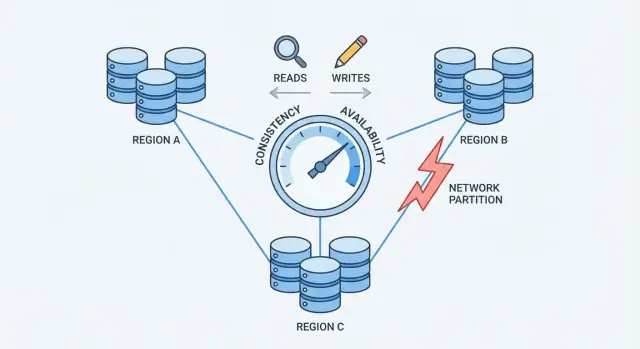
What Consistency and Availability Mean in Practice
When a database is split across multiple machines (replicas), you get speed and resilience—but you also introduce periods where those machines don’t perfectly agree or can’t reliably talk to each other.
Consistency (plain meaning)
Consistency means: after a successful write, everyone reads the same value. If you update your profile email, the next read—no matter which replica answers—returns the new email.
In practice, systems that prioritize consistency may delay or reject some requests during failures to avoid returning conflicting answers.
Availability (plain meaning)
Availability means: the system replies to every request, even if some servers are down or disconnected. You might not get the latest data, but you get an answer.
In practice, systems that prioritize availability may accept writes and serve reads even while replicas disagree, then reconcile differences later.
What the trade-off means for real applications
A trade-off means you can’t maximize both goals at the same time in every failure scenario. If replicas can’t coordinate, the database must either:
- Wait/fail some requests to protect a single, agreed-upon truth (favor consistency), or
- Keep responding to users even if it risks stale or conflicting data (favor availability)
A simple example: shopping cart vs. bank transfer
- Shopping cart: If your cart count is briefly off by one on another device, it’s annoying but usually acceptable. Many teams prefer higher availability and reconcile later.
- Bank transfer: If you move $500 and your balance temporarily shows two different answers, that’s a serious problem. Here, stronger consistency is often worth occasional “please try again” failures.
No single best choice
The right balance depends on what errors you can tolerate: a short outage, or a short period of wrong/old data. Most real systems choose a point in between—and make the trade-off explicit.
Why Distribution Changes the Rules
A database is “distributed” when it stores and serves data from multiple machines (nodes) that coordinate over a network. To an application, it may still look like one database—but under the hood, requests can be handled by different nodes in different places.
Replication: the reason teams add nodes
Most distributed databases replicate data: the same record is stored on multiple nodes. Teams do this to:
- keep the service running if a machine dies
- reduce latency by serving users from a nearby node
- scale reads (and sometimes writes) across more hardware
Replication is powerful, but it immediately raises a question: if two nodes both have a copy of the same data, how do you guarantee they always agree?
Partial failure is normal, not exceptional
On a single server, “down” is usually obvious: the machine is up or it isn’t. In a distributed system, failure is often partial. One node might be alive but slow. A network link might drop packets. A whole rack might lose connectivity while the rest of the cluster keeps running.
This matters because nodes can’t instantly know whether another node is truly down, temporarily unreachable, or just delayed. While they’re waiting to find out, they still have to decide what to do with incoming reads and writes.
Guarantees change when communication isn’t guaranteed
With one server, there’s one source of truth: every read sees the latest successful write.
With multiple nodes, “latest” depends on coordination. If a write succeeds on node A but node B can’t be reached, should the database:
- block the write until B acknowledges it (protecting consistency), or
- accept the write anyway (protecting availability)?
That tension—made real by imperfect networks—is why distribution changes the rules.
Network Partitions: The Core Problem
A network partition is a break in communication between nodes that are supposed to work as one database. The nodes may still be running and healthy, but they can’t reliably exchange messages—because of a failed switch, an overloaded link, a bad routing change, a misconfigured firewall rule, or even a noisy neighbor in a cloud network.
Why partitions are unavoidable at scale
Once a system is spread across multiple machines (often across racks, zones, or regions), you no longer control every hop between them. Networks drop packets, introduce delays, and sometimes split into “islands.” At small scale these events are rare; at large scale they’re routine. Even a short disruption is enough to matter, because databases need constant coordination to agree on what happened.
How partitions create conflicting “latest” data
During a partition, both sides keep receiving requests. If users can write on both sides, each side may accept updates that the other side doesn’t see.
Example: Node A updates a user’s address to “New Street.” At the same time, Node B updates it to “Old Street Apt 2.” Each side believes its write is the most recent—because it has no way to compare notes in real time.
User-visible symptoms
Partitions don’t show up as neat error messages; they show up as confusing behavior:
- Timeouts: the database waits for another node to confirm a write or a read.
- Stale reads: you refresh and still see old data because you hit a replica that missed updates.
- Split-brain behavior: different users see different “truths,” depending on which side they reach.
This is the pressure point that forces a choice: when the network can’t guarantee communication, a distributed database must decide whether to prioritize being consistent or being available.
CAP Theorem Without the Jargon
CAP is a compact way to describe what happens when a database is spread across multiple machines.
The three terms (plain English)
- Consistency (C): after you write a value, any later read returns that same value.
- Availability (A): every request gets a non-error response, even if some servers are having trouble.
- Partition tolerance (P): the system keeps operating even if the network splits and servers can’t talk reliably.
The key takeaway
When there’s no partition, many systems can look both consistent and available.
When there is a partition, you must choose what to prioritize:
- Choose Consistency: reject or delay some requests until servers can agree.
- Choose Availability: accept requests on each side of the split, even if answers can temporarily disagree.
A simple timeline you can picture
- 10:00 Client writes
balance = 100to Server A. - 10:01 Network partition: Server A can’t reach Server B.
- 10:02 Client reads from Server B.
- If you prioritize Consistency, Server B must refuse or wait.
- If you prioritize Availability, Server B replies, but it might still say
balance = 80.
Common misconception
CAP doesn’t mean “pick only two” as a permanent rule. It means during a partition, you can’t guarantee both Consistency and Availability at the same time. Outside partitions, you can often get very close to both—until the network misbehaves.
Choosing Consistency: What You Gain and What You Lose
Choosing consistency means the database prioritizes “everyone sees the same truth” over “always respond.” In practice, this usually points to strong consistency, often described as linearizable behavior: once a write is acknowledged, any later read (from anywhere) returns that value, as if there were a single up-to-date copy.
What happens during a partition
When the network splits and replicas can’t reliably talk to each other, a strongly consistent system can’t safely accept independent updates on both sides. To protect correctness, it typically:
- Blocks requests while waiting for coordination, or
- Rejects requests (returns errors/timeouts) if it can’t reach the required replicas/leader.
From the user’s perspective, this can look like an outage even though some machines are still running.
What you gain
The main benefit is simpler reasoning. Application code can behave like it’s talking to one database, not several replicas that might disagree. This reduces “weird moments” such as:
- Reading older data right after a successful update
- Seeing two different values for the same record depending on which replica you hit
- Losing invariants (e.g., overselling inventory) due to concurrent, conflicting writes
You also get cleaner mental models for auditing, billing, and anything that must be correct the first time.
What you lose
Consistency has real costs:
- Higher latency: many operations must wait for coordination (often across machines or regions).
- More errors during failures: partitions, slow replicas, or leader issues can translate into timeouts or “try again later.”
If your product can’t tolerate failed requests during partial outages, strong consistency may feel expensive—even when it’s the right choice for correctness.
Choosing Availability: What You Gain and What You Lose
Choosing availability means you optimize for a simple promise: the system responds, even when parts of the infrastructure are unhealthy. In practice, “high availability” isn’t “no errors ever”—it’s that most requests still get an answer during node failures, overloaded replicas, or broken network links.
What happens during a network partition
When the network splits, replicas can’t reliably talk to each other. An availability-first database typically keeps serving traffic from the reachable side:
- Reads are answered locally from whatever data the replica currently has.
- Writes are accepted locally and queued/replicated later when connectivity returns.
This keeps applications moving, but it also means different replicas may temporarily accept different truths.
What you gain
You get better uptime: users can still browse, place items in a cart, post comments, or record events even if a region is isolated.
You also get a smoother user experience under stress. Instead of timeouts, your app can continue with reasonable behavior (“your update is saved”) and sync later. For many consumer and analytics workloads, that trade is worth it.
What you lose
The price is that the database may return stale reads. A user might update a profile on one replica, then immediately read from another replica and see the old value.
You also risk write conflicts. Two users (or the same user in two locations) can update the same record on different sides of a partition. When the partition heals, the system must reconcile divergent histories. Depending on the rules, one write may “win,” fields may merge, or the conflict may require application logic.
Availability-first design is about accepting temporary disagreement so the product keeps responding—then investing in how you detect and repair the disagreement later.
Quorums and Voting: A Middle Ground
Quorums are a practical “voting” technique many replicated databases use to balance consistency and availability. Instead of trusting a single replica, the system asks enough replicas to agree.
The (N, R, W) idea
You’ll often see quorums described with three numbers:
- N: how many replicas exist for a piece of data
- W: how many replicas must confirm a write before it’s considered successful
- R: how many replicas are consulted for a read
A common rule of thumb is: if R + W > N, then every read overlaps with the latest successful write on at least one replica, which reduces the chance of reading stale data.
Intuitive examples
If you have N=3 replicas:
- Single-replica approach (R=1, W=1): Fast and highly available, but you can easily read an out-of-date replica.
- Majority voting (R=2, W=2): A write must reach 2 replicas, and a read consults 2 replicas. This increases the odds you see the newest value because the read and write sets overlap.
Some systems go further with W=3 (all replicas) for stronger consistency, but that can cause more write failures when any replica is slow or down.
What quorums do during partitions
Quorums don’t eliminate partition problems—they define who is allowed to make progress. If the network splits 2–1, the side with 2 replicas can still satisfy R=2 and W=2, while the isolated single replica can’t. That reduces conflicting updates, but it means some clients will see errors or timeouts.
The trade-offs
Quorums usually mean higher latency (more nodes to contact), higher cost (more cross-node traffic), and more nuanced failure behavior (timeouts can look like unavailability). The benefit is a tunable middle ground: you can dial R and W toward fresher reads or higher write success depending on what matters most.
Eventual Consistency and Common Anomalies
Eventual consistency means replicas are allowed to be temporarily out of sync, as long as they converge to the same value later.
A concrete analogy
Think of a chain of coffee shops updating a shared “sold out” sign for a pastry. One store marks it sold out, but the update reaches other stores a few minutes later. During that window, another store might still show “available” and sell the last one. Nobody’s system is “broken”—the updates are just catching up.
Common anomalies you’ll notice
When data is still propagating, clients can observe behaviors that feel surprising:
- Stale reads: you read old data from a replica that hasn’t received the latest write yet.
- Read-your-writes gaps: you write an update, then immediately read from another replica (or after a failover) and don’t see your own change.
- Out-of-order updates: two updates arrive in different sequences on different replicas, briefly producing inconsistent views.
Techniques that help replicas converge
Eventual consistency systems typically add background mechanisms to reduce inconsistency windows:
- Read repair: if a read detects mismatched replicas, the system updates stale replicas in the background.
- Hinted handoff: if a replica is down, another node temporarily stores “hints” of writes to forward when it returns.
- Anti-entropy (sync): periodic reconciliation (often via merkle trees or checksums) to find and fix drift.
When eventual consistency works well
It’s a good fit when being available matters more than being perfectly current: activity feeds, view counters, recommendations, cached profiles, logs/telemetry, and other non-critical data where “correct in a moment” is acceptable.
Conflict Resolution: How Divergent Writes Get Reconciled
When a database accepts writes on multiple replicas, it can end up with conflicts: two (or more) updates to the same item that happened independently on different replicas before those replicas could sync.
A classic example is a user updating their shipping address on one device while also changing their phone number on another. If each update lands on a different replica during a temporary disconnect, the system must decide what the “true” record is once replicas exchange data again.
Last-write-wins (LWW): simple, but risky
Many systems start with last-write-wins: whichever update has the newest timestamp overwrites the others.
It’s attractive because it’s easy to implement and fast to compute. The downside is that it can silently lose data. If “newest” wins, then an older-but-important change is discarded—even if the two updates touched different fields.
It also assumes timestamps are trustworthy. Clock skew between machines (or clients) can cause the “wrong” update to win.
Keeping history: version vectors and related ideas
Safer conflict handling usually requires tracking causal history.
At a conceptual level, version vectors (and simpler variants) attach a small piece of metadata to each record that summarizes “which replica has seen which updates.” When replicas exchange versions, the database can detect whether one version includes another (no conflict) or whether they diverged (conflict that needs resolution).
Some systems use logical timestamps (e.g., Lamport clocks) or hybrid logical clocks to reduce reliance on wall-clock time while still providing an ordering hint.
Merging instead of overwriting
Once a conflict is detected, you have choices:
- App-level merges: your application decides how to combine fields, prompt users, or keep both versions for review.
- CRDTs (Conflict-Free Replicated Data Types): data structures designed to merge automatically and deterministically (useful for counters, sets, collaborative text, etc.). They often avoid “winner-takes-all” behavior while staying highly available.
The best approach depends on what “correct” means for your data—sometimes losing a write is acceptable, and sometimes it’s a business-critical bug.
How to Choose for Your Use Case
Picking a consistency/availability posture isn’t a philosophical debate—it’s a product decision. Start by asking: what’s the cost of being wrong for a moment, and what’s the cost of saying “try again later”?
Map business risk to consistency needs
Some domains need a single, authoritative answer at write time because “almost correct” is still wrong:
- Money and billing: double-charges, overdrafts, and refunds typically demand strong consistency.
- Identity and permissions: login, password resets, access control, and role changes should avoid split-brain behavior.
- Inventory and capacity: if overselling is unacceptable (tickets, limited stock), lean consistent—or design explicit reservations.
If the impact of a temporary mismatch is low or reversible, you can usually lean more available.
Decide how much stale data you can tolerate
Many user experiences work fine with slightly old reads:
- Feeds and timelines: a post showing up a few seconds later is usually acceptable.
- Analytics and dashboards: batchy or delayed numbers are common and expected.
- Caches and search indexes: users accept “not updated yet” if it’s fast and stable.
Be explicit about how stale is okay: seconds, minutes, or hours. That time budget drives your replication and quorum choices.
Choose the failure mode users will hate least
When replicas can’t agree, you typically end up with one of three UX outcomes:
- Spinner / waiting (prioritize correctness, may feel slow)
- Error / retry (honest, but disruptive)
- Stale result (smooth, but occasionally surprising)
Pick the least damaging option per feature, not globally.
Quick checklist
Lean C (consistency) if: wrong results create financial/legal risk, security issues, or irreversible actions.
Lean A (availability) if: users value responsiveness, stale data is tolerable, and conflicts can be resolved safely later.
When in doubt, split the system: keep critical records strongly consistent, and let derived views (feeds, caches, analytics) optimize for availability.
Design Patterns to Reduce Pain from the Trade-Off
You rarely have to pick a single “consistency setting” for an entire system. Many modern distributed databases let you choose consistency per operation—and smart applications take advantage of that to keep user experience smooth without pretending the trade-off doesn’t exist.
Use per-operation consistency levels
Treat consistency like a dial you turn based on what the user is doing:
- Critical updates (payments, inventory decrements, password changes): use stronger consistency (e.g., quorum/linearizable writes).
- Non-critical reads (feeds, dashboards, “last seen”): allow weaker reads (local/one replica/eventual) for speed and resilience.
This avoids paying the strongest consistency cost for everything, while still protecting the operations that truly need it.
Mix strong and weak in one flow
A common pattern is strong for writes, weaker for reads:
- Write with a strict level so the system has an authoritative record.
- Read with a looser level, and if you detect something “off” (missing item, stale counter), refresh with a stronger read or show a “still updating” hint.
In some cases, the reverse works: fast writes (queued/eventual) plus strong reads when confirming a result (“Did my order place?”).
Design for retries: idempotency
When networks wobble, clients retry. Make retries safe with idempotency keys so “submit order” executed twice doesn’t create two orders. Store and reuse the first result when the same key is seen again.
Long workflows: sagas and compensation
For multi-step actions across services, use a saga: each step has a corresponding compensating action (refund, release reservation, cancel shipment). This keeps the system recoverable even when parts temporarily disagree or fail.
Testing and Observability for Consistency vs. Availability
You can’t manage the consistency/availability trade-off if you can’t see it. Production issues often look like “random failures” until you add the right measurements and tests.
What to measure (and why)
Start with a small set of metrics that map directly to user impact:
- Latency (p50/p95/p99): watch for spikes during failovers, leader changes, or quorum retries.
- Error rate: separate “hard” errors (timeouts, 5xx) from “soft” errors (served from a fallback, partial results).
- Stale read rate: percentage of reads that return data older than your target (for example, older than 2 seconds).
- Conflict rate: how often concurrent writes require reconciliation (including last-write-wins overwrites).
If you can, tag metrics by consistency mode (quorum vs. local) and region/zone to spot where behavior diverges.
Test partitions on purpose
Don’t wait for the real outage. In staging, run chaos experiments that simulate:
- dropped packets and high latency between replicas
- one region becoming unreachable
- partial partitions where only some nodes can talk
Verify not just “the system stays up,” but what guarantees hold: do reads stay fresh, do writes block, do clients get clear errors?
Alerting that catches the trade-off early
Add alerts for:
- replication lag exceeding your tolerated staleness window
- quorum failures (can’t reach enough replicas) and rising retry counts
- increasing write conflicts or reconciliation backlog
Finally, make the guarantees explicit: document what your system promises during normal operation and during partitions, and educate product and support teams on what users might see and how to respond.
Prototyping CAP Choices Faster (Without Rebuilding Everything)
If you’re exploring these trade-offs in a new product, it helps to validate assumptions early—especially around failure modes, retry behavior, and what “stale” looks like in the UI.
One practical approach is to prototype a small version of the workflow (write path, read path, retry/idempotency, and a reconciliation job) before committing to a full architecture. With Koder.ai, teams can spin up web apps and backends via a chat-driven workflow, iterate quickly on data models and APIs, and test different consistency patterns (for example, strict writes + relaxed reads) without the overhead of a traditional build pipeline. When the prototype matches the desired behavior, you can export the source code and evolve it into production.
FAQ
Why do distributed databases face a consistency vs availability trade-off?
In a replicated database, the “same” data lives on multiple machines. That boosts resilience and can lower latency, but it introduces coordination problems: nodes can be slow, unreachable, or split by the network, so they can’t always agree instantly on the latest write.
What does “consistency” mean in plain terms?
Consistency means: after a successful write, any later read returns that same value—no matter which replica serves it. In practice, systems often enforce this by delaying or rejecting reads/writes until enough replicas (or a leader) confirm the update.
What does “availability” mean in plain terms?
Availability means the system returns a non-error response to every request, even when some nodes are down or can’t communicate. The response might be stale, partial, or based on local knowledge, but the system avoids blocking users during failures.
What is a network partition, and why does it matter so much?
A network partition is a break in communication between nodes that should act like one system. Nodes may still be healthy, but messages can’t reliably cross the split, which forces the database to choose between:
- blocking/rejecting requests to preserve a single truth (consistency), or
- answering requests on each side and reconciling later (availability).
What do users actually experience during partitions or replica disagreement?
During a partition, both sides can accept updates they can’t immediately share. That can lead to:
- Timeouts (waiting for unreachable replicas)
- Stale reads (reading from a behind replica)
- Split-brain behavior (different users see different “truths”)
These are user-visible outcomes of replicas being temporarily unable to coordinate.
Does CAP theorem really mean you can only pick two out of three?
It doesn’t mean “pick two forever.” It means when a partition happens, you can’t guarantee both:
- Consistency (everyone reads the latest acknowledged write), and
- Availability (every request gets a response)
Outside partitions, many systems can appear to offer both most of the time—until the network misbehaves.
How do quorums (N, R, W) help balance consistency and availability?
Quorums use voting across replicas:
- N = number of replicas
- W = replicas that must confirm a write
- R = replicas consulted for a read
A common guideline is R + W > N to reduce stale reads. Quorums don’t remove partitions; they define which side can make progress (e.g., the side that still has a majority).
What is eventual consistency, and what anomalies should I expect?
Eventual consistency allows replicas to be temporarily out of sync as long as they converge later. Common anomalies include:
- Stale reads
- Read-your-writes gaps (you don’t immediately see your own update)
- Out-of-order updates
Systems often mitigate this with read repair, hinted handoff, and periodic anti-entropy reconciliation.
How are conflicting writes reconciled after a partition heals?
Conflicts happen when different replicas accept different writes to the same item during a disconnect. Resolution strategies include:
- Last-write-wins (LWW): simple but can silently drop updates (and depends on clocks)
- Version vectors / causal metadata: detect true conflicts vs. ordered updates
- Merges / CRDTs: deterministic reconciliation for certain data types
Pick a strategy based on what “correct” means for your data.
How do I choose the right consistency vs availability posture for my application?
Decide based on business risk and the failure mode your users can tolerate:
- Favor strong consistency for money, permissions, inventory, and irreversible actions.
- Favor availability/eventual for feeds, analytics, caches, and logs where small delays are acceptable.
Practical patterns include per-operation consistency levels, safe retries with idempotency keys, and sagas with compensation for multi-step workflows.