

Elon Musk and AI: Building It While Warning the World
Elon Musk builds and funds AI while also urging caution. Review key moments, likely incentives, and what his mixed message means for AI policy.
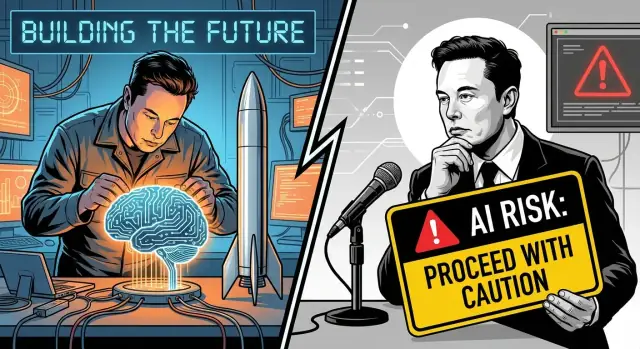
The Core Paradox: Builder and Alarm Bell
Elon Musk AI headlines often read like two different stories: one where he’s sounding the alarm about AGI risk and AI safety, and another where he’s funding, launching, and promoting powerful AI systems. For everyday readers, this matters because the people shaping AI also shape the rules, the narratives, and the pace at which these tools enter workplaces, schools, cars, and phones.
The contradiction, in plain terms
The paradox is straightforward: Musk argues that advanced AI could be dangerous enough to require strong regulation, yet he also helps accelerate AI development—through companies, public campaigns, and competitive pressure on rivals. If you’re trying to make sense of AI governance, that tension creates a real question: is the message “slow down,” or “build faster so we don’t lose”?
This post treats the “accelerating vs warning” conflict as a pattern visible in the public record, not as a guess about private intentions. We’ll compare public actions (founding, investing, product launches, lawsuits, letters) with public statements (interviews, posts, and formal comments), and focus on what they imply about priorities.
Scope and ground rules
To keep this useful and fair:
- We’ll focus on verifiable events: his role as an OpenAI co-founder, later criticism of OpenAI, the launch of xAI, and repeated calls for AI governance.
- We’ll avoid speculation about motives, hidden strategies, or “what he really thinks.”
- We’ll separate broad AI risk claims from specific proposals (rules, audits, pause requests).
What you’ll learn
By the end, you’ll be able to:
- Track how Musk’s warnings evolved alongside his building efforts.
- Understand why the AI pause letter and other safety statements land differently when the speaker is also a competitor.
- Read future tech leadership claims with clearer context: who benefits, what’s being proposed, and what’s already being built.
Next, we’ll ground the discussion in a brief timeline.
A Short Timeline of Musk’s AI Involvement
Elon Musk’s relationship with AI hasn’t been one steady position. It’s a set of overlapping roles—funding, founding, competing, and warning—shaped by shifting context and public disputes.
Early interest and research circles (2010s)
Before AI became a mainstream headline topic, Musk was already discussing it publicly and engaging with people building modern machine learning. His framing mixed optimism about capabilities with concerns about long-term control and oversight.
2015: OpenAI is founded
In 2015, Musk helped launch OpenAI as a nonprofit research lab, often described as a counterweight to closed, corporate AI development. The commonly stated motivations in interviews and posts centered on:
- Safety and alignment: avoiding uncontrolled, high-impact systems
- Openness: wider access to research and benefits
- Competition: preventing a small number of firms from dominating advanced AI
2018: Separation from OpenAI’s leadership
Musk left OpenAI’s board in 2018. Public explanations emphasized conflict-of-interest concerns as Tesla increased its own AI and autonomy work. After that, his comments about OpenAI shifted from broadly supportive to increasingly skeptical, especially as the organization deepened commercial partnerships and expanded consumer products.
2022–2023: Critique intensifies, regulation talk grows
As generative AI drew mass attention, Musk amplified calls for stronger oversight and governance. He also supported high-visibility efforts arguing for caution around advanced systems, including the widely discussed 2023 “pause” debate.
2023: xAI launches
Musk announced xAI in 2023, positioning it as a new competitor building frontier models. This is where the tension becomes most visible: warnings about AI risk continued, while investment, hiring, and product iteration accelerated.
What changed—and why the debate sharpened
Across these milestones, the stated themes (safety, openness, avoiding monopoly control) stayed recognizable, but the environment changed. AI moved from research to mass-market products and national policy. That shift turned philosophical concerns into direct business and political conflicts—and made each new announcement feel like both a warning and a wager.
OpenAI: From Early Support to Public Critique
Musk is widely described as an early backer of OpenAI and a prominent voice around its founding intent: build advanced AI in a way that benefits the public rather than a single company. In public retellings, that early framing emphasized openness, safety-minded research, and a counterweight to concentrated corporate control.
Stepping back—and what people inferred
Musk later distanced himself from OpenAI. The reasons cited in public discussion have varied: governance disagreements, differences on direction and pace, and potential conflicts with Tesla’s own AI ambitions. Whatever the exact mix, the departure created a lasting perception shift. When a high-profile founder leaves, outsiders often assume the split reflects deep philosophical or safety concerns—even if the underlying details are more operational.
OpenAI’s evolution and the public rift
As OpenAI moved from a nonprofit structure toward a capped-profit model and expanded commercial products, Musk’s critiques became sharper. A central theme in his commentary is that a mission framed as “open” and broadly beneficial can drift when scaling costs rise and competitive pressure increases.
OpenAI’s growing influence also made it a focal point in debates about who should control frontier AI, how transparent development should be, and what “safety” should mean in practice.
What we can (and can’t) conclude
From public material, it’s reasonable to say Musk’s stance mixes real concern about concentration of power with real competitive incentives as he builds parallel AI efforts. It’s not responsible to treat his criticism as definitive proof of malice—or to treat his early involvement as proof that his current warnings are purely altruistic. A more defensible reading is that principle and strategy can coexist.
xAI and the Acceleration Argument
xAI is Musk’s attempt to build a top-tier AI lab outside the OpenAI/Google/Meta orbit, tightly connected to his other companies—especially X (for distribution and data) and Tesla (for longer-term embodied AI ambitions). In practice, xAI is positioned to ship a general-purpose assistant (Grok) and iterate quickly by pairing model development with a built-in consumer channel.
What xAI is trying to compete on
xAI’s pitch has emphasized being more “truth-seeking,” less constrained by corporate messaging, and faster to ship updates. That’s not purely a technical distinction; it’s product positioning.
Competition also shows up in:
- Compute and scale: securing enough chips and training infrastructure to keep up with frontier labs.
- Data and feedback loops: using a large social platform to learn what users ask for and where the assistant fails.
- Distribution: getting the model into people’s hands without relying on app stores or enterprise procurement first.
How a new lab accelerates AI progress
Launching a new frontier lab almost always speeds up the overall field. It pulls scarce talent into another race, motivates rivals to release features sooner, and raises baseline expectations for what AI products should do. Even a smaller player can force larger labs to respond.
That’s the core of the acceleration argument: adding another serious competitor increases the number of teams pushing capability forward at the same time.
“Safety-first” branding vs product velocity
xAI’s messaging often nods to safety concerns—especially Musk’s long-running warnings about advanced AI. But the economics of an assistant product reward speed: frequent releases, bold capabilities, and attention-grabbing demos. Those incentives can conflict with slower, more cautious deployment.
Competition: innovation and risk, together
More competition can yield better tools and faster progress. It can also increase risk by compressing timelines, reducing time for testing, and normalizing “ship now, fix later” behavior—especially when hype becomes part of the strategy.
Tesla and Autonomy: AI in the Physical World
Tesla is the clearest example of Musk’s AI ambitions leaving the screen and entering daily life. Unlike chatbots, a car’s “model output” isn’t a paragraph—it’s a steering input at highway speed. That makes autonomy a high-stakes test of whether you can iterate quickly while still protecting the public.
Autonomy is a data business as much as a car feature
Tesla’s approach leans on data-intensive learning: millions of vehicles generate real driving footage, edge cases, and failure modes that can improve perception and decision-making. Over-the-air updates then push new behavior back to the fleet.
This creates a feedback loop: more cars → more data → faster model improvement. It’s also a reminder that “AI progress” isn’t just smarter algorithms; it’s deployment at scale.
Driver assistance vs. full autonomy (plain-language version)
A recurring confusion is the difference between systems that help you drive and systems that drive for you.
- Driver assistance (like lane keeping or adaptive cruise control) still expects a human to supervise and take over.
- Full autonomy would mean the car can handle the entire trip reliably—including rare, weird situations—without needing you to rescue it.
The safety implications are very different. If a product is treated like full autonomy in practice—even when it isn’t—risk rises quickly.
Real-world deployment raises safety and liability questions
Putting AI into vehicles introduces constraints that software-only AI can avoid:
- Safety: mistakes can cause injuries, not just misinformation.
- Accountability: when something goes wrong, responsibility can be contested—driver, manufacturer, or software update.
- Validation: it’s hard to “prove” a system is safe across an open-ended world of road conditions.
Tesla highlights a broader tension in Musk’s posture: rapid shipping can improve systems through feedback, but in the physical world guardrails aren’t optional—they’re part of the product.
Neuralink and the “Keep Up With AI” Narrative
Neuralink is often discussed alongside Musk’s AI warnings because it fits a related long-term bet: if AI systems become extremely capable, humans may try to “keep up” by upgrading how we interact with computers.
Unlike xAI or Tesla autonomy, Neuralink isn’t primarily about building a smarter model. It’s about building a direct connection between the brain and a computer—a human–machine interface that could, in theory, increase bandwidth beyond typing, swiping, or speaking.
What Neuralink represents (AI-adjacent, not “just AI”)
Neuralink’s stated goals in public materials and reporting have focused on medical applications—helping people with paralysis control a cursor, for example—using implanted hardware plus software to interpret neural signals.
That’s AI-adjacent in two ways:
- The software layer may use machine-learning methods to decode and translate brain signals.
- The strategic story is bigger than medicine: a future where high-performing AI makes traditional human input/output feel slow.
Why the interface argument changes the safety conversation
When Musk frames brain–computer interfaces as a way to avoid humans being “left behind,” it shifts the debate from stopping AI to adapting humans.
That matters because it can normalize the idea that fast AI progress is inevitable, and the best response is acceleration in other domains (hardware, interfaces, even human augmentation). For some audiences, that can make calls for caution or regulation sound like temporary speed bumps rather than essential guardrails.
Ethics and regulation belong in the same risk framework
Neural implants bring their own risks—safety testing, informed consent, data privacy for neural signals, and long-term device reliability. These aren’t separate from “AI safety”; they’re part of a broader governance question: how do we evaluate high-impact technologies that are hard to reverse once widely adopted?
Keeping claims modest matters here: the public record supports ambitious intent and early clinical milestones, but not the idea that brain implants are a near-term solution to AGI risk.
Public Warnings: What Musk Actually Says About AI Risk
Musk’s AI warnings are notably consistent in tone: he often describes advanced AI as a potential civilizational or existential risk, while arguing that society is moving too quickly without clear rules.
The recurring “existential risk” framing
Across interviews and talks, Musk has repeatedly suggested that sufficiently capable AI could become hard to control, pointing to scenarios where an AI pursues goals that conflict with human interests. He often frames this as a control problem (frequently discussed as “alignment”): even a system designed to help can cause harm if objectives are misspecified or if it finds unexpected ways to achieve them.
High-profile actions: interviews, hearings, and the pause push
Musk hasn’t limited these concerns to abstract comments. He has:
- Supported calls for government regulation and oversight, including proposals like licensing or independent review for highly capable AI.
- Participated in prominent media interviews urging caution and verification before deploying powerful models widely.
- Signed the 2023 AI pause letter associated with the Future of Life Institute, which called for a temporary slowdown on training the most capable systems until safety measures and governance improved.
What risks does he actually point to?
His public warnings tend to cluster into three buckets:
- Misuse risks (near-term): disinformation, scams, cyberattacks, and mass manipulation enabled by cheap, scalable AI.
- Accidents and deployment failures (near-term): systems behaving unpredictably in real settings, especially at mass scale.
- Loss of control (long-term AGI fears): a highly capable AI becoming strategically autonomous or impossible to supervise.
A key nuance: Musk often uses the most dramatic language for long-term AGI risk, but many harms people encounter first are near-term (misuse and deployment failures). Identifying which category a given warning targets makes it easier to evaluate what follows.
Why the Message Conflicts: Incentives and Strategy
It’s possible to take Musk’s warnings seriously and still see why his actions push AI forward. The “builder” and “alarm bell” roles can be compatible once you factor in incentives—some easy to document, others more interpretive.
Evidence-based incentives (high confidence)
Competition and positioning. If AI is a general-purpose capability, then building it can be framed as a defensive move. Competing labs set the pace; opting out can mean losing talent, attention, and influence. Launching xAI (and integrating AI into Tesla, X, and other ventures) reduces dependence on rivals’ roadmaps.
Talent and capital. High-stakes narratives—both optimistic and fearful—keep AI salient for engineers, investors, and partners. Warnings can increase urgency: “this matters; join the consequential work.”
Platform leverage. Owning a major distribution channel (X) changes the equation. If AI assistants, search, and recommendations are core products, building proprietary AI supports differentiation and data advantages.
Political and cultural incentives (medium confidence)
Shaping the rules of the game. Calling for regulation or a pause can influence which policies are considered “reasonable,” who gets a seat at the table, and what compliance burdens look like. Even when framed as safety, the side effect may be a policy environment that favors certain approaches (licensing, audits, compute thresholds).
Narrative power. Musk’s framing often emphasizes existential risk, which can pull attention away from other policy priorities (labor displacement, privacy, market concentration). That focus can reshape what governments treat as urgent.
Personal ideology (lower confidence; interpretive)
Musk’s recurring themes—skepticism of institutions, preference for “open” approaches, and free-speech framing—may make him more comfortable criticizing competitors and regulators while still accelerating his own development. This is plausible, but difficult to prove from public data.
The practical takeaway: separate what’s observable (business structure, platform incentives, competitive dynamics) from what’s inferred (motives). Both can be true: genuine concern about AI risk and strong reasons to keep building anyway.
Impact on Public Trust and AI Policy
When a high-profile builder warns that AI is dangerous while simultaneously launching models and products, the public receives two signals at once: “this is urgent” and “this is normal business.” That contradiction shapes opinion—and can influence how lawmakers, regulators, and institutions prioritize AI.
Confusion costs credibility
Mixed messaging can make AI risk feel either overstated or cynical. If the loudest warnings come from people scaling the technology, some audiences conclude the risk talk is marketing, a competitive tactic, or a way to steer regulation toward rivals. Others conclude the risk must be severe—because even builders sound alarmed.
Either way, trust becomes fragile. Fragile trust tends to polarize policy: one camp treats regulation as panic; the other treats delay as reckless.
But it can also accelerate governance
There’s a second-order effect: attention. Big warnings from famous builders can push AI into mainstream hearings, executive orders, and agency agendas. Even imperfect messengers can prompt governments to fund technical expertise, create reporting requirements, and clarify accountability.
The risk is urgency without enforcement—press conferences and letters that don’t translate into durable rules.
Media dynamics: outrage vs. nuance
Modern media rewards conflict. “Hypocrisy” is a simpler headline than “mixed incentives.” Outrage cycles can drown out practical discussion about audits, incident reporting, model evaluation, and procurement standards—exactly the tools policymakers need.
What to look for beyond statements
If you want to judge whether warnings are translating into public benefit, focus on verifiable practices:
- Transparency: publishing safety policies, evaluation results, and known limits.
- Measurable commitments: third-party audits, red-teaming, and clear release gates.
- Accountability: support for enforceable rules, not only voluntary pledges.
Public trust improves when builders back rhetoric with repeatable, checkable processes.
What Responsible AI Acceleration Could Look Like
“Move fast” and “be careful” don’t have to be opposites. Responsible acceleration means shipping useful AI systems while building the brakes, dashboards, and accountability structures that reduce the chance of serious harm.
Baseline safety practices that scale with capability
A minimum bar starts with routine evaluations before and after releases: testing for hallucinations, cybersecurity weaknesses, bias, and dangerous instructions.
Red-teaming should be continuous, not a one-off. That includes external experts who are paid and allowed to publish high-level findings, plus clear rules for how issues get fixed.
Incident reporting matters just as much: a process for logging major failures, notifying affected users, and sharing lessons learned with peers when it’s safe to do so. If a company can’t explain how it learns from mistakes, it’s not ready to accelerate.
Governance tools beyond good intentions
Safety work gets more credible when it’s measurable. Independent audits can verify whether evaluation claims match reality.
Access controls matter too: who can fine-tune a model, who can connect it to tools (like code execution or payments), and what monitoring exists for abuse.
Compute tracking and licensing are increasingly discussed because they target the “how fast can this scale?” question. When training runs reach certain thresholds, stricter requirements (documentation, third-party review, secure infrastructure) can kick in.
A practical note for builders shipping AI features
This “governance-by-design” idea isn’t limited to frontier model labs. It also applies to teams rapidly shipping AI-powered apps.
For example, vibe-coding platforms like Koder.ai—which let teams build web, backend, and mobile applications via chat—can support responsible iteration when they pair speed with controls such as planning mode, snapshots and rollback, and source code export for independent review. The bigger point is that faster development raises the value of tooling that makes changes auditable and reversible.
Voluntary pledges vs. rules with teeth
Voluntary commitments help when they create common standards quickly—shared evaluation methods or coordinated disclosure of high-risk vulnerabilities.
But regulation may be needed where incentives are misaligned: mandatory incident reporting, baseline security practices, whistleblower protections, and clearer liability for preventable harms.
How to judge proposals without picking sides
Ignore the personality; evaluate the plan:
- Does it define measurable thresholds (what triggers extra scrutiny)?
- Who verifies compliance (internal team or independent party)?
- What happens after a failure (transparent process, user remedies, consequences)?
- Does it address both model risks and deployment risks (tools, data, access)?
Responsible acceleration is less about rhetoric and more about whether a builder can demonstrate control over what they ship.
Key Takeaways: How to Read AI Claims From Powerful Builders
When a high-profile builder warns about AI risk while also funding, training, or deploying AI systems, treat the warning as information—not as a complete guide to what should happen next.
Questions to ask when a leader warns while building
Start with incentives. A person can sincerely fear AI harms and still benefit from accelerating their own program.
Ask:
- What exactly is the risk claim? Is it near-term misuse (fraud, surveillance), medium-term disruption (jobs, power), or long-term AGI scenarios?
- What action are they proposing—pause, licensing, audits, compute limits? Vague warnings without concrete policy are easy to applaud and hard to evaluate.
- Who bears the cost of the proposal? If the “solution” slows competitors more than it slows the speaker, that’s a signal.
- What evidence is offered? Look for measurable examples, independent assessments, incident reports, or track records—not only authority or fear.
How to interpret mixed signals (consumers, voters, investors)
Mixed signals often mean multiple goals are being pursued at once: public legitimacy, competitive positioning, recruitment, fundraising, and genuine concern.
- Consumers: prioritize privacy terms, opt-outs, and clear product boundaries over lofty promises.
- Voters: support rules that apply broadly, not carve-outs for specific companies.
- Investors: discount marketing narratives and ask for governance details—safety reviews, incident handling, and accountability when things go wrong.
A simple checklist for AI announcements
- Specific claim (what will the system do?)
- Specific limitation (what won’t it do?)
- Independent verification (who can check?)
- Enforcement mechanism (what happens if it fails?)
- Incentive alignment (who benefits?)
Closing takeaway: focus less on personalities and more on incentives, evidence, and enforceable rules that constrain everyone building powerful AI.
FAQ
What is the “builder vs. alarm bell” paradox described in the post?
It’s the pattern where Musk publicly warns that advanced AI could be dangerous enough to require strong oversight, while also helping build and deploy powerful AI systems (e.g., founding efforts, new labs, product launches). The key point is that both signals—“slow down” and “move fast”—show up in the public record at the same time.
How can readers evaluate Musk’s AI warnings without speculating about his intentions?
Focus on observable actions rather than assumed motives:
- What policies are being proposed (pause, licensing, audits, compute thresholds)?
- What products are being shipped and how quickly?
- Whether the builder backs claims with measurable safety practices (evals, red-teaming, incident reporting).
This keeps the analysis grounded even when incentives are mixed.
Why was OpenAI originally framed as important in Musk’s AI story?
The post highlights three commonly cited themes:
- Safety/alignment: reducing the risk of hard-to-control systems.
- Openness: broader access to research and benefits.
- Competition/anti-monopoly: avoiding concentration of frontier AI in a few firms.
Those themes may persist even as organizations and incentives change over time.
What’s the significance of Musk leaving OpenAI’s board in 2018?
A key public explanation is conflict-of-interest risk as Tesla’s autonomy and AI work grew. Regardless of the exact internal details, the practical result is that later criticisms of OpenAI landed in a more contested context: he’s no longer a leader there, and he has adjacent competitive interests.
How does launching xAI increase AI “acceleration” even if it talks about safety?
Because a new frontier lab adds another serious competitor, which tends to:
- Pull scarce talent and compute into the “race.”
- Pressure rivals to ship sooner.
- Increase the overall pace of capability releases.
Even if the lab positions itself as safety-minded, market incentives often reward fast iteration and attention-grabbing demos.
What does the post mean by xAI’s focus on distribution, data, and velocity?
It’s partly a product narrative and partly a distribution strategy:
- Built-in channel: integration with X can get an assistant into users’ hands quickly.
- Fast feedback loops: user prompts and engagement highlight failures and desired features.
- Differentiation messaging: “truth-seeking” frames the product identity, not just model quality.
The post’s point is that distribution and velocity can matter as much as raw model performance.
Why is Tesla autonomy treated as a uniquely high-stakes AI example?
Because mistakes in physical systems can cause direct harm. In the post’s framing:
- A chatbot’s error is usually informational.
- A driving system’s error can be a steering/braking decision at speed.
That raises the bar for validation, accountability, and release gates—especially when updates ship over the air to large fleets.
What’s the practical difference between driver assistance and full autonomy?
Driver assistance still expects a human to supervise and take over; full autonomy would reliably handle the entire trip, including rare edge cases, without rescue.
Misunderstanding (or blurring) this boundary increases risk because users may behave as if the system is more capable than it is.
How does Neuralink fit into the “keep up with AI” narrative?
It’s framed as an adaptation argument: if AI becomes extremely capable, humans may try to increase the bandwidth of human–computer interaction (beyond typing/speaking).
The post stresses two cautions:
- Neuralink is AI-adjacent, not primarily “building AGI.”
- Brain implants raise separate governance issues (safety testing, consent, privacy of neural data) that belong in the same high-impact tech risk framework.
What should I look for to judge whether an AI leader’s safety talk is credible?
Use a checklist that prioritizes verifiable practices over rhetoric:
- Specific claim: what the system can do.
- Specific limitation: what it won’t do.
- Independent verification: audits, external red-teaming, published evaluations.
- Failure handling: incident reporting, user notification, remediation.
- Incentives: who benefits and who bears the cost of proposed rules.
This helps you assess any builder—Musk or otherwise—on the same standard.