

Food pantry daily log for boxes in and out with totals
Use a food pantry daily log to track boxes in and boxes out each day, keep simple totals, and make reporting easier for any team.
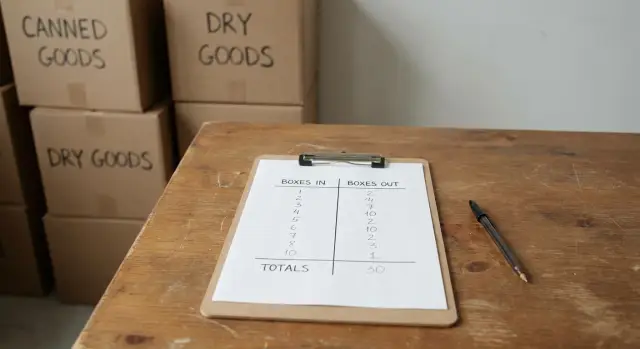
Why a daily in and out log matters
In a food pantry, boxes move fast. A delivery shows up, volunteers break down cases, some items go straight to the floor, and families pick up food all day. Without a simple way to record what came in and what went out, the numbers in your head and the numbers on the shelves stop matching.
The trouble usually hits at closing. Someone asks, “How many boxes did we distribute today?” One person says 40, another remembers 55. Then you find an open pallet in the back, a few boxes set aside for tomorrow, and a couple of “temporary” piles that never got counted. Now you’re guessing, and the next shift starts in the dark.
A daily log isn’t about perfect accounting. It’s about clear, repeatable totals anyone can record during a busy shift. If you can answer “boxes in,” “boxes out,” and “ending on hand” with confidence, you can plan pickups, avoid running out of staples, and report your work without stress.
A simple log helps because it keeps shifts consistent, makes end-of-day counts quicker, flags problems early (missing boxes, double-counting, unrecorded donations), and gives partners one set of totals.
It also fits how pantries actually operate. Volunteers can jot down tallies as they go. Coordinators can check the math. Shift leads can spot gaps before the doors close.
Example: If 30 boxes arrive in the morning and 48 go out by afternoon, the next question is simple: did you start with at least 18 boxes on hand, or did something get missed?
What to track each day (and what to skip)
A good daily log is simple enough that anyone can fill it out without guessing. The goal is to track the flow of boxes in and boxes out, then end with totals you trust.
Start by agreeing on what a “box” means, and write that definition at the top. For example: “1 box = one packed pantry box for a household” or “1 box = one sealed case from a distributor.” If you mix these, your numbers will drift. If you handle both, label them (like “client boxes” vs “case boxes”) so totals still mean something.
Track only what you need to balance the day:
- Boxes in: donations, scheduled deliveries, transfers from partner sites.
- Boxes out: client pickups, outreach events, internal use (like stocking a community fridge).
- Starting and ending on hand: so you can see the full picture.
- Notes (only for exceptions): damaged, expired, returned, or unknown source.
- Who/when: date, shift label, and initials.
Keep notes short. “3 damaged” or “2 expired” is enough. Long explanations slow people down and usually don’t help later.
Decide how detailed you want to be. Many pantries do fine with total boxes only. If reporting requires categories, keep them light (like “produce” and “dry goods”) and only add them if the team can count them reliably. A good test: if an entry takes more than 30 seconds, people will skip it on busy days.
What to skip during a shift: tracking every item, brand, or exact weight. Unless you have dedicated time and staff, that level of detail usually creates gaps and makes totals less accurate.
Pick a format your team will actually use
The best log is the one people fill out every time, even when the line is long and the phone is ringing. Before building anything fancy, watch one busy shift and decide three things: where the log will live, who writes in it, and who checks the totals.
Paper is often the fastest to adopt. A clipboard at intake and another at distribution makes it hard to forget. It also works when the internet is down. The tradeoff is that weekly totals take time to add up.
A spreadsheet helps when you want totals without hand math. One person can enter the day’s numbers at the end of the shift (or during quieter moments), and formulas can calculate daily and weekly sums. The risk is access: if it’s on one computer, the log turns into “someone else’s job.”
A simple app can help when you have multiple shifts, shared responsibility, or more than one location. Shared access matters when several people need to update the same log. The downside is setup and training, so keep it simple.
A practical approach: start with paper for four weeks, using the exact fields you want long-term. If totals are hard to compile, move to a spreadsheet or app using the same layout. The habit stays even if the format changes.
Set up the log template in 10 minutes
A daily log works best when someone can pick it up mid-shift and still keep counts clean.
Put the basics at the top: date and a clear shift label. Use the same options each day (AM, PM, Event) so you don’t end up with “mystery totals” when combining shifts.
Then create one row per box type (or one row per category if that’s how you operate). Keep the columns limited to what you need to balance:
- Starting count
- Boxes in
- Boxes out
- Ending count
- Initials
Add a Notes column, but make it intentionally small. Notes are for exceptions like “2 boxes damaged” or “10 went to senior delivery,” not a story.
Finally, decide where the log lives during the shift. Keep it where the last action happens. If boxes leave at check-in, keep it at check-in. If intake happens in storage, keep it there. The closer the log is to the work, the more accurate it will be.
Step by step: how to fill it out during a shift
Start your shift by using yesterday’s ending number (or the last count from the previous shift) as today’s starting count.
As items arrive, log them right away. Don’t wait until the end of the day. It’s easy to forget a small drop-off or mix up two deliveries. If one person is unloading, assign a second person as the “scribe” for five minutes so the entry happens while details are fresh.
When boxes go out, record them as they leave, not later. A simple habit works: each time a cart leaves the storage area, write down how many boxes left and what program it was for (walk-in pantry, delivery route, partner agency). That keeps the log accurate even during a rush.
A basic flow most teams can follow:
- Write the starting count before anything moves.
- Add each delivery or donation as its own entry.
- Subtract boxes as they leave, in real time.
- Do a quick physical count near the end of the shift.
- Initial the final line and note anything unusual.
At closing, compare the physical count to what the math says. If they match, initial the line so the next shift knows it’s confirmed. If they don’t, don’t rewrite the whole sheet. Circle the balance, write “count off by +2” (or whatever it is), and add a short reason so someone can follow up.
Example: You start with 120 boxes. A truck brings 40 (now 160). Later, 55 go out for distribution (now 105). Your end count shows 104. Note “off by -1, likely damaged box discarded” and flag it for the coordinator.
Totals that make reporting and planning easier
A daily log isn’t just a record. It should answer three questions quickly: how much came in today, how much went out, and what’s left.
The three daily totals to write every day
Put these at the bottom of the page (or as the last row in a sheet): total in, total out, and ending on hand.
Add one fast accuracy check:
- Start on hand + Total in - Total out = End on hand
- If it doesn’t match, circle the line and fix it before the next shift
This catches most common issues: a pickup that never got logged, a delivery counted twice, or mixing “boxes” and “cases.”
Roll-ups for weekly and monthly reporting
For weekly reporting, keep it simple. Sum the daily totals to get weekly “in” and “out,” then scan the week for patterns. If Thursday is always the busiest, schedule more volunteers, plan more packing time, or order earlier.
For monthly reporting, stick to what people actually read: total in, total out, ending on hand on the last day, plus a brief notes summary. Notes explain the story behind the numbers (holiday drive increased donations, freezer was down, extra distribution event).
Only split totals when you truly need them. Common reasons include different programs (walk-in vs home delivery), special events (mobile pantry day, school drive), or restricted items that must be tracked separately. If you do split totals, use the same simple equation for each group so everything still balances.
Handling real-life exceptions without making it complicated
A log only works if it can handle messy days. The goal isn’t perfect detail. The goal is consistent rules so your totals still mean something.
For partial boxes, pick one rule and write it at the top. Many pantries either round to the nearest full box or allow simple fractions like 0.5. If you choose rounding, add a quick note when it matters (for example, “2 boxes + half”). If you choose fractions, keep it limited so people don’t argue about tiny amounts.
Damaged or expired items should still be counted, so your on-hand number stays honest. The simplest approach is to treat them as boxes out with a clear reason in Notes. That also explains why donations looked strong but distributions didn’t.
If you have multiple distribution lines (front desk, drive-through, delivery), totals drift quickly. A simple fix is to assign one person per shift to collect the final numbers from each line and write the combined totals. Everyone else focuses on serving.
After-hours donations happen. Instead of creating a separate system, log them as the next day’s “in” with a short note like “left at door 7pm.” Your log stays daily, and the story stays clear.
For corrections, don’t hide mistakes. Use a visible method:
- Draw one line through the wrong entry (keep it readable)
- Write the corrected number next to it
- Add initials (and a short reason if it changes totals)
- Re-total only the section you changed
- If a page gets too messy, start a new page and mark “continued”
Example: A volunteer logs 10 boxes out, then finds 2 boxes were expired and removed. Don’t erase. Cross out the old total, write “12 out (10 served + 2 expired),” and your end-of-day numbers will still add up.
Common mistakes that break the numbers
Most problems aren’t math problems. They’re small habits that pile up until the totals feel wrong.
One of the biggest issues is changing what a “box” means. If Monday a box is a pre-packed family kit, but Wednesday it becomes “any cardboard box that left the building,” your numbers won’t match real stock. Pick a definition and keep it for a reporting period (often a week or month).
Another common issue is logging later from memory. A busy shift makes it tempting to “write it down at the end,” but then a volunteer rotates out and details are gone. If you can’t log every single movement, log in short batches (for example, every 30 minutes).
Totals also break when you skip the ending count. The math only helps if you verify it. A quick end count is your safety check.
Problems that show up often:
- Mixing units in one total (items, pounds, and boxes)
- Adding “misc” boxes with no note
- Multiple shifts writing in different places with no clear owner
- Forgetting transfers between storage, staging, and the front table
Example: On Tuesday, one volunteer logs “12 out” as 12 grocery bags, while another logs “8 out” as 8 pre-packed boxes. The day looks like 20 boxes out, but it isn’t a real box total. Clear labels and one owner per day keep the numbers dependable.
End of day quick checklist
The last five minutes of a shift decide whether tomorrow starts calm or confused. If your numbers match at closing, the next person can open the door and trust the shelf count.
Before you leave:
- Confirm the starting number is written down (or clearly matches the previous shift’s ending).
- Scan intake: every delivery, donation, and restock is logged as boxes in.
- Scan output: every client pickup, partner transfer, and special event is logged as boxes out.
- Do the math once: starting + in - out = ending. Then compare it to what you can reasonably see on hand.
- Add one short note for anything unusual (damage, corrections, late delivery, big event, temporary storage move).
If the math doesn’t match, don’t guess. Recount one category (usually boxes out), check for a missed entry, and write a note about what you changed.
Example: If you started with 120, received 35, and gave out 42, your ending should be 113. If the shelves look closer to 103, a 10-box partner pickup may have gone out without being recorded. Write it in, re-total, and note “missed partner pickup, added after recount.”
Example: one day of tracking with simple numbers
Here’s a Tuesday example. The pantry starts with 40 standard food boxes on the shelf (yesterday’s ending count).
Line-by-line entries (boxes only):
| Time | In | Out | Note |
|---|---|---|---|
| 9:05 | 12 | 0 | Donation drop-off (12 boxes) |
| 10:30 | 0 | 9 | 9 households served |
| 12:10 | 0 | 6 | Walk-ins |
| 1:15 | 8 | 0 | Late delivery arrived (8 boxes) |
| 2:40 | 0 | 10 | Scheduled pickup |
| 3:20 | 0 | 0 | 1 box crushed and unsafe - removed |
At the end of the day, total the columns:
- Total boxes in: 12 + 8 = 20
- Total boxes out: 9 + 6 + 10 = 25
- Adjustments: -1 (damaged box removed)
Final totals for the day
Starting boxes (40) + In (20) - Out (25) + Adjustments (-1) = Ending boxes (34)
So the shelf count should end at 34 boxes.
Quick math check (and what to do if it fails)
If your physical count isn’t 34, don’t guess.
- Re-add the In and Out totals (most errors are simple addition).
- Look for a missing note (late deliveries and damaged boxes are easy to forget).
- Recount the shelf once, slowly, and have a second person confirm.
- If it still doesn’t match, write the actual ending count and a one-line reason (example: “count off by 2, likely unlogged pickup at 11:50”).
This keeps the log honest and makes tomorrow’s starting number reliable.
Next steps: make it easy to run every day
A log only helps if it survives busy days. The goal is simple: someone can pick it up tomorrow and get reliable totals, even if today was chaos.
Give the log a clear owner. That doesn’t mean one person fills it out forever. It means one person keeps blank forms ready, answers questions, and makes sure totals get saved. Also decide where it lives (clipboard in the packing area, shared file for digital, or both) so nobody has to hunt for it.
A few habits keep the system from fading out: assign one role per shift to record boxes in and boxes out (with a backup), keep the form where the work happens, set a weekly 10-minute review to spot missing days or odd spikes, and remove fields nobody uses.
If your team wants a shared tool, a basic web or mobile log app can be easier than paper, especially when multiple people need the same totals. If you don’t have a developer, Koder.ai (koder.ai) can help you create a simple in-and-out logging app from chat, then export the source code or host it when you’re ready.
Keep improving with tiny changes. One less confusing field is often better than a “perfect” form nobody uses.
FAQ
What should a food pantry daily log include?
Record the starting count, boxes in, boxes out, and ending count for each shift. Add a short note only for exceptions such as damaged or expired boxes.
How do we decide what counts as a box?
Choose one definition and write it at the top of the form. For example, count one packed household food box as one box, and keep sealed distributor cases in a separate category.
How do we calculate the ending box total?
Use this check: starting on hand + boxes in - boxes out = expected ending on hand. Compare that result with a quick physical count before the shift ends.
When should volunteers update the log?
Log boxes when they arrive or leave, not from memory at closing. During a rush, record short batches at regular intervals, such as every 30 minutes.
Where should we keep the daily log?
Keep the form where boxes move. Put an intake log near receiving and an output tally at check-in, then have the shift lead combine the totals before closing.
Should we use paper, a spreadsheet, or an app?
Start with paper if that is easiest for volunteers. Move the same layout to a spreadsheet or shared app when weekly totals, multiple shifts, or several locations make paper harder to manage.
How do we log damaged or expired boxes?
Count damaged or expired boxes as boxes out and write the reason in Notes. This keeps the on-hand number accurate and explains the difference between donations and client distributions.
What should we do when someone makes a logging mistake?
Do not erase it. Draw one line through the incorrect entry, write the corrected number beside it, add initials, and recalculate the affected total.
What if the physical count does not match the log?
Write the actual count, note the difference, and check recent deliveries, pickups, transfers, and damaged boxes. Recount once with another person when possible, then let the coordinator follow up.
What is the end-of-day checklist for a pantry log?
At closing, confirm all incoming and outgoing boxes are logged, calculate the ending total, compare it with the shelf count, add any exception notes, and initial the final line.