

Foxconn and the Platform Playbook of Building Technology
Foxconn shows how manufacturing orchestration, supplier networks, and logistics can turn “building tech” into a platform-style business. Learn the playbook.
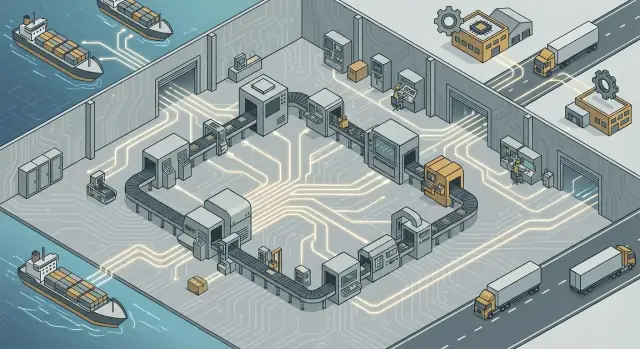
Why “building tech” can be a platform business
When people hear “building tech,” they picture a factory floor: machines, workers, and assembly lines. But the real differentiator is often an operating capability—a repeatable way to take a product design and turn it into millions of reliable units, on time, at a predictable cost.
That capability can behave like a platform.
“Building tech” is a service layer, not a place
Think of manufacturing as a service layer that sits between an idea and the real world. Brands bring designs, demand forecasts, and timelines. The manufacturer provides a standardized system for sourcing parts, coordinating suppliers, assembling devices, testing quality, and shipping at scale.
The more that system can be reused across products and customers, the more it starts to look like a platform business model: a set of shared rails that many “apps” (products) can run on.
What this article focuses on (and what it doesn’t)
This is not a story about secret margins or insider numbers. It’s about mechanisms—how “building tech” becomes a repeatable engine:
- Orchestration: turning thousands of moving pieces into one coordinated plan.
- Supply chain leverage: using scale to get better speed, pricing, and capacity.
- Execution discipline: keeping quality, yield, and delivery stable as volume grows.
Why the platform analogy matters
Platforms win by lowering the cost of repeating a hard thing. In manufacturing, the “hard thing” is going from prototype to mass production without chaos. When a manufacturer accumulates playbooks, supplier relationships, quality systems, and operational data, each new product can ramp faster—with fewer surprises.
That’s the lens we’ll use to understand Foxconn: not just as a large contract manufacturer, but as an organization that productizes the act of building.
Foxconn’s role in the hardware value chain (in plain English)
Foxconn sits in a part of the hardware world that’s easy to misunderstand: it’s not “just a factory,” and it’s not a consumer brand either. It’s a specialist in turning designs into millions of consistent units—fast—while managing the messy reality of suppliers, parts shortages, process tuning, and quality escapes.
The terms people mix up (OEM, ODM, EMS)
Hardware manufacturing gets described with overlapping acronyms. Here’s the plain-English version:
- OEM (Original Equipment Manufacturer): The company whose logo is on the product and who owns the customer relationship (e.g., a phone or laptop brand).
- ODM (Original Design Manufacturer): A manufacturer that provides a ready-made design (or major parts of the design) that a brand can customize and sell.
- EMS (Electronics Manufacturing Services): A provider focused on building electronics to a customer’s design—assembly, testing, sometimes sourcing and logistics.
- Contract manufacturing: The umbrella term for “someone else builds it for you.” Foxconn is often discussed as EMS/contract manufacturing, but its value frequently extends beyond basic assembly.
What customers are really buying from Foxconn
At scale, the “product” is operational performance. Brands buy:
- Speed to volume: ramping from prototypes to mass production without months of delay.
- Yield improvement: getting more sellable units per batch (lower scrap and rework).
- Quality consistency: fewer returns, fewer headline-grabbing defects.
- Cost control: predictable unit economics, not just low labor cost.
- Risk handling: supplier issues, process changes, compliance, and contingency planning.
Why this isn’t pure commodity assembly
If assembly were the only thing, the lowest bidder would always win. In reality, the hard part is coordinating hundreds of parts, multiple tiers of suppliers, and tightly controlled processes—while meeting aggressive launch dates.
The “secret sauce” is repeatable execution: proven lines, trained operators, tuned test procedures, and the ability to debug manufacturing problems quickly.
Where margins are made (and where they get competed away)
Margins tend to appear in:
- Ramps and transitions: when a new product needs rapid process development and stabilization.
- Complex programs: high mix, tight tolerances, demanding test/traceability requirements.
- Reliability work: reducing failure rates through better process control.
Margins often get competed away in mature, stable products where requirements are fixed and multiple suppliers can build to the same spec. That’s why operational know-how—and the ability to keep learning across programs—matters as much as the factory footprint itself.
Manufacturing orchestration: the hidden product
When people think about contract manufacturing, they picture factories and machines. But Foxconn’s real “product” is often orchestration: the ability to reliably coordinate thousands of parts, dozens of suppliers, multiple sites, and changing requirements—so a finished device ships on time.
The end-to-end flow (the part customers feel)
At a high level, the job is to keep one continuous flow moving:
- Sourcing: parts availability, alternates, supplier lead times
- Build: line balancing, staffing, tooling readiness
- Test: test coverage, calibration, failure handling
- Pack: labeling, compliance inserts, region variants
- Ship: carrier handoffs, customs paperwork, delivery windows
Any break in the chain—one late connector, one firmware mismatch, one missing label spec—can stall the entire program. Orchestration is the work of preventing those breaks and recovering quickly when they happen.
The “control tower” that keeps everything aligned
Think of a control tower as a single operational view of reality: what’s arriving, what’s on the line, what failed test, what’s blocked, and what can be rerouted. It’s part people, part process, part systems.
The key isn’t micromanaging every station. It’s maintaining tight feedback loops so issues surface early (before thousands of units are affected) and decisions are made with full context across supply, schedule, and quality.
Interfaces matter more than machines
Orchestration depends on clean interfaces between the brand and the manufacturer:
- Forecasts: what volumes are expected, by region and week
- Change orders: what changes, when it takes effect, and what inventory is impacted
- Engineering updates: drawings, tolerances, firmware versions, test limits
When these inputs are ambiguous or late, even a world-class factory can produce the wrong thing efficiently.
Why coordination beats any single breakthrough
A faster machine helps one step. Great coordination improves every step—reducing waiting, rework, and surprise shortages. That compounding effect is why “manufacturing orchestration” is a competitive advantage you can’t easily copy by buying similar equipment.
Supplier network mastery: how scale becomes leverage
A factory’s real advantage isn’t just machines and labor—it’s access. When you’re building millions of devices, the difference between “we can get the part” and “we’re waiting on the part” becomes a business advantage.
Foxconn’s scale turns supplier management into leverage: more visibility, more options, and faster problem-solving when something breaks.
How suppliers get qualified (the basics)
Before a supplier becomes “approved,” the bar is practical and repeatable:
- Capability: Can they actually make the part to spec, at the needed tolerances, with consistent output?
- Reliability: Do they hit dates, communicate changes early, and handle surprises without excuses?
- Compliance: Can they meet required standards (safety, environmental, labor, documentation) and pass audits?
- Capacity: Can they scale from prototypes to full production without quality collapsing or lead times exploding?
Large manufacturers can run this qualification at volume—comparing suppliers side by side, building scorecards, and keeping backup options warm.
Multi-sourcing vs. single-sourcing (and why it’s never simple)
For critical parts, multi-sourcing reduces risk: if one supplier has a disruption, another can fill the gap. The tradeoff is complexity—more testing, more contracts, more coordination.
Single-sourcing can be cheaper and cleaner operationally, and sometimes it’s unavoidable (unique tooling, patented processes, or a supplier that’s simply the best). But it concentrates risk. The “right” choice often depends on how hard the part is to replace and how painful a shortage would be.
Relationships, purchasing power, and lead times
When demand spikes, suppliers prioritize customers who offer predictable forecasts, fast payment, and long-term volume. Scale also helps negotiate:
- Better allocation during shortages
- Shorter lead times through reserved capacity
- Quicker engineering support when a part needs changes
A simple bottleneck example
Imagine a phone build where every component is available—except one power-management chip with a 16-week lead time. You can’t “mostly” assemble a finished product; that single constrained part stalls the entire program, ties up cash in partially built inventory, and can even miss a launch window.
That’s why supplier network mastery is leverage: it’s not just buying parts cheaper—it’s keeping the whole system moving when one small piece threatens to stop it.
Design-for-manufacture as a competitive advantage
A product design can be “right” for the user and still be painful to build. For a manufacturer like Foxconn, the advantage isn’t just cheaper labor or bigger factories—it’s the ability to shape designs into versions that can be produced, tested, and ramped reliably.
DFM/DFA in plain English
DFM (Design for Manufacture) and DFA (Design for Assembly) mean making choices that reduce ambiguity and friction on the line: fewer unique parts, connectors that can’t be plugged in backwards, tolerances that match real tooling, and layouts that allow automated placement and easy inspection.
Small decisions add up. A screw that requires a custom bit, a cable that’s hard to route, or a component placed too close to an edge can create slowdowns, quality escapes, or extra manual steps that don’t show up in a CAD model.
Early engineering involvement prevents “surprises”
When manufacturing engineers are involved early, they can flag risk before it becomes rework: parts with long lead times, materials that behave unpredictably at scale, or designs that require frequent calibration.
That reduces late-stage redesigns, missed launch dates, and expensive “temporary” fixes that become permanent. It also accelerates decision-making: teams can choose between design options based not only on performance, but on yield, throughput, and testability.
Change management without stopping the line
Revisions are inevitable. The operational edge is handling them without chaos: clear version control, controlled roll-in/roll-out plans, and parallel builds when needed (old rev and new rev) so production doesn’t halt while teams validate a fix.
Test strategy is part of manufacturability
Testing isn’t a separate phase—it’s a design requirement. Accessible test points, built-in self-checks, and fixtures designed alongside the product can shorten cycle time and improve yield.
If you can’t test it quickly and consistently, you can’t build it at scale.
Quality at scale: yield, traceability, and repeatability
When you manufacture millions of devices, “quality” isn’t a vague promise—it’s math. Small percentage changes determine whether a program makes money, ships on time, or becomes a customer-support nightmare.
The numbers that decide profitability
- Yield is the share of units that pass each step (and final test) the first time. If a line runs at 98% yield instead of 95%, that difference can mean tens of thousands more sellable units per week.
- Scrap is material or units that must be thrown away because they can’t be fixed economically. Scrap is direct cost: you already paid for parts, labor, and time.
- Rework is fixing units that fail. Rework often looks cheaper than scrap, but it quietly consumes capacity, adds delays, and can introduce variation.
At scale, the real cost isn’t only parts—it’s lost throughput. A factory that’s busy reworking yesterday’s problems can’t build today’s orders.
Systems that make quality repeatable
To keep outcomes consistent across shifts, lines, and sites, manufacturers rely on disciplined routines:
- Standardized work: the same steps, tools, and acceptance criteria, so “how it’s built” doesn’t depend on who is on the station.
- Traceability: linking each unit to key components, process settings, operators, and test results. When something fails in the field, you can narrow it to a batch, supplier lot, or machine setting—fast.
- Audits and layered checks: not to “police” people, but to catch drift early.
- Continuous improvement: small, relentless fixes that prevent defects from returning.
The failure-analysis loop
High-volume factories run a tight cycle: detect → diagnose → fix → prevent recurrence.
Detection happens through in-line testing and trend monitoring. Diagnosis uses data (traceability) plus hands-on analysis. The fix might be a process tweak, a supplier correction, or a design change. Prevention means updating standard work, training, and controls so the same failure can’t quietly creep back.
Why brands trust consistent execution
Global brands don’t just buy assembly—they buy predictability: stable yield, controlled changes, and the confidence that a problem can be isolated and corrected without stopping the whole program.
Repeatable quality becomes a competitive moat because it protects launch dates, customer experience, and reputation.
Scaling production without losing control
Scaling hardware isn’t just “make more.” It’s keeping the same product experience while the factory turns from a controlled workshop into a high-speed system.
The trap is assuming the hard part is unit cost; often, the real race is time-to-volume—how fast you can reach stable, high output without quality drifting.
Capacity planning is a bottleneck hunt
Good capacity planning goes beyond counting assembly lines. You have to balance lines, labor, tooling, and the few critical constraints that quietly cap output.
A line can look “available” on paper, but still be blocked by:
- A single custom tool with long lead time
- A test station that takes 45 seconds while assembly takes 15
- A specialized operator role that can’t be trained overnight
- One component that is yield-sensitive and slows everything downstream
The play is to identify the constraint early and plan around it—sometimes by duplicating the bottleneck step, sometimes by redesigning the process so it’s less fragile.
Ramp-up phases: from pilots to mass production
Most successful ramps follow a predictable sequence:
- Pilot builds to prove the process and train teams
- Validation builds to lock in specs, tests, and work instructions
- Mass production once yields and takt times stabilize
The key control mechanism is disciplined change management: if design tweaks, supplier substitutions, or process shortcuts happen informally during ramp, you get hidden variation that only appears at scale.
Seasonality, launch spikes, and “flex capacity”
Consumer electronics demand is lumpy—product launches and holiday peaks can dwarf baseline volumes. “Flex capacity” in practice means pre-qualified options: extra shifts, mirrored lines, alternate tools, and second-source components that have already passed validation.
When you can ramp fast, you can ship earlier, capture demand, and learn sooner—often worth more than shaving cents off the bill of materials.
Logistics and fulfillment: turning factories into fast delivery
A factory doesn’t feel “fast” until you look at what surrounds it. For a company like Foxconn, logistics is the connective tissue that turns assembly capacity into reliable delivery dates.
Inbound vs outbound: two different problems
Inbound logistics is about getting thousands of components (chips, displays, connectors, screws, packaging) to the right line at the right hour. The challenge isn’t distance—it’s coordination. A missing $0.20 part can stop a whole product.
Outbound logistics flips the priorities: finished goods must leave the factory in the right configuration, with the right paperwork, and on the right route to hit retail launches or online delivery windows. Here, accuracy and timing matter as much as speed.
Packaging, customs, and “where does it sit?”
Packaging is not decoration—it’s an operational choice. The carton size affects pallet density, air-freight cost, damage rates, and even how quickly a warehouse can process shipments.
Customs and compliance are another hidden clock. Correct product codes, certifications, and documentation prevent shipments from being held. Warehousing then becomes the buffer zone: some inventory sits near factories for flexibility, some sits closer to customers for fast fulfillment.
Last-mile coordination is often outsourced, but it still needs tight control: carrier selection, delivery appointment windows, return labels, and exception handling when something goes wrong.
Lead times, buffers, and the cash-flow tradeoff
Lead time is not just “how long it takes”—it’s how much certainty you can promise. Buffers (extra time, extra inventory, extra capacity) make delivery promises safer, but they tie up cash.
Too little buffer risks stockouts and missed launches; too much buffer turns into slow-moving inventory and write-downs.
Resilience tools when the plan breaks
When disruptions happen, teams lean on a few practical levers:
- Alternate routes and carriers (switching air/sea, ports, or lanes)
- Safety stock for critical components (not everything)
- Postponement strategies (finish late-stage customization closer to demand)
Done well, logistics becomes a product feature: predictable delivery dates, fewer surprises, and the ability to scale volume without chaos.
Platform dynamics: repeatability, switching costs, and learning
When people say “platform business,” they often mean software. But a high-volume manufacturer can behave like a platform too—by reusing the same production system across many different product programs.
Repeatability: the factory as a reusable product
The “platform” here is a set of repeatable processes: how a line is designed, how parts are qualified, how tests are run, how defects are handled, and how changes are approved.
Once those building blocks work, they can be copied (and improved) across programs—phones, tablets, accessories, or anything with similar components.
What gets shared is very tangible:
- Tooling know-how (fixtures, jigs, line layout patterns)
- Test frameworks (hardware/software test steps, pass/fail criteria, calibration routines)
- Supplier shortlists and qualification history
- Training playbooks for operators, technicians, and line leaders
Over time, this becomes a library of “known-good” methods that reduce risk and speed up ramp-ups.
Switching costs: why moving a mature program is painful
As a product matures, the manufacturer accumulates thousands of tiny decisions: which vendor lot codes behave best, how to tune a pick-and-place machine for a tricky package, which rework steps preserve yield, and how to interpret borderline test results.
Much of this knowledge is embedded in processes, people, and tooling—not just in documents.
So even if another factory offers a lower quoted price, a move can trigger hidden costs: re-qualifying suppliers, rebuilding fixtures, re-validating tests, retraining teams, and surviving a new yield curve.
Those switching costs are a major reason mature programs tend to stay put.
Learning and “network effects” at the operations level
More programs running through the same manufacturing system can improve bargaining power with suppliers and create faster learning loops. A defect seen in one product can lead to a process tweak that prevents it in the next.
The result is a compounding advantage: scale improves capability, and capability attracts more scale.
Operations data as the operating system of manufacturing
Factories don’t “run on machines” as much as they run on decisions: what to build next, where to place people, which parts to quarantine, which supplier lot to re-test.
At Foxconn scale, those decisions can’t be made from memory or gut feel. They’re made from operations data—captured continuously and fed into systems that coordinate thousands of moving pieces.
The role of IT: turning activity into coordination
A modern contract manufacturer relies on a stack of planning and execution tools: demand and capacity planning, production scheduling, warehouse systems, and shop-floor execution.
The value isn’t the software brand; it’s the closed loop between plan and reality.
On the floor, data is created everywhere: scan events when material moves, machine parameters and cycle times, test results, rework codes, operator IDs, and timestamps.
Traceability records link a finished unit back to component lots, process steps, and test stations—so when something breaks, you can narrow the blast radius fast.
Data quality: the difference between control and noise
“Garbage in, garbage out” is painfully literal in manufacturing. If operators skip scans, stations aren’t time-synced, or defect codes are inconsistent, then forecasts drift, yield reports lie, and teams argue about whose spreadsheet is “right.”
High-quality data requires boring discipline: standard definitions, enforced workflows, calibrated equipment, and clear ownership.
The fastest factories aren’t the ones with the most dashboards—they’re the ones where the numbers are trusted.
Decisions that get better when the data is clean
When the data is reliable, it improves everyday execution:
- Line balancing: spotting bottlenecks by station cycle time and shifting labor or tooling before queues build.
- Defect hotspots: seeing where failures cluster (by station, shift, supplier lot) and targeting fixes instead of blaming “random variation.”
- Yield management: distinguishing true process drift from test noise, and prioritizing the highest-impact interventions.
The pragmatic caveat
Software enables visibility and speed, but it doesn’t substitute for process discipline. Systems can tell you what happened and where; only strong operating routines—clear escalation paths, root-cause habits, and accountability—turn that data into repeatable manufacturing performance.
A helpful parallel exists in software delivery: teams also need a “control tower” across plans, changes, environments, and rollbacks. Platforms like Koder.ai apply the same platform logic—standardized rails and tight feedback loops—by letting teams build and iterate on web, backend, and mobile apps through a chat interface, with planning mode plus snapshots/rollback for controlled changes. The point isn’t that software equals manufacturing; it’s that repeatability comes from the system around the work, not just the work itself.
Risks and constraints: where the model can break
A manufacturing platform can look unbeatable when volumes are rising and the supply chain is stable. The weak points show up when shocks hit—because scale amplifies both wins and failures.
Concentration risk: too much exposure in one place
When production and suppliers cluster in a small set of regions, the whole system inherits local fragility. Geopolitical tensions can trigger export controls, tariffs, sanctions, or sudden compliance requirements.
Regulatory changes (labor, environment, customs) can increase lead times or costs with little warning. Even “simple” disruptions—port congestion, fuel price spikes, extreme weather—can turn a well-tuned plan into a missed launch.
Supplier dependency: single points of failure
Electronics often rely on parts that are single-sourced, capacity-constrained, or have long qualification cycles (custom chips, camera modules, specialty connectors, battery materials).
If one supplier slips, the factory can’t “work around it” with extra labor. The line may stop, or you ship partial volumes, or you redesign midstream—each option damages margins and timelines.
Quality and reputation risk when scaling fast
Ramping from pilot to millions of units compresses learning into weeks. If process controls, traceability, or training lag behind, small defect rates become massive recall numbers.
Worse, inconsistent quality erodes trust with the brand customer and end users at the same time.
Mitigations that actually reduce blast radius
Diversification helps when it’s real: multi-region footprints, dual builds across sites, and alternate logistics routes. Dual sourcing and pre-qualified substitutes reduce dependency on long-lead parts.
Transparency matters too—shared dashboards, early warning signals, and clear escalation paths.
Finally, contingency planning (buffer inventory in the right places, frozen change windows, and well-rehearsed response playbooks) turns “unknown unknowns” into manageable scenarios.
Practical lessons: a playbook you can apply beyond Foxconn
You don’t need Foxconn-level scale to borrow the operational advantages that make big manufacturers hard to beat. The transferable skill is orchestration: aligning design, suppliers, production, quality, and logistics so the whole system improves with every build.
1) Choosing a manufacturing partner: questions to ask
A factory tour and a good quote aren’t enough. Use this checklist to pressure-test real capability:
- NPI (new product introduction): Who owns ramp planning, and what’s their typical timeline from EVT/DVT to mass production?
- Quality system: How do they track defects by station and by supplier lot? Can they show past yield improvements?
- Test capability: Do they build fixtures in-house or outsource? Who writes and maintains test software?
- Supply chain reach: Which components do they source directly, and which do you need to buy? What are their lead-time “red zones”?
- Change control: How are engineering changes approved, documented, and rolled out on the line?
- Capacity and prioritization: If demand spikes, what is the mechanism to secure line time—contract terms, deposits, shared forecasts?
2) Preparing your product for production
Operational excellence starts before the first unit is built:
- BOM hygiene: one part number = one spec; approved alternates; clear lifecycle status (active/EOL); preferred vendors.
- Test plan: define what gets tested, where (board vs. final assembly), and pass/fail limits. Add traceability requirements early.
- Change control: set a single source of truth (PLM/ERP or a disciplined spreadsheet system), revision rules, and a weekly ECO cadence.
3) What to track weekly (the “no surprises” dashboard)
Keep it simple and consistent:
- Yield: first-pass yield by station, top defect codes, rework rate.
- On-time delivery: plan vs. actual shipments, late reasons.
- Shortages: parts at risk by lead time, substitutes approved, expediting costs.
- Engineering changes: open ECOs, aging, and units affected in the field or in WIP.
4) Takeaways for any business
Treat operations as a product you improve: standard work, feedback loops, and learning that compounds.
The more you can make your process repeatable—across variants, suppliers, and sites—the more leverage you gain on cost, speed, and reliability, even without massive scale.
FAQ
What does it mean to say “building tech” can be a platform business?
It means the core advantage isn’t a specific factory building, but a repeatable operating system for taking a design from prototype to millions of consistent units.
Like a software platform, the same “rails” (supplier qualification, line design, test strategy, change control, logistics playbooks) can be reused across many products and customers—reducing time, risk, and cost each time.
What are customers really buying from Foxconn (beyond assembly)?
Brands mostly buy predictable execution, not just assembly labor:
- Speed to volume (faster ramps)
- Stable yield and quality consistency
- Cost predictability (unit economics that don’t drift)
- Risk handling (shortages, compliance, disruptions)
In other words, they buy the ability to ship on time at scale without chaos.
How do OEM, ODM, and EMS differ—and where does Foxconn fit?
In typical hardware programs:
- OEM: owns the brand, product definition, and customer relationship.
- ODM: provides a design (partly or fully) that the brand can customize.
- EMS: builds to the customer’s design; often includes sourcing, test, and logistics.
Foxconn is commonly discussed as EMS/contract manufacturing, but often provides higher-value orchestration and ramp capabilities too.
What is “manufacturing orchestration,” and why is it so valuable?
Orchestration is the end-to-end coordination that keeps the whole build flowing:
- Parts arrive on time (and alternates are ready)
- Lines are staffed, tooled, and balanced
- Tests catch issues early and route failures correctly
- Packaging and labeling match region/compliance needs
- Shipments leave with correct paperwork and timing
A single missing part or ambiguous spec can stall everything, so orchestration is a product in itself.
What is a manufacturing “control tower” in practice?
A control tower is a centralized operational view that links plan to reality:
- What material is inbound and where it is
- What’s on each line, what’s blocked, and why
- Yield/failure trends and which lots/stations are implicated
- What decisions to make (reroute, quarantine, expedite, re-sequence)
The goal is fast feedback loops—catch issues before thousands of units are affected.
How are suppliers qualified for high-volume electronics manufacturing?
Qualification usually checks four practical things:
- Capability: can they hit the spec/tolerance consistently?
- Reliability: do they deliver on time and communicate early?
- Compliance: can they pass audits and documentation requirements?
- Capacity: can they scale without quality collapsing?
Large manufacturers also maintain scorecards and backup options so one supplier failure doesn’t become a full program stop.
When should you multi-source vs single-source a component?
Use a risk-based approach:
- Multi-source when a part is critical, replaceable, and shortages would halt shipping.
- Single-source when unique tooling/IP or clear performance leadership makes it unavoidable.
If you must single-source, mitigate with actions like reserved capacity, approved alternates, safety stock for that part, and clear escalation paths.
How does design-for-manufacture (DFM/DFA) change outcomes at scale?
Design choices determine how smoothly you can build and test:
- Reduce part count and unique fasteners
- Make connectors foolproof and routings easy
- Choose tolerances and materials that match real processes
- Design test points and calibration access early
A design can be great for users but still be slow, fragile, or hard to test on the line—DFM/DFA prevents that.
What metrics should teams watch weekly to avoid production surprises?
Track a small set of metrics that reveal drift early:
- First-pass yield by station and top defect codes
- Rework and scrap rates (and where they occur)
- On-time delivery vs plan, with clear late reasons
- Shortage risks by lead time and approved substitutes
- Open engineering changes (ECOs) and WIP/field impact
Consistency matters more than having many dashboards—use definitions everyone trusts.
Where can the manufacturing “platform” model break—and how do you reduce the blast radius?
Common breakpoints are concentrated exposure and single points of failure:
- Over-reliance on one region (geopolitics, weather, port congestion)
- Single-sourced, long-lead components (chips, camera modules, specialty connectors)
- Ramping too fast without controls (quality escapes scale into recalls)
Practical mitigations include dual builds across sites, pre-qualified alternates, alternate logistics routes, well-defined change freezes, and contingency buffers focused on critical parts—not everything.