

Gabe Newell, Valve, and Steam: Profit in Owning Distribution
How Valve turned Steam into a powerful distribution platform—shaping PC gaming, developer economics, and long-term profitability beyond making hit games.
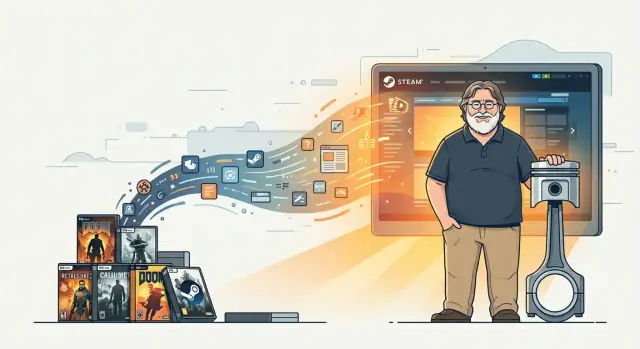
Why Distribution Often Outearns Making Games
A hit game can change a studio’s fate overnight—but it can also fade just as quickly. Sales spike around launch, marketing costs pile up, and the long tail is unpredictable.
Distribution, by contrast, is the business of taking a small cut from a very large number of transactions, year after year, across many titles you didn’t have to invent, fund, or bet the company on.
That’s the core question behind Steam’s story: why can owning the “store and pipes” of PC gaming generate more consistent profit than making the next blockbuster?
Gabe Newell’s bet wasn’t just on games
Gabe Newell co-founded Valve after leaving Microsoft with a strong sense for how software markets reward control points: the places where users, developers, and payments meet.
Valve still made games, but Newell’s bigger business choice was to invest in the infrastructure around games—updates, authentication, downloads, community features, and eventually a full storefront.
This wasn’t a creative gamble. It was a structural one.
What “owning distribution” means on PC
Owning distribution on PC doesn’t mean controlling what gets made. It means controlling the main path between players and games:
- Where customers browse and discover new titles
- Where purchases happen (and refunds, too)
- Where updates, patches, and multiplayer services are delivered
- Where communities, wishlists, and libraries live
When that layer becomes a habit for millions of players, each new game release—by Valve or anyone else—flows through the same channel.
The themes this article follows
Steam’s profitability is less about one genius fee and more about platform economics: scale, repeat purchasing, and leverage. As more users arrive, more developers follow. As more games arrive, the store becomes more useful to users.
That flywheel compounds over time, turning distribution into a durable business—while hit-driven game revenue remains, by nature, volatile.
Gabe Newell and Valve’s Early Bet on PC
Gabe Newell didn’t start in games. He spent more than a decade at Microsoft, where he saw firsthand how software companies scale: ship updates, fix bugs quickly, and keep a direct relationship with customers.
When he left to co-found Valve in 1996, he brought that “software as a service” instinct into a part of entertainment that still behaved like packaged goods.
Valve’s early years: hit game, hard lesson
Valve broke out with Half-Life in 1998, proving a small studio could beat larger publishers on quality and community.
But success also exposed a constraint: PC games were largely sold through boxed retail. That meant long lead times, dependence on distributors, and limited control over what happened after launch.
For a studio that wanted to update frequently—fixing exploits, balancing multiplayer, adding content—boxed distribution was a poor fit.
Why boxed retail held PC gaming back
Before Steam, PC game sales and support were full of friction:
- Patching was messy: updates were scattered across websites, mirrors, and magazines’ cover discs. Players were often on different versions, breaking multiplayer and increasing support costs.
- Fraud and piracy were constant: CD keys, cracks, and counterfeit copies hurt revenue and made online authentication unreliable.
- Fragmentation was the default: different installers, different accounts, different server browsers, different update tools—each game felt like its own little ecosystem.
The opening for a centralized platform
Valve’s early bet was that PC gaming needed a single, dependable layer for delivery: one place to authenticate users, keep games updated, and make buying (and rebuying) painless.
That idea wasn’t just about distribution—it was about creating a tighter feedback loop between developer and player.
Steam would later formalize this strategy, but the logic started earlier: if you can control the pipe, you can fix the experience end-to-end—and capture more value than a one-time box sale ever could.
Steam’s Origin Story: From Tool to Storefront
Steam didn’t start as a grand plan to dominate PC game distribution. Its first job was practical: solve the messy reality of shipping PC games that needed frequent fixes, reliable authentication, and a consistent way to deliver content to millions of players.
A utility first: updates, login, delivery
In the early 2000s, patching a PC game meant hunting for downloads, dealing with mirrors, and hoping you grabbed the right version. Steam centralized three pain points at once:
- Automatic updates so everyone ran the same build (critical for multiplayer)
- Authentication tied to an account, reducing key-sharing and piracy friction
- Content delivery that could push new files quickly without shipping new discs
For Valve, this was less about “selling games” and more about making sure people could actually play them—especially online.
The early backlash—and why it faded
Players initially resisted Steam because it felt like extra software standing between them and their game. Always-online moments, new account requirements, and unfamiliar UI created real irritation.
What changed minds wasn’t a marketing campaign; it was convenience compounding over time. Once Steam reliably patched games, remembered your library, handled reinstalls, and made multiplayer smoother, the hassle turned into habit.
Milestones that turned a tool into a store
A few growth moments pushed Steam beyond “Valve’s updater”:
- Major Valve releases that required Steam, forcing adoption through must-play titles
- Third-party publishers joining once the platform proved it could deliver at scale
- A growing catalog that made Steam useful even when you weren’t playing a Valve game
What Steam offered that retail and early downloads didn’t
Retail was great at distribution, terrible at ongoing service. Early digital downloads were fragmented and unreliable.
Steam bundled the missing pieces into one place: consistent patching, account-based ownership, scalable delivery, and a single library that followed you from PC to PC.
The Platform Flywheel: Users, Games, and Network Effects
Steam works less like a single product and more like a two-sided marketplace: one side is players looking for games and community, the other is developers and publishers looking for customers.
Valve’s advantage comes from getting both sides to reinforce each other—quietly, continuously, and without needing a constant stream of marketing stunts.
The core loop: more users → more games → more users
When a storefront has a lot of active players, it becomes a safer bet for studios. A large audience means higher odds of visibility, sales, and reviews that help a game travel further.
That attracts more developers and publishers, which increases the number and variety of games.
More games then makes the store more useful for players: whatever your taste—AAA, indie, niche simulators, local co-op—there’s likely something for you, plus seasonal sales and recommendations that reduce the effort of finding your next purchase.
This is the flywheel: each rotation makes the next rotation easier.
Network effects: value grows with participation
Steam’s network effects aren’t just about raw catalog size. They’re social and behavioral:
- Friends lists and activity feeds make games feel more “alive” when your circle is playing.
- Reviews, guides, forums, and user-generated content help buyers decide and help games stay relevant.
- Multiplayer is smoother when more players are already on the same platform.
As participation increases, the platform becomes more useful for everyone—especially for mid-sized and smaller games that rely on community momentum.
Switching costs: the invisible moat
Even if another store offers a one-time discount, Steam benefits from switching costs that build up over years:
- Your library is already there.
- Your friends list and groups are there.
- Achievements, playtime history, and badges are there.
- Cloud saves and settings are there.
None of these are individually “must-have.” Together, they make switching feel like starting over.
Advantage without hype
This is why Steam’s position compounds over time. Valve doesn’t need every game to be a blockbuster or every feature launch to be loud. The marketplace structure itself creates momentum—steady, repeatable, and hard to dislodge once it’s spinning.
How Steam Makes Money: Fees, Volume, and Repeat Purchases
Steam’s core business is simple: it runs a store and takes a cut when money changes hands. If a game sells for $20, the developer/publisher doesn’t receive the full $20—Steam keeps a percentage (often described as a “take rate”), and the rest goes to the company that made or funded the game.
The take-rate, in plain terms
Think of Steam like a mall owner. It provides the building, payment processing, customer traffic, and the “front desk” (store pages, downloads, refunds). In exchange, it charges rent as a percentage of sales.
Each individual transaction might look modest, but the store isn’t betting on one tenant—it collects from thousands.
One hit game vs. a toll booth on many games
A traditional game sale is largely one-and-done: you ship a title, you sell copies, and revenue spikes around launch.
A platform fee model compounds differently. Steam earns repeatedly across:
- New releases every week
- Back-catalog games that keep selling years later
- Add-ons and upgrades (DLC, expansions, soundtrack bundles)
Instead of living or dying by a single blockbuster, it benefits from the total spending of the entire PC audience.
Why scale beats any single release
Catalog scale is the advantage: more games attract more players, which attracts more developers, which increases selection again.
Even if any one title underperforms, the overall store can still grow because the “average” across thousands of games matters more than the “max” of one.
Seasonal sales and pricing tools: volume drivers
Steam also makes more when customers buy more—so it invests heavily in pricing mechanics.
Seasonal sales, daily deals, bundles, regional pricing, and discount scheduling tools reduce friction for buyers and give publishers controlled ways to trade margin for volume.
When millions of people add “just one more game” to their cart, the take rate quietly scales with it.
Lower Friction, Higher Spend: Convenience as a Business Strategy
Steam’s most underrated “feature” isn’t a social feed or a big seasonal sale—it’s the steady removal of tiny obstacles that stop people from buying games.
When the path from “that looks interesting” to “I’m playing” is smooth, purchases happen more often, and they happen with less second-guessing.
Where Steam removes friction
Convenience on Steam is a chain, and the chain is only as strong as its weakest link.
Discovery is the first link: search, filters, tags, wishlists, recommendations, and “what’s trending” modules help players find something that matches their mood without hunting across dozens of sites.
Payment is the next link: saved payment methods, local currency pricing in many regions, and a familiar checkout flow reduce the mental effort of buying—especially for smaller, impulse-friendly purchases.
Delivery and updates complete the loop: one library, one install button, automatic patching, and cloud features (where supported) make the game feel “kept up” without the player babysitting files or download pages.
Reliability, trust, and repeat buying
People buy more when they trust the process. Steam builds trust through visible community signals—ratings, written reviews, playtime indicators, and user discussions—so shoppers can sanity-check a purchase quickly.
It also benefits from predictable expectations: players know there’s a refund mechanism, even if they don’t plan to use it, and that sense of safety can reduce hesitation.
Add account security features and a consistent update pipeline, and the store starts to feel like a dependable utility rather than a gamble.
What this means for developers
Lower friction doesn’t just help Steam—it raises conversion for studios: fewer abandoned carts, fewer “I’ll buy it later” moments, fewer support requests about patching or downloads.
When purchase, install, and updates are effortless, more interested players become paying customers—and more paying customers become repeat buyers.
Developer Value: Tools and Services That Keep Studios Shipping
A storefront isn’t just a place to take payments. For many studios, Steam is also a production partner—because the work of shipping and maintaining a PC game includes a long tail of infrastructure that players expect, but developers don’t want to rebuild from scratch.
Steamworks: the “invisible” product developers actually use
Steamworks is Valve’s developer toolkit and service layer. It’s not flashy to players, but it’s where a lot of day-to-day value lives: APIs, backend services, dashboards, and distribution features that help a team launch, patch, and operate a game at scale.
For a small studio, this can be the difference between focusing on gameplay versus hiring specialists to build plumbing.
Platform services that replace months of engineering
Steamworks includes a menu of common platform features that players treat as table stakes:
- Matchmaking and multiplayer services (sessions, lobbies, invites)
- Achievements and stats (a ready-made progression and bragging layer)
- Cloud saves (less support friction when players switch PCs)
- Leaderboards, friends, and presence integrations
- Betas/branches, patch delivery, and rollback options for safer updates
None of these features is “the game,” but each one can eat real calendar time if you build it yourself—plus ongoing operations after launch.
A similar pattern shows up outside gaming: developer platforms that bundle hosting, auth, databases, and deployment win by reducing time-to-market. For example, Koder.ai approaches software creation through a chat-based workflow—using an agentic LLM architecture under the hood—so teams can spin up web (React), backend (Go + PostgreSQL), or mobile (Flutter) projects faster, then export source code, deploy, and roll back via snapshots.
Lower costs and faster time-to-market
Integrated services reduce both direct costs (servers, tooling, vendor subscriptions) and indirect costs (QA complexity, customer support tickets, and patch risk).
They also shorten the path from prototype to a shippable product: a team can use proven building blocks instead of designing systems, writing backend code, and negotiating third-party integrations.
That speed matters commercially. A faster launch can mean hitting a better window, responding to player feedback sooner, and iterating without drowning in infrastructure work.
Why tooling creates loyalty (and stickiness)
When a game is built around Steamworks features—achievements, cloud saves, friends, matchmaking—the platform stops being interchangeable.
Developers become less likely to move, because switching isn’t just “uploading to another store”; it can require re-implementing features, re-testing everything, and risking a worse player experience.
This is distribution as a product: Valve isn’t only selling reach. It’s selling a smoother path to shipping—and that keeps studios coming back for the next release.
Discovery Power: Why the Storefront Controls Attention
A modern PC storefront isn’t just a payment page—it’s the main way players decide what to play next.
When thousands of games launch every year, “being on Steam” is table stakes. What separates a hit from a quiet release is often whether the store’s discovery systems put a game in front of the right people at the right time.
Algorithmic discovery: placement is the new shelf space
Steam’s front page, category hubs, and “More Like This” rails function like automated shelves. Placement matters because most users don’t search for a specific title; they browse.
The recommendation system learns from what players view, play, refund, review, and wishlist, then uses those signals to predict what will convert.
That makes discovery a compounding advantage: a small burst of interest can trigger more impressions, which can trigger more purchases, which can trigger even more visibility.
The mechanics: tags, wishlists, recommendations, reviews
Several inputs shape how a game is matched to an audience:
- Tags help Steam understand genre and intent (“co-op,” “souls-like,” “cozy”). Accurate tags improve where the game appears; misleading tags can backfire.
- Wishlists are a proxy for latent demand. Big wishlist counts can make a launch look promising, and notifications turn into day-one traffic.
- Recommendations personalize discovery. If your game converts well with a particular cohort, Steam will try it on similar players.
- User reviews influence both trust and traffic. They’re social proof and a quality signal; a “Mostly Positive” label can change whether a click becomes a purchase.
The trade-off: visibility help vs. attention competition
Steam offers discovery tools that a standalone website can’t match—but those same tools sit beside endless alternatives.
Players can compare prices, review scores, and screenshots in seconds. Convenience increases spending, yet it also tightens competition for attention.
Distribution control shapes outcomes
Because the storefront mediates discovery, it can tilt results without changing the game itself: featuring, category placement, algorithmic boosts, discount visibility, and review presentation all affect momentum.
Owning distribution means owning the primary channel where demand is created, not just fulfilled.
Profitability Through Diversification, Not Just Blockbusters
People often talk about “hits” as if they’re the only way to win in games.
A hit business is a movie studio, a chart-topping album, or a single breakout game: one big release pays for the misses.
An infrastructure business is more like an airport, a payment network, or a grocery store chain: it earns a little from many transactions, across many “products,” year after year.
Why studios feel the volatility
Game studios typically live on a release cycle. Revenue spikes when a title launches, then falls off.
If reviews miss, a platform policy changes, or marketing fails to catch fire, a whole year (or more) of work can underperform. Costs, meanwhile, are steady: salaries, contractors, software, and overhead don’t pause because a launch didn’t land.
How platforms profit from the whole market
A distribution platform earns when the market is busy, not only when one game becomes a phenomenon.
If ten mid-sized games each do “pretty well,” the platform participates in all ten. If a new genre takes off, the platform participates. If older games keep selling during seasonal sales, the platform participates.
That’s diversification: revenue spread across thousands of releases, plus ongoing purchases like DLC, soundtracks, and in-game items. Even when one publisher has a bad year, someone else is having a good one.
What Valve’s model suggests about risk and resilience
Valve’s Steam strategy implies a different kind of resilience: fewer all-or-nothing bets on a single blockbuster, and more upside from overall PC gaming growth.
When your business earns from the category, not just your own catalog, you can survive misses—and still benefit when the next surprise hit arrives.
Competition and Countermoves: Why Challengers Struggle
Steam isn’t impossible to compete with—but it’s hard to dislodge because it’s more than a checkout page.
Most challengers try one of two counter-strategies: build a first-party store around their own catalog, or use exclusives to force attention.
First-party stores and the exclusives play
Publishers launching their own launchers and storefronts can make sense on paper: lower platform fees, direct customer data, and tighter control over marketing.
Exclusives (timed or permanent) are the sharper tool—if a game can’t be bought elsewhere, some players will follow.
The catch is that exclusives often create a “single-game relationship.” When the exclusive window ends—or the player finishes that one title—many users drift back to where the rest of their library lives.
What competitors actually have to match
To become a default choice, challengers need to match a bundle of expectations, not just a storefront UI:
- Library gravity: a deep catalog across genres and eras, plus wishlists and ownership history.
- Features: painless updates, cloud saves, controller support, refunds, mod support, and reliable downloads.
- Trust: consistent policies, security, and a track record of not breaking purchases.
- Community: reviews, forums, guides, workshops/mods, and social features that keep players engaged between purchases.
If any one piece is missing, users feel the switching cost immediately—extra logins, fragmented friends lists, duplicated installs, and scattered libraries.
Why price cuts alone rarely stick
Aggressive discounts, coupons, or temporarily better revenue shares can attract trial usage, but convenience and habit tend to win over time.
Players optimize for fewer launchers, fewer passwords, and a single place to manage everything—especially once they’ve accumulated a backlog.
Price matters, but it usually needs to be paired with long-term product parity and a reason to stay after the deal ends.
Community and Content: Retention Beyond the Store
Steam isn’t just a checkout page for games—it’s a place people “hang out.” That matters because time spent inside the client increases the chances of discovering something new, returning after finishing a game, and building habits that are hard to break.
Features that keep people logged in
A purchase can be a one-time event. Community features turn it into an ongoing routine:
- Friends and chat make Steam a social layer over PC gaming. Even when players switch games, their conversations and invites stay in one place.
- Groups organize people around genres, creators, tournaments, or local communities—creating reasons to return that aren’t tied to a single release.
- Forums and guides keep discussion, troubleshooting, and “how do I beat this?” moments inside Steam instead of on external sites.
- Trading cards and item trading add a light meta-game: collecting, exchanging, and browsing the Market nudges users back even when they’re not actively playing.
Workshop: content that outlives the game’s launch
The Steam Workshop is especially powerful because it turns players into contributors. Mods, maps, skins, and quality-of-life tweaks can extend a game’s lifespan by years.
For players, Workshop content is immediate: click subscribe, launch, and play.
For developers, it’s a retention engine: the community keeps producing new reasons to reinstall, invite friends, or try a different playstyle—without the studio shipping a full expansion every time.
Retention beyond any single title
When your identity, friends list, mod subscriptions, and library all live on the same platform, leaving becomes inconvenient.
Even if a player is “done” with one game, they’re still on Steam to:
- check what friends are playing,
- read updates,
- browse community creations,
- pick up a discounted game during a sale.
The hidden cost: moderation and quality control
Community doesn’t run itself. Forums can attract harassment and spam, Workshop pages can host low-effort or stolen content, and item economies invite scams.
Steam’s retention advantage comes with real operational costs: moderation, reporting tools, policy enforcement, and ongoing work to keep discovery and community spaces usable.
What PC Gaming Can Learn from Valve’s Distribution Play
Valve’s biggest strategic lesson isn’t “make a hit game.” It’s that owning distribution changes the profit equation.
A successful game pays once; a successful channel gets paid repeatedly—across many games, across many years, and often with far less risk than funding AAA production.
The real takeaway: control the point of purchase
Steam sits between players and content. That position compounds: every improvement in checkout flow, updates, community features, or recommendations can raise spending across the entire catalog, not just one title.
That’s why distribution can outperform development even when development is what created the audience in the first place.
When building a platform makes sense (and when it doesn’t)
A platform bet is rational when you can:
- Offer a clear advantage over existing storefronts (reach, trust, pricing, features)
- Sustain long-term investment in infrastructure, support, and policy
- Attract both sides of the market: players and developers
It’s a poor fit when your “platform” is really just a branded launcher without unique value, or when your audience is too small to create meaningful pull for third parties.
The broader point: platforms win by bundling the unglamorous work—distribution, deployment, updates, and operational reliability—into something teams can depend on. That’s as true for game distribution as it is for modern app development platforms like Koder.ai.
Actionable channel choices for developers
For most studios, the smarter move is to treat distribution as a portfolio:
- Use major storefronts for reach, then optimize your page, updates, and discounts to capture demand.
- Build direct relationships (newsletter, Discord, wishlists) so algorithms aren’t your only source of attention.
- Negotiate where possible (publishers, bundles, subscriptions), but assume standard revenue share and plan margins accordingly.
Why Valve’s approach is hard to copy
Steam wasn’t copied easily because it combined timing (PC shift to digital), scale (huge user base), and credible trust built over years.
Competitors can replicate features; they struggle to replicate the flywheel of existing libraries, friends lists, habits, and developer dependence that keeps Steam central.
FAQ
Why can owning distribution be more profitable than making games?
Distribution earns repeatedly because it takes a small cut from many transactions across many titles over time.
A game studio’s revenue is usually launch-spiky and hit-driven, while a platform participates in:
- New releases
- Back-catalog sales
- DLC/bundles/add-ons
- Seasonal sale volume
What does “owning distribution” actually mean on PC?
In this context, “owning distribution” means controlling the main path between players and games:
- Discovery (where people browse)
- Checkout (where payments/refunds happen)
- Delivery (downloads/updates)
- The persistent layer (library, accounts, community)
You don’t control what gets made—you control where demand is captured and served.
Why did Steam start as an updater instead of a store?
Steam started as a utility to solve PC pain points like patching and authentication.
Once players relied on it for automatic updates, account-based ownership, and smoother multiplayer, it became a habit—and then a natural place to buy games.
How does Steam’s fee model work in plain terms?
Steam’s “take rate” is the percentage it keeps from each sale in exchange for running the storefront and infrastructure.
Practically, it’s paying for:
- Customer traffic and discovery surfaces
- Payment processing and refunds
- Hosting and content delivery
- Tooling and account systems
What is the “platform flywheel” and why does it matter?
A two-sided marketplace gets stronger as each side grows:
- More players make Steam attractive to developers.
- More games make Steam useful to players.
That loop compounds, so the platform can grow even if no single title is a mega-hit.
What are Steam’s switching costs for players?
Switching costs are the accumulated reasons changing platforms feels like starting over.
On Steam they include:
- A large existing library
- Friends/social graph
- Cloud saves and play history
- Achievements, guides, and community content
Even if another store is cheaper once, these frictions pull users back.
What is Steamworks, and why do developers rely on it?
Steamworks is Valve’s developer toolkit and service layer that helps studios ship and operate games.
It can replace months of engineering by providing common features like:
- Achievements/stats
- Cloud saves
- Matchmaking/lobbies
- Beta branches and patch delivery
How does Steam discovery influence which games succeed?
In crowded markets, the storefront often controls attention through recommendations and placement.
To improve your odds:
- Use accurate tags and clear positioning
- Build wishlists before launch (they convert into launch-day traffic)
- Prioritize review quality and player trust (performance, onboarding, support)
Small early momentum can trigger more algorithmic exposure.
Why are seasonal sales so powerful—and how should studios use them?
Steam sales work because they reduce buying friction and encourage volume.
For developers, the practical approach is to:
- Plan discounts strategically (don’t “train” your audience to wait forever)
- Use bundles/DLC to increase average cart value
- Keep your back-catalog visible with periodic, predictable promos
Why is it so hard for other PC stores to beat Steam?
Challengers often compete on exclusives, lower fees, or short-term discounts—but users still want one reliable home for their library.
To dislodge Steam, a competitor must match a bundle of expectations (not just price):
- Features and reliability
- Trust and policies
- Community and content ecosystems
- A catalog that keeps people staying after the deal ends