

Go vs Rust for Backend Applications: How to Choose Wisely
A practical comparison of Go and Rust for backend apps: performance, safety, concurrency, tooling, hiring, and when each language is the best fit.
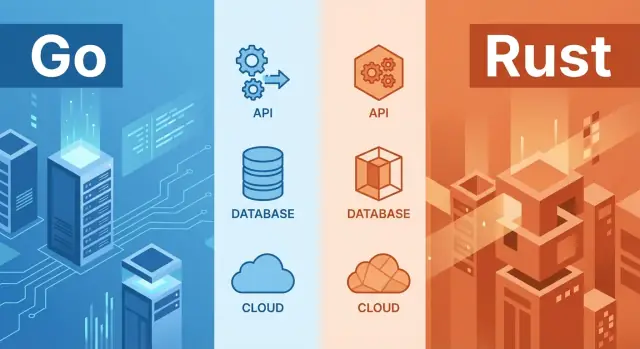
What you’re choosing between (and why it matters)
“Backend applications” is a broad bucket. It can mean public-facing APIs, internal microservices, background workers (cron jobs, queues, ETL), event-driven services, real-time systems, and even the command-line tools your team uses to operate all of the above. Go and Rust can handle these jobs—but they push you toward different tradeoffs in how you build, ship, and maintain them.
There isn’t a single winner. The “right” choice depends on what you’re optimizing for: speed to deliver, predictable performance, safety guarantees, hiring constraints, or operational simplicity. Picking a language isn’t just a technical preference; it affects how quickly new teammates become productive, how incidents are debugged at 2 a.m., and how expensive your systems are to run at scale.
The key decision factors (what this article will cover)
To make the choice practical, the rest of this post breaks the decision down into a few concrete dimensions:
- Developer experience and day-to-day productivity
- Performance in real services (throughput, latency, resource usage)
- Safety and reliability (memory bugs, crashes, security risks)
- Concurrency model (goroutines vs async Rust)
- Ecosystem and libraries for backend work
- Build, deploy, and operations
- Observability and production debugging
- Team fit: hiring, onboarding, and long-term maintenance
How to use this post quickly
If you’re in a hurry, skim the sections that match your current pain:
- Shipping fast with a small team → focus on productivity, ecosystem, and ops
- Chasing tail latency or cutting cloud costs → jump to performance and concurrency
- Reducing crash classes and security issues → read safety and reliability
Then use the decision framework at the end to sanity-check your choice against your team and goals.
Go and Rust in one minute: the core differences
Go and Rust can both power serious backend systems, but they’re optimized for different priorities. If you understand their design goals, a lot of the “which one is faster/better” debate becomes clearer.
Go: simplicity and speed of delivery
Go was designed to be easy to read, easy to build, and easy to ship. It favors a small language surface area, quick compilation, and straightforward tooling.
In backend terms, that often translates to:
- Fast developer onboarding and consistent code style across teams
- Simple cross-compilation into a single static-ish binary and painless container images
- Great ergonomics for networking, HTTP services, and microservices
Go’s runtime (especially garbage collection and goroutines) trades some low-level control for productivity and operational simplicity.
Rust: safety, control, predictable performance
Rust was designed to prevent entire classes of bugs—especially memory-related ones—while still offering low-level control and performance characteristics that are easier to reason about under load.
That typically shows up as:
- Strong compile-time guarantees (ownership/borrowing) that reduce crashes and security issues
- Fine-grained control over memory, concurrency, and data layouts
- Performance that can be very consistent when latency spikes matter
Clearing up a common misconception
“Rust is only for systems programming” isn’t accurate. Rust is widely used for backend APIs, high-throughput services, edge components, and performance-critical infrastructure. It’s just that Rust asks for more upfront effort (designing data ownership and lifetimes) to earn safety and control.
Typical backend sweet spots
Go is a strong default for HTTP APIs, internal services, and cloud-native microservices where iteration speed and hiring/onboarding matter.
Rust shines in services with strict latency budgets, heavy CPU work, high concurrency pressure, or security-sensitive components where memory safety is a top priority.
Developer experience and productivity
Developer experience is where the Go vs Rust decision often becomes obvious, because it shows up every day: how fast you can change code, understand it, and ship it.
Feedback loops: compile times and iteration speed
Go tends to win on “edit–run–fix” speed. Compiles are typically quick, the tooling is uniform, and the standard workflow (build, test, format) feels consistent across projects. That tight loop is a real productivity multiplier when you’re iterating on handlers, business rules, and service-to-service calls.
Rust’s compile times can be longer—especially as the codebase and dependency graph grow. The tradeoff is that the compiler is doing more for you. Many issues that would become runtime bugs in other languages get surfaced while you’re still coding.
Onboarding and day-to-day complexity
Go is intentionally small: fewer language features, fewer ways to write the same thing, and a culture of straightforward code. That usually means faster onboarding for mixed-experience teams and fewer “style debates,” which helps maintain velocity as the team grows.
Rust has a steeper learning curve. Ownership, borrowing, and lifetimes take time to internalize, and early productivity can dip while new developers learn the mental model. For teams willing to invest, that complexity can pay back later via fewer production issues and clearer boundaries around resource usage.
Maintainability: readability vs guarantees
Go code is often easy to scan and review, which supports long-term maintenance.
Rust can be more verbose, but its stricter checks (types, lifetimes, exhaustive matching) help prevent whole classes of bugs early—before they reach code review or production.
A practical rule: match the language to team experience. If your team already knows Go, you’ll likely ship faster in Go; if you already have strong Rust expertise (or your domain demands strict correctness), Rust may deliver higher confidence over time.
Performance: throughput, latency, and real-world tradeoffs
Backend teams care about performance for two practical reasons: how much work a service can do per dollar (throughput), and how consistently it responds under load (tail latency). Average latency might look fine in a dashboard while your p95/p99 spikes cause timeouts, retries, and cascading failures across other services.
Throughput vs tail latency (why both matter)
Throughput is your “requests per second” capacity at an acceptable error rate. Tail latency is the “slowest 1% (or 0.1%) of requests,” which often determines user experience and SLO compliance. A service that is fast most of the time but occasionally stalls can be harder to operate than a slightly slower service with stable p99.
Where Go commonly performs well
Go often excels in I/O-heavy backend services: APIs that spend most of their time waiting on databases, caches, message queues, and other network calls. The runtime, scheduler, and standard library make it easy to handle high concurrency, and the garbage collector is good enough for many production workloads.
That said, GC behavior can show up as tail-latency jitter when allocations are heavy or request payloads are large. Many Go teams get great results by being mindful about allocations and using profiling tools early—without turning performance tuning into a second job.
Where Rust commonly shines
Rust tends to shine when the bottleneck is CPU work or when you need tight control over memory:
- compute-heavy tasks (serialization at very high rates, compression, crypto, image/video processing)
- low-level networking, protocol handling, and high-performance proxies
- services where predictable latency is critical and pauses are unacceptable
Because Rust avoids garbage collection and encourages explicit data ownership, it can deliver high throughput with more predictable tail latency—especially when the workload is allocation-sensitive.
Benchmark your workload, not the internet’s anecdotes
Real-world performance depends more on your workload than on language reputation. Before committing, prototype the “hot path” and benchmark it with production-like inputs: typical payload sizes, database calls, concurrency, and realistic traffic patterns.
Measure more than a single number:
- p50/p95/p99 latency
- CPU utilization and memory footprint
- allocation rate (and GC impact, if applicable)
- behavior under load: timeouts, retry storms, and queue buildup
Don’t ignore optimization cost
Performance isn’t just what the program can do—it’s also how much effort it takes to reach and maintain that performance. Go can be faster to iterate on and tune for many teams. Rust can deliver excellent performance, but it may require more up-front design work (data structures, lifetimes, avoiding unnecessary copies). The best choice is the one that hits your SLOs with the least ongoing engineering tax.
Safety and reliability: memory, crashes, and security
Safety in backend services mostly means: your program shouldn’t corrupt data, expose one customer’s data to another, or fall over under normal traffic. A large chunk of that comes down to memory safety—preventing bugs where code accidentally reads or writes the wrong part of memory.
Memory safety in plain terms
Think of memory as your service’s working desk. Memory-unsafe bugs are like grabbing the wrong paper from the pile—sometimes you notice immediately (a crash), sometimes you silently send the wrong document (data leak).
Go: garbage collection + simpler rules
Go uses garbage collection (GC): the runtime automatically frees memory you’re no longer using. This removes an entire class of “forgot to free it” bugs and makes coding fast.
Tradeoffs:
- GC can introduce occasional latency spikes (usually small, but important for tight SLOs).
- You can still create memory pressure by holding references longer than needed.
- Concurrency bugs (data races) are possible if you share memory without coordination.
Rust: ownership/borrowing + compile-time checks
Rust’s ownership and borrowing model forces the compiler to prove that memory access is valid. The payoff is strong guarantees: whole categories of crashes and data corruption are prevented before the code ships.
Tradeoffs:
- Steeper learning curve and longer time-to-first-feature for many teams.
- You can bypass some guarantees with
unsafe, but that becomes a clearly marked risk area.
Common failure modes you’ll actually see
- Leaks: less common in Go due to GC, but still possible via unbounded caches; Rust can leak logically (e.g., intentional “forget”), but it’s rarer in typical service code.
- Races: Go can hit data races without careful locking/channel design; Rust makes many races hard or impossible in safe code.
- Panics/crashes: both can panic. Go panics often come from nil pointer dereferences; Rust panics are usually explicit checks. In both, treat panics as bugs and recover only at well-defined boundaries.
Security updates and dependencies
- Go: Go modules plus tools like
govulncheckhelp detect known issues; updates are generally straightforward. - Rust: Cargo makes dependency pinning and updates predictable;
cargo-auditis commonly used to flag vulnerable crates.
Guidance for risk-sensitive services
For payments, authentication, or multi-tenant systems, favor the option that reduces “impossible” bug classes. Rust’s memory-safety guarantees can materially lower the chance of catastrophic vulnerabilities, while Go can be a strong choice if you pair it with strict code reviews, race detection, fuzzing, and conservative dependency practices.
Concurrency model: goroutines vs async Rust
Concurrency is about handling many things at once (like serving 10,000 open connections). Parallelism is about doing many things at the same time (using multiple CPU cores). A backend can be highly concurrent even on one core—think “pause and resume” while waiting on the network.
Go: goroutines + channels (concurrency by default)
Go makes concurrency feel like ordinary code. A goroutine is a lightweight task you start with go func() { ... }(), and the runtime scheduler multiplexes many goroutines onto a smaller set of OS threads.
Channels give you a structured way to pass data between goroutines. This often reduces shared-memory coordination, but it doesn’t remove the need to think about blocking: unbuffered channels, full buffers, and forgotten receives can all stall a system.
Bug patterns you’ll still see in Go include data races (shared maps/structs without locks), deadlocks (cyclical waits), and goroutine leaks (tasks waiting forever on I/O or channels). The runtime also includes garbage collection, which simplifies memory management but can introduce occasional GC-related pauses—usually small, but relevant for tight latency targets.
Rust: async/await + explicit runtimes (control by design)
Rust’s common model for backend concurrency is async/await with an async runtime like Tokio. Async functions compile into state machines that yield control when they hit an .await, letting one OS thread drive many tasks efficiently.
Rust has no garbage collector. That can mean steadier latency, but it shifts responsibility to explicit ownership and lifetimes. The compiler also enforces thread-safety via traits like Send and Sync, preventing many data races at compile time. In return, you must be careful about blocking inside async code (e.g., CPU-heavy work or blocking I/O), which can freeze the executor thread unless you offload it.
Quick checklist (workload-driven)
- Many network connections, straightforward request/response, team wants simplicity → Go goroutines.
- Strict tail-latency goals, sensitive to GC jitter, careful control over allocation → Rust async.
- Lots of shared mutable state and past race-condition incidents → Rust can prevent classes of bugs early.
- Heavy CPU work mixed with I/O (compression, crypto, transforms) → either, but plan explicit worker pools/offloading (Go) or blocking-aware design (Rust).
Ecosystem and libraries for backend work
Your backend won’t be written in “the language” alone—it’s built on HTTP servers, JSON tooling, database drivers, auth libraries, and operational glue. Go and Rust both have strong ecosystems, but they feel very different.
Standard libraries and common web stacks
Go’s standard library is a big advantage for backend work. net/http, encoding/json, crypto/tls, and database/sql cover a lot without extra dependencies, and many teams ship production APIs with a minimal stack (often plus a router like Chi or Gin).
Rust’s standard library is intentionally smaller. You typically pick a web framework and async runtime (commonly Axum/Actix-Web plus Tokio), which can be great—but it does mean more early decisions and more third‑party surface area.
HTTP, JSON, gRPC, and database drivers
- HTTP: Go’s
net/httpis mature and straightforward. Rust’s frameworks are fast and expressive, but you’ll rely more on ecosystem conventions. - JSON: Go’s
encoding/jsonis ubiquitous (though not the fastest). Rust’sserdeis widely loved for correctness and flexibility. - gRPC: Go has excellent first-party-feeling support via
google.golang.org/grpc. Rust’s Tonic is the common choice and works well, but you’ll spend more time aligning versions/features. - Databases: Go’s
database/sqlplus drivers (and tools like sqlc) are proven. Rust offers strong options like SQLx and Diesel; check whether their migration, pooling, and async support matches your needs.
Dependency management (and avoiding churn)
Go modules make dependency upgrades relatively predictable, and Go’s culture tends to prefer small, stable building blocks.
Rust’s Cargo is powerful (workspaces, features, reproducible builds), but feature flags and fast-moving crates can introduce upgrade work. To reduce churn, choose stable foundations (framework + runtime + logging) early, and validate the “must-haves” before committing—ORM or query style, authentication/JWT, migrations, observability, and any SDKs you can’t avoid.
Build, deploy, and operations
Backend teams don’t just ship code—they ship artifacts. How your service builds, starts, and behaves in containers often matters as much as raw performance.
Binary size, startup time, and container images
Go usually produces a single static-ish binary (depending on CGO usage) that’s easy to copy into a minimal container image. Startup is typically quick, which helps with autoscaling and rolling deployments.
Rust also produces a single binary, and it can be very fast at runtime. However, release binaries can be larger depending on features and dependencies, and build times may be longer. Startup time is generally good, but if you pull in heavier async stacks or crypto/tooling, you’ll feel it more in build and image size than in “hello world.”
Operationally, both can run well in small images; the practical difference is often how much work it takes to keep builds lean.
Cross-compilation and multi-arch builds
If you deploy to mixed architectures (x86_64 + ARM64), Go makes multi-arch builds straightforward with environment flags, and cross-compiling is a common workflow.
Rust supports cross-compilation too, but you’ll typically be more explicit about targets and system dependencies. Many teams rely on Docker-based builds or toolchains to ensure consistent results.
CI/CD considerations
A few patterns show up quickly:
- Linting: Go’s formatting and lint tooling is fast and standardized; Rust’s
cargo fmt/clippyare excellent but may add noticeable CI time. - Tests: Both have good built-in test runners; Rust’s compilation step makes test jobs heavier, while Go tests tend to iterate quickly.
- Build caching: Go benefits from module and build caches; Rust benefits heavily from caching the Cargo registry and
target/artifacts. Without caching, Rust pipelines can feel slow.
Common deployment targets
Both languages are widely deployed to:
- Docker and Kubernetes (common for microservices)
- Cloud services (VMs, managed container platforms)
- Serverless (works best when cold-start behavior and packaging are handled carefully)
Go often feels “default-friendly” for containers and serverless. Rust can shine when you need tight resource usage or stronger safety guarantees, but teams usually invest a bit more in build and packaging.
A quick trial: deploy “hello-world service” in both
If you’re undecided, run a small experiment: implement the same tiny HTTP service in Go and Rust, then deploy each using the same path (for example, Docker → your staging cluster). Track:
- CI time from clean checkout
- Final image size
- Cold start time / readiness time
- Memory usage under a simple load test
This short trial tends to surface the operational differences—tooling friction, pipeline speed, and deployment ergonomics—that don’t show up in code comparisons.
If your main goal is to reduce time-to-prototype during this evaluation, tools like Koder.ai can help you spin up a working baseline quickly (for example, a Go backend with PostgreSQL, common service scaffolding, and deployable artifacts) so your team can spend more time on measuring latency, failure behavior, and operational fit. Since Koder.ai supports source code export, it can also be used as a starting point for a pilot without locking you into a hosted workflow.
Observability and debugging in production
When a backend service misbehaves, you don’t want guesses—you want signals. A practical observability setup usually includes logs (what happened), metrics (how often and how bad), traces (where time is spent across services), and profiling (why CPU or memory is high).
What you should be able to answer quickly
Good tooling helps you answer questions like:
- Is this a user-facing outage or a slow-down in one dependency?
- Which endpoint or customer is affected?
- Did latency increase because of CPU, GC/allocations, lock contention, or an external call?
Go: strong built-ins, smooth workflows
Go ships with a lot that makes production debugging straightforward: pprof for CPU/memory profiling, stack traces that are easy to read, and a mature culture around exporting metrics. Many teams standardize on common patterns quickly.
A typical workflow is: detect an alert → check dashboards → jump into a trace → grab a pprof profile from the running service → compare allocations before/after a deploy.
Rust: excellent performance visibility, more choices
Rust doesn’t have a single “default” observability stack, but the ecosystem is strong. Libraries like tracing make structured, contextual logs and spans feel natural, and integrations with OpenTelemetry are widely used. Profiling is often done with external profilers (and sometimes compiler-assisted tools), which can be very powerful, but may require more setup discipline.
Incident response: plan it early
Regardless of Go vs Rust, decide early how you’ll:
- correlate logs/metrics/traces with request IDs
- sample traces without losing key edge cases
- expose safe, authenticated debug endpoints
Observability is easiest to build before the first incident—after that, you’re paying interest.
Team fit: hiring, onboarding, and long-term maintenance
The “best” backend language is often the one your team can sustain for years—through feature requests, incidents, turnover, and changing priorities. Go and Rust both work well in production, but they ask different things of your people.
Hiring and learning curve
Go tends to be easier to hire for and faster to onboard. Many backend engineers can become productive in days because the language surface area is small and the conventions are consistent.
Rust’s learning curve is steeper, especially around ownership, lifetimes, and async patterns. The upside is that the compiler teaches aggressively, and teams often report fewer production surprises once the initial ramp-up is done. For hiring, Rust talent can be harder to find in some markets—plan for longer lead time or internal upskilling.
Long-term maintenance: readability, upgrades, dependency health
Go codebases often age well because they’re straightforward to read, and the standard tooling nudges teams toward similar structures. Upgrades are usually uneventful, and the module ecosystem is mature for common backend needs.
Rust can deliver very stable, safe systems over time, but maintenance success depends on discipline: keeping dependencies current, watching crate health, and budgeting time for occasional compiler/lint-driven refactors. The payoff is strong guarantees around memory safety and a culture of correctness—but it can feel “heavier” for teams that move quickly.
Team norms: reviews, linting, and style
Whichever you choose, lock in norms early:
- Code review focus (simplicity vs correctness vs performance)
- Automated formatting (gofmt or rustfmt) and linting (staticcheck or clippy)
- A short style guide and “how we do services here” template
Consistency matters more than perfection: it reduces onboarding time and makes maintenance predictable.
A practical shortcut
If you’re a small team shipping product features weekly, Go is usually the safer bet for staffing and onboarding speed.
If you’re a larger team building long-lived, correctness-sensitive services (or you expect performance and safety to dominate), Rust can be worth the investment—provided you can support the expertise long-term.
When to pick Go (and when to pick Rust)
Choosing between Go and Rust often comes down to what you’re optimizing for: speed of delivery and operational simplicity, or maximum safety and tight control over performance.
Pick Go when speed and simplicity win
Go is usually a strong choice if you want a team to ship and iterate quickly with minimal friction.
- You’re building many small-to-medium microservices where consistency and maintainability matter more than squeezing out every last millisecond.
- You want straightforward deployments (single static-ish binaries are common), predictable builds, and simple container images.
- Your services are I/O-heavy: REST/JSON APIs, CRUD backends, internal tooling, background workers that mostly wait on queues or databases.
- You’re staffing a team broadly (more generalist backend engineers) and want fast onboarding.
Example fits: an API gateway that aggregates upstream calls, background workers pulling jobs from a queue, internal admin APIs, scheduled batch jobs.
Pick Rust when safety and tight performance matter
Rust tends to shine when failures are expensive, and when you need deterministic performance under load.
- You’re writing performance-critical parts: high-throughput streaming, low-latency proxies, custom networking, compression, parsing, or crypto-heavy workloads.
- Memory safety is a top priority and you want to reduce entire classes of bugs (use-after-free, data races) by construction.
- You need more control over CPU and memory behavior to keep latency stable at high concurrency.
Example fits: a streaming service that transforms events at very high volume, a reverse proxy handling many concurrent connections, a rate limiter or auth component where correctness is critical.
A practical mixed approach
Many teams mix them: Rust for hot paths (proxy, stream processor, high-performance library), Go for surrounding services (API orchestration, business logic, admin tools).
Caution: mixing languages adds build pipelines, runtime differences, observability variance, and requires expertise in two ecosystems. It can be worth it—but only if the Rust component is truly a bottleneck or a risk reducer, not just a preference.
A simple decision framework and next steps
If you’re stuck debating Go vs Rust, decide like you would for any backend technology choice: score what matters, run a small pilot, and commit only after you’ve measured real results.
A lightweight scoring rubric (1–5)
Pick the criteria that map to your business risk. Here’s a simple default—score both Go and Rust from 1 (weak) to 5 (strong), then weight the categories if one is especially important.
- Performance (throughput/latency): 1–5
- Safety (memory, crashes, security posture): 1–5
- Team fit (hiring, onboarding, familiarity): 1–5
- Delivery speed (time to build/iterate): 1–5
- Ops simplicity (builds, deploys, on-call ergonomics): 1–5
Interpretation tip: if one category is a “must not fail” (e.g., safety for a security-sensitive service), treat a low score as a blocker rather than averaging it away.
A 1–2 week pilot plan to validate assumptions
Keep the pilot small, real, and measurable—one service or a thin slice of a larger one.
Days 1–2: Define the target
Choose one backend component (e.g., an API endpoint or worker) with clear inputs/outputs. Freeze requirements and test data.
Days 3–7: Build the same slice in both languages (or one, if you have a strong default)
Implement:
- One critical endpoint or job
- Basic auth/validation
- Database or queue integration (minimal)
- Metrics, logs, and tracing hooks
Days 8–10: Load test + failure testing
Run the same scenarios, including timeouts, retries, and partial dependency failures.
Days 11–14: Review and decide
Hold a short “engineering + ops” review: what was easy, what was brittle, what surprised you.
Tip: if your team is resource-constrained, consider generating a baseline service scaffold first (routes, database wiring, logging, metrics). For Go-based backends, Koder.ai can speed up that setup via a chat-driven workflow, then let you export the code so your pilot remains a normal repo with normal CI/CD.
Measurable outcomes to track
Use concrete numbers so the decision doesn’t devolve into preference.
- Latency: p50/p95/p99 response times under a defined load
- Throughput: requests/sec (or jobs/sec) at acceptable latency
- Error rate: application errors + dependency-induced failures
- Resource cost: CPU and memory at the same load
- Dev time: hours to first working version + hours to add one change request
- Deploy effort: time to ship, complexity of build artifacts, rollback simplicity
Document tradeoffs—and revisit after production learnings
Write down what you learned: what you gained, what you paid (complexity, hiring risk, tooling gaps), and what you’re deferring. Revisit the choice after the first production milestone—real on-call incidents and performance data will often matter more than benchmarks.
Takeaway: pick the language that minimizes your biggest risk, then validate with a short pilot. Next steps: run the rubric, schedule the pilot, and make the decision based on measured latency, error rate, developer time, and deploy friction—not vibes.
FAQ
Is Go or Rust better for backend applications overall?
Pick Go when you’re optimizing for delivery speed, consistent conventions, and straightforward operations—especially for I/O-heavy HTTP/CRUD services.
Pick Rust when memory safety, tight tail-latency, or CPU-heavy work is a top constraint, and you can afford a steeper ramp-up.
If you’re unsure, build a small pilot of your “hot path” and measure p95/p99, CPU, memory, and dev time.
Which language leads to faster developer productivity and iteration?
In practice, Go often wins for time-to-first-working-service:
- Small language surface area and consistent style
- Fast edit–run–fix cycles
- Strong standard library for HTTP and common backend needs
Rust can become highly productive once the team internalizes ownership/borrowing, but early iteration may be slower due to compile times and the learning curve.
Is Rust always faster than Go in real backend services?
It depends on what you mean by “performance.”
- Throughput (req/s): both can be excellent.
- Tail latency (p95/p99): Rust often has an edge in allocation-sensitive services because there’s no GC.
- I/O-heavy services: Go commonly performs very well because most time is spent waiting on networks/DBs.
The reliable approach is to benchmark your actual workload with production-like payloads and concurrency.
Which is safer for production services and security-sensitive code?
Rust provides strong compile-time guarantees that prevent many memory-safety bugs and makes lots of data races difficult or impossible in safe code.
Go is memory-safe in the sense that it has garbage collection, but you can still hit:
- data races (shared state without proper coordination)
- nil pointer panics
- latency jitter from GC under heavy allocation
For risk-sensitive components (auth, payments, multi-tenant isolation), Rust’s guarantees can meaningfully reduce catastrophic bug classes.
How big of a problem is Go garbage collection for latency SLOs?
Go’s most common “surprise” is GC-related tail-latency jitter when allocation rates spike or large request payloads create memory pressure.
Mitigations usually include:
- profiling allocations early
- reusing buffers carefully (where safe)
- avoiding unnecessary object churn in hot paths
- watching p99 under realistic load, not just averages
Should I prefer Go’s goroutines or Rust’s async/await for concurrency?
Go goroutines feel like normal code: you spawn a goroutine and the runtime schedules it. This is often the simplest path to high concurrency.
Rust async/await typically uses an explicit runtime (e.g., Tokio). It’s efficient and predictable, but you must avoid blocking the executor (CPU-heavy work or blocking I/O) and sometimes design more explicitly around ownership.
Rule of thumb: Go is “concurrency by default,” Rust is “control by design.”
Which ecosystem is better for typical backend needs like HTTP, JSON, and databases?
Go has a very strong backend story with minimal dependencies:
net/http,crypto/tls,database/sql,encoding/json- mature patterns for services and microservices
Rust often requires earlier stack choices (runtime + framework), but shines with libraries like:
serdefor robust serialization- modern web frameworks (e.g., Axum/Actix-Web)
- strong async ecosystem
If you want fewer early architectural decisions, Go is usually simpler.
What are the practical differences in building, deploying, and running Go vs Rust services?
Both can produce single-binary services, but the day-to-day ops feel different.
- Go: cross-compilation is straightforward; minimal container images are common; CI is usually fast.
- Rust: builds can be slower without caching; binary/image size can grow with dependency features; cross-compilation often needs more explicit setup.
A quick proof is deploying the same tiny service both ways and comparing CI time, image size, and cold-start/readiness time.
Which language is easier to observe and debug in production?
Go generally has smoother “default” production debugging:
- built-in tooling like
pprof - readable stack traces
- widely adopted metrics patterns
Rust observability is excellent but more choice-driven:
tracingfor structured spans and logs- common OpenTelemetry integrations
- profiling often relies more on external tooling
Regardless of language, standardize request IDs, metrics, traces, and safe debug endpoints early.
Is it reasonable to use both Go and Rust in the same backend system?
Yes—many teams use a mixed approach:
- Rust for hot paths (proxies, stream processors, performance-critical libraries)
- Go for surrounding services (API orchestration, business logic, tooling)
Only do this if the Rust component clearly reduces a bottleneck or risk. Mixing languages adds overhead: extra build pipelines, operational variance, and the need to maintain expertise in two ecosystems.