

Grace Hopper and the Compiler Revolution That Shaped Coding
Learn how Grace Hopper helped invent compilers, pushed for readable code, and shaped languages like COBOL—changing how software is written and maintained.
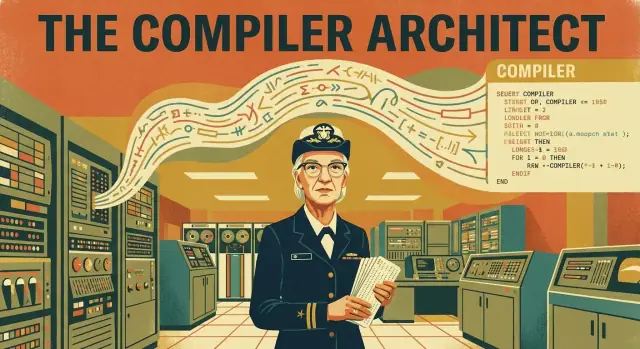
Why Grace Hopper Still Matters to How We Code
Most of us write code expecting it to be readable, reusable, and relatively portable. We name variables, call libraries, and assume our program will run on machines we’ve never seen. That expectation didn’t arrive by accident. It’s the result of a major shift in how humans and computers divide work—and compilers are the bridge.
The core question: what changed, and why did it matter?
Early programmers weren’t “typing code” the way we think of it now. They were managing computers at a level so detailed and fragile that every instruction felt like handcrafting a machine. The key question is this:
How did programming move from being a hardware-specific craft to a human-centered practice that teams can maintain over time?
Hopper’s role: making the machine adapt to the human
Grace Hopper is central to that change because she pushed a radical idea for her era: the computer should do more of the translating. Instead of forcing people to write long, error-prone sequences tailored to a single machine, Hopper helped pioneer early compiler work—systems that could turn more human-friendly instructions into the low-level steps a computer actually executes.
Her work helped prove that “translation” wasn’t a luxury. It was a productivity breakthrough. Once you can express intent more clearly, you can:
- write programs faster,
- spot mistakes more easily,
- share code with other people,
- and update software without rewriting everything from scratch.
What you’ll learn in this article
We’ll walk through what programming looked like before compilers, what a compiler actually does (without the jargon), and how Hopper’s A-0 work and the rise of COBOL pushed software toward readable, standardized languages. Along the way, you’ll see practical consequences that still shape modern development: portability, teamwork, long-term maintenance, and the everyday assumption that code should be understandable by humans—not just machines.
If you’ve ever benefited from clear error messages, portable code, or a language designed to be read like instructions, you’re living in the world Hopper helped build.
Programming Before Compilers: The Hard Way
Grace Hopper didn’t start out trying to make programming “easier.” She started where early computing demanded you start: with the machine’s limits. Trained as a mathematician, she joined the U.S. Navy during World War II and was assigned to work on the Harvard Mark I, one of the first large-scale electromechanical computers.
The Mark I wasn’t a laptop you could reboot after a mistake—it was a room-sized resource shared by a team, scheduled carefully, and treated like expensive lab equipment.
What programming looked like without compilers
Before compilers, programming was closer to wiring a control panel than writing what we’d recognize as code. Instructions had to match the hardware’s needs exactly, often as numeric codes or very low-level operations. If you wanted the machine to add, compare, or move values, you expressed it in the machine’s own vocabulary—step by step.
That work was:
- Manual: you translated your logic into tiny operations yourself.
- Error-prone: a single wrong digit or address could break everything.
- Slow to change: even small updates meant re-checking long chains of instructions.
The real constraint: time was expensive
Early computers were scarce, and “computer time” was a budget item. You couldn’t casually run a program ten times to see what happened. Teams prepared carefully, double-checked everything, then waited for a turn to run jobs. Every minute wasted on avoidable mistakes was time not spent solving the actual problem.
This pressure shaped Hopper’s thinking: if humans were spending more effort speaking the machine’s language than solving the task, the bottleneck wasn’t only the hardware—it was the method.
Machine Code, Assembly, and the Problem of Human Time
Before compilers, programmers spoke to computers in the computer’s own “native” language.
Machine code, in plain language
Machine code is a stream of 0s and 1s that the processor can execute directly. Each pattern means something like “add these two numbers,” “move this value,” or “jump to another step.” It’s precise—and brutally hard for humans to read, write, and debug.
Assembly: a small step toward readability
Assembly language is machine code with nicknames. Instead of writing raw bits, you write short words like LOAD, ADD, or JUMP, plus memory addresses. An assembler then translates those words into the exact 0s and 1s for that specific machine.
Assembly was easier than pure machine code, but it still forced people to think like the hardware: registers, memory locations, and the exact order of operations.
Why early programs were glued to their hardware
Early computers weren’t interchangeable. Different machines had different instruction sets, memory layouts, and even different ways to represent numbers. A program written for one processor’s instructions often couldn’t run on another at all.
Software was less like a “recipe” and more like a custom-built key for a single lock.
When small changes caused big rewrites
Because programs were built from low-level steps, a “simple” request—like adding a new report column, changing a file format, or adjusting how a calculation rounds—could ripple through the whole program.
If a new feature required extra instructions, you might have to rearrange memory addresses, update jump targets, and re-check every place that assumed the old layout. The computer’s time was precious, but human time was the real bottleneck—and it was being burned on details that had little to do with the business problem.
The Big Idea: What a Compiler Does
Early computers were powerful but painfully literal. They could only follow instructions expressed in the tiny set of operations their hardware understood. That meant programming often looked like writing directly to the machine, one step at a time.
A compiler flipped the work pattern: instead of people “speaking machine,” you could write instructions in a more human-friendly form—and let software handle the translation. In a practical sense, it’s a program that helps produce programs.
What “compiling” actually means
Compiling is the process of turning code that humans can read and write into machine instructions the computer can execute. You can think of it like translating a recipe into the exact button-presses a kitchen robot needs.
At a high level, a compiler typically:
- reads your source code (the text you wrote),
- checks it for mistakes and inconsistencies,
- translates it into a lower-level form the machine can run (often creating an executable or another output file).
The magic isn’t that the computer suddenly “understands English.” The magic is that the compiler does the tedious, error-prone conversion work at speed and with consistency.
Compiler vs. interpreter (the common confusion)
People often mix up compilers and interpreters because both help run human-friendly code.
A simple way to separate them:
- A compiler translates the whole program (or large chunks) ahead of time, producing something the computer can run.
- An interpreter runs your program by translating and executing it step by step as it goes.
Both approaches can feel similar from the outside (“I write code and it runs”), but the workflow and performance trade-offs differ. The key point for Hopper’s story is that compilation made “writing code” less about hardware details and more about expressing intent.
Hopper’s A-0 and the First Steps Toward Compilers
Grace Hopper’s A-0 system (often dated to 1952) is one of the earliest “compiler-like” tools—though it didn’t look like modern compilers that translate a full human-readable language into machine code.
What A-0 did (in plain terms)
Instead of writing every instruction by hand, a programmer could write a program that referenced prebuilt routines by an identifier. A-0 would then:
- look up the requested routines in a catalog (a library list),
- pull the correct machine-code blocks for those routines,
- stitch them together into a complete executable program (what we’d now call linking).
So the programmer wasn’t asking the computer to “understand English-like code” yet. They were asking it to automate a repetitive, error-prone assembly job: selecting and combining known building blocks.
Subroutines and libraries: less repetition, fewer mistakes
A-0 leaned on a powerful idea: subroutines. If you already had a tested routine for something like input/output, mathematical operations, or data movement, you shouldn’t have to rewrite it every time.
This changed day-to-day work in two big ways:
- Speed: teams could build new programs by reusing existing pieces.
- Reliability: reusing proven routines reduced the chance of introducing fresh bugs through duplication.
The mindset shift: programming as reuse + automation
The deeper impact of A-0 wasn’t only technical—it was cultural. It suggested programming could be about describing what you want assembled from reliable components and letting tools do the mechanical work.
That attitude—reuse libraries, standardize routines, and automate translation—became the foundation for compilers, standard languages, and modern software development practices.
Human-Friendly Code: The Push for Readability
Early programmers didn’t just fight with machines—they also fought with each other’s assumptions about what “real” programming looked like. To many engineers, serious work meant instructions that resembled the hardware: tight, numeric, and explicit. Anything that looked like plain language felt suspiciously imprecise.
Why “English-like” code sounded wrong
Grace Hopper argued that computers should serve people, not the other way around. Her push for more readable notation—statements closer to business terms than to machine operations—was controversial because it challenged a core belief: that efficiency required humans to think in machine-shaped steps.
Skeptics worried that English-like commands would be ambiguous, hide important details, and encourage sloppy thinking. Hopper’s counterpoint was practical: most programming time isn’t spent typing instructions—it’s spent understanding them later.
Readability is a maintenance strategy
Readable code isn’t about making programs “easy”; it’s about making them survivable. When code communicates intent, teams can review changes faster, onboard new people with fewer mistakes, and diagnose issues without reverse-engineering every decision.
This matters even more over years. Software outlives job roles, departments, and sometimes the original purpose it was built for. Human-friendly structure and naming reduce the cost of change, which is often the biggest cost in software.
Tradeoffs: performance, tooling, and early skepticism
Hopper’s approach had limits. Early compilers and tooling were immature, and higher-level code could produce slower or larger programs than hand-tuned assembly. Debugging could also feel indirect: errors might appear in compiled output rather than in the source text.
Still, the long-term payoff was clear: readable source code made it possible to build bigger systems with more people—and to keep those systems working long after the first version shipped.
COBOL and the Move Toward Standardized Languages
COBOL (Common Business-Oriented Language) was built around a simple goal: make programs readable to the people who run businesses, not just to the people who wire machines together. Grace Hopper pushed hard for this idea—if code was going to live for years, move between teams, and survive staff turnover, it had to be understandable.
What COBOL tried to achieve
COBOL was designed for business data processing: payroll, inventory, billing, and other work where the “shape” of data matters as much as the math. That’s why COBOL put so much emphasis on records, fields, and clear descriptions of what a program is doing.
A big part of the ambition was clarity. COBOL leaned into English-like structure so that someone skimming the program could follow the intent. This wasn’t about making programming “easy”—it was about making it legible and maintainable when the cost of mistakes in business systems could be huge.
Committees, standards, and why they mattered
COBOL’s real breakthrough wasn’t only its syntax. It was the move toward standardization.
Instead of being tied to one manufacturer’s hardware or one company’s private language, COBOL was shaped by committees and formal specifications. That process could be slow and political, but it created a shared target that multiple vendors could implement.
In practice, that meant organizations could invest in COBOL with more confidence: training materials lasted longer, hiring was easier, and code had a better chance of surviving a hardware change.
Standardization also changed expectations. Languages were no longer just tools you “got with the machine.” They became public agreements—rules for how humans write instructions and how compilers translate them.
A balanced view: strengths and criticisms
COBOL’s strengths are easy to explain: it’s explicit, its data structures are central, and it supports long-lived business systems. That longevity is not an accident; it’s the result of design choices that favored clarity and stability.
The criticisms are just as real. COBOL can be verbose, and its readability can feel rigid compared to modern languages. But the verbosity was often the point: the code shows its work, which can help auditing, maintenance, and handoffs.
COBOL marks a turning point where programming languages began to act less like personal shortcuts and more like standards-driven infrastructure—shared, teachable, and built to last.
From One Machine to Many: Portability and Standardization
Early programs were often married to a specific machine. If you changed computers, you didn’t just move files—you frequently had to rewrite the program, because the instructions and conventions were different. That made software fragile and expensive, and it slowed down adoption of new hardware.
Portability: the real “write once, run (almost) anywhere”
Compilers introduced a powerful separation: you write your program in a higher-level language, and the compiler translates it into the native instructions of a particular computer.
That’s what people mean by portability: the same source code can be built for different machines—as long as there’s an appropriate compiler (and you avoid machine-specific assumptions). Instead of rewriting a payroll system from scratch for every new computer, organizations could keep the logic and just recompile.
Better hardware without a software do-over
This shift changed the economics of hardware improvement. Manufacturers could release faster or more capable machines, and customers didn’t have to throw away years of software investment.
Compilers became a kind of “adapter layer” between stable business needs and rapidly changing technology. You could upgrade processors, memory models, and peripherals while keeping the application’s intent intact. Some changes still required updates—especially around input/output—but the core idea was no longer tied to one set of opcodes.
Standardization: shared languages, shared ecosystems
Portability improves dramatically when the language is standardized. Standard rules mean that code written for one compiler is far more likely to compile on another, reducing vendor lock-in and making software easier to share.
That legacy is everywhere today:
- cross-platform apps built from a common codebase (desktop, mobile, web),
- standardized languages and runtimes that behave predictably across systems,
- large ecosystems—libraries, tools, and hiring pipelines—that exist because people trust the “same code” will mean roughly the same thing in different places.
Grace Hopper’s push toward human-friendly, widely usable programming wasn’t just about convenience. It helped turn software from machine-specific instructions into a portable asset that could survive hardware generations.
How Compilers Changed Software Work and Maintenance
Compilers didn’t just speed up programming—they reshaped how software teams were organized. When code could be written in higher-level terms (closer to business rules than to machine instructions), different people could contribute more effectively.
New roles, clearer handoffs
Early projects often separated work into roles like analysts (who defined what the system should do), programmers (who translated that into code), and operators (who ran jobs and managed machine time). With compilers, analysts could describe workflows in more structured, consistent ways, while programmers spent less effort “hand-assembling” instructions and more time designing logic that matched those workflows.
The result was a cleaner handoff: requirements → readable source code → compiled program. That made large projects less dependent on a few specialists who knew the quirks of one machine.
Maintenance became the real bill
As software started living for years—not weeks—maintenance became a major cost. Fixes, updates, and small policy changes added up. Readable source code made that survivable: someone new could understand intent without decoding thousands of low-level steps.
Compilers supported this by encouraging structure: named variables, reusable routines, and clearer control flow. When the code explains itself, maintenance stops being archaeology.
Better testing and debugging habits
Clearer abstractions also improved testing and debugging. Instead of chasing a single wrong machine instruction, teams could reason about features (“this calculation is wrong for refunds”) and isolate issues to a module or function.
Even when compilers produced cryptic errors in early days, they still pushed a valuable discipline: keep source code organized, verify behavior step by step, and make changes where the meaning is expressed—not where the hardware happens to store bits.
Common Myths About Compilers and “Easy” Programming
Compilers translate human-friendly instructions into machine-friendly ones. That shift made software faster to write and easier to share—but it also created a few myths that still pop up in how people talk about coding.
Myth 1: “The compiler makes the program correct”
A compiler mainly checks whether your code follows the language’s rules and can be translated into something a computer can run. If your logic is wrong, the compiler will often happily produce a valid program that does the wrong thing.
For example, a payroll calculation can compile cleanly while still paying the wrong amount because of a mistaken formula, a missing edge case, or a time-zone assumption you didn’t notice.
Myth 2: “High-level languages prevent bugs”
High-level languages reduce certain classes of errors—like mixing up CPU instructions or manually managing tiny memory details—but they don’t eliminate bugs. You can still:
- mishandle input and create security holes,
- write code that works for “normal” cases but fails on unusual ones,
- build systems that are hard to change because they’re unclear or inconsistent.
Readable code is a big win, but readability is not the same as correctness.
Myth 3: “If it’s readable, it must be safe and efficient”
Code can be beautifully named and nicely formatted while still being insecure (e.g., trusting user input), slow (e.g., repeated database calls in a loop), or fragile (e.g., hidden dependencies).
The better framing is: readable code makes it easier to find problems and fix them. It doesn’t guarantee there are no problems.
Practical habits that beat myths
Compilers are tools, not babysitters. Reliability still comes from how people work:
- Naming: choose names that explain intent, not just mechanics.
- Documentation: write down assumptions (inputs, outputs, limits).
- Reviews: get a second set of eyes before changes ship.
- Tests: check behavior automatically so changes don’t break old promises.
Grace Hopper pushed for code that humans could understand. The best follow-through is pairing that readability with disciplined practices that keep “easy” from becoming “careless.”
The Compiler Legacy in Modern Languages and Tools
Hopper’s core bet was simple: if we can describe work in terms people understand, computers should handle the translation. That idea is baked into nearly every modern programming experience—from writing Python or JavaScript to shipping apps built with industrial compiler toolchains.
From “automatic programming” to modern toolchains
Today, a “compiler” is rarely a single program. It’s a pipeline: parsing your code, checking it, transforming it, optimizing it, and producing something runnable (machine code, bytecode, or an optimized bundle). Whether you write Go, Rust, Swift, or C#, you’re benefiting from the same promise Hopper pushed: reduce human drudgery, keep intent clear, and let machines do the repetitive conversion work.
This is also why modern development keeps moving toward higher-level interfaces that still produce real, deployable systems. In platforms like Koder.ai, for example, you describe what you want in a chat interface, and an agent-based workflow helps generate and refine an application (web, backend, or mobile) while still producing exportable source code. In a very Hopper-like way, the goal is the same: move effort from tedious translation toward clear intent, reviewable output, and faster iteration.
Quality of life features we now take for granted
Modern compilers don’t just translate—they teach and protect.
When you see an error message that points to the exact line and suggests a fix, that’s a legacy of treating programming as a human activity, not a machine ritual.
Optimization is another quiet win: compilers can make code faster or smaller without forcing developers to hand-tune every instruction.
Static analysis (often built into compilers or paired tools) catches problems early—type mismatches, unreachable code, possible null errors—before software reaches customers.
How this shows up in everyday work
All of this adds up to faster development cycles: you write clearer code, tools flag issues sooner, and builds produce reliable outputs across environments. Even when you never say the word “compiler,” you feel it every time your IDE underlines a bug, your CI build fails with a precise diagnostic, or your release runs faster after a toolchain update.
That’s Hopper’s vision echoed in daily practice.
Key Takeaways: The Shift That Changed Software Forever
Grace Hopper’s compiler work didn’t just make computers easier to program—it changed what software could be. Before compilers, every improvement depended on painstaking, low-level effort. After compilers, a bigger share of human time could go into ideas, rules, and behavior instead of instruction-by-instruction translation.
What actually changed—and why it lasted
Two shifts made the difference:
- Automation: the compiler took over the repetitive job of turning meaningful instructions into machine-ready steps. That reduced manual errors and sped up iteration.
- Readability: code moved closer to human language and business logic. Programs became documents teams could discuss, review, and maintain—not just puzzles only the original author could decode.
These benefits reinforced each other. When code is easier to read, it’s easier to improve. When translation is automated, teams can afford to refactor and adapt software as needs change. That’s why compilers weren’t a one-time trick—they became the foundation for modern languages, tooling, and collaboration.
The main takeaway: compilers scale human effort
A compiler is less about “making programming easy” and more about making programming scalable. It lets one person’s intent travel farther: across larger projects, bigger teams, longer time spans, and more machines.
A quick reflection for your own code
If someone new joined your team tomorrow, what’s one small change you could make so they understand your code faster—better names, clearer structure, or a short comment explaining the “why”?
FAQ
Why is Grace Hopper still relevant to modern software development?
Grace Hopper helped shift programming from hardware-specific instructions to human-centered source code by pioneering early compiler-like systems. Her work demonstrated that tools could translate intent into machine steps, making software faster to write, easier to share, and easier to maintain.
What was programming like before compilers existed?
Before compilers, programming often meant writing machine code or very low-level instructions tailored to a specific computer. Work was manual, brittle, and slow to change; a small feature could force widespread rewrites because addresses, jumps, and memory layout were tightly coupled to the hardware.
What’s the difference between machine code and assembly, in simple terms?
Machine code is the raw bit patterns (0s and 1s) a CPU executes directly. Assembly uses readable mnemonics like LOAD or ADD, but it’s still tied to a particular machine’s instruction set and forces you to think in registers, addresses, and exact operation order.
What does a compiler actually do?
A compiler translates human-written source code into a lower-level form the computer can run (often an executable). It also checks code against language rules and can optimize output, reducing the need for humans to do repetitive, error-prone translation work by hand.
Compiler vs. interpreter: what’s the practical difference?
A compiler typically translates the whole program (or large units) ahead of time into runnable output. An interpreter translates and executes as it goes, step by step. In practice, many modern systems blend both approaches, but the workflow difference still matters for performance and deployment.
What was Hopper’s A-0 system, and why was it important?
A-0 let programmers reference prebuilt routines by identifier, then automatically pulled the correct machine-code blocks and stitched them into an executable (similar to what we’d now call linking). It didn’t yet compile an English-like language, but it proved that automation and reuse could replace tedious manual assembly.
How did subroutines and libraries change everyday programming work?
Reusing subroutines means you rely on tested building blocks instead of rewriting the same logic repeatedly. That improves speed and reliability:
- less duplicate code to maintain
- fewer new bugs from copy/paste
- faster development by assembling known parts
What did COBOL try to achieve, and why did it matter?
COBOL aimed to make business programs readable and stable over time, emphasizing clear data records and explicit structure. Its bigger impact was standardization: a shared specification that multiple vendors could implement, reducing lock-in and making code and skills more portable across machines.
How did compilers enable portability across different computers?
Portability means the same source code can be compiled for different machines, as long as compilers exist for each target and you avoid machine-specific assumptions. This let organizations preserve software investment while upgrading hardware, instead of rewriting core systems from scratch.
Do compilers and high-level languages prevent bugs automatically?
Compilers don’t guarantee correctness; they mainly enforce language rules and translate code. Practical ways to reduce real-world bugs include:
- write tests for behavior and edge cases
- use code review to catch logic mistakes
- document assumptions (inputs, units, time zones)
- keep code readable so problems are easier to spot and fix