

Hindi English storefront SEO: URLs, hreflang, and workflow
Hindi English storefront SEO for India: choose a clean URL structure, add hreflang correctly, and build a content workflow that avoids thin pages.
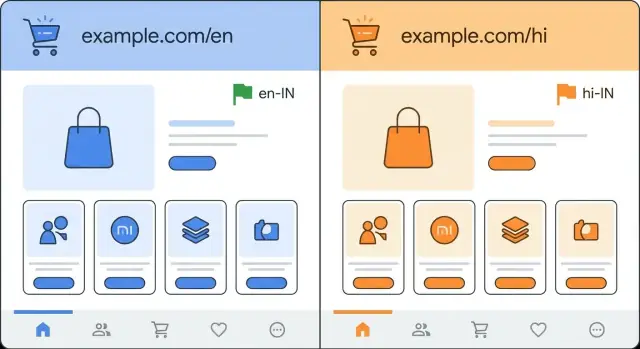
Why Hindi + English stores often create SEO duplication
SEO duplication in a Hindi + English store usually looks like two pages that are almost the same, except for language. They have the same products, the same headings, and the same meta tags, so Google struggles to understand which one should rank for which user.
This often happens when a store publishes translated URLs without clear signals, or when English pages are cloned and only a few words are changed. The result is a set of “different” pages that add no new value, which can be treated as thin or duplicate content.
Cannibalization is the next problem. It means two pages from your own site compete for the same search, so neither performs as well as it could. For example, if you have an English category page and a Hindi category page that both try to rank for “men shoes” (because the Hindi page still uses mostly English copy and titles), Google may switch between them or rank the weaker one.
The goal for Hindi English storefront SEO is simple: one clear page per language and intent. English pages should strongly target English queries, and Hindi pages should strongly target Hindi queries, with clean separation and clear relationships between them.
India makes this harder because people do not search in one neat language. Many users search in English, Hindi, and mixed queries (Hinglish), like “best pressure cooker 5 litre” or “saree under 1000.” If your Hindi pages are just lightly edited English pages, they can end up competing with your English pages for those mixed searches.
A quick way to spot duplication risk is to check these:
- Same titles and descriptions across languages n- Very similar body text and headings, just swapped words
- Hindi pages that still read mostly like English
- Multiple pages that answer the same “buy” intent with no clear language focus
Choosing a URL structure that scales
Your URL structure is the first decision that either prevents duplication or quietly creates it. It affects how search engines crawl, how you measure performance, and how hard it is to keep English and Hindi pages aligned over time.
There are three common setups:
- Subfolders:
example.com/en/andexample.com/hi/ - Subdomains:
en.example.comandhi.example.com - Separate domains:
example.inandexample.com(or a dedicated Hindi domain)
Subfolders are the best default for most teams doing Hindi English storefront SEO. Everything lives under one domain, so authority, crawling, and reporting stay in one place. It is also simpler to enforce consistent rules for canonical tags, internal linking, and templates. If you are a small team, this setup usually reduces mistakes that lead to duplicated or thin translated pages.
Subdomains can work, but they behave more like separate sites in practice. You often end up with split analytics views, duplicated tracking setup, and two sets of technical SEO checks. Maintenance tends to drift: the English site gets improvements first, and the Hindi site lags, which can create quality gaps.
Separate domains make sense only when the businesses are truly different (different fulfillment rules, pricing, or legal requirements). Otherwise, they multiply effort: separate sitemaps, separate authority building, and more chances for mismatched pages that compete.
One rule matters more than the choice: pick a pattern and apply it everywhere. If categories are in /hi/, products, filters, blog content, and support pages should follow the same structure. Inconsistent patterns are a common reason multilingual sites accidentally publish multiple URLs for the same intent.
Clean URL patterns for English and Hindi pages
A clean URL pattern makes it obvious that pages are different languages, not duplicates. For Hindi English storefront SEO, the simplest rule is: one language, one URL, always.
A common, clear pattern is using language folders:
- English:
/en/ - Hindi:
/hi/
So your pages become easy to reason about:
- Category:
/en/mens-shoes/and/hi/purush-joote/ - Product:
/en/puma-running-shoe-12345/and/hi/puma-daudne-joota-12345/ - Blog:
/en/blog/how-to-measure-feet/and/hi/blog/pair-kaise-mapen/ - Help:
/en/help/returns/and/hi/help/returns/
What to localize vs what to keep stable
Localize the parts users read. Keep the parts systems depend on stable.
Localize these:
- Human slugs for categories, products, articles, and help topics
- Words like "returns", "shipping", "size-guide" if those sections exist in both languages
Keep these stable (do not translate):
- SKUs, product IDs, variant IDs, and any stable numeric identifiers (like
12345) - Tracking parameters and internal codes that support analytics or inventory
Keeping an ID at the end of the URL is helpful when your Hindi slug changes later, because the URL can still map to the same product.
Home page language choice without duplicates
Avoid having multiple URLs that look like the “main” home page. Pick one default and make the others explicit.
A simple setup is:
- Default home:
/(choose either English or a neutral selector) - Language homes:
/en/and/hi/
If you use a language selector at /, make sure it does not create indexable copies like /?lang=hi and /?lang=en. Those are easy to multiply and hard to control. Keep language switching tied to the folder URLs so every language has one clean, consistent address.
Hreflang basics for Hindi and English
Hreflang is a small piece of markup that tells Google, “These pages are the same product or category, just written for different languages or regions.” It does not boost rankings by itself. It mainly helps Google show the right version to the right shopper, so your Hindi page does not compete with your English page.
For India, the most common setup is language plus country:
- Hindi for India:
hi-IN - English for India:
en-IN
If you also serve English to other countries, you might use plain en for a global English page, and keep en-IN for India-specific English (prices in INR, shipping rules, local terms). Pick the smallest set that matches how different the pages really are.
How hreflang “groups” your pages
Hreflang works as a cluster. Each language version should reference the other versions, and also reference itself. For example, the English product page points to the Hindi version, and the Hindi page points back to the English version. If one page forgets to include the other, the signal gets weaker and Google may treat them as separate pages.
This is where many Hindi English storefront SEO setups go wrong: they add hreflang only on English pages, or only on a few templates, so Google sees an incomplete set.
What is x-default and when to use it
x-default is for a “fallback” page when you cannot confidently match a user to a language or region. It is useful if you have a language selector page, or a neutral gateway page that asks users to pick Hindi or English.
Do not point x-default to one of your main language pages unless that page truly works as the default for everyone. Otherwise, it can confuse Google and send mixed signals about which version should rank.
Canonicals and indexing rules that prevent duplicates
Canonical tags and hreflang do different jobs, and most bilingual stores need both. Hreflang tells Google which language version to show to which user. Canonical tells Google which URL is the main version when several pages are very similar.
For Hindi English storefront SEO, the safest default is: each real language page canonicals to itself. Your English product page points to the English URL, and your Hindi product page points to the Hindi URL. Then they also reference each other with hreflang. This keeps both pages eligible to rank, without being treated as duplicates.
Do not canonical one language to the other unless you truly do not want it indexed. If your Hindi page is just an auto translation with missing details (or it is a temporary placeholder), a canonical to the English page can be a short-term safety net. But it also tells search engines to ignore the Hindi URL for ranking, so use it only when you mean it.
Indexing rules matter most for pages that multiply fast:
- Add noindex to internal search results pages.
- Consider noindex for low value filter combinations (especially if they create near-identical category pages).
- Keep faceted navigation useful for users, but do not let every filter URL become a separate indexed page.
Parameter and sorting URLs are a common source of index bloat. If you have URLs like ?sort=price or ?utm_source=, pick a clean “main” version (usually the unfiltered category) and canonical all parameter versions to it. If some filters deserve their own landing pages (like “Men’s running shoes”), create a fixed URL for that filter and treat it like a real category with unique copy, not a parameter page.
A practical translation workflow (step by step)
A good workflow is what keeps Hindi and English pages from competing with each other. The goal is not to translate everything. The goal is to publish pages that deserve to rank in each language and are clearly mapped to the right intent.
Step-by-step workflow you can actually run
-
Start with a page inventory and a rule for “both vs one”. Keep high-intent pages in both languages (home, top categories, best sellers, shipping, returns, contact). Keep long-tail filters, near-duplicate subcategories, and low-traffic landing pages in one language until you have proof they earn searches.
-
Write a translation brief before anyone touches text. Include tone (formal Hindi vs conversational), a glossary for product names and materials, how you’ll show sizes and units, and the exact words you will use for shipping, COD, returns, warranty, and offers. This prevents 20 versions of the same term across templates.
-
Localize commercial pages first, not the entire catalog. Translate and adapt category intros, buying guides, FAQs, and trust sections. For product pages, focus on parts that change decisions: title, key benefits, specs, care instructions, and delivery/returns. If a product has only one short line in English, translating it creates a thin Hindi page. In that case, keep the product in one language and translate the category and support pages instead.
-
Do a structured QA pass that includes SEO elements. Check title tags and meta descriptions for meaning (not word-for-word). Confirm one clear H1, clean headings, and breadcrumbs in the right language. Make sure internal links and anchor text match the destination language, so Hindi navigation does not keep pointing to English pages (and vice versa).
-
Publish in small batches and watch performance by language. Release 20 to 50 URLs, then monitor impressions, clicks, and queries for each language. If Hindi pages start ranking for English queries (or the opposite), adjust copy and internal links so each page answers the right language intent. This is where Hindi English storefront SEO is won or lost.
A simple example: if your English category says “running shoes” and the Hindi version uses multiple variants across pages, pick one primary Hindi phrasing in the brief and keep it consistent. Consistency helps users, and it reduces the chance of two pages being seen as interchangeable.
If you use a build platform like Koder.ai, keep the brief and glossary as a shared reference, then reuse the same template sections (shipping, returns, sizing) so translated pages stay complete, not half-empty.
Avoiding thin pages on product and category templates
The fastest way to create SEO duplication is to publish a Hindi version for every product even when the page has almost no real information. If the Hindi page is just a translated title and one short line, Google may treat it as low value and still crawl it, which can drag down the whole section (and sometimes confuse which language should rank).
Products with little text need more than a direct translation. Add details that help a buyer decide, even if you keep it short: what’s in the box, size and fit notes, materials, care instructions, warranty terms, delivery timelines by region, and a couple of real FAQs. The goal is not to make Hindi longer than English, but to make it complete.
A good template helps you avoid “near-empty” pages. Build consistent blocks that can be filled for every SKU and every category:
- Page title + one clear on-page heading (don’t stuff keywords)
- Meta description that matches what’s actually on the page
- 3 to 5 FAQs (availability, sizing, payment, returns)
- Shipping and returns snippet (short, plain language)
- Trust info like warranty, COD rules, or exchange window
Now set a minimum content rule before a page can be indexed. This is where many Hindi English storefront SEO projects go wrong: they translate everything, then index everything.
A practical rule set could be:
- Index only if the page has a complete Hindi description (not just a sentence)
- Index only if at least 2 FAQs are answered in Hindi
- Index only if key attributes are translated (size, material, compatibility)
- Otherwise keep it live for users but mark it as not indexable until it’s ready
Example: you launch Hindi for a fashion catalog of 2,000 SKUs. Start by indexing only your top 200 products and top categories where you can fill the template properly. For the rest, publish Hindi UI elements but hold back indexing until the content meets your minimum rule. If you build with a platform like Koder.ai, you can bake these checks into templates and use snapshots and rollback if a batch publish creates too many thin pages.
Handling Hinglish and mixed-intent searches
Hinglish searches are common in India because people mix scripts and languages in one query, like “wireless earbuds price” or “मिक्सर grinder 750w”. For SEO, this usually means the searcher wants the same product, but their wording is a blend of habits, keyboard settings, and comfort level.
A useful rule: do not treat Hinglish as a third language version. If you create separate pages just to target mixed queries, you often end up with near-duplicate content that competes with your main English or Hindi page.
Keep brand names, model numbers, and technical identifiers consistent across languages. These terms are often typed in English even inside Hindi queries, and consistency helps both users and search engines match the right page. For example, keep “Philips HL7756/00” exactly the same on both English and Hindi pages, even if the surrounding text is translated.
Bilingual elements can help without turning the page into a messy mix. Add them only where people expect them, like in specs, dimensions, SKU, or compatibility notes. A simple pattern is: Hindi label + English unit term, or Hindi sentence with the model name unchanged.
Here’s what usually works best for Hindi English storefront SEO when you want to capture mixed-intent searches without cannibalization:
- Keep each page primarily one language, based on its URL language.
- Use consistent product titles with the same model term, then translate the descriptive part.
- Add bilingual breadcrumbs or spec tables only if they improve clarity.
- Let category pages target broader terms; let product pages target model-specific terms.
Set expectations: you will not make one page rank perfectly for every language mix. Instead, aim for clean English pages, clean Hindi pages, and small bilingual cues that help the “in-between” searches land on the right version.
Example scenario: launching Hindi without hurting English rankings
A D2C store selling personal care has 500 products. Their English site already ranks for product and category terms, so they want Hindi pages without creating duplicates or pushing English pages out of results. This is a classic Hindi English storefront SEO problem: you want more reach, not two versions fighting each other.
They choose a clear folder structure:
- English:
/en/(example:/en/category/face-wash/) - Hindi:
/hi/(example:/hi/category/face-wash/)
They launch in phases instead of translating everything on day one. First, they translate the top 20 categories and the top 100 products that get most traffic and sales. For the other 400 products, they do not publish thin Hindi pages with copied English text. Those stay English-only until Hindi content is ready.
Duplicates are avoided with three simple rules. Each language page has a self-referencing canonical, and English pages keep working exactly as before. Every translated page gets hreflang annotations pointing to its pair (en <-> hi). And Hindi pages are not created by swapping only the title and a few words - they rewrite key parts (category intro, product benefits, usage, FAQs) so the page is genuinely useful in Hindi.
After launch, they monitor weekly in Search Console and analytics. In week two they spot cannibalization: the Hindi category page starts appearing for English queries, while the English page drops slightly. The fix is straightforward: they adjust the Hindi page to use natural Hindi headings and Hindi keywords (not English terms), tighten internal links so English menus point to English pages, and verify hreflang is correct. Within two weeks, results separate cleanly: English pages win English queries, and Hindi pages grow on Hindi queries.
Common mistakes that cause cannibalization
Cannibalization happens when Google sees two (or twenty) pages as competing answers to the same query. In Hindi English storefront SEO, it often starts with good intentions: you launch Hindi fast, then rankings wobble because the site now has many near-duplicates.
One common trigger is auto-translation pushed live without human review, with every page allowed to index. If the Hindi version reads awkwardly or repeats the English structure without local context, it can look thin. Google may test it for the same keywords, then bounce between versions.
Hreflang mistakes are another frequent cause. If your Hindi page points to English, but the English page does not point back (missing return link), the signal is weak. Wrong language or region codes, or hreflang pointing to non-canonical URLs, also creates confusion.
Canonical tags can accidentally make it worse. If you canonical both English and Hindi to the same English URL, you are telling search engines: “these are duplicates, keep only English.” That can remove Hindi from results or cause both to fight over indexing.
Watch out for “same intent, many pages.” This shows up when teams create multiple Hindi category variants that all mean the same thing (for example, two different translations used in navigation and on-site search). They end up targeting the same query with separate URLs.
Faceted filters can quietly multiply the problem. When size, color, brand, and price filters generate indexable URLs, you can produce thousands of pages that look like categories but have little unique value.
Here are the patterns to audit first:
- Indexing every machine-translated page without quality checks
- Hreflang missing return links or pointing to the wrong URL version
- Canonicals collapsing Hindi and English onto one URL
- Duplicate Hindi categories created by inconsistent naming
- Filter and sort URLs allowed to index at scale
A quick reality check: search your own site for a top category term in both languages. If you can find multiple URLs that a human would call “the same page,” Google likely can too.
Quick checklist before you publish
Before you push Hindi pages live, do one calm pass over the basics. Most ranking drops happen because small signals (URLs, canonicals, hreflang, internal links) disagree with each other.
Publish-ready checklist
Use this as a final gate for your Hindi English storefront SEO release:
-
One URL pattern, everywhere. Pick a single rule and apply it to home, categories, products, blog/help pages, and any landing pages. Avoid mixing patterns like some pages on subfolders and others on parameters.
-
Self-canonical on every language page. The English page should canonical to itself, and the Hindi page should canonical to itself. Only use cross-canonicals when you intentionally want one page to be the only version indexed.
-
Complete, correct hreflang set. Each English page points to its Hindi equivalent and back again. Include an
x-defaultonly if you have a true default page (for example, a language selector page). -
No indexing for low-value duplicates. Filters, internal search results, near-duplicate sort orders, and thin variations should be blocked from indexing (usually with
noindexplus clean internal linking), while still allowing crawl to core pages. -
Translation QA is not just text. Check page titles, H1/H2 headings, meta descriptions, image alt text where it matters, internal links (they should stay in-language), and structured data fields that can be localized (like product names). Also confirm currency, shipping copy, and return policy snippets match the right market.
After launch, separate tracking is what keeps you safe. Report performance for /en/ and /hi/ independently (rankings, clicks, indexed pages, top queries). If Hindi pages are growing but English pages dip, slow the rollout and fix templates before translating more.
Next steps: a simple rollout plan and tools
Pick a default language first. For India, many stores keep English as the default for new visitors, then offer a clear language switch that changes the URL (not just the text on the page). Make the switch consistent across header, footer, and checkout so users do not bounce mid-journey.
Plan the rollout in waves so you can measure impact and fix issues before translating everything. A practical order is: top revenue categories first, then the best-selling products inside those categories, and only then the long tail. This keeps your Hindi pages focused on queries that matter and reduces the risk of thin pages.
Set a simple quality gate before a translated page is allowed to index. The goal is that each Hindi page is useful on its own, not a copy that competes with English.
- Add at least 2-3 pieces of unique, local-friendly info (shipping, sizing, usage notes, FAQs).
- Ensure titles and meta descriptions are written for Hindi intent, not machine-translated.
- Confirm internal links point to the correct language version.
- Check that hreflang pairs are complete (hi-IN and en-IN or your chosen setup).
- Keep low-value pages noindex until they meet the bar.
For tools, use Google Search Console to spot indexing and cannibalization early, plus a crawler to verify hreflang and canonicals at scale. If you are rebuilding, you can prototype your /en/ and /hi/ routes in Koder.ai by describing the structure in chat, generating React pages quickly, and using snapshots and rollback to iterate safely before deployment. This keeps the Hindi English storefront SEO work controlled, measurable, and reversible.
FAQ
Why do Hindi and English store pages create duplicate-content problems?
Use one clear URL for each language and keep the page intent separate. For most stores, folders such as /en/ and /hi/ make this easier to manage.
What URL structure should a Hindi and English store use?
Subfolders are the simplest default: use one domain with language folders such as /en/ and /hi/. They keep reporting, technical checks, and internal linking in one place.
Should product URLs be translated into Hindi?
Translate human-readable slugs when they help shoppers, but keep SKUs, product IDs, variant IDs, and model numbers unchanged. Stable IDs help your system match both versions to the same item.
How should I use hreflang for Hindi and English in India?
Add reciprocal hreflang tags on every paired page. An English India page should reference en-IN and hi-IN, and the Hindi page should reference the same two URLs, including itself.
Should Hindi pages canonical to English pages?
Give each complete language page a self-referencing canonical. The English page should canonical to its own URL, and the Hindi page should canonical to its own URL.
When do I need an x-default hreflang tag?
Use x-default for a neutral language selector or gateway page. Do not point it to English or Hindi unless that version genuinely suits users who have no clear language match.
Do I need separate pages for Hinglish searches?
Keep every page mainly in its URL language. Retain brand names, model numbers, units, and technical identifiers in English where shoppers expect them, but do not create separate pages only for Hinglish queries.
When is a Hindi product page ready to index?
Index a Hindi product page only when it gives shoppers enough useful Hindi information to make a decision. Include a proper description, translated attributes, delivery or return details, and at least a couple of relevant FAQs.
What is the safest way to launch Hindi pages?
Start with revenue-driving categories and best-selling products, then publish in batches of about 20 to 50 URLs. Check impressions, clicks, indexed pages, and search queries for /en/ and /hi/ separately before expanding.
How can I stop filters and sort URLs from creating duplicates?
Keep internal search pages out of the index and usually noindex low-value filter, sorting, and parameter URLs. Create a fixed landing page only for filters that deserve unique content and have real search demand.