

The Origin and Evolution of Anthropic as an AI Company
Trace the history of Anthropic from its founding and early research to the development of Claude and key milestones that shaped its safety-focused AI work.
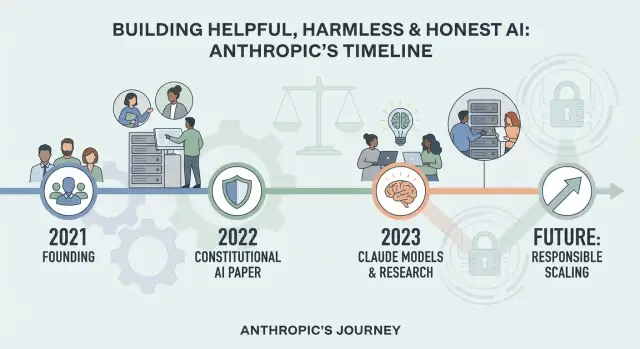
Overview: Why Anthropic’s History Matters
Anthropic is an AI research and product company best known for its Claude family of language models. Founded by researchers with deep experience in large-scale AI systems, Anthropic sits at the intersection of fundamental AI research, practical products, and work on AI safety and alignment.
This article traces the history of Anthropic from its origins to the present, highlighting the key ideas, decisions, and milestones that shaped the company. We will move chronologically: starting with the AI research context that preceded Anthropic’s founding, then exploring the founders and early team, the company’s mission and values, its technical foundations, funding and growth, product evolution from Claude to Claude 3.5, and its role in the broader AI research community.
Anthropic’s history matters for more than just company trivia. From the beginning, it has treated AI safety and alignment as central research questions rather than afterthoughts. Concepts like Constitutional AI, extensive red-teaming, and model evaluations for safety are not side projects but core parts of how Anthropic builds and deploys systems. That stance has influenced how other AI labs, policymakers, and customers think about advanced models.
The goal here is to give a factual, balanced account of Anthropic’s development: what the company set out to do, how its work on Claude and related tools evolved, which research directions proved pivotal, and how safety considerations shaped its timeline and milestones. This is not a corporate brochure, but a historical overview aimed at readers who want to understand how one influential AI company has tried to align rapid technical progress with long-term safety concerns.
By the end, you should have a clear picture of where Anthropic came from, how its priorities shaped its products and research, and why its approach matters for the future of AI.
AI Research Context Before Anthropic’s Founding
From Deep Learning Breakthroughs to Foundation Models
By the late 2010s, deep learning had already transformed computer vision and speech. ImageNet-winning convolutional networks, large-scale speech recognizers, and practical machine translation systems showed that scaling data and compute could unlock striking new capabilities.
A key turning point came with the transformer architecture (Vaswani et al., 2017). Unlike recurrent networks, transformers handled long-range dependencies efficiently and parallelized well across GPUs. This opened the door to training far larger models on vast text corpora.
Google’s BERT (2018) demonstrated that pretraining on generic text and then fine‑tuning could beat specialized models across many NLP tasks. Shortly afterward, OpenAI’s GPT series pushed the idea further: train a single large autoregressive model and rely on scale plus minimal prompting instead of task‑specific fine‑tuning.
Scaling Laws and the Power of Size
Around 2019–2020, work on neural scaling laws formalized what practitioners were observing: model performance improved predictably as parameters, data, and compute increased. Studies showed that larger language models:
- Gained stronger few‑shot and zero‑shot abilities
- Developed emergent skills (e.g., basic reasoning, code generation)
- Generalized surprisingly well across domains
GPT‑2 in 2019, then GPT‑3 in 2020, illustrated how sheer scale could turn a generic text model into a flexible tool for translation, summarization, question answering, and more—often without task‑specific training.
Rising Concerns About Safety and Alignment
Alongside this progress, researchers and policymakers grew more concerned about how increasingly capable models were being built and deployed. Risks discussed in technical and policy communities included:
- Misuse for disinformation, spam, and social manipulation
- Amplification of bias, toxicity, and stereotypes
- Lack of transparency and predictability in model behavior
- Long‑term alignment challenges as systems grew more capable
The partial release of GPT‑2, framed explicitly around misuse risks, signaled that leading labs were wrestling with these questions in real time.
Academic groups and nonprofits—such as CHAI at Berkeley, the Future of Humanity Institute, the Center for Security and Emerging Technology, and others—were exploring alignment strategies, interpretability tools, and governance frameworks. DeepMind and OpenAI created internal safety teams and began publishing work on topics like reward learning, scalable oversight, and value alignment.
Tension Between Speed and Caution
By the early 2020s, competitive pressure among major labs and tech companies encouraged rapid scaling of models and aggressive deployment timelines. Public demos and commercial APIs showed strong demand for generative AI, which in turn attracted significant investment.
At the same time, many researchers argued that safety, reliability, and governance were not keeping pace with capability gains. Technical proposals for alignment were still early, empirical understanding of failure modes was limited, and evaluation practices were underdeveloped.
This tension—between pursuit of ever-larger, more general models and calls for more careful, methodical development—defined the research environment immediately preceding Anthropic’s founding.
Founding Anthropic: Origins and Early Team
Anthropic was founded in 2021 by siblings Dario and Daniela Amodei and a small group of colleagues who had spent years at the center of cutting‑edge AI research.
Dario had led the language model team at OpenAI and contributed to influential work on scaling laws, interpretability, and AI safety. Daniela had led safety and policy work at OpenAI and previously worked on neuroscience and computational research, focusing on how complex systems behave and fail. Around them were researchers, engineers, and policy specialists from OpenAI, Google Brain, DeepMind, and other labs who had collectively trained, deployed, and evaluated some of the earliest large‑scale models.
Motivations for starting Anthropic
By 2020–2021, large language models had moved from speculative research to practical systems influencing products, users, and public debate. The founding group had seen both the promise and the risks up close: rapid capability gains, surprising emergent behaviors, and safety techniques that were still immature.
Several concerns motivated the creation of Anthropic:
- Alignment and control: How to ensure increasingly capable models act in ways that are predictable, helpful, and aligned with human values.
- Deployment decisions: How choices about training data, access, and commercialization affect misuse, security, and social impact.
- Governance and incentives: Whether existing organizational structures and financial incentives were suited to stewarding potentially transformative AI systems.
Anthropic was conceived as an AI research company whose central organizing principle would be safety. Rather than treating safety as a final add‑on, the founders wanted it woven into how models were designed, trained, evaluated, and deployed.
A safety‑first research company
From the outset, Anthropic’s vision was to advance frontier AI capabilities while simultaneously developing techniques to make those systems more interpretable, steerable, and reliably helpful.
That meant:
- Investing in safety‑relevant research areas such as alignment, interpretability, and reliability.
- Building internal processes that subjected new models to red‑teaming, stress tests, and multi‑disciplinary review before wide release.
- Structuring the company with an explicit public‑benefit orientation, signaling that long‑term societal impact would be treated as a core objective alongside technical progress.
The founders saw an opportunity to create an organization where decisions about scaling models, exposing capabilities, and partnering with customers would be systematically filtered through safety and ethics considerations, not handled case‑by‑case under commercial pressure.
The early core team and its expertise
Anthropic’s first hires reflected this philosophy. The early team combined:
- Large‑scale ML experts who knew how to train and optimize massive language models.
- Alignment and interpretability researchers focused on understanding what models learn and how they generalize.
- Security and red‑teaming specialists experienced in probing systems for misuse vectors and failure modes.
- Policy and societal‑impact experts who could reason about regulation, governance, and downstream effects.
This mix allowed Anthropic to approach AI development as a socio‑technical project rather than a purely engineering challenge. Model design, infrastructure, evaluation, and deployment strategies were discussed jointly by researchers, engineers, and policy staff from the very beginning.
Founded amid active debates about advanced AI
The company’s creation coincided with intense discussions across the AI community about how to handle rapidly scaling systems: open access vs. gated APIs, open‑sourcing vs. controlled releases, centralization of compute, and the long‑term risks of misaligned advanced AI.
Anthropic positioned itself as an attempt to answer one of the central questions in those debates: what would it look like to build a frontier AI lab whose structure, methods, and culture are explicitly oriented around safety and long‑term responsibility, while still pushing the research frontier forward?
Mission, Values, and Focus on AI Safety
Anthropic was founded around a clear mission: to build AI systems that are reliable, interpretable, and steerable, and that ultimately benefit society. From the start, the company framed its work not just as building capable models, but as shaping how advanced AI behaves as it becomes more powerful.
Helpful, honest, and harmless
Anthropic summarizes its values for AI behavior in three words: helpful, honest, harmless.
- Helpful means models should actually solve users’ problems, follow instructions, and provide useful, concrete assistance.
- Honest means prioritizing truthfulness over persuasion, avoiding fabricated facts, and clearly marking uncertainty.
- Harmless means minimizing the risk of causing physical, psychological, or societal harm, including refusing unsafe or abusive requests.
These values are not marketing slogans; they act as engineering targets. Training data, evaluation suites, and deployment policies are all shaped around measuring and improving along these three dimensions, not just raw capability.
Safety, reliability, and interpretability as first principles
Anthropic treats AI safety and reliability as primary design constraints, not afterthoughts. That has translated into major investments in:
- Alignment and safety research, including work on avoiding harmful outputs, misuse, and failure modes as models scale.
- Reliability, such as reducing hallucinations, improving factual accuracy, and handling edge cases and adversarial prompts.
- Interpretability, with research into understanding internal model mechanisms so that behavior can be audited and better controlled.
The company’s public communications consistently emphasize the long-term risks of powerful AI systems and the need for predictable, inspectable behavior.
Constitutional AI: steering behavior through principles
To operationalize its values, Anthropic introduced Constitutional AI. Instead of relying solely on human feedback to correct model behavior, Constitutional AI uses a written “constitution” of high-level principles—drawing on widely accepted norms such as human rights and general safety guidelines.
Models are trained to:
- Self-critique their own answers against those principles.
- Revise their responses to better align with the constitution.
This method scales alignment supervision: one set of carefully chosen principles can guide many training interactions without requiring humans to rate every response. It also makes model behavior more transparent, because the governing rules can be read, debated, and updated over time.
How values shape research priorities and products
Anthropic’s mission and safety focus directly influence which research directions it pursues and how it ships products.
On the research side, this means prioritizing projects that:
- Improve controllability and steering of large models.
- Shed light on internal model representations and circuits.
- Develop evaluations for harmfulness, deception, and misuse risks.
- Study how risks change as models become more capable.
On the product side, tools like Claude are designed with safety constraints from the outset. Refusal behavior, content filtering, and system prompts grounded in constitutional principles are treated as core product features, not add-ons. Enterprise offerings emphasize auditability, clear safety policies, and predictable model behavior.
By tying its mission to concrete technical choices—helpful, honest, harmless behavior; constitutional training methods; interpretability and safety research—Anthropic has positioned its history and evolution around the question of how to align increasingly capable AI systems with human values.
Early Research Directions and Technical Foundations
From its first months, Anthropic treated safety research and capability work as a single, intertwined agenda. The company’s early technical focus can be grouped into a few core streams.
Understanding and Steering Model Behavior
A major strand of early research examined how large language models behave under different prompts, training signals, and deployment settings. Teams systematically probed:
- When and why models generated harmful, misleading, or overly confident text
- How behavior changed as model size and training data scaled
- Which prompting patterns most reliably elicited helpful, honest answers
This work led to structured evaluations of “helpfulness” and “harmlessness,” and to internal benchmarks that tracked trade‑offs between the two.
Alignment via Human Feedback and Rules
Anthropic built on reinforcement learning from human feedback (RLHF), but added its own twists. Researchers experimented with:
- More detailed comparison data from human labelers
- Granular rubrics for assessing safety‑relevant behavior
- Procedures for detecting subtle failure modes, not just obvious toxicity
These efforts fed into the company’s early work on Constitutional AI: training models to follow a written “constitution” of principles instead of relying only on human preference rankings. That approach aimed to make alignment more transparent, auditable, and consistent.
Interpretability and Internal Representations
Another early pillar was interpretability—trying to see what models “know” internally. Anthropic published work on features and circuits in neural networks, probing how concepts are represented across layers and activations.
Although still exploratory, these studies established a technical foundation for later mechanistic interpretability projects, and signaled that the company was serious about opening up “black box” systems.
Stress‑Testing Through Evaluations and Red‑Teaming
To support all of this, Anthropic invested heavily in evaluations. Dedicated teams designed adversarial prompts, scenario tests, and automated checks to uncover edge cases before models were widely deployed.
By treating evaluation frameworks as first‑class research artifacts—iterated, versioned, and published—Anthropic quickly gained a reputation in the AI research community for disciplined, safety‑driven methodology that was tightly integrated with the development of more capable Claude models.
Funding Milestones and Company Growth
Early capital and first major rounds
Anthropic’s trajectory was shaped early by unusually large funding for a young research company.
Public reports describe an initial seed phase in 2020–2021, followed by a substantial Series A financing in 2021 of roughly $100M+, which gave the founding team room to hire core researchers and begin serious model training.
In 2022, Anthropic announced a much larger Series B round, widely reported at around $580M. That round, backed by a mix of technology investors and crypto‑related capital, positioned the company to compete at the frontier of large‑scale AI research, where compute and data costs are extremely high.
From 2023 onward, funding shifted toward strategic partnerships with major cloud providers. Public announcements highlighted multi‑billion‑dollar investment frameworks with Google and Amazon, structured around both equity investment and deep cloud and hardware commitments. These partnerships combined capital with access to large-scale GPU and TPU infrastructure.
Fueling research, infrastructure, and hiring
This influx of capital directly enabled Anthropic to:
- Train increasingly large and capable Claude models on vast compute clusters.
- Build internal tooling, data pipelines, and evaluation frameworks for safety‑oriented research.
- Secure long‑term cloud commitments, reducing uncertainty around future compute access.
The company moved from a small founding group—largely former OpenAI researchers and engineers—to a growing organization spanning multiple disciplines. As headcount expanded into the hundreds (according to public reporting), new roles emerged beyond pure ML research.
Key hiring priorities
Funding allowed Anthropic to hire:
- Safety and alignment researchers to explore scalable oversight, Constitutional AI, and red‑teaming.
- Infrastructure and reliability engineers to manage large training runs and model deployment.
- Product and API engineers to turn research models into usable services.
- Policy, governance, and trust & safety experts to interface with regulators, customers, and civil society.
This mix signaled that Anthropic saw AI safety not just as a research theme, but as an organizational function that required engineers, researchers, lawyers, policy specialists, and communications professionals working together.
From research lab to product‑driven organization
As funding grew, Anthropic gained the capacity to pursue both long‑term safety research and near‑term products. Early on, nearly all resources went into fundamental research and training foundation models. With later rounds and strategic cloud partnerships, the company could:
- Maintain a dedicated research track focused on alignment, evaluations, and interpretability.
- Run multiple large training efforts in parallel (e.g., Claude, Claude 2, Claude 3 families).
- Build and operate APIs, enterprise features, and integrations without diverting all researchers into product engineering.
The result was a shift from a small, research‑heavy founding team to a larger, more structured organization that could iterate on Claude as a commercial product while still investing heavily in safety‑critical research and internal governance practices.
From Claude to Claude 3.5: Product and Model Evolution
Claude has been Anthropic’s primary product line and the public face of its research. From the first invite-only releases to Claude 3.5 Sonnet, each generation has aimed to increase capability while tightening reliability and safety.
Early Claude: Proving the Helpful–Harmless–Honest Assistant
Early Claude versions, tested with a small group of partners in 2022 and early 2023, were designed as general-purpose text assistants for writing, analysis, coding, and conversation. These models showcased Anthropic’s focus on harmlessness: more consistent refusals on dangerous requests, clearer explanations of limitations, and a conversational style tuned for honesty over persuasion.
At the same time, Anthropic pushed context length forward, enabling Claude to work over long documents and multi-step chats, which made it useful for summarization, contract review, and research workflows.
Claude 2 and 2.1: Scaling Context and Reliability
With Claude 2 (mid‑2023) Anthropic widened access through the Claude app and APIs. The model improved at structured writing, coding, and following complex instructions, while also offering very long context windows suitable for analyzing large files and project histories.
Claude 2.1 refined these gains: fewer hallucinations on factual tasks, better long-context recall, and more consistent safety behavior. Enterprises began using Claude for customer support drafting, policy analysis, and internal knowledge assistants.
Claude 3 to 3.5 Sonnet: Multimodality and Tool-Use
The Claude 3 family (Opus, Sonnet, Haiku) introduced major jumps in reasoning, speed tiers, and multimodal input, allowing users to query not just text but also images and complex documents. Larger context windows and better adherence to instructions opened up new use cases in analytics, product development, and data exploration.
Claude 3.5 Sonnet (released mid‑2024) pushed this further. It delivered near top-tier reasoning and coding quality at a mid-priced tier, with faster responses suitable for interactive products. It also markedly improved tool use and structured output, making it easier to integrate into workflows that rely on function calling, databases, and external APIs.
Feedback-Driven Evolution with Safety at the Core
Across versions, Anthropic paired performance gains with stronger safety and reliability. Constitutional AI, extensive red-teaming, and systematic evaluations were updated with each release to keep refusal behavior, privacy protections, and transparency aligned with growing capabilities.
User and customer feedback heavily shaped this evolution: logs (handled under strict privacy rules), support tickets, and partnership programs highlighted where Claude misunderstood instructions, over‑refused, or produced unclear answers. Those insights fed into training data, evaluation suites, and product design, guiding Claude’s trajectory from an experimental assistant to a versatile, production-ready AI used across industries.
Collaborations, Customers, and Real-World Use Cases
Anthropic’s models moved from research labs into production systems relatively quickly, driven by demand from organizations that wanted strong reasoning, clearer controls, and predictable behavior.
Who Adopted Claude
The early user base clustered around a few segments:
- Enterprises using Claude inside internal tools for knowledge work, analytics, and customer operations.
- Developer teams and startups integrating Claude through the API to power their own SaaS products.
- Nonprofits, research groups, and policy organizations experimenting with safer assistants for analysis, drafting, and education.
This mix helped Anthropic tune Claude for both large compliance‑heavy environments and agile product teams.
Notable Collaborations and Partnerships
Several public collaborations signaled Anthropic’s move into mainstream infrastructure:
- Quora’s Poe integrated Claude as a key option for end users, showcasing its dialogue and explanation quality.
- Productivity and collaboration tools such as Notion and others incorporated Claude variants for writing help, summarization, and structured content generation.
- Search and browsing assistants, including DuckDuckGo’s experiments with AI answers, used Anthropic models behind the scenes.
- Cloud and platform partnerships with providers like Amazon (via Bedrock) and Google Cloud made Claude accessible to enterprises already building on those ecosystems.
These arrangements extended Anthropic’s reach far beyond direct API customers.
Positioning the API and Tools
Anthropic framed its API as a general‑purpose reasoning and assistant layer rather than a narrow chatbot service. Documentation and examples emphasized:
- Easy HTTP and SDK integration
- Long‑context workflows (processing large documents, logs, or knowledge bases)
- System prompts and tools (functions) for tailored behaviors
This made it natural to embed Claude in existing products, internal applications, and data pipelines rather than treating it as a separate destination app.
Typical Real‑World Use Cases
Across sectors, a few patterns emerged:
- Knowledge work support: drafting emails and reports, summarizing meetings, rewriting policies, or turning raw notes into structured documents.
- Coding assistance: explaining unfamiliar code, suggesting implementations, generating tests, and reviewing pull requests.
- Analysis and research: digesting long PDFs, comparing policies or contracts, and extracting structured data for analysts or legal teams.
- Customer‑facing assistants: powering chat widgets, help‑center search, and guided troubleshooting flows, often fine‑tuned via prompt design and tool use.
These uses typically combined Claude’s language abilities with customer data and business logic inside existing systems.
Safety and Controllability in Customer Messaging
Anthropic’s commercial messaging leaned heavily on safety, steerability, and predictability. Marketing materials and technical docs highlighted:
- Constitutional AI as a method for aligning model behavior with written principles
- Guardrails against disallowed content and sensitive use cases
- Configuration options for tone, level of initiative, and refusal behavior
- Ongoing evaluations, red‑teaming, and incident response practices
For risk‑sensitive customers—financial institutions, healthcare organizations, education platforms—this emphasis was often as important as raw model capability, shaping how and where Claude was deployed in real products.
Governance, Safety Practices, and External Engagement
From the beginning, Anthropic has treated governance and safety as core design constraints rather than afterthoughts. That shows up in how models are trained, evaluated, released, and monitored over time.
Governance and Safety Reviews
Anthropic publicly commits to staged deployment of models, guided by internal safety reviews and a Responsible Scaling Policy. Before major releases, teams run extensive evaluations on potentially dangerous capabilities such as cyber misuse, persuasion, or biological threat assistance, and they use those results to decide whether to ship, restrict, or further harden a model.
Red‑teaming is a central ingredient. Specialists and external experts are asked to probe models for failure modes, measuring how easily they can be induced to produce harmful content or instructions. Findings feed into safety fine‑tuning, product guardrails, and updated policies.
Safety reviews do not end at launch. Anthropic tracks misuse reports, monitors behavioral drift across updates, and uses customer feedback and incident reports to refine model configurations, access controls, and default settings.
Constitutional AI: Structuring Principles into Models
Constitutional AI is Anthropic’s most distinctive safety method. Instead of relying solely on human raters to label what is acceptable, models are trained to critique and revise their own answers according to a written “constitution” of norms.
These principles draw from publicly available sources such as human rights documents and widely accepted AI ethics guidelines. The goal is to build models that can explain why an answer is inappropriate and adjust it, rather than simply blocking content through hard filters.
Constitutional AI thus operationalizes Anthropic’s mission: align powerful systems with clear, knowable principles, and make that alignment procedure transparent enough for external scrutiny.
External Engagement and Standards
Anthropic’s governance is not purely internal. The company has participated in safety commitments with governments and peer labs, contributed to technical benchmarks and evaluations, and supported the development of shared standards for frontier models.
Public records show engagement with policymakers through hearings, advisory roles, and consultations, as well as collaboration with evaluation organizations and standards bodies on tests for dangerous capabilities and alignment quality.
These external channels serve two purposes: they expose Anthropic’s practices to outside critique, and they help translate research on safety, evaluations, and alignment methods into emerging rules, norms, and best practices for advanced AI systems.
In this way, governance practices, red‑teaming, and structured methods like Constitutional AI directly reflect the company’s original mission: build capable AI systems while systematically reducing risks and increasing accountability as capabilities grow.
Anthropic in the Wider AI Research Community
Anthropic sits alongside OpenAI, DeepMind, Google, and Meta as one of the main frontier AI labs, but it has carved out a distinct identity by foregrounding safety and interpretability as core research problems rather than side constraints.
Position among leading labs
From its early papers onward, Anthropic has focused on questions other labs often treated as secondary: alignment, failure modes, and scaling-related risks. Work on Constitutional AI, red‑teaming methodologies, and interpretability has been widely read by researchers who build and evaluate large models, even at competing organizations.
By publishing technical work at major conferences and on preprint servers, Anthropic’s researchers contribute to the same shared pool of methods and benchmarks that drive progress across labs—while consistently tying performance results to questions of controllability and reliability.
Public role in AI safety and governance
Anthropic has taken an unusually visible role in public discussions of AI safety. Company leaders and researchers have:
- Signed and helped shape voluntary safety commitments with the U.S. government.
- Participated in the UK AI Safety Summit and related multilateral initiatives on frontier model oversight.
- Engaged with the U.S. AI Safety Institute Consortium and similar efforts to define evaluation standards.
In these settings, Anthropic often argues for concrete, testable safety standards, independent evaluations, and phased deployment of the most capable systems.
Collaboration, benchmarks, and open engagement
Anthropic participates in shared benchmarks and evaluation efforts for large language models, particularly those that stress-test models for harmful capabilities, misuse potential, or deceptive behavior.
Researchers from Anthropic publish extensively, present at workshops, and collaborate with academics on topics such as interpretability, scaling behavior, and preference learning. They have released selected datasets, papers, and tools that allow outside researchers to probe model behavior and alignment techniques.
Although Anthropic is not an open-source lab in the sense of releasing its largest models freely, its work has influenced open-source communities: techniques like Constitutional AI and specific evaluation practices have been adapted in open projects aiming to make smaller models safer.
Reflecting broader shifts in AI development
Anthropic’s trajectory mirrors a wider shift in how powerful models are developed and governed. Early large-model research was dominated by raw capability gains; over time, concerns about misuse, systemic risk, and long-term alignment moved closer to the center of the field.
By organizing itself explicitly around safety, investing in interpretability at scale, and engaging governments on frontier model oversight, Anthropic has both responded to and accelerated this shift. Its history illustrates how cutting-edge capability research and rigorous safety work are increasingly intertwined expectations for any lab working at the frontier of AI.
Looking Ahead: Ongoing Goals and Historical Lessons
Anthropic’s story so far highlights a central tension in AI: meaningful safety work usually depends on pushing capabilities forward, yet every breakthrough raises fresh safety questions. The company’s history is, in many ways, an experiment in managing that tension in public.
From founding motivations to present trajectory
Anthropic was started by researchers who worried that general‑purpose AI systems might be hard to reliably steer as they became more capable. That concern shaped early priorities: interpretability research, alignment methods like Constitutional AI, and careful deployment practices.
As Claude models have grown more capable and commercially relevant, the original motivations are still visible but now operate under stronger real‑world pressures: customer needs, competition, and fast model scaling. The company’s trajectory suggests an attempt to keep safety research and product development tightly coupled rather than treating safety as a separate, slower track.
Long‑term goals: beneficial, controllable AI
Public materials point to several recurring long‑term aims:
- Build AI systems that are helpful, honest, and harmless by default.
- Develop methods (e.g., constitutional training, evaluations, interpretability tools) that make behavior more predictable and steerable.
- Contribute to broader norms, standards, and governance practices that reduce systemic risks from very capable models.
The emphasis is not just on preventing catastrophic failures, but on creating a technology that many different institutions can reliably guide, even as models approach transformative impact.
Open questions and challenges
Significant uncertainties remain—for Anthropic and for the field:
- Can alignment techniques keep pace with capability gains, especially as models acquire new forms of agency or tool use?
- Will commercial and geopolitical incentives support cautious scaling, or push toward ever-faster deployment?
- How far can interpretability and evaluations go in detecting subtle failure modes before deployment?
- What institutional arrangements—audits, standards, licensing, or others—will actually work in practice?
Why this history matters
Understanding Anthropic’s history helps put its current work in context. Choices around model releases, safety reports, collaboration with external evaluators, and participation in policy discussions are not isolated decisions; they follow from founding concerns about control, reliability, and long‑term impact.
As Anthropic pursues more capable Claude models and broader real‑world integrations, its past offers a useful lens: progress and caution are being pursued together, and the degree to which that balance succeeds will shape both the company’s future and the trajectory of AI development more broadly.
FAQ
What is Anthropic and what does the company focus on?
Anthropic is an AI research and product company focused on building large-scale language models, best known for the Claude family. It sits at the intersection of:
- Frontier AI research (training advanced, general-purpose models)
- Practical products (APIs, apps, and enterprise tools powered by Claude)
- AI safety and alignment (making models reliable, steerable, and less harmful)
From its founding, Anthropic has treated safety and alignment as core research problems rather than optional add-ons, and this orientation shapes its technical work, products, and governance practices.
Why was Anthropic founded, and by whom?
Anthropic was founded in 2021 by Dario and Daniela Amodei, along with colleagues from labs like OpenAI, Google Brain, and DeepMind. The founding team had hands-on experience training and deploying some of the earliest large language models and saw both their potential and their risks.
They started Anthropic because they were concerned that:
- Alignment and control were not keeping pace with rapidly scaling capabilities.
- Deployment decisions (access, safeguards, commercialization) had major societal implications.
- Existing organizational incentives might not be well suited to stewarding very powerful AI systems.
Anthropic was conceived as an organization where safety and long-term societal benefit would be primary design constraints, not afterthoughts.
What does “helpful, honest, harmless” mean in practice for Anthropic’s models?
Anthropic summarizes its behavioral goals for AI with three targets:
- Helpful: The model should follow instructions, solve real problems, and provide specific, actionable assistance.
- Honest: It should prioritize truthfulness, avoid fabricating facts when possible, and clearly signal uncertainty or limitations.
- Harmless: It should minimize risk of physical, psychological, or societal harm, including refusing unsafe, abusive, or illegal requests.
These are treated as engineering objectives: they shape training data, evaluation metrics, safety policies, and deployment decisions for models like Claude.
What is Constitutional AI and how does it shape Claude’s behavior?
Constitutional AI is Anthropic’s method for steering model behavior using a written set of principles rather than relying solely on human ratings.
In practice, Anthropic:
- Defines a “constitution” based on broadly accepted norms (e.g., human rights, safety guidelines).
- Trains models to critique their own outputs against those principles.
- Has the model revise its answers to better conform to the constitution.
This approach aims to:
- Scale alignment supervision without hand-labeling every interaction.
- Make behavior more transparent, because the guiding principles are explicit and editable.
- Produce models that can explain and correct problematic outputs, not just block content via hard filters.
What were Anthropic’s main early research priorities?
Anthropic’s technical agenda has combined capability and safety work from the outset. Key early directions included:
- Alignment techniques: Reinforcement learning from human feedback plus rule-based and constitutional training.
- Behavioral analysis: Systematically probing when and why models produce harmful, misleading, or overconfident outputs.
- Interpretability research: Studying internal representations and circuits to better understand what models “know.”
- Evaluations and red-teaming: Designing adversarial tests, benchmarks, and stress tests to reveal failure modes before deployment.
These strands were tightly integrated with the development of Claude, rather than being separate from product work.
How has Anthropic financed its growth, and what did the funding enable?
Anthropic has raised large funding rounds and formed strategic partnerships to support frontier-scale research:
- Early seed and Series A funding (2020–2021) enabled initial hiring and first large model training runs.
- A substantial Series B (around $580M, reported in 2022) financed larger-scale experiments and infrastructure.
- Later multi-billion-dollar partnerships with cloud providers like Google and Amazon combined equity investment with long-term access to GPUs, TPUs, and managed infrastructure.
This capital has primarily funded compute for training Claude models, tooling and evaluations for safety research, and expansion of multidisciplinary teams across research, engineering, and policy.
How has Claude evolved from its early versions to Claude 3.5?
Claude has evolved through several major generations:
- Early Claude (2022–early 2023): Invite-only assistant emphasizing harmlessness, refusals on dangerous requests, and long-context conversations.
- Claude 2 / 2.1: Wider access via app and API, better coding and structured writing, very long context windows, and reduced hallucinations.
- Claude 3 family (Opus, Sonnet, Haiku): Higher reasoning ability, multimodal inputs (including images and complex documents), and tiered models for different speed–cost trade-offs.
- Claude 3.5 Sonnet: Near top-tier reasoning and coding at a mid-priced tier, faster interactive responses, and improved tool use and structured output.
Each step has paired capability gains with updated safety training, evaluations, and refusal behavior.
In what ways does Anthropic’s approach differ from other frontier AI labs?
Anthropic differs from many other AI labs in how centrally it organizes around safety and governance:
- Safety-first structure: Safety, alignment, and interpretability are treated as primary research programs, not side teams.
- Constitutional AI: It has developed a distinct, principle-based alignment method that can be externally inspected and debated.
- Responsible scaling: Anthropic uses staged deployment, safety reviews, and red-teaming to decide when and how to release models.
- Public engagement: The company is unusually active in policy discussions, standards efforts, and safety commitments with governments.
At the same time, it competes at the frontier of capabilities, so its identity is defined by trying to keep progress and safety tightly coupled.
How are organizations using Claude in real-world applications?
Claude is used across a range of organizations and products, typically as a general-purpose reasoning layer rather than just a chat interface. Common patterns include:
- Enterprise knowledge work: Drafting and summarizing documents, analyzing policies or contracts, and assisting with research.
- Developer tools and SaaS products: Powering writing assistants, coding help, and analytics features via the API.
- Customer support and user-facing assistants: Handling help-center queries, triaging issues, and guiding troubleshooting flows.
- Research, education, and policy work: Assisting nonprofits, think tanks, and educators with drafting, comparison, and analysis tasks.
These deployments often rely on Claude’s long context, tool use, and safety guardrails to fit into existing workflows and compliance regimes.
What broader lessons about AI development can we draw from Anthropic’s history?
Anthropic’s history illustrates several broader lessons about frontier AI:
- Safety and capability are intertwined: Meaningful safety work often depends on working with the most capable models, and those models in turn require strong safety methods.
- Governance must scale with power: As models become more capable, staged deployment, external evaluations, and clear standards become more important.
- Transparency helps alignment: Approaches like Constitutional AI and interpretability research make it easier for outsiders to understand and critique how models are trained to behave.
- Incentives matter: Funding structures, partnerships, and organizational design all influence how cautiously or aggressively models are developed and released.
Understanding Anthropic’s trajectory helps explain current debates about how to balance rapid AI progress with long-term safety and societal impact.