

Nvidia History: From Graphics Startup to AI Infrastructure
Trace Nvidia history from the 1993 NV1 gamble through GeForce, CUDA, AlexNet, Blackwell, Rubin, and the full-stack systems behind its AI lead.
Why Nvidia's history matters
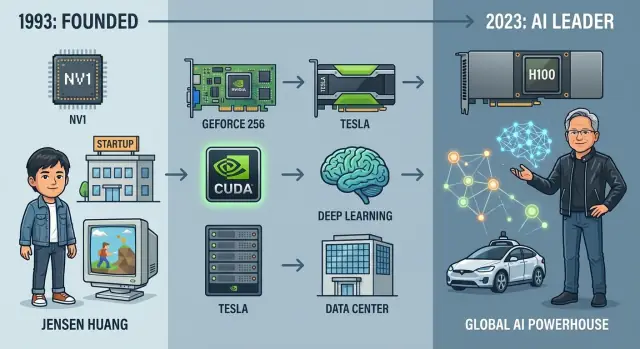
Nvidia's rise explains how a specialist graphics chip became the foundation of modern AI computing. The company began with consumer 3D graphics, survived a nearly fatal architectural mistake, built a programmable computing platform before a large market existed, and then spent years turning individual accelerators into complete data center systems.
Different audiences still encounter different versions of the company. Gamers know GeForce graphics cards, ray tracing, and AI-assisted rendering. Researchers know CUDA libraries and accelerators used for scientific computing. Cloud operators buy dense systems containing GPUs, CPUs, networking, switches, and management software. Investors see a company whose revenue mix shifted from gaming toward AI infrastructure with unusual speed.
Those businesses are connected by one recurring idea: a CPU should not perform every type of computation. Nvidia repeatedly identifies workloads with large amounts of parallel work, designs specialized processors for them, and surrounds those processors with software that makes them usable. Graphics supplied the first mass market. Scientific computing supplied demanding early users. Deep learning supplied the workload that turned accelerated computing into a data center priority.
The result was never guaranteed. NV1 used the wrong graphics primitives for the standards that won. CUDA required years of software spending before it produced material revenue. Nvidia entered servers against established CPU vendors, acquired a networking company for $6.9 billion, and committed to rack-scale liquid-cooled systems that are much harder to build than add-in cards.
Three decisions explain much of the outcome:
- Nvidia treated software, libraries, and developer support as products rather than accessories to silicon.
- It used gaming volume to fund architectures that could later address research and data center workloads.
- It expanded around the GPU whenever another bottleneck, such as memory movement or networking, limited useful performance.
That pattern matters to engineers and business builders because raw chip specifications tell only part of the story. A processor becomes a durable platform when developers can program it, systems can scale it, customers can operate it, and each new generation can run existing software with limited disruption.
Founding Nvidia and surviving the first wrong turn
Nvidia was founded on April 5, 1993, by Jensen Huang, Chris Malachowsky, and Curtis Priem to bring high-performance 3D graphics to consumer PCs. Huang had worked in microprocessor design at AMD and chip integration at LSI Logic. Malachowsky and Priem brought graphics and systems experience from Sun Microsystems, with Priem also having worked at IBM. The three used meetings at a Denny's restaurant to shape the plan that became Nvidia.
The opportunity looked large but unsettled. Professional 3D graphics lived mainly in expensive workstations used for computer-aided design, visualization, and media production. Consumer PCs were gaining faster processors, CD-ROM drives, better displays, and a growing games market, yet graphics hardware remained fragmented. Dozens of semiconductor companies were pursuing the same opening.
Nvidia's first product, NV1, arrived in 1995 and was sold in the Diamond Edge 3D card. It combined 2D and 3D graphics, audio, and Sega controller support. Its most consequential design choice was quadratic texture mapping, an approach based on curved surfaces rather than the triangle polygons that became standard in Microsoft Direct3D and much of the wider industry.
NV1 could run software written for its architecture, including a PC version of Sega's Virtua Fighter, but developers had little reason to support a small proprietary target once triangle-based APIs gained momentum. A technically ambitious chip therefore faced a software shortage at the exact moment platform compatibility became decisive.
Nvidia's work with Sega produced another graphics project, commonly known as NV2. Huang eventually concluded that continuing the architecture would waste both companies' time. Sega ended the console project but supplied financial support that helped Nvidia redirect its remaining resources. The episode left the startup with little room for another failure.
The replacement effort focused on standards, schedule, and a narrower product definition. Nvidia reduced its staff, adopted triangle rendering, and designed NV3 around Direct3D. That chip became the RIVA 128, released in 1997. It shipped more than one million units in its first four months and gave Nvidia both revenue and credibility with PC manufacturers.
The rescue established several operating habits that survived the startup period. Nvidia would abandon an elegant design when the market had selected a different programming standard. It would release hardware and drivers on a rapid cadence. It would also work directly with software developers, because a graphics processor without compatible games was inventory rather than a platform.
The company formalized its fabless model through a manufacturing relationship with TSMC in 1998. Instead of owning expensive fabrication plants, Nvidia concentrated spending on architecture, software, and product design while relying on an external foundry. That structure supported fast growth, but it also created a dependency that became more significant as advanced manufacturing capacity concentrated in Taiwan.
Nvidia completed its initial public offering in January 1999 at $12 per share. The IPO did not end the operational pressure. Graphics generations moved quickly, driver quality affected every product review, and rivals such as 3dfx, ATI, Matrox, and S3 remained capable of taking customers with a single strong release.
RIVA, GeForce, and the PC graphics contest
RIVA and GeForce established Nvidia by combining competitive silicon with steady driver support and broad compatibility. The RIVA 128 proved that the company could recover from NV1, while RIVA TNT and TNT2 improved color depth, image quality, multitexturing, and performance across the APIs developers were adopting.
The late 1990s PC market rewarded that combination. A fast card could still disappoint if its drivers crashed, rendered a game incorrectly, or lagged behind a new DirectX release. Nvidia treated drivers as a continuing engineering responsibility and used frequent releases to support new games and correct problems. That practice later helped the company manage a much larger computing software stack.
In 1999 Nvidia introduced GeForce 256 and marketed it as the first graphics processing unit, or GPU. The historical importance lies less in ownership of the term than in the architectural change it described. GeForce 256 integrated hardware transform and lighting, moving geometry calculations that CPUs had handled into the graphics processor.
That offload gave developers more room for game logic, physics, and richer scenes. It also widened the definition of graphics acceleration. The processor was no longer a fixed device that merely placed textured pixels on a screen. Each generation absorbed more of the rendering pipeline and exposed more control to software.
Nvidia reinforced its position through major PC manufacturers and game developers. OEM design wins put its chips into mainstream systems, while developer relations helped studios tune releases for GeForce hardware. The company also won the graphics contract for Microsoft's original Xbox, giving it experience supplying a complete platform with strict performance, cost, and delivery requirements.
Competition remained severe. Nvidia agreed in 2000 to acquire core assets from 3dfx, the company whose Voodoo cards had defined early enthusiast 3D gaming. ATI remained an independent rival and later became part of AMD. Nvidia could lead one generation and stumble in the next, as the poorly received GeForce FX family demonstrated in parts of the DirectX 9 era.
The response was a faster architectural correction. GeForce 6 restored competitiveness, while later generations added unified shaders, better programmability, and growing floating-point throughput. Nvidia kept separate brands for different buyers: GeForce for consumers, Quadro for professional visualization, and eventually Tesla for compute accelerators.
Graphics continued to supply technical ideas that crossed into AI. Programmable shaders taught Nvidia how developers used parallel execution. Texture and frame-buffer demands drove memory bandwidth. Multi-GPU gaming contributed experience with interconnects and workload distribution. The need to support old games while launching new hardware also imposed a form of software compatibility that pure hardware startups often underestimate.
Nvidia renewed the rendering model in 2018 with the Turing architecture and GeForce RTX. Dedicated RT Cores accelerated ray-intersection calculations, while Tensor Cores supported neural methods such as Deep Learning Super Sampling. Rendering increasingly combined conventional rasterization, ray tracing, and learned reconstruction rather than relying on one technique.
The Blackwell-based GeForce RTX 50 family, introduced in 2025, continued that convergence with fourth-generation RT Cores, fifth-generation Tensor Cores, neural shaders, and DLSS 4. Gaming was therefore more than Nvidia's original source of cash. It remained a large deployment channel for AI-assisted graphics and local model inference even after data centers became the larger business.
Programmable shaders opened the path to general computing
Programmable shaders changed Nvidia's strategic direction by revealing that a graphics processor could execute useful programs beyond a fixed rendering pipeline. Early GPUs contained dedicated stages for geometry, lighting, texture application, and pixel output. They were fast because the hardware was specialized, but developers could alter only a limited set of settings.
GeForce 3, released in 2001, supported programmable vertex shaders. Pixel and fragment programs became more capable across subsequent generations. Game developers used them for custom lighting, water, skin, shadows, and post-processing effects, while researchers began treating the same processors as inexpensive parallel machines.
Those research experiments were awkward. A scientist who wanted to perform matrix operations often had to express data as textures and computations as drawing operations. Results might be written into a frame buffer and read back through graphics APIs. The hardware delivered impressive throughput, but the programming method demanded graphics knowledge unrelated to the scientific problem.
The experiments still exposed a favorable economic structure. Gaming created enough volume to fund large chips with many arithmetic units and high-bandwidth memory. Researchers could buy that hardware at a fraction of the cost of a custom scientific processor. The same transistor investment could therefore address entertainment and technical computing if Nvidia supplied a suitable programming layer.
Nvidia moved toward a unified shader architecture, in which groups of programmable processors could handle different shader stages instead of assigning separate hardware to each one. The GeForce 8 family and its G80 architecture made that model commercially significant. A unified pool improved utilization for graphics and gave general computing a more regular execution target.
GPU computing also imposed limits that shaped later products. Parallel hardware excels when a workload contains many similar operations with enough independent work to fill thousands of execution lanes. Branch-heavy serial code may run better on a CPU. Data transfer can erase acceleration gains if an application repeatedly moves small amounts of information between processor memories. Fast arithmetic is useful only when memory capacity, bandwidth, and communication keep the units supplied.
These constraints explain Nvidia's later expansion. CUDA addressed programmability. High-bandwidth memory addressed local data supply. NVLink addressed movement between processors. Mellanox networking addressed communication across servers. The history moved outward from a chip because every solved bottleneck exposed the next one.
CUDA turned GPU hardware into a computing platform
CUDA gave programmers a direct model for parallel computing and created a software commitment that competitors could not answer with a faster chip alone. Nvidia announced the architecture in 2006 and released the first development tools in 2007, allowing developers to write C-like kernels without translating their problems into graphics operations.
The programming model exposed threads, blocks, grids, shared memory, and device memory. A developer still had to understand parallel work and data movement, but no longer needed to pretend that a numerical array was an image. That distinction opened the hardware to scientists, engineers, and quantitative developers who had little interest in rendering.
Nvidia then funded the less visible parts of platform adoption: compilers, debuggers, profilers, documentation, samples, university courses, and compatibility across successive GPUs. Libraries made the largest difference for users who did not want to write kernels. cuBLAS supplied tuned linear algebra, cuFFT handled fast Fourier transforms, and later libraries addressed sparse operations, random numbers, imaging, data analytics, and other domains.
Early adoption came from workloads with obvious parallel structure:
- Molecular dynamics and computational chemistry
- Seismic processing and medical imaging
- Option pricing and Monte Carlo simulation
- Linear algebra and scientific solvers
- Signal processing and computational fluid dynamics
Performance claims required care. A GPU could reduce a particular kernel from hours to minutes while leaving an entire application constrained by input processing, serial work, or communication. The durable benefit came when teams restructured complete workloads around the accelerator rather than treating it as a drop-in replacement for every CPU instruction.
Nvidia supported that work through research grants, university programs, developer events, and the GPU Technology Conference. Students learned one programming environment, researchers published code using it, and employers later hired people who already knew the tools. Libraries accumulated years of optimization and numerical testing.
This produced switching costs, but lock-in alone does not explain continued use. Developers stay when the cost of moving exceeds the benefit and when the current platform keeps improving. Nvidia used backward compatibility, broad framework support, tuned libraries, and new hardware features to preserve that calculation across multiple product cycles.
CUDA also changed Nvidia internally. A chip company can declare a product finished when manufacturing begins. A computing platform requires continuing compiler work, security updates, library maintenance, documentation, and support for new programming frameworks. Revenue from a board is recognized once, while software obligations continue across the board's usable life.
That long commitment looked expensive before the market for GPU computing matured. It became Nvidia's strongest defense once AI demand accelerated, because a new accelerator vendor had to compete against years of working code and developer experience rather than against benchmark results alone.
Tesla and the move into data centers
The Tesla product line gave Nvidia a dedicated route into servers and supercomputers, separating compute products from graphics cards built to drive displays. Introduced in 2007, Tesla accelerators emphasized numerical performance, memory capacity, reliability features, and operation inside dense systems.
Data center buyers evaluate different constraints than gamers. They care about sustained throughput, error handling, thermal design, software support periods, serviceability, cluster communication, and performance per unit of power. Double-precision arithmetic matters for many scientific simulations even when it contributes little to a game. Error-correcting memory can be essential when a calculation runs for days across thousands of devices.
National laboratories and universities became early reference customers. The Titan supercomputer at Oak Ridge National Laboratory combined CPUs with Nvidia K20X accelerators and began serving researchers in 2012. Systems like Titan demonstrated that GPU acceleration could operate at supercomputer scale in production science, not merely in a workstation demonstration.
Professional visualization provided another bridge. Quadro products already placed Nvidia hardware in engineering, design, film, and scientific organizations. Those relationships helped the company understand certified applications, long support cycles, and institutional purchasing before AI made accelerator clusters a board-level expense.
Cloud access widened the market. Amazon Web Services introduced GPU instances, followed by Microsoft Azure, Google Cloud, and other providers. Researchers and startups could rent accelerators by the hour instead of purchasing a server, finding space for it, and maintaining drivers themselves. This reduced the cost of experimentation and allowed successful projects to request more capacity without rebuilding their local infrastructure.
The hardware roadmap moved through several architectures and product families. Kepler improved energy efficiency and compute capability. Pascal paired the P100 with high-bandwidth memory and NVLink. Volta's V100 introduced Tensor Cores for dense matrix operations. Ampere's A100 expanded mixed-precision support and partitioning features. Hopper's H100 targeted transformer training and inference with a Transformer Engine and faster interconnects.
Each generation increased theoretical throughput, but usable cluster performance depended on the whole system. Operators needed compatible host processors, storage, network adapters, switches, power delivery, cooling, firmware, schedulers, containers, and monitoring. A single accelerator could lead a benchmark while a poorly balanced cluster left expensive processors waiting for data.
That reality pulled Nvidia toward systems engineering. The company introduced reference designs and worked closely with server makers, then began shipping integrated appliances. Data center customers were buying a time-to-results outcome, and Nvidia increasingly controlled the components that determined whether the advertised compute could be sustained.
AlexNet made deep learning a commercial direction
AlexNet showed that GPU-trained neural networks could outperform established computer vision methods at meaningful scale. In the 2012 ImageNet competition, Alex Krizhevsky, Ilya Sutskever, and Geoffrey Hinton trained the network for roughly five to six days using two GeForce GTX 580 GPUs with 3 GB of memory each. Its error rate was far lower than that of competing systems, drawing attention to both deep convolutional networks and the hardware used to train them.
Neural networks fit GPUs because training repeatedly applies matrix multiplications, convolutions, activation functions, and reductions across large arrays. Those operations contain enough parallel work to occupy many execution units. GPUs also offered memory bandwidth that helped feed the calculations, although model size and communication soon created new limits.
The breakthrough was a demonstration, not a complete commercial stack. Researchers still needed reliable primitives, framework integrations, multi-GPU communication, and methods for lower-precision arithmetic. Nvidia responded with software and architecture changes directed at neural networks.
The cuDNN library, first released in 2014, supplied optimized implementations of deep-learning operations. Framework maintainers could integrate the library once, allowing many users to receive GPU acceleration without writing custom kernels. Caffe, Theano, Torch, TensorFlow, and PyTorch each helped move the abstraction level farther from individual device instructions.
Reduced precision changed the economics of training. Many neural-network operations do not require 64-bit floating-point arithmetic. Hardware that processes 32-bit, 16-bit, 8-bit, and smaller formats can increase throughput and reduce memory use when software manages numerical accuracy correctly. Volta's Tensor Cores, introduced in 2017, accelerated matrix operations suited to that pattern. Later architectures added formats and controls aimed at transformers and inference.
Nvidia packaged these pieces in DGX-1 in 2016. The 3U system combined eight Tesla P100 accelerators, NVLink connections, storage, networking, and a prepared software environment. A lab could buy an integrated machine rather than assemble compatible components and resolve the software configuration independently.
The model evolved from selling a processor to selling an AI computer. HGX supplied baseboards and reference platforms for system manufacturers. DGX expanded into larger systems and SuperPOD designs. Cloud providers offered instances based on the same accelerator generations, while enterprises could deploy related software on their own servers.
Transformer models increased the value of scale. Training larger language models required more computation, more accelerator memory, and faster collective communication. Serving those models introduced another economic measure: the cost and latency of generating tokens for users. Nvidia could address both phases because the software stack included training libraries, communication tools, inference optimization, and model-serving components.
Generative AI therefore amplified work that had begun years before AlexNet. The 2012 result identified a high-growth application for parallel processors, while the earlier CUDA investment made Nvidia the practical platform available when the application arrived.
The software ecosystem became the competitive moat
Nvidia's software ecosystem reduces the work required to turn accelerator hardware into a functioning application. Its value comes from several layers that solve different problems rather than from one proprietary interface.
CUDA supplies the programming foundation and runtime. CUDA-X libraries provide tuned functions for mathematics, data processing, communications, imaging, and machine learning. NCCL coordinates collective operations among GPUs, which is necessary when a model is distributed across many devices. TensorRT optimizes trained models for inference, while Triton Inference Server manages model serving across supported frameworks and hardware configurations.
Higher layers address full workflows. RAPIDS accelerates data preparation and analytics. NeMo provides tools for developing and adapting generative models. NIM packages selected models and inference components as deployable microservices. Nvidia AI Enterprise offers supported software for organizations that want defined release and maintenance processes.
The practical advantage is cumulative. A framework can use tuned kernels without requiring every user to become a GPU specialist. A library can adopt instructions from a new architecture while keeping its application interface familiar. An enterprise can validate a supported combination of drivers, containers, orchestration software, and servers instead of testing every component independently.
Compatibility is never automatic. New precisions can affect model accuracy. Compiler changes can expose assumptions in old code. Driver, firmware, container, and framework versions must remain coordinated. Nvidia spends heavily on this integration work because predictable operation protects the value of the hardware.
The ecosystem extends through partners. Server manufacturers build systems around HGX and MGX designs. Cloud providers operate GPU instances and managed services. Software vendors certify applications. Consultants and systems integrators deploy clusters. Universities train developers, and startups receive technical support through Nvidia programs.
Vertical platforms reuse the same underlying components while adding domain tools:
- DRIVE combines automotive computing, simulation, perception software, and development tools.
- Isaac addresses robotics development, synthetic data, perception, and control.
- Clara groups healthcare and life-sciences workflows such as imaging and genomics.
- Omniverse connects simulation and collaborative 3D workflows around OpenUSD.
- Jetson packages accelerator hardware and software for robots, cameras, and other edge systems.
These offerings do not guarantee adoption in every industry. Automotive programs have long validation cycles. Healthcare deployments face clinical and regulatory constraints. Industrial simulations require accurate models and integration with existing operational data. Nvidia supplies a common computing base, but customers and partners still perform substantial domain work.
The moat can also weaken. Open frameworks increasingly isolate applications from vendor-specific code. Compiler projects can target several accelerator types. AMD's ROCm environment has matured, and cloud companies control their own software services around custom chips. Large buyers may accept porting costs to gain supply diversity or lower operating expenses.
Nvidia's defense is therefore continued usefulness, not incompatibility for its own sake. The company must keep libraries fast, support widely used frameworks, make new hardware productive quickly, and provide enough operational value that buyers prefer the integrated platform despite its price and concentration risk.
Strategic bets expanded Nvidia beyond the GPU
Nvidia expanded beyond graphics processors whenever adjacent technology limited system performance or opened another computing market. Some bets became central businesses, while others consumed years of work without producing the expected result.
Tegra was an early attempt to place Nvidia processors in phones, tablets, cars, and embedded devices. The mobile phone market favored integrated system-on-chip vendors with strong modem positions, where Nvidia lacked a durable advantage. Tegra found more suitable roles in automotive systems, the Shield product family, embedded development boards, and Nintendo's Switch console.
The lesson was that processor performance alone does not overcome platform economics. Power, radio integration, application compatibility, supply agreements, and customer roadmaps can matter more than graphics capability. Nvidia narrowed its mobile ambitions and applied the technology to markets where parallel computing and graphics carried more weight.
The company also built or acquired technologies around interconnects. NVLink, announced in 2014 and introduced with Pascal systems, provided faster direct communication among GPUs and supported closer CPU-GPU connections in selected designs. NVSwitch allowed more accelerators to communicate through a high-bandwidth switching fabric inside a server or rack.
Nvidia's $6.9 billion Mellanox acquisition, announced in 2019 and completed in 2020, extended that control across the data center network. Mellanox brought InfiniBand, high-speed Ethernet, network adapters, switches, and deep experience in remote direct memory access. Those assets became increasingly valuable as AI clusters grew from a few accelerators to thousands.
Distributed training can stall when processors wait for gradients, parameters, or activations. Low-latency networking and efficient collective operations improve the percentage of time that GPUs spend calculating. Mellanox therefore addressed the economics of every accelerator in a cluster, not a peripheral feature.
BlueField data processing units moved networking, storage, security, and infrastructure tasks away from host CPUs. Spectrum-X applied Ethernet products and software to AI cluster traffic, while Quantum systems continued the InfiniBand line. Nvidia could now design the compute fabric from accelerator links inside a rack through network connections across many racks.
The attempted Arm acquisition followed a different path. Nvidia announced the $40 billion proposal in 2020, intending to combine its accelerated computing work with Arm's widely licensed CPU instruction set and intellectual property. Customers and regulators worried that ownership by a chip supplier could compromise Arm's neutral licensing position. Nvidia terminated the transaction in 2022 after regulatory opposition.
The failed deal did not end Nvidia's CPU plans. Grace, an Arm-based data center CPU designed by Nvidia, entered systems paired with Hopper and Blackwell GPUs. Building a CPU allowed the company to tune memory, coherence, power use, and chip-to-chip communication for accelerator-heavy workloads without owning the Arm ecosystem.
Nvidia has also acquired companies in software, storage, cluster management, and AI development. The most strategically significant transactions share one purpose: reducing friction or idle time around expensive compute. That criterion distinguishes a coherent platform expansion from diversification for its own sake.
Blackwell and Rubin turned the rack into the product
Blackwell and Rubin mark Nvidia's move from selling accelerators inside servers to engineering the data center rack as one computing unit. The shift reflects model sizes and inference workloads that exceed the memory, communication, and power limits of an individual chip.
Nvidia announced the Blackwell platform in 2024. A Blackwell GPU combines two large dies through a high-bandwidth chip-to-chip connection, allowing them to operate as one logical device. The GB200 Grace Blackwell Superchip pairs two Blackwell GPUs with a Grace CPU through NVLink-C2C.
The GB200 NVL72 extends the design to a liquid-cooled rack containing 72 Blackwell GPUs and 36 Grace CPUs connected through fifth-generation NVLink. BlueField data processing units and external InfiniBand or Spectrum-X Ethernet networks connect the rack to storage and other systems. The product boundary now includes cooling, cabling, switching, firmware, and orchestration along with processors.
Blackwell Ultra, including GB300 systems, increased memory and targeted reasoning and inference workloads that retain long contexts or move large amounts of model state. Nvidia's fiscal 2026 results showed the commercial impact: growth came from both Blackwell compute and the NVLink, Ethernet, and InfiniBand products required to operate it at scale.
The Rubin platform moved into production in 2026, with partner systems scheduled for deployment during the second half of the year. Its platform combines the Vera CPU, Rubin GPU, NVLink 6 switch, ConnectX-9 network adapter, BlueField-4 data processor, and Spectrum-6 Ethernet switch. Nvidia designed those parts together for large mixture-of-experts models, long-context inference, and AI agents that perform repeated reasoning and tool-use steps.
This annual platform cadence changes the buyer's problem. A cloud operator is no longer comparing isolated GPU peak throughput. It must compare tokens per unit of power, application latency, effective memory capacity, networking utilization, software readiness, cooling requirements, installation time, and the amount of revenue a rack can generate.
Rack-scale integration creates advantages and obligations. Nvidia can tune the full communication path and sell more content per installation. Customers receive a validated design with fewer integration choices. Yet the company must coordinate a much larger supply chain, manage system-level failures, support liquid cooling, and deliver enough software maturity for buyers to use a new architecture quickly.
The approach also changes gross margins. Selling a complete system includes more lower-margin physical components than selling a standalone accelerator, even if the total profit per installation is high. Manufacturing defects, last-minute design changes, or unavailable memory and packaging capacity can affect a much larger bill of materials.
Power has become a hard limit. A data center may obtain chips faster than it can obtain utility capacity, substations, generators, cooling equipment, or construction permits. Nvidia's future gains therefore depend on useful work per watt and per rack, not solely on the number of arithmetic operations printed in a specification.
Competition tests every layer of the platform
Nvidia faces competition from merchant accelerators, cloud-designed chips, alternative software stacks, and customers seeking bargaining power. The threat differs by workload, so no single benchmark settles the contest.
AMD is the closest direct competitor across both gaming graphics and data center GPUs. Its Instinct accelerators and ROCm software target training, inference, and high-performance computing. The MI300 generation gained meaningful deployments, followed by MI350 products and the MI400 family with the Helios rack design in 2026. AMD competes through memory capacity, open standards, processor integration, and customers' desire for a second supplier.
Intel retains a large server CPU base and has pursued discrete GPUs and Gaudi accelerators. Its accelerator strategy has changed several times, illustrating how difficult it is to maintain silicon cadence, software adoption, and system availability together. A credible alternative needs framework support and cluster-scale operation, not an impressive chip in isolation.
Cloud providers attack a different part of Nvidia's position. Google's tensor processing units power internal services and are available through Google Cloud, with Ironwood addressing large-scale training, reasoning, and inference. AWS offers Trainium for model development and Inferentia for serving, including Trainium3 systems. Other large technology companies design accelerators or networking silicon for their own workloads.
Custom chips can win when a buyer controls the models, compiler, data centers, and utilization. The buyer can remove features it does not need and optimize around predictable software. Merchant GPUs retain an advantage when customers need broad framework compatibility, many model types, rapid deployment, and access across several clouds.
Specialist companies pursue wafer-scale processors, dataflow architectures, inference chips, optical interconnects, and other approaches. Cerebras, Groq, and numerous startups focus on particular performance or latency problems. Their challenge is turning a technical advantage into available systems, reliable software, and enough production capacity for large customers.
Competition also comes from abstraction. PyTorch, JAX, portable compilers, containerized services, and inference engines can reduce the amount of vendor-specific work visible to application developers. If teams can move a model with limited changes, purchasing departments gain leverage even when underlying kernels remain highly optimized for each device.
Buyers should compare systems with their own workload rather than relying on peak arithmetic. A useful evaluation includes model accuracy at the selected precision, batch size, prefill and decode behavior, memory limits, interconnect scaling, power, availability, support, and engineering effort. A cheaper accelerator can become expensive if it sits idle or requires months of porting. A premium platform can also be uneconomic when a simpler device meets the latency and throughput target.
Nvidia's position remains strongest where customers value one broadly supported environment across local development, cloud training, large clusters, and production inference. Its vulnerability grows where a buyer has enough scale and software control to optimize a narrower alternative.
Export controls and supply concentration became operating risks
Government policy and concentrated manufacturing now influence Nvidia's product design, inventory, customer access, and margins. Advanced accelerators are treated as strategic technology because they can support commercial AI, scientific research, intelligence analysis, and military applications.
United States export restrictions introduced in 2022 affected A100 and H100 products sold to China and other restricted destinations. Rules expanded in 2023 to cover more products and performance measures. Nvidia developed compliant variants, including H20, but the policy continued to change.
In April 2025 the United States required licenses for H20 shipments to China and certain related markets. Nvidia recorded a $4.5 billion charge for excess inventory and purchase obligations during fiscal 2026. Limited licenses later allowed some H20 shipments, while a 2026 policy permitted case-by-case review of H200 applications under specified conditions. Nvidia still reported that it was effectively unable to compete in China's data center compute market at the end of fiscal 2026.
The episode demonstrates a semiconductor-specific risk. A company commits to wafers, memory, packaging, and systems months before final delivery. A rule imposed after those commitments can turn a product designed for one region into inventory that cannot be redirected easily. A compliant redesign may also be commercially weak if local competitors offer fewer restrictions or if another rule arrives before production scales.
Antitrust questions arise from Nvidia's market position and full-stack strategy. Regulators can examine acquisitions, supply practices, bundling, cloud relationships, and access to software or hardware. The abandoned Arm transaction showed that control over neutral infrastructure receives different scrutiny than ordinary product expansion.
Manufacturing concentration creates a separate exposure. Nvidia remains fabless and depends heavily on TSMC for advanced wafers. It also needs high-bandwidth memory, advanced packaging, substrates, networking components, power systems, and contract manufacturers capable of assembling complex racks. Capacity for one component cannot compensate for a shortage in another.
Taiwan is central to leading-edge semiconductor manufacturing and system assembly, while South Korea is important to memory supply. Earthquakes, utility interruptions, shipping problems, trade restrictions, or conflict could disrupt output. Geographic diversification takes years because advanced facilities, qualified processes, and supplier networks cannot be duplicated by moving an order to an ordinary factory.
AI data centers add local constraints. Large deployments require power generation, transmission, cooling water or alternative heat-removal systems, land, permits, and skilled operators. National and regional rules governing energy, data location, privacy, and foreign investment can determine where systems are installed even when accelerator supply is available.
Nvidia must therefore manage engineering, policy, and physical infrastructure together. Its scale improves purchasing power and supplier coordination, but the value concentrated in each product generation makes mistakes and external shocks more expensive.
Jensen Huang's leadership shaped Nvidia's operating model
Jensen Huang's long tenure gave Nvidia unusual continuity across graphics, mobile computing, scientific acceleration, and AI. He has served as chief executive since the company's founding, allowing technical investments to continue through periods when public markets valued them lightly.
Huang combines product communication with detailed technical involvement. Public presentations translate architectures into workload and system economics, while internal reviews are known for direct feedback and broad information sharing. The leather jacket became recognizable branding, but the more consequential trait is his insistence on understanding how hardware, software, networking, and markets affect one another.
Nvidia operates with a relatively flat structure for its size. Information can travel to senior leadership through concise status messages and large review groups rather than through a long chain of private management meetings. This can expose problems quickly and let specialists challenge assumptions across organizational boundaries.
The model also creates pressure. Direct criticism, high expectations, frequent product cycles, and visibility into unfinished work are demanding for employees. Practices that helped a smaller engineering company move quickly require discipline as headcount, regulatory duties, and customer commitments grow.
Several cultural principles recur in Nvidia's major decisions:
- Intellectual honesty matters when an architecture or market assumption fails.
- Product plans combine long semiconductor cycles with rapid software iteration.
- Developers are treated as primary users whose adoption must be earned.
- Technical bets can run for years when the underlying reasoning remains sound.
- System performance takes precedence over optimizing one component in isolation.
CUDA is the clearest example of patient investment, while the NV1 pivot shows the opposite skill: abandoning a path when evidence invalidates it. Persistence and flexibility are compatible only when leaders distinguish a difficult plan from a false premise.
Founder control can support consistency, but it also concentrates judgment. Nvidia's future depends on succession planning, leaders who can challenge Huang, and processes that work without his participation in every significant decision. Scale introduces responsibilities that startup urgency cannot solve by itself, including compliance, safety, security, labor management, and reliable delivery to governments and global enterprises.
The company's culture has also widened beyond graphics engineering. Researchers, compiler teams, networking specialists, system architects, cloud operators, automotive groups, and industry software teams must coordinate on the same platform. Nvidia's organizational challenge is preserving fast technical debate while operating infrastructure whose failure can affect customers far beyond the PC games market.
The financial transformation followed the product transformation
Nvidia's financial results changed when data center systems became the dominant revenue source, turning a cyclical graphics supplier into one of the world's largest computing infrastructure businesses. The progression was gradual for years and then accelerated with generative AI demand.
After the 1999 IPO, Nvidia's revenue depended heavily on PC graphics, game cycles, workstation demand, and relationships with board manufacturers and OEMs. Gaming remained profitable, but inventory corrections could be sharp. New graphics generations required large research spending before demand was certain.
Several downturns exposed that cyclicality. The 2008 financial crisis reduced technology spending. Cryptocurrency mining drove unusually high graphics card demand and then contributed to an inventory correction in 2018. Pandemic-era demand and supply disruptions were followed by another gaming adjustment during 2022. Nvidia also recorded product-related charges when engineering or market assumptions failed.
Data center sales changed both scale and customer concentration. Fiscal 2024 revenue reached $60.9 billion, including $47.5 billion from Data Center. Fiscal 2025 revenue rose to $130.5 billion, with Data Center contributing $115.2 billion. Fiscal 2026 revenue reached $215.9 billion, including $193.7 billion from Data Center.
The fiscal 2026 figures show how completely the mix had shifted. Data Center accounted for almost 90 percent of annual revenue, while gaming remained a large but much smaller business. In the quarter ended April 26, 2026, total revenue was $81.6 billion and Data Center revenue was $75.2 billion as Blackwell 300 systems and networking products ramped.
Profitability reflects both scarce high-value accelerators and the cost of supplying full systems. Nvidia reported a 71.1 percent GAAP gross margin for fiscal 2026, down from 75.0 percent in fiscal 2025. The decline reflected the move from Hopper HGX products toward complete Blackwell data center solutions and the H20 inventory charge. High revenue therefore does not make product mix or policy risk irrelevant.
The customer base creates another tension. Cloud providers, AI laboratories, server manufacturers, and other large direct customers can account for substantial purchases. Their capital spending plans may change quickly, and some are developing internal chips while buying Nvidia systems. Demand can remain strong in aggregate while an individual product or customer creates volatility.
Nvidia's stock reflected the changing expectations. The company's market value passed $1 trillion in 2023 as investors priced in the scale of AI infrastructure demand, then crossed further trillion-dollar milestones during 2024. A 10-for-1 stock split became effective in June 2024, following a 4-for-1 split in 2021 and several earlier splits. Splits changed the share count and price per share, not the value of the business.
A sound financial analysis separates demand from durable economics. Buyers may continue building AI capacity while shifting toward lower-cost inference chips. Nvidia can grow revenue while gross margin moves lower because systems include more third-party content. Rapid architecture transitions can create inventory charges. Power and construction limits can delay deployments even when customers want more compute.
The long-term case rests on accelerated computing replacing more general-purpose work, AI inference becoming a recurring production workload, and Nvidia retaining a large share of the systems and software value. The opposing case rests on customer concentration, custom silicon, alternative accelerators, export controls, supply constraints, and spending that may run ahead of profitable AI applications. Both cases should be evaluated against cash flows and deployment economics rather than a simple label such as chip company or software platform.
What Nvidia's past says about its next phase
Nvidia's next phase depends on making larger AI systems economical to operate, not merely making each processor faster. Training remains demanding, but production inference, reasoning models, and software agents can consume compute continuously. The important customer measures are shifting toward latency, tokens per watt, tokens per dollar, uptime, and revenue per unit of installed power.
Rubin shows how Nvidia plans to answer that demand: annual platform releases, tighter integration across processors and networking, larger memory systems, and software tuned for changing model structures. Faster cadence can keep customers on the platform, but it can also shorten the economic life of expensive equipment and place more strain on suppliers and engineering teams.
Physical AI is another large bet. DRIVE, Isaac, Jetson, Omniverse, and simulation tools connect model training with machines that perceive and act in the physical world. Robots and vehicles need low-latency local inference, while cloud systems can perform training, fleet analysis, and simulation. Progress depends on safety, reliability, sensor data, and real deployment economics as much as accelerator performance.
Digital twins extend the same approach into factories, warehouses, power systems, and other engineered environments. Simulation can reduce the cost of testing layouts or robot behavior before physical changes are made. Its value depends on accurate models and maintained operational data, so software integration remains as demanding as rendering.
For application builders, the history explains why AI infrastructure can feel distant even when it shapes daily work. A non-technical founder can describe a web, server, or mobile application in Koder.ai while language models and a mixture of agents perform work behind the chat interface. That experience abstracts the accelerators, networking, hosting, and model software underneath it. Nvidia's commercial opportunity grows when more products consume AI without requiring their users to manage GPU kernels or clusters.
Builders can draw several practical lessons from the company's record. Choose an urgent application that can fund a broader platform. Invest in developer experience before competitors treat it as a priority. Preserve compatibility when users commit code and training to the product. Expand into adjacent components only when they remove a measured bottleneck. Abandon a technical premise when standards or evidence prove it wrong.
Policymakers face a different set of choices. Accelerator supply, advanced packaging, memory, energy, cloud access, and software skills now affect national computing capacity. Export controls can restrict adversaries while also creating inventory losses, reducing vendor access to foreign developers, and encouraging domestic alternatives in restricted markets. Competition policy must distinguish integration that improves system performance from practices that prevent customers from choosing viable substitutes.
Nvidia's history is ultimately a sequence of compounding commitments. Graphics funded parallel hardware. Programmable shaders exposed a general computing opportunity. CUDA accumulated software and developers. AlexNet supplied a defining AI workload. DGX, Mellanox, Grace, Blackwell, and Rubin expanded the product boundary until the rack became the computer.
That sequence created Nvidia's lead, but it does not make the lead permanent. The company must keep solving the next operational constraint while competitors attack price, openness, supply diversity, and specialized performance. Its earlier success came from recognizing when the computing model had changed. Its future depends on doing that again before the current model becomes an assumption it is unwilling to question.
FAQ
What made Nvidia’s original vision different from other chip companies in the 1990s?
Nvidia was founded around a very specific bet: that 3D graphics would move from expensive workstations into mass‑market PCs, and that this shift would need a dedicated graphics processor tightly coupled with software.
Instead of trying to be a general semiconductor company, Nvidia:
- Focused on accelerated graphics for everyone, not just professionals.
- Designed chips and software drivers/APIs together, not separately.
- Optimized for cost and OEM adoption, so big PC makers could ship Nvidia by default.
This narrow but deep focus on one problem—real‑time graphics—created the technical and cultural base that later translated into GPU computing and AI acceleration.
How did CUDA help Nvidia become the default hardware for AI and deep learning?
CUDA turned Nvidia’s GPUs from fixed‑function graphics hardware into a general‑purpose parallel computing platform.
Key ways it enabled AI dominance:
- Simplified programming: Researchers could write C/C++ (and later Python via frameworks) instead of abusing graphics APIs.
- Reusable libraries: cuBLAS, cuFFT, cuDNN and others gave plug‑and‑play acceleration for math and neural networks.
- Ecosystem momentum: Once frameworks like TensorFlow and PyTorch optimized for CUDA, Nvidia became the default hardware.
- Compounding lock‑in: Every CUDA‑based project increased the cost of switching to non‑CUDA accelerators.
By the time deep learning took off, the tools, docs, and habits around CUDA were already mature, giving Nvidia a huge head start.
Why was the Mellanox acquisition such a big deal for Nvidia’s AI strategy?
Mellanox gave Nvidia control over the networking fabric that connects thousands of GPUs in AI supercomputers.
For large models, performance depends not just on fast chips but on how quickly they can exchange data and gradients. Mellanox brought:
- InfiniBand and advanced Ethernet for low‑latency, high‑bandwidth links.
- Expertise in RDMA and high‑performance interconnects.
- Building blocks for NVLink/NVSwitch‑based systems.
This let Nvidia sell integrated platforms (DGX, HGX, full data center designs) where GPUs, networking, and software are co‑optimized, instead of just selling standalone accelerator cards.
How does Nvidia make money today, and how has its revenue mix changed over time?
Nvidia’s revenue has shifted from being gaming‑heavy to data‑center‑dominant.
At a high level:
- Gaming: GeForce GPUs, gaming laptops, and related software remain a large, profitable business.
- Data center: Now the primary growth engine, driven by AI training/inference, cloud GPU instances, and full systems (DGX/HGX) with networking.
- Professional visualization: Workstation GPUs for designers/engineers.
- Automotive and edge: Smaller today, but strategic bets (DRIVE, Jetson, robotics, Omniverse‑based solutions).
High‑end AI platforms and networking carry premium prices and margins, which is why data center growth has transformed Nvidia’s overall profitability.
What competitive threats does Nvidia face from AMD, Intel, and custom AI chips?
Nvidia faces pressure from both traditional rivals and custom accelerators:
- AMD: Competes directly with gaming GPUs and MI‑series AI accelerators, often pitching lower cost per FLOP.
- Intel: Attacks via CPUs, its own GPUs, and dedicated AI chips.
- Cloud and big tech: Google (TPU), Amazon (Trainium/Inferentia), and others design in‑house chips to reduce dependence on Nvidia.
- Startups and regional players: Specialized AI accelerators and Chinese vendors aim at cost, efficiency, or regulatory niches.
Nvidia’s main defenses are performance leadership, CUDA/software lock‑in, and integrated systems. But if alternatives become “good enough” and easier to program, its share and pricing power could be pressured.
How do export controls, regulation, and geopolitics affect Nvidia’s business?
Advanced GPUs are now treated as strategic technology, especially for AI.
Impacts on Nvidia include:
- Export controls: U.S. rules limit shipping top‑end AI GPUs to China and some other regions. Nvidia must design lower‑spec variants and may lose some high‑margin demand.
- Antitrust scrutiny: Regulators closely watch deals (like the blocked Arm acquisition) and business practices that could entrench Nvidia’s dominance.
- Supply chain risk: Heavy reliance on TSMC and advanced packaging in Taiwan exposes Nvidia to geopolitical and capacity risks.
As a result, Nvidia’s strategy must account not only for engineering and markets but also for policy, trade rules, and regional industrial plans.
What does Nvidia’s AI software stack look like in simple terms?
Nvidia’s AI stack is a layered set of tools that hide GPU complexity from most developers:
- CUDA: The core programming model that exposes GPUs as parallel processors.
- Math and HPC libraries: cuBLAS, cuSPARSE, cuFFT, etc., for fast linear algebra and numerical routines.
- AI‑specific libraries: cuDNN for neural network primitives, TensorRT for optimized inference, Triton for model serving.
- Data and analytics: RAPIDS for GPU‑accelerated data science and analytics.
- Vertical SDKs: Domain toolkits for automotive (Drive), healthcare (Clara), robotics (Isaac), simulation/digital twins (Omniverse).
Most teams call these libraries through frameworks like PyTorch or TensorFlow, so they rarely write low‑level GPU code directly.
How do Nvidia’s bets in autonomous driving and robotics fit into its overall strategy?
Autonomous driving and robotics are extensions of Nvidia’s core AI and simulation platform into physical systems.
Strategically, they:
- Reuse the same CUDA and AI libraries developed for data centers.
- Drive demand for edge and embedded GPUs (Jetson, in‑car Drive platforms).
- Lock in long‑cycle customers (automakers, industrial firms) with combined hardware + software + tools.
- Create heavy simulation workloads (via Omniverse/Isaac) that further justify large GPU deployments.
These markets may be smaller than cloud AI today but can generate durable, high‑margin revenue and deepen Nvidia’s ecosystem across industries.
What can founders and engineers learn from Nvidia’s evolution from graphics startup to AI platform?
Nvidia’s trajectory offers several lessons:
- Own the full stack: Combining chips, system design, and software (CUDA, SDKs) creates durable moats.
- Bet early on new compute bottlenecks: Programmable shaders, CUDA, and deep learning support were all made before the markets were obvious.
- Treat developers as first‑class customers: Documentation, libraries, conferences, and direct support compound adoption.
- Align with ecosystems and standards: The NV1 misstep taught Nvidia to follow dominant APIs (like DirectX) rather than fight them.
For builders, the takeaway is to pair deep technical insight with ecosystem thinking, not just focus on raw performance.
How might Nvidia’s position change if AI hardware architectures move beyond traditional GPUs?
If future workloads move away from GPU‑friendly patterns, Nvidia would need to adapt its hardware and software quickly.
Possible shifts include:
- Wider adoption of specialized AI ASICs that trade flexibility for efficiency on narrow tasks.
- New paradigms (e.g., neuromorphic, analog, or radically different memory hierarchies) that don’t map well to current GPU designs.
- Standardized open software stacks (e.g., ROCm‑like ecosystems, better CPU/ASIC tooling) that weaken CUDA’s lock‑in.
Nvidia’s likely response would be to:
- Evolve its architectures toward the new workloads.
- Extend its software stack to support or encapsulate new hardware types.
- Use its system‑level expertise (networking, platforms, vertical SDKs) to stay relevant even if “GPU” in the old sense becomes less central.
Its history suggests it can pivot, but such shifts would test how adaptable the company really is.