

From Nonprofit Lab to AI Leader: The History of OpenAI
Explore the history of OpenAI, from its nonprofit origins and key research milestones to the launch of ChatGPT, GPT-4, and its evolving mission.
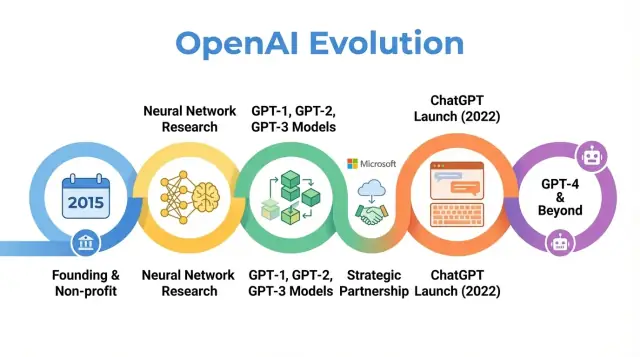
Overview: Why OpenAI’s History Matters
OpenAI is an AI research and deployment company whose work has shaped how people think about artificial intelligence, from early research papers to products like ChatGPT. Understanding how OpenAI evolved—from a small nonprofit lab in 2015 to a central player in AI—helps explain why modern AI looks the way it does today.
OpenAI’s story is not just a sequence of model releases. It is a case study in how mission, incentives, technical breakthroughs, and public pressure interact. The organization began with a strong emphasis on open research and broad benefit, then restructured to attract capital, formed a deep partnership with Microsoft, and launched products used by hundreds of millions of people.
Why this history matters
Tracing OpenAI’s history illuminates several wider trends in AI:
-
Mission and values: OpenAI was founded with the stated goal of ensuring that artificial general intelligence benefits all of humanity. How that mission has been interpreted and revised over time reveals the tensions between idealistic goals and commercial realities.
-
Research breakthroughs: The progression from early projects to systems like GPT-3, GPT-4, DALL·E, and Codex tracks a broader shift toward large-scale foundation models that power many current AI applications.
-
Governance and structure: The move from a pure nonprofit to a capped-profit entity, and the creation of complex governance mechanisms, highlight how new organizational forms are being tried to manage powerful technologies.
-
Public impact and scrutiny: With ChatGPT and other releases, OpenAI moved from a research lab known mainly within AI circles to a household name, drawing attention to safety, alignment, and regulation debates that now shape policy discussions worldwide.
This article follows OpenAI’s journey from 2015 to its latest developments, showing how each phase reflects broader shifts in AI research, economics, and governance—and what that might mean for the future of the field.
Founding OpenAI: Mission and Early Team
The 2015 AI Moment
OpenAI was founded in December 2015, at a point when machine learning—especially deep learning—was rapidly improving but still far from general intelligence. Image recognition benchmarks were falling, speech systems were getting better, and companies like Google, Facebook, and Baidu were pouring money into AI.
A growing concern among researchers and tech leaders was that advanced AI might end up controlled by a handful of powerful corporations or governments. OpenAI was conceived as a counterweight: a research organization focused on long‑term safety and broad distribution of AI’s benefits, rather than on narrow commercial advantage.
Mission: AGI for the Benefit of All
From day one, OpenAI defined its mission in terms of artificial general intelligence (AGI), not just incremental machine learning progress. The core statement was that OpenAI would work to ensure AGI, if created, “benefits all of humanity.”
That mission had several concrete implications:
- Prioritizing safety research and long‑term alignment questions
- Committing to share research, code, and insights widely where possible
- Avoiding a winner‑take‑all race dynamic by collaborating with other institutions
Early public blog posts and the founding charter emphasized both openness and caution: OpenAI would publish much of its work, but would also consider the societal impact of releasing powerful capabilities.
Founders, Early Leaders, and Structure
OpenAI began as a nonprofit research lab. The initial funding commitments were announced at around $1 billion in pledged support, though this was a long‑term pledge rather than upfront cash. Key early backers included Elon Musk, Sam Altman, Reid Hoffman, Peter Thiel, Jessica Livingston, and YC Research, along with support from companies such as Amazon Web Services and Infosys.
The early leadership team combined startup, research, and operating experience:
- Sam Altman – co‑founder and initial chair of the board (later CEO)
- Elon Musk – co‑founder and early donor, board member in the initial period
- Greg Brockman – former Stripe CTO, joining as CTO and a co‑founder
- Ilya Sutskever – leading deep learning researcher, joining as Chief Scientist
- Wojciech Zaremba and John Schulman – co‑founders and core research leaders
This mix of Silicon Valley entrepreneurship and top‑tier AI research shaped OpenAI’s early culture: highly ambitious about pushing the frontier of AI capabilities, but organized as a mission‑driven nonprofit aimed at long‑term global impact rather than short‑term commercialization.
Nonprofit Era: Early Research and Open Science
When OpenAI launched as a nonprofit research lab in 2015, its public promise was simple but ambitious: advance artificial intelligence while sharing as much as possible with the wider community.
Open by default
The early years were defined by an "open by default" philosophy. Research papers were posted quickly, code was usually released, and internal tools were turned into public projects. The idea was that accelerating broad scientific progress—and scrutiny—would be safer and more beneficial than concentrating capabilities inside a single company.
At the same time, safety was already part of the conversation. The team discussed when openness might increase misuse risk and began sketching ideas for staged release and policy reviews, even if those ideas were still informal compared with later governance processes.
Flagship research areas
OpenAI’s early scientific focus spanned several core areas:
- Reinforcement learning (RL): Work on agents mastering games like Dota 2 and complex control tasks helped push RL algorithms, exploration methods, and scalability.
- Robotics: Experiments with robot hands solving manipulation tasks showed how RL and simulation could transfer into the physical world.
- Unsupervised and self-supervised learning: Researchers explored how models could learn from large, unlabeled datasets, foreshadowing later foundation models.
These projects were less about polished products and more about testing what was possible with deep learning, compute, and clever training regimes.
Tools that shaped a community
Two of the most influential outputs of this era were OpenAI Gym and Universe.
- OpenAI Gym provided a common set of RL environments and benchmarks. It standardized how researchers compared algorithms and dramatically lowered the barrier to entry for new labs and students.
- Universe aimed to train and evaluate agents on a large variety of existing software environments, from games to web apps. Although Universe itself was eventually retired, it crystallized interest in general-purpose agents.
Both projects reflected a commitment to shared infrastructure rather than proprietary advantage.
How peers and media saw OpenAI
During this nonprofit period, OpenAI was often portrayed as a mission-driven counterweight to large tech firms’ AI labs. Peers valued the quality of its research, the availability of code and environments, and the willingness to engage in safety discussions.
Media coverage emphasized the unusual combination of high-profile funders, a non-commercial structure, and a promise to publish openly. That reputation—as an influential, open research lab concerned with long-term consequences—set expectations that would later shape reactions to every strategic shift the organization made.
Building Powerful Models: From GPT-1 to GPT-3
The turning point in OpenAI’s history was its decision to focus on large transformer-based language models. This shift transformed OpenAI from a primarily research-focused nonprofit into a company known for foundational models that others build on.
GPT-1: Proving the Transformer Idea (2018)
GPT-1 was modest by later standards—117 million parameters, trained on BookCorpus—but it offered a crucial proof of concept.
Instead of training separate models for each NLP task, GPT-1 showed that a single transformer model, trained with a simple objective (predict the next word), could be adapted with minimal fine-tuning to tasks like question answering, sentiment analysis, and textual entailment.
For OpenAI’s internal roadmap, GPT-1 validated three ideas:
- Scale matters: bigger models on more data perform better in a surprisingly general way.
- Pretraining + fine-tuning can beat task-specific systems.
- Transformers are a powerful architecture for language.
GPT-2: Capabilities and Misuse Concerns (2019)
GPT-2 pushed the same basic recipe much further: 1.5 billion parameters and a much larger web-derived dataset. Its outputs were often startlingly coherent: multi-paragraph articles, fictional stories, and summaries that looked, at a glance, like human writing.
Those capabilities raised alarms about potential misuse: automated propaganda, spam, harassment, and fake news at scale. Instead of releasing the full model immediately, OpenAI adopted a staged release strategy:
- Initial release of a smaller model, with technical paper and examples
- Continued internal and external red-teaming to explore misuse
- Gradual release of larger versions as OpenAI assessed risks
This was one of the first high-profile examples of OpenAI explicitly tying deployment decisions to safety and social impact, and it shaped how the organization thought about disclosure, openness, and responsibility.
GPT-3: Scale, Generality, and the API (2020)
GPT-3 scaled up again—this time to 175 billion parameters. Instead of relying mainly on fine-tuning for each task, GPT-3 demonstrated “few-shot” and even “zero-shot” learning: the model could often perform a new task simply from instructions and a few examples in the prompt.
That level of generality changed how both OpenAI and the broader industry thought about AI systems. Rather than building many narrow models, one large model could serve as a general-purpose engine for:
- Copywriting and content generation
- Code snippets and autocomplete
- Question answering, chat, and search augmentation
Crucially, OpenAI chose not to open-source GPT-3. Access was offered via a commercial API. This decision marked a strategic pivot:
- From publishing models to operating them as a managed service
- From pure research lab to platform provider with paying customers
- From one-off demos to a developer ecosystem building on OpenAI’s models
GPT-1, GPT-2, and GPT-3 trace a clear arc in OpenAI’s history: scaling transformers, discovering emergent capabilities, wrestling with safety and misuse, and laying the commercial groundwork that would later support products like ChatGPT and the continued development of GPT-4 and beyond.
Restructuring the Organization: OpenAI LP and Capped-Profit Model
By 2018, OpenAI’s leaders were convinced that staying a small, donation-funded lab would not be enough to build and safely steer very large AI systems. Training frontier models already required tens of millions of dollars in compute and talent, with cost curves clearly pointing much higher. To compete for top researchers, scale experiments, and secure long-term access to cloud infrastructure, OpenAI needed a structure that could attract serious capital without abandoning its original mission.
Why OpenAI LP Was Created
In 2019, OpenAI launched OpenAI LP, a new “capped-profit” limited partnership. The goal was to unlock large external investment while keeping the nonprofit’s mission — ensuring that artificial general intelligence benefits all of humanity — at the top of the decision-making hierarchy.
Traditional venture-backed startups are ultimately accountable to shareholders seeking uncapped returns. OpenAI’s founders worried that this would create strong pressure to prioritize profit over safety, openness, or careful deployment. The LP structure was a compromise: it could issue equity-like interests and raise money at scale, but under a different set of rules.
How the Capped-Profit Model Works
In the capped-profit model, investors and employees can earn returns on their stakes in OpenAI LP, but only up to a fixed multiple of their original investment (for early investors, often cited as up to 100x, with lower caps in later tranches). Once that cap is reached, any additional value created is meant to flow to the nonprofit parent to be used in line with its mission.
This contrasts sharply with typical startups, where equity value can, at least theoretically, grow without limit and where maximizing shareholder value is the legal and cultural default.
Relationship Between the Nonprofit and the LP
OpenAI Nonprofit remains the controlling entity. Its board oversees OpenAI LP and is chartered to prioritize humanity’s interests over those of any particular group of investors or employees.
Formally:
- The nonprofit holds the controlling stake in OpenAI LP.
- The nonprofit board appoints key leadership and can, in principle, override decisions that conflict with the mission.
- Fiduciary duty is framed around the nonprofit’s charter, not pure financial optimization.
This governance design is meant to give OpenAI the fundraising and hiring flexibility of a commercial organization while retaining mission-first control.
Debates and Impact on Funding and Hiring
The restructuring sparked debate inside and outside the organization. Supporters argued it was the only practical way to secure the billions likely required for cutting-edge AI research while still constraining profit incentives. Critics questioned whether any structure that offers large returns could truly resist commercial pressure, and whether the caps were high enough or clearly enforced.
Practically, OpenAI LP opened the door to large strategic investments, most notably from Microsoft, and allowed the company to offer competitive compensation packages pegged to potential upside. That, in turn, enabled OpenAI to scale its research teams, expand training runs for models like GPT-3 and GPT-4, and build the infrastructure needed to deploy systems such as ChatGPT at global scale — all while maintaining a formal governance link back to its nonprofit origins.
Strategic Partnership with Microsoft
The 2019 Investment and Long-Term Deal
In 2019, OpenAI and Microsoft announced a multi‑year partnership that reshaped both companies’ roles in AI. Microsoft invested a reported $1 billion, combining cash and Azure cloud credits, in exchange for becoming OpenAI’s preferred commercial partner.
The deal aligned with OpenAI’s need for massive compute resources to train increasingly large models, while giving Microsoft access to cutting‑edge AI that could differentiate its products and cloud platform. Over subsequent years, the relationship deepened through additional financing and technical collaboration.
Azure as OpenAI’s Cloud Backbone
OpenAI chose Microsoft Azure as its primary cloud platform for several reasons:
- Scale and custom hardware: Azure committed to building specialized clusters with thousands of GPUs (and later custom accelerators) tuned for large‑scale training.
- Co-engineering: OpenAI engineers worked closely with Azure teams to optimize networking, storage, and orchestration specifically for large language models.
- Financial structure: The investment and cloud credits lowered the upfront cost of experiments that would have been prohibitively expensive elsewhere.
This made Azure the default environment for training and serving models like GPT‑3, Codex, and later GPT‑4.
Co-Developing Supercomputing Infrastructure
The partnership led to one of the world’s largest AI supercomputing systems, built on Azure for OpenAI’s workloads. Microsoft highlighted these clusters as flagship examples of Azure’s AI capabilities, while OpenAI relied on them to push model size, training data, and experimentation speed.
This joint infrastructure effort blurred the line between “customer” and “partner”: OpenAI effectively influenced Azure’s AI roadmap, and Azure was tuned to OpenAI’s needs.
Licensing, Products, and Public Perception
Microsoft received exclusive licensing rights to some OpenAI technologies, most notably GPT‑3. That allowed Microsoft to embed OpenAI models across its products—Bing, Office, GitHub Copilot, Azure OpenAI Service—while other companies accessed them via OpenAI’s own API.
This exclusivity fueled debate: supporters argued it provided the funding and distribution needed to scale powerful AI safely; critics worried it concentrated influence over frontier models in a single major tech company.
At the same time, the partnership gave OpenAI mainstream visibility. Microsoft’s branding, product integrations, and enterprise sales channels helped move OpenAI systems from research demos into everyday tools used by millions, shaping public perception of OpenAI as both an independent lab and a core Microsoft AI partner.
Breakthroughs Beyond Text: DALL·E, CLIP, and Codex
As OpenAI’s models improved at understanding and generating language, the team pushed into new modalities: images and code. This shift expanded OpenAI’s work from writing and dialogue into visual creativity and software development.
CLIP: Connecting Images and Language
CLIP (Contrastive Language–Image Pretraining), announced in early 2021, was a major step toward models that understand the world more like humans do.
Instead of training only on labeled images, CLIP learned from hundreds of millions of image–caption pairs scraped from the public web. It was trained to match images with their most likely text descriptions and to distinguish them from incorrect ones.
This gave CLIP surprisingly general abilities:
- Recognizing objects and styles without task‑specific training
- Following natural-language prompts (e.g., “a photo of a tabby cat”) to classify images
- Serving as a flexible visual backbone for other systems
CLIP became a foundation for later generative image work at OpenAI.
DALL·E and DALL·E 2: Text-to-Image Creativity
DALL·E (2021) applied GPT-style architectures to images, generating pictures directly from text prompts: “an armchair in the shape of an avocado” or “a storefront sign that says ‘openai’”. It demonstrated that language models could be extended to produce coherent, often whimsical imagery.
DALL·E 2 (2022) significantly improved resolution, realism, and controllability. It introduced features such as:
- Inpainting: editing parts of an existing image via text
- Outpainting: extending an image beyond its original borders
- Style and composition control: steering output with detailed prompts
These systems changed how designers, marketers, artists, and hobbyists prototype ideas, shifting some creative work from manual drafting toward iterative prompt‑driven exploration.
Codex and the Future of Software Development
Codex (2021) took the GPT-3 family and adapted it to source code, training on large public codebases. It can translate natural language into working snippets for languages like Python, JavaScript, and many others.
GitHub Copilot, built on Codex, brought this into everyday development tools. Programmers began receiving entire functions, tests, and boilerplate as suggestions, using natural-language comments as guidance.
For software development, Codex hinted at a gradual shift:
- From writing every line by hand to supervising and refining AI-generated drafts
- From memorizing syntax to focusing on architecture, intent, and review
Together, CLIP, DALL·E, and Codex showed that OpenAI’s approach could extend beyond text into vision and code, broadening the impact of its research across art, design, and engineering.
ChatGPT and the Public Spotlight
Launch and explosive adoption
OpenAI launched ChatGPT as a free "research preview" on November 30, 2022, announcing it in a short blog post and tweet rather than a major product campaign. The model was based on GPT‑3.5 and optimized for dialogue, with guardrails to refuse some harmful or unsafe requests.
Usage surged almost immediately. Millions of people signed up within days, and ChatGPT became one of the fastest‑growing consumer applications ever. Screenshots of conversations flooded social media as users tested its ability to write essays, debug code, draft emails, and explain complex topics in plain language.
Everyday use at work, school, and home
ChatGPT’s appeal came from its versatility rather than a single narrow use case.
In education, students used it to summarize readings, generate practice questions, translate or simplify academic articles, and get step‑by‑step explanations of math or science problems. Teachers experimented with it to design syllabi, draft rubrics, and create differentiated learning materials, even as schools debated whether and how it should be allowed.
At work, professionals asked ChatGPT to draft emails, marketing copy, and reports, outline presentations, generate code snippets, write test cases, and serve as a brainstorming partner for product ideas or strategies. Individual freelancers and small businesses especially leaned on it as a low‑cost assistant for content and analysis.
For everyday problem‑solving, people turned to ChatGPT for travel plans, cooking ideas from what was in their fridge, basic legal and medical explanations (typically with disclaimers to seek professional advice), and help learning new skills or languages.
From free preview to paid offerings
The initial research preview was free to reduce friction and collect feedback on failures, misuse, and missing capabilities. As usage grew, OpenAI faced both high infrastructure costs and user demand for more reliable access.
In February 2023, OpenAI introduced ChatGPT Plus, a subscription plan that offered faster responses, priority access during peak times, and early access to new features and models such as GPT‑4. This created a recurring revenue stream while keeping a free tier for broad access.
Over time, OpenAI added more business‑oriented options: API access to the same conversational models, tools for integration into products and workflows, and offerings such as ChatGPT Enterprise and team plans aimed at organizations needing higher security, admin controls, and compliance features.
Debate, regulation, and ethical concerns
ChatGPT’s sudden visibility intensified long‑running debates about AI.
Regulators and policymakers worried about privacy, data protection, and compliance with existing laws, especially in regions like the European Union. Some authorities temporarily restricted or investigated ChatGPT while assessing whether data collection and processing met legal standards.
Educators confronted plagiarism and academic integrity concerns as students could generate essays and homework answers that were difficult to detect. This led to bans or strict policies in some schools, while others shifted toward assignments that emphasized process, oral exams, or in‑class work.
Ethicists and researchers raised alarms about misinformation, overreliance on AI for critical decisions, bias in responses, and potential impacts on creative and knowledge‑work jobs. There were also questions about training data, copyright, and the rights of artists and writers whose work might have influenced model behavior.
For OpenAI, ChatGPT marked a turning point: it transformed the organization from a mostly research‑focused lab into a company at the center of global discussions about how powerful language models should be deployed, governed, and integrated into everyday life.
GPT-4 and Advancing AI Capabilities
From GPT-3.5 to GPT-4
OpenAI released GPT-4 in March 2023 as a major step beyond GPT-3.5, the model that initially powered ChatGPT. GPT-4 improved on reasoning, following complex instructions, and maintaining coherence over longer conversations. It also became far better at handling nuanced prompts, such as explaining legal clauses, summarizing technical papers, or drafting code from ambiguous requirements.
Compared to GPT-3.5, GPT-4 reduced many obvious failure modes: it was less likely to invent sources when asked for citations, handled edge cases in math and logic problems more reliably, and produced more consistent outputs across repeated queries.
Multimodal and Benchmark Performance
GPT-4 introduced multimodal capabilities: in addition to text, it can accept images as input in some configurations. This enables use cases like describing charts, reading handwritten notes, interpreting UI screenshots, or analyzing photos to extract structured information.
On standardized benchmarks, GPT-4 significantly outperformed previous models. It achieved near top-percentile scores on simulated professional exams such as the bar exam, SAT, and various advanced placement tests. It also improved on coding and reasoning benchmarks, reflecting stronger abilities in both language understanding and problem solving.
Ecosystem Impact and Remaining Challenges
GPT-4 quickly became the core of OpenAI’s API and powered a new wave of third‑party products: AI copilots in productivity suites, coding assistants, customer support tools, education platforms, and vertical-specific applications in fields like law, finance, and healthcare.
Despite these advances, GPT-4 still hallucinates, can be prompted into unsafe or biased outputs, and lacks genuine understanding or up‑to‑date factual knowledge. OpenAI focused heavily on alignment research for GPT-4—using techniques like reinforcement learning from human feedback, red‑teaming, and system‑level safety rules—but emphasizes that careful deployment, monitoring, and ongoing research are still required to manage risks and misuse.
Safety, Alignment, and Governance at OpenAI
From its early years, OpenAI framed safety and alignment as core to its mission, not an afterthought to product launches. The organization has consistently stated that its goal is to build highly capable AI systems that are aligned with human values and deployed in a way that benefits everyone, not just its shareholders or early partners.
The OpenAI Charter and Stated Priorities
In 2018, OpenAI published the OpenAI Charter, which formalized its priorities:
- Make broadly beneficial AGI, and avoid enabling uses that could harm humanity.
- Cooperate with other research and policy institutions on safety.
- Be prepared to assist other projects if they are closer to safe AGI than OpenAI itself.
The Charter effectively acts as a governance compass, shaping decisions about research directions, deployment speed, and external partnerships.
Safety, Policy, and Red-Teaming Structures
As models grew more capable, OpenAI built dedicated safety and governance functions alongside its core research teams:
- Alignment & safety research groups explore how to make models behave in line with human intent, even under pressure or adversarial prompting.
- Policy and governance teams analyze societal impacts, manage responsible deployment policies, and interact with governments and standards bodies.
- Red-teaming programs invite internal specialists and external experts to stress‑test models for misuse, bias, security weaknesses, and other harmful behavior before release.
These groups influence launch decisions, access tiers, and usage policies for models like GPT‑4 and DALL·E.
Techniques: RLHF and Beyond
A defining technical approach has been reinforcement learning from human feedback (RLHF). Human labelers review model outputs, rank them, and train a reward model. The main model is then optimized to produce responses closer to human‑preferred behavior, reducing toxic, biased, or unsafe outputs.
Over time, OpenAI has layered RLHF with additional techniques: system-level safety policies, content filters, fine‑tuning for specific domains, and monitoring tools that can restrict or flag high‑risk use.
External Collaboration and Public Frameworks
OpenAI has participated in public safety frameworks, such as voluntary commitments with governments, model reporting practices, and frontier model safety standards. It has collaborated with academics, civil-society organizations, and security researchers on evaluations, red‑teaming, and audits.
These collaborations, combined with formal documents like the Charter and evolving usage policies, form the backbone of OpenAI’s approach to governing increasingly powerful AI systems.
Controversies, Criticism, and Internal Tensions
OpenAI’s rapid rise has been shadowed by criticism and internal strain, much of it centered on how closely the organization still aligns with its original mission of broad, safe benefit.
From “Open” Science to Closed Models
Early on, OpenAI emphasized open publication and sharing. Over time, as models like GPT-2, GPT-3, and GPT-4 grew more capable, the company shifted toward limited releases, API-only access, and fewer technical details.
Critics argued this move conflicted with the promise implied by the name “OpenAI” and the early nonprofit messaging. Supporters within the company have argued that withholding full model weights and training details is necessary to manage misuse risks and security concerns.
OpenAI has responded by publishing safety evaluations, system cards, and policy documents, while still keeping core model weights proprietary. It presents this as a balance between openness, safety, and competitive pressure.
Power, Data, and Commercialization
As OpenAI deepened its partnership with Microsoft—integrating models into Azure and products like Copilot—observers raised concerns about concentration of compute, data, and decision-making power.
Critics worry that a small number of companies now control the most advanced general-purpose models and the vast infrastructure behind them. Others argue that aggressive commercialization (ChatGPT Plus, enterprise offerings, and exclusive licensing) diverges from the original nonprofit mission of broadly shared benefit.
OpenAI’s leadership has framed revenue as necessary to fund expensive research while maintaining a capped-profit structure and a charter that prioritizes humanity’s interests over shareholder returns. It has also introduced programs like free access tiers, research partnerships, and some open-source tools to demonstrate public benefit.
Leadership Tensions and High-Profile Departures
Internal disagreements over how fast to move, how open to be, and how to prioritize safety have surfaced repeatedly.
Dario Amodei and others left in 2020 to found Anthropic, citing different views on safety and governance. Later, resignations from key safety researchers, including Jan Leike in 2024, publicly highlighted concerns that short-term product goals were taking precedence over long-term safety work.
The most visible rupture occurred in November 2023, when the board briefly removed CEO Sam Altman, citing a loss of trust. After intense employee backlash and negotiations involving Microsoft and other stakeholders, Altman returned, the board was reconstituted, and OpenAI pledged governance reforms, including a new Safety and Security Committee.
These episodes underscored that the organization is still wrestling with how to reconcile rapid deployment, commercial success, and its stated responsibilities around safety and broad benefit.
OpenAI’s Evolving Role in the Future of AI
OpenAI has shifted from a small, research-focused nonprofit into a central infrastructure provider for AI, influencing how new tools are built, regulated, and understood.
From Lab to Platform
Instead of just publishing models, OpenAI now operates a full platform used by startups, enterprises, and solo developers. Through APIs for models like GPT-4, DALL·E, and future systems, it has become:
- A technical foundation for products in healthcare, education, developer tools, and creative industries
- A reference point for benchmarks, best practices, and safety features other labs adopt or critique
This platform role means OpenAI is not only advancing research—it is setting defaults for how millions of people first experience powerful AI.
Shaping Research, Industry, and Policy
OpenAI’s work pushes competitors and open-source communities to respond with new models, training methods, and safety approaches. That competition accelerates progress while sharpening debates about openness, centralization, and commercialization of AI.
Governments and regulators increasingly look to OpenAI’s practices, transparency reports, and alignment research when writing rules for AI deployment, safety evaluations, and responsible use. Public conversations about ChatGPT, GPT-4, and future systems heavily influence how society imagines both the risks and benefits of AI.
Open Questions: Power, Equity, Accountability
As models grow more capable, unresolved issues around OpenAI’s role become more important:
- How concentrated should control over frontier models be?
- Who gets early or preferential access—and on what terms?
- How are training data, environmental impacts, and external safety audits governed?
- What obligations does OpenAI have to people and countries that are not customers but are affected by its technologies?
These questions will shape whether future AI systems amplify existing inequalities or help reduce them.
How to Engage with OpenAI Today
Developers and businesses can:
- Build on OpenAI’s APIs while adopting independent safety checks, red-teaming, and monitoring
- Combine OpenAI models with open-source tools to avoid over-reliance on a single provider
- Participate in feedback programs, policy consultations, and research collaborations where possible
Individuals can:
- Learn how models work, what their limitations are, and how data is used
- Use AI tools critically—verifying outputs, avoiding over-dependence, and reporting harmful behavior
OpenAI’s future influence will depend not only on its internal decisions, but on how governments, competitors, civil society, and everyday users choose to engage, critique, and demand accountability from the systems it builds.
FAQ
Why was OpenAI founded in the first place?
OpenAI was founded in 2015 as a nonprofit research lab with the mission to ensure that artificial general intelligence (AGI), if created, benefits all of humanity.
Several factors shaped its creation:
- Concern that powerful AI might be controlled by a few companies or governments
- A desire to prioritize long‑term safety and alignment over short‑term profit
- Interest in accelerating open, collaborative research rather than closed, proprietary systems
This origin story continues to influence OpenAI’s structure, partnerships, and public commitments today.
What does OpenAI mean by AGI and what is its mission?
AGI (artificial general intelligence) refers to AI systems that can perform a wide range of cognitive tasks at or above human level, rather than being narrow tools optimized for a single job.
OpenAI’s mission is to:
- Help build AGI that is broadly beneficial, not captured by a small group
- Focus on safety and alignment so powerful systems behave in line with human values
- Share benefits as widely as possible, including through research, partnerships, and access programs
This mission is formalized in the OpenAI Charter and shapes major decisions about research directions and deployment.
Why did OpenAI switch from a nonprofit to a capped-profit structure?
OpenAI moved from a pure nonprofit to a “capped‑profit” limited partnership (OpenAI LP) to raise the large amounts of capital needed for cutting‑edge AI research while trying to keep its mission at the top of the hierarchy.
Key points:
- Investors and employees can earn returns, but only up to a fixed cap
- The nonprofit parent controls OpenAI LP and is supposed to prioritize humanity’s interests
- This structure aims to balance access to funding and talent with safeguards against pure profit‑maximization
It is an experiment in governance, and its effectiveness remains a subject of debate.
What does Microsoft actually gain from its partnership with OpenAI?
Microsoft provides OpenAI with massive cloud compute via Azure and has invested billions of dollars in the company.
The partnership includes:
- Custom supercomputing infrastructure for training large models like GPT‑4
- Exclusive licensing of certain technologies (such as GPT‑3) for Microsoft’s products
- Integration of OpenAI models into tools like GitHub Copilot, Bing, and Microsoft 365
In return, OpenAI gains the resources needed to train and deploy frontier models at global scale, while Microsoft gets differentiated AI capabilities for its ecosystem.
How did GPT-1, GPT-2, GPT-3, and GPT-4 change OpenAI’s trajectory?
The GPT series shows a progression in scale, capabilities, and deployment strategy:
- GPT‑1 (2018): Small by today’s standards but proved that a single transformer model, trained to predict the next word, could generalize across many language tasks.
- GPT‑2 (2019): Much larger, with surprisingly coherent text generation; prompted concerns about misuse and led to staged, cautious release.
- GPT‑3 (2020): Massive jump in size and versatility; enabled few‑shot and zero‑shot learning and was offered via a commercial API instead of open‑sourcing.
- GPT‑4 (2023): Better reasoning, reliability, and multimodal input (text + images); became the backbone for ChatGPT and many third‑party applications.
Each step pushed technical boundaries while forcing new decisions about safety, access, and commercialization.
Why is OpenAI less "open" today than when it started?
OpenAI began with an “open by default” approach—releasing papers, code, and tools like OpenAI Gym widely. As models became more powerful, it shifted toward:
- Limited or delayed release of full model weights
- API‑based access instead of downloadable models
- More emphasis on safety evaluations and system cards than on raw training details
OpenAI argues this is necessary to reduce misuse risks and manage security. Critics counter that it undermines the original promise implied by the name “OpenAI” and concentrates power in one company.
How does OpenAI try to keep its AI systems safe and aligned?
OpenAI uses a mix of organizational structures and technical methods to manage safety and misuse:
- A formal Charter that commits it to broadly beneficial AGI and cooperation on safety
- Dedicated safety, alignment, policy, and red‑teaming teams that influence launch and access decisions
- Techniques like reinforcement learning from human feedback (RLHF), content filters, and monitoring tools
- Staged rollouts and differentiated access tiers for higher‑risk capabilities
These measures reduce risk but do not eliminate problems such as hallucinations, bias, and potential misuse, which remain active research and governance challenges.
Why was the release of ChatGPT such a turning point for OpenAI and AI in general?
ChatGPT, launched in late 2022, made large language models directly accessible to the general public through a simple chat interface.
It changed AI adoption by:
- Turning a research technology into an everyday tool for writing, coding, and learning
- Rapidly familiarizing millions of people with conversational AI
- Forcing institutions (schools, companies, regulators) to confront practical questions about plagiarism, privacy, bias, and dependency on AI tools
This public visibility also intensified scrutiny of OpenAI’s governance, business model, and safety practices.
How might OpenAI’s technologies affect jobs and creative work?
OpenAI’s models, especially Codex and GPT‑4, are already altering parts of knowledge and creative work:
Potential benefits:
- Automating repetitive writing and coding tasks
- Assisting with drafting, brainstorming, and translation
- Expanding access to education and expertise via conversational tutors
Risks and concerns:
- Displacement or restructuring of some white‑collar and creative roles
- Overreliance on imperfect systems for critical decisions
- Unequal access to high‑quality tools, which could widen economic gaps
The net impact will depend heavily on policy, organizational choices, and how individuals and firms choose to integrate AI into their workflows.
How can individuals and organizations responsibly engage with OpenAI today?
You can engage with OpenAI’s ecosystem in several ways:
- As a user: Try ChatGPT and other tools, learn their strengths and limitations, and treat outputs as drafts to review rather than final truth.
- As a developer or business: Use OpenAI’s APIs to build products, but add your own safety checks, logging, and domain‑specific guardrails.
- As a citizen or researcher: Follow documentation, safety reports, and the OpenAI Charter; participate in public consultations, audits, and critical research when possible.
In all cases, it helps to stay informed about how models are trained and governed, and to push for transparency, accountability, and equitable access as these systems grow more capable.