

From GPT-1 to GPT-4: The History of OpenAI’s GPT Models
Explore the history of OpenAI’s GPT models, from GPT-1 to GPT-4o, and see how each generation advanced language understanding, usability, and safety.
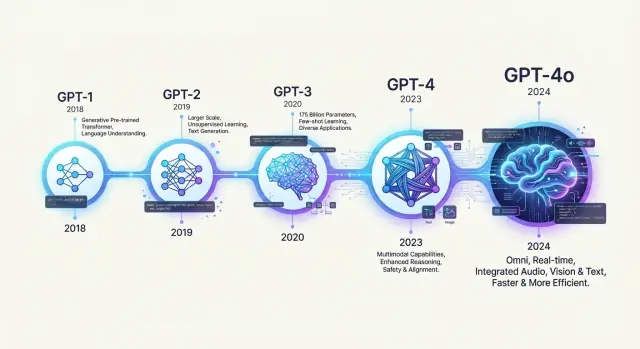
Why the history of GPT models matters
GPT models are a family of large language models built to predict the next word in a sequence of text. They read massive amounts of text, learn patterns in how language is used, and then use those patterns to generate new text, answer questions, write code, summarize documents, and much more.
The acronym itself explains the core idea:
- Generative – they create new text, not just classify existing text.
- Pre-trained – they are trained on broad data first, then adapted to specific tasks.
- Transformer – they use the transformer architecture, which is very good at modeling long-range dependencies in language.
Understanding how these models evolved helps make sense of what they can and cannot do, and why each generation feels like such a jump in capability. Each version reflects specific technical choices and trade-offs about model size, training data, objectives, and safety work.
- GPT-1 introduced the basic recipe: pre-train on general text, then fine-tune.
- GPT-2 scaled that recipe and sparked the first public debates about powerful text generators.
- GPT-3 showed strong few-shot and in-context learning, delivered mostly through an API.
- GPT-3.5 turned that research capability into something people could use every day.
- GPT-4 improved reasoning and added multimodal abilities (text plus images).
- GPT-4o and GPT-4o mini focused on efficiency, cost, and real-time, interactive use.
This article follows a chronological, high-level overview: from early language models and GPT-1, through GPT-2 and GPT-3, to instruction tuning and ChatGPT, and finally GPT-3.5, GPT-4, and the GPT-4o family. Along the way, we will look at the main technical trends, how usage patterns changed, and what these shifts suggest about the future of large language models.
Foundations: from early language models to GPT
Before GPT, language models were already a core part of NLP research. Early systems were n‑gram models, which predicted the next word from a fixed window of previous words using simple counts. They powered spelling correction and basic autocomplete but struggled with long‑range context and data sparsity.
The next big step was neural language models. Feed‑forward networks and later recurrent neural networks (RNNs), especially LSTMs and GRUs, learned distributed word representations and could, in principle, handle longer sequences. Around the same time, models like word2vec and GloVe popularized word embeddings, showing that unsupervised learning from raw text could capture rich semantic structure.
However, RNNs were slow to train, hard to parallelize, and still struggled with very long contexts. The breakthrough came with the 2017 paper “Attention Is All You Need”, which introduced the transformer architecture. Transformers replaced recurrence with self‑attention, letting models directly connect any two positions in a sequence and making training highly parallel.
This opened the door to scaling language models far beyond what RNNs could manage. Researchers began to see that a single, large transformer trained to predict the next token on massive text corpora could learn syntax, semantics, and even some reasoning skills without task‑specific supervision.
OpenAI’s key idea was to formalize this as generative pre‑training: first train a large decoder‑only transformer on a broad internet‑scale corpus to model text, then adapt that same model to downstream tasks with minimal additional training. This approach promised a single general‑purpose model instead of many narrow ones.
That conceptual shift—from small, task‑specific systems to a large, generatively pre‑trained transformer—set the stage for the first GPT model and the entire GPT series that followed.
GPT-1: the first generative pre-trained transformer
GPT-1 marked OpenAI’s first step toward the GPT series we know today. Released in 2018, it had 117 million parameters and was built on the Transformer architecture introduced by Vaswani et al. in 2017. Though small by later standards, it crystallized the core recipe that all later GPT models follow.
The core training idea
GPT-1 was trained with a simple but powerful idea:
- Generative pre-training on a large, general-purpose text corpus.
- Task-specific fine-tuning on smaller labeled datasets.
For pre-training, GPT-1 learned to predict the next token in text drawn primarily from BooksCorpus and Wikipedia-style sources. This objective—next-word prediction—required no human labels, allowing the model to absorb broad knowledge about language, style, and facts.
After pre-training, the same model was fine-tuned with supervised learning on classic NLP benchmarks: sentiment analysis, question answering, textual entailment, and others. A small classifier head was added on top, and the whole model (or most of it) was trained end-to-end on each labeled dataset.
The key methodological point was that the same pre-trained model could be lightly adapted to many tasks, instead of training a separate model for each task from scratch.
Research insights from a modest-scale model
Despite its relatively small size, GPT-1 delivered several influential insights:
- Pre-training as general-purpose NLP learning: The paper showed that a single generative model, trained on raw text, could match or beat task-specific architectures on multiple benchmarks after fine-tuning.
- Transformers work well for language: Prior state-of-the-art models often used recurrent or convolutional networks. GPT-1 helped validate pure Transformer decoders as a strong architecture for language modeling.
- Scaling hints: The results suggested that performance kept improving as model size and data grew, hinting that much larger models might unlock new capabilities.
- Unified architecture, many tasks: GPT-1 used essentially one architecture and one objective for many downstream problems, foreshadowing the “foundation model” idea.
GPT-1 already showed early traces of zero-shot and few-shot generalization, though this was not yet the central theme. Most evaluation still relied on fine-tuning separate models for each task.
Why GPT-1 stayed a research prototype
GPT-1 was never aimed at consumer deployment or a broad developer API. Several factors kept it in the research realm:
- Scale limits: 117M parameters was small enough that generation quality and factuality were clearly constrained.
- Narrow evaluation focus: The work centered on NLP benchmarks, not interactive assistants or production use cases.
- Safety and reliability not yet foregrounded: There was little discussion of misuse, hallucinations, or alignment; those concerns grew with later models.
- No public-facing product: OpenAI released the paper and code, but not a managed service or interface.
Even so, GPT-1 established the template: generative pre-training on large text corpora, followed by simple task-specific fine-tuning. Every later GPT model can be viewed as a scaled, refined, and increasingly capable descendant of this first generative pre-trained transformer.
GPT-2: scaling up and first public debates
GPT-2, released in 2019, was the first GPT model that truly grabbed global attention. It scaled the original GPT-1 architecture from 117 million parameters to 1.5 billion, showing how far simple scaling of a transformer language model could go.
Scaling up: 1.5B parameters and what changed
Architecturally, GPT-2 was very similar to GPT-1: a decoder-only transformer trained with next-token prediction on a large web corpus. The key difference was scale:
- Parameters: 117M → 1.5B
- Data: Far larger and more diverse web text
This jump in size dramatically improved fluency, coherence over longer passages, and the ability to follow prompts without task‑specific training.
Zero-shot and few-shot surprises
GPT-2 made many researchers rethink what “just” next-token prediction could do.
Without any fine-tuning, GPT-2 could perform zero-shot tasks like:
- Answering factual questions from a prompt
- Translating short sentences between languages
- Generating summaries from a single input paragraph
With a couple of examples in the prompt (few-shot), performance often improved further. This hinted that large language models could internally represent a broad range of tasks, using in-context examples as an implicit programming interface.
Staged release and fears of misuse
The impressive generation quality triggered some of the first major public debates around large language models. OpenAI initially withheld the full 1.5B model, citing concerns over:
- Fake news and disinformation at scale
- Spam and low‑effort content flooding online platforms
- Impersonation and misleading chat-like agents
Instead, OpenAI adopted a staged release:
- Public release of a smaller 117M model
- Gradual release of 345M and 774M variants
- Full 1.5B model released later in 2019
This incremental approach was one of the earliest examples of an explicit AI deployment policy centered on risk assessment and monitoring.
Community experimentation and perception shifts
Even the smaller GPT-2 checkpoints led to a wave of open-source projects. Developers fine‑tuned models for creative writing, code autocompletion, and experimental chatbots. Researchers probed bias, factual errors, and failure modes.
These experiments changed how many people viewed large language models: from niche research artifacts to general-purpose text engines. GPT-2’s impact set expectations—and raised concerns—that would shape the reception of GPT-3, ChatGPT, and later GPT-4‑class models in the ongoing evolution of OpenAI’s GPT family.
GPT-3: in-context learning and the API era
GPT-3 arrived in 2020 with a headline 175 billion parameters, over 100× larger than GPT-2. That single number captured attention: it suggested sheer memorization power, but more importantly, it unlocked behaviors that hadn’t really been seen at scale before.
In-context learning and the rise of prompt engineering
The defining discovery with GPT-3 was in-context learning. Instead of fine-tuning the model on new tasks, you could paste a few examples into the prompt:
- Show it a handful of English–French sentence pairs, and it translated.
- Provide a few Q&A pairs, and it answered new questions.
- Demonstrate a style of writing, and it imitated that style.
The model wasn’t updating its weights; it was using the prompt itself as a kind of temporary training set. This led to ideas like zero-shot, one-shot, and few-shot prompting, and sparked the first wave of prompt engineering: carefully crafting instructions, examples, and formatting to coax better behavior without touching the underlying model.
From research result to commercial API
Unlike GPT-2, which had downloadable weights, GPT-3 was made available primarily through a commercial API. OpenAI launched a private beta of the OpenAI API in 2020, positioning GPT-3 as a general-purpose text engine that developers could call over HTTP.
This shifted large language models from niche research artifacts to a broad platform. Instead of training their own models, startups and enterprises could prototype ideas with a single API key, paying per token.
Key early use cases
Early adopters quickly explored patterns that would later feel standard:
- Coding help: generating code snippets, regexes, or refactoring suggestions.
- Writing aid: drafting emails, blog posts, marketing copy, and summaries.
- Prototyping products: building chatbots, semantic search, and no-code/low-code tools.
GPT-3 proved that a single, general model—accessible via an API—could power a wide range of applications, setting the stage for ChatGPT and later GPT-3.5 and GPT-4 systems.
Instruction tuning, alignment, and the rise of ChatGPT
Why instruction tuning was needed
Base GPT-3 was trained only to predict the next token on internet-scale text. That objective made it good at continuing patterns, but not necessarily at doing what people asked. Users often had to craft prompts carefully, and the model might:
- Ignore instructions or change topics
- Generate unsafe, biased, or factually wrong content without warnings
- Overconfidently assert nonsense
Researchers called this gap between what users want and what the model does the alignment problem: the model’s behavior wasn’t reliably aligned with human intentions, values, or safety expectations.
InstructGPT: learning to follow directions
OpenAI’s InstructGPT (2021–2022) was a turning point. Instead of only training on raw text, they added two key stages on top of GPT-3:
- Supervised fine-tuning (SFT): Human labelers wrote ideal responses to many prompts (e.g., “Explain quantum computing in simple terms”). The model was fine-tuned to imitate these examples.
- Reinforcement learning from human feedback (RLHF): Labelers ranked multiple model outputs for the same prompt. A “reward model” learned these preferences, and the base model was optimized (via policy gradients) to produce higher-ranked answers.
This produced models that:
- Follow explicit instructions more reliably
- Refuse more harmful requests
- Are generally more helpful and polite by default
In user studies, smaller InstructGPT models were preferred over much larger base GPT-3 models, showing that alignment and interface quality can matter more than raw scale.
From InstructGPT to ChatGPT
ChatGPT (late 2022) extended the InstructGPT approach to multi-turn dialogue. It was essentially a GPT-3.5-class model, fine-tuned with SFT and RLHF on conversational data instead of only single-shot instructions.
Instead of an API or playground aimed at developers, OpenAI launched a simple chat interface:
- Users could talk to the model like a messaging app
- Context across turns made it feel conversational and persistent
- People could correct the model, refine questions, and explore ideas iteratively
This lowered the barrier for non-technical users. No prompt engineering expertise, no code, no configuration—just type and get answers.
The result was a mainstream breakthrough: technology built on years of transformer research and alignment work suddenly became accessible to anyone with a browser. Instruction tuning and RLHF made the system feel cooperative and safe enough for wide release, while the chat interface turned a research model into a global product and everyday tool.
GPT-3.5: from research system to everyday tool
GPT-3.5 marked the moment when large language models stopped being mostly a research curiosity and started to feel like everyday utilities. It sat squarely between GPT-3 and GPT-4 in capability, but its real significance was how accessible and practical it became.
A bridge between GPT-3 and GPT-4
Technically, GPT-3.5 refined the core GPT-3 architecture with better training data, updated optimization, and extensive instruction tuning. Models in the series—including text-davinci-003 and later gpt-3.5-turbo—were trained to follow natural language instructions more reliably than GPT-3, respond more safely, and maintain coherent multi-turn conversations.
This made GPT-3.5 a natural stepping stone toward GPT-4. It previewed patterns that would define the next generation: stronger reasoning on everyday tasks, better handling of longer prompts, and more stable dialogue behavior, all without the full jump in complexity and cost associated with GPT-4.
ChatGPT and the rise of conversational AI
The first public release of ChatGPT in late 2022 was powered by a GPT-3.5-class model fine-tuned with reinforcement learning from human feedback (RLHF). This dramatically improved how the model:
- Stayed on topic across multiple turns
- Asked for clarification instead of guessing
- Followed instructions phrased in casual language
For many people, ChatGPT was their first hands-on experience with a large language model, and it set expectations for what “AI chat” should feel like.
gpt-3.5-turbo and why it became the default
When OpenAI released gpt-3.5-turbo through the API, it offered a compelling mix of price, speed, and capability. It was cheaper and faster than earlier GPT-3 models, yet provided better instruction following and dialogue quality.
This balance made gpt-3.5-turbo the default choice for many applications:
- Startups used it for customer support bots, content generation, and internal tools.
- Developers adopted it for code explanation, inline documentation, and simple code synthesis.
- Product teams integrated it into productivity apps, turning features like autocomplete, summarization, and drafting into standard expectations.
GPT-3.5 therefore played a pivotal transitional role: powerful enough to unlock real products at scale, economical enough to be widely deployed, and aligned closely enough with human instructions to feel genuinely useful in everyday workflows.
GPT-4: multimodal models and stronger reasoning
GPT-4, released by OpenAI in 2023, marked a shift from “large text model” to general-purpose assistant with stronger reasoning skills and multimodal input.
From GPT-3 to GPT-4: what actually changed
Compared with GPT-3 and GPT-3.5, GPT-4 focused less on sheer parameter count and more on:
- Reasoning and reliability: Better performance on exams and benchmarks (bar exams, Olympiad-style problems, coding challenges), and fewer obvious logic errors.
- Steerability: System messages let developers specify style, role, and constraints more directly.
- Longer context: Certain GPT-4 variants handle much longer prompts, enabling document-level analysis and multi-step workflows.
The flagship family included gpt-4 and later gpt-4-turbo, which aimed to deliver similar or better quality at lower cost and latency.
Multimodal: understanding more than text
A headline feature of GPT-4 was its multimodal ability: in addition to text input, it could accept images. Users could:
- Ask questions about diagrams, charts, or handwritten notes
- Get descriptions of user interface screenshots
- Use images to guide code, design, or data extraction tasks
This made GPT-4 feel less like a text-only model and more like a general reasoning engine that happens to communicate via language.
Safety, alignment, and control
GPT-4 was also trained and tuned with a stronger emphasis on safety and alignment:
- Expanded RLHF (reinforcement learning from human feedback) to reduce harmful or misleading outputs
- More refined content policies and refusal behaviors
- Better tools for controlling tone, verbosity, and persona through system prompts and API settings
Models such as gpt-4 and gpt-4-turbo became the default choice for serious production uses: customer support automation, coding assistants, education tools, and knowledge search. GPT-4 set the stage for later variants like GPT-4o and GPT-4o mini, which pushed further on efficiency and real-time interaction while inheriting many of GPT-4’s reasoning and safety advances.
GPT-4o and GPT-4o mini: efficiency and real-time use
GPT-4o ("omni") marks a shift from “most capable at any cost” toward “fast, affordable, and always-on.” It is designed to deliver GPT-4‑level quality while being much cheaper to run and quick enough for live, interactive experiences.
What GPT-4o is optimized for
GPT-4o unifies text, vision, and audio in a single model. Instead of bolting separate components together, it natively handles:
- Text chat and coding
- Image understanding (screenshots, photos, diagrams)
- Real-time audio input and output
This integration cuts down on latency and complexity. GPT-4o can respond in near real time, stream answers as it thinks, and seamlessly switch between modalities within one conversation.
Speed, cost, and everyday access
A key design goal for GPT-4o was efficiency: better performance per dollar and lower latency per request. This allows OpenAI and developers to:
- Offer cheaper or even free tiers while keeping quality high
- Power high-volume products (chat, support, education) without prohibitive costs
- Run more interactive features like streaming responses and live corrections
The result is that capabilities once reserved for limited, high-priced APIs are now accessible to students, hobbyists, small startups, and teams experimenting with AI for the first time.
GPT-4o mini: small, fast, and everywhere
GPT-4o mini pushes accessibility further by trading some peak capability for speed and ultra-low cost. It is well suited for:
- Always-on assistants and background agents
- Simple chatbots, routing, and summarization
- Lightweight tools that need quick, inexpensive responses
Because 4o mini is economical, developers can embed it in many more places—inside apps, customer portals, internal tools, or even on low-budget services—without worrying as much about usage bills.
Together, GPT-4o and GPT-4o mini extend advanced GPT features to real-time, conversational, and multi-modal use cases, while widening who can practically build with—and benefit from—state-of-the-art models.
Technical trends shaping GPT evolution
Several technical currents run through every generation of GPT models: scale, feedback, safety, and specialization. Together, they explain why each new release feels qualitatively different, not just bigger.
Scaling laws and the “more data, more compute, better models” pattern
A key discovery behind GPT progress is scaling laws: as you increase model parameters, dataset size, and compute in a balanced way, performance tends to improve smoothly and predictably across many tasks.
Early models showed that:
- Larger transformers trained on more diverse, higher-quality text generalize better.
- Many abilities (translation, coding, reasoning-like behavior) emerge once scale passes certain thresholds, even without task-specific training.
This led to a systematic approach:
- Plan model size and dataset size together, based on empirical scaling curves.
- Use ever-larger, deduplicated, filtered corpora mixing web data, books, code, and proprietary data.
- Optimize training efficiency (better parallelism, kernels, hardware utilization) to make each scaling step economically viable.
Reinforcement learning from human feedback (RLHF)
Raw GPT models are powerful but indifferent to user expectations. Reinforcement learning from human feedback (RLHF) reshapes them into helpful assistants:
- Collect human-written or human-rated responses to prompts.
- Train a reward model that predicts which responses people prefer.
- Use reinforcement learning (often Proximal Policy Optimization) so the base model learns to generate high‑reward responses.
Over time, this evolved into instruction tuning + RLHF: first fine‑tune on many instruction–response pairs, then apply RLHF to refine behavior. This combination underpins ChatGPT‑style interactions.
Safety evaluations and content filters
As capabilities grew, so did the need for systematic safety evaluations and policy enforcement.
Technical patterns include:
- Dedicated red‑teaming and automated tests for misuse scenarios (e.g., harmful advice, disallowed content).
- Safety‑tuned variants of the model, optimized to refuse or redirect risky requests.
- Content filters that run alongside the model: classifiers and heuristics checking prompts and outputs against safety policies before delivery.
These mechanisms are repeatedly iterated: new evaluations discover failure modes, which feed back into training data, reward models, and filters.
From one giant model to tailored model families
Earlier releases centered on a single “flagship” model with a few smaller variants. Over time, the trend shifted toward families of models optimized for different constraints and use cases:
- High‑end models for complex reasoning and multimodal tasks.
- Lighter, cheaper models (such as “mini” variants) aimed at real‑time interaction, large‑scale deployment, or edge use.
- Specialized models tuned for coding, moderation, or enterprise workflows.
Under the hood, this reflects a mature stack: shared base architectures and training pipelines, then targeted fine‑tuning and safety layers to produce a portfolio rather than a single monolith. This multi‑model strategy is now a defining technical and product trend in GPT evolution.
How GPT models changed AI usage and applications
GPT models turned language-based AI from a niche research tool into infrastructure that many people and organizations now build on.
New building blocks for developers
For developers, GPT models behave like a flexible “language engine.” Instead of hand‑coding rules, they send natural‑language prompts and get back text, code, or structured outputs.
This has changed how software is designed:
- Prototypes can be built in hours using simple API calls.
- Apps offload complex tasks like summarization, translation, and code generation to the model.
- New patterns such as agents, tool use (function calling), and retrieval‑augmented generation have emerged.
As a result, many products now rely on GPT as a core component rather than an add‑on feature.
How businesses integrate GPT
Companies use GPT models both internally and in customer‑facing products.
Internally, teams automate support triage, draft emails and reports, assist with programming and QA, and analyze documents and logs. Externally, GPT powers chatbots, AI copilots in productivity suites, coding assistants, content and marketing tools, and domain‑specific copilots for finance, law, healthcare, and more.
APIs and hosted products make it possible to add advanced language features without managing infrastructure or training models from scratch, which lowers the barrier for small and medium‑sized organizations.
Effects on research, education, and creative work
Researchers use GPT to brainstorm hypotheses, generate code for experiments, draft papers, and explore ideas in natural language. Educators and students lean on GPT for explanations, practice questions, tutoring, and language support.
Writers, designers, and creators use GPT for outlining, ideation, world‑building, and polishing drafts. The model is less a replacement and more a collaborator that speeds up exploration.
Concerns and trade‑offs
The spread of GPT models also raises serious concerns. Automation may shift or displace some jobs while increasing demand for others, pushing workers toward new skills.
Because GPT is trained on human data, it can reflect and amplify social biases if not carefully constrained. It can also generate plausible but incorrect information, or be misused to produce spam, propaganda, and other misleading content at scale.
These risks have prompted work on alignment techniques, usage policies, monitoring, and tools for detection and provenance. Balancing powerful new applications with safety, fairness, and trust remains an open challenge as GPT models continue to advance.
Future directions and open questions for GPT models
As GPT models grow more capable, the core questions are shifting from can we build them? to how should we build, deploy, and govern them?
Technical frontiers
Efficiency and accessibility. GPT-4o and GPT-4o mini hint at a future where high-quality models run cheaply, on smaller servers, and eventually on personal devices. Key questions:
- How far can we shrink models while preserving reasoning quality?
- Can training and inference become energy-efficient enough to scale sustainably?
Personalization without overfitting. Users want models that remember preferences, style, and workflows without leaking data or becoming biased toward one person’s views. Open questions include:
- How to separate core model knowledge from user-specific adaptation?
- How to personalize safely across many devices and apps?
Reliability and reasoning. Even top models still hallucinate, fail silently, or behave unpredictably under distribution shift. Research is probing:
- Methods for verifiable reasoning and tooling-assisted checks
- Ways to represent uncertainty and say "I don’t know" appropriately
Societal and governance challenges
Safety and alignment at scale. As models gain agency through tools and automation, aligning them with human values—and keeping them aligned under continual updates—remains an open challenge. This includes cultural pluralism: whose values and norms are encoded, and how are disagreements handled?
Regulation and standards. Governments and industry groups are drafting rules for transparency, data use, watermarking, and incident reporting. The open questions:
- What should be mandatory (audits, red-teaming, safety evaluations)?
- How to harmonize rules across jurisdictions so innovation and safety both benefit?
A balanced outlook
Future GPT systems will likely be more efficient, more personalized, and more tightly integrated into tools and organizations. Alongside new capabilities, expect more formal safety practices, independent evaluation, and clearer user controls. The history from GPT-1 to GPT-4 suggests steady progress, but also that technical advances must move in step with governance, social input, and careful measurement of real-world impact.
FAQ
What is a GPT model in simple terms?
GPT (Generative Pre-trained Transformer) models are large neural networks trained to predict the next word in a sequence. By doing this at scale on massive text corpora, they learn grammar, style, facts, and patterns of reasoning. Once trained, they can:
- Generate new text (stories, emails, code)
- Answer questions and explain concepts
- Summarize and translate documents
- Act as conversational assistants or copilots in apps
Why does the history of GPT models matter for today’s users?
Knowing the history clarifies:
- Why capabilities jumped between versions (e.g., GPT-2 → GPT-3 → GPT-4)
- What each model is good and bad at (reasoning, context length, multimodality)
- How safety and alignment evolved (from raw text generation to ChatGPT-style assistants)
- Why current tools look the way they do, from APIs to chat interfaces and “mini” models
It also helps set realistic expectations: GPTs are powerful pattern learners, not infallible oracles.
What are the major milestones from GPT-1 to GPT-4o?
Key milestones include:
- GPT-1 (2018): Proved that a single generative transformer, pre-trained on text then fine-tuned, could handle many NLP tasks.
- GPT-2 (2019): Scaled to 1.5B parameters, showing strong zero-shot and few-shot abilities and sparking public debate about misuse.
- GPT-3 (2020): 175B parameters and strong in-context learning, delivered mainly via API.
- GPT-3.5 / ChatGPT (2022): Instruction tuning and RLHF turned GPT into a practical, conversational assistant.
- GPT-4 (2023): Better reasoning, longer context, and multimodal input (text + images).
- GPT-4o & 4o mini: Focus on efficiency, low cost, and real-time, multimodal interaction.
How do instruction tuning and RLHF change GPT behavior?
Instruction tuning and RLHF make models more aligned with what people actually want.
- Instruction tuning (SFT): Fine-tunes the model on many prompt–response pairs written by humans, so it learns to follow instructions clearly.
- RLHF: Trains a reward model from human rankings of outputs, then optimizes the GPT model to produce higher-rated answers.
Together they:
- Improve helpfulness and clarity
- Reduce unsafe or unwanted outputs
- Make smaller aligned models preferable to much larger unaligned ones in real use
What actually changed from GPT-3.5 to GPT-4?
GPT-4 differs from earlier models in several ways:
- Reasoning: Better performance on exams, coding tasks, and complex instructions.
- Steerability: System messages let developers shape tone, persona, and constraints.
- Context length: Some variants accept much longer inputs for document-scale tasks.
- Multimodality: It can accept images as input, enabling tasks like diagram analysis or UI understanding.
These changes push GPT-4 from a text generator toward a general-purpose assistant.
What are GPT-4o and GPT-4o mini best suited for?
GPT-4o and GPT-4o mini are optimized for speed, cost, and real-time use rather than just peak capability.
- GPT-4o: A single model handling text, images, and audio, with low latency suitable for live chat, voice assistants, and interactive tools.
- GPT-4o mini: Smaller and cheaper, ideal for:
- High-volume chatbots and support flows
- Lightweight summarization, routing, and drafting
- Always-on agents embedded across many apps
They make advanced GPT features economically viable for wider, everyday use.
How are developers and businesses integrating GPT models into products?
Developers commonly use GPT models to:
- Build chatbots and copilots (support, sales, internal tools)
- Draft and summarize emails, reports, tickets, and documentation
- Generate and explain code, tests, and data transformations
- Implement translation, sentiment analysis, and classification without bespoke ML
- Prototype complex workflows via tool use and retrieval-augmented generation
Because access is via API, teams can integrate these capabilities without training or hosting their own large models.
What are the main limitations and risks of today’s GPT models?
Current GPT models have important limitations:
- Hallucinations: They can produce confident but incorrect or fabricated information.
- Bias: Training data can encode social and cultural biases that appear in outputs.
- Context sensitivity: Performance can degrade on very long, messy, or out-of-distribution inputs.
- Lack of true understanding: They model patterns in text, not grounded world knowledge.
For critical uses, outputs should be verified, constrained with tools (e.g., retrieval, validators), and paired with human oversight.
What future directions for GPT models does the article highlight?
Several trends will likely shape future GPT systems:
- Efficiency: Smaller, cheaper models with near–GPT-4 quality, possibly running on personal or edge devices.
- Personalization: Safer ways to adapt to individual users’ preferences and workflows without leaking or overfitting to private data.
- Reliability: Better handling of uncertainty, verifiable reasoning, and explicit “I don’t know” behavior.
- Governance: Stronger standards for safety evaluations, transparency, and incident reporting as models gain capabilities and autonomy.
The direction is toward more capable yet more controlled and accountable systems.
How should teams think about using GPT models safely and effectively?
The article suggests several practical guidelines:
- Choose the right tier: Use high-end models (e.g., GPT-4-class) for complex reasoning; use 4o mini–style models for high-volume, simple tasks.
- Layer safety: Combine aligned models with content filters, usage policies, and human review where stakes are high.
- Design for verification: Treat outputs as drafts or suggestions, not ground truth; add retrieval and checks for critical information.
- Iterate prompts and UX: Small changes in instructions, context, and interface can greatly affect reliability and user trust.
Using GPTs effectively means pairing their strengths with safeguards and good product design.