

From Origins to Hype: Why Rust Programming Is Taking Off
Explore the history of Rust, its design goals, key milestones, and real-world adoption to understand why this memory-safe language is gaining traction.
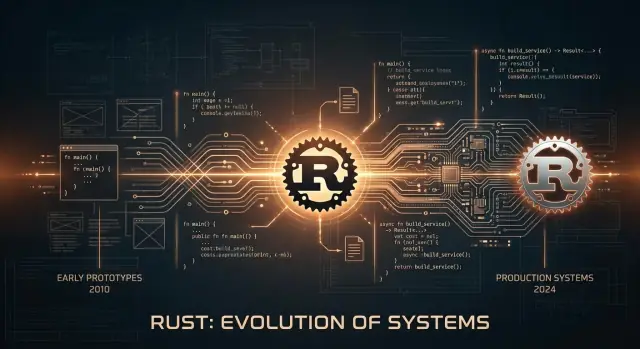
What Is Rust and Why Its Story Matters
Rust is a systems programming language focused on three things: memory safety, high performance, and fine-grained control over hardware. It aims to give you the power of C and C++—writing low-level, high-speed code—without the usual minefield of crashes, data races, and security vulnerabilities.
Rust’s core idea is that many bugs can be prevented at compile time. Through its ownership and borrowing model, Rust enforces strict rules about how data is shared and mutated. If your code compiles, you avoid entire classes of errors that often slip into production in other languages.
Why a New Systems Language Was Needed
Traditional systems languages were designed decades ago, before multi-core processors, internet-scale services, and the current focus on security. They offer great control, but memory errors, undefined behavior, and concurrency bugs are common and expensive.
Rust was created to keep the speed and control of those older languages while dramatically raising the safety bar. It tries to make “doing the right thing” the default, and “shooting yourself in the foot” much harder.
What This Article Covers—and Who It’s For
This article traces Rust’s path from an experimental project to a widely adopted language. We’ll explore its origins, key milestones, design goals, and technical features, along with its ecosystem, community governance, real-world use, business and security benefits, trade-offs, and future.
It’s written for:
- Developers weighing Rust against C, C++, Go, or others
- Tech leaders and architects evaluating stack choices
- Students and self-taught learners curious how and why modern languages emerge
Origins of Rust: From Personal Project to Backed Language
Rust began in 2006 as a side project by Graydon Hoare, then an engineer at Mozilla. After being frustrated by memory corruption bugs and crashes in software he used daily, Hoare started sketching a language that would give low-level control like C and C++ but with strong guarantees about safety. He experimented with ideas like affine types and ownership, trying to prevent entire classes of bugs at compile time instead of relying on testing and careful discipline.
From experiment to Mozilla project
Mozilla noticed Hoare’s work around 2009, seeing alignment with its own struggle to keep Firefox both fast and secure. The company began sponsoring the project, first informally and then as an official research effort. This support gave Rust the time and space to move from a prototype compiler to something that could eventually power browser components.
Early public snapshots, such as the 0.x releases starting in 2012, made it clear that Rust was still very experimental. Major features—like the borrow checker, pattern matching semantics, and the syntax for lifetimes—were repeatedly redesigned. The language even shifted away from its first garbage-collected approach toward the ownership model it is known for today.
Shaped by early adopters
Feedback from adventurous users, especially systems programmers trying Rust on small tools and prototypes, was critical. Their complaints about ergonomics, cryptic error messages, and unstable libraries pushed the team to refine both the language and its tooling, laying the foundation for Rust’s later stability and appeal.
Key Milestones in Rust’s Evolution
Rust’s story is shaped by a sequence of deliberate milestones rather than sudden rewrites. Each step narrowed the experiment and hardened it into a production language.
From 0.x Experiments to Rust 1.0
Early 0.x releases (around 2010–2014) were highly experimental. Core ideas like ownership and borrowing existed, but syntax and libraries shifted frequently as the team searched for the right design.
By the 0.9 and 0.10 era, key concepts such as Option, pattern matching, and traits had stabilized enough that a path to 1.0 became realistic.
Rust 1.0 shipped in May 2015. The 1.0 release was less about features and more about a promise: stable language, stable standard library, and a focus on backwards compatibility so code wouldn’t break every six months.
Stability Guarantees and the RFC Process
Alongside 1.0, Rust formalized its stability story: new features would appear behind feature flags on the nightly compiler, and only move to stable once vetted.
The RFC (Request for Comments) process became the main vehicle for major decisions. Proposals like traits, async/await, and editions themselves went through public RFCs, with open discussion and iteration.
Rust Editions: 2015, 2018, 2021
Editions are infrequent, opt‑in bundles of improvements:
- 2015 Edition: essentially codified Rust 1.0 with minor polish.
- 2018 Edition: major usability upgrade, with module system cleanup, the
?operator, and groundwork for async. - 2021 Edition: smaller, focused on quality-of-life improvements and aligning the language with modern best practices.
Editions are explicitly backwards compatible: old code keeps compiling, and tools like cargo fix help migrate when teams choose.
Borrow Checker Improvements and Async/Await
Two technical milestones deeply changed how Rust feels to use:
- Non-Lexical Lifetimes (NLL), stabilized around the 2018 Edition, made the borrow checker far less rigid. Rust became better at understanding when values are no longer used, reducing “false positive” borrow errors.
- Async/await, stabilized in Rust 1.39 (2019), gave Rust first-class, ergonomic asynchronous programming backed by zero-cost abstractions. Instead of manually juggling futures and combinators, developers write async code that looks almost like synchronous code.
Together, these milestones turned Rust from a promising experimental language into a stable, evolving platform with a predictable upgrade path and a strong track record of compatibility.
Rust’s Design Goals: Safety, Speed, and Control
Rust was designed around a small set of clear priorities: memory safety, fearless concurrency, high performance, and practical productivity for systems programmers.
Safety without a Garbage Collector
The core idea is memory safety by default, but without a garbage collector.
Instead of runtime tracing, Rust enforces ownership, borrowing, and lifetimes at compile time. This prevents use-after-free, data races, and many buffer bugs before the code runs. You still manage memory manually, but the compiler checks your work.
This directly answers long‑standing C and C++ issues where manual management is powerful but error‑prone, and where security vulnerabilities often stem from undefined behavior.
Predictable, Low-Level Performance
Rust aims for performance comparable to C and C++. There is no GC pause, no hidden allocations imposed by the language, and very little runtime.
Zero-cost abstractions are a guiding principle: you can write expressive, high‑level code (iterators, traits, pattern matching) that compiles down to tight, predictable machine code.
This predictability matters for systems work such as kernels, game engines, databases, and real‑time services.
Control and Interoperability
Rust targets the same low-level control as C and C++: direct memory access, fine‑grained control over layout, and explicit handling of errors and resources.
Through extern "C" and FFI, Rust integrates with existing C code and libraries, letting teams adopt it incrementally. You can wrap C APIs safely, implement new components in Rust, and keep the rest of a system in C or C++.
Productivity and Concurrency
Beyond raw control, Rust’s design aims to make correct code easier to write:
- The type system encodes ownership rules.
- Concurrency APIs are checked to prevent data races.
- Helpful compiler errors guide you while refactoring.
Together, these goals turn traditional systems‑level pain points—memory bugs, data races, and unpredictable performance—into well‑defined, compiler‑enforced constraints.
Technical Features That Set Rust Apart
Rust’s appeal rests on a few core ideas that reshape how systems code is written, debugged, and maintained.
Ownership, Borrowing, and Lifetimes
Rust models memory with ownership: every value has a single owner, and when that owner goes out of scope, the value is dropped. Instead of implicit copies, you move values or borrow them.
Borrowing comes in two flavors: immutable (&T) and mutable (&mut T) references. Lifetimes describe how long these borrows remain valid. The compiler’s borrow checker uses these rules to reject data races, use-after-free, and many null or dangling-pointer bugs at compile time, without a garbage collector.
Zero-Cost Abstractions
Rust’s iterators, closures, and higher-level APIs are designed so their compiled code is as efficient as hand-written loops. This “zero-cost abstraction” philosophy means you can use rich standard library constructs without paying hidden runtime overhead.
Types, Traits, and Pattern Matching
Rust’s type system encourages precise modeling of intent. Enums let you represent variants with associated data, rather than scattering flags and magic values. Traits provide shared behavior without inheritance, and generics allow writing reusable, type-safe code without runtime type checks.
Pattern matching (match, if let, while let) lets you deconstruct complex types in a concise, exhaustive way, forcing you to handle every possible case.
Explicit, Expressive Error Handling
Instead of exceptions, Rust uses Result<T, E> for recoverable errors and Option<T> for presence/absence. This pushes error handling into the type system, so the compiler enforces that you handle failures deliberately, improving reliability without sacrificing clarity.
Ecosystem and Tooling: Cargo, Crates.io, and Beyond
Rust’s rise is tightly linked to its tools. The language ships with an opinionated workflow that makes building, testing, and sharing code much smoother than in many systems languages.
Cargo: Build Tool and Package Manager
Cargo is Rust’s unified build system and package manager. One command (cargo build) compiles your project, handles incremental builds, and wires in dependencies. Another (cargo run) builds and executes; cargo test runs all tests.
Dependencies are declared in a single Cargo.toml file. Cargo resolves versions, fetches code, compiles it, and caches outputs automatically, so even complex projects stay manageable.
Crates.io and Code Reuse
Crates.io is the central registry for Rust packages (“crates”). Publishing a crate is a single Cargo command, and consuming it is just adding an entry to Cargo.toml.
This has encouraged code reuse across domains: serialization (Serde), HTTP and web frameworks (Reqwest, Axum, Actix Web), CLI tooling (Clap), async runtimes (Tokio, async-std), embedded crates for no_std targets, and a growing set of WebAssembly-focused projects.
rustup, Docs, Tests, and Beyond
rustup manages toolchains and components: stable, beta, nightly compilers, plus rustfmt, clippy, and targets for cross-compilation. Switching versions or adding a new target is a single command.
Documentation and quality tooling are treated as first-class. cargo doc builds API docs from code comments, cargo test integrates unit and integration tests, and cargo bench (with nightly) supports benchmarks. Together, they encourage libraries that are well-documented, well-tested, and ready for real production uses across web, CLI, embedded, async services, and WASM modules.
Community and Governance Behind Rust’s Growth
Rust’s rise is tightly linked to how it is governed and how its community operates: open, deliberate, and relentlessly focused on helping people succeed with the language.
Open collaboration and team-based leadership
Rust development happens in the open, primarily on GitHub. Work is split across dedicated teams—language, compiler, libraries, tooling, infrastructure, community, and more. Each team has clear ownership and published charters, but decisions are made through discussion and consensus rather than top‑down directives.
This structure lets companies, individual contributors, and researchers all participate on equal technical footing. Maintainers are visible and reachable, which lowers the barrier for new contributors to show up, propose changes, and eventually join teams.
The RFC process and transparent decision-making
Major changes to Rust go through the Request for Comments (RFC) process. Proposals are opened as public documents, debated in issues and pull requests, and refined in the open. Once a team reaches “final comment period,” the outcome is clearly documented along with the rationale.
This process slows down risky changes, creates an accessible design record, and gives users a say in the direction of the language long before features ship in a stable release.
Rust Foundation and long-term stewardship
Formed in 2021, the Rust Foundation provides legal, financial, and organizational backing. It holds trademarks and other IP, funds critical infrastructure like crates.io, and supports maintainers through grants and sponsorships.
Importantly, the Foundation does not own the language roadmap. Technical direction remains in the community-led teams, preventing any single company from taking control while still inviting industry investment and participation.
Inclusivity, documentation, and learning culture
Rust’s community has prioritized inclusivity from early on. A clear Code of Conduct, active moderation, and explicit expectations for respectful collaboration make official forums, Discord, and Zulip approachable even for beginners.
The project invests heavily in documentation: The Rust Programming Language (“The Book”), Rust by Example, rustdoc-generated API docs, and exercises like Rustlings. Compiler error messages are written to teach, often suggesting concrete fixes. This mix of friendly tone, excellent docs, and guidance in the tooling itself makes the language more welcoming than many systems-programming communities.
Events, meetups, and online spaces
Conferences such as RustConf, RustFest, and newer regional events, plus countless local meetups, give users a place to share war stories, patterns, and production experiences. Many talks are published online, so ideas spread well beyond attendees.
Meanwhile, forums, community blogs, and Q&A spaces help teams see real-world pain points quickly, feeding back into design and tooling improvements. That tight feedback loop between practitioners and maintainers has been a major driver of Rust’s adoption across companies and projects.
Rust in Production: Where It’s Being Used and Why
Rust has moved well beyond experiments and side projects into mainstream production systems.
Who Uses Rust
Organizations such as Mozilla, Microsoft, Google, AWS, Cloudflare, Dropbox, and Discord have publicly discussed using Rust in parts of their infrastructure. Rust appears in browsers, cloud services, networking stacks, game engines, databases, and even operating-system components.
Open-source projects amplify this trend. Examples include parts of Firefox, the Servo engine, modern databases and message brokers, build tools, and kernels or unikernels written partly in Rust. When a widely used project adopts Rust for a critical path, it validates the language for many other teams.
Typical Production Use Cases
Rust is especially common where performance and control matter:
- Systems software: kernels, drivers, filesystems, networking, distributed systems.
- Web services and APIs: high-throughput backends, proxies, and edge services.
- Command-line tools: fast, portable CLIs that are easy to distribute.
- Embedded and IoT: firmware and low-level controllers where memory is scarce and failures are costly.
Why Teams Choose Rust
The primary draw is memory safety without garbage collection. Rust’s type system and ownership model prevent many vulnerabilities (buffer overflows, use-after-free, data races) at compile time, which is attractive for security-sensitive components such as cryptography, sandboxing layers, and parsers.
In many codebases, Rust either replaces existing C/C++ modules or augments them with safer new components while keeping C ABI boundaries. This incremental adoption path lets teams modernize hotspots and security-critical sections without rewriting entire systems, making Rust a pragmatic choice for production work.
How Rust Compares to C, C++, Go, and Other Languages
Rust sits at an interesting point: it offers low-level control like C and C++, but with a very different approach to safety and tooling.
Rust vs. C and C++
C and C++ put full responsibility for memory on the programmer: manual allocation, pointer arithmetic, and few guarantees against use-after-free, data races, or buffer overflows. Undefined behavior is easy to introduce and hard to track down.
Rust keeps the same ability to work close to the metal, but enforces ownership, borrowing, and lifetimes at compile time. The borrow checker ensures that references are valid and that mutation is controlled, eliminating many classes of memory bugs without a garbage collector.
The trade-off: C/C++ can feel more flexible and sometimes quicker for very small, low-level hacks, while Rust often forces you to restructure code to satisfy the compiler. In return, you get stronger safety guarantees and usually comparable performance.
Rust vs. Go
Go favors simplicity and fast iteration. Garbage collection, goroutines, and channels make concurrent network services straightforward. Latency-sensitive or memory-constrained workloads, however, may struggle with GC pauses or overhead.
Rust opts for explicit control: no GC, fine-grained ownership of data across threads, and zero-cost abstractions. Concurrency is safe by construction but sometimes more verbose. For teams prioritizing developer speed and easy onboarding, Go can be preferable; for tight performance budgets or strict safety requirements, Rust often wins.
Rust vs. Managed Languages (Java, C#, etc.)
Managed languages run on virtual machines, rely on garbage collectors, and emphasize productivity, rich standard libraries, and mature ecosystems. They shine for large business applications, web backends, and systems where absolute performance is less critical than development speed and maintainability.
Compared with them, Rust offers:
- Similar or better raw performance
- Predictable latency (no GC pauses)
- Direct control over memory layout and system resources
But you sacrifice some conveniences: reflection-heavy frameworks, dynamic class loading, and large, time-tested enterprise stacks are still mostly in Java, C#, or similar.
Choosing Rust vs. Other Options
Rust is often an excellent fit for:
- Systems programming: OS components, drivers, databases, game engines
- Performance-critical services: proxies, observability agents, crypto, data processing
- Security-sensitive components where memory safety is non-negotiable
Another language may be better when:
- You need the fastest possible prototype or small internal tool (Python, JavaScript, Go)
- Your organization depends on existing JVM or .NET ecosystems
- You’re doing heavy data science or ML (Python, R, Julia)
Rust can also serve as a “systems core” inside larger applications written in higher-level languages, via FFI bindings. This hybrid approach lets teams keep rapid development in familiar stacks while moving performance- or security-critical pieces to Rust over time.
Why Developers Enjoy Writing Rust Code
Rust has a reputation for being “hard,” yet many developers end up calling it their favorite language. The learning curve is real, especially around ownership and borrowing, but it’s also what makes the language satisfying.
Ownership as an “aha!” moment
At first, ownership and the borrow checker feel strict. You battle compiler errors about lifetimes, moves, and borrows. Then something clicks: those rules encode clear mental models about who owns data and who is allowed to use it when.
Developers often describe this as trading runtime surprises for compile-time guidance. Once you internalize ownership, concurrency and memory management feel less scary, because the compiler forces you to think through edge cases early.
The compiler as a teammate
Rust’s compiler errors are famously detailed. They point directly to problematic code, suggest fixes, and include links to explanations. Instead of vague messages, you get actionable hints.
This, combined with cargo for builds, testing, and dependency management, makes the toolchain feel cohesive. rustfmt, clippy, and excellent IDE integration give you feedback before you even run the code.
Modern libraries and practices
Rust’s ecosystem encourages modern patterns: async I/O, strong type-safety, expressive enums and pattern matching, and dependency injection via traits instead of inheritance. Popular crates (like tokio, serde, reqwest, axum, bevy) make it pleasant to build real systems.
A community that values care
The community tends to emphasize kindness, documentation, and learning. Official guides are approachable, crate authors write thorough docs, and questions are usually met with patience.
Developers say they prefer Rust because it:
- Catches entire classes of bugs at compile time
- Encourages clear, explicit code
- Makes concurrency less terrifying
- Feels thoughtfully designed rather than accidental
The result is a language that can be challenging to start, but deeply rewarding to master.
Business and Security Reasons Rust Gains Traction
Fewer Security Incidents from Memory Safety
Many high‑profile security vulnerabilities trace back to memory bugs: use‑after‑free, buffer overflows, data races. Rust’s ownership and borrowing model prevents most of these at compile time, without relying on a garbage collector.
For businesses, that translates into fewer critical CVEs, less emergency patching, and lower reputational and legal risk. Security teams can focus on higher‑level threats instead of fighting the same memory‑safety fires.
Reliability and Lower Maintenance Costs
Rust code that compiles tends to fail less at runtime. The type system and strict error handling push edge cases to the surface during development.
Over the lifetime of a product, this means:
- Fewer production crashes and outages
- Simpler incident response and root‑cause analysis
- Reduced maintenance overhead as systems age
Stable, predictable behavior is particularly attractive for infrastructure, networking, and embedded products that must run for years.
Concurrency Without Chaos
Rust encourages highly concurrent architectures—async I/O, multi‑threaded services—while preventing data races at compile time. That reduces elusive concurrency bugs, which are among the most expensive to diagnose in production.
The financial impact shows up as lower on‑call fatigue, fewer late‑night rollbacks, and more efficient use of hardware due to safe parallelism.
Compliance, Regulation, and Policy Pressure
Governments and large enterprises are starting to call out memory‑unsafe languages as systemic risk. Rust fits emerging guidance that favors languages with built‑in memory safety for critical systems.
Adopting Rust can support compliance narratives for:
- Secure‑by‑design initiatives
- Safety‑critical or regulated domains (finance, telecom, automotive, medical)
- Vendor and supply‑chain security reviews
Modernizing Legacy Systems Incrementally
A common obstacle is existing C or C++ code that no one can rewrite wholesale. Rust’s FFI makes gradual replacement practical: teams can wrap dangerous components with Rust, then peel away old modules over time.
This incremental approach:
- Improves security at the boundaries first
- Limits migration risk
- Lets teams build Rust expertise while systems stay online
The result is a path to modern, safer infrastructure without disruptive rewrites or multi‑year big‑bang projects.
Challenges, Trade-offs, and Criticisms of Rust
Rust solves serious problems, but it also introduces real costs.
Steep Learning Curve
Ownership, borrowing, and lifetimes are the most frequent pain points. Developers used to garbage collection or manual memory management often struggle to internalize Rust’s rules.
The borrow checker can feel obstructive at first, and lifetimes in generic or async code can look intimidating. This slows down onboarding and makes Rust harder to adopt for large teams with mixed experience levels.
Compile-Time Overhead
Rust moves many checks to compile time, which improves safety but increases compile times, especially for large projects and heavy generics.
This affects iteration speed: quick change–compile–run cycles can feel sluggish compared with scripting languages or smaller C/C++ projects. The community is investing heavily in faster incremental compilation, improved linker performance, and features like cargo check to keep feedback loops shorter.
Ecosystem Gaps and Interoperability
Compared with decades-old ecosystems around C++, Java, or Python, Rust still has gaps:
- Fewer mature options for GUI frameworks, data science, and certain enterprise domains
- Less tooling and libraries around legacy protocols and specialized hardware
Interoperability with existing C/C++ or JVM codebases is also non-trivial. While FFI works, it introduces unsafe boundaries, build complexity, and extra glue code.
The community is addressing this through focused working groups, bindings and bridges (such as bindgen, cxx, and other FFI helpers), long-term library maintenance efforts, and initiatives to standardize patterns across popular crates, making Rust more practical as a gradual, incremental addition to existing systems rather than a greenfield-only choice.
The Future of Rust and Its Role in Software Development
Rust is moving from an interesting alternative to a foundational part of modern systems. Over the next decade, its influence is likely to deepen in places where correctness, performance, and long-term maintainability matter most.
Deeper into Operating Systems and Low-Level Software
Rust is already used in kernels, drivers, and firmware, and that trend should accelerate. Memory safety without a garbage collector is exactly what OS and embedded teams want.
Expect more hybrid systems: C or C++ cores with new components written in Rust, especially drivers, filesystems, and security-sensitive modules. As more standard libraries and kernel APIs gain first-class Rust support, greenfield kernels and microkernels in Rust will look increasingly practical rather than experimental.
Cloud Infrastructure, Networking, and WASM
Cloud providers, CDNs, and networking vendors are steadily adopting Rust for proxies, control planes, and performance-critical services. Its async story and strong type system are well-suited to high-throughput, network-heavy workloads.
On the application side, WebAssembly (WASM) is a natural match. Rust’s ability to compile to small, predictable binaries with tight control over memory makes it attractive for plugin systems, edge computing, and “functions at the edge” models that must be safe to run in untrusted environments.
Investment, Education, and the Talent Pipeline
Large companies are funding Rust teams, sponsoring tooling, and standardizing on Rust for new internal services. Major open-source infrastructure—databases, observability tools, developer platforms—is increasingly Rust-based, which further legitimizes the language for conservative organizations.
Universities are starting to offer Rust courses or integrate it into systems, security, and programming languages curricula. As graduates arrive already comfortable with ownership and borrowing, resistance to adopting Rust inside companies will drop.
Rust in the Future Software Stack
Rust is unlikely to replace C/C++ or higher-level languages outright. Instead, it is poised to own critical “spine” layers of software stacks: kernels, runtimes, core libraries, data engines, security-sensitive components, and performance bottlenecks.
Higher-level applications may remain in languages like Python, JavaScript/TypeScript, or Java, but with Rust underneath powering services, extensions, and high-value modules. If this trajectory continues, future developers may routinely stand on Rust-powered foundations without even realizing it.
Getting Started with Rust: Practical Steps for Newcomers
Rust rewards deliberate learning. Here’s a practical path that works well for both individuals and teams.
Step 1: Follow the official learning path
Start with The Rust Programming Language (often called “the Book”). It is the canonical reference, written and maintained by the Rust team, and teaches concepts in a logical order.
Complement it with:
- Rust By Example for runnable, focused examples
- Rustlings for small exercises that force you to read and understand real Rust code
Read the Book linearly up through ownership, borrowing, lifetimes, and error handling; skim later chapters and return when you hit those topics in practice.
Step 2: Use the Rust Playground and tiny CLI tools
Experiment in the Rust Playground while you learn ownership and lifetimes. It’s perfect for quick “what happens if…?” questions.
On your machine, install Rust with rustup, then build very small CLI projects:
- A todo list that reads/writes a local file
- A text search tool (a simplified
grep) - A JSON/CSV formatter
These projects are small enough to finish, but rich enough to touch I/O, error handling, and basic data structures.
Step 3: Rewrite small pieces from other languages
Take something you already know from Python, JavaScript, or C++ and rewrite just a small component in Rust:
- A pure function (e.g., a parser or data transformer)
- A performance‑critical loop
- A small library with a clean API
This makes Rust concepts concrete, because you already understand the problem and can focus on the language differences.
Step 4: Use community channels for questions
When you get stuck, don’t stay stuck alone. Rust has an active, friendly community across multiple channels:
- The official user forum
- Community Discord and Zulip chat
- Q&A on programming forums and Rust‑tagged questions on major help sites
- The /r/rust community for announcements and discussion
Asking “Why does the borrow checker reject this?” with a minimal code sample is one of the fastest ways to level up.
Step 5: Introduce Rust incrementally in teams
For existing teams and codebases, avoid an all‑or‑nothing rewrite. Instead:
- Start with internal tools: build or replace a small CLI utility in Rust
- Wrap a Rust library behind a C FFI or language‑specific bindings, so other services can call it without changing their stack
- Target performance‑ or safety‑critical slices first: parsing, crypto, data processing, or components prone to memory bugs
- Keep early Rust services small, well‑documented, and easy to observe and roll back
Encourage pair programming between Rust‑curious developers and someone slightly ahead on the learning path, and treat early Rust projects as learning investments as much as product work.
FAQ
What problems was Rust originally designed to solve?
Rust was created to bring memory safety and fearless concurrency to low-level systems programming without using a garbage collector.
It specifically targets:
- Memory bugs like use-after-free, buffer overflows, and data races
- Concurrency issues common in multi-threaded C/C++ code
- The difficulty of maintaining large, long-lived systems written in unsafe languages
Rust keeps C-like performance and control, but moves many classes of bugs from runtime to compile time through its ownership and borrowing model.
How is Rust different from C and C++ in real-world use?
Rust differs from C and C++ in several practical ways:
- Memory safety by default: Ownership, borrowing, and lifetimes are enforced by the compiler, preventing many common memory bugs.
- No garbage collector: You keep explicit control over memory, but the compiler checks your work.
- Modern tooling:
cargo,crates.io, andrustupprovide a unified build, dependency, and toolchain story out of the box. - Stronger guarantees: If your code compiles without
unsafe, you avoid entire classes of undefined behavior that are easy to slip into C/C++.
You still get low-level control, FFI with C, and predictable performance, but with far stricter safety guarantees.
Is Rust mature enough for production, and where is it used today?
Yes, Rust is widely used in production by companies like Mozilla, Microsoft, Google, AWS, Cloudflare, Dropbox, and Discord.
Typical production scenarios include:
- High-throughput web services and proxies
- System components such as kernels, drivers, and networking stacks
- Command-line tools that must be fast and portable
- Embedded and IoT software where crashes are costly
Many teams start by rewriting specific modules (parsers, crypto, performance hotspots) in Rust while keeping the rest of their stack in C, C++, or a managed language.
How hard is it to learn Rust, and how can I reduce the pain of the learning curve?
Rust has a real learning curve, mainly around ownership, borrowing, and lifetimes, but it is manageable with the right approach.
To make it easier:
- Learn using The Rust Programming Language (“the Book”) first, not only random snippets.
- Expect the borrow checker to feel strict; treat compiler errors as guidance, not blockers.
- Start with small CLI tools instead of large services.
- Use the Rust Playground to experiment with patterns you don’t understand.
Once the ownership model “clicks,” most developers report that concurrency and memory management feel simpler than in traditional systems languages.
When does it actually make sense to choose Rust over Go, Java, or Python?
Rust is a strong choice when you need performance, safety, and long-term reliability together. It’s especially appropriate when:
- You have strict latency requirements and can’t afford GC pauses.
- You’re building security- or safety-critical components (crypto, parsers, sandboxes, kernels, device control).
- You need fine-grained control over memory layout, threading, and system calls.
Languages like Go, Java, or Python may be better when:
- Time-to-market matters more than absolute performance.
- Your organization is deeply invested in their ecosystems and tooling.
- You’re building mostly business logic or data-heavy applications where GC overhead is acceptable.
How can we adopt Rust incrementally in an existing codebase?
You can introduce Rust gradually without rewriting everything:
- Start with tools: Build or replace small internal CLI utilities in Rust.
- Wrap Rust behind FFI: Expose a Rust library via a C ABI and call it from existing C/C++, Java, Python, or Node.js code.
- Target hotspots: Rewrite performance- or security-critical modules (parsing, crypto, data processing, edge services) in Rust first.
- Keep changes isolated: Give new Rust components clear boundaries and good observability so they’re easy to roll back.
This incremental approach lets you gain Rust’s benefits while limiting risk and avoiding big-bang rewrites.
What are the main drawbacks or risks of adopting Rust in a team?
The main drawbacks and risks are organizational, not just technical:
- Learning curve: Onboarding developers takes time; early development may slow down.
- Compile times: Large Rust projects can compile more slowly than small C or Go codebases.
- Ecosystem gaps: Some areas (GUIs, data science, certain enterprise domains) are less mature than in older ecosystems.
- Interoperability overhead: FFI boundaries introduce
unsafecode, build complexity, and extra glue.
Mitigate these by starting with small, focused projects, investing in training, and keeping unsafe and FFI surfaces minimal and well-reviewed.
How does Rust help with security and regulatory or compliance concerns?
Rust improves security mainly through memory safety and explicit error handling:
- The ownership model eliminates most use-after-free, buffer overflows, and data races in safe code.
Result<T, E>andOption<T>push error handling into the type system, so failures are handled deliberately.- Rust’s design aligns with emerging guidance that favors memory-safe languages for critical systems.
For compliance and risk management, this supports secure-by-design narratives and reduces the likelihood of high-impact memory-safety CVEs in core infrastructure.
What parts of Rust’s ecosystem and tooling should newcomers focus on first?
For early projects, you only need a small set of tools and concepts:
- rustup: to install and manage Rust toolchains (stable, beta, nightly).
- cargo: for building, testing, running, and managing dependencies.
- crates.io: to find and reuse community crates (e.g.,
serde,tokio,reqwest,clap). - rustfmt and clippy: for consistent formatting and linting.
Learn how to:
- Create a new project with
cargo new. - Add dependencies in
Cargo.toml. - Run tests with
cargo test.
This workflow is enough to build serious CLI tools and services before you touch more advanced features like async or FFI.
What is a concrete, step-by-step way to start learning Rust effectively?
A practical path looks like this:
- Work through the Book up through ownership, borrowing, lifetimes, and error handling.
- Use Rust By Example and Rustlings to reinforce concepts hands-on.
- Build tiny CLI projects (todo list, simple
grep, JSON/CSV formatter) to practice I/O and error handling. - Rewrite a small, known component from another language in Rust so you can focus on language differences, not problem definition.
- Ask questions early in community spaces when you get stuck.
For more detail, see the “Getting Started with Rust: Practical Steps for Newcomers” section in the article.