

The History of Stripe: From Startup Idea to Payments Leader
A clear timeline of Stripe’s growth—from early founders and product focus to major launches, global expansion, and its role in modern online payments.
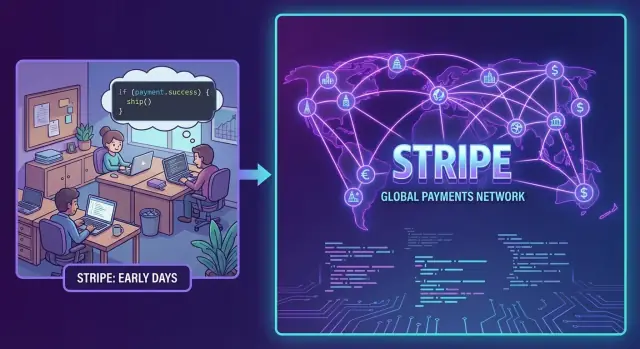
What Stripe Is and Why Its Origin Story Matters
Stripe is a payments platform: software that helps a business accept money online and route it to the right place—its bank account, a seller on a marketplace, or multiple parties in a single transaction.
That sounds simple, but behind the “Pay” button are problems most companies don’t want to build from scratch: securely collecting card details, connecting to banks and card networks, handling failed charges, managing refunds, preventing fraud, and keeping records that make accounting and customer support possible.
A practical history, not hype
This section (and the article overall) isn’t a celebration of a brand. It’s a practical history of how online payments went from slow and painful to integrate to something many teams can add in days.
Understanding that shift helps you evaluate payment tools with clearer expectations—especially around what you still need to own (pricing, checkout design, customer experience) versus what a platform can handle (payment rails, risk controls, and operational tooling).
Why Stripe’s story matters to merchants and developers
For merchants, Stripe’s origin story explains why modern payment providers emphasize speed to launch, global reach, and built-in risk controls. It also highlights trade-offs you’ll face as you grow: more payment methods, more countries, more compliance requirements, and higher expectations for reliability.
For developers, Stripe’s early choices around APIs and documentation shaped a “payments as software” approach—making billing, subscriptions, and marketplace payouts feel like product features rather than banking projects.
What you’ll learn in the timeline
Next, we’ll walk through the problem Stripe set out to fix, its early product focus, how it spread through the startup ecosystem, and how it expanded into a broader platform. You’ll see the milestones that turned Stripe from a developer tool into infrastructure used by global businesses.
The Problem Stripe Set Out to Fix
Stripe didn’t start as “a payments company” in the abstract—it started as an attempt to remove a very specific kind of friction: getting paid online was unnecessarily hard.
For many businesses, especially small teams and early-stage startups, the challenge wasn’t finding customers. It was getting from “someone wants to buy” to “money actually arrives,” without weeks of paperwork, confusing technical steps, and a patchwork of third-party tools.
What online payments looked like before Stripe
Before Stripe’s rise, accepting card payments on a website often felt like assembling furniture without the instructions.
Businesses typically had to:
- Set up a merchant account through a bank or processor (often slow and approval-heavy)
- Sign separate agreements for payment gateways and fraud tools
- Deal with complex documentation and inconsistent integration options
- Reconcile payments across dashboards that didn’t talk to each other
Even after everything was approved, the experience still wasn’t smooth. Updates were painful, testing was limited, and small mistakes could break checkout—turning paying customers into abandoned carts.
The key insight: make integration simple for developers
Stripe’s core insight was that payments adoption could be accelerated by treating developers as first-class users.
Instead of forcing businesses to navigate a maze of providers, Stripe pushed toward a single, clean integration model: straightforward APIs, clear documentation, and a faster path from “I want to accept payments” to “it’s live.” This developer-first approach wasn’t about coding for its own sake—it was about reducing the time and uncertainty between an idea and a working business.
Before vs. after (the practical difference)
Before Stripe: payments required multiple vendors, long setup times, and complicated implementation steps.
After Stripe: one provider could cover the core flow, onboarding was faster, and teams could launch with fewer moving parts—making it easier for new internet businesses to start charging customers and grow.
Founders, Early Vision, and the First Product Focus
Stripe is closely tied to its founders, Patrick and John Collison—two brothers who had already built software products before turning their attention to payments. Their perspective wasn’t “let’s start a bank.” It was more practical: online businesses were growing quickly, but accepting payments still felt like a maze of forms, gateways, and brittle integrations.
A simple goal: make payments feel like software
The initial vision centered on one idea: if the internet could make publishing, hosting, and analytics easier, why couldn’t it do the same for getting paid?
Stripe’s first product focus reflected that: a straightforward way for developers to accept card payments without needing deep payments expertise. Instead of asking businesses to stitch together multiple vendors, the product aimed to provide a clean API and a predictable set of building blocks.
Developer-first details that mattered
Early Stripe differentiated itself less through flashy features and more through the small things developers care about:
- Fast setup you could test quickly (including the ability to simulate payments)
- Clear, readable documentation that didn’t assume prior payments knowledge
- Sensible defaults, so teams could launch without weeks of configuration
This helped Stripe spread organically: a developer could try it, get a successful test, and show progress in a single afternoon.
Tight feedback loops shaped the product
In the beginning, the product evolved through close, frequent feedback from early users—often startup teams shipping quickly and unwilling to tolerate complex onboarding. That feedback influenced everything from error messages to dashboard usability to which edge cases needed to be handled automatically.
The result was a product that felt unusually polished for something as complicated as payment processing. Stripe didn’t try to solve every financial problem at once; it focused on removing the first, most painful hurdle: getting a working payment flow into production with minimal friction.
The Developer-First Approach That Drove Adoption
Stripe didn’t win early on by having the loudest brand—it won by making payments feel like a normal part of building software. Instead of forcing businesses to wrestle with long bank forms and confusing gateways, Stripe focused on the people actually implementing payments: developers.
What an API means (without the jargon)
An API is basically a “plug” and “socket” that lets two systems talk to each other. Think of it like ordering at a restaurant: you don’t walk into the kitchen and cook the meal yourself—you read a menu, place an order, and the kitchen sends back what you asked for.
Stripe’s API was that “menu” for payments: clear options, predictable results, and fewer mystery steps.
Easy integration became the advantage
For startups, speed matters. If adding payments takes weeks, it blocks launching and earning revenue. Stripe made integration feel like adding a simple feature: a small set of calls to accept a card payment, create a customer, or issue a refund. That reduced the need for specialized payment consultants and made it possible for small teams to move fast.
In practice, this is also why modern build tools tend to win: when you can go from idea to working checkout quickly, you can test pricing, onboarding, and conversion earlier. For example, vibe-coding platforms like Koder.ai can help teams scaffold a React web app (or a Flutter mobile app), add a checkout flow, and iterate via chat—then export source code when it’s time to harden the implementation and integrate payments properly.
Tooling that made developers confident
Stripe’s documentation became part of the product. Clear examples, straightforward explanations, and copy‑paste snippets helped teams get to a working checkout quickly.
Just as important was “test mode”—a safe sandbox where you could run fake transactions and simulate failures (like a declined card) without risking real money. That lowered anxiety and made teams more willing to try Stripe early.
Developer experience turns into word of mouth
When developers have a smooth setup, they recommend it. Stripe’s approach turned individual engineers into advocates—bringing it into new startups, side projects, and eventually larger companies. That quiet, repeated adoption created momentum that traditional sales-led payment providers struggled to match.
Early Customers and the Startup Ecosystem
Stripe’s earliest momentum came from startups building on the web and needing a payment system that didn’t slow them down. Instead of negotiating with banks, waiting on paperwork, or stitching together multiple vendors, founders could start accepting card payments quickly—often the same day they decided to charge.
Why startups reached for Stripe first
Early-stage companies tend to optimize for speed: ship a product, test pricing, and iterate. Stripe fit that rhythm with straightforward onboarding, clear documentation, and an API designed for product teams rather than finance departments.
Transparent pricing also mattered. Startups could forecast costs without worrying about hidden gateway fees or long-term contracts. That “what you see is what you pay” approach reduced friction in budgeting and made it easier to try paid plans early. (For a general sense of how pricing is structured, see /pricing.)
Common early use cases
Many early customers were SaaS companies turning free tools into paid subscriptions. Recurring billing, saved cards, and automated receipts meant a small team could run a paid service without building a finance stack from scratch.
Others were marketplaces and platform-style startups that needed to move money between multiple parties—buyers, sellers, and the business itself. Even basic “take a fee, pay the vendor” models were hard to implement reliably with older processors, so a developer-friendly toolkit became a competitive advantage.
Ecommerce startups also adopted Stripe early, especially those testing new product niches or launching quickly with minimal infrastructure. Being able to accept major cards, track payments, and handle refunds without complex setup helped these teams focus on customer acquisition and fulfillment rather than payment plumbing.
Expanding Beyond One Market: Global Payments Challenges
Stripe’s earliest momentum came from doing one thing extremely well: helping internet businesses accept card payments in a single, familiar market. But as those businesses grew, their customers didn’t stay neatly inside one country. The next phase of Stripe’s story is the messy reality of taking a payment product global.
Why global reach is hard in payments
Payments look simple at checkout, yet behind the scenes they’re tied to local rules, banking systems, and customer expectations. Expanding internationally means navigating differences in:
- Regulation and compliance: identity checks, data handling expectations, and reporting requirements vary widely.
- Banking and settlement: how money moves from a customer to a merchant can depend on domestic networks, cut-off times, and local banking relationships.
- Risk and dispute norms: fraud patterns, chargeback processes, and what counts as acceptable evidence can differ by region.
- Customer behavior: shoppers often trust the payment methods they grew up with—not necessarily cards.
Local payment methods and multi-currency support
To serve international businesses well, Stripe had to think beyond “accept Visa and Mastercard.” In many countries, customers prefer bank transfers, debit schemes, or wallet-based payments.
Supporting these methods isn’t just adding a new button on checkout; it can require different authorization flows, different confirmation timing (instant vs. delayed), different refund mechanics, and new reconciliation patterns.
Multi-currency support adds another layer. Pricing, conversion, and settlement in different currencies affect everything from how customers see totals to how businesses manage cash flow. Even when a product can display a currency, it still needs a reliable way to move and settle funds accurately.
Compliance and banking partnerships (high level)
Global payments typically require working with local financial institutions and partners to access domestic networks and meet regional requirements. Alongside product work, that means building processes and controls that scale across countries—so businesses can expand without re-architecting their payments stack each time they enter a new market.
Key Product Milestones: From Payments to a Platform
Stripe’s early win was straightforward: make it easy for an internet business to accept card payments with a clean API and sane defaults. But the larger opportunity was hiding in plain sight—once a company could take a payment, it immediately needed to manage billing logic, reduce fraud, pay out other parties, and sometimes issue payment instruments of its own.
Payments as the foundation
The original Stripe Payments experience focused on removing friction for developers and finance teams alike: predictable integrations, clear error handling, and tooling that made payments feel like a product feature rather than a bank project.
That foundation mattered because every expansion that followed shared the same underlying customer need: fewer vendors, fewer reconciliations, and faster iteration on revenue models.
Turning transactions into recurring revenue
Billing and subscriptions (Stripe Billing) arrived as more businesses shifted from one-time checkout to recurring plans and usage-based pricing.
Customer benefit: Billing helps companies launch subscriptions and invoices faster, while automating proration, retries, and revenue workflows that are painful to build in-house.
Making trust measurable
As Stripe’s volume grew, so did the need to separate real customers from bots and stolen cards.
Fraud prevention (Stripe Radar) was a milestone because it treated risk as a product problem, not just a manual review queue.
Customer benefit: Radar reduces chargebacks and fraudulent payments using adaptive risk signals, so legitimate customers get through with less friction.
Powering platforms and marketplaces
The next major leap was supporting businesses that weren’t just selling to customers—they were enabling other sellers.
Connect / marketplaces (Stripe Connect) addressed onboarding, payouts, and compliance complexities that appear when money flows between multiple parties.
Customer benefit: Connect lets platforms pay out sellers and service providers more efficiently while handling key compliance and reporting needs.
Issuing: building new financial products
Finally, Stripe expanded from moving money to creating the instruments that move it.
Issuing (Stripe Issuing) enabled companies to offer branded cards for spending, expense management, or partner programs.
Customer benefit: Issuing helps businesses launch payment cards quickly with controls and real-time visibility, without building a bank relationship from scratch.
Taken together, these milestones show Stripe’s shift from “take a payment” to “run the money layer of an internet business”—a platform approach shaped by what customers needed right after their first successful transaction.
Serving Platforms and Marketplaces at Scale
As online businesses matured, a new kind of customer became central to Stripe’s growth: platforms and marketplaces. These companies aren’t simply taking a payment. They’re coordinating money movement between multiple parties—often in near real time—and doing it in a way that feels invisible to the end user.
What platforms and marketplaces actually need
A marketplace (like a delivery app) typically has three money flows at once: the customer pays, the platform takes a fee, and the seller (restaurant, courier, shop) gets the rest. That creates requirements that basic payment tools don’t cover:
- Split payments and fees: automatically allocate funds between the platform and the seller.
- Onboarding for sellers/contractors: help new participants start earning without weeks of back-and-forth.
- Payouts: move funds out to individuals and businesses on schedules they expect.
A simple example
Take ride-sharing. A rider pays $30. The platform keeps a service fee, the driver receives the remainder, and refunds or adjustments may happen later.
Multiply that by thousands of drivers across regions—each with their own payout preferences and local constraints—and “accepting cards” becomes the smallest part of the problem.
Why this became a growth engine for Stripe
Supporting platforms meant Stripe wasn’t just enabling one business—it was powering many businesses through that platform. When a creator platform, marketplace, or SaaS ecosystem grows, every new seller or creator can increase payment volume without Stripe having to acquire each one individually.
The operational complexity behind the scenes
At scale, these models bring serious operational work: verifying who’s getting paid, handling disputes and chargebacks, managing payout timing, and keeping accurate records for reporting. Stripe’s ability to package that complexity into reusable building blocks helped it become a default choice for platform-style businesses.
From Startup Tool to Enterprise Infrastructure
Stripe didn’t start out as enterprise software. Its early appeal was speed: a clean API that helped small teams launch payments without negotiating with multiple banks or stitching together legacy gateways. But once those startups grew—or once larger companies began evaluating Stripe—the bar changed.
What enterprises need (and why it’s different)
Enterprise payment operations are less about getting the first transaction to work and more about making millions of transactions predictable.
Reliability and performance become board-level concerns: uptime, latency, and the ability to handle traffic spikes without manual intervention.
Reporting needs also shift. Finance teams want detailed reconciliation, clearer payout logic, standardized exports, and controls that make month-end close less painful. Global coverage matters too: multi-currency support, local payment methods, and the practical ability to sell in new countries without re-platforming each time.
How Stripe positioned itself for larger companies
Over time, Stripe broadened from payments via API into a set of tools that support the full lifecycle of running payments at scale.
That meant more than adding features. It meant building for multiple stakeholders—not just developers. Dashboards, role-based access, audit-friendly logs, and richer analytics help operational teams manage day-to-day activity without writing code for every task.
It also required a stronger posture around compliance and risk. As companies mature, they look for clear security practices and industry standards (for example, PCI requirements for card data handling), plus tooling that reduces fraud and disputes without adding friction for customers.
Integrations and partnerships as a growth lever
Enterprise systems rarely live in isolation. Stripe’s ability to plug into existing stacks—through integrations with common accounting, billing, and commerce tools, plus relationships across the payments ecosystem—made adoption less of a “rip and replace” decision.
The result is a shift in perception: Stripe becomes not just a checkout component, but infrastructure that can support multiple products, teams, and geographies under one payments strategy.
Trust, Security, and Risk: What Had to Mature
Stripe didn’t become infrastructure just by making payments easy. Handling money is a trust business, and trust is earned through boring-but-critical work: keeping systems up, protecting data, and managing fraud and disputes at scale.
What trust looks like in payments
For merchants, trust is practical. You need confidence that checkout won’t fail during a launch, that customer card details are handled safely, and that funds will arrive when expected. For buyers, trust shows up as a smooth payment flow that doesn’t feel risky—or trigger unnecessary declines.
That’s why a payments company’s reputation is tied to uptime, reliability, and a clear compliance posture. It’s less about flashy features and more about proving—day after day—that the rails won’t crack under pressure.
Safeguards in plain language
As Stripe matured, it had to operationalize a set of safeguards that many early-stage startups underestimate:
- Encryption: making sensitive data unreadable in transit and (where applicable) at rest.
- Access controls: limiting who and what can touch production systems and customer data.
- Monitoring and alerting: tracking payment success rates, latency, and error spikes so issues are detected quickly.
- Risk controls: identifying suspicious patterns (unusual volumes, mismatched locations, repeated attempts) and stepping in before losses grow.
- Dispute tooling: helping merchants respond to chargebacks with evidence and clearer workflows.
The user impact: fewer headaches at checkout
When these pieces improve, merchants feel it immediately: fewer fraudulent orders, fewer chargebacks, and fewer “Why is my card being declined?” support tickets. Buyers see faster, more consistent checkout experiences.
In Stripe’s story, maturing trust, security, and risk management wasn’t a side quest—it was the work that allowed the product to move from “great for developers” to “reliable enough for everyone.”
What Stripe’s History Teaches Businesses Today
Stripe’s growth wasn’t driven by a single breakthrough moment—it was a pattern: make payments simpler than the status quo, ship improvements quickly, and steadily expand from “take a card payment” into a broader platform.
Three themes worth borrowing
First, simplicity wins adoption. Stripe reduced friction for builders by making payments feel like a product feature, not a bank project.
Second, iteration beats perfection. New countries, payment methods, dispute tools, reporting—Stripe’s history shows that payments is never “done.” The best providers treat reliability, compliance, and user experience as ongoing work.
Third, platform expansion follows customer needs. Many businesses start with basic payments, then require subscriptions, invoicing, fraud prevention, tax support, or marketplace payouts. Stripe’s milestones reflect that journey.
Practical takeaways when choosing a payments provider
Look beyond headline pricing and ask:
- How fast can you launch (docs, SDKs, dashboard usability)?
- How well does it support your business model (one-time, recurring, marketplaces)?
- Can it grow with you globally (currencies, local payment methods, settlement options)?
- What’s the real operational burden (disputes, refunds, reconciliation, risk tools)?
If you’re building a new product, also consider your build workflow—not just your processor. Many teams now prototype faster using chat-driven development, then tighten security and operational details before launch. Koder.ai, for instance, supports planning mode, snapshots/rollback, deployment/hosting, and source code export—useful when you want to iterate quickly on checkout UX while keeping a clear path to production-grade engineering.
If you’re currently comparing providers, you may find these helpful:
- /blog/payment-gateway-vs-processor
- /pricing
The bigger lesson is balance: choose a provider that’s easy now, but won’t box you in later—because the payments space will keep evolving with new regulations, customer expectations, and payment methods.
FAQ
What is Stripe, in practical terms?
Stripe is a payments platform that helps you accept money online and route it to the right place (your bank account, sellers on a marketplace, multiple parties in a split).
In practice, it bundles work most teams don’t want to build: secure card capture, bank/network connections, retries for failed payments, refunds, fraud controls, and reporting/reconciliation.
What made online payments so hard before Stripe-style platforms?
Before modern platforms, you often needed a merchant account, a separate gateway, and extra fraud tools—each with its own paperwork, dashboards, and integration quirks.
That meant long setup times, brittle checkouts, and painful testing/reconciliation compared with a single-provider approach.
What does “developer-first payments” actually mean, and why did it matter?
It focused on developers as primary users: simple APIs, clear docs, good defaults, and fast onboarding.
That reduced the time from “we want to charge” to “payments are live,” which mattered most to small teams trying to launch quickly.
How does Stripe’s “test mode” reduce risk during implementation?
Test mode is a safe environment where you can run simulated transactions without moving real money.
Use it to validate:
- Successful payment flows
- Declines and error handling
- Refund and dispute logic
- Webhook/event processing
Why did Stripe spread so quickly in startups and early-stage products?
Startups prioritize speed and predictability: quick setup, readable docs, and pricing they can understand without negotiation.
That fit common early needs like launching a paid SaaS plan, adding saved cards, and handling refunds without assembling multiple vendors.
Why is taking payments internationally more complicated than it looks?
Global payments aren’t just “add another currency.” You have to handle:
- Local regulations and compliance requirements
- Different settlement timelines and banking rails
- Varying fraud/chargeback norms
- Customer preferences for local payment methods (not always cards)
Plan for extra integration and operational work as you expand country by country.
When does a business outgrow basic payment acceptance and need a broader platform?
Beyond one-time charges, many businesses need:
- Subscriptions and invoices (proration, retries, receipts)
- Fraud prevention tuned to evolving patterns
- Marketplace onboarding and payouts
- Issuing cards for spending controls
A good evaluation question is: “What will we need right after the first successful transaction?”
What unique payment challenges do platforms and marketplaces face?
Marketplaces need to move money between multiple parties while keeping records clean.
Common requirements include:
- Splitting funds and collecting platform fees
- Onboarding sellers/contractors (often with identity checks)
- Scheduling payouts and handling reversals/refunds
- Managing disputes and chargebacks tied to the underlying seller
What changes when Stripe (or any provider) becomes “enterprise infrastructure”?
Enterprise payments are less about getting checkout working once and more about making large volume predictable.
Look for:
- Reliability (uptime, latency, traffic spikes)
- Reconciliation and export tools for finance teams
- Role-based access and audit-friendly logs
- Strong security/compliance posture and dispute tooling
What are the most practical questions to ask when choosing a payments provider?
Don’t choose based on headline pricing alone. Validate:
- Time to launch (SDKs, docs, dashboard usability)
- Fit for your model (one-time, recurring, marketplace)
- Global readiness (currencies, local methods, settlement)
- Operational burden (refunds, disputes, reconciliation, fraud tools)
If you’re comparing basics, also review /blog/payment-gateway-vs-processor and /pricing.