

How ACID Guarantees Shape Reliable Transactional Systems
Learn how ACID guarantees affect database design and app behavior. Explore atomicity, consistency, isolation, durability, trade-offs, and real examples.
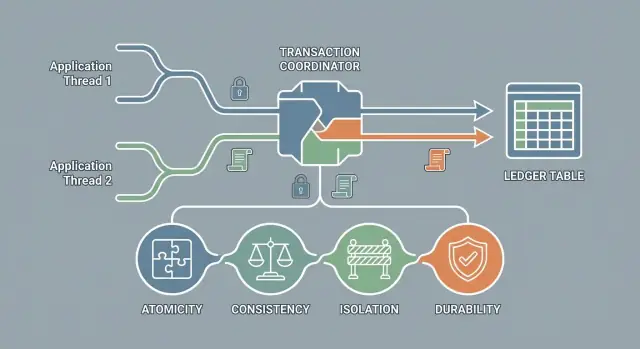
What “ACID” Means for Everyday Transactions
When you pay for groceries, book a flight, or move money between accounts, you expect the outcome to be unambiguous: either it worked, or it didn’t. Databases aim to provide that same certainty—even when many people use the system at once, servers crash, or networks hiccup.
A transaction, in plain terms
A transaction is a single unit of work the database treats as one “package.” It might include multiple steps—subtracting inventory, creating an order record, charging a card, and writing a receipt—but it’s meant to behave as one coherent action.
If any step fails, the system should rewind to a safe point rather than leaving a half-finished mess.
Why partial updates cause real business problems
Partial updates aren’t just technical glitches; they become customer support tickets and financial risk. For example:
- A payment is captured, but the order isn’t created—customers are charged with no confirmation.
- An order is created, but inventory isn’t reduced—your site oversells and you cancel later.
- A bank transfer debits one account but doesn’t credit the other—balances stop making sense.
These failures are hard to debug because everything looks “mostly correct,” yet the numbers don’t add up.
ACID is a set of guarantees (not a product)
ACID is shorthand for four guarantees many databases can provide for transactions:
- Atomicity: all-or-nothing execution
- Consistency: data stays within valid rules
- Isolation: concurrent transactions don’t interfere in unsafe ways
- Durability: once committed, changes persist
It’s not a specific database brand or a single feature you toggle; it’s a promise about behavior.
Benefits—and the costs you should expect
Stronger guarantees usually mean the database must do more work: extra coordination, waiting for locks, tracking versions, and writing to logs. That can reduce throughput or increase latency under heavy load. The goal isn’t “maximum ACID at all times,” but choosing guarantees that match your real business risks.
Atomicity: All-or-Nothing Updates
Atomicity means a transaction is treated as a single unit of work: it either finishes completely or has no effect at all. You never end up with “half an update” visible in the database.
A simple bank transfer example
Imagine transferring $50 from Alice to Bob. Under the hood, this typically involves at least two changes:
- Subtract $50 from Alice’s balance
- Add $50 to Bob’s balance
With atomicity, those two changes succeed together or fail together. If the system can’t safely do both, it must do neither. That prevents the nightmare outcome where Alice is charged but Bob doesn’t receive the money (or Bob receives it without Alice being charged).
Commit vs. rollback (plain English)
Databases give transactions two exits:
- Commit: “All steps succeeded; make the results official.”
- Rollback: “Something went wrong; undo everything from this transaction.”
A useful mental model is “draft vs. publish.” While the transaction is running, the changes are provisional. Only a commit publishes them.
What can go wrong mid-transaction?
Atomicity matters because failures are normal:
- App crash: your service stops after updating one table but before updating the next.
- Network drop: the app can’t reach the database, or the client never receives the “success” response.
- Power loss: the database server stops unexpectedly.
If any of these happens before the commit completes, atomicity ensures the database can roll back so partial work doesn’t leak into real balances.
Atomicity plus idempotency and retries
Atomicity protects database state, but your application still must handle uncertainty—especially when a network drop makes it unclear whether a commit happened.
Two practical complements:
- Retries: repeat a request when you don’t get a response.
- Idempotency: make repeating the same request safe (for example, using an idempotency key so “transfer #123” is applied at most once).
Together, atomic transactions and idempotent retries help you avoid both partial updates and accidental double-charges.
Consistency: Keeping Data Within Valid Rules
Consistency in ACID doesn’t mean “the data looks reasonable” or “all replicas match.” It means every transaction must take the database from one valid state to another valid state—according to the rules you define.
Consistency is defined by rules you choose
A database can only keep data consistent relative to explicit constraints, triggers, and invariants that describe what “valid” means for your system. ACID doesn’t invent these rules; it enforces them during transactions.
Common examples include:
- Foreign keys: every
order.customer_idmust point to an existing customer. - Unique constraints: no two users can share the same email.
- Check constraints / invariants: an account balance can’t go below zero, or an item quantity can’t be negative.
If these rules are in place, the database will reject any transaction that would violate them—so you don’t end up with “half-valid” data.
Application validation vs. database constraints
App-level validation is important, but it’s not sufficient on its own.
- Application validation improves user experience (clear error messages, early feedback) and can enforce complex business rules.
- Database constraints act as the final gatekeeper—especially when multiple services, background jobs, imports, or admin tools write to the same tables.
A classic failure mode is checking something in the app (“email is available”) and then inserting the row. Under concurrency, two requests can pass the check at the same time. A unique constraint in the database is what guarantees only one insert succeeds.
What consistency looks like in practice
If you encode “no negative balances” as a constraint (or enforce it reliably within a single transaction), then any transfer that would overdraw an account must fail as a whole. If you don’t encode that rule anywhere, ACID can’t protect it—because there’s nothing to enforce.
Consistency is ultimately about being explicit: define the rules, then let transactions ensure those rules are never broken.
Isolation: Working Safely Under Concurrency
Isolation ensures transactions don’t step on each other. While one transaction is in progress, other transactions should not see half-finished work or accidentally overwrite it. The goal is simple: each transaction should behave as if it were running alone, even when many users are active at the same time.
Why concurrency makes this hard
Real systems are busy: customers place orders, support agents update profiles, background jobs reconcile payments—all at once. These actions overlap in time, and they often touch the same rows (an account balance, inventory count, or booking slot).
Without isolation, timing becomes part of your business logic. A “subtract stock” update could race with another checkout, or a report might read data mid-change and show numbers that never existed in a stable state.
Isolation is usually configurable
Full “act like you’re alone” isolation can be expensive. It can reduce throughput, increase waiting (locks), or cause transaction retries. Meanwhile, many workflows don’t need the strictest protection—reading yesterday’s analytics, for example, can tolerate minor inconsistencies.
That’s why databases offer configurable isolation levels: you choose how much concurrency risk you’ll accept in exchange for better performance and fewer conflicts.
A quick preview: anomalies isolation prevents (or allows)
When isolation is too weak for your workload, you’ll run into classic anomalies:
- Dirty reads: reading changes that another transaction hasn’t committed.
- Lost updates: two transactions overwrite each other and one set of changes disappears.
- Phantom reads: re-running a query returns a different set of rows because another transaction inserted or removed matching data.
Understanding these failure modes makes it easier to pick an isolation level that matches your product’s promises.
Common Anomalies Isolation Prevents (or Allows)
Isolation determines what other transactions you’re allowed to “see” while yours is still running. When isolation is too weak for a workload, you can get anomalies—behaviors that are technically possible but surprising to users.
Read anomalies
Dirty read happens when you read data another transaction has written but not committed.
Scenario: Alex transfers $500 out of an account, the balance temporarily becomes $200, and you read that $200 before Alex’s transfer later fails and rolls back.
User outcome: a customer sees an incorrect low balance, a fraud rule triggers incorrectly, or a support agent gives the wrong answer.
Non-repeatable read means you read the same row twice and get different values because another transaction committed in between.
Scenario: You load an order total ($49.00), then refresh details a moment later and see $54.00 because a discount line was removed.
User outcome: “My total changed while I was checking out,” leading to mistrust or abandoned carts.
Phantom read is like non-repeatable read, but with a set of rows: a second query returns extra (or missing) rows because another transaction inserted/deleted matching records.
Scenario: A hotel search shows “3 rooms available,” then during booking the system rechecks and finds none because new reservations were added.
User outcome: double booking attempts, inconsistent availability screens, or overselling inventory.
Write anomalies (common real-world bugs)
Lost update occurs when two transactions read the same value and both write back updates, with the later write overwriting the earlier one.
Scenario: Two admins edit the same product price. Both start from $10; one saves $12, the other saves $11 last.
User outcome: someone’s change disappears; totals and reports are wrong.
Write skew happens when two transactions each make a change that is individually valid, but together violate a rule.
Scenario: Rule: “At least one on-call doctor must be scheduled.” Two doctors independently mark themselves off-call after checking that the other is still on-call.
User outcome: you end up with zero coverage, despite each transaction “passing” its checks.
Why not always use the strictest isolation?
Stronger isolation reduces anomalies but can increase waiting, retries, and costs under high concurrency. Many systems choose weaker isolation for read-heavy analytics, while using stricter settings for money movement, booking, and other correctness-critical flows.
Isolation Levels: Choosing the Right Safety Setting
Isolation is about what your transaction is allowed to “see” while other transactions are running. Databases expose this as isolation levels: higher levels reduce surprising behavior, but can cost throughput or increase waiting.
The common isolation levels
- Read Uncommitted: You may read changes another transaction hasn’t committed yet (“dirty reads”). Almost nothing is prevented.
- Read Committed: You only read committed data, so dirty reads are prevented. But if you run the same query twice, you might see different results because someone else committed in between (“non-repeatable reads”).
- Repeatable Read: Reads you’ve already made stay stable during the transaction, so non-repeatable reads are generally prevented. Depending on the engine, you may still see “phantoms” (new rows that match a search condition) or you may not.
- Serializable: Transactions behave as if they ran one at a time. This is the strongest setting, generally preventing dirty reads, non-repeatable reads, and phantoms, and reducing many subtle write anomalies.
Choosing a level: throughput vs. correctness
Teams often pick Read Committed as a default for user-facing apps: good performance, and “no dirty reads” matches most expectations.
Use Repeatable Read when you need stable results inside a transaction (for example, generating an invoice from a set of line items) and you can tolerate some overhead.
Use Serializable when correctness is more important than concurrency (for example, enforcing complex invariants like “never oversell inventory”), or when you can’t easily reason about race conditions in application code.
Read Uncommitted is rare in OLTP systems; it’s sometimes used for monitoring or approximate reporting where occasional wrong reads are acceptable.
Important warning: behavior varies
Names are standardized, but exact guarantees differ by database engine (and sometimes by configuration). Confirm with your database documentation and test the anomalies that matter to your business.
Durability: Making Commits Stick
Durability means that once a transaction is committed, its results should survive a crash—power loss, process restart, or a sudden machine reboot. If your app tells a customer “payment successful,” durability is the promise that the database won’t “forget” that fact after the next failure.
How databases make commits survive crashes
Most relational databases achieve durability with write-ahead logging (WAL). At a high level, the database writes a sequential “receipt” of changes to a log on disk before it considers the transaction committed. If the database crashes, it can replay the log during startup to restore the committed changes.
To keep recovery time reasonable, databases also create checkpoints. A checkpoint is a moment where the database ensures enough of the recent changes are written into the main data files, so recovery doesn’t need to replay an unbounded amount of log history.
Durability depends on storage and configuration
Durability is not a single on/off switch; it depends on how aggressively the database forces data to stable storage.
- With synchronous settings, the database waits for the log to be flushed (often via an OS-level
fsync) before confirming commit. This is safer, but can add latency. - With asynchronous settings, the database may acknowledge commit before the log is fully on durable storage. Performance can improve, but a crash can lose the most recent “committed” transactions.
The underlying hardware matters too: SSDs, RAID controllers with write caches, and cloud volumes can behave differently under failure.
Backups and replication are related—but different
Backups and replication help you recover or reduce downtime, but they’re not the same as durability. A transaction can be durable on the primary even if it hasn’t reached a replica yet, and backups are typically point-in-time snapshots rather than commit-by-commit guarantees.
How Databases Enforce ACID Under the Hood
When you BEGIN a transaction and later COMMIT, the database coordinates many moving parts: who can read which rows, who can update them, and what happens if two people try to change the same record at once.
Pessimistic vs. optimistic concurrency control
A key “under the hood” choice is how to handle conflicts:
- Pessimistic locking assumes conflicts are likely. When a transaction updates a row, the database locks it so other transactions must wait. This prevents many anomalies, but it can cause blocking.
- Optimistic approaches assume conflicts are rare. Transactions proceed with less blocking, and the database detects conflicts at commit time (or via checks) and may reject one transaction so it can be retried.
Many systems blend both ideas depending on workload and isolation level.
MVCC: readers don’t block writers
Modern databases often use MVCC (Multi-Version Concurrency Control): instead of keeping only one copy of a row, the database keeps multiple versions.
- Readers can see a consistent snapshot (an older version) without waiting.
- Writers can create a new version while reads continue.
This is a big reason some databases handle lots of reads and writes concurrently with less blocking—though write/write conflicts still need resolution.
Deadlocks: when waiting forms a loop
Locks can lead to deadlocks: Transaction A waits for a lock held by B, while B waits for a lock held by A.
Databases typically resolve this by detecting the cycle and aborting one transaction (a “deadlock victim”), returning an error so the application can retry.
Practical signs something’s wrong
If ACID enforcement is creating friction, you’ll often see:
- Lock waits increasing during peak usage
- Timeouts (queries failing after waiting too long)
- Contention hot spots (a few rows/tables updated constantly, like counters or “last seen” fields)
These symptoms often mean it’s time to revisit transaction size, indexing, or which isolation/locking strategy fits the workload.
How ACID Shapes Application Design Decisions
ACID guarantees aren’t just database theory—they influence how you design APIs, background jobs, and even UI flows. The core idea is simple: decide which steps must succeed together, then wrap only those steps in a transaction.
Designing APIs around “one business change”
A good transactional API usually maps to a single business action, even if it touches multiple tables. For example, a /checkout operation might: create an order, reserve inventory, and record a payment intent. Those database writes should typically live in one transaction so they commit together (or roll back together) if any validation fails.
A common pattern is:
- Do input validation before opening the transaction.
- Open a transaction.
- Perform the minimum required reads/writes.
- Commit.
This keeps atomicity and consistency while avoiding slow, fragile transactions.
Transaction boundaries in requests, services, and jobs
Where you place transaction boundaries depends on what “one unit of work” means:
- User requests: Keep transactions short—ideally a few queries. Don’t hold locks while rendering views or waiting on downstream responses.
- Background jobs: Treat each job attempt as a unit of work. If a job processes 10,000 records, commit in batches so you can restart safely.
- Service boundaries: Prefer keeping a transaction inside one service’s database. Crossing services usually needs a different approach (like an outbox), because one ACID transaction can’t easily cover multiple databases.
Error handling: rollback, retries, and safe replays
ACID helps, but your application must still handle failures correctly:
- Rollback on error: If any step fails, abort the transaction so partial updates don’t leak.
- Retry on transient errors: Serialization failures and deadlocks are normal under concurrency. Retrying the whole transaction is often the right fix.
- Make operations idempotent: If a request is retried (by the client or your job runner), you should be able to “safely replay” it without double-charging or double-shipping—use idempotency keys and unique constraints.
Common anti-patterns
Avoid long transactions, calling external APIs inside a transaction, and user think time inside a transaction (for example, “lock cart row, ask user to confirm”). These increase contention and make isolation conflicts far more likely.
Where tools can help (without changing the fundamentals)
If you’re building a transactional system quickly, the biggest risk is rarely “not knowing ACID”—it’s accidentally scattering one business action across multiple endpoints, jobs, or tables without a clear transaction boundary.
Platforms like Koder.ai can help you move faster while still designing around ACID: you can describe a workflow (for example, “checkout with inventory reservation and payment intent”) in a planning-first chat, generate a React UI plus a Go + PostgreSQL backend, and iterate with snapshots/rollback if a schema or transaction boundary needs to change. The database still enforces the guarantees; the value is in speeding up the path from a correct design to a working implementation.
ACID in Distributed and Multi-Service Systems
A single database can usually deliver ACID guarantees within one transaction boundary. Once you spread work across multiple services (and often multiple databases), those same guarantees become harder to keep—and more expensive when you try.
Consistency vs. availability: the trade-off you feel in production
Strict consistency means every read sees the “latest committed truth.” High availability means the system keeps responding even when parts are slow or unreachable.
In a multi-service setup, a temporary network problem can force a choice: block or fail requests until every participant agrees (more consistent, less available), or accept that services may be briefly out of sync (more available, less consistent). Neither is “always right”—it depends on what mistakes your business can tolerate.
Why distributed transactions are difficult
Distributed transactions require coordination across boundaries you don’t fully control: network delays, retries, timeouts, service crashes, and partial failures.
Even if every service is correct, the network can create ambiguity: did the payment service commit but the order service never received the acknowledgment? To resolve that safely, systems use coordination protocols (like two-phase commit), which can be slow, reduce availability during failures, and add operational complexity.
Practical patterns that replace “one big transaction”
Sagas break a workflow into steps, each committed locally. If a later step fails, earlier steps are “undone” using compensating actions (for example, refund a charge).
Outbox/inbox patterns make event publishing and consumption reliable. A service writes business data and an “event to publish” record in the same local transaction (outbox). Consumers record processed message IDs (inbox) to handle retries without duplicating effects.
Eventual consistency accepts short windows where data differs between services, with a clear plan for reconciliation.
When to relax guarantees—and how to control risk
Relax guarantees when:
- You can tolerate temporary mismatches (shipping status lagging behind order creation).
- You can correct errors with compensations (refunds, cancellations).
- Latency and uptime matter more than instant global correctness.
Control risk by defining invariants (what must never be violated), designing idempotent operations, using timeouts and retries with backoff, and monitoring for drift (stuck sagas, repeated compensations, growing outbox tables). For truly critical invariants (for example, “never overspend an account”), keep them within a single service and a single database transaction where possible.
Practical Checklist: Designing, Testing, and Monitoring ACID Systems
A transaction can be “correct” in a unit test and still fail under real traffic, restarts, and concurrency. Use this checklist to keep ACID guarantees aligned with how your system behaves in production.
1) Design: Define invariants and a transaction boundary
Start by writing down what must always be true (your data invariants). Examples: “account balance never goes negative,” “order total equals sum of line items,” “inventory can’t drop below zero,” “a payment is linked to exactly one order.” Treat these as product rules, not database trivia.
Then decide what must be inside one transaction versus what can be deferred.
- Data invariants: list the tables/rows involved and the exact rule.
- Failure scenarios: process crash mid-request, network timeout after commit, retry causing duplicates, replica failover, disk full.
- Concurrency profile: which operations run in parallel (checkout spikes, batch updates, scheduled jobs), expected contention hotspots, and whether reads must be “as of now” or can be slightly stale.
Keep transactions small: touch fewer rows, do less work (no external API calls), and commit quickly.
2) Test: Prove behavior under races and faults
Make concurrency a first-class test dimension.
- Race-condition tests: run the same critical operation concurrently (for example, two checkouts for the last item) and assert invariants never break.
- Fault injection: kill the app process mid-transaction; inject timeouts; simulate retries; force a DB restart; verify outcomes are either committed once or safely rolled back.
- Load tests with correctness checks: under peak throughput, validate not only latency but also totals, counts, and “no duplicates” constraints.
If you support retries, add an explicit idempotency key and test “request repeated after success.”
3) Monitor: Catch ACID pain before users do
Watch indicators that your guarantees are becoming expensive or fragile:
- Lock waits and queue time (rising contention)
- Deadlocks (frequency, victim queries)
- Long-running transactions (often the root cause)
- Replication lag (stale reads and delayed failover)
- Commit/fsync times (storage pressure; durability cost)
Alert on trends, not just spikes, and tie metrics back to the endpoints or jobs causing them.
Rules of thumb: isolation and transaction scope
Use the weakest isolation that still protects your invariants; don’t “max it out” by default. When you need strict correctness for a small critical section (money movement, inventory decrement), narrow the transaction to just that section and keep everything else outside it.
FAQ
What does ACID mean in a database, in practical terms?
ACID is a set of transactional guarantees that help databases behave predictably under failures and concurrency:
- Atomicity: all steps succeed or none do
- Consistency: every commit preserves your defined rules/constraints
- Isolation: concurrent transactions don’t create unsafe interference
- Durability: committed changes survive crashes
What is a transaction, and why does it matter?
A transaction is a single “unit of work” the database treats as one package. Even if it performs multiple SQL statements (e.g., create order, decrement inventory, record payment intent), it has only two outcomes:
- Commit: all changes become official
- Rollback: none of the changes take effect
Why are partial updates such a big business problem?
Because partial updates create real-world contradictions that are expensive to fix later—for example:
- customer charged but no order recorded
- order recorded but inventory not reduced (overselling)
- one side of a transfer applied but not the other
ACID (especially atomicity + consistency) prevents these “half-finished” states from becoming visible as truth.
How does atomicity prevent half-finished operations?
Atomicity ensures the database never exposes a “half-complete” transaction. If anything fails before commit—app crash, network drop, DB restart—the transaction is rolled back so earlier steps don’t leak into persistent state.
In practice, atomicity is what makes multi-step changes (like a transfer that updates two balances) safe.
If ACID is safe, why do I still need idempotency and retries?
You can’t always know whether a commit happened if the client loses the response (e.g., network timeout right after commit). Combine ACID transactions with:
- Retries for transient failures
- Idempotency keys (or unique constraints) so repeating the same request applies at most once
This prevents both partial updates and accidental double-charges/double-writes.
What does “consistency” mean in ACID (and what doesn’t it mean)?
In ACID, “consistency” means the database moves from one valid state to another according to rules you define—constraints, foreign keys, uniqueness, and checks.
If you don’t encode a rule (e.g., “balance can’t go below zero”), ACID can’t enforce it automatically. The database needs explicit invariants to protect.
Why use database constraints if my application already validates inputs?
App validation improves UX and can enforce complex rules, but it can fail under concurrency (two requests pass the same check at the same time).
Database constraints are the final gatekeeper:
- Unique constraints prevent duplicate emails
- Foreign keys prevent orphaned records
- Check constraints/invariants prevent invalid values
Use both: validate early in the app, enforce definitively in the database.
What kinds of concurrency bugs does isolation protect against?
Isolation controls what your transaction can observe while others run. Weak isolation can produce anomalies such as:
- Dirty reads: seeing uncommitted data
- Non-repeatable reads: same row changes between reads
- Phantoms: query returns a different set of rows
- Lost updates / write skew: concurrent writes break correctness
Isolation levels let you trade performance for protection against these anomalies.
How do I choose an isolation level without killing performance?
A common, practical baseline is Read Committed for many OLTP apps because it prevents dirty reads with good performance. Move upward when needed:
- Repeatable Read for stable in-transaction reads (e.g., invoice generation)
- Serializable for correctness-critical invariants (e.g., avoiding oversells) when you can tolerate more contention/retries
Always confirm behavior in your specific database engine because details vary.
What does durability guarantee, and what can weaken it?
Durability means once the database confirms a commit, the change will survive crashes. Typically this is implemented via write-ahead logging (WAL) and checkpoints.
Be aware of configuration trade-offs:
- Synchronous commit/fsync: safer, potentially higher latency
- Asynchronous settings: faster, but may lose recent “committed” transactions on crash
Backups and replication help recovery/availability, but they’re not the same guarantee as durability.