

MVPs in 2025: What to Build, Fake, or Ignore as a Founder
A practical 2025 guide to MVP thinking: decide what to build, what to fake safely, and what to ignore so you can validate demand and ship faster.
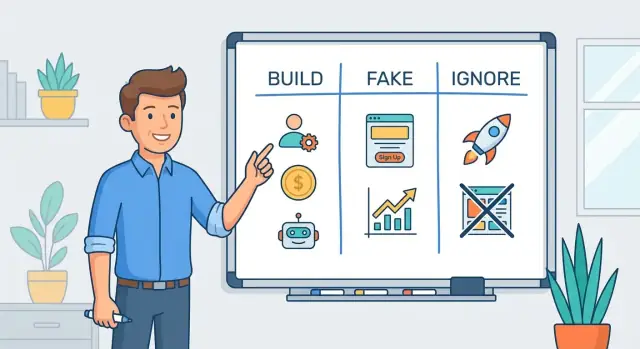
MVPs in 2025: The Goal Is Learning, Not Shipping Features
An MVP in 2025 isn’t “the smallest version of your product.” It’s the smallest test of your business that can produce a clear learning outcome. The point is to reduce uncertainty—about the customer, the problem, willingness to pay, or the channel—not to ship a trimmed-down roadmap.
If your MVP can’t answer a specific question (e.g., “Will busy clinic managers pay $99/month to reduce no-shows?”), it’s likely just early product development wearing an MVP label.
What an MVP is (and what it isn’t)
MVP is: a focused experiment that delivers a real outcome for a narrowly defined user, so you can measure demand and behavior.
MVP is not: a mini product, a feature checklist, or a “v1” you secretly hope to scale. It’s also not an excuse for sloppy quality in the one thing you’re testing. You can be minimal and still be credible.
MVP vs prototype vs pilot vs beta
- Prototype: demonstrates an idea (often without real data or real users). Great for testing usability and understanding, weak for proving demand.
- MVP: delivers a core outcome end-to-end (even if parts are manual) so you can test value and buying behavior.
- Pilot: a controlled rollout with a specific customer or group, typically with higher-touch support and clearer success criteria.
- Beta: wider access to a near-ready product to find bugs, edge cases, and adoption friction—not to discover whether the problem matters.
The expectations to set upfront
Move fast, but be deliberate:
- Speed: aim for days or a few weeks, not quarters.
- Focus: one user, one job-to-be-done, one core flow.
- Measurable outcomes: define what “yes,” “no,” and “not sure” look like before you build.
Treat the MVP as a learning tool and you earn the right to ignore distractions—each iteration becomes sharper, not just bigger.
Start With the Problem: Who It’s For and What Changes for Them
An MVP only works if it’s aimed at a specific person with a specific problem that already has urgency. If you can’t name who it’s for and what changes in their day after using it, you’re not building an MVP—you’re collecting features.
Identify the customer (and their urgency)
Start by describing a single, real customer type—not “small businesses” or “creators,” but someone you could recognize in the wild.
Ask:
- Who are they? Role, context, constraints (time, budget, approvals).
- What job are they trying to get done? The outcome they’re hiring a solution for.
- Why now? What makes this painful or time-sensitive this week, not “someday”? Deadlines, revenue pressure, compliance, churn, embarrassment, opportunity cost.
If urgency is missing, validation will be slow and noisy—people will be “interested” without changing behavior.
State the core promise in one sentence
Write a promise that connects customer + job + outcome:
“For [specific customer], we help you [complete job] so you can [measurable outcome] without [main sacrifice or risk].”
This sentence is your filter: anything that doesn’t strengthen it is probably not in the MVP.
Define the smallest moment of value (“aha”)
Your MVP should deliver one undeniable moment where the user thinks: “This works.”
Examples of an “aha” moment:
- A report that answers a question they currently guess at
- A booking confirmed without back-and-forth
- A draft created that’s “good enough to send”
Make it observable: what does the user see, click, or receive?
Name the main alternative they use today
Your competitor is usually a workaround:
- Spreadsheet, inbox search, templates, a VA, an agency, “asking a colleague,” or doing nothing
Knowing the alternative clarifies your MVP: you’re not trying to be perfect—you’re trying to be a better trade-off than what they already rely on.
Turn Your Idea Into Testable Hypotheses and Decisions
An MVP is only useful if it answers a specific question that changes what you do next. Before you design screens or write code, translate your idea into hypotheses you can test—and decisions you’re willing to make.
Start with 2–3 hypotheses you can actually test
Write them as statements you can prove or disprove within days or weeks:
- Problem hypothesis: “People who manage [job-to-be-done] currently lose time/money because [current workaround], and they feel the pain weekly.”
- Willingness-to-pay hypothesis: “At least X out of Y qualified prospects will commit to pay $N/month (or prepay) after seeing a demo or pilot offer.”
- Retention driver hypothesis: “If users achieve [core outcome] within the first [time window], they return [frequency] without reminders.”
Keep the numbers imperfect but explicit. If you can’t add a number, you can’t measure it.
Pick one primary question to answer first
Your MVP should prioritize the biggest uncertainty. Examples:
- “Will they pay at all?” (pricing test / pre-sell)
- “Is the problem urgent enough to switch?” (concierge workflow)
- “Can we deliver the outcome reliably?” (manual-first pilot)
Choose one. Secondary questions are fine only if they don’t slow the primary test.
Define stop, pivot, and double-down criteria
Decide in advance what results mean:
- Stop: “Fewer than 2 of 15 target customers will book a second call after seeing the offer.”
- Pivot: “They buy, but only when it includes [different segment / different outcome].”
- Double down: “5+ customers prepay or sign LOIs within 2 weeks, and at least 3 complete onboarding.”
Avoid goals like “get feedback.” Feedback is only valuable when it triggers a decision.
What to Build: The One Flow That Delivers the Core Outcome
Your MVP should deliver value once, end-to-end, for a real person. Not “most of the product.” Not “a demo.” One completed journey where the user gets the outcome they came for.
Start by defining the core outcome
Ask: When someone uses this, what changes for them by the end of the session? That change is your outcome. The MVP is the shortest path that reliably produces it.
The minimum real things you must build
To deliver the outcome once, you typically need only a few “real” components:
- A single entry point (landing page, invite link, or simple screen) that gets the right user into the flow
- The core action the user takes (create, request, schedule, compare, submit—whatever causes the change)
- The system response that produces the outcome (result, confirmation, recommendation, matched lead, generated plan)
- A way to deliver it to the user (in-app screen, email, download link)
Everything else is supporting infrastructure you can postpone.
Core workflow vs. supporting features
Separate the core workflow from common supporting features like accounts, settings, roles, admin dashboards, notifications, preference management, integrations, and full analytics suites. Many MVPs only need lightweight tracking and a manual back office.
Pick one happy path (and delay edge cases)
Choose a single user type, a single scenario, and a single success definition. Handle edge cases later: unusual inputs, complex permissions, retries, cancellations, multi-step customization, and rare errors.
Think in a thin vertical slice
A “thin vertical slice” means you build a narrow end-to-end path through the whole experience—just enough UI, logic, and delivery to complete the job once. It’s small, but it’s real, and it teaches you what users actually do.
What to Fake: Safe Shortcuts That Preserve Learning
Speed isn’t about cutting corners everywhere—it’s about cutting corners in places that don’t change the customer’s decision. The goal of “faking” in an MVP is to deliver the promised outcome quickly, then learn whether people want it enough to return, recommend it, or pay for it.
Concierge delivery: manual fulfillment behind a simple front end
A concierge MVP is often the fastest way to test value: you do the work manually, and customers experience the result.
For example, instead of building a full matching algorithm, you can ask a few onboarding questions and hand-pick results yourself. The user still gets the core outcome; you learn what “good” looks like, what inputs matter, and what edge cases appear.
Wizard-of-Oz UX: the UI looks automated, humans run the process
With Wizard-of-Oz, the product appears automated, but a person is operating it behind the scenes. This is useful when automation is expensive but you need to test the interaction model.
Keep the experience honest in practice: set expectations on turnaround times, avoid implying real-time automation if you can’t deliver it, and document every manual step so you can later decide what to automate first.
Fake data where safe (seeded content, demo catalogs, simulated history)
Seeded content can prevent an empty-product problem. A marketplace can start with a curated catalog; a dashboard can show simulated history to demonstrate how insights will look.
Rules of thumb:
- Seed data to explain value, not to mislead about traction.
- Label examples as “sample” or “demo” when it could affect trust.
- Never fabricate customer reviews, ratings, or performance claims.
Use templates and no-code for non-differentiating parts
Don’t build custom infrastructure for things customers don’t choose you for. Use templates for landing pages and onboarding, no-code for internal tools, and off-the-shelf components for scheduling, email, and analytics. Save engineering time for the one thing that makes your offer meaningfully better.
What must not be faked: security, billing, and legal
Some shortcuts create irreversible damage:
- Security & privacy: don’t “temporarily” store sensitive data in unsafe places.
- Billing: avoid charging flows you can’t reconcile cleanly; be clear about refunds and terms.
- Legal/compliance: don’t test in regulated areas without the right constraints.
Fake the automation, not the responsibility.
What to Ignore: Common MVP Time Sinks That Don’t Prove Demand
Early on, your job isn’t to build a “real product.” It’s to reduce uncertainty: do the right people have this problem, and will they change behavior (or pay) to solve it? Anything that doesn’t answer those questions is usually an expensive distraction.
1) Polish and branding beyond basic trust
A clean UI helps, but weeks spent on brand systems, animations, illustration packs, and pixel-perfect screens rarely change the core signal.
Do the minimum that communicates credibility: clear copy, consistent spacing, working forms, and obvious contact/support. If users won’t try it when it looks “decent,” a full rebrand won’t save it.
2) Multi-platform builds before demand is proven
Building web + iOS + Android sounds like “meeting users where they are.” In practice, it’s three codebases and triple the surface area for bugs.
Pick one channel that matches your audience’s habit (often a simple web app) and validate there first. Port only after you see repeat usage or paid conversion.
3) Complex permissions, multi-tenant admin, full localization
Role-based access, admin panels, and internationalization are legitimate needs—just not Day 1 needs.
Unless your first customers are explicitly enterprises or global teams, treat these as future requirements. You can start with a single “owner” role and manual workarounds.
4) Perfect scalability and microservices
Optimizing for millions of users before you have dozens is a classic trap.
Choose boring, simple architecture that you can change quickly. You need reliability for experiments, not distributed systems.
5) Advanced analytics dashboards before you know the key metric
Dashboards feel productive, but they often measure everything except what matters.
Start by defining one or two behaviors that indicate real value (e.g., repeat use, completed outcome, payment). Track them simply—spreadsheet, basic events, even manual logs—until the signal is clear.
Design the Experiment: How You’ll Validate Without Guessing
An MVP is only as useful as the experiment wrapped around it. If you don’t decide who you’ll talk to, what you’ll ask, and what would change your mind, you’re not validating—you’re collecting vibes.
1) Pick a realistic recruiting plan
Start with the channel you can actually execute this week:
- Warm intros: past colleagues, advisors, friendly founders—ask for 2–3 specific introductions.
- Communities: Slack/Discord groups, subreddits, meetups—participate, then invite people to a short call.
- Outbound: a tight list and a simple message tied to a clear pain (not your product).
Decide your target segment up front (role + context + trigger). “Small businesses” isn’t a segment; “US-based wedding photographers who spend 3+ hours/week on client follow-ups” is.
2) Define the smallest credible sample size
For early-stage MVPs, aim for a sample that can reveal patterns, not produce statistical certainty.
A practical rule: 8–12 conversations in one consistent segment to find repeating problems, then 5–10 structured trials (demo/prototype/concierge) to see if people take the next step.
3) Write the script: ask, observe, measure
Your script should include:
- Questions: current workflow, last time the problem happened, what they tried, what they pay for today.
- Observations: where they hesitate, what they ignore, what they do without prompting.
- Measures: commitments (time booked, data shared, pilot started, payment attempted).
4) Time-box it and define next steps
Run experiments in days or 1–2 week blocks. Before you start, write down:
- Pass/fail thresholds (e.g., “3 paid pilots” or “6 users complete the flow without help”).
- The decision you’ll make next: iterate, narrow the segment, change the offer, or stop.
This keeps your MVP focused on learning—not endless building.
Metrics That Matter: Signals Stronger Than “People Liked It”
Early MVP feedback is noisy because people are polite, curious, and often optimistic. The goal is to measure behavior that costs them something: time, effort, reputation, or money. If your metrics don’t force a trade-off, they won’t predict demand.
Activation: the “got value” moment
Activation is the first action that proves the user received the core outcome—not that they clicked around.
For example: “created a first report and shared it,” “booked the first appointment,” or “completed the first workflow end-to-end.” Define it as a single, observable event and track the activation rate from each acquisition channel.
Retention: repeat behavior with a clear window
Retention isn’t “they opened the app again.” It’s repeating the value action on a cadence that matches the problem.
Set a time window that fits reality: daily for habit products, weekly for team workflows, monthly for finance/admin tasks. Then ask: Do activated users repeat the core action without being chased? If retention depends on constant reminders, your product may be a service—or the value isn’t strong enough yet.
Revenue signals: money (or near-money) beats compliments
Strong signals include pre-orders, deposits, paid pilots, and paid onboarding. LOIs can help, but treat them as a weak signal unless they include specific scope, timeline, and a clear path to payment.
If users won’t pay yet, test willingness to pay with pricing pages, checkout flows, or “request invoice” steps—then follow up and ask what stopped them.
Qualitative proof: pain, urgency, and pull
Look for consistency across conversations:
- The same problem described in their own words
- A clear “why now” (deadlines, risk, lost revenue)
- Users introducing you to teammates or asking, “When can I use this?”
When activation, retention, and payment intent move together, you’re not just hearing interest—you’re seeing demand.
AI in the MVP: Use It to Learn Faster, Not to Hide Uncertainty
AI can be a force-multiplier in an MVP—when it reduces time-to-learning. The trap is using “AI-powered” as a blanket to cover unclear requirements, weak data, or a fuzzy value proposition. Your MVP should make uncertainty visible, not bury it.
Where AI genuinely helps an MVP
Use AI when it accelerates cycles of feedback:
- Speed: draft replies, summarize interviews, classify inbound requests, generate variants for messaging tests.
- Personalization: adapt onboarding text, recommendations, or follow-ups based on a user’s context (with clear boundaries).
- Automation: remove busywork from a workflow so you can observe the “moment of value” sooner.
If AI doesn’t shorten the path to seeing whether users get the outcome, it’s probably scope.
Don’t build a business on untrusted output
Model output is probabilistic. In an MVP, that means errors will happen—and they can destroy trust before you’ve learned anything. Avoid “fully automated” claims unless you can reliably measure quality and recover from failures.
Practical safeguards:
- Add confidence thresholds and route low-confidence cases to a fallback.
- Keep a human review loop (you, contractors, or the user) for critical decisions.
- Log inputs/outputs so you can debug what users actually experienced.
Set expectations and design for differentiation
Tell users what the AI does, what it doesn’t, and how to correct it. A simple “review and approve” step can protect trust and create useful training data.
Finally, don’t rely on the model itself as your moat. Differentiate through proprietary data, a workflow people adopt daily, or distribution (a channel you can reach consistently). The MVP goal: prove that combination creates repeatable value.
Tech Choices for Speed: Build for Change, Not Perfection
Your MVP tech stack is a temporary decision-making system. The best choice isn’t what scales forever—it’s what lets you change your mind quickly without breaking everything.
Start with the simplest architecture that supports iteration
Prefer a “boring” baseline: one app, one database, one queue (or none), and a clean separation between UI and core logic. Avoid microservices, event-driven everything, or heavy internal tooling until you’ve proven the workflow is worth keeping.
A simple rule: if a component doesn’t reduce learning time, it’s likely increasing it.
Choose tools that reduce integration friction
Pick providers that remove entire categories of work:
- Auth: managed authentication (passwordless, OAuth, team accounts) so you don’t build security-sensitive flows from scratch.
- Payments: a hosted checkout + customer portal so pricing experiments don’t require new backend code each time.
- Email: a transactional email service with templates, deliverability, and webhooks for “signup confirmed,” “trial ending,” etc.
This keeps your MVP focused on the core product decision rather than plumbing.
Where a vibe-coding platform can compress MVP timelines
If your bottleneck is turning a validated flow into a working vertical slice, a vibe-coding platform like Koder.ai can help you move from “spec” to “usable app” faster—especially for the first end-to-end path.
Because Koder.ai builds web apps (React) and backends (Go + PostgreSQL) via a chat interface—plus supports planning mode, source code export, deployment/hosting, and snapshots/rollback—you can iterate on the core flow quickly without locking yourself into premature infrastructure. The key is to use that speed to run more experiments, not to expand scope.
Set basic non-negotiables
Speed doesn’t mean careless. Minimum bar:
- Privacy: collect the least data needed, document what you store, and avoid copying customer data into random tools.
- Backups: automated database backups with periodic restore tests.
- Access control: separate admin roles from user roles; log critical actions.
Make a lightweight “rebuild triggers” roadmap
Instead of guessing when to rewrite, define triggers up front: e.g., “3+ weekly deployments blocked by architecture,” “we changed the core workflow twice,” or “support time exceeds X hours/week due to data model limits.” When a trigger hits, rebuild one layer at a time—not the whole product.
Pricing and Packaging: Validate Willingness to Pay Early
If your MVP only proves that people are curious, you’re still guessing. In 2025, a startup MVP should test whether the problem is painful enough that someone will pay to make it go away.
Test pricing with real offers (not opinions)
Skip the “Would you pay for this?” conversation. Instead, present a clear offer: what they get, what it costs, and what happens next. Even for a concierge MVP, you can send a simple proposal or checkout link and ask them to choose a plan.
Good signals include asking for an invoice, requesting procurement steps, negotiating terms, or committing to a pilot start date.
Package around outcomes, not features
Early on, keep packages few and easy to compare. Tie each package to the result the customer wants—speed, certainty, saved time, reduced risk—rather than a list of tools.
For example, instead of “Basic includes 3 reports,” consider:
- Starter: get the first measurable outcome within 7 days
- Team: repeat the outcome across multiple people/projects
- Done-with-you: hands-on support to reach the outcome faster
This helps you learn which outcome is the real hook and which customers value speed vs. autonomy.
Decide what you charge for (and why)
Pick a pricing model that matches the value you’re creating:
- Usage if value scales with volume (messages, records, runs)
- Seats if collaboration is the main driver
- Results if you can define a clear measurable win
- Service if the customer is buying expertise more than software
You can revise later, but you need a starting point to validate willingness to pay.
Avoid “free forever” unless the path is obvious
Free can help distribution, but only if it leads predictably to paid: a time limit, a usage cap, or a feature that naturally upgrades. Otherwise you’ll attract the wrong feedback—people who like “free,” not people who need your solution.
Go-to-Market as Part of the MVP: Build the Feedback Loop
An MVP without go-to-market is just a prototype you like. In 2025, your “minimum” should include a repeatable way to reach people, learn from them, and adjust weekly.
Map a simple funnel you can actually measure
Keep it brutally simple:
reach → interest → trial → value → paid
Define each step in one sentence. Example: reach = saw the post; interest = clicked and left email; trial = booked a call; value = got the promised outcome; paid = started a subscription. If you can’t observe a step, it doesn’t exist.
Pick one channel to start (and commit)
Choose a single distribution channel for the first sprint—LinkedIn outbound, a niche community, cold email, partnerships, or ads. One channel forces clarity: message, audience, offer.
Set a small weekly target (e.g., 50 outreaches, 10 conversations, 3 trials). Track it in a simple sheet. If the channel doesn’t produce conversations, you don’t have a product problem yet—you have a reach problem.
Build the feedback loop into the work
Make learning unavoidable:
- Sales calls: record objections and “what would make this a no-brainer?”
- Onboarding notes: where people stall, what they misunderstand, what they try next
- Support requests: the real feature requests (often phrased as confusion)
Then translate feedback into a single decision for the next experiment.
Founder checklist
- Build: one measurable funnel and one channel playbook
- Fake: concierge onboarding, manual fulfillment, personal follow-ups
- Ignore: brand perfection, multi-channel launches, “awareness” metrics without trials
- Next experiment: one change to increase trial → value (not more features)
FAQ
What is an MVP in 2025, really?
An MVP in 2025 is the smallest test that produces a clear learning outcome (e.g., demand, willingness to pay, retention driver, channel viability). It should answer one primary question that changes your next decision—not ship a trimmed roadmap.
How is an MVP different from a prototype?
A prototype proves usability/understanding (often without real users or real outcomes). An MVP delivers the core outcome end-to-end (even if manual behind the scenes) to test value and buying behavior. If nobody can complete the promised outcome, you built a demo—not an MVP.
When should I run a pilot vs a beta?
A pilot is a controlled rollout with a specific customer/group, higher-touch support, and explicit success criteria. A beta is broader access to a near-ready product to find bugs, edge cases, and adoption friction. Use beta after you already know the problem matters; use a pilot when you want proof in a real environment with clear measurement.
How do I define the core promise of my MVP?
Use the one-sentence promise:
“For [specific customer], we help you [job] so you can [measurable outcome] without [main sacrifice/risk].”
If you can’t fill this in concretely, your MVP scope will drift and your results will be hard to interpret.
What is the “aha moment,” and how do I pick it?
It’s the first observable moment where the user thinks “this works” because the promised change happened.
Examples:
- A report that answers a question they used to guess at
- A booking confirmed without back-and-forth
- A draft produced that’s good enough to send
Define it as a single event you can track (not a feeling).
What hypotheses should an MVP test first?
Start with 2–3 testable hypotheses and put numbers on them:
- Problem: pain happens weekly due to current workaround
- Willingness to pay: X of Y prospects commit at $N/mo
- Retention driver: users who reach the outcome in T return F times
Then choose one primary question (e.g., “Will they pay?”) and design the MVP to answer it fast.
What should I actually build versus postpone?
Build only what’s required to deliver the outcome once, end-to-end:
- One entry point (landing page/invite)
- One core action (create/request/schedule/submit)
- One system response (result/confirmation/recommendation)
- One delivery method (screen/email/download)
Delay accounts, roles, dashboards, integrations, edge cases, and heavy analytics until you see real demand.
What is safe to fake in an MVP, and what is not?
Fake automation when it doesn’t change the customer’s decision:
- Concierge MVP: you fulfill manually behind a simple front end
- Wizard-of-Oz: UI looks automated, humans operate it behind the scenes
- Seeded content: demos/catalogs to prevent the empty-product problem (label as sample when trust is at stake)
Don’t fake security/privacy, billing accuracy, or legal/compliance—those shortcuts can create irreversible damage.
Which MVP metrics matter more than “people liked it”?
Prefer signals that cost users something:
- Activation: they complete the core outcome (one trackable event)
- Retention: they repeat the value action on a realistic cadence without being chased
- Revenue intent: prepay, deposit, paid pilot, invoice request, or a checkout attempt
Compliments and “this is cool” feedback are weak unless they lead to commitment.
How do I validate pricing and willingness to pay early?
Use pricing as an experiment, not a debate. Present a real offer (scope + price + next step) and measure behavior:
- Do they commit to a start date?
- Do they ask for an invoice/procurement?
- Do they negotiate terms (a stronger signal than opinions)?
Package around outcomes (speed, certainty, saved time, reduced risk) rather than feature counts so you learn what customers truly value.