

How Google Powered GPT but Let OpenAI Win the AI Race
Explore how Google created the Transformer tech behind GPT yet allowed OpenAI to capture the generative AI spotlight, and what this means for innovators.
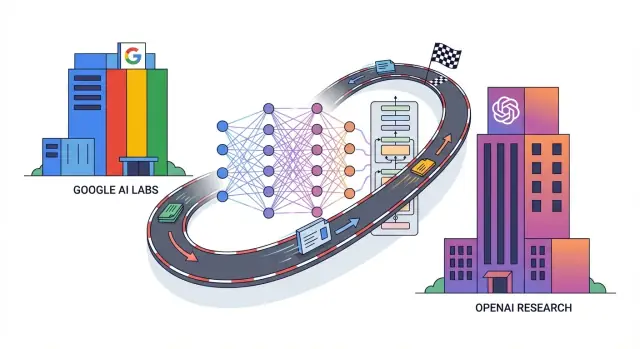
Overview: How Google powered GPT but lost the spotlight
Google didn’t “miss” AI so much as invent a big part of what made the current wave possible—and then let someone else turn it into the defining product.
Google researchers created the Transformer architecture, the core idea behind GPT models. That 2017 paper, “Attention Is All You Need,” showed how to train very large models that understand and generate language with remarkable fluency. Without that work, GPT as we know it would not exist.
OpenAI’s achievement was not a magical new algorithm. It was a set of strategic choices: scale Transformers far beyond what most thought practical, pair them with enormous training runs, and package the result as easy-to-use APIs and, eventually, ChatGPT—a consumer product that made AI feel tangible to hundreds of millions of people.
This article is about those choices and tradeoffs, not secret drama or personal heroes and villains. It traces how Google’s research culture and business model led it to favor BERT-like models and incremental search improvements, while OpenAI pursued a much riskier bet on general-purpose generative systems.
We’ll walk through:
- How Google built early AI dominance and a world-class research organization
- Why the Transformer paper was such a breakthrough—and what it actually changed
- How OpenAI turned that foundation into GPT and ChatGPT
- The diverging strategies: BERT and search at Google vs. scaled GPT and APIs at OpenAI
- The “ChatGPT moment,” when OpenAI out-executed Google in public
- Cultural and incentive differences that shaped both companies’ decisions
- Google’s reset with Bard and Gemini
- Concrete lessons for builders who don’t want to repeat Google’s mistake
If you care about AI strategy—how research turns into products, and products into enduring advantage—this story is a case study in what matters more than having the best paper: having the clearest bets and the courage to ship.
Google’s early AI dominance and research culture
Google entered modern machine learning with two huge structural advantages: data at unimaginable scale and an engineering culture already optimized for large distributed systems. When it turned that machinery toward AI, it quickly became the gravitational center of the field.
From Google Brain to DeepMind
Google Brain started as a side project around 2011–2012, led by Jeff Dean, Andrew Ng, and Greg Corrado. The team focused on large‑scale deep learning, using Google’s data centers to train models that were simply out of reach for most universities.
DeepMind joined in 2014 through a high‑profile acquisition. While Google Brain lived closer to products and infrastructure, DeepMind leaned into long‑horizon research: reinforcement learning, games, and general‑purpose learning systems.
Together, they gave Google an unparalleled AI engine room: one group embedded in Google’s production stack, the other pursuing moonshot research.
Milestones that signaled AI dominance
Several public milestones cemented Google’s status:
- ImageNet breakthroughs: Although the original 2012 ImageNet win (AlexNet) came from the University of Toronto, Google quickly hired many leading researchers and pushed the state of the art with models like Inception. Vision benchmarks became a showcase for Google’s scale and tooling.
- AlphaGo and successors: DeepMind’s AlphaGo defeating Lee Sedol in 2016, followed by AlphaGo Zero and AlphaZero, demonstrated that deep reinforcement learning could master complex domains with minimal human hand‑crafting.
- “AI‑first” rhetoric: Around 2016–2017, Sundar Pichai began calling Google an “AI‑first company.” AI powered Search, Ads, YouTube recommendations, Photos, Maps, and Android—touching billions of users, even if most never saw the models directly.
These victories convinced many researchers that if you wanted to work on the most ambitious AI problems, you went to Google or DeepMind.
Talent density as an innovation engine
Google concentrated an extraordinary share of the world’s AI talent. Turing Award winners like Geoffrey Hinton and senior figures such as Jeff Dean, Ilya Sutskever (before he left for OpenAI), Quoc Le, Oriol Vinyals, Demis Hassabis, and David Silver worked within a few orgs and buildings.
This density created powerful feedback loops:
- New ideas spread quickly through internal talks, mailing lists, and shared code.
- Teams could form ad hoc to attack hard problems, knowing the needed expertise was usually an internal ping away.
- Researchers benefited from production‑grade infrastructure—data pipelines, distributed training systems, and specialized hardware—without having to build everything themselves.
That combination of elite talent and heavy infrastructure investment made Google the place where frontier AI research often originated.
A culture optimized for papers and platforms
Google’s AI culture leaned heavily toward publishing and platform building over polished consumer AI products.
On the research side, the norm was to:
- Publish at conferences like NeurIPS, ICML, and ICLR.
- Open‑source tools (e.g., TensorFlow) that reflected Google’s internal systems.
- Release influential papers on vision, sequence modeling, reinforcement learning, and large‑scale training.
On the engineering side, Google poured resources into infrastructure:
- Tensor Processing Units (TPUs) tailored for neural network workloads.
- Sophisticated training and serving stacks inspired by internal systems like Borg.
- Data and experimentation platforms that made it easy to run huge studies on real traffic.
These choices were highly aligned with Google’s core businesses. Better models and tooling directly improved Search relevance, ad targeting, and content recommendations. AI was treated as a general capability layer rather than a standalone product category.
The result was a company that dominated the science and plumbing of AI, integrated it deeply into existing services, and broadcast its progress through influential research—while remaining cautious about building new, consumer‑facing AI experiences as products in their own right.
The birth of the Transformer: Google’s breakthrough paper
In 2017, a small Google Brain and Google Research team quietly published a paper that rewired the entire field: “Attention Is All You Need” by Ashish Vaswani, Noam Shazeer, Niki Parmar, Jakob Uszkoreit, Llion Jones, Aidan Gomez, Łukasz Kaiser, and Illia Polosukhin.
The core idea was simple but radical: you could throw away recurrence and convolutions, and build sequence models using only attention. That architecture was named the Transformer.
What the Transformer fixed about RNNs and LSTMs
Before Transformers, state-of-the-art language systems were based on RNNs and LSTMs. They had two major problems:
- Sequential bottleneck: RNNs process tokens one by one, so training and inference are hard to parallelize. GPUs sit idle waiting for the previous step to finish.
- Long-range dependencies: As sequences grow, it becomes harder for RNNs to remember information from many steps back, even with LSTMs and attention layers tacked on.
The Transformer solved both:
- Self-attention lets every token directly “look at” every other token in the sequence, in a single layer.
- The model processes all tokens in parallel, turning training into a GPU-friendly matrix-multiplication problem.
- Multi-head attention allows the model to learn different “views” of context (syntax, coreference, topic, etc.) simultaneously.
Position information is added via positional encodings, so the model knows order without needing recurrence.
Why this unlocked scalable and multimodal models
Because all operations are parallelizable and based on dense matrix multiplications, Transformers scale cleanly with more data and compute. That scaling property is exactly what GPT, Gemini, and other frontier models rely on.
The same attention machinery also generalizes beyond text: you can apply Transformers to image patches, audio frames, video tokens, and more. That made the architecture a natural foundation for multimodal models that read, see, and listen with a unified backbone.
Open publication and the road to GPT
Crucially, Google published the paper openly and (via follow‑on work and libraries like Tensor2Tensor) made the architecture easy to reproduce. Researchers and startups worldwide could read the details, copy the design, and scale it up.
OpenAI did exactly that. GPT‑1 is, architecturally, a Transformer decoder stack with a language-modeling objective. The direct technical ancestor of GPT is Google’s Transformer: same core self-attention blocks, same positional encodings, same bet on scale — just applied in a different product and organizational context.
From Transformer to GPT: how OpenAI built on Google’s work
When OpenAI launched GPT, it wasn’t inventing a new paradigm from scratch. It was taking Google’s Transformer blueprint and pushing it further than most research groups were willing—or able—to go.
Turning Transformers into GPT
The original GPT (2018) was essentially a Transformer decoder trained on a simple objective: predict the next token in long stretches of text. That idea traces directly back to Google’s 2017 Transformer architecture, but where Google focused on translation benchmarks, OpenAI treated “next-word prediction at scale” as the foundation for a general-purpose text generator.
GPT-2 (2019) scaled the same recipe to 1.5B parameters and a far larger web corpus. GPT-3 (2020) jumped to 175B parameters, trained on trillions of tokens using massive GPU clusters. GPT-4 extended the pattern again: more parameters, more data, better curation, and more compute, wrapped in safety layers and RLHF to shape behavior into something conversational and useful.
Throughout this progression, the algorithmic core stayed close to Google’s Transformer: self-attention blocks, positional encodings, and stacked layers. The leap was in sheer scale and relentless engineering.
Scaling as a strategy, not just a research experiment
Where Google’s early language models (like BERT) targeted understanding tasks—classification, search ranking, question answering—OpenAI optimized for open-ended generation and dialogue. Google published state-of-the-art models and moved on to the next paper. OpenAI turned a single idea into a product pipeline.
Open research from Google, DeepMind, and academic labs fed directly into GPT: Transformer variants, optimization tricks, learning-rate schedules, scaling laws, and better tokenization. OpenAI absorbed these public results, then invested heavily in proprietary training runs and infrastructure.
The intellectual spark—Transformers—came from Google. The decision to bet the company on scaling that idea, shipping an API, and then a consumer chat product was OpenAI’s.
Why Google prioritized BERT and search over GPT-style products
Google’s early commercial success with deep learning came from making its core money-printing machine—search and ads—smarter. That context shaped how it evaluated new architectures like the Transformer. Instead of racing to build free‑form text generators, Google doubled down on models that made ranking, relevance, and quality better. BERT was the perfect fit.
BERT as the “search native” Transformer
BERT (Bidirectional Encoder Representations from Transformers) is an encoder‑only model trained with masked language modeling: parts of a sentence are hidden, and the model must infer the missing tokens using the full context on both sides.
That training objective aligned almost perfectly with Google’s problems:
- Query understanding: Search queries are short, messy, and ambiguous. BERT’s bidirectional context let Google interpret “bank near me with no monthly fee” or “how to appeal parking ticket nyc” with far greater nuance.
- Document understanding: Ranking billions of pages requires fine-grained semantic similarity. BERT embeddings let Google better match queries to passages, not just whole documents.
- Quality and spam detection: A masked LM is naturally good at spotting text that “doesn’t belong,” which is useful for filtering junk content and low-quality pages.
Critically, encoder‑style models fit neatly into Google’s existing retrieval and ranking stack. They could be called as relevance signals alongside hundreds of other features, improving search without rewriting the whole product.
Why masked language modeling fit Google’s business
Google needs answers that are reliable, traceable, and monetizable:
- Reliable: Search results must be anchored to real pages and sources. Masked language modeling trains the model to understand language, not hallucinate long outputs.
- Traceable: Each result links to a publisher. That supports the open web ecosystem and gives users a way to verify information.
- Monetizable: Search ads fit cleanly around a ranked list of links. Better relevance means better click‑through rates and higher value per query.
BERT improved all three without disturbing the proven search UI or ads model. GPT‑style autoregressive generators, by contrast, offered less obvious incremental value to the existing business.
Internal risk calculus: safety, misinformation, and brand
Free‑form generation raised sharp internal concerns:
- Misinformation and hallucinations: Generative models confidently invent facts. For a company that is often treated as an authority, that is a direct brand risk.
- Harmful content: Unfiltered generation can produce toxic, biased, or dangerous text. Deploying that at Google scale invites public backlash and regulatory pressure.
- Regulatory exposure: As antitrust and content regulation heated up, launching a global, open‑ended AI chatbot looked like tempting fate.
Most internal use cases that passed policy review were assistive and constrained: auto‑completion in Gmail, smart replies, translation, and ranking boosts. Encoder‑style models were easier to bound, monitor, and justify than a general conversational system answering anything from health advice to politics.
Cannibalization fears: don’t kill the search cash cow
Even when Google had working chat and generative prototypes, a core question stayed unresolved: Would great direct answers reduce search queries and ad clicks?
A chat experience that gives you a full answer in one shot changes user behavior:
- Fewer clicks to external sites → publishers upset, weaker web ecosystem
- Less room and intent for traditional search ads → revenue uncertainty
Leadership’s instinct was to integrate AI as an enhancer of search, not a replacement. That meant ranking tweaks, rich snippets, and gradually more semantic understanding—exactly where BERT excelled—rather than a bold, standalone conversational product that might disrupt the core business model.
How these choices slowed public-facing generative products
Individually, each decision was rational:
- Favor models that directly improve search and ads metrics
- Prioritize safety, reliability, and regulatory caution
- Protect the search experience and monetization model
Collectively, they meant Google under-invested in productizing GPT‑style, autoregressive generation for the public. Research teams explored large decoder models and dialog systems, but product teams had weak incentives to ship a chatbot that:
- Didn’t clearly improve key search KPIs
- Threatened ad revenue and publisher relationships
- Introduced substantial safety and PR risks
OpenAI, without a search empire to protect, made the opposite bet: that a highly capable, openly accessible chat interface—even with imperfections—would create new demand at massive scale. Google’s focus on BERT and search alignment delayed its move into consumer‑facing generative tools, setting the stage for ChatGPT to define the category first.
OpenAI’s bet on scale, APIs, and consumer chat experiences
From research lab to capped‑profit company
OpenAI started in 2015 as a non‑profit research lab, funded by a handful of tech founders who saw AI as both an opportunity and a risk. For the first few years, it looked similar to Google Brain or DeepMind: publish papers, release code, push the science forward.
By 2019, the leadership realized that frontier models would demand billions of dollars in compute and engineering. A pure non‑profit would struggle to raise that kind of capital. The answer was a structural innovation: OpenAI LP, a “capped‑profit” company sitting under the non‑profit.
Investors could now earn a return (up to a cap), while the board kept an explicit mission focus on broadly beneficial AGI. That structure made it possible to sign very large financing and cloud compute deals without turning into a conventional startup.
Scale as the core hypothesis
Where many labs optimized for clever architectures or highly specialized systems, OpenAI made a blunt bet: extremely large, general‑purpose language models might be surprisingly capable if you just keep scaling data, parameters, and compute.
GPT‑1, GPT‑2, and GPT‑3 followed a simple formula: mostly standard Transformer architecture, but bigger, trained longer, and on more diverse text. Instead of tailoring models for each task, they leaned into “one big model, many uses” via prompting and fine‑tuning.
This was not just a research stance. It was a business strategy: if one API could power thousands of use cases—from copywriting tools to coding assistants—OpenAI could become a platform, not just a research lab.
API‑first: turning models into a platform
The GPT‑3 API, launched in 2020, made that strategy concrete. Rather than shipping heavy on‑premise software or tightly scoped enterprise products, OpenAI exposed a simple cloud API:
- Send text, receive model output.
- Pay per token.
- Build whatever you want on top.
This “API‑first” approach let startups and enterprises handle UX, compliance, and domain expertise, while OpenAI focused on training ever‑larger models and improving alignment.
The API also created a clear revenue engine very early. Instead of waiting for perfect, fully‑featured products, OpenAI let the ecosystem discover use cases and effectively do product R&D on its behalf.
Willingness to ship imperfect products
OpenAI consistently chose to ship before the models were polished. GPT‑2 launched with safety concerns and a staged release; GPT‑3 entered the world through a controlled beta with obvious flaws—hallucinations, bias, inconsistency.
The clearest expression of this philosophy was ChatGPT in late 2022. It was not the most advanced model OpenAI had, nor was it particularly refined. But it offered:
- A simple chat interface almost anyone could understand.
- Free access at the start, inviting massive experimentation.
- A fast iteration loop based on real user conversations.
Instead of tuning the model endlessly in private, OpenAI treated the public as an enormous feedback engine. Guardrails, moderation, and UX evolved week by week, driven directly by observed behavior.
Strategic partnership with Microsoft and access to compute
OpenAI’s bet on scale required enormous compute budgets. That is where the Microsoft partnership was decisive.
Starting in 2019 and deepening over the following years, Microsoft provided:
- Multi‑billion‑dollar investments into OpenAI LP.
- Exclusive cloud hosting on Azure for OpenAI’s models.
- Joint go‑to‑market via products like Bing Chat and Copilot.
For OpenAI, this solved a core constraint: they could scale training runs on dedicated AI supercomputers without building or financing their own cloud.
For Microsoft, it was a way to differentiate Azure and infuse AI into Office, GitHub, Windows, and Bing far faster than building everything in‑house.
The feedback loop: users → data → revenue → bigger models
All of these choices—scale, API‑first, consumer chat, and the Microsoft deal—fed into a reinforcing loop:
- Better models attracted developers and users.
- APIs and ChatGPT made it easy to integrate or experiment.
- Usage generated revenue, which funded larger training runs and better infrastructure.
- Real‑world interactions produced high‑value data for fine‑tuning and reinforcement learning from human feedback.
- Improved models powered new features (plugins, tools, multimodal) that attracted even more users.
Instead of optimizing for perfect research papers or cautious internal pilots, OpenAI optimized for this compounding loop. Scale was not just about bigger models; it was about scaling users, data, and cash flow fast enough to keep pushing the frontier.
The ChatGPT shock: when OpenAI out-executed Google
When OpenAI launched ChatGPT on November 30, 2022, it looked like a low-key research preview: a simple chat box, no paywall, and a short blog post. Within five days, it crossed a million users. Within weeks, screenshots and use cases filled Twitter, TikTok, and LinkedIn. People were writing essays, debugging code, drafting legal emails, and brainstorming business ideas with a single tool.
The product wasn’t presented as “a demo of a Transformer-based large language model.” It was just: Ask anything. Get an answer. That clarity made the technology instantly legible to non-experts.
Google’s internal shock
Inside Google, the reaction was closer to alarm than admiration. Leadership declared a “code red.” Larry Page and Sergey Brin were pulled back into product and strategy discussions. Teams that had worked on conversational models for years suddenly found themselves under intense scrutiny.
Engineers knew that Google had systems roughly comparable to ChatGPT’s underlying capabilities. Models like LaMDA, PaLM, and earlier Meena already demonstrated fluent conversation and reasoning on internal benchmarks. But they lived behind gated tools, safety reviews, and complex internal approvals.
Externally, it looked like Google had been blindsided.
ChatGPT vs. LaMDA: similar tech, different product
At a technical level, ChatGPT and Google’s LaMDA were cousins: large Transformer-based language models fine-tuned for dialogue. The gap was not primarily in model architecture; it was in product decisions.
OpenAI:
- Shipped a single, clean interface
- Accepted real-world messiness and iteration
- Invested heavily in alignment and RLHF, then learned from millions of conversations
Google:
- Held LaMDA back behind restricted demos
- Optimized for risk avoidance and reputation protection
- Struggled to turn research prototypes into a consumer-facing product
Bard’s rushed debut and public missteps
Under pressure to show a response, Google announced Bard in February 2023. The preview demo tried to mirror ChatGPT’s conversational magic: ask Bard a question, see a clever answer.
But one of the flagship answers — about discoveries from the James Webb Space Telescope — was wrong. The error slipped into Google’s own marketing material, was spotted within minutes, and wiped billions off Alphabet’s market cap in a day. It reinforced a brutal narrative: Google was late, nervous, and sloppy, while OpenAI looked confident and prepared.
The irony was painful for Googlers. Hallucinations and factual mistakes were well-known issues with large language models. The difference was that OpenAI had already normalized this in users’ minds with clear UI cues, disclaimers, and an experimentation framing. Google, by contrast, wrapped Bard’s debut in polished, high-stakes branding — and then stumbled on a basic fact.
Speed, UX, and narrative: OpenAI’s execution edge
ChatGPT’s edge over Google’s internal systems was never just a bigger model or a more novel algorithm. It was speed of execution and clarity of experience.
OpenAI:
- Turned a research line into a single, viral product
- Embraced a public beta mindset: “try it, break it, tell us”
- Designed a UX that mapped directly to what people already do with text: ask, answer, iterate
Google moved slower, optimized for zero mistakes, and framed Bard as a glossy launch rather than a learning phase. By the time Bard reached users, ChatGPT had already become a daily habit for students, knowledge workers, and developers.
The shock inside Google was not just that OpenAI had good AI. It was that a much smaller organization had taken ideas Google helped invent, packaged them into a product ordinary people loved, and redefined the public perception of who led AI — all in a matter of weeks.
Culture, incentives, and risk: Google versus OpenAI
Google and OpenAI started from similar technical foundations but very different organizational realities. That difference shaped almost every decision around GPT-style systems.
Incentives: cash machine vs survival mode
Google’s core business is search and ads. That engine throws off enormous, predictable cash, and most senior incentives are tied to protecting it.
Launching a powerful conversational model that might:
- reduce ad impressions,
- answer questions without search,
- and hallucinate in ways that damage trust,
was naturally viewed as a threat. The default was caution. Any new AI product had to prove it wouldn’t hurt search or brand safety.
OpenAI, by contrast, had no cash cow. Its incentive was existential: ship valuable models, win developer mindshare, sign big compute deals, and turn research into revenue before others did. Risk of not launching outweighed risk of launching too early.
Culture: risk tolerance and PR sensitivity
Google had lived through antitrust scrutiny, privacy fights, and global regulation. That history created a culture where:
- PR, policy, and legal teams had strong veto power
- safety reviews were long and multi-layered
- reputation damage was treated as a top-tier risk
OpenAI accepted that powerful models would be messy in public. The company emphasized iteration with guardrails over long internal perfection cycles. It was still cautious, but the tolerance for product risk was far higher.
Structure and speed: committees vs concentration of power
At Google, big launches typically pass through multiple committees, cross-org sign-offs, and complex OKR negotiations. That slows any product that cuts across Search, Ads, Cloud, and Android.
OpenAI concentrated power in a small leadership group and a focused product team. Decisions about ChatGPT, pricing, and API direction could be made quickly, then adjusted based on real usage.
When research alone stopped being enough
For years, Google’s edge rested on publishing the best papers and training the strongest models. But once others could replicate the research, the advantage moved to research plus:
- product design
- developer experience
- data feedback loops
- go-to-market speed
OpenAI treated models as a product substrate: ship an API, ship a chat interface, learn from users, then feed that back into the next model generation.
Google, by contrast, spent years keeping its most capable systems as internal tools or narrow demos. By the time it tried to productize them at scale, OpenAI had already created habits, expectations, and an ecosystem around GPT.
The gap was less about who understood transformers better, and more about who was willing—and structurally able—to turn that understanding into products in front of hundreds of millions of people.
Technical innovation vs product innovation: who did what
Google: the technical engine
On the technical side, Google never stopped being a powerhouse. It led on infrastructure: custom TPUs, advanced datacenter networking, and internal tooling that made training massive models routine years before most companies could even attempt it.
Google researchers pushed the frontier on model architectures (Transformers, attention variants, mixture-of-experts, retrieval-augmented models), scaling laws, and training efficiency. Many of the key papers that defined modern large-scale ML came from Google or DeepMind.
But much of this innovation stayed inside docs, internal platforms, and narrowly scoped features in Search, Ads, and Workspace. Instead of one clear “AI product,” users saw dozens of small, disconnected enhancements.
OpenAI: the product and platform engine
OpenAI took a different path. Technically, it built on ideas others had published, including Google’s. Its advantage was turning those ideas into a single, clear product line:
- One flagship experience: ChatGPT, with an obvious use case and no setup.
- One main platform: the API, with stable endpoints and predictable pricing.
- One story for developers: good docs, examples, and a simple mental model—“call the model like a function.”
This unified packaging turned raw model capability into something people could adopt overnight. While Google shipped powerful models under multiple brands and surfaces, OpenAI concentrated attention on a small number of names and flows.
Distribution beats pure technical lead
Once ChatGPT took off, OpenAI gained something Google had previously owned: default mindshare. Developers experimented on OpenAI by default, wrote tutorials against its API, and pitched investors on products “built on GPT.”
The underlying model quality gap—if any—mattered less than the distribution gap. Google’s technical edge in infrastructure and research did not automatically translate into market leadership.
The lesson: winning the science is not enough. Without a clear product, pricing, story, and path to integration, even the strongest research engine can be outpaced by a focused product company.
After the wake-up call: Bard, Gemini, and Google’s AI reset
When ChatGPT exposed how far behind Google looked in product execution, the company triggered a very public “code red.” What followed was an accelerated, sometimes messy, but genuine reset of Google’s AI strategy.
From Bard to Gemini: admitting the reset
Google’s first answer was Bard, a chat interface built on LaMDA and then upgraded to PaLM 2. Bard felt rushed and cautious at the same time: limited access, slow rollout, and clear product constraints.
The real reset arrived with Gemini:
- Gemini Ultra, Pro, Nano as a coherent model family for cloud, consumer, and on-device use
- Bard rebranded as Gemini (and Gemini Advanced) to signal a clean break from the experimental era
- A public commitment to make Gemini the central AI brand across Google products
This shift repositioned Google from “search company experimenting with chatbots” to “AI-first platform with a flagship model family,” even if that positioning lagged OpenAI’s head start.
Weaving Gemini into Google’s core products
Google’s strength is distribution, so the reset focused on integrating Gemini everywhere users already are:
- Search: Search Generative Experience and AI Overviews that answer queries directly, not just link to pages
- Workspace: Gemini assistants for Gmail, Docs, Sheets, Slides, and Meet that draft, summarize, and analyze content
- Android: Gemini as a system-level assistant, multimodal input, and on-device Nano models for privacy-sensitive tasks
- Chrome: Gemini-powered writing help, tab organization, and developer features inside the browser
The strategy: if OpenAI wins on “newness” and brand, Google can still win on default presence and tight integration with daily workflows.
Safety, governance, and measured exposure
As Google widened access, it leaned heavily on its AI Principles and safety posture:
- Extensive red-teaming and evaluation before releasing higher-capability models
- Region-by-region rollouts, with some features gated by age and account type
- Investments in alignment research, content filters, and refusal behaviors
- Watermarking and provenance work (e.g., SynthID for images and media)
The tradeoff: stronger guardrails and slower experimentation versus OpenAI’s faster iteration and occasional public missteps.
Has Google actually caught up?
On pure model quality, Gemini Advanced and the top-tier Gemini models appear competitive with GPT-4 on many benchmarks and developer reports. In some multimodal and coding tasks, Gemini even leads; in others, GPT-4 (and successors) still set the bar.
Where Google still trails is mindshare and ecosystem:
- OpenAI remains the default choice for many startups and researchers
- The “ChatGPT” brand is synonymous with AI for mainstream users
- OpenAI’s API and plugin/tooling ecosystem matured earlier and faster
Google’s counterweight is massive distribution (Search, Android, Chrome, Workspace) and deep infra. If it can convert those into delightful, AI-native experiences faster, it can narrow or even reverse the perception gap.
A multipolar future, not a two-horse race
The reset is happening in a field that is no longer just Google vs OpenAI:
- OpenAI: consumer mindshare, rapid iteration, strong developer ecosystem
- Google: infrastructure, data, distribution, and Gemini across products
- Open source (Meta’s Llama, Mistral, and others): fast-moving, cheap, and good enough for many use cases
- Anthropic and others: differentiation around safety, reliability, and specific verticals
Google’s late but serious reset means it is no longer “missing” the generative AI moment. But the future looks multipolar: no single winner, and no single company controlling the direction of model or product innovation.
For builders, that means designing strategies that assume several strong providers, powerful open models, and constant leapfrogging—rather than betting everything on a single AI stack or brand.
Key lessons for builders: how not to repeat Google’s mistake
Google proved that you can invent the breakthrough and still lose the first major wave of value. For builders, the point is not to admire that paradox, but to avoid reenacting it.
1. Ship products, not just papers
Treat every major research result as a product hypothesis, not an endpoint.
- Put a directly responsible product owner on every big research breakthrough.
- Within weeks, define a concrete user problem and a v1 experience, however narrow.
- Set a deadline where the default outcome is: it launches to real users, even if only to 1,000 of them.
If a result is important enough to publish, it is important enough to prototype for customers.
2. Align incentives with shipped impact
People do what they are rewarded for.
- Make promotions and prestige depend on shipped user impact, not only citations, patents, or internal demos.
- Celebrate cross-functional teams (research, engineering, product, legal) that move a risky idea into production.
- Give single-threaded leaders authority over both experimentation and launch, so decisions don’t die in committee.
3. Make explicit product bets on new primitives
Transformers were a new computing primitive. Google treated them mainly as an internal infrastructure upgrade and a paper; OpenAI treated them as a product engine.
When you land on a similarly deep idea:
- Name 1–2 flagship products that will push that idea to the limit.
- Ring-fence a team and budget for at least 12–24 months.
- Accept overlap and even internal competition with legacy products when the upside is huge.
4. Balance safety with real-world learning
Brand and safety concerns are valid, but using them to justify endless delay is not.
Create a tiered risk model:
- High-stakes use cases (health, finance, elections) get strict gates.
- Low-stakes, clearly labeled experiments can ship early with careful monitoring and kill switches.
Instead of waiting for certainty, design for controlled exposure: progressive rollout, strong logging, quick revert paths, red-teaming, and public communication that you are still learning.
5. Own the platform you enable
Google enabled others to build GPT-style systems by open-sourcing ideas and tooling, then largely watched from the sidelines as others built the iconic experiences.
When you expose a powerful new capability:
- Build a reference product that showcases the ceiling of what’s possible.
- Offer APIs early, but keep a flagship first-party experience that you relentlessly iterate.
- Treat external developers as partners who extend your platform, not as the only ones who will figure out what users want.
6. Institutionalize the “from paper to product” path
You cannot depend on one visionary exec or one heroic team.
Bake the transition into how the company works:
- Standardize a pipeline: idea → internal demo → limited external pilot → general launch.
- Create a dedicated group whose sole job is turning top research outputs into products or APIs.
- Rotate senior researchers into product leadership roles so the people who understand the capability also own its application.
7. Commit to being surprised by your own tech
The biggest miss at Google was not failing to foresee AI; it was underestimating what its own inventions could become in consumers’ hands.
For founders, PMs, and execs, the practical mindset is:
- Assume your breakthrough has more surface area than you can see from inside the building.
- Get it in front of users early enough that they can show you the surprising, messy, high-value uses.
- Be willing to pivot your roadmap when those uses conflict with your original, neat strategy decks.
Future breakthroughs—whether in models, interfaces, or entirely new computing primitives—will be commercialized by teams that are willing to move from “we discovered this” to “we are fully accountable for shipping this” very quickly.
The lesson from Google is not to publish less or to hide research. It is to pair world-class discovery with equally ambitious product ownership, clear incentives, and a bias to learn in public. The organizations that do that will own the next wave, not just write the paper that starts it.
FAQ
Did Google actually invent GPT, or is that an overstatement?
Not exactly, but Google invented the core technology that made GPT possible.
- Google researchers created the Transformer architecture in 2017 (“Attention Is All You Need”).
- GPT models (GPT‑1, 2, 3, 4) are essentially large Transformer decoders trained at massive scale.
- OpenAI did not replace Google’s idea; it scaled and productized it.
So Google built much of the intellectual and infrastructure foundation. OpenAI won the first big wave of value by turning that foundation into a mainstream product (ChatGPT and APIs).
If Google had the core tech, why didn’t it launch something like ChatGPT first?
Google focused on research, infrastructure, and incremental search improvements, while OpenAI focused on shipping one bold, general-purpose product.
Key differences:
- Incentives:
- Google: Protect search and ads revenue; avoid brand and regulatory risk.
- OpenAI: No cash cow; survival depended on shipping valuable AI quickly.
- Culture:
- Google: Optimized for papers, internal tools, and cautious rollouts.
- OpenAI: Optimized for fast public iteration, even with imperfect models.
- Strategy:
- Google: Used Transformers mainly to improve search (e.g., BERT).
- OpenAI: Used Transformers as the basis for a general chat interface and a platform API.
Technically, Google wasn’t behind; organizationally and product-wise, it moved slower where it mattered for public perception and adoption.
What’s the practical difference between Google’s BERT and OpenAI’s GPT?
BERT and GPT both use Transformers but are optimized for different jobs:
-
BERT (Google):
- Uses an encoder-only architecture.
- Trained with masked language modeling (predict missing words given full context).
- Great for understanding: query intent, document relevance, classification, spam detection.
- Fits cleanly into search ranking and other back-end systems.
-
GPT (OpenAI):
- Uses a decoder-only Transformer.
- Trained with next-token prediction (generate the next word in a sequence).
- Great for generation: writing, code, dialogue, explanations.
- Ideal for chatbots and general-purpose text-generation tools.
Google optimized for making search smarter; OpenAI optimized for making a flexible language engine people could talk to directly.
Why was Google so cautious about releasing a powerful public chatbot?
Google saw free-form generation as risky and hard to monetize within its core model.
Main concerns:
- Brand and trust: A chatbot that hallucinates under the Google banner could undermine trust in Search as an authority.
- Safety and policy: Open-ended generation can produce harmful or biased content, attracting regulators and public backlash.
- Business model:
- Direct answers might reduce clicks to websites, upsetting publishers.
- Fewer page views mean less ad inventory, threatening revenue.
Given its size and regulatory exposure, Google defaulted to cautious integration of AI into existing products rather than launching a disruptive, standalone chatbot early.
What exactly did OpenAI do differently to turn Google’s research into a winning product?
OpenAI made three big bets and executed consistently:
-
Scale as a strategy, not a side experiment
It pushed standard Transformers to extreme scale (data, parameters, compute), leaning on scaling laws rather than constantly changing architectures. -
API-first platform
It turned models into a simple cloud API early, letting thousands of others discover use cases and build businesses on top. -
Consumer chat as the flagship product
ChatGPT made AI legible to everyone: “ask anything, get an answer.” It didn’t wait for perfection; it launched, learned from users, and iterated fast.
These moves created a reinforcing loop of users → data → revenue → bigger models → better products, which outpaced Google’s slower, more fragmented productization.
Was Google actually behind OpenAI in AI capability when ChatGPT launched?
Not really. The main shock was product and narrative, not raw model capability.
- Google had comparable internal systems (e.g., LaMDA, PaLM) before ChatGPT launched.
- The surprise was that a smaller lab:
- Took similar underlying tech.
- Wrapped it in a clean, viral product (ChatGPT).
- Accepted public imperfections and iterated in the open.
This flipped public perception: from “Google leads AI” to “ChatGPT and OpenAI define AI.” Google’s real miss was underestimating how powerful its own inventions could be in a simple user-facing experience.
Why did ChatGPT feel so much better than Google’s Bard and other early responses?
ChatGPT’s edge came from execution and framing rather than unique algorithms.
Key elements:
- Simple UX: One chat box, no setup, clear mental model.
- Free and open at launch: Low friction, massive experimentation.
- Expectation-setting: Framed as a “research preview” so users tolerated flaws.
- Fast iteration: Used live conversations to drive RLHF, safety improvements, and feature design.
Google’s Bard launch, by contrast, was:
- Late and reactive (after “code red”).
- Wrapped in high-stakes marketing with less tolerance for visible mistakes.
- Built on strong models, but without the same clarity of purpose or iteration speed.
The difference wasn’t that Google couldn’t build ChatGPT; it’s that OpenAI actually shipped it and learned in public.
What are the main lessons from Google vs OpenAI for founders and product teams?
For most builders, the story highlights how to turn deep tech into durable advantage:
- Don’t stop at the paper or prototype. Treat breakthroughs as product hypotheses and get them in front of real users early.
- Align incentives with shipping. Reward teams for launched impact, not just internal demos or citations.
- Make explicit bets on new primitives. When you find something as fundamental as Transformers, build at least one flagship product that pushes it to the extreme.
- Balance safety with learning. Use staged rollouts, clear labels, and kill switches instead of endless internal review.
- Own the showcase product. Offer APIs, but also keep a first-party experience that demonstrates the full potential of your tech.
The core lesson: technical leadership without product ownership is fragile. Someone else can—and will—turn your ideas into the defining product if you don’t.
How can a smaller company or startup avoid repeating Google’s mistakes around AI?
You can make the “Google mistake” at any scale if you:
- Treat research as an end-state instead of a starting point for products.
- Let risk-avoidant processes veto small, controlled launches.
- Optimize org charts and OKRs around protecting legacy revenue.
To avoid that:
- Put a single, empowered owner on turning each major breakthrough into a user-facing pilot.
- Design a standard pipeline: idea → internal demo → limited public beta → broader release.
- Accept that some new products will compete with your existing lines—and protect them long enough to see if they unlock a bigger future.
You don’t have to be as big as Google to get stuck; you just have to let structure and fear outrun curiosity and speed.
Has Google permanently lost the AI race to OpenAI, or is it catching up with Gemini?
Google is still a technical powerhouse and has reset aggressively with Gemini:
- It now offers a coherent model family (Ultra, Pro, Nano) and has rebranded Bard as Gemini.
- Gemini is being woven into Search, Workspace, Android, and Chrome, giving it huge distribution.
- On many benchmarks, top-end Gemini models are competitive with GPT‑4.
Where Google still lags is:
- Mindshare: ChatGPT remains the default reference for “AI” to most people.
- Ecosystem: OpenAI’s API and tooling matured earlier; many startups are already built on it.
The likely future is multipolar: several strong closed providers (Google, OpenAI, others) plus fast-evolving open-source models. Google hasn’t “lost AI”; it missed the first generative wave, then pivoted. The race is now about execution speed, ecosystem depth, and integration into real workflows, not just who wrote which paper first.