

How Microframeworks Enable Flexible Custom Architectures
Learn how microframeworks let teams assemble custom architectures with clear modules, middleware, and boundaries—plus trade-offs, patterns, and pitfalls.
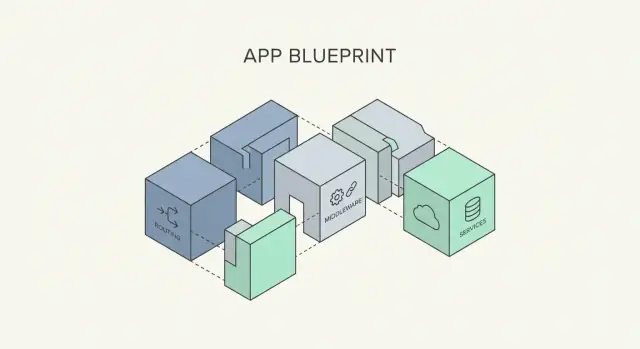
What Microframeworks Are and Why They Matter
Microframeworks are lightweight web frameworks that focus on the essentials: receiving a request, routing it to the right handler, and returning a response. Unlike full-stack frameworks, they usually don’t bundle everything you might need (admin panels, ORM/database layers, form builders, background jobs, authentication flows). Instead, they provide a small, stable core and let you add only what your product actually requires.
Microframeworks vs. full-stack frameworks
A full-stack framework is like buying a fully furnished house: consistent and convenient, but harder to remodel. A microframework is closer to an empty-but-structurally-sound space: you decide the rooms, the furniture, and the utilities.
That freedom is what we mean by custom architecture—a system design shaped around your team’s needs, your domain, and your operational constraints. In plain terms: you choose the components (logging, database access, validation, auth, background processing) and decide how they connect, rather than accepting a pre-defined “one right way.”
Why teams choose microframeworks
Teams often reach for microframeworks when they want:
- Speed to first endpoint without committing to a heavyweight stack
- Flexibility to adopt specific libraries (or avoid them)
- Constraint-friendly deployments, like serverless functions, edge runtimes, or minimal containers
- Clear boundaries between services or modules as the codebase grows
What this article will (and won’t) cover
We’ll focus on how microframeworks support modular design: composing building blocks, using middleware, and adding dependency injection without turning the project into a science experiment.
We won’t compare specific frameworks line-by-line or claim microframeworks are always better. The goal is to help you choose structure deliberately—and evolve it safely as requirements change.
The Core Idea: Assemble Only the Pieces You Need
Microframeworks work best when you treat your application like a kit, not a pre-built house. Instead of accepting an opinionated stack, you start with a small core and add capabilities only when they pay for themselves.
Start with the smallest useful core
A practical “core” is usually just:
- Routing: mapping URLs to handlers
- Request/response handling: a consistent way to read input and return output
- Error handling: a single place to convert failures into clean responses
That’s enough to ship a working API endpoint or web page. Everything else is optional until you have a concrete reason.
Add features as explicit modules
When you need authentication, validation, or logging, add them as separate components—ideally behind clear interfaces. This keeps your architecture understandable: each new piece should answer “what problem does this solve?” and “where does it plug in?”
Examples of “add only what you need” modules:
- Auth when you have real users or third-party access
- Validation when inputs start causing bugs or support costs
- Logging/metrics when you need to debug production issues quickly
Keep early decisions reversible
Early on, choose solutions that don’t trap you. Prefer thin wrappers and configuration over deep framework magic. If you can swap a module without rewriting business logic, you’re doing it right.
A simple definition of done for architecture choices: the team can explain the purpose of each module, replace it in a day or two, and test it independently.
Architecture Building Blocks You Can Mix and Match
Microframeworks stay small by design, which means you get to choose the “organs” of your application instead of inheriting a full body. This is what makes custom architecture practical: you can start minimal, then add pieces only when a real need shows up.
Request handling: router, handlers, middleware
Most microframework-based apps begin with a router that maps URLs to controllers (or simpler request handlers). Controllers can be organized by feature (billing, accounts) or by interface (web vs. API), depending on how you want to maintain the code.
Middleware typically wraps the request/response flow and is the best place for cross-cutting concerns:
- Authentication and authorization
- Rate limiting
- Caching
- Metrics, logging, and request tracing
Because middleware is composable, you can apply it globally (everything needs logging) or only to specific routes (admin endpoints need stricter auth).
Data access: pick the right level of abstraction
Microframeworks rarely force a data layer, so you can select one that matches your team and workload:
- An ORM when you want productivity and consistent modeling
- A query builder for tighter control without writing everything by hand
- Raw SQL for performance-sensitive queries or complex reporting
A good pattern is to keep data access behind a repository or service layer, so switching tools later doesn’t ripple through your handlers.
Optional modules: background jobs and queues
Not every product needs async processing on day one. When it does, add a job runner and a queue (email sending, video processing, webhooks). Treat background jobs like a separate “entry point” into your domain logic, sharing the same services as your HTTP layer rather than duplicating rules.
Middleware as the Backbone for Cross-Cutting Concerns
Middleware is where microframeworks deliver the most leverage: it lets you handle cross-cutting needs—things every request should get—without bloating each route handler. The goal is simple: keep handlers focused on business logic, and let middleware deal with the plumbing.
Keep handlers small by moving shared work upstream
Instead of repeating the same checks and headers in every endpoint, add middleware once. A clean handler can then look like: parse input, call a service, return a response. Everything else—auth, logging, validation defaults, response formatting—can happen before or after.
Typical middleware order (and why it matters)
Order is behavior. A common, readable sequence is:
- Request ID + basic logging: create correlation early so every log line matches the same request.
- Error handling / recovery: wrap the rest so exceptions become consistent error responses.
- Security and HTTP headers: CORS, rate limiting, auth/session parsing—before you do real work.
- Body parsing + input normalization: make sure handlers receive predictable data.
- Compression: near the end so it can compress the final response body.
If compression runs too early, it may miss errors; if error handling runs too late, you risk leaking stack traces or returning inconsistent formats.
Practical examples you’ll use immediately
- Request IDs: add an
X-Request-Idheader and include it in logs. - Error handling: map exceptions to a stable JSON shape (
{ error, message, requestId }). - CORS: enforce allowed origins and headers centrally.
- Compression: reduce payload sizes for JSON-heavy APIs.
Avoid “middleware spaghetti”
Group middleware by purpose (observability, security, parsing, response shaping) and apply it at the right scope: global for truly universal rules, and route-group middleware for specific areas (e.g., /admin). Name each middleware clearly and document the expected order in a short comment near the setup so future changes don’t silently break behavior.
Inversion of Control and Dependency Injection Without the Pain
A microframework gives you a thin “request in, response out” core. Everything else—database access, caching, email, third‑party APIs—should be swappable. That’s where Inversion of Control (IoC) and Dependency Injection (DI) help, without turning your codebase into a science project.
IoC in plain language: don’t let your code “go shopping”
If a feature needs a database, it’s tempting to create it directly inside the feature (“new database client here”). The downside: every place that “goes shopping” is now tightly tied to that specific database client.
IoC flips that: your feature asks for what it needs, and the app wiring hands it in. Your feature becomes easier to reuse and easier to change.
DI: plugging in parts instead of hardwiring them
Dependency Injection just means passing dependencies in rather than creating them inside. In a microframework setup, this is often done at startup:
- create the real components (database, HTTP client, logger)
- hand them to your route handlers/services
- keep that wiring in one predictable place
You don’t need a big DI container to get the benefits. Start with a simple rule: construct dependencies in one place, and pass them down.
Practical approach: interfaces + adapters around storage and APIs
To make components interchangeable, define “what you need” as a small interface, then write adapters for specific tools.
Example pattern:
UserRepository(interface):findById,create,listPostgresUserRepository(adapter): implements those methods using PostgresInMemoryUserRepository(adapter): implements the same methods for tests
Your business logic only knows about UserRepository, not Postgres. Swapping storage becomes a configuration choice, not a rewrite.
The same idea works for external APIs:
PaymentsGatewayinterfaceStripePaymentsGatewayadapterFakePaymentsGatewayfor local development
Keep configuration centralized and predictable
Microframeworks make it easy to accidentally scatter configuration across modules. Resist that.
A maintainable pattern is:
- one configuration module that reads environment variables once
- one composition root (startup file) that builds the dependency graph
- routes that receive already-wired services
This gives you the main goal: swap components without rewriting the app. Changing databases, replacing an API client, or introducing a queue becomes a small change in the wiring layer—while the rest of the code stays stable.
Common Patterns Microframeworks Support
Microframeworks don’t force a “one true way” to structure your code. Instead, they give you routing, request/response handling, and a small set of extension points—so you can adopt patterns that match your team size, product maturity, and change rate.
Layered (Controller / Service / Repository)
This is the familiar “clean and simple” setup: controllers handle HTTP concerns, services hold business rules, and repositories talk to the database.
It fits well when your domain is straightforward, your team is small to mid-size, and you want predictable places to put code. Microframeworks support it naturally: routes map to controllers, controllers call services, and repositories are wired in via lightweight manual composition.
Hexagonal (Ports-and-Adapters)
Hexagonal architecture is useful when you expect your system to outlive today’s choices—database, message bus, third-party APIs, or even the UI.
Microframeworks work nicely here because the “adapter” layer is often your HTTP handlers plus a thin translation step into domain commands. Your ports are interfaces in the domain, and adapters implement them (SQL, REST clients, queues). The framework stays at the edge, not in the center.
Modular Monolith (Feature Modules with Boundaries)
If you want microservice-like clarity without operational overhead, a modular monolith is a strong option. You keep one deployable app, but split it into feature modules (e.g., Billing, Accounts, Notifications) with explicit public APIs.
Microframeworks make this easier because they don’t auto-wire everything: each module can register its own routes, dependencies, and data access, making boundaries visible and harder to accidentally cross.
Minimal constraints, maximum intent
Across all three patterns, the benefit is the same: you choose the rules—folder layout, dependency direction, and module boundaries—while the microframework provides a stable, small surface area to plug into.
From Monolith to Microservices: Choosing the Right Shape
Microframeworks make it easy to start small and stay flexible, but they don’t answer the bigger question: what “shape” should your system take? The right choice depends less on technology and more on team size, release cadence, and how painful coordination has become.
Quick comparisons: monolith, modular monolith, microservices
A monolith ships as one deployable unit. It’s often the fastest path to a working product: one build, one set of logs, one place to debug.
A modular monolith is still one deployable, but internally separated into clear modules (packages, bounded contexts, feature folders). This is frequently the best “next step” once the codebase grows—especially with microframeworks, where you can keep modules explicit.
Microservices split the deployable into multiple services. This can reduce coupling between teams, but it also multiplies operational work.
Service boundaries: when to split (and when not to)
Split when a boundary is already real in your work:
- Different teams need to release independently.
- A module has distinct data ownership and rules (not just different endpoints).
- Scaling requirements are genuinely different (e.g., heavy background processing vs. lightweight reads).
Avoid splitting when it’s mostly convenience (“this folder is big”) or when services would share the same database tables. That’s a sign you haven’t found a stable boundary yet.
API gateways and shared libraries: pros and cons
An API gateway can simplify clients (one entry point, centralized auth/rate limiting). The downside: it can become a bottleneck and a single failure point if it grows too smart.
Shared libraries speed up development (common validation, logging, SDKs), but they also create hidden coupling. If multiple services must upgrade together, you’ve recreated a distributed monolith.
Operational overhead to plan for
Microservices add recurring costs: more deploy pipelines, versioning, service discovery, monitoring, tracing, incident response, and on-call rotations. If your team can’t comfortably run that machinery, a modular monolith built with microframework components is often the safer architecture.
Practical Blueprint: A Maintainable Microframework Setup
A microframework gives you freedom, but maintainability is something you have to design. The goal is to make the “custom” parts easy to find, easy to replace, and hard to misuse.
1) Start with a clean, boring project structure
Pick a structure you can explain in one minute and enforce with code review. One practical split is:
app/(composition root: wires modules together)modules/(business capabilities)transport/(HTTP routing, request/response mapping)shared/(cross-cutting utilities: config, logging, error types)tests/
Keep naming consistent: module folders use nouns (billing, users), and entry points are predictable (index, routes, service).
2) Define module ownership and public APIs
Treat each module like a small product with clear boundaries:
- Expose a small public surface (e.g.,
modules/users/public.ts) - Keep internals private (
modules/users/internal/*) - Document ownership (“who approves changes here”) and expectations (SLAs, data rules)
Avoid “reach-through” imports like modules/orders/internal/db.ts from another module. If another part of the app needs it, promote it to the public API.
3) Add observability from day one
Even tiny services need basic visibility:
- Structured logs with request IDs
- A small metrics set (latency, error rate, key business counters)
- Tracing hooks if you make outbound calls (HTTP, DB, queue)
Put these in shared/observability so every route handler uses the same conventions.
4) Standardize validation and error responses
Make errors predictable for clients and easy for humans to debug. Define one error shape (e.g., code, message, details, requestId) and one validation approach (schema per endpoint). Centralize mapping from internal exceptions to HTTP responses so handlers stay focused on business logic.
Where Koder.ai fits in (when you want speed without locking in)
If your goal is to move fast while keeping a microframework-style architecture explicit, Koder.ai can be useful as a scaffolding and iteration tool rather than a replacement for good design. You can describe your desired module boundaries, middleware stack, and error format in chat, generate a working baseline app (for example, a React frontend with a Go + PostgreSQL backend), and then refine the wiring deliberately.
Two features map especially well to custom architecture work:
- Planning mode to align on structure (modules, ports/adapters, route groups) before generating or changing code.
- Snapshots and rollback to safely experiment with architectural changes (e.g., introducing DI, extracting a module, adding a queue) without fear of getting stuck.
Because Koder.ai supports source code export, you can keep ownership of the architecture and evolve it in your repo the same way you would with a hand-built microframework project.
Testing Strategies That Keep Custom Architectures Safe
Microframework-based systems can feel “hand-assembled,” which makes testing less about a single framework’s conventions and more about protecting the seams between your pieces. The goal is confidence without turning every change into a full end-to-end run.
Unit vs. integration: what to prioritize
Start with unit tests for business rules (validation, pricing, permissions logic) because they’re fast and pinpoint failures.
Then invest in a smaller number of high-value integration tests that exercise the wiring: routing → middleware → handler → persistence boundary. These catch the subtle bugs that happen when components are combined.
Testing middleware and request handlers effectively
Middleware is where cross-cutting behavior hides (auth, logging, rate limits). Test it like a pipeline:
- Build a minimal request context.
- Run the middleware with a “next handler” that records what it received.
- Assert both side effects (e.g., headers added) and control flow (e.g., request blocked on missing auth).
For handlers, prefer testing the public HTTP shape (status codes, headers, response body) rather than internal function calls. This keeps tests stable even as internals change.
Isolating external services with DI or fakes
Use dependency injection (or simple constructor parameters) to swap real dependencies for fakes:
- Fake email/payment clients to avoid network calls.
- In-memory repositories for unit tests.
- A local database container for a few integration tests that validate queries.
Contract tests when teams grow
When multiple services or teams depend on an API, add contract tests that lock down request/response expectations. Provider-side contract tests ensure you don’t accidentally break consumers, even if your microframework setup and internal modules evolve.
Trade-Offs and Pitfalls to Watch For
Microframeworks give you freedom, but freedom is not automatically clarity. The main risks show up later—when the team grows, the codebase expands, and “temporary” decisions become permanent.
Flexibility can turn into inconsistency
With fewer built-in conventions, two teams can build the same feature in two different styles (routing, error handling, response formats, logging). That inconsistency slows reviews and makes onboarding harder.
A simple guardrail helps: write a short “service template” doc (project structure, naming, error format, logging fields) and enforce it with a starter repo and a few lints.
Hidden coupling and shared-utils sprawl
Microframework projects often start clean, then accumulate a utils/ folder that quietly becomes a second framework. When modules share helpers, constants, and global state, boundaries blur and changes create surprise breakage.
Prefer explicit shared packages with versioning, or keep sharing minimal: types, interfaces, and well-tested primitives. If a helper depends on business rules, it likely belongs in a domain module, not “utils.”
Security gaps when you assemble auth and validation yourself
When you’re wiring authentication, authorization, input validation, and rate limiting manually, it’s easy to miss a route, forget a middleware, or validate only “happy path” inputs.
Centralize security defaults: secure headers, consistent auth checks, and validation at the edge. Add tests that assert protected endpoints are protected.
Middleware chains can hurt performance
Unplanned middleware layering adds overhead—especially if multiple middlewares parse bodies, hit storage, or serialize logs.
Keep middleware small and measurable. Document the standard order, and review new middleware for cost. If you suspect bloat, profile requests and remove redundant steps.
A Simple Decision Guide for Picking Your Architecture
Microframeworks give you options—but options need a decision process. The goal isn’t to find the “best” architecture; it’s to pick a shape that your team can build, operate, and change without drama.
Step 1: Run a quick checklist
Before you choose “monolith” or “microservices,” answer these:
- Team size and skills: Can you realistically support multiple deployable services (on-call, CI/CD, observability), or do you need a single, simpler runtime?
- Deadlines: If speed matters most, start with fewer moving parts and defer splitting.
- Compliance and security needs: Auditing, data residency, and access controls often dictate structure more than performance does.
If you’re uncertain, default to a modular monolith built with a microframework. It keeps boundaries clear while staying easy to ship.
Step 2: Pick conventions early (and write them down)
Microframeworks won’t enforce consistency for you, so choose conventions up front:
- Routing style (RESTful resources vs. action routes)
- Folder layout (by feature vs. by technical layer)
- A consistent error format (so clients can reliably handle failures)
A one-page “service contract” document saved in /docs is often enough.
Step 3: Decide your must-have modules
Start with the cross-cutting pieces you’ll need everywhere:
- Authentication/authorization
- Logging and request tracing
- Input validation and error handling
Treat these as shared modules, not copy-pasted snippets.
Step 4: Re-evaluate quarterly
Architectures should change as requirements do. Every quarter, review where deployments are slowing down, which parts scale differently, and what breaks most often. If one domain becomes a bottleneck, that’s your candidate to split next—not the whole system.
Example Evolution: How a Custom Architecture Grows
A microframework setup rarely starts “fully designed.” It usually starts with one API, one team, and a tight deadline. The value shows up as the product grows: new features arrive, more people touch the code, and your architecture needs to stretch without snapping.
Stage 1: A single API with a few routes
You begin with a minimal service: routing, request parsing, and one database adapter. Most logic lives close to the endpoints because it’s faster to ship.
Stage 2: Features become modules
As you add auth, payments, notifications, and reporting, you separate them into modules (folders or packages) with clear public interfaces. Each module owns its models, business rules, and data access, exposing only what other modules need.
Stage 3: Cross-cutting concerns move into middleware
Logging, auth checks, rate limiting, and request validation migrate into middleware so every endpoint behaves consistently. Because order matters, you should document it.
What to document so growth stays predictable
Document:
- Module boundaries: what each module owns, and what it must not touch
- Middleware order: what runs first, what runs last, and why
- SLAs/expectations: latency targets, error budgets, and dependency contracts (even if informal at first)
Signals it’s time to refactor—or split services
Refactor when modules start sharing too many internals, build times slow noticeably, or “small changes” require edits across multiple modules.
Consider splitting into separate services when teams are blocked by shared deployments, different parts need different scaling, or an integration boundary is already behaving like a separate product.
Conclusion and Next Steps
Microframeworks are a good fit when you want to shape the application around your domain rather than around a prescribed stack. They work especially well for teams that value clarity over convenience: you’re willing to choose (and maintain) a few key building blocks in exchange for a codebase that stays understandable as requirements change.
Key takeaways to keep you on track
Your flexibility only pays off if you protect it with a few habits:
- Boundaries first: decide what “belongs together” (modules/services) and what must not leak across boundaries.
- Modules over magic: prefer small, explicit components with clear responsibilities and minimal shared state.
- Consistency beats creativity: standardize request/response shapes, error handling, logging fields, and configuration patterns.
- Testing is your safety net: once you customize the architecture, tests are what keep refactors safe and integrations predictable.
Next steps you can do this week
Start with two lightweight artifacts:
- Draft a module map: list your core modules, their public interfaces, and the dependencies you’ll allow between them.
- Draft a middleware stack: write down the order and purpose of each middleware (auth, validation, rate limiting, tracing, error handling), plus what data it is allowed to add to the request context.
Finally, document decisions as you make them—even short notes help. Keep an “Architecture Decisions” page in your repo and review it periodically so yesterday’s shortcuts don’t become today’s constraints.
FAQ
What is a microframework, and how is it different from a full-stack framework?
A microframework focuses on the essentials: routing, request/response handling, and basic extension points.
A full-stack framework typically bundles many “batteries included” features (ORM, auth, admin, forms, background jobs). Microframeworks trade convenience for control—you add only what you need and decide how pieces connect.
When should a team choose a microframework?
Microframeworks are a good fit when you want to:
- Ship quickly without buying into a heavy, opinionated stack
- Run in constraint-friendly environments (serverless, edge, small containers)
- Keep service/module boundaries explicit as the codebase grows
- Swap components (DB layer, auth, queue) with minimal ripple effects
What’s the minimum set of pieces you need to start a microframework app?
A “smallest useful core” is usually:
- Routing (URL → handler)
- Request/response primitives (read input, return output)
- Centralized error handling (consistent failures)
Start there, ship one endpoint, then add modules only when they clearly pay for themselves (auth, validation, observability, queues).
What belongs in middleware vs. in route handlers?
Middleware is best for cross-cutting concerns that apply broadly, such as:
- Request IDs and structured logging
- Error handling/recovery
- Security headers, CORS, rate limiting
- Auth/session parsing
- Body parsing and normalization
- Compression
Keep route handlers focused on business logic: parse → call service → return response.
What is a sensible middleware order for APIs?
Order changes behavior. A common, reliable sequence is:
- Request ID + basic logging
- Error handling/recovery
- Security headers + CORS + rate limiting + auth
- Body parsing + validation/input normalization
- Compression near the end
Document the order near setup code so future changes don’t silently break responses or security assumptions.
What does Inversion of Control (IoC) mean in a microframework project?
Inversion of Control means your business code doesn’t construct its own dependencies (it doesn’t “go shopping”). Instead, the application wiring provides what it needs.
Practically: build the database client, logger, and API clients at startup, then pass them into services/handlers. This reduces tight coupling and makes testing and swapping implementations much easier.
Do you need a DI container when using a microframework?
No. You can get most DI benefits with a simple composition root:
- Create dependencies once (DB, logger, HTTP clients)
- Pass them into module factories/services
- Keep wiring in one predictable file/module
Add a container only if the dependency graph becomes painful to manage manually—don’t start with complexity by default.
How do you keep components swappable (e.g., database or payments)?
Put storage and external APIs behind small interfaces (ports), then implement adapters:
UserRepositoryinterface withfindById,create,listPostgresUserRepositoryfor productionInMemoryUserRepositoryfor tests
Handlers/services depend on the interface, not the concrete tool. Switching databases or third-party providers becomes a wiring/config change, not a rewrite.
What project structure helps microframework apps stay maintainable?
A practical structure that keeps boundaries visible:
app/composition root (wiring)modules/feature modules (domain capabilities)transport/HTTP routing + request/response mappingshared/config, logging, error types, observabilitytests/
Enforce module public APIs (e.g., modules/users/public.ts) and avoid “reach-through” imports into internals.
What testing approach works best for custom microframework architectures?
Prioritize fast unit tests for business rules, then add fewer high-value integration tests that exercise the full pipeline (routing → middleware → handler → persistence boundary).
Use DI/fakes to isolate external services, and test middleware like a pipeline (assert headers, side effects, and blocking behavior). If multiple teams depend on APIs, add contract tests to prevent breaking changes.