

How Multi-Tenant Databases Impact Security and Performance
Learn how multi-tenant databases affect security and performance, the main risks (isolation, noisy neighbors), and practical controls to keep tenants safe and fast.
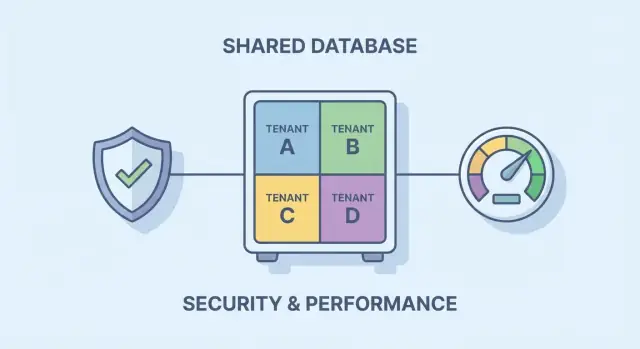
What a Multi-Tenant Database Means
A multi-tenant database is a setup where many customers (tenants) share the same database system—the same database server, the same underlying storage, and often the same schema—while the application ensures each tenant can access only their own data.
Think of it like an apartment building: everyone shares the building’s structure and utilities, but each tenant has their own locked unit.
Multi-tenant vs. single-tenant (high level)
In a single-tenant approach, each customer gets dedicated database resources—for example, their own database instance or their own server. Isolation is simpler to reason about, but it’s typically more expensive and operationally heavy as the customer count grows.
With multi-tenancy, tenants share infrastructure, which can be efficient—but it also means your design must intentionally enforce boundaries.
Why SaaS teams choose multi-tenancy
SaaS companies often pick multi-tenancy for practical reasons:
- Lower cost per customer (shared compute, storage, licensing, and ops time)
- Simpler operations at scale, such as fewer databases to patch, upgrade, and monitor
- Faster onboarding for new customers (no need to provision a whole new database stack)
The key expectation: design determines outcomes
Multi-tenancy itself isn’t automatically “secure” or “fast.” Outcomes depend on choices like how tenants are separated (schema, rows, or databases), how access control is enforced, how encryption keys are handled, and how the system prevents one tenant’s workload from slowing down others.
The rest of this guide focuses on those design choices—because in multi-tenant systems, security and performance are features you build, not assumptions you inherit.
Common Multi-Tenant Database Models
Multi-tenancy isn’t one design choice—it’s a spectrum of how tightly you share infrastructure. The model you pick defines your isolation boundary (what must never be shared), and that directly affects database security, performance isolation, and day-to-day operations.
Database-per-tenant
Each tenant gets its own database (often on the same server or cluster).
Isolation boundary: the database itself. This is usually the cleanest tenant isolation story because cross-tenant access typically requires crossing a database boundary.
Operational trade-offs: heavier to operate at scale. Upgrades and schema migrations may need to run thousands of times, and connection pooling can get complicated. Backups/restores are straightforward at the tenant level, but storage and management overhead can grow quickly.
Security & tuning: generally easiest to secure and tune per customer, and a strong fit when tenants have different compliance requirements.
Schema-per-tenant
Tenants share a database, but each tenant has its own schema.
Isolation boundary: the schema. It’s meaningful separation, but it relies on correct permissions and tooling.
Operational trade-offs: upgrades and migrations are still repetitive, but lighter than database-per-tenant. Backups are trickier: many tools treat the database as the unit of backup, so tenant-level operations may require schema-level exports.
Security & tuning: easier to enforce isolation than shared tables, but you must be disciplined about privileges and ensuring queries never reference the wrong schema.
Table-per-tenant
All tenants share a database and schema, but each tenant has separate tables (e.g., orders_tenant123).
Isolation boundary: the table set. It can work for a small number of tenants, but it scales poorly: metadata bloat, migration scripts become unwieldy, and query planning can degrade.
Security & tuning: permissions can be precise, yet operational complexity is high, and it’s easy to make mistakes when adding new tables or features.
Shared-table (shared schema)
All tenants share the same tables, distinguished by a tenant_id column.
Isolation boundary: your query and access-control layer (commonly row-level security). This model is operationally efficient—one schema to migrate, one index strategy to manage—but it’s the most demanding for database security and performance isolation.
Security & tuning: hardest to get right because every query must be tenant-aware, and the noisy neighbor problem is more likely unless you add resource throttling and careful indexing.
A useful rule: the more you share, the simpler upgrades become—but the more rigor you need in tenant isolation controls and performance isolation.
How Multi-Tenancy Changes the Security Model
Multi-tenancy doesn’t just mean “multiple customers in one database.” It changes your threat model: the biggest risk shifts from outsiders breaking in to authorized users accidentally (or deliberately) seeing data that belongs to a different tenant.
Authentication vs. authorization: tenant context is an authorization decision
Authentication answers “who are you?” Authorization answers “what are you allowed to access?” In a multi-tenant database, tenant context (tenant_id, account_id, org_id) must be enforced during authorization—not treated as an optional filter.
A common mistake is assuming that once a user is authenticated and you “know” their tenant, the application will naturally keep queries separated. In practice, separation must be explicit and enforced at a consistent control point (e.g., database policies or a mandatory query layer).
The core rule: every read and write must be tenant-scoped
The simplest rule is also the most important: every read and write must be scoped to exactly one tenant.
That applies to:
- SELECTs (including list pages and exports)
- UPDATE/DELETE operations
- Background jobs and ETL scripts
- Admin tooling and support workflows
If tenant scoping is optional, it will eventually be skipped.
Common failure modes that cause cross-tenant access
Cross-tenant leaks often come from small, routine errors:
- Missing tenant filters in one endpoint or one code path
- “Broken” joins where one table is scoped but the joined table is not
- Cached responses keyed only by user or URL, not by tenant
- Reused prepared statements that accidentally bind the wrong
tenant_id
Why “it works in tests” can still leak in production
Tests typically run with tiny datasets and clean assumptions. Production adds concurrency, retries, caches, mixed tenant data, and real edge cases.
A feature might pass tests because only one tenant exists in the test database, or because fixtures don’t include overlapping IDs across tenants. The safest designs make it hard to write an unscoped query at all, instead of relying on reviewers to catch it every time.
Isolation Controls That Prevent Cross-Tenant Data Access
The core security risk in a multi-tenant database is simple: a query that forgets to filter by tenant can expose someone else’s data. Strong isolation controls assume mistakes will happen and make those mistakes harmless.
Tenant identifiers and strict scoping patterns
Every tenant-owned record should carry a tenant identifier (for example, tenant_id) and your access layer should always scope reads and writes by it.
A practical pattern is “tenant context first”: the application resolves the tenant (from subdomain, org ID, or token claims), stores it in request context, and your data access code refuses to run without that context.
Guardrails that help:
- Require
tenant_idin primary/unique keys where appropriate (to prevent collisions across tenants). - Add foreign keys that include
tenant_idso cross-tenant relationships can’t be created accidentally.
Row-level security (RLS) and policy-based access
Where supported (notably PostgreSQL), row-level security can move tenant checks into the database. Policies can restrict every SELECT/UPDATE/DELETE so only rows matching the current tenant are visible.
This reduces reliance on “every developer remembered the WHERE clause,” and it can also protect against certain injection or ORM misuse scenarios. Treat RLS as a second lock, not the only lock.
Schema/database separation as an isolation tool
If tenants have higher sensitivity or stricter compliance needs, separating tenants by schema (or even by database) can reduce blast radius. The tradeoff is increased operational overhead.
Safe defaults: deny-by-default and least privilege
Design permissions so the default is “no access”:
- Application roles should have only the minimum table access they need.
- Admin workflows should use separate accounts and audited elevation.
- Avoid shared “superuser” connections in application code.
These controls work best together: strong tenant scoping, database-enforced policies where possible, and conservative privileges that limit damage when something slips.
Encryption and Key Management in Shared Datastores
Encryption is one of the few controls that still helps even when other isolation layers fail. In a shared datastore, the goal is to protect data while it moves, while it sits, and while your app proves which tenant it’s acting for.
Encrypting data in transit and at rest
For data in transit, require TLS for every hop: client → API, API → database, and any internal service calls. Enforce it at the database level where possible (for example, rejecting non-TLS connections) so “temporary exceptions” don’t quietly become permanent.
For data at rest, use database or storage-level encryption (managed disk encryption, TDE, encrypted backups). This protects against lost media, snapshot exposure, and some classes of infrastructure compromise—but it won’t stop a buggy query from returning another tenant’s rows.
Shared keys vs per-tenant keys
A single shared encryption key is simpler to operate (fewer keys to rotate, fewer failure modes). The downside is blast radius: if that key is exposed, all tenants are exposed.
Per-tenant keys reduce blast radius and can help with customer requirements (some enterprises want tenant-specific key control). The tradeoff is complexity: key lifecycle management, rotation schedules, and support workflows (e.g., what happens if a tenant disables their key).
A practical middle ground is envelope encryption: a master key encrypts per-tenant data keys, keeping rotation manageable.
Secrets management for database credentials
Store database credentials in a secrets manager, not environment variables in long-lived configs. Prefer short-lived credentials or automatic rotation, and scope access by service role so a compromise in one component can’t automatically reach every database.
Token and session handling: preventing forged tenant context
Treat tenant identity as security-critical. Never accept a raw tenant ID from the client as “truth.” Bind tenant context to signed tokens and server-side authorization checks, and validate it on every request before any database call.
Auditing, Monitoring, and Incident Readiness
Multi-tenancy changes what “normal” looks like. You’re not just watching a database—you’re watching many tenants sharing the same system, where one mistake can turn into cross-tenant exposure. Good auditability and monitoring reduce both the likelihood and the blast radius of incidents.
Audit logs: record the full story
At minimum, log every action that can read, change, or grant access to tenant data. The most useful audit events answer:
- Who: user/service identity, auth method, role, source IP/device
- What: operation (SELECT/UPDATE/DELETE), affected objects, query class (not necessarily full SQL), before/after for privileged changes
- When: timestamp with timezone, request/trace ID for correlation
- Tenant: tenant ID as a first-class field (never inferred later)
Also log administrative actions: creating tenants, changing isolation policies, modifying row-level security rules, rotating keys, and changing connection strings.
Alerting for cross-tenant and privilege anomalies
Monitoring should detect patterns that are unlikely in healthy SaaS usage:
- Queries returning rows for multiple tenant IDs, or sudden spikes in “tenant mismatch” rejections
- Access from a service account to a tenant it doesn’t usually touch
- Rapid role/permission changes, new admins, disabled security policies, or RLS bypass attempts
Tie alerts to actionable runbooks: what to check, how to contain, and who to page.
Admin controls and break-glass procedures
Treat privileged access as a production change. Use least-privilege roles, short-lived credentials, and approvals for sensitive operations (schema changes, data exports, policy edits). For emergencies, keep a break-glass account that is tightly controlled: separate credentials, mandatory ticket/approval, time-bounded access, and extra logging.
Retention and tenant-scoped log access
Set retention based on compliance and investigation needs, but scope access so tenant support staff can only view logs for their tenant. When customers request audit exports, provide tenant-filtered reports rather than raw shared logs.
Performance Basics and the Noisy Neighbor Problem
Multi-tenancy improves efficiency by letting many customers share the same database infrastructure. The tradeoff is that performance becomes a shared experience too: what one tenant does can affect others, even if their data is fully isolated.
The “noisy neighbor” problem (plain English)
A “noisy neighbor” is a tenant whose activity is so heavy (or so spiky) that it consumes more than its fair share of shared resources. The database isn’t “broken”—it’s just busy handling that tenant’s work, so other tenants wait longer.
Think of it like an apartment building with shared water pressure: one unit runs multiple showers and the washing machine at once, and everyone else notices weaker flow.
What’s actually shared?
Even when each tenant has separate rows or schemas, many performance-critical components are still shared:
- CPU: query execution, sorting, joins, encryption/decryption, background maintenance.
- Memory: buffer/cache pages, query working memory, internal queues.
- Disk / I/O: reading data files, writing logs, flushing checkpoints, running compaction/vacuum.
- Connections: database connection limits and thread pools.
- Caches: plan cache, buffer cache, and sometimes application-side caches feeding the database.
When these shared pools get saturated, latency rises for everyone.
Why bursty workloads hurt other tenants
Many SaaS workloads arrive in bursts: an import, end-of-month reports, a marketing campaign, a cron job that runs at the top of the hour.
Bursts can create “traffic jams” inside the database:
- A single tenant launches many expensive queries at once, pushing CPU to 100%.
- Large writes trigger extra I/O (log writes, index maintenance), slowing reads for others.
- Connection spikes fill the pool, so other tenants can’t get a slot quickly.
Even if the burst lasts only a few minutes, it can cause knock-on delays as queues drain.
What users typically notice
From the customer’s perspective, noisy-neighbor issues feel random and unfair. Common symptoms include:
- Timeouts during login, search, checkout, or report generation
- Slow pages that used to be quick, especially list views and dashboards
- Inconsistent speed (fast at 10:05, slow at 10:10, fast again at 10:20)
- Background jobs lagging (exports taking longer, webhooks delayed)
These symptoms are early warning signs that you need performance isolation techniques (covered next) rather than only “more hardware.”
Resource Isolation and Throttling Techniques
Multi-tenancy works best when one customer can’t “borrow” more than their fair share of database capacity. Resource isolation is the set of guardrails that keeps a heavy tenant from slowing everyone else down.
Connection pooling limits and per-tenant quotas
A common failure mode is unbounded connections: one tenant’s traffic spike opens hundreds of sessions and starves the database.
Set hard caps in two places:
- At the application pool: limit max connections per service instance and reserve a minimum for background jobs.
- Per tenant: enforce quotas such as “N concurrent requests” or “M concurrent DB sessions” mapped from the tenant’s plan.
Even if your database can’t enforce “connections per tenant” directly, you can approximate it by routing each tenant through a dedicated pool or pool partition.
Rate limiting and workload shaping (app + DB)
Rate limiting is about fairness over time. Apply it close to the edge (API gateway/app) and, where supported, inside the database (resource groups/workload management).
Examples:
- Token-bucket limits per tenant on expensive endpoints (exports, search)
- Priority tiers so interactive requests win over batch workloads
- Queue-based shaping to smooth bursts instead of pushing them straight into the database
Query timeouts, statement limits, and circuit breakers
Protect the database from “runaway” queries:
- Query/statement timeouts to stop long scans
- Maximum rows/bytes returned for endpoints that can explode in result size
- Circuit breakers that temporarily block a tenant’s expensive feature when error rates or latency cross a threshold
These controls should fail gracefully: return a clear error and suggest retry/backoff.
Read replicas and caching to reduce contention
Move read-heavy traffic away from the primary:
- Read replicas for dashboards, reporting, and analytics-style queries
- Caching (per-tenant keys, short TTLs) for repeated lookups and configuration data
The goal isn’t only speed—it’s reducing lock pressure and CPU contention so noisy tenants have fewer ways to impact others.
Data Modeling Choices That Affect Speed
Multi-tenant performance problems often look like “the database is slow,” but the root cause is usually the data model: how tenant data is keyed, filtered, indexed, and physically laid out. Good modeling makes tenant-scoped queries naturally fast; bad modeling forces the database to work too hard.
Indexing for tenant-scoped queries
Most SaaS queries should include a tenant identifier. Model that explicitly (for example, tenant_id) and design indexes that start with it. In practice, a composite index like (tenant_id, created_at) or (tenant_id, status) is far more useful than indexing created_at or status alone.
This also applies to uniqueness: if emails are only unique per tenant, enforce it with (tenant_id, email) rather than a global email constraint.
Avoiding full-table scans (missing tenant filters)
A common slow-query pattern is an accidental cross-tenant scan: a query that forgets the tenant filter and touches a huge portion of the table.
Make the safe path the easy path:
- Require tenant filters in your query layer (ORM scopes, repository methods)
- Use database protections where available (for example, default tenant views or policies) so unscoped access fails fast
Partitioning and sharding: by tenant or by time
Partitioning can reduce the amount of data each query must consider. Partition by tenant when tenants are large and uneven. Partition by time when access is mostly recent (events, logs, invoices), often with tenant_id as a leading index column inside each partition.
Consider sharding when a single database can’t meet peak throughput, or when one tenant’s workload threatens everyone else.
Managing hot tenants
“Hot tenants” show up as disproportionate read/write volume, lock contention, or oversized indexes.
Spot them by tracking per-tenant query time, rows read, and write rates. When one tenant dominates, isolate them: move to a separate shard/database, split large tables by tenant, or introduce dedicated caches and rate limits so other tenants keep their speed.
Operational Practices That Protect Both Security and Performance
Multi-tenancy rarely fails because the database “can’t do it.” It fails when day-to-day operations allow small inconsistencies to snowball into security gaps or performance regressions. The goal is to make the safe path the default for every change, job, and deploy.
Standardize the tenant key (and enforce it everywhere)
Pick a single, canonical tenant identifier (e.g., tenant_id) and use it consistently across tables, indexes, logs, and APIs. Consistency reduces both security mistakes (querying the wrong tenant) and performance surprises (missing the right composite indexes).
Practical safeguards:
- Require
tenant_idin all primary access paths (queries, repositories, ORM scopes) - Add composite indexes that start with
tenant_idfor common lookups - Prefer database constraints where possible (foreign keys that include
tenant_id, or check constraints) to catch bad writes early
Guard against tenant mix-ups in background work
Async workers are a common source of cross-tenant incidents because they run “out of band” from the request that established tenant context.
Operational patterns that help:
- Pass
tenant_idexplicitly in every job payload; don’t rely on ambient context - Include the tenant key in idempotency keys and cache keys
- Log
tenant_idon job start/end and on every retry so investigations can quickly scope impact
Make migrations tenant-safe by design
Schema and data migrations should be deployable without a perfect, synchronized rollout.
Use rolling changes:
- Expand/contract strategy (add new column/index, dual-write/read, then remove old paths)
- Avoid long, blocking operations; batch backfills by tenant to control load
- Ensure every backfill query is tenant-scoped and rate-limited to prevent self-inflicted noisy-neighbor effects
Test for isolation failures—not just happy paths
Add automated negative tests that deliberately try to access another tenant’s data (read and write). Treat these as release blockers.
Examples:
- Attempt to fetch a known record from Tenant A while authenticated as Tenant B
- Run background job tests with a mismatched
tenant_idand verify hard failure - Regression tests for every query helper to confirm tenant scoping is always applied
Backups, Restores, and Tenant-Level Data Operations
Backups are easy to describe (“copy the database”) and surprisingly hard to execute safely in a multi-tenant database. The moment many customers share tables, you need a plan for how to recover one tenant without exposing or overwriting others.
Backup/restore strategies: one tenant vs everyone
A full-database backup is still the foundation for disaster recovery, but it’s not enough for day-to-day support cases. Common approaches include:
- Full backups + point-in-time recovery for “everyone” incidents (corruption, region outage)
- Tenant-scoped exports (logical dumps filtered by
tenant_id) to restore a single tenant’s data - Separate storage per tenant (when feasible) to make restores naturally tenant-bounded
If you rely on logical exports, treat the export job like production code: it must enforce tenant isolation (for example, via row-level security) rather than trusting a WHERE clause written once and forgotten.
Tenant-level export/delete (privacy requests)
Privacy requests (export, delete) are tenant-level operations that touch security and performance. Build repeatable, audited workflows for:
- Exporting tenant data in a consistent snapshot
- Deleting tenant data without leaving orphan rows
- Proving completion via logs and checksums
Preventing accidental cross-tenant restores
The biggest risk isn’t a hacker—it’s a rushed operator. Reduce human error with guardrails:
- Require a tenant identifier plus a secondary confirmation (tenant name, billing ID)
- Validate row counts and tenant_id distribution before import
- Restore into a quarantine environment first, then promote
DR drills and verifying boundaries afterward
After a disaster recovery drill, don’t stop at “the app is up.” Run automated checks that confirm tenant isolation: sample queries across tenants, audit log review, and spot verification that encryption keys and access roles are still correctly scoped.
When Multi-Tenancy Stops Being the Right Fit
Multi-tenancy is often the best default for SaaS, but it isn’t a permanent decision. As your product and customer mix evolve, the “one shared datastore” approach can start creating business risk or slowing delivery.
Signals it’s time to increase isolation
Consider moving from fully shared to more isolated setups when one or more of these show up consistently:
- Growth and scale effects: a few tenants drive a disproportionate share of traffic, storage, or background jobs, and performance tuning for everyone else becomes harder.
- Compliance and contractual requirements: customers ask for dedicated environments, specific residency controls, separate encryption key ownership, or stricter audit boundaries than your shared model can cleanly provide.
- Heavy tenants with unique patterns: large imports, reporting bursts, or custom integrations create recurring contention that can’t be solved with tuning and throttles alone.
Hybrid models that keep costs reasonable
You don’t have to choose between “all shared” and “all dedicated.” Common hybrid approaches include:
- Carve out a small set of top-tier tenants into separate databases or clusters while keeping the long tail on shared infrastructure.
- Tiered offerings: shared by default, isolated for enterprise plans.
- Functional isolation: keep transactional workloads shared, but move analytics/reporting for heavy tenants to separate stores.
Cost and complexity to explain to stakeholders
More isolation usually means higher infrastructure spend, more operational overhead (migrations, monitoring, on-call), and more release coordination (schema changes across multiple environments). The trade-off is clearer performance guarantees and simpler compliance conversations.
Next steps
If you’re evaluating isolation options, review related guides in /blog or compare plans and deployment options on /pricing.
If you want to prototype a SaaS quickly and pressure-test multi-tenant assumptions early (tenant scoping, RLS-friendly schemas, throttling, and operational workflows), a vibe-coding platform like Koder.ai can help you spin up a working React + Go + PostgreSQL app from chat, iterate in planning mode, and deploy with snapshots and rollback—then export the source code when you’re ready to harden the architecture for production.
FAQ
What is a multi-tenant database in plain terms?
A multi-tenant database is a setup where multiple customers share the same database infrastructure (and often the same schema), while the application and/or database enforces that each tenant can only access their own data. The core requirement is strict tenant scoping on every read and write.
Why do SaaS teams choose multi-tenancy?
Multi-tenancy is often chosen for:
- Lower cost per customer (shared compute/storage/licensing)
- Simpler operations at scale (fewer databases to patch, upgrade, and monitor)
- Faster onboarding (no need to provision a full database stack per customer)
The tradeoff is that you must intentionally build isolation and performance guardrails.
What are the main multi-tenant database models?
Common models (from more isolation to more sharing) are:
- Database-per-tenant: strongest isolation boundary, heavier ops.
- Schema-per-tenant: good separation, still repetitive migrations.
- Table-per-tenant: can work briefly, often scales poorly.
- Shared-table (tenant_id column): simplest ops, hardest to secure/tune.
Your choice sets your isolation boundary and operational burden.
How does multi-tenancy change the security threat model?
The biggest risk shifts toward cross-tenant access caused by routine mistakes, not just external attackers. Tenant context (like tenant_id) must be treated as an authorization requirement, not an optional filter. You also need to assume production realities like concurrency, caching, retries, and background jobs.
What typically causes cross-tenant data leaks?
The most common causes include:
- Missing tenant filters in one code path
- Joins where one table is scoped but the joined table is not
- Caches keyed by URL/user but not tenant
- Prepared statements binding the wrong
tenant_id - Background jobs that lose tenant context
Design guardrails so unscoped queries are hard (or impossible) to run.
When should you use row-level security (RLS), and what does it protect against?
Row-level security (RLS) moves tenant checks into the database using policies that restrict SELECT/UPDATE/DELETE to rows matching the current tenant. It reduces reliance on “everyone remembered the WHERE clause,” but it should be paired with app-layer scoping, least privilege, and strong testing. Treat RLS as an extra lock, not your only lock.
What are the most important isolation controls to prevent cross-tenant access?
A practical baseline includes:
- A canonical
tenant_idon tenant-owned tables - Composite uniqueness and foreign keys that include
tenant_id - Deny-by-default permissions and least-privilege DB roles
- Separate, audited admin access (avoid superuser in app code)
- Negative tests that attempt cross-tenant reads/writes
The goal is to make mistakes fail safely.
How does encryption and key management work in a shared datastore?
Encryption helps, but it covers different risks:
- In transit (TLS): protects data moving between services.
- At rest: protects snapshots/disks/backups, but not buggy queries.
- Per-tenant keys reduce blast radius but add operational complexity.
Also treat tenant identity as security-critical: don’t trust a raw tenant ID from the client; bind it to signed tokens and server-side checks.
What is the noisy neighbor problem, and how do you mitigate it?
Noisy neighbor issues happen when one tenant consumes shared resources (CPU, memory, I/O, connections), increasing latency for others. Practical mitigations include:
- Hard connection pool limits (and per-tenant quotas where possible)
- Rate limiting and workload shaping for expensive endpoints
- Query timeouts, max rows/bytes, and circuit breakers
- Read replicas and per-tenant caching keys
Aim for fairness, not just raw throughput.
When should you move away from full multi-tenancy, and what hybrid options exist?
It’s time to increase isolation when you consistently see:
- A few tenants dominating traffic/storage and causing contention
- Compliance demands for dedicated environments, residency, or key control
- Workloads that can’t be contained with throttles/tuning alone
Common hybrids are carving out top-tier tenants into separate databases/clusters, tiered plans (shared vs dedicated), or moving analytics/reporting to separate stores.