

How Nim Feels Like Python Yet Runs Close to C Speed
Learn how Nim keeps readable, Python-like code while compiling to fast native binaries. See the features that enable C-like speed in practice.
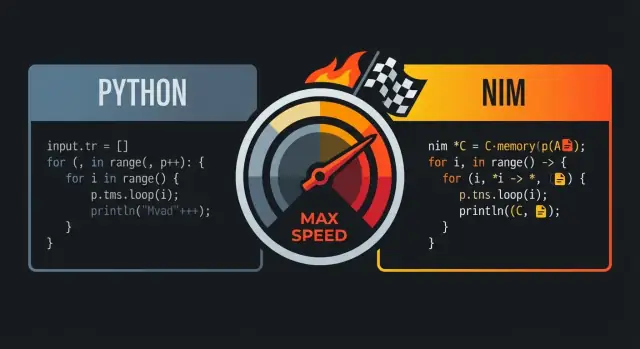
Why People Compare Nim to Python and C
Nim gets compared to Python and C because it aims for the sweet spot between them: code that reads like a high-level scripting language, but compiles into fast native executables.
The core promise: readability plus speed
At a glance, Nim often feels “Pythonic”: clean indentation, straightforward control flow, and expressive standard library features that encourage clear, compact code. The key difference is what happens after you write it—Nim is designed to compile to efficient machine code rather than run on a heavyweight runtime.
For many teams, that combination is the point: you can write code that looks close to what you’d prototype in Python, yet ship it as a single native binary.
Who this matters for
This comparison resonates most with:
- Python developers hitting performance ceilings (CPU-heavy tasks, tight loops, data processing)
- Product teams that want quick iteration without committing to a slower runtime
- Engineers who like C’s speed but don’t want low-level ceremony for everyday code
What “C-level performance” means in practice
“C-level performance” doesn’t mean every Nim program automatically matches hand-tuned C. It means Nim can generate code that’s competitive with C for many workloads—especially where overhead matters: numeric loops, parsing, algorithms, and services that need predictable latency.
You’ll typically see the biggest gains when you remove interpreter overhead, minimize allocations, and keep hot code paths simple.
Expectations: speed still depends on choices
Nim won’t rescue an inefficient algorithm, and you can still write slow code if you allocate excessively, copy large data structures, or ignore profiling. The promise is that the language gives you a path from readable code to fast code without rewriting everything in a different ecosystem.
The result: a language that feels friendly like Python, but is willing to be “close to the metal” when performance actually matters.
Python-Like Syntax: Readable Code Without the Overhead
Nim is often described as “Python-like” because the code looks and flows in a familiar way: indentation-based blocks, minimal punctuation, and a preference for readable, high-level constructs. The difference is that Nim remains a statically typed, compiled language—so you get that clean surface without paying a runtime “tax” for it.
Indentation-based blocks and clean structure
Like Python, Nim uses indentation to define blocks, which makes control flow easy to scan in reviews and diffs. You don’t need braces everywhere, and you rarely need parentheses unless they improve clarity.
let limit = 10
for i in 0..<limit:
  if i mod 2 == 0:
    echo i
That visual simplicity matters when you’re writing performance-sensitive code: you spend less time fighting syntax and more time expressing intent.
Familiar building blocks: loops, slices, strings
Many everyday constructs map closely to what Python users expect.
- Loops:
forloops over ranges and collections feel natural. - Slices: sequences and strings support slicing-style operations.
- Strings: string handling is straightforward, with a standard library designed for practical work.
let nums = @[10, 20, 30, 40, 50]
let middle = nums[1..3]   # slice: @[20, 30, 40]

let s = "hello nim"
echo s[0..4]              # "hello"
The key difference from Python is what happens under the hood: these constructs compile to efficient native code rather than being interpreted by a VM.
Static typing that doesn’t get in your way
Nim is strongly statically typed, but it also leans heavily on type inference, so you don’t end up writing verbose type annotations just to get work done.
var total = 0          # inferred as int
let name = "Nim"      # inferred as string
When you do want explicit types (for public APIs, clarity, or performance-sensitive boundaries), Nim supports that cleanly—without forcing it everywhere.
Helpful compiler errors and warnings
A big part of “readable code” is being able to maintain it safely. Nim’s compiler is strict in useful ways: it surfaces type mismatches, unused variables, and questionable conversions early, often with actionable messages. That feedback loop helps you keep code Python-simple while still benefiting from compile-time correctness checks.
If you like Python’s readability, Nim’s syntax will feel like home. The difference is that Nim’s compiler can validate your assumptions and then produce fast, predictable native binaries—without turning your code into boilerplate.
How Nim Compiles: From Source Code to Native Binaries
Nim is a compiled language: you write .nim files, and the compiler turns them into a native executable you can run directly on your machine. The most common route is via Nim’s C backend (and it can also target C++ or Objective-C), where Nim code is translated into backend source code and then compiled by a system compiler like GCC or Clang.
What “native binary” really means
A native binary runs without a language virtual machine and without an interpreter stepping through your code line by line. That’s a big part of why Nim can feel high-level yet avoid many of the runtime costs associated with bytecode VMs or interpreters: startup time is typically fast, function calls are direct, and hot loops can execute close to the hardware.
Whole-program optimization opportunities
Because Nim compiles ahead of time, the toolchain can optimize across your program as a whole. In practice that can enable better inlining, dead-code elimination, and link-time optimization (depending on flags and your C/C++ compiler). The result is often smaller, faster executables—especially compared to shipping a runtime plus source.
Typical workflow: compile, run, ship
During development you’ll usually iterate with commands like nim c -r yourfile.nim (compile and run) or use different build modes for debug vs release. When it’s time to ship, you distribute the produced executable (and any required dynamic libraries, if you link against them). There’s no separate “deploy the interpreter” step—your output is already a program the OS can execute.
Compile-Time Power: Doing Work Before the Program Runs
One of Nim’s biggest speed advantages is that it can do certain work at compile time (sometimes called CTFE: compile-time function execution). In plain terms: instead of calculating something every time your program runs, you ask the compiler to calculate it once while building the executable, then bake the result into the final binary.
Why compile-time work matters
Runtime performance often gets eaten up by “setup costs”: building tables, parsing known formats, checking invariants, or precomputing values that never change. If those results are predictable from constants, Nim can shift that effort into compilation.
That means:
- less startup time (no “warm-up” step)
- fewer allocations and branches during execution
- simpler runtime code paths (often easier for the compiler to optimize)
Practical examples
Generating lookup tables. If you need a table for fast mapping (say, ASCII character classes or a small hash map of known strings), you can generate the table at compile time and store it as a constant array. The program then does O(1) lookups with zero setup.
Validating constants early. If a constant is out of range (a port number, a fixed buffer size, a protocol version), you can fail the build instead of shipping a binary that discovers the issue later.
Precomputing derived constants. Things like masks, bit patterns, or normalized configuration defaults can be computed once and reused everywhere.
A note of caution: keep it readable
Compile-time logic is powerful, but it’s still code that someone must understand. Prefer small, well-named helpers; add comments explaining “why now” (compile time) vs “why later” (runtime). And test compile-time helpers the same way you test regular functions—so optimizations don’t turn into hard-to-debug build errors.
Macros and Metaprogramming Without Losing Clarity
Nim’s macros are best understood as “code that writes code” during compilation. Instead of running reflective logic at runtime (and paying for it on every execution), you can generate specialized, type-aware Nim code once, then ship the resulting fast binary.
Removing boilerplate (and runtime checks)
A common use is replacing repetitive patterns that would otherwise bloat your codebase or add per-call overhead. For example, you can:
- Generate serialization/deserialization functions for a type, rather than hand-writing field-by-field logic.
- Produce input validation code based on a compact schema, instead of checking every field with a pile of
ifs scattered through the program. - Build optimized dispatch code (e.g., mapping commands to handlers) without runtime lookup tables.
Because the macro expands into normal Nim code, the compiler can still inline, optimize, and remove dead branches—so the “abstraction” often disappears in the final executable.
Domain-specific syntax (without a custom compiler)
Macros also enable lightweight domain-specific syntax. Teams use this to express intent clearly:
- Fast parsers: write a declarative grammar-like description, have the macro emit tight parsing code.
- Serializers: specify field tags/format rules, generate packing/unpacking code.
- Mini-DSLs for routing, SQL query building, or configuration mappings.
Done well, this can make the call site read like Python—clean and direct—while compiling down to efficient loops and pointer-safe operations.
Keeping macros maintainable
Metaprogramming can get messy if it turns into a hidden programming language inside your project. A few guardrails help:
- Document what the macro generates and show a small example of the expanded code.
- Keep macros narrow: solve one clear problem rather than becoming a “framework.”
- Prefer ordinary generics/templates when they work; reach for macros when you truly need AST-level transformation.
Memory Management: ARC/ORC and Predictable Performance
Nim’s default memory management is a big reason it can feel “Pythonic” while still behaving like a systems language. Instead of a classic tracing garbage collector that periodically scans memory to find unreachable objects, Nim typically uses ARC (Automatic Reference Counting) or ORC (Optimized Reference Counting).
ARC/ORC vs. tracing GC (high level)
A tracing GC works in bursts: it pauses normal work to walk through objects and decide what can be freed. That model can be great for developer ergonomics, but the pauses can be hard to predict.
With ARC/ORC, most memory is freed right when the last reference goes away. In practice, this tends to produce more consistent latency and makes it easier to reason about when resources are released (memory, file handles, sockets).
Why predictability helps performance
Predictable memory behavior reduces “surprise” slowdowns. If allocations and frees happen continuously and locally—rather than in occasional global cleanup cycles—your program’s timing is easier to control. That matters for games, servers, CLI tools, and anything that must stay responsive.
It also helps the compiler optimize: when lifetimes are clearer, the compiler can sometimes keep data in registers or on the stack, and avoid extra bookkeeping.
Stack vs. heap, lifetimes, and copying vs. moving
As a simplification:
- Stack values are short-lived and cheap to create; they disappear when a scope ends.
- Heap values live longer and can be shared across scopes, but allocating them is costlier.
Nim lets you write high-level code while still caring about lifetimes. Pay attention to whether you’re copying large structures (duplicating data) or moving them (transferring ownership without duplicating). Avoid accidental copies in tight loops.
Practical tips to avoid unnecessary allocations
If you want “C-like speed,” the fastest allocation is the one you don’t do:
- Reuse buffers (for strings, sequences, IO) instead of recreating them repeatedly.
- Prefer in-place updates in hot paths.
- Build data incrementally with preallocated capacity when possible.
These habits pair well with ARC/ORC: fewer heap objects means less reference-count traffic, and more time spent doing your actual work.
Data Structures and Layout: Getting Speed From Simplicity
Nim can feel high-level, but its performance often comes down to a low-level detail: what gets allocated, where it lives, and how it’s laid out in memory. If you pick the right shapes for your data, you get speed “for free,” without writing unreadable code.
Value types vs ref: where allocations happen
Most Nim types are value types by default: int, float, bool, enum, and also plain object values. Value types typically live inline (often on the stack or embedded inside other structures), which keeps memory access tight and predictable.
When you use ref (for example, ref object), you’re asking for an extra level of indirection: the value usually lives on the heap and you manipulate a pointer to it. That can be useful for shared, long-lived, or optional data, but it can add overhead in hot loops because the CPU has to follow pointers.
Rule of thumb: prefer plain object values for performance-critical data; reach for ref when you truly need reference semantics.
seq and string: convenient, but know the costs
seq[T] and string are dynamic, resizable containers. They’re great for everyday programming, but they can allocate and reallocate as they grow. The cost pattern to watch:
- Appending can occasionally trigger a resize (copying existing elements)
- Many small
seqs or strings can create lots of separate heap blocks
If you know sizes up front, pre-size (newSeq, setLen) and reuse buffers to reduce churn.
Why layout matters: a simple CPU cache mental model
CPUs are fastest when they can read contiguous memory. A seq[MyObj] where MyObj is a plain value object is typically cache-friendly: elements sit next to each other.
But a seq[ref MyObj] is a list of pointers scattered across the heap; iterating it means jumping around in memory, which is slower.
Practical advice for hot paths
For tight loops and performance-sensitive code:
- Prefer
array(fixed-size) orseqof value objects - Keep frequently accessed fields together in a single
object - Avoid “pointer chains” (
refinsideref) unless necessary
These choices keep data compact and local—exactly what modern CPUs like.
Abstractions That Compile Away
One reason Nim can feel high-level without paying a big runtime tax is that many “nice” language features are designed to compile into straightforward machine code. You write expressive code; the compiler lowers it into tight loops and direct calls.
What “zero-cost abstraction” means in Nim
A zero-cost abstraction is a feature that makes code easier to read or reuse, but doesn’t add extra work at runtime compared to writing the low-level version by hand.
An intuitive example is using an iterator-style API to filter values, while still getting a simple loop in the final binary.
proc sumPositives(a: openArray[int]): int =
  for x in a:
    if x > 0:
      result += x
Even though openArray looks flexible and “high-level,” this typically compiles into a basic indexed walk over memory (no Python-style object overhead). The API is pleasant, but the generated code is close to the obvious C loop.
Inlining, generics, and specialization (plain-English version)
Nim aggressively inlines small procedures when it helps, meaning the call can disappear and the body is pasted into the caller.
With generics, you can write one function that works for multiple types. The compiler then specializes it: it creates a tailored version for each concrete type you actually use. That often yields code as efficient as handwritten, type-specific functions—without you duplicating logic.
“Nice APIs” that still become tight loops
Patterns like small helpers (mapIt, filterIt-style utilities), distinct types, and range checks can be optimized away when the compiler can see through them. The end result can be a single loop with minimal branching.
The one big caveat: abstractions that force allocations
Abstractions stop being “free” when they create heap allocations or hidden copying. Returning new sequences repeatedly, building temporary strings in inner loops, or capturing large closures can introduce overhead.
Rule of thumb: if an abstraction allocates per-iteration, it can dominate runtime. Prefer stack-friendly data, reuse buffers, and watch for APIs that silently create new seqs or strings in hot paths.
Interoperability With C: Reuse Speed and Ecosystems
One practical reason Nim can “feel high-level” while staying fast is that it can call C directly. Instead of rewriting a proven C library in Nim, you can import its header definitions, link the compiled library, and call the functions almost as if they were native Nim procedures.
What Nim’s C FFI looks like (high level)
Nim’s foreign function interface (FFI) is based on describing the C functions and types you want to use. In many cases you either:
- declare the C symbols in Nim with
importc(pointing at the exact C name), or - use helper tooling to generate Nim declarations from C headers.
After that, the Nim compiler links everything into the same native binary, so the call overhead is minimal.
Why this matters: reuse without rewrites
This gives you immediate access to mature ecosystems: compression (zlib), crypto primitives, image/audio codecs, database clients, OS APIs, and performance-critical utilities. You keep Nim’s readable, Python-like structure for your app logic while leaning on battle-tested C for the heavy lifting.
Pitfalls to watch: ownership and conversions
FFI bugs usually come from mismatched expectations:
- Ownership rules: Who allocates and who frees? If a C function returns a pointer you must free, you need a clear “free path” in Nim. If C keeps a pointer to memory you passed in, you must ensure that memory stays alive.
- Strings and buffers: Nim strings are not C strings. Converting to
cstringis easy, but you must ensure null-termination and lifetime. For binary data, prefer explicitptr uint8/length pairs.
Wrap C APIs safely (and testably)
A good pattern is to write a small Nim wrapper layer that:
- exposes idiomatic Nim procs and types,
- centralizes conversions and error handling,
- hides raw pointers behind RAII-like helpers (
defer, destructors) where appropriate.
This makes it much easier to unit test and reduces the chance that low-level details leak into the rest of your codebase.
Performance Toolkit: Build Modes, Flags, and Profiling
Nim can feel fast “by default,” but the last 20–50% often depends on how you build and how you measure. The good news: Nim’s compiler exposes performance controls in a way that’s approachable even if you’re not a systems expert.
Build modes that matter
For real performance numbers, avoid benchmarking debug builds. Start with a release build and only add extra checks when you’re hunting bugs.
# Solid default for performance testing
nim c -d:release --opt:speed myapp.nim

# More aggressive (fewer runtime checks; use with care)
nim c -d:danger --opt:speed myapp.nim

# CPU-specific tuning (great for single-machine deployments)
nim c -d:release --opt:speed --passC:-march=native myapp.nim
A simple rule: use -d:release for benchmarks and production, and reserve -d:danger for cases where you’ve already built confidence with tests.
Profiling workflow: measure first, optimize second
A practical flow looks like this:
- Measure end-to-end first (wall-clock time, memory, throughput). Tools like
hyperfineor plaintimeare often enough. - Find hotspots next. Nim supports built-in profiling (
--profiler:on) and also plays well with external profilers (Linuxperf, macOS Instruments, Windows tooling) because you’re producing native binaries. - Optimize the hottest 1–2 functions, then measure again. If the hotspot moves, that’s progress.
When using external profilers, compile with debug info to get readable stack traces and symbols during analysis:
nim c -d:release --opt:speed --debuginfo myapp.nim
Micro-optimizations to avoid
It’s tempting to tweak tiny details (manual loop unrolling, rearranging expressions, “clever” tricks) before you have data. In Nim, the bigger wins usually come from:
- choosing a better algorithm,
- reducing allocations and copying,
- improving data layout (e.g., using contiguous sequences when possible),
- lowering overhead in critical loops.
CI-friendly benchmarks and regression checks
Performance regressions are easiest to fix when caught early. A lightweight approach is to add a small benchmark suite (often via a Nimble task like nimble bench) and run it in CI on a stable runner. Store baselines (even as simple JSON output) and fail the build when key metrics drift beyond an allowed threshold. This keeps “fast today” from turning into “slow next month” without anyone noticing.
Where Nim Shines (and Where It Might Not)
Nim is a strong fit when you want code that reads like a high-level language but ships as a single, fast executable. It rewards teams that care about performance, deployment simplicity, and keeping dependencies under control.
Great fits
For many teams, Nim shines in “product-like” software—things you compile, test, and distribute.
- CLIs and developer tools: ship one native binary, start fast, keep startup overhead low.
- Networking tools and services: good throughput and predictable latency, while still keeping code readable.
- Game tooling and pipelines: asset converters, build tools, editors, and automation where speed matters but you don’t want C/C++ complexity.
Cases to be cautious about
Nim can be less ideal when your success depends on runtime dynamism more than compiled performance.
- Heavy dynamic plugin systems: if you expect to load and unload lots of third-party extensions at runtime, Nim’s compiled model may add friction.
- Rapid one-off scripts: if your workflow is “edit, run immediately, throw away,” Python (or shell scripts) can be quicker for small tasks.
Team considerations
Nim is approachable, but it still has a learning curve.
- Agree on style conventions early (module layout, error handling, naming) to avoid “everyone writes Nim differently.”
- Plan for onboarding: pairing and a small internal guide help more than long docs.
- Be realistic about ecosystem gaps: some libraries exist, but you won’t find a package for everything like in Python.
A pilot project approach
Pick a small, measurable project—like rewriting a slow CLI step or a network utility. Define success metrics (runtime, memory, build time, deploy size), ship to a small internal audience, and decide based on results rather than hype.
If your Nim work needs a surrounding product surface—an admin dashboard, a benchmark runner UI, or an API gateway—tools like Koder.ai can help you scaffold those pieces quickly. You can vibe-code a React frontend and a Go + PostgreSQL backend, then integrate your Nim binary as a service via HTTP, keeping the performance-critical core in Nim while speeding up the “everything around it.”
A Practical Checklist to Get Python-Like Code at C Speed
Nim earns its “Python-like but fast” reputation by combining readable syntax with an optimizing native compiler, predictable memory management (ARC/ORC), and a culture of paying attention to data layout and allocations. If you want the speed benefits without turning your codebase into low-level spaghetti, use this checklist as a repeatable workflow.
A speed-first checklist (without sacrificing clarity)
- Compile like you mean it: use a release build for real measurements.
- Start with
-d:releaseand consider--opt:speed. - Enable link-time optimizations when appropriate (
--passC:-flto --passL:-flto).
- Start with
- Pick data structures intentionally: prefer simple, contiguous representations.
seq[T]is great, but tight loops often benefit from arrays,openArray, and avoiding needless resizing.- Keep hot data small and close together; fewer pointers usually means fewer cache misses.
- Be allocation-aware: ARC/ORC helps, but it can’t remove work you create.
- Reuse buffers, preallocate with
newSeqOfCap, and avoid building temporary strings in loops. - Watch for hidden copies when slicing or concatenating.
- Reuse buffers, preallocate with
- Let abstractions compile away: write clean code, then verify it.
- Prefer iterators/templates for expressiveness, but confirm they inline in release builds.
- Measure before “optimizing”: profile to find the real hotspots.
- If you’re new to profiling, see /blog/performance-profiling-basics.
Next steps: prove it on your machine
- Try a tiny benchmark: pick a function that does real work (parsing, filtering, math), and compare debug vs release builds.
- Ship one real feature: implement a small module end-to-end, then tighten only the hot path (not the whole codebase).
If you’re still deciding between languages, /blog/nim-vs-python can help frame the trade-offs. For teams evaluating tooling or support options, you can also check /pricing.
FAQ
Why do people compare Nim to both Python and C?
Because Nim aims for Python-like readability (indentation, clean control flow, expressive standard library) while producing native executables with performance often competitive with C for many workloads.
It’s a common “best of both” comparison: prototype-friendly code structure, but without an interpreter in the hot path.
Does Nim really deliver “C-level performance”?
Not automatically. “C-level performance” usually means Nim can generate competitive machine code when you:
- use efficient algorithms
- keep hot loops simple
- minimize allocations/copying
- profile and optimize the real bottlenecks
You can still write slow Nim if you create lots of temporary objects or choose inefficient data structures.
What does it mean that Nim compiles to a “native binary”?
Nim compiles your .nim files into a native binary, commonly by translating to C (or C++/Objective-C) and then invoking a system compiler like GCC or Clang.
In practice, this tends to improve startup time and hot-loop speed because there’s no interpreter stepping through code at runtime.
How does compile-time execution (CTFE) help performance?
It lets the compiler do work during compilation and embed the result into the executable, which can reduce runtime overhead.
Typical uses include:
- generating lookup tables once (instead of at startup)
- validating constants early (fail the build, not production)
- precomputing derived constants (masks, defaults, tables)
Keep CTFE helpers small and well-documented so build-time logic stays readable.
Are Nim macros worth using, or do they hurt readability?
Macros generate Nim code during compilation (“code that writes code”). Used well, they remove boilerplate and avoid runtime reflection.
Good fits:
- generate serializers/deserializers
- build optimized dispatch/routing
- emit tight parsers from declarative specs
Maintainability tips:
- show a small expansion example in docs/comments
- keep macros narrow; prefer generics/templates when sufficient
How does Nim’s ARC/ORC memory management affect performance?
Nim commonly uses ARC/ORC (reference counting) rather than a classic tracing GC. Memory is often freed when the last reference goes away, which can improve latency predictability.
Practical impact:
- fewer “stop-the-world” style pauses
- more predictable resource release (memory, files, sockets)
You still want to reduce allocations in hot paths to minimize reference-count traffic.
What data-structure choices matter most for speed in Nim?
Favor contiguous, value-based data in performance-sensitive code:
- prefer
objectvalues overref objectin hot data structures - use
seq[T]of value objects for cache-friendly iteration - avoid
seq[ref T]when you don’t need shared reference semantics
If you know sizes up front, preallocate (newSeqOfCap, setLen) and reuse buffers to reduce reallocations.
What does “abstractions that compile away” mean in Nim?
Many Nim features are designed to compile into straightforward loops and calls:
- inlining removes small function-call overhead
- generics are specialized per concrete type
- helpers like
openArrayoften compile to simple indexed iteration
The main caveat: abstractions stop being “free” when they allocate (temporary seqs/strings, per-iteration closures, repeated concatenation in loops).
How practical is Nim’s interoperability with C in real projects?
You can call C functions directly via Nim’s FFI (importc declarations or generated bindings). This lets you reuse mature C libraries with minimal call overhead.
Watch out for:
- ownership rules (who allocates/frees)
- string/buffer conversions (
stringvscstring) - lifetime issues when C holds pointers you passed
A good pattern is a small wrapper module that centralizes conversions and error handling.
What’s a sensible build-and-profiling workflow to get Nim performance?
Use release builds for any serious measurement, then profile.
Common commands:
nim c -d:release --opt:speed myapp.nimnim c -d:danger --opt:speed myapp.nim(only when well-tested)nim c -d:release --opt:speed --debuginfo myapp.nim(profiling-friendly)
Workflow:
- measure end-to-end
- locate hotspots (built-in profiler or external tools)
- optimize 1–2 hottest functions, re-measure