

How NoSQL Databases Emerged to Fix Scaling and Flexibility
Learn why NoSQL databases emerged: the web’s scale, flexible data needs, and the limits of relational systems—plus key models and tradeoffs.
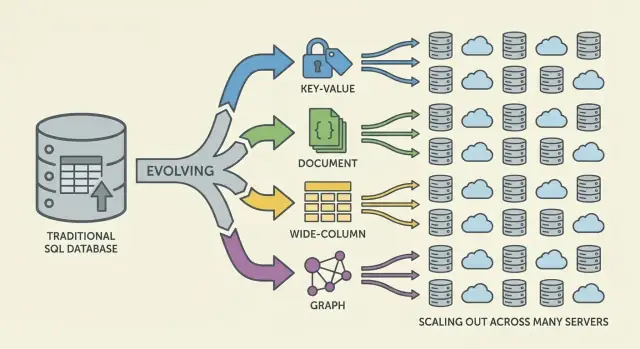
What Problem Was NoSQL Trying to Solve?
NoSQL emerged when many teams ran into a mismatch between what their applications needed and what traditional relational databases (SQL databases) were optimized for. SQL didn’t “fail”—but at web scale, some teams began prioritizing different goals.
The two pressures: scale and change
First, scale. Popular consumer apps started seeing traffic spikes, constant writes, and massive volumes of user-generated data. For these workloads, “just buy a bigger server” became expensive, slow to implement, and ultimately limited by the biggest machine you could reasonably operate.
Second, change. Product features evolved quickly, and the data behind them didn’t always fit neatly into a fixed set of tables. Adding new attributes to user profiles, storing multiple event types, or ingesting semi-structured JSON from different sources often meant repeated schema migrations and cross-team coordination.
Why relational databases struggled in certain cases
Relational databases are excellent at enforcing structure and enabling complex queries across normalized tables. But some high-scale workloads made those strengths harder to capitalize on:
- Lots of concurrent writes across many tables can create contention.
- Heavy join-based queries can become costly as data grows rapidly.
- Scaling out across many machines is possible, but operating it while keeping strict consistency everywhere can be complicated.
The result: some teams sought systems that traded certain guarantees and capabilities for simpler scaling and faster iteration.
NoSQL: a family of approaches, not one thing
NoSQL isn’t a single database or design. It’s an umbrella term for systems that emphasize some mix of:
- Horizontal scaling (adding more machines)
- Flexible data models
- Access patterns tuned to specific application needs
A reset on expectations
NoSQL was never meant to be a universal replacement for SQL. It’s a set of tradeoffs: you may gain scalability or schema flexibility, but you might accept weaker consistency guarantees, fewer ad-hoc query options, or more responsibility in application-level data modeling.
Why Traditional Scaling Started to Break Down
For years, the standard answer to a slow database was straightforward: buy a bigger server. Add more CPU, more RAM, faster disks, and keep the same schema and operational model. This “scale up” approach worked—until it stopped being practical.
Vertical scaling ran into hard limits
High-end machines get expensive quickly, and the price/performance curve eventually becomes unfriendly. Upgrades often require large, infrequent budget approvals and maintenance windows to move data and cut over. Even if you can afford bigger hardware, a single server still has a ceiling: one memory bus, one storage subsystem, and one primary node absorbing the write load.
Growth changed the shape of the workload
As products grew, databases faced constant read/write pressure rather than occasional peaks. Traffic became truly 24/7, and certain features created uneven access patterns. A small number of heavily accessed rows or partitions could dominate traffic, producing hot tables (or hot keys) that dragged down everything else.
Operational bottlenecks became common:
- Index bloat as new features demanded more secondary indexes
- Contention from many concurrent writes hitting the same tables
- Lock waits that made latency unpredictable under load
- Replication lag and slower failovers as datasets grew
Bigger servers didn’t solve global availability
Many applications also needed to be available across regions, not just fast in one data center. A single “main” database in one location increases latency for distant users and makes outages more catastrophic. The question shifted from “How do we buy a larger box?” to “How do we run the database across many machines and locations?”
The Need for Flexible Data Models
Relational databases shine when your data shape is stable. But many modern products don’t sit still. A table schema is intentionally strict: every row follows the same set of columns, types, and constraints. That predictability is valuable—until you’re iterating quickly.
Rigid schemas and the real cost of change
In practice, frequent schema changes can be expensive. A seemingly small update may require migrations, backfills, index updates, coordinated deployment timing, and compatibility planning so older code paths don’t break. On large tables, even adding a column or changing a type can become a time-consuming operation with real operational risk.
That friction pushes teams to delay changes, accumulate workarounds, or store messy blobs in text fields—none of which is ideal for rapid iteration.
Semi-structured data fits how products evolve
A lot of application data is naturally semi-structured: nested objects, optional fields, and attributes that evolve over time.
For example, a “user profile” might start with name and email, then grow to include preferences, linked accounts, shipping addresses, notification settings, and experiment flags. Not every user has every field, and new fields arrive gradually. Document-style models can store nested and uneven shapes directly without forcing every record into the same rigid template.
Faster iteration, fewer awkward joins
Flexibility also reduces the need for complex joins for certain data shapes. When a single screen needs a composed object (an order with items, shipping info, and status history), relational designs may require multiple tables and joins—plus ORM layers that attempt to hide that complexity but often add friction.
NoSQL options made it easier to model data closer to how the application reads and writes it, helping teams ship changes faster.
The Web-Scale Shift That Changed Database Requirements
Web applications didn’t just get bigger—they changed shape. Instead of serving a predictable number of internal users during business hours, products began serving millions of global users around the clock, with sudden spikes driven by launches, news, or social sharing.
Always-on expectations raised the bar: downtime became a headline, not an inconvenience. At the same time, teams were asked to ship features faster—often before anyone knew what the “final” data model should look like.
Distributed became the default path to growth
To keep up, scaling up a single database server stopped being enough. The more traffic you handled, the more you wanted capacity you could add incrementally—add another node, spread load, isolate failures.
This pushed architecture toward fleets of machines rather than one “main” box, and changed what teams expected from databases: not just correctness, but predictable performance under high concurrency and graceful behavior when parts of the system are unhealthy.
Patterns teams adopted before databases caught up
Before “NoSQL” was a mainstream category, many teams were already bending systems toward web-scale realities:
- Caching layers (often in-memory) to reduce repeated reads
- Denormalization to avoid expensive joins and reduce round-trips
- Precomputed views and materialized rollups for feeds, timelines, and dashboards
These techniques worked, but they shifted complexity into application code: cache invalidation, keeping duplicated data consistent, and building pipelines for “ready-to-serve” records.
How this forced databases to evolve
As these patterns became standard, databases had to support distributing data across machines, tolerating partial failures, handling high write volumes, and representing evolving data cleanly. NoSQL databases emerged in part to make common web-scale strategies first-class rather than constant workarounds.
Distributed Tradeoffs and the CAP Theorem
When data lives on one machine, the rules feel simple: there’s a single source of truth, and every read or write can be checked immediately. When you spread data across servers (often across regions), a new reality appears: messages can be delayed, nodes can fail, and parts of the system can temporarily stop communicating.
The core distributed tradeoff (in plain language)
A distributed database must decide what to do when it can’t safely coordinate. Should it keep serving requests so the app stays “up,” even if results might be slightly out of date? Or should it refuse some operations until it can confirm replicas agree, which can look like downtime to users?
These situations occur during router failures, overloaded networks, rolling deployments, firewall misconfigurations, and cross-region replication delays.
CAP in one frame: C, A, and P
The CAP theorem is a shorthand for three properties you’d like at the same time:
- Consistency (C): every read returns the latest write (or an error). In practice, “everyone sees the same answer right now.”
- Availability (A): every request gets a response (not necessarily the newest data).
- Partition Tolerance (P): the system continues operating even if the network splits into isolated groups.
The key point isn’t “pick two forever.” It’s: when a network partition happens, you must choose between consistency and availability. In web-scale systems, partitions are treated as inevitable—especially in multi-region setups.
Partitions connect directly to real outages
Imagine your app runs in two regions for resilience. A fiber cut or routing issue prevents synchronization.
- If you prioritize availability, both regions keep accepting writes, and data may temporarily diverge.
- If you prioritize consistency, one region may reject writes (or reads) until it can confirm agreement.
Different NoSQL systems (and even different configurations of the same system) make different compromises depending on what matters most: user experience during failures, correctness guarantees, operational simplicity, or recovery behavior.
Scaling Out: Sharding and Replication as Core Ideas
Scaling out (horizontal scaling) means increasing capacity by adding more machines (nodes) rather than buying a single bigger server. For many teams, this was a financial and operational shift: commodity nodes could be added incrementally, failures were expected, and growth didn’t require risky “big box” migrations.
Sharding (partitioning): spreading the work
To make many nodes useful, NoSQL systems leaned on sharding (also called partitioning). Instead of one database handling every request, data is split into partitions and distributed across nodes.
A simple example is partitioning by a key (like user_id):
- Node A stores users 1–1,000,000
- Node B stores users 1,000,001–2,000,000
Reads and writes spread out, reducing hotspots and letting throughput grow as you add nodes. The partition key becomes a design decision: pick a key aligned with query patterns, or you can accidentally funnel too much traffic into one shard.
Replication: availability and read scaling
Replication means keeping multiple copies of the same data on different nodes. This improves:
- Availability: if one node fails, another replica can serve requests.
- Read capacity: reads can be served from multiple replicas.
Replication also enables spreading data across racks or regions to survive localized outages.
The hidden cost: rebalancing and operations
Sharding and replication introduce ongoing operational work. As data grows or nodes change, the system must rebalance—moving partitions while staying online. If handled poorly, rebalancing can cause latency spikes, uneven load, or temporary capacity shortages.
This is a core tradeoff: cheaper scaling via more nodes, in exchange for more complex distribution, monitoring, and failure handling.
Consistency Models: From Strict to Eventual
Once data is distributed, a database must define what “correct” means when updates happen concurrently, networks slow down, or nodes can’t communicate.
Strict (strong) consistency
With strong consistency, once a write is acknowledged, every reader should see it immediately. This matches the “single source of truth” experience many people associate with relational databases.
The challenge is coordination: strict guarantees across nodes require multiple messages, waiting for enough responses, and handling failures mid-flight. The farther apart nodes are (or the busier they are), the more latency you may introduce—sometimes on every write.
Eventual consistency
Eventual consistency relaxes that guarantee: after a write, different nodes may briefly return different answers, but the system converges over time.
Examples:
- A “like” counter might show 101 likes on one replica while another still shows 100 for a few seconds.
- A new post may appear in a feed for some users before others, especially across regions.
For many user experiences, that temporary mismatch is acceptable if the system remains fast and available.
Conflicts and how they’re resolved
If two replicas accept updates at nearly the same time, the database needs a merge rule.
Common approaches include:
- Timestamps (last-write-wins): keep the update with the newest timestamp. Simple, but can lose data if clocks drift or if “newest” isn’t semantically correct.
- Version vectors (conceptually): track which replicas have seen which updates, detect concurrent writes, and either merge or surface conflicts.
Where strong consistency still matters
Strong consistency is usually worth the cost for money movement, inventory limits, unique usernames, permissions, and any workflow where “two truths for a moment” can cause real harm.
The Main NoSQL Database Families (and What They Optimized For)
NoSQL is a set of models that make different tradeoffs around scale, latency, and data shape. Understanding the “family” helps you predict what will be fast, what will be painful, and why.
Key-value stores: speed through simplicity
Key-value databases store a value behind a unique key, like a giant distributed hashmap. Because the access pattern is typically “get by key” / “set by key,” they can be extremely fast and horizontally scalable.
They’re great when you already know the lookup key (sessions, caching, feature flags), but they’re limited for ad-hoc querying: filtering across multiple fields is often not the point of the system.
Document databases: flexible records, JSON-like shape
Document databases store JSON-like documents (often grouped into collections). Each document can have a slightly different structure, which supports schema flexibility as products evolve.
They optimize for reading and writing whole documents and querying by fields inside them—without forcing rigid tables. The tradeoff: modeling relationships can get tricky, and joins (if supported) can be more limited than in relational systems.
Wide-column stores: high write throughput at huge scale
Wide-column databases (inspired by Bigtable) organize data by row keys, with many columns that can vary per row. They shine at massive write rates and distributed storage, making them a strong fit for time-series, event, and log workloads.
They tend to reward careful design around access patterns: you query efficiently by primary key and clustering rules, not arbitrary filters.
Graph databases: relationships-first querying
Graph databases treat relationships as first-class data. Instead of repeatedly joining tables, they traverse edges between nodes, making “how are these things connected?” queries natural and fast (fraud rings, recommendations, dependency graphs).
Quick guide: when each model fits best
- Key-value: fastest lookups by ID; caching, sessions, counters
- Document: evolving product data; profiles, catalogs, content
- Wide-column: heavy ingestion at scale; telemetry, logs, time-series
- Graph: deep relationship queries; social graphs, routing, fraud analysis
Data Modeling Changes: Fewer Joins, More Intentional Design
Relational databases encourage normalization: split data into many tables and reassemble with joins at query time. Many NoSQL systems push you to design around the most important access patterns—sometimes at the cost of duplication—to keep latency predictable across nodes.
Why denormalization is so common
In distributed databases, a join can require pulling data from multiple partitions or machines. That adds network hops, coordination, and unpredictable latency. Denormalization (storing related data together) reduces round-trips and keeps a read “local” as often as possible.
A practical consequence: you might store the same customer name in an orders record even if it also exists in customers, because “show me the last 20 orders” is a core query.
Query constraints: fewer joins, more modeling in the app
Many NoSQL databases support limited joins (or none), so the application takes on more responsibility:
- Fetch a document/row by key and render directly
- Read two datasets separately and merge in code
- Precompute “view” data (counts, summaries) to avoid expensive scans
This is why NoSQL modeling often starts with: “What screens do we need to load?” and “What are the top queries we must make fast?”
Secondary indexes—and their hidden costs
Secondary indexes can enable new queries (“find users by email”), but they aren’t free. In distributed systems, each write may update multiple index structures, leading to:
- Write amplification: one logical write becomes several physical writes
- Extra storage: index entries can rival the data size
- Operational complexity: indexes may lag or require careful tuning
Examples of modeling choices that improve performance
- Embed over reference: store order items inside an order document to read an order in one request
- Bucket time-series data: keep events per device per day to avoid unbounded partitions
- Materialize read models: maintain a “user_profile_summary” record to serve a profile page without scanning posts, likes, and follows
Benefits and Tradeoffs Teams Accepted
NoSQL wasn’t adopted because it was “better” in every way. It was adopted because teams were willing to trade certain conveniences of relational databases for speed, scale, and flexibility under web-scale pressure.
What teams gained
Scale-out by design. Many NoSQL systems made it practical to add machines (horizontal scaling) instead of continuously upgrading a single server. Sharding and replication were core capabilities, not afterthoughts.
Flexible schemas. Document and key-value systems let applications evolve without routing every field change through a strict table definition, reducing friction when requirements changed weekly.
High availability patterns. Replication across nodes and regions made it easier to keep services running during hardware failures or maintenance.
What teams paid for
Data duplication and denormalization. Avoiding joins often means duplicating data. That improves read performance but increases storage and introduces “update it everywhere” complexity.
Consistency surprises. Eventual consistency can be acceptable—until it isn’t. Users may see stale data or confusing edge cases unless the application is designed to tolerate or resolve conflicts.
Harder analytics (sometimes). Some NoSQL stores excel at operational reads/writes but make ad-hoc querying, reporting, or complex aggregations more cumbersome than SQL-first systems.
Why operations and tooling mattered
Early NoSQL adoption often shifted effort from database features to engineering discipline: monitoring replication, managing partitions, running compaction, planning backups/restores, and load-testing failure scenarios. Teams with strong operational maturity benefited most.
How to evaluate the tradeoffs
Choose based on workload realities: expected latency, peak throughput, dominant query patterns, tolerance for stale reads, and recovery requirements (RPO/RTO). The “right” NoSQL choice is usually the one that matches how your application fails, scales, and needs to be queried—not the one with the most impressive checklist.
How to Decide If NoSQL Is the Right Fit Today
Choosing NoSQL shouldn’t start with database brands or hype—it should start with what your application needs to do, how it will grow, and what “correct” means for your users.
Start with requirements and access patterns
Before picking a datastore, write down:
- The top 5–10 queries/operations you must support (reads, writes, search, aggregations)
- Expected traffic now vs. in 12–24 months
- Your tolerance for stale data (milliseconds, seconds, never)
- Your failure expectations (what happens if a node or region goes down?)
If you can’t describe your access patterns clearly, any choice will be guesswork—especially with NoSQL, where modeling is often shaped around how you read and write.
A simple decision checklist (SQL vs NoSQL vs hybrid)
Use this as a quick filter:
- Choose SQL if you need strong consistency by default, complex ad-hoc queries, and lots of relationships that benefit from joins.
- Choose NoSQL if you need easy horizontal scale for specific access patterns, can design data around those patterns, and can accept relaxed consistency for some workflows.
- Choose a hybrid if different parts of the app have different needs (common in real products).
A practical signal: if your “core truth” (orders, payments, inventory) must be correct at all times, keep that in SQL or another strongly consistent store. If you’re serving high-volume content, sessions, caching, activity feeds, or flexible user-generated data, NoSQL can fit well.
Consider polyglot persistence (on purpose)
Many teams succeed with multiple stores: for example, SQL for transactions, a document database for profiles/content, and a key-value store for sessions. The goal isn’t complexity for its own sake—it’s matching each workload to a tool that handles it cleanly.
This is also where developer workflow matters. If you’re iterating on architecture (SQL vs NoSQL vs hybrid), being able to spin up a working prototype quickly—API, data model, and UI—can de-risk decisions. Platforms like Koder.ai help teams do that by generating full-stack apps from chat, typically with a React frontend and a Go + PostgreSQL backend, then letting you export the source code. Even if you later introduce a NoSQL store for specific workloads, having a strong SQL “system of record” plus rapid prototyping, snapshots, and rollback can make experiments safer and faster.
Validate with testing, not opinions
Whatever you choose, prove it:
- Run load tests with realistic queries and data sizes.
- Do failure drills (kill nodes, simulate network issues, test restores).
- Create a schema evolution plan: how you’ll add fields, migrate records, and keep old/new versions working during rollout.
If you can’t test these scenarios, your database decision stays theoretical—and production will end up doing the testing for you.
FAQ
What was NoSQL originally trying to solve?
NoSQL addressed two common pressures:
- Scale: high write volumes, traffic spikes, and datasets that outgrew a single “bigger server.”
- Change: fast-moving product requirements that made frequent relational schema migrations costly and risky.
It wasn’t about SQL being “bad,” but about different workloads prioritizing different tradeoffs.
Why did scaling a single relational database server start to break down?
Traditional “scale up” hits practical limits:
- High-end hardware gets expensive quickly and upgrades are disruptive.
- One machine becomes a bottleneck for writes, disks, and failover.
- Global users suffer latency when the primary database is in one region.
NoSQL systems leaned into scaling out by adding nodes instead of continually buying a larger box.
Why did rigid schemas become a problem for modern applications?
Relational schemas are strict by design, which is great for stability but painful under rapid iteration. On large tables, even “simple” changes can require:
- Migrations and backfills
- Index updates
- Coordinated deployments across teams
- Downtime risk or long maintenance windows
Document-style models often reduce this friction by allowing optional and evolving fields.
Is NoSQL only about horizontal scaling (scaling out)?
Not necessarily. Many SQL databases can scale out, but it can be operationally complex (sharding strategies, cross-shard joins, distributed transactions).
NoSQL systems often made distribution (partitioning + replication) a first-class design, optimized for simpler, predictable access patterns at large scale.
Why do NoSQL designs often use denormalization and fewer joins?
Denormalization stores data in the shape you read it, often duplicating fields to avoid expensive joins across partitions.
Example: keeping customer name inside an orders record so “last 20 orders” is a single fast read.
The tradeoff is update complexity: you must keep duplicated data consistent via application logic or pipelines.
What does the CAP theorem mean in practical terms for NoSQL?
In distributed systems, the database must decide what happens during network partitions:
- Prefer availability: keep serving requests, possibly returning stale data.
- Prefer consistency: reject/limit operations until replicas agree.
CAP is a reminder that under partition, you can’t guarantee both perfect consistency and full availability at the same time.
What’s the difference between strong consistency and eventual consistency?
Strong consistency means once a write is acknowledged, all readers see it immediately; it often requires coordination across nodes.
Eventual consistency means replicas may temporarily disagree, but converge over time. It can work well for feeds, counters, and high-availability user experiences—if the application tolerates brief staleness.
How do NoSQL databases handle conflicting writes?
A conflict happens when different replicas accept concurrent updates. Common strategies include:
- Last-write-wins (timestamps): simple, but can drop updates if “winning” isn’t what you want.
- Versioning approaches (e.g., vectors): detect concurrency and either merge or surface conflicts.
Your choice depends on whether losing intermediate updates is acceptable for that data.
How do I choose between key-value, document, wide-column, and graph databases?
A quick fit guide:
- Key-value: fastest lookups by key (sessions, caching, feature flags).
- Document: flexible JSON-like records (profiles, catalogs, content).
- Wide-column: massive write throughput (events, logs, time-series).
- Graph: relationship traversal (recommendations, fraud rings, dependency graphs).
Pick based on your dominant access patterns, not general popularity.
How can I tell if NoSQL is the right choice for my system today?
Start with requirements and prove them with tests:
- List your top 5–10 operations and expected growth.
- Define tolerance for stale reads and failure behavior (node/region loss).
- Run load tests with realistic data sizes.
- Do failure drills (kill nodes, simulate partitions, test restore).
Many real systems are hybrid: SQL for core truth (payments, inventory), NoSQL for high-volume or flexible data (feeds, sessions, profiles).