

How to Create a Mobile App for Appointment Scheduling Across Services
Learn how to plan, design, and build a mobile app that lets users book appointments across different services, with calendars, payments, reminders, and admin tools.
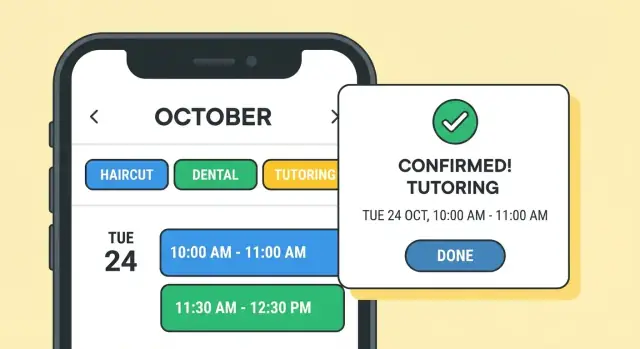
Define the Scheduling Problem and App Model
A scheduling app is only “simple” when it’s clear what problem it solves. Are you helping one business fill its calendar, or are you matching customers with multiple providers across different services? Those two choices drive everything else: your data model, user flows, pricing, and even what “availability” means.
Common scheduling scenarios (and why they differ)
Appointment booking looks similar on the surface, but the rules change by industry:
- Salons and spas: staff members, chair/room constraints, add-ons, walk-ins.
- Clinics and therapy: longer sessions, privacy, recurring visits, strict cancellation rules.
- Fitness and coaching: 1:1 vs group classes, packages, recurring slots.
- Tutoring: remote vs in-person, student-specific schedules, time-zone issues.
- Home services: travel time, service area, variable job duration.
Single-business vs. marketplace: pick your app model
A single-business app (one brand, one set of staff and locations) is usually faster to build and easier to control.
A multi-provider marketplace adds provider onboarding, listings, search, and more complex policies—because each provider can have different hours, services, and pricing.
What “across services” really means
“Across services” can include multiple categories (haircut vs. massage), locations (branches or at-home visits), and durations (30/60/90 minutes). It may also include different resource constraints: a person, a room, or a piece of equipment.
Define success metrics early
Decide how you’ll measure impact:
- More completed bookings per week
- Better retention (repeat customers)
- Fewer no-shows and late cancellations
- Higher provider utilization (less idle time)
These metrics keep product decisions grounded as features expand.
Map User Roles and Core Booking Flows
Before you design screens or pick features, map the people who will use the app and the “happy path” they expect. Most scheduling apps have three roles—customer, provider, and admin—but the details change a lot depending on whether you’re booking haircuts, repairs, tutoring, or multiple services in one cart.
Customer flow: from discovery to confirmation
A customer’s mental model is simple: “Find a service, pick a time, and know it’s confirmed.” A clear core flow looks like this:
- Browse services (by category, price, location, ratings)
- Pick a provider and, if relevant, a specific staff member
- Choose date/time from available options
- Review details (duration, address/online link, price, cancellation policy)
- Book, reschedule, cancel, and pay (if required)
Keep the decision points obvious: service → staff (optional) → time → confirmation.
If you support multi-service booking (e.g., cut + color), decide whether customers build a bundle first or add services after selecting a provider.
Provider flow: availability, approvals, and change handling
Providers care about control and predictability. Their core actions usually include:
- Set and update availability (working hours, breaks, time off)
- Accept or auto-accept bookings (depending on your policy)
- Handle cancellations, reschedules, and late arrivals
- View upcoming day/week schedule and customer details
Define what happens when a provider can’t make an appointment: can they propose a new time, reassign to another staff member, or must they cancel?
Admin flow: rules, quality, and exceptions
Admins keep the marketplace consistent:
- Manage services, staff profiles, pricing, taxes, and policies
- Handle disputes, refunds, chargebacks, and customer support cases
- Review provider compliance (hours, cancellations, no-show rates)
Guest vs. account-based booking (trade-offs)
Guest booking can increase conversion, especially for first-time users. The trade-off is weaker identity: harder refunds, fewer reminders across devices, and more fraud risk.
A common compromise is “guest checkout + account after booking,” where the confirmation screen prompts users to save details for rescheduling, receipts, and faster future bookings.
Design Your Service and Availability Rules
Before you build screens or write code, decide what exactly can be booked and under what conditions. Clear rules prevent double bookings, reduce support requests, and make pricing and staffing much easier later.
Define a service catalog that’s bookable
Start with a structured catalog instead of a loose list. Each service should have a predictable “shape” so the app can calculate time and price.
- Categories: e.g., Hair, Massage, Home Cleaning, Tutoring.
- Base services: name, standard duration, price (or “from” price), and required resources (one provider, a room, equipment).
- Add-ons: extra time/price items (e.g., “deep tissue +15 min”).
- Bundles: multi-step bookings (e.g., “cut + color”) with total duration and whether steps must be consecutive.
A practical tip: pick one “source of truth” for duration. If you let both providers and services define duration freely, customers will see inconsistent slot lengths.
Model provider profiles like a schedule template
Provider profiles need more than a photo and bio. Capture details that affect availability and matching:
- Skills / eligible services (who can perform what)
- Locations (single site, multiple branches, or travel radius)
- Working hours by day, plus breaks and recurring exceptions
If you plan on multi-location booking, decide whether a provider’s hours are global or per location.
Availability rules that prevent “almost possible” bookings
Most real-world scheduling is about the edges:
- Buffer time between appointments (travel, reset)
- Prep/cleanup time before/after specific services
- Max daily bookings (or max service hours) to prevent overload
These rules should adjust the bookable slots automatically—customers shouldn’t have to guess what’s feasible.
Policies customers can understand (and your team can enforce)
Define policies as selectable settings, not free-text notes:
- Cancellation windows (e.g., free up to 24 hours)
- Deposits required for certain services/providers
- Reschedule limits (count and cutoff time)
Keep the wording simple in the booking flow, then store the exact policy version applied to each appointment for future disputes.
Choose the Right Data Model for Scheduling
Your data model decides whether scheduling stays simple as you add more services, staff, and locations. A good model makes it easy to answer questions like “Is Taylor available at 3:30?” and “What changed on this booking, and who changed it?” without hacks.
Model the appointment as a first-class record
An Appointment should be more than “start time + end time.” Treat it as a timeline of states with clear metadata:
- Status: requested, confirmed, checked-in, completed, canceled, no-show (and optional “rescheduled”).
- Timestamps: created_at, confirmed_at, canceled_at, updated_at.
- Time zone: store the original booking time zone (what the user saw) and normalize to UTC for calculations.
- Recurrence (if you support it): store a recurrence rule (e.g., weekly) plus generated instances, so edits don’t unexpectedly rewrite past visits.
Also store the basics: customer_id, service_id, location_id, assigned resources, price/deposit fields (even if payments are handled elsewhere), and free-text notes.
Separate services from resources (and support capacity)
Most scheduling failures happen when you mix “what is booked” with “who/what performs it.” Use a Resource model that can represent:
- Staff (1:1 appointments)
- Rooms (e.g., treatment room, studio)
- Equipment (e.g., laser, vehicle)
- Capacity-based resources (e.g., a class with capacity 12)
Appointments should reference one or more required resources. That way, a massage can require a therapist + a room, while a group session only consumes “capacity.”
Multi-location and travel time (when needed)
If providers work across locations, include location calendars and link resources to allowed locations.
For mobile/at-home services, add optional travel buffers: before/after minutes based on distance or a fixed rule. Model travel time as blocked time on the provider resource so it prevents back-to-back bookings.
Keep an audit trail you can trust
Scheduling is full of “Who changed this?” moments. Add an audit trail table (append-only): who (user/admin/system), what changed (field diffs), when, and why (reason code). It speeds up support, prevents disputes, and helps you debug edge cases.
Build the Scheduling Engine (Slots, Conflicts, Time Zones)
Your scheduling engine is the truth source for what can be booked. It needs to answer one simple question reliably: is this time actually available? Under the hood, you’ll balance speed (fast slot lists) with accuracy (no double-booking).
Slot generation vs. real-time availability
Most apps show a grid of options (“9:00, 9:30, 10:00…”). You can create that list in two main ways:
- Pre-generated slots: generate available slots for each provider/service window (e.g., next 30 days), store them, and update when rules change.
- Real-time queries: generate slots on the fly from working hours + breaks + existing bookings.
Pre-generation makes the UI feel instant, but requires background jobs and careful updates. Real-time is simpler to maintain, but can get slow as you scale.
Many teams use a hybrid: cache the next few days and compute longer ranges on demand.
Prevent double-booking (locking + conflict checks)
Double-booking usually happens when two people tap “Book” within seconds of each other. Avoid it with a two-step approach:
- Conflict check: verify that the requested time range doesn’t overlap any existing appointment for the provider, room, or required staff.
- Locking strategy: ensure only one booking can be created for that resource/time.
Common patterns include database transactions with unique constraints (best when you can model a “slot id”), row-level locks on a provider’s schedule, or a short-lived “hold” that expires if the user doesn’t pay/confirm in time.
Time zones, daylight saving, and display formats
Store timestamps in UTC, but always associate appointments with a time zone (usually the provider’s location). Convert for display based on the viewer (customer vs. provider) and show clear labels like “10:00 AM (London time)”.
Daylight saving changes create tricky days (missing or repeated hours). Your engine should:
- Generate slots in local time but validate against UTC conversions.
- Avoid offering non-existent local times on DST jump days.
- Handle appointments that span the DST boundary without shifting duration.
Waitlists and overbooking rules
If you allow them, define explicit rules:
- Waitlist: when a slot is full, collect preferred times and auto-offer the first freed slot.
- Overbooking: permit limited overlap only for specific services/providers, with caps (e.g., “max 2 concurrent walk-ins”) and clear internal visibility to prevent staff overload.
The key is consistency: your UI can be friendly, but the engine must be strict.
Create a Booking UX That Feels Simple
A scheduling app can have a powerful engine underneath, but users judge it by how quickly they can find a service, pick a time, and feel confident they won’t make a mistake. Your UX should reduce decisions, prevent invalid selections, and make costs obvious before checkout.
Search and filters that match real intent
Start with search that supports both “what” and “when.” Users often think in combinations: “haircut tomorrow,” “dentist near me,” or “massage under $100.”
Provide filters that are easy to scan and reset: service type, date/time window, price range, rating, and distance. Keep the results page stable—don’t reshuffle on every tap—so people don’t lose their place.
Slot picking patterns that prevent errors
Use a two-step picker: choose a date first, then show only valid slots for that date. Disable unavailable times rather than hiding them entirely (people learn faster when they can see what’s blocked).
If you support multi-service booking, show the total duration and the end time (“90 min, ends 3:30 PM”) before the user commits.
Pricing that’s clear before confirmation
Show a simple breakdown early: base price, add-ons, taxes, fees, and any deposit. If pricing can vary by staff member or time, label it plainly (“Evening rate”). On the final screen, repeat the total and what’s due now vs. later.
Accessibility isn’t optional
Use high-contrast text, scalable font sizes, and large tap targets (especially for time slots). Every control—filters, calendar days, slot buttons—should have screen reader labels that describe state (“2:00 PM, unavailable”). Accessible UX also reduces booking mistakes for everyone.
Notifications, Reminders, and No-Show Reduction
Notifications are where a scheduling app either feels effortless—or starts to annoy people. The goal is simple: keep everyone informed with the fewest possible messages, sent on the channels they actually want.
Pick channels and let users choose
Support push, SMS, and email, but don’t force them equally.
Customers typically prefer push for reminders and SMS for last-minute changes. Providers often want email summaries plus push for real-time updates.
In settings, offer:
- Channel preferences (push/SMS/email) per message type (booking, reminder, changes)
- Quiet hours (e.g., no push after 9pm)
- Language and time zone confirmation (especially for travelers)
Make confirmation, reschedule, and cancellation predictable
Every booking should trigger an immediate confirmation to both sides with the same core details: service, provider, location, start time, duration, price, and policy.
Reschedule and cancellation flows work best when they’re “one-tap” actions from the notification and the booking screen. After a change, send a single update that clearly states what changed and whether any fees apply.
A practical reminder cadence for customers:
- Instant confirmation
- 24 hours before (optional)
- 2 hours before (optional)
For providers, add a daily schedule digest and instant alerts for new bookings or cancellations.
Reduce no-shows without being heavy-handed
No-shows usually happen because people forget, get stuck, or don’t feel committed. Common tools:
- Deposits or card-on-file for high-demand services
- A “Confirm your appointment” prompt 12–24 hours before (if not confirmed, flag it for the provider)
- Clear cancellation windows and fees shown before checkout and in the confirmation
If you allow waitlists, automatically offer newly opened slots to the next person and notify the provider only once the slot is rebooked.
Follow up after the appointment
Post-appointment messaging can drive retention without spamming:
Send a receipt, request a review, and offer a “Book again” shortcut to the same service/provider. If applicable, include care instructions or a summary note from the provider, and keep it accessible inside the booking history.
Payments, Deposits, and Refund Handling
Payments can turn a simple booking flow into a support headache if the rules aren’t clear. Treat this section as part product design, part customer-service policy: the app should make it obvious what the customer owes, when they owe it, and what happens if plans change.
Payment options to support
Most scheduling apps do well with three modes:
- Pay now: the customer pays the full amount during booking. Best for high no-show risk and prepaid services.
- Deposit only: collect a fixed amount or percentage to secure the slot, and charge the remainder in person or after the service.
- Pay later: reserve the appointment without charging (often paired with stricter cancellation rules).
Whichever you offer, show the price breakdown before confirmation: service price, taxes/fees (if any), deposit amount, and what’s due later.
Refunds and partial refunds (make the rules explicit)
Define refund logic in plain language and reflect it in the UI:
- Cancellation windows (e.g., “Full refund if cancelled 24h+ before”)
- What happens to deposits (refundable, non-refundable, or convertible to credit)
- Partial refunds for late cancellations (e.g., refund service price but keep deposit)
- Provider-initiated cancellations (typically full refund + automatic rebooking prompt)
Automate the decision as much as possible so support isn’t manually calculating exceptions.
Extras: tips, discounts, promo codes, gift cards
Optional, but valuable:
- Tips at checkout (pay now) or after completion
- Promo codes for acquisition and retention
- Gift cards/store credit as an alternative to refunds
Security basics
Use a payment provider that supports tokenized payments and keeps PCI compliance on their side (e.g., hosted payment fields). Your app should store only the minimum: payment status, amounts, and provider transaction IDs—not raw card data.
Calendar Integrations and External Sync
Calendar sync is one of the fastest ways to build trust: providers can keep using the calendar they already live in, while your app stays accurate.
One-way vs. two-way sync
One-way sync pushes booked appointments from your app into an external calendar (Google, Apple, Outlook). It’s simpler, safer, and often enough for an MVP.
Two-way sync also reads busy times (and sometimes events) from the external calendar to block availability in your app. This is more convenient, but you must handle edge cases like private events, recurring meetings, and edits made outside your app.
Avoid duplicates and handle external edits
Duplicates usually happen when you “create event” on every update. Use a stable identifier:
- Store the external event ID returned by Google/Microsoft (or an ICS UID) on your appointment record.
- On reschedule/cancel, update or delete the same event instead of creating a new one.
For external edits, decide what you will treat as the source of truth. A common, user-friendly rule is:
- If the provider edits the external calendar event time, treat it as busy time only (don’t move the booking automatically).
- If the event is deleted externally, keep the booking but flag “calendar link broken” and offer a one-tap “recreate event.”
ICS invites and user expectations
Even without deep integrations, send ICS invites in confirmation emails so customers can add appointments to Apple Calendar or Google Calendar in one tap.
If you offer native Google/Apple calendar connections, users expect:
- Changes in your app to update their calendar quickly
- Clear time zone behavior (event time matches the appointment location)
- Reliable reminders (from your app and/or their calendar—explain which)
Provider visibility controls
Providers need control over what gets shared:
- Choose which calendars to sync (personal vs business)
- Decide whether external events are treated as “busy only” (no titles/details imported)
- Control what appointment details are written out (service name vs “Busy”) for privacy
If you later add an admin dashboard, include these settings under /settings so support doesn’t have to troubleshoot sync manually.
Provider Tools and Admin Dashboard Requirements
A scheduling app lives or dies on what happens after a customer books. Providers need fast controls to keep availability accurate, and admins need oversight to prevent messy edge cases from becoming support tickets.
Provider tools (what the service staff needs)
At minimum, each provider should be able to manage their working reality without calling support:
- Set hours and availability patterns (weekly templates, multiple locations, different hours per service)
- Time off and exceptions (vacations, sick days, one-off schedule changes)
- Breaks and buffers (lunch, travel time, cleanup time between appointments)
- Capacity settings for group services (e.g., “Yoga class: 12 spots”) and shared resources (e.g., “Room A”)
Add lightweight daily operations features:
- A calendar view (day/week) with filters by service and location
- Customer notes visible to the provider (preferences, allergies, access instructions)
- Status controls: confirm, mark arrived, completed, no-show
Admin dashboard (what the business needs)
The admin dashboard should centralize everything that affects bookability and money:
- Manage services, durations, add-ons, pricing, and deposits
- Manage users, roles, permissions, and provider onboarding
- Configure locations (hours, address details, room/resource rules)
- Set global booking rules (lead time, cancellation windows, limits per customer)
Reporting and support tools
Reporting turns scheduling into decisions:
- Bookings vs. cancellations, revenue, provider utilization, and popular times/services
Support tools reduce friction:
- Manual booking on behalf of customers
- Overrides (force-book, waive deposit, move appointments)
- Full booking timeline/audit log and internal notes for customer conversations
If you offer tiers, keep advanced reporting and overrides behind an admin-only area like /pricing.
MVP Scope, Tech Stack, and Build Plan
A scheduling app can expand endlessly, so the first release should focus on one thing: letting a customer book a time with the right provider, reliably.
MVP scope (must-have screens + APIs)
For a multi-service booking MVP, aim for a tight set of screens: service catalog (with duration/price), provider selection (or “best available”), calendar view of available times, booking details + confirmation, and “My bookings” for reschedule/cancel.
On the backend, keep the first API surface small: list services/providers, fetch availability, create booking, update/cancel booking, and send notifications.
Add basic admin tools for managing provider hours and time off—without this, support requests pile up quickly.
Tech choices (mobile + backend + database)
Native (Swift/Kotlin) is great for polished performance, but cross-platform (React Native or Flutter) is usually faster for an MVP with one shared UI.
For the backend, pick something your team can ship and maintain: Node.js, Django, or Rails all work well. Use Postgres for bookings and availability rules, and Redis for short-lived holds during checkout to prevent double-booking.
Fast prototyping with Koder.ai (optional, but practical)
If you want to validate your booking flows quickly before committing to months of custom engineering, a vibe-coding platform like Koder.ai can help you prototype the core product (service catalog → availability → booking → admin basics) from a chat-driven spec.
Koder.ai can generate a React web app, a Go backend with PostgreSQL, and a Flutter mobile app, and it supports planning mode, source-code export, and snapshots/rollback—useful when you’re iterating on tricky scheduling rules and don’t want regressions.
Testing checklist (the bugs users actually notice)
Test:
- Time zones per user and per provider
- Daylight Saving Time changes (missing/duplicated hours)
- Double-booking under concurrent taps
- Reschedules that cross date boundaries
- Refund and deposit edge cases (partial refunds, cancellation windows)
Rollout plan (beta, feedback, versioning)
Start with a small beta group (5–20 providers) and a simple feedback loop: in-app “Report an issue,” plus a weekly review of failed bookings and cancellations.
Version your API from day one so you can iterate without breaking older app builds, and publish a clear change log for internal ops and support.
Security, Privacy, and Reliability Checklist
A scheduling app handles personal details, calendars, and payments—so small security mistakes quickly turn into big trust problems. Use this checklist to keep your MVP safe and dependable without overbuilding.
User accounts, permissions, and data minimization
Start by collecting only what you truly need to book an appointment: name, contact method, time, and service. Avoid storing sensitive notes by default.
Use role-based access:
- Customers can view and manage only their own bookings.
- Providers can see bookings assigned to them (and only the customer data needed to deliver the service).
- Admins can manage providers, services, disputes, and refunds.
Enforce least-privilege permissions in your API, not just the UI.
Store passwords with modern hashing (e.g., bcrypt/Argon2), enable optional 2FA for providers/admins, and secure sessions with short-lived tokens.
Logging and monitoring for booking failures
Treat booking as a critical transaction. Track errors like “slot already taken,” payment failures, and calendar sync issues.
Log events with correlation IDs (one ID per booking attempt) so you can trace what happened across services. Keep logs free of sensitive data (no full card details, minimal PII). Set alerts for spikes in failed bookings, timeouts, and notification delivery errors.
Backups and disaster recovery basics
Back up the database frequently and test restores on a schedule. Define RPO/RTO targets (how much data you can lose, and how quickly you must recover).
Document a simple incident playbook: who gets paged, how to disable booking temporarily, and how to communicate status (e.g., /status).
Privacy and compliance considerations
Publish clear retention rules (when you delete canceled bookings and inactive accounts). Offer export/delete requests.
If you serve regulated categories, requirements change:
- Health: HIPAA (US) or local medical privacy rules.
- Payments: PCI DSS scope—prefer a payment provider that tokenizes cards.
- Finance/identity: stronger KYC, audit trails, and encryption requirements.
Encrypt data in transit (TLS) and at rest for sensitive fields, and review third-party SDKs before shipping.
FAQ
What should an appointment scheduling app include first?
Start with one booking model: choose a service, select a provider or best available option, pick a valid time, and confirm. Add marketplace search, bundles, and complex payment rules after people can book reliably.
Should I build for one business or multiple providers?
A single-business app manages one company’s staff, locations, and services. A marketplace also needs provider profiles, onboarding, search, separate pricing, and different availability rules for each provider.
What data should an appointment record store?
Store each appointment with its status, start and end time, customer, service, location, assigned resources, price, and the booking time zone. Keep UTC timestamps for calculations and retain the original local time for display.
How do I stop double bookings?
Treat staff, rooms, equipment, and class capacity as separate resources. The booking engine must confirm that every required resource is free for the whole appointment, including any prep, cleanup, or travel time.
How should the app calculate available time slots?
Generate times from working hours, breaks, service duration, buffers, existing appointments, and resource limits. Check availability again inside the booking transaction, because two customers may choose the same time at nearly the same moment.
How should a scheduling app handle time zones?
Store times in UTC, attach the provider location’s time zone, and convert times for each viewer. On daylight-saving dates, block local times that do not exist and test repeated hours carefully.
When should the app show prices and cancellation rules?
Show the full price before confirmation: service price, add-ons, taxes or fees, deposit, and any amount due later. State the cancellation and refund rule on the same screen so customers know the terms before they pay.
Which appointment reminders work best?
Send an immediate confirmation, then optional reminders such as 24 hours and 2 hours before the appointment. Let customers choose push, SMS, or email and keep cancellation or rescheduling actions easy to reach.
Do I need Google, Apple, or Outlook calendar sync for an MVP?
Begin with one-way calendar sync, which writes confirmed appointments to an external calendar. Store the external event ID so reschedules update the same event instead of creating duplicates; add two-way busy-time sync when the basics work well.
What scheduling app bugs should I test before launch?
Test concurrent booking attempts, time-zone conversions, daylight-saving changes, cancellations near the cutoff, refunds, deposits, and reschedules across dates. Also test provider time off, room conflicts, and failed notification delivery.