

Joe Armstrong and Erlang: Let It Crash for Reliable Platforms
Explore how Joe Armstrong shaped Erlang’s concurrency, supervision, and “let it crash” mindset—ideas still used to build dependable real-time services.
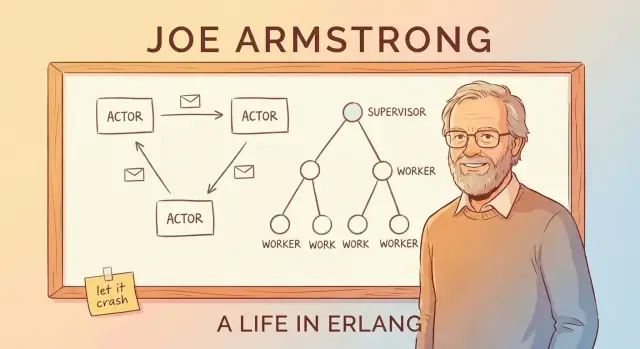
What This Post Covers (and Why It Still Matters)
Joe Armstrong didn’t just help create Erlang—he became its clearest, most persuasive explainer. Through talks, papers, and a pragmatic point of view, he popularized a simple idea: if you want software that stays up, you design for failure instead of pretending you can avoid it.
This post is a guided tour of the Erlang mindset and why it still matters when you’re building reliable real-time platforms—things like chat systems, call routing, live notifications, multiplayer coordination, and infrastructure that needs to respond quickly and consistently even while parts of it misbehave.
“Real-time” in plain terms
Real-time doesn’t always mean “microseconds” or “hard deadlines.” In many products it means:
- fast responses users can feel (no mysterious pauses)
- predictable behavior under load (it may slow down, but it shouldn’t spiral)
- continued service during partial failures (a bad component shouldn’t take everything down)
Erlang was built for telecom systems where these expectations are non-negotiable—and that pressure shaped its most influential ideas.
The three pillars we’ll focus on
Rather than diving into syntax, we’ll focus on the concepts that made Erlang famous and keep reappearing in modern systems design:
- Concurrency by default: build software from many small, isolated workers instead of a few giant ones.
- Fault tolerance as a design goal: assume bugs, timeouts, and crashes will happen—and plan what should happen next.
- “Let it crash”: don’t over-defend every line of code; fail fast and recover cleanly using structure (not heroics).
Along the way, we’ll connect these ideas to the actor model and message passing, explain supervision trees and OTP in approachable terms, and show why the BEAM VM makes the whole approach practical.
Even if you’re not using Erlang (and never will), the point still holds: Armstrong’s framing gives you a powerful checklist for building systems that stay responsive and available when reality gets messy.
Joe Armstrong’s Motivation: Building Systems That Stay Up
Telecom switches and call-routing platforms don’t get to “go down for maintenance” the way many websites can. They’re expected to keep handling calls, billing events, and signaling traffic around the clock—often with strict requirements for availability and predictable response times.
Erlang started inside Ericsson in the late 1980s as an attempt to meet those realities with software, not just specialized hardware. Joe Armstrong and his colleagues weren’t chasing elegance for its own sake; they were trying to build systems that operators could trust under constant load, partial failures, and messy real-world conditions.
What “reliable” meant in practice
A key shift in thinking is that reliability isn’t the same as “never failing.” In large, long-running systems, something will fail: a process will hit unexpected input, a node will reboot, a network link will flap, or a dependency will stall.
So the goal becomes:
- keep serving users even when parts misbehave
- detect failures quickly
- recover automatically, with minimal human intervention
- isolate faults so one bug doesn’t take everything down
This is the mindset that later makes ideas like supervision trees and “let it crash” feel reasonable: you design for failure as a normal event, not an exceptional catastrophe.
Less myth, more problem-solving
It’s tempting to tell the story as a single visionary’s breakthrough. The more useful view is simpler: telecom constraints forced a different set of tradeoffs. Erlang prioritized concurrency, isolation, and recovery because those were the practical tools needed to keep services running while the world kept changing around them.
That problem-first framing is also why Erlang’s lessons still translate well today—anywhere uptime and fast recovery matter more than perfect prevention.
Concurrency as the Default: Many Small Workers
A core idea in Erlang is that “doing many things at once” isn’t a special feature you bolt on later—it’s the normal way you structure a system.
Lightweight processes, explained simply
In Erlang, work is split into lots of tiny “processes.” Think of them as small workers, each responsible for one job: handling a phone call, tracking a chat session, monitoring a device, retrying a payment, or watching a queue.
They’re lightweight, meaning you can have huge numbers of them without needing huge hardware. Instead of one heavyweight worker trying to juggle everything, you get a crowd of focused workers that can start quickly, stop quickly, and be replaced quickly.
Why “one big program” breaks differently
Many systems are designed like a single big program with many parts tightly connected. When that kind of system hits a serious bug, a memory issue, or a blocking operation, the failure can ripple outward—like tripping one breaker and blacking out the whole building.
Erlang pushes the opposite: isolate responsibilities. If one small worker misbehaves, you can drop and replace that worker without taking down unrelated work.
Message passing as “sending notes”
How do these workers coordinate? They don’t poke around in each other’s internal state. They send messages—more like passing notes than sharing a messy whiteboard.
One worker can say, “Here’s a new request,” “This user disconnected,” or “Try again in 5 seconds.” The receiving worker reads the note and decides what to do.
The key benefit is containment: because workers are isolated and communicate by messages, failures are less likely to spread across the entire system.
Message Passing and the Actor Model (Without the Jargon)
A simple way to understand Erlang’s “actor model” is to picture a system made of many small, independent workers.
Actors: tiny workers that only talk by sending messages
An actor is a self-contained unit with its own private state and a mailbox. It does three basic things:
- receives messages (one at a time) from its mailbox
- updates its own internal state
- sends messages to other actors
That’s it. No hidden shared variables, no “reach into another worker’s memory.” If one actor needs something from another, it asks by sending a message.
Why avoiding shared state removes whole categories of bugs
When multiple threads share the same data, you can get race conditions: two things change the same value at nearly the same time, and the result depends on timing. That’s where bugs become intermittent and hard to reproduce.
With message passing, each actor owns its data. Other actors can’t mutate it directly. This doesn’t eliminate every bug, but it dramatically reduces issues caused by simultaneous access to the same piece of state.
Back-pressure, explained like a queue at a coffee shop
Messages don’t arrive “for free.” If an actor receives messages faster than it can process them, its mailbox (queue) grows. That’s back-pressure: the system is telling you, indirectly, “this part is overloaded.”
In practice, you monitor mailbox sizes and build limits: shedding load, batching, sampling, or pushing work to more actors instead of letting queues grow forever.
A concrete example: chat notifications
Imagine a chat app. Each user could have an actor responsible for delivering notifications. When a user goes offline, messages keep arriving—so the mailbox grows. A well-designed system might cap the queue, drop non-critical notifications, or switch to digest mode, rather than letting one slow user degrade the whole service.
“Let It Crash” Explained: Fail Fast, Recover Faster
“Let it crash” isn’t a slogan for sloppy engineering. It’s a reliability strategy: when a component gets into a bad or unexpected state, it should stop quickly and loudly instead of limping along.
What it really means
Rather than writing code that tries to handle every possible edge case inside one process, Erlang encourages keeping each worker small and focused. If that worker hits something it truly can’t handle (corrupt state, violated assumptions, unexpected input), it exits. Another part of the system is responsible for bringing it back.
This shifts the main question from “How do we prevent failure?” to “How do we recover cleanly when failure happens?”
The tradeoff: fewer defensive checks, clearer logic
Defensive programming everywhere can turn simple flows into a maze of conditionals, retries, and partial states. “Let it crash” trades some of that in-process complexity for:
- simpler, more readable code paths
- faster detection of broken assumptions
- recovery that is consistent (because it’s centralized)
The big idea is that recovery should be predictable and repeatable, not improvised inside every function.
When it fits—and when it doesn’t
It fits best when failures are recoverable and isolated: a temporary network issue, a bad request, a stuck worker, a third-party timeout.
It’s a poor fit when a crash could cause irreversible harm, such as:
- data loss without a durable source of truth
- safety-critical operations where “try again” isn’t acceptable
Fast restarts and known-good state
Crashing only helps if coming back is quick and safe. In practice, that means restarting workers into a known-good state—often by reloading configuration, rebuilding in-memory caches from durable storage, and resuming work without pretending the broken state never existed.
Supervision Trees: Designing for Failure on Purpose
Erlang’s “let it crash” idea only works because crashes aren’t left to chance. The key pattern is the supervision tree: a hierarchy where supervisors act like managers and workers do the actual job (handling a call, tracking a session, consuming a queue, etc.). When a worker misbehaves, the manager notices and restarts it.
Managers that restart workers
A supervisor doesn’t try to “fix” a broken worker in place. Instead, it applies a simple, consistent rule: if the worker dies, start a fresh one. That makes the recovery path predictable and reduces the need for ad-hoc error handling sprinkled throughout the code.
Just as important, supervisors can also decide when not to restart—if something is crashing too often, it may indicate a deeper issue, and repeatedly restarting can make things worse.
Restart strategies (high-level)
Supervision isn’t one-size-fits-all. Common strategies include:
- One-for-one: only the failing worker is restarted. This fits independent tasks where one failure shouldn’t disturb others.
- Group restarts: if one worker fails, a related set is restarted together. This fits tightly-coupled components that must stay in sync.
Dependencies: the part you have to think through
Good supervision design starts with a dependency map: which components rely on which others, and what “fresh start” really means for them.
If a session handler depends on a cache process, restarting only the handler might leave it connected to a bad state. Grouping them under the right supervisor (or restarting them together) turns messy failure modes into consistent, repeatable recovery behavior.
OTP: Reusable Building Blocks for Reliable Services
If Erlang is the language, OTP (Open Telecom Platform) is the kit of parts that turns “let it crash” into something you can run in production for years.
OTP as a toolbox of proven patterns
OTP isn’t a single library—it’s a set of conventions and ready-made components (called behaviours) that solve the boring-but-critical parts of building services:
gen_serverfor a long-running worker that keeps state and handles requests one at a timesupervisorfor automatically restarting failed workers according to clear rulesapplicationfor defining how a whole service starts, stops, and fits into a release
These aren’t “magic.” They’re templates with well-defined callbacks, so your code plugs into a known shape instead of inventing a new shape every project.
Why standard patterns beat custom frameworks
Teams often build ad-hoc background workers, homegrown monitoring hooks, and one-off restart logic. It works—until it doesn’t. OTP reduces that risk by pushing everyone toward the same vocabulary and lifecycle. When a new engineer joins, they don’t have to learn your custom framework first; they can rely on shared patterns that are widely understood in the Erlang ecosystem.
How OTP guides architecture day-to-day
OTP nudges you to think in terms of process roles and responsibilities: what is a worker, what is a coordinator, what should restart what, and what should never restart automatically.
It also encourages good hygiene: clear naming, explicit startup order, predictable shutdown, and built-in monitoring signals. The result is software that’s designed to run continuously—services that can recover from faults, evolve over time, and keep doing their job without constant human babysitting.
BEAM VM: The Runtime That Makes the Model Practical
Erlang’s big ideas—tiny processes, message passing, and “let it crash”—would be much harder to use in production without the BEAM virtual machine (VM). BEAM is the runtime that makes these patterns feel natural, not fragile.
Scheduling: fairness over “one big thread”
BEAM is built to run huge numbers of lightweight processes. Instead of relying on a handful of OS threads and hoping the application behaves, BEAM schedules Erlang processes itself.
The practical benefit is responsiveness under load: work is sliced into small chunks and rotated through fairly, so no single busy worker is meant to dominate the system for long. That fits perfectly with a service made of many independent tasks—each doing a bit of work, then yielding.
Isolation and “per-process” memory cleanup
Each Erlang process has its own heap and its own garbage collection. That’s a key detail: cleaning up memory in one process doesn’t require pausing the whole program.
Just as important, processes are isolated. If one crashes, it doesn’t corrupt the memory of others, and the VM stays alive. This isolation is the foundation that makes supervision trees realistic: failure is contained, then handled by restarting the failed part rather than tearing everything down.
Distribution: multiple nodes, one system
BEAM also supports distribution in straightforward terms: you can run multiple Erlang nodes (separate VM instances) and let them communicate by sending messages. If you’ve understood “processes talk by messaging,” distribution is an extension of the same idea—some processes just happen to live on another node.
BEAM isn’t about raw speed promises. It’s about making concurrency, fault containment, and recovery the default, so the reliability story is practical rather than theoretical.
Upgrades Without Stopping the System (Hot Code, Carefully)
One of Erlang’s most talked-about tricks is hot code swapping: updating parts of a running system with minimal downtime (where the runtime and tooling support it). The practical promise isn’t “never restart again,” but “ship fixes without turning a brief bug into a long outage.”
What “hot code” really means
In Erlang/OTP, the runtime can keep two versions of a module loaded at once. Existing processes may finish work using the old version while new calls can start using the new one. That gives you room to patch a bug, roll out a feature, or adjust behavior without kicking everyone off the system.
Done well, this supports reliability goals directly: fewer full restarts, shorter maintenance windows, and quicker recovery when something slips into production.
The constraints nobody should ignore
Not every change is safe to swap live. Some examples of changes that need extra care (or a restart) include:
- state shape changes (a process expects data in one format, but new code expects another)
- protocol or message-format changes that must match across services
- schema migrations that take time or require coordination
Erlang provides mechanisms for controlled transitions, but you still have to design the upgrade path.
The mindset: upgrades and rollbacks are normal
Hot upgrades work best when upgrades and rollbacks are treated as routine operations, not rare emergencies. That means planning versioning, compatibility, and a clear “undo” path from the start. In practice, teams pair live-upgrade techniques with staged rollouts, health checks, and supervision-based recovery.
Even if you never use Erlang, the lesson transfers: design systems so changing them safely is a first-class requirement, not an afterthought.
Where Erlang’s Ideas Shine in Real-Time Platforms
Real-time platforms are less about perfect timing and more about staying responsive while things constantly go wrong: networks wobble, dependencies slow down, and user traffic spikes. Erlang’s design—championed by Joe Armstrong—fits this reality because it assumes failure and treats concurrency as normal, not exceptional.
Common “real-time” use cases
You see Erlang-style thinking shine anywhere you have lots of independent activities happening at once:
- Messaging and chat: millions of small conversations, each with its own state and retries.
- Real-time communication: voice/video signaling, presence updates, and session coordination.
- IoT coordination: fleets of devices checking in, dropping off, and reappearing unpredictably.
- Payments workflows: multi-step processes where some steps are slow, unavailable, or need compensating actions.
What “soft real-time” usually means
Most products don’t need hard guarantees like “every action completes within 10 ms.” They need soft real-time: consistently low latency for typical requests, quick recovery when parts fail, and high availability so users rarely notice incidents.
Failure is normal: design for it
Real systems hit issues like:
- Dropped connections (mobile networks, Wi‑Fi handoffs)
- Timeouts when a downstream service is slow
- Partial outages where one region or dependency degrades
Erlang’s model encourages isolating each activity (a user session, a device, a payment attempt) so a failure doesn’t spread. Instead of building one giant “try to handle everything” component, teams can reason in smaller units: each worker does one job, talks via messages, and if it breaks, it’s restarted cleanly.
That shift—from “prevent every failure” to “contain and recover from failures quickly”—is often what makes real-time platforms feel stable under pressure.
Common Misunderstandings and Real Limits
Erlang’s reputation can sound like a promise: systems that never go down because they just restart. The reality is more practical—and more useful. “Let it crash” is a tool for building dependable services, not a license to ignore hard problems.
Restarts aren’t a band-aid
A common mistake is treating supervision as a way to hide deep bugs. If a process crashes immediately after starting, a supervisor may keep restarting it until you end up with a crash loop—burning CPU, spamming logs, and potentially causing a bigger outage than the original bug.
Good systems add backoff, restart intensity limits, and clear “give up and escalate” behavior. Restarts should restore healthy operation, not mask a broken invariant.
State is the hard part
Restarting a process is often easy; recovering correct state is not. If state lives only in memory, you must decide what “correct” means after a crash:
- Should you rebuild from a durable store?
- Can you replay events safely (idempotency)?
- What happens to in-flight work or partially applied updates?
Fault tolerance doesn’t replace careful data design. It forces you to be explicit about it.
You still need observability
Crashes are only helpful if you can see them early and understand them. That means investing in logging, metrics, and tracing—not just “it restarted, so we’re fine.” You want to notice rising restart rates, growing queues, and slow dependencies before users feel it.
Real operational limits exist
Even with the BEAM’s strengths, systems can fail in very ordinary ways:
- Memory growth from leaks, caches, or large heaps
- Mailbox backlog when producers outpace consumers (latency spikes and timeouts)
- Dependency failures (databases, third-party APIs, DNS) where restarting your code won’t fix the root cause
Erlang’s model helps you contain and recover from failures—but it can’t remove them.
How to Apply the Lessons Today (Even If You Don’t Use Erlang)
Erlang’s biggest gift isn’t syntax—it’s a set of habits for building services that keep running when parts inevitably fail. You can apply those habits in almost any stack.
Translate the ideas into concrete actions
Start by making failure boundaries explicit. Break your system into components that can fail independently, and make sure each one has a clear contract (inputs, outputs, and what “bad” looks like).
Then automate recovery instead of trying to prevent every error:
- Isolate components: run risky work in separate processes/containers/threads so one crash doesn’t poison everything.
- Define boundaries: timeouts, retries with backoff, circuit breakers, and bulkheads to stop cascading failures.
- Make recovery routine: health checks, auto-restarts, and safe defaults so the system returns to a known-good state quickly.
One practical way to make these habits “real” is to bake them into the tooling and lifecycle, not just the code. For example, when teams use Koder.ai to vibe-code web, backend, or mobile apps via chat, the workflow naturally encourages explicit planning (Planning Mode), repeatable deployments, and safe iteration with snapshots and rollback—concepts that align with the same operational mindset Erlang popularized: assume change and failure will happen, and make recovery boring.
Starting points outside Erlang
You can approximate “supervision” patterns with tools you may already use:
- Supervisors: systemd, Kubernetes Deployments, or a process manager (restart-on-failure, readiness probes).
- Process isolation: separate worker services for CPU-heavy or untrusted tasks.
- Message passing: queues/streams (RabbitMQ, SQS, Kafka) to decouple producers and consumers and smooth spikes.
A quick decision checklist
Before you copy patterns, decide what you actually need:
- Expected failure modes: overload, partial outages, slow dependencies, bad inputs, memory leaks.
- Latency needs: do you require real-time responses, or is eventual processing OK?
- Recovery objective: fast restart, graceful degradation, or manual intervention?
- Team skills and tooling: who will own on-call, observability, and incident response?
If you want practical next steps, see more guides in /blog, or browse implementation details in /docs (and plans in /pricing if you’re evaluating tooling).
FAQ
Why is Joe Armstrong’s Erlang mindset still relevant today?
Erlang popularized a practical reliability mindset: assume parts will fail and design what happens next.
Instead of trying to prevent every crash, it emphasizes fault isolation, fast detection, and automatic recovery, which maps well to real-time platforms like chat, call routing, notifications, and coordination services.
What does “real-time” mean in the post’s plain terms?
In this context, “real-time” usually means soft real-time:
- responses feel fast and consistent
- behavior stays predictable under load
- the system keeps working through partial failures
It’s less about microsecond deadlines and more about avoiding stalls, spirals, and cascading outages.
What does “concurrency by default” mean in Erlang-style design?
Concurrency-by-default means structuring the system as many small, isolated workers rather than a few large, tightly coupled components.
Each worker handles a narrow responsibility (a session, device, call, retry loop), which makes scaling and failure containment easier.
What are Erlang “lightweight processes,” and why do they matter?
Lightweight processes are small independent workers you can create in large numbers.
Practically, they help because:
- you can model one process per “thing” (user/session/device)
- failures stay local to a single worker
- restarting work is cheap compared to rebooting a monolith
Why does Erlang prefer message passing over shared state?
Message passing is coordination by sending messages rather than sharing mutable state.
This helps reduce whole classes of concurrency bugs (like race conditions) because each worker owns its internal state; others can only request changes indirectly via messages.
What is back-pressure in an actor/message system, and how do you handle it?
Back-pressure happens when a worker receives messages faster than it can handle them, so its mailbox grows.
Practical ways to deal with it include:
- monitoring mailbox/queue sizes
- applying limits (drop, sample, or cap)
- spreading load across more workers
- degrading gracefully (e.g., switch to digests for non-critical notifications)
What does “let it crash” actually mean (and what doesn’t it mean)?
“Let it crash” means: if a worker reaches an invalid or unexpected state, it should fail fast rather than limp along.
Recovery is handled structurally (via supervision), which can produce simpler code paths and more predictable recovery—provided restarts are safe and fast.
What are supervision trees, and why are they central to fault tolerance?
A supervision tree is a hierarchy where supervisors monitor workers and restart them according to defined rules.
Instead of sprinkling ad-hoc recovery everywhere, you centralize it:
- decide what restarts when something fails
- prevent endless crash loops with limits/backoff
- restart groups together when components must stay in sync
What is OTP, and how does it help build reliable services?
OTP is the set of standard patterns (behaviours) and conventions that make Erlang systems operable long-term.
Common building blocks include:
gen_serverfor stateful workerssupervisorfor restart policiesapplicationfor clean start/stop and releases
The advantage is shared, well-understood lifecycles instead of one-off frameworks.
How can I apply Erlang’s lessons if I’m not using Erlang?
You can apply the same principles in other stacks by making failure and recovery first-class:
- isolate risky work (separate processes/services/containers)
- add timeouts, retries with backoff, circuit breakers, and bulkheads
- automate recovery (health checks + restart-on-failure)
- use message queues/streams to decouple components
For more, the post points to related guides in /blog and implementation details in /docs.