

John Backus & FORTRAN: The Language That Made Software Scale
John Backus led FORTRAN at IBM, proving high-level code could still run fast—boosting productivity and helping software grow into a real industry.
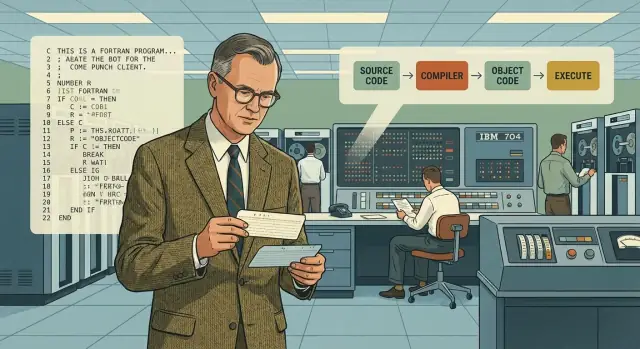
Why FORTRAN Was a Big Deal
In the early 1950s, computers were rare, expensive machines used by governments, universities, and large companies. They were powerful for their time—but programming them was painfully slow. Many programs were written directly in machine code or assembly, where every instruction had to match the hardware’s tiny set of operations. A small change in a formula could mean rewriting long stretches of code, and a single mistake might crash a whole run after hours of waiting.
John Backus and IBM’s Unlikely Idea
John Backus was an engineer at IBM who had already seen how much time was being burned on low-level coding. He led a small team to try something radical: let programmers write math-heavy instructions in a form closer to how they thought about problems, and let a compiler translate that into fast machine code.
The project became FORTRAN (short for “Formula Translation”), aimed at IBM’s scientific customers—people doing numerical work, not clerical record-keeping. The promise was straightforward: write less code, get fewer bugs, and still run efficiently on machines like the IBM 704.
The Big Question: Would It Be Fast Enough?
At the time, many programmers believed high-level languages were a luxury. They assumed anything “English-like” would run far slower than carefully hand-tuned assembly—too slow to justify the convenience. With computers costing fortunes and compute time tightly rationed, performance wasn’t a “nice to have.” It was the whole point.
So FORTRAN wasn’t just a new syntax. It was a wager that automation could match expert human skill: that a compiler could produce code good enough to earn trust from scientists and engineers who cared about every cycle.
What This Article Will Cover
The story of FORTRAN is part technical breakthrough, part culture shift. Next, we’ll look at what programming felt like before high-level languages, how Backus’s team built a compiler that could compete with hand-written code, and why that success changed the economics of software—setting patterns that modern teams still rely on today.
Before High-Level Languages: The Assembly-Only Reality
Before FORTRAN, “programming” usually meant writing instructions in the computer’s own vocabulary—or something only slightly friendlier.
Machine code and assembly were the job
Early computers executed machine code: numeric opcodes and memory addresses. Because that was nearly impossible to manage at any scale, programmers used assembly language, which replaced many numbers with short mnemonics. But assembly was still a thin layer over the hardware. You didn’t describe what you wanted in mathematical terms—you spelled out how to do it step by step, register by register.
For a scientific calculation, that could mean hand-managing loops, memory layout, and intermediate values. Even a small change in a formula might require rewriting multiple parts of the program because everything was interconnected through addresses and jumps.
The pain points: time, errors, and lock-in
Assembly programming was slow and fragile. Common problems included:
- Time sink: Writing and debugging took far longer than the underlying math.
- Error-prone details: One wrong address, a missed carry, or an off-by-one jump could invalidate results.
- Hardware-specific code: Programs were tightly bound to a machine model (like the IBM 704). Moving code to another system could mean starting over.
Why faster iteration mattered
Scientists and engineers didn’t just run one calculation—they refined models, reran simulations, and explored “what if” scenarios. When each update meant days or weeks of recoding and testing, experimentation slowed to a crawl.
This is where a new kind of cost became obvious: programmer time. Hardware was expensive, but so were skilled people. By the mid-1950s, the bottleneck wasn’t always the machine’s speed—it was how long it took humans to make the machine do useful work reliably.
John Backus and IBM’s Bet on a New Kind of Programming
John Backus didn’t start out as a destined “computer pioneer.” After a restless early career and time in the U.S. Army, he found his way into IBM in the early 1950s, when computers were still rare and mostly programmed by hand. Backus quickly stood out for two things: a practical impatience with tedious work, and a talent for organizing ambitious engineering efforts.
IBM’s goal: make the 704 pay off
IBM had a problem and an opportunity wrapped into one machine: the IBM 704. It was powerful for its time and designed with features that mattered for math-heavy tasks (like floating-point arithmetic). But technical and scientific customers—engineers, researchers, government labs—were spending enormous time writing and debugging assembly language. If programming stayed that slow, even a great computer would sit underused.
IBM’s bet was simple to state and risky to attempt: make the 704 easier to program without giving up speed.
A team built around a compiler, not a slogan
Backus led a team that treated FORTRAN as two inseparable projects: a language people could write, and a compiler that could translate it into fast machine code. That second half was the real wager. Many experts believed “automatic programming” would always be too inefficient to replace hand-tuned assembly.
What “high-level” meant then
A high-level language wasn’t “nice syntax.” It meant writing formulas, loops, and structured instructions closer to the math and logic of a problem—then trusting the compiler to produce code competitive with what a skilled programmer would craft by hand. That trust is what IBM and Backus were trying to earn.
What FORTRAN Promised (and Why People Doubted It)
FORTRAN’s core promise was simple but radical: instead of telling the machine how to do every tiny step, you could write statements that looked much closer to the math you already used.
An engineer could write something like “compute this formula for many values,” rather than manually spelling out the sequence of loads, adds, stores, and jumps that assembly required. The hope was that programming could become more like expressing an idea—and less like wiring a control panel with words.
“Compiled” in plain terms
FORTRAN didn’t run directly on the computer. A separate program—the compiler—translated FORTRAN source code into the machine’s own low-level instructions.
You can think of it as a skilled translator: you write in a language humans can read; the compiler rewrites it into a language the IBM 704 can execute.
Design goals: readable, fast, and usable
Backus’s team aimed for a rare combination:
- Readability: code that matched algebra and common scientific notation.
- Speed: output programs that would run close to hand-written assembly.
- Practicality: features people actually needed for numerical work, not just academic elegance.
That last point mattered. FORTRAN wasn’t trying to be everything to everyone—it was meant to get real calculations done with fewer mistakes.
Why people doubted it
The skepticism was intense. Many programmers believed performance required total control, and that “automatic” translation would be wasteful. Others worried about debugging: if the compiler generated the final instructions, how would you know what the machine was truly doing?
A clear target audience
FORTRAN’s first users were engineers and scientists—people with equations to run, models to test, and results to produce. For them, the promise wasn’t novelty; it was time saved, fewer transcription errors, and programs that could be shared and maintained by more than a small priesthood of assembly experts.
The Compiler Challenge: Turning English-Like Code into Speed
FORTRAN wasn’t just a new way to write programs—it demanded a new way to translate them. That translation job fell to the compiler, and its success would decide whether FORTRAN became a revolution or a footnote.
What a compiler is (an everyday analogy)
Think of a compiler like a highly skilled interpreter at a technical meeting. You speak in clear, high-level sentences (“compute this equation, repeat for each value”), but the audience only understands a strict, low-level vocabulary. A mediocre interpreter might translate your meaning correctly yet awkwardly—slow, wordy, and full of detours. A great interpreter preserves both meaning and efficiency, delivering something the audience can act on immediately.
FORTRAN needed that great interpreter.
Why compiler quality mattered more than language elegance
Early programmers were not choosing FORTRAN for beauty or comfort. They were choosing it only if it could pay its rent: fewer coding hours without a penalty in runtime. On expensive machines like the IBM 704, wasted CPU time was wasted money—and in scientific work, slow code could mean results arriving too late to matter.
So the real product wasn’t the language spec; it was the compiler’s output. If the compiled program ran nearly as fast as hand-written assembly, teams could justify switching. If it didn’t, they’d abandon FORTRAN no matter how “nice” it looked.
The key technical hurdle: formulas into fast machine code
FORTRAN’s selling point—writing math as math—also made compilation hard. The compiler had to:
- Parse algebraic expressions correctly (including operator precedence)
- Decide when to keep values in registers versus memory
- Reorder computations safely to reduce instructions
- Generate tight loops that didn’t waste cycles
Skepticism that could have killed adoption
Many engineers assumed high-level code must be slower by definition. Backus’s team had to beat that assumption with evidence: compiled programs that were competitive, predictable, and trustworthy. Without that performance credibility, FORTRAN would have been seen as an academic convenience—not a tool for real work.
Optimization: The Secret Weapon That Won Users
FORTRAN’s big promise wasn’t just that it let you write code faster—it was that the compiled program could still run fast. That mattered because early adopters weren’t casual hobbyists; they were engineers and scientists who measured value in machine hours and results delivered.
What “optimization” meant (in plain English)
Optimization is the compiler doing extra work so you don’t have to. You write clear, math-like statements, and the compiler quietly rewrites them into a version that uses fewer instructions, fewer memory accesses, and less time on the IBM 704.
Importantly, the goal wasn’t to be “clever.” It was to be predictably efficient—so people could trust that writing in FORTRAN wouldn’t punish them with slow programs.
Optimizations people could actually feel
The FORTRAN compiler applied improvements that map to everyday intuition:
- Avoiding repeated work: if a value doesn’t change inside a loop, compute it once instead of every time.
- Smarter use of registers: keep frequently used values close to the CPU instead of constantly fetching them from memory.
- Cleaning up algebraic steps: simplify expressions so the machine performs fewer operations.
- Better loop handling: reduce unnecessary jumps and bookkeeping so tight loops run faster.
None of these required programmers to think about instruction timing or memory addresses—yet those details were exactly what assembly programmers cared about.
Why this won over assembly programmers
Assembly had a powerful argument: “I can always make it faster by hand.” Early skeptics assumed a high-level language would produce bulky, wasteful machine code.
Backus’s team treated that skepticism as a product requirement. Optimization wasn’t a nice-to-have feature; it was the proof that abstraction didn’t mean surrendering performance.
The reputation effect
Once word spread that FORTRAN programs could compete with hand-written assembly in speed for many real workloads, adoption accelerated. The compiler became a kind of trusted teammate: write the intent clearly, let the compiler sweat the details, and still get results that respected the hardware.
What FORTRAN Made Easier: Loops, Subroutines, and Arrays
FORTRAN didn’t just “look nicer” than assembly. It packaged a few practical ideas that mapped directly to the day-to-day work of scientists and engineers: repeat a calculation, reuse a method, and store lots of numbers in a predictable way.
Loops that matched real math
Scientific programs are full of “do this N times” tasks: summing measurements, stepping through time, iterating toward a solution, or running the same equation across many data points. In assembly, repetition often meant hand-written jump logic—easy to get wrong and hard to read later.
FORTRAN’s DO loop made that intent obvious:
      SUM = 0.0
      DO 10 I = 1, 100
         SUM = SUM + X(I)
 10   CONTINUE
Instead of managing multiple jumps and counters manually, programmers could state the range and focus on the formula.
Subroutines for reuse (and teamwork)
Engineering work repeats: compute a matrix multiply, convert units, evaluate a polynomial, read a standard data format. Subroutines let teams write one trusted routine and call it from many places. That reduced copy‑paste programming—one of the fastest ways to spread mistakes.
Just as importantly, subroutines encouraged splitting a big program into smaller parts people could review, test, and improve independently.
Arrays: the natural shape of scientific data
Measurements, vectors, tables, grids, and matrices are central to scientific computing. Arrays gave programmers a direct way to represent that structure, instead of juggling many separate variables or doing manual address arithmetic in memory.
Fewer “mystery jumps,” fewer bugs
Assembly-heavy control flow relied on lots of conditional and unconditional jumps. A single wrong target label could quietly break results. By offering structured constructs like loops and named subroutines, FORTRAN reduced the need for tangled jump logic—making programs easier to verify and less fragile under change.
From Research to Real Work: Where FORTRAN Took Off
FORTRAN wasn’t just a clever idea from a lab—it became widely successful because it was used repeatedly by people solving expensive, time-sensitive problems. A language can be admired (even influential) without changing daily work. FORTRAN changed daily work because teams trusted it enough to bet real deadlines and budgets on it.
The first big users: science and engineering
Early adopters were groups that lived and died by computation: aerospace programs, physics labs, weather and climate efforts, and engineering departments doing structural and electrical calculations. These weren’t toy examples. They were workloads where a small improvement in productivity meant more experiments, more design iterations, and fewer errors hidden inside hand-tuned assembly.
FORTRAN fit especially well because its core features matched the shape of the problems: arrays for matrices and grids, loops for repeated numerical steps, and subroutines for organizing math-heavy code into manageable pieces.
Sharing programs became realistic
Assembly programs were tightly coupled to specific machines and written in a style that was hard for outsiders to read or modify. FORTRAN didn’t magically make software portable across all computers, but it did make programs more understandable. That made it practical to circulate code within an organization—and, increasingly, between organizations—without requiring the original author to “translate” every detail.
Reuse stops being a slogan
Once programmers could express calculations at a higher level, keeping a library of trusted routines started to make sense. Teams could reuse numerical methods, input/output patterns, and domain-specific calculations with less fear that changing one line would break everything. That shift—code as an asset worth maintaining and reusing—helped push programming from one-off craft toward repeatable work.
How FORTRAN Helped Create a Software Industry
FORTRAN didn’t just make programmers happier—it changed the economics of writing software. Before it, every new scientific or engineering problem often meant weeks of hand-tuned assembly. That work was expensive, hard to verify, and closely tied to one machine and one specialist. A high-level language made a different model possible: write the intent once, then let a compiler handle the gritty details.
Cheaper code, bigger ambitions
When a team could deliver working programs faster, it could attempt projects that were previously unrealistic: larger simulations, longer-running analyses, and more frequent revisions as requirements evolved. This matters because most real work isn’t “write it once”—it’s change requests, bug fixes, and performance tuning. FORTRAN reduced the cost of all that ongoing iteration.
Separating domain knowledge from machine knowledge
FORTRAN also encouraged a split in roles:
- Domain experts (physicists, engineers, mathematicians) could read and often write code closer to their formulas.
- Low-level specialists could focus on compilers, libraries, and performance-critical kernels rather than rewriting entire programs in assembly.
That division of labor scales: instead of every project relying on a few rare assembly “wizards,” more people could contribute, review, and maintain programs.
From one-off programs to reusable products
Once a language becomes shared infrastructure, software starts to look like something you can package and sell. FORTRAN accelerated the growth of reusable libraries, training materials, and standardized coding practices. Companies could justify investing in tools and teams because the output wasn’t locked to a single custom job—it could be adapted, supported, and improved across many customers and projects.
In other words, FORTRAN helped shift programming from a craft performed per-machine to an industry built on repeatable methods and reusable software.
FORTRAN’s Long Shadow: Ideas That Shaped Later Languages
FORTRAN didn’t just make one machine easier to program. It helped establish a set of expectations about what programming languages should do—and what compilers could do—at a time when both ideas were still controversial.
Compiler technology as a feature, not an afterthought
A key lesson from FORTRAN’s success is that language design and compiler design are inseparable. Early critics weren’t only skeptical of “English-like” code; they doubted a compiler could translate it into efficient machine instructions. The FORTRAN team’s answer—invest heavily in compilation and optimization—echoes through later language projects.
You can see this mindset in the long-running belief that better compiler techniques unlock better languages: safer abstractions, clearer syntax, and higher productivity without sacrificing performance. Many later systems—from scientific languages to mainstream ones—borrowed the idea that the compiler is responsible for doing the hard work that programmers used to do manually.
Optimization as an expectation
FORTRAN helped normalize the notion that a compiler should produce competitive code, especially for numerical workloads. While not every later language chased the same performance goals, the baseline expectation changed: high-level didn’t have to mean slow.
This shifted compiler research and practice toward optimization techniques (like analyzing loops, reorganizing computations, and managing registers) that became standard topics in compiler construction over the following decades.
Portability and standards: slow, then inevitable
Early FORTRAN was closely tied to IBM hardware, and portability wasn’t the main selling point at first. But as FORTRAN spread across institutions and machines, the cost of rewriting scientific code became obvious. Over time, broad historical consensus credits FORTRAN as one of the major forces pushing the industry toward language standardization.
The result wasn’t instant, and it wasn’t perfect—but it helped set a precedent: languages that outlive a single vendor or computer generation need stable definitions, not just good implementations.
Limitations and Critiques: What FORTRAN Didn’t Solve
FORTRAN solved a painful problem—writing complex calculations without drowning in assembly—but it didn’t magically make programming “easy.” Early users discovered that a high-level language could remove one set of headaches while exposing new ones.
Readability vs. performance wasn’t a free lunch
FORTRAN’s reputation for speed came with trade-offs in how code looked and how people wrote it. Programs were often shaped around what the compiler could optimize, not what was most readable.
One concrete example: a scientist might split a clear calculation into several steps or reorder statements simply because it ran faster that way. The result could be code that performed well but was harder for a new teammate to follow.
Portability had limits in a hardware-diverse world
FORTRAN is often praised for helping programs move between machines, but in the beginning “portable” still had an asterisk. Computers differed in word size, input/output devices, and even basic numeric behavior. Teams sometimes kept separate versions of the same program for different systems, or sprinkled in machine-specific parts when they needed special features.
A simple example: reading data from cards, tape, or a printer-like device could require different handling, even if the math was identical.
The language didn’t eliminate complexity
FORTRAN was built for scientific computing, not for everything. It didn’t provide strong tools for organizing large codebases the way later languages would. Debugging could still be slow and frustrating, and early compilers sometimes produced cryptic errors that felt like “back to assembly,” just with different wording.
A debate that still sounds familiar
FORTRAN triggered arguments that modern teams still recognize: should developers prioritize maximum speed, or clearer code and higher-level abstractions? The best answer depended on context then—and it still does now.
FORTRAN proved that abstraction could pay off, but it also taught an enduring lesson: every layer of convenience has edges, and teams have to decide which trade-offs they can live with.
Lessons for Modern Software Teams
FORTRAN succeeded because it treated developer time as the scarce resource. Backus and IBM didn’t just invent nicer syntax—they proved that investing in tools can unlock whole new classes of software.
Productivity beats “cleverness”
FORTRAN’s pitch was simple: write fewer lines, ship more correct programs. Modern teams relearn this constantly. A week spent building a safer API, a clearer module boundary, or a script that automates a painful workflow often returns more value than squeezing 3% out of a hot loop that might not matter.
Earn trust in abstractions
People doubted FORTRAN because abstraction felt like giving up control. The compiler changed that by delivering speed close to hand-written assembly.
The modern version is trust in frameworks, managed runtimes, and cloud services—but that trust is earned, not assumed. When an abstraction breaks, teams retreat into “manual mode.” The antidote is the same as in 1957: measurable performance, transparent behavior, and predictable failure modes.
Tooling changes what’s possible
FORTRAN wasn’t only a language—it was a compiler effort that made high-level programming viable at scale. Today’s equivalents are:
- Compilers and interpreters that optimize and warn
- Linters and formatters that make code review faster
- Testing and CI that turn changes into routine events, not crises
There’s also a newer category of tooling that echoes the original FORTRAN bet: using automation to move work from human hands into a “compiler-like” system. Vibe-coding platforms such as Koder.ai push this idea further by letting teams describe what they want in chat, then having an agent-based system generate and iterate on real applications (for example, React on the web, Go + PostgreSQL on the backend, and Flutter for mobile). In practice, features like planning mode, snapshots, and rollback aim to provide the same thing FORTRAN had to prove: higher-level intent, without losing operational control.
Good tools don’t just prevent bugs; they expand ambition. They let teams build bigger systems with smaller teams.
Wrap-up
Backus’s lasting impact is the idea that software scales when the system around the code—language, compiler, and practices—helps people work faster and with more confidence. That’s still the playbook for modern engineering teams.
FAQ
Why was FORTRAN such a big deal compared to assembly?
FORTRAN mattered because it reduced the human cost of programming without demanding a big runtime penalty.
- Programmers could write math-like formulas instead of register-by-register assembly.
- The compiler generated machine code that was often close to hand-written performance.
- That combination made iterative scientific work (change → rerun → refine) dramatically faster.
What does it mean that FORTRAN was “compiled,” and why did that matter?
A compiler is a program that translates human-written source code into the low-level instructions a specific machine can execute.
In FORTRAN’s case, the compiler had to do two jobs well:
- Correctness: preserve the meaning of formulas, loops, and control flow.
- Efficiency: choose instruction sequences and memory/register usage that didn’t waste expensive CPU time.
Why was performance the make-or-break issue for early FORTRAN users?
Because the main objection to high-level languages was speed. If compiled FORTRAN ran much slower than assembly, scientific and engineering teams couldn’t justify the convenience.
FORTRAN’s adoption hinged on the compiler proving it could produce competitive machine code, not just “working” code.
What kinds of optimizations did the FORTRAN compiler use to compete with assembly?
Typical optimizations included practical, mechanical improvements such as:
- Common subexpression elimination: avoid recomputing the same value.
- Loop optimizations: reduce unnecessary bookkeeping and repeated work inside loops.
- Register allocation: keep frequently used values in registers instead of memory.
- Algebraic simplification: generate fewer operations when it’s safe.
These were exactly the kinds of tricks assembly programmers relied on—now automated.
How did FORTRAN’s loops, subroutines, and arrays change day-to-day programming?
FORTRAN made core numerical patterns easy to express:
DOloops for repeated calculations over ranges.- Subroutines to package reusable math and let teams share trusted routines.
- Arrays to represent vectors, tables, and matrices directly.
Together, these features reduced “mystery jumps” and manual address arithmetic—two common sources of bugs in assembly.
Did FORTRAN make programs portable across different computers?
Not immediately, and not perfectly. Early FORTRAN reduced human rewriting costs and improved readability, but real portability was limited by:
- Different hardware word sizes and numeric behavior
- Machine-specific input/output devices and formats
- Vendor differences in compiler behavior
Over time, the pressure to move scientific code across machines helped push the industry toward standardization.
How did FORTRAN help turn programming into an industry?
It changed the economics:
- Faster development meant teams could attempt larger simulations and more iterations.
- Division of labor became realistic: domain experts could write clearer code while specialists improved compilers and libraries.
- Reusable software (libraries, training, coding practices) became worth investing in because code wasn’t a one-off assembly artifact.
What were FORTRAN’s main limitations and criticisms?
Several trade-offs showed up in practice:
- Code was sometimes written to suit what the compiler could optimize, not what read best.
- Debugging could still be painful, especially with early tools and cryptic compiler messages.
- Early versions weren’t designed for organizing very large systems the way later languages would.
It solved a major bottleneck, but it didn’t eliminate complexity.
What should modern software teams learn from FORTRAN’s success?
The core lesson is that investing in tooling can unlock scale.
Practical takeaways:
- Treat developer time as a scarce resource; automate repetitive work.
- Earn trust in abstractions with measurable performance and predictable behavior.
- Make iteration cheap (tests, CI, linters, good build tooling) so change becomes routine rather than risky.
Is FORTRAN still relevant today, and when would you use it?
It’s still used heavily in scientific and numerical computing, especially where mature, validated libraries and long-lived codebases matter.
If you’re learning it for historical or practical reasons:
- Focus on arrays, loops, and numerical patterns first.
- Pay attention to compiler flags and profiling—performance is still a common reason people keep FORTRAN around.
- Expect to encounter legacy style in older code, even when modern Fortran features exist.