

KLA and Fab Yield: Inspection & Metrology That Cut Cost
A practical guide to how KLA-style inspection and metrology shape yield, scrap, cycle time, and cost—plus what to track and how fabs choose tools.
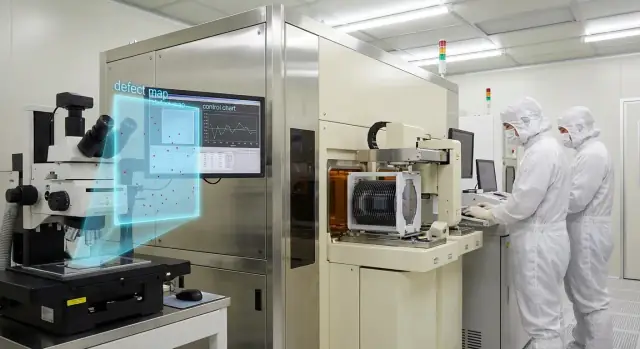
Why inspection and metrology decide fab outcomes
Inspection and metrology are the fab’s “eyes,” but they look for different things.
Inspection answers: Is something wrong somewhere on the wafer? It scans for defects like particles, scratches, pattern breaks, contamination, or subtle anomalies that correlate with future failures.
Metrology answers: Is the process doing what we intended? It measures critical dimensions (CD), overlay (layer-to-layer alignment), film thickness, and other parameters that determine whether the chip will function.
Speed and accuracy translate directly into output
A fab can only control what it can measure—yet measurement itself consumes tool time, engineering attention, and queue space. That creates a constant trade-off:
- Faster measurement means quicker learning, tighter control, and fewer wafers built “blind.”
- More accurate and repeatable measurement means fewer false alarms and fewer missed problems.
If inspection is too slow, defects can spread across lots before anyone notices. If metrology is too noisy, engineers may “chase ghosts,” adjusting a process that wasn’t actually drifting.
The quiet decisions that shape yield and cost
Most of the highest-impact fab decisions aren’t dramatic—they’re routine calls made dozens of times per day based on measurement data:
- Stop vs. continue: Do we pause a tool because a trend line looks risky, or do we let production run?
- Rework vs. scrap: Is the issue correctable (clean, etch-back, re-litho), or is it not worth more cycle time?
- Ship vs. hold: Do we release product now, or hold lots for extra review to avoid escapes?
These calls quietly determine yield, cycle time, and cost per wafer. The best fabs don’t just “measure a lot”—they measure the right things, at the right frequency, with confidence in the signal.
What this article will (and won’t) do
This article focuses on concepts you can use to understand how vendors like KLA fit into yield management—why certain measurements matter, how they drive action, and how they affect economics.
It won’t dive into proprietary specifications or model-by-model claims. Instead, it will explain the practical logic behind inspection and metrology choices, and how those choices ripple into competitiveness.
Where measurement fits in the fab flow
A wafer doesn’t “get measured once.” It gets checked repeatedly as it moves through loops of patterning and material change. A simplified path looks like: lithography (print the pattern) → etch (transfer it) → deposition (add films) → CMP (planarize) → repeat for dozens of layers → electrical test and final sort.
The measurement insert points (and the why)
Measurements are inserted right where variation becomes expensive to fix later:
- After lithography: CD and overlay checks confirm the pattern is the right size and placed correctly before you etch it into the wafer. Catching issues here prevents “baking in” errors.
- After etch: inspection and CD verify the pattern survived transfer. Etch bias can quietly shift features even if litho looked fine.
- After deposition: film thickness and uniformity checks ensure the added layer matches target. Small thickness errors can compound across stacks.
- After CMP: metrology confirms planarity and remaining thickness. Over-polish can remove functional material; under-polish can break the next litho focus window.
Sampling plans: not every layer is equal
Fabs don’t measure everything at the same rate. Critical layers (tight design rules, sensitive overlay budgets, new process steps) tend to get higher sampling—more wafers per lot, more sites per wafer, and more frequent inspection. Less critical or mature layers often use lighter sampling to protect throughput.
The sampling plan is a business decision as much as a technical one: measure too little and escapes rise; measure too much and cycle time suffers.
Inline vs. offline: speed vs. depth
- Inline metrology/inspection happens in the production flow, close to the tool that created the result. It’s faster for control loops and limits queue time.
- Offline measurements are done in dedicated areas or labs (often deeper analysis, sometimes slower). They’re useful for troubleshooting, model building, and confirming root cause—but they can delay action.
The practical goal is balance: enough inline coverage to steer the process in time, plus targeted offline work when the data says something has changed.
Defects: what gets found, what gets missed, and why it matters
Inspection is often described as “finding defects,” but the operational job is deciding which signals are worth reacting to. A modern fab can generate millions of defect “events” per day; only a fraction affect electrical performance. Platforms and tools (including KLA-class systems) help turn raw images into decisions—but the trade-offs are always there.
Common defect types (and why they’re tricky)
Defects vary by layer, pattern, and process step:
- Particles: dust, residue, or airborne contamination that lands on the wafer and prints into the film or resist.
- Pattern defects: missing features, extra features, line breaks, or localized deformations that change the intended layout.
- Scratches and handling marks: mechanical damage from robots, carriers, or CMP interactions.
- Bridges/shorts: unintended connections between lines, often caused by resist scumming, etch issues, or pattern collapse.
Many of these look similar at first glance. A bright “blob” might be a harmless resist speck on one layer, but a yield killer on another.
Nuisance vs. killer defects
A killer defect is one that is likely to cause a functional failure (opens, shorts, leakage, parametric shift). A nuisance defect is real or apparent but doesn’t impact yield—think cosmetic pattern roughness that stays within margin.
Classification matters because fabs don’t just pay for detection; they pay for what detection triggers: review time, lot holds, rework, engineering analysis, and tool downtime. Better classification means fewer expensive reactions.
Defect density and yield (high level)
At a high level, defect density is “how many defects per unit area.” As chips get larger or design rules tighten, the probability that at least one killer lands in a critical area rises. That’s why reducing killer defect density—even modestly—can create a noticeable yield lift.
What gets missed: false negatives and false positives
No inspection system is perfect:
- False negatives (missed killers) are the most dangerous: yield loss shows up later, after more value is added.
- False positives (nuisance flagged as defects) quietly inflate cost: extra review, unnecessary excursions, and slower cycle time.
The goal isn’t “find everything.” It’s to find the right things early enough—and cheaply enough—to change outcomes.
Metrology basics: CD, overlay, and process drift
Metrology is how a fab turns “the tool ran” into “the pattern is actually what we intended.” Three measurements show up everywhere in yield learning because they connect directly to whether transistors and wires will work: critical dimension (CD), overlay, and drift.
Critical dimension (CD): the width that sets device behavior
CD is the measured width of a printed feature—think of the gate length of a transistor or the width of a narrow metal line. When CD is even slightly off, electrical behavior shifts quickly: too narrow can increase resistance or cause opens; too wide can short to neighbors or change transistor drive current. Modern designs have tiny margins, so a few nanometers of bias can move you from “safe” to “systematic failure” across many dies.
CD problems often have recognizable focus/exposure signatures. If focus is off, lines may look rounded, necked, or “pinched.” If exposure dose is off, features can print too big or too small. These are pattern fidelity issues: the shape may be distorted even if the average width looks acceptable.
Overlay: when layers don’t land on each other
Overlay measures how well one layer aligns to the previous layer. If alignment errors accumulate, vias miss their targets, contacts land partially, or edges overlap in the wrong places. A chip can have “perfect” CDs on each layer and still fail because the layers don’t line up.
How fabs measure it (conceptually)
At a high level, fabs use optical metrology for fast, high-throughput measurements and SEM-based metrology when they need sharper, more detailed views of tiny features. Vendors are chosen based on how well the measurements catch real drift early—before it turns into lot-wide yield loss.
Process drift is the quiet enemy: temperature, chemistry, tool wear, or reticle changes can nudge CD and overlay slowly, until the fab is suddenly outside spec.
From measurements to action: SPC, feedback, and feedforward
Measurements only reduce cost when they trigger consistent decisions. That “last mile” is Statistical Process Control (SPC): the routine that turns inspection and metrology signals into actions operators trust.
Feedback vs. feedforward (an easy example)
Imagine a CD measurement after an etch step starts drifting wider.
Feedback control is the classic loop: you measure the result, then adjust the etcher recipe so the next lot lands back on target. It’s powerful, but it’s always a step behind.
Feedforward control uses upstream information to prevent the error from showing up later. For example, if lithography overlay or focus measurements indicate a known bias on a specific scanner, you can automatically adjust downstream etch or deposition settings before processing the lot.
Control limits, excursions, and why alarms must be trusted
SPC charts draw control limits (often based on process variation) around a target. When data crosses those limits, it’s an excursion—a sign the process changed, not just normal noise.
If teams routinely override alarms because “it’s probably fine,” two things happen:
- Real excursions blend into background noise.
- The factory shifts from prevention to firefighting (holds, meetings, rework).
Trusted alarms enable fast, repeatable containment: stop the line for the right reasons, not constantly.
Why measurement latency changes correction quality
Latency is the time between processing and a usable measurement. If CD results arrive after multiple lots are already run, feedback corrections fix the future while defects pile up in the present. Lower latency (or smarter sampling) shrinks the “at-risk” material and improves both feedback and feedforward.
SPC discipline reduces holds and rework
When limits, response plans, and ownership are clear, fewer lots go on hold “just in case,” and fewer wafers need expensive rework. The payoff is quieter operations: less variability, fewer surprises, and faster yield learning.
The economics: how measurement choices change cost per wafer
Measurement isn’t “overhead” in a fab—it’s a set of choices that either prevents expensive mistakes or creates expensive busywork. The cost impact shows up in predictable buckets:
- Scrap: wafers or die that must be discarded.
- Rework: repeat litho/etch/clean steps, extra metrology, extra handling risk.
- Tool time: capacity lost to holds, queueing, and repeat processing.
- WIP and delays: inventory sitting idle while engineers debug, plus cycle-time penalties.
- Expedites and lot splits: operational churn that increases variability and errors.
Sensitivity can raise cost if it isn’t paired with prioritization
Higher sensitivity in inspection (for example, pushing to smaller defect sizes) can reduce escapes—but it can also flood engineering with nuisance signals. If every “possible defect” becomes a hold, the fab pays in tool idle time, queue growth, and analysis labor.
The economic question is not “Can the tool see it?” but “Does acting on it prevent more loss than it creates?”
Sampling strategy is a direct cost lever
Where you measure more—or less—matters as much as which tool you buy. High-risk layers (new process steps, tight overlay layers, known excursion points) usually deserve denser sampling. Stable, mature layers may be better served by lighter sampling plus strong SPC guardrails.
Many fabs use inspection/metrology outputs to tune this layer-by-layer: increase coverage where excursions are frequent, and pull back where signals rarely drive action.
“Good catches” vs. expensive noise
A good catch: early detection of a focus drift that would have degraded an entire lot, enabling a quick correction and saving downstream litho/etch steps.
Expensive noise: repeatedly flagging benign patterning artifacts that trigger holds and reviews, while yield and electrical results stay unchanged—burning cycle time without reducing scrap.
Throughput and cycle time: measurement is a factory constraint
Yield learning doesn’t happen “for free.” Every inspection scan, metrology sample, and defect review consumes scarce tool time—and when that capacity is tight, measurement becomes a factory constraint that stretches cycle time.
Where cycle time really grows
Most cycle-time impact isn’t the scan itself; it’s the waiting. Fabs commonly see queues build at:
- Metrology tools (CD, overlay, film thickness) when sampling spikes after a process change.
- Inspection review stations when a high-defect lot triggers extra classifications and manual checks.
- Engineering holds while teams reconcile conflicting signals (tool A says “excursion,” tool B says “within spec”).
Those queues slow lots across the line, increase WIP, and can force suboptimal decisions—like skipping confirmatory measurements just to keep material moving.
Capacity planning: throughput, recipe mix, utilization
Planning measurement capacity isn’t just “buy enough tools.” It’s matching capacity to recipe mix. A long, sensitive inspection recipe can consume multiples of the tool time of a lightweight monitor.
Key levers fabs use:
- Define sampling plans by risk, not habit (higher sampling for new tools, new materials, and known weak steps).
- Reserve surge capacity for excursions and process ramps.
- Protect utilization headroom; running inspection/metrology at near-100% utilization typically creates unstable queues.
Automation reduces hidden waiting
Automation improves cycle time when it reduces the “in-between” work:
- Automated wafer handling and tight integration with the fab scheduler reduce idle gaps.
- Recipe auto-selection (by product, layer, and context) prevents wrong-recipe rework.
- Smart routing to available tools balances load and avoids a single bottleneck.
Faster root-cause prevents repeated excursions
The biggest payoff of speed is learning. When inspection and metrology results flow quickly into a clear, actionable diagnosis, the fab avoids repeating the same excursion across multiple lots. That reduces rework, scrap risk, and the compounding cycle-time hit of “more sampling because we’re worried.”
Advanced process challenges: EUV, complexity, and tighter margins
Shrinking features doesn’t just make chips faster—it makes measurement harder. At advanced nodes, the “allowable error” window gets so small that inspection sensitivity and metrology precision must improve at the same time. The consequence is simple: a defect or a few nanometers of drift that was harmless before can suddenly flip a wafer from “good” to “marginal.”
EUV: new failure modes, less room to average things out
EUV changes the defect and metrology problem in a few important ways:
- Stochastic defects: random, shot-noise-like events (missing/extra material, micro-bridges, micro-breaks) can appear even when the process is nominal. They’re intermittent, which makes them difficult to catch with spot checks.
- Mask-related risks: EUV masks are reflective and complex. Defects on or under the mask stack can print in non-obvious ways, and some mask issues behave differently across the field.
This pushes fabs toward more sensitive inspection, smarter sampling, and tighter links between what’s measured and what’s adjusted.
Complexity: multi-patterning and tall stacks stress the targets
Even with EUV, many layers involve multi-patterning steps and complex 3D stacks (more films, more interfaces, more topography). That raises the chance of:
- overlay compounding across steps,
- CD targets shifting because the “measured edge” isn’t the “electrical edge,”
- harder-to-model signals as materials and profiles vary.
Metrology targets can become less representative, and recipes often need frequent tuning to stay correlated to yield.
Requirements vary by layer and device
Not every layer needs the same sensitivity or precision. Logic, memory, and power devices emphasize different failure mechanisms, and within one chip, gate, contact, via, and metal layers can demand very different inspection thresholds and metrology uncertainty. Winning fabs treat measurement strategy as layer-by-layer engineering, not a one-size setting.
Operational reality: recipes, matching, and day-to-day stability
Inspection and metrology only help yield if the results are repeatable from shift to shift and tool to tool. In practice, that depends less on the physics of measurement and more on operational discipline: recipes, tool matching, calibration, and controlled change.
Recipe management = repeatability
A “recipe” is the saved set of measurement locations, optics/beam settings, focus strategies, thresholds, sampling plans, and classification rules used on a given layer/product. Good recipe management turns a complex tool into a consistent factory instrument.
Small recipe differences can create “fake” excursions—one shift sees more defects simply because the sensitivity changed. Many fabs treat recipes as production assets: versioned, access-controlled, and tied to product/layer IDs so the same wafer gets measured the same way every time.
Calibration and matching across tools
Most high-volume fabs run multiple tools (often multiple generations) for capacity and redundancy. If Tool A reads 3 nm higher CD than Tool B, you don’t have two processes—you have two rulers.
Calibration keeps the ruler anchored to a reference. Matching keeps different rulers aligned. This includes periodic gauge checks, reference wafers, and statistical monitoring of offsets and drift. Vendors provide matching workflows, but fabs still need clear ownership: who approves offsets, how often to re-match, and what limits trigger a stop.
Change control and validation
Recipes must change when materials, patterns, or targets change—but every change needs validation. A common practice is “shadow mode”: run the updated recipe in parallel, compare deltas, then promote it only if it preserves correlation and does not break downstream SPC limits.
Operator workflow: review → classification → disposition
Day-to-day stability depends on fast, consistent decisions:
- Review: confirm signal quality and rule out tool/handling issues.
- Classification: separate nuisance signals from true systematic defects.
- Disposition: decide rework, hold, engineering lot, or continue.
When this workflow is standardized, measurement becomes a dependable control loop rather than another source of variability.
What to track: KPIs that link measurement to competitiveness
Measurement only improves competitiveness when it changes decisions faster than the process drifts. The KPIs below connect inspection/metrology performance to yield, cycle time, and cost—without turning your weekly review into a data dump.
Inspection KPIs (are we seeing the right defects?)
Capture rate: the share of “real” yield-limiting defects your inspection finds. Track it by defect type and layer, not as a single headline number.
Defect adder: defects introduced by measurement steps themselves (handling, extra queue time leading to WIP risk, rework). If your adder rises, “more sampling” can backfire.
Nuisance rate: the fraction of detected events that are not actionable (noise, harmless patterning artifacts). High nuisance rate consumes review capacity and delays root-cause work.
Metrology KPIs (can we trust the numbers across tools and time?)
Precision: repeatability of a tool on the same feature; ties directly to how tight your control limits can be.
Accuracy: closeness to the true value (or an agreed reference). Precision without accuracy can drive systematic mis-control.
TMU (total measurement uncertainty): a practical roll-up that combines repeatability, matching, sampling effects, and recipe sensitivity.
Tool matching: agreement between tools running the same recipe. Poor matching inflates apparent process variation and complicates dispatching.
Fab response KPIs (do we act before yield is lost?)
Excursion rate: how often the process leaves its normal window (by module, layer, and shift). Pair with escape rate (excursions not caught before downstream impact).
Mean time to detect (MTTD): time from excursion start to detection. Shortening MTTD often yields bigger gains than marginally improving raw tool specs.
Lots on hold: volume and age of held lots due to metrology/inspection signals. Too low can mean you’re missing issues; too high hurts cycle time.
Business KPIs (does measurement pay back?)
Yield learning rate: yield improvement per week/month after major changes (new node, new toolset, major recipe revision).
Cost of poor quality (COPQ): scrap + rework + expedite + late discovery costs attributed to escapes.
Cycle time impact: measurement-induced queue time and rework loops. A useful view is “minutes of cycle time added per lot” by control step.
If you want an easy starting set, pick one KPI from each group and review it alongside SPC signals in the same meeting. For more on turning metrics into action loops, see /blog/from-measurements-to-action-spc-feedback-feedforward.
How fabs evaluate tools and vendors (including KLA)
Tool selection in a fab is less like buying a standalone instrument and more like choosing part of the factory’s nervous system. Teams typically evaluate both the hardware and the surrounding measurement program: what it can find, how fast it runs, and how reliably its data can drive decisions.
Core evaluation criteria
First, fabs look at sensitivity (the smallest defect or process change the tool can reliably detect) and nuisance rate (how often it flags harmless signals). A tool that finds more issues is not automatically better if it overwhelms engineers with false alarms.
Second is throughput: wafers per hour at the required recipe settings. A tool that only hits spec in a slow mode may create bottlenecks.
Third is cost of ownership, which includes more than the purchase price:
- Uptime and stability (how often it needs intervention)
- Consumables and service contracts
- Engineering time to maintain recipes, matching, and alarms
- Floor space and utilities
Integration and workflow fit
Fabs also assess how smoothly the tool plugs into existing systems: MES/SPC, standard fab communication interfaces, and data formats that enable automated charting, excursion detection, and lot disposition. Just as important is the review workflow—how defects get classified, how sampling is managed, and how fast results return to the process module.
How pilots are run
A common pilot strategy uses split lots (send matched wafers through different measurement approaches) plus golden wafers to check tool-to-tool consistency over time. Results are compared against a baseline: current yield, current detection limits, and the speed of corrective action.
Where KLA fits
In many fabs, vendors such as KLA are evaluated alongside other inspection and metrology suppliers in these same categories—capability, factory fit, and economics—because the winning choice is the one that improves decisions per wafer, not just measurements per wafer.
Practical takeaways and a checklist for better yield learning
Yield learning is a simple cause-and-effect chain, even if the tools are complex: detect → diagnose → correct.
Inspection finds where and when defects appear. Metrology explains how far the process drifted (CD, overlay, film thickness, etc.). Process control turns that evidence into action—adjusting recipes, tuning scanners/etch tools, tightening maintenance, or changing sampling plans.
A checklist to improve measurement ROI
Use this list when you want better yield impact without “just buying more measurements.”
- Start from the decision, not the tool: What decision will the measurement trigger (hold lot, rework, recipe tweak, tool maintenance)? If there’s no clear action, ROI will be weak.
- Right-size sampling: Measure more where variability is high (new process steps, tool after maintenance) and less where the process is proven stable.
- Cut latency: A perfect measurement that arrives after 2–3 lots have already run is expensive. Prioritize faster routing, queue discipline, and automation for high-risk steps.
- Separate detection from disposition: Ensure you have enough review capacity to classify top defect types quickly (killer vs. nuisance). Otherwise, you’ll “find” problems without learning.
- Watch false alarms: Too many nuisance defects or unstable metrology creates unnecessary holds. Tune thresholds and maintain tool matching.
- Close the loop: Confirm that feedback/feedforward actually reduces excursions (before/after charts, SPC rule hits, scrap rate changes).
- Measure the measurement: Track repeatability, matching, and calibration health. Bad metrology is worse than no metrology because it drives wrong actions.
Turning measurement data into usable internal tooling (without a long software project)
One underrated lever is how quickly teams can operationalize measurement data—dashboards that combine SPC signals, tool matching status, hold aging, and MTTD/escape-rate trends.
This is where a vibe-coding platform like Koder.ai can help: teams can describe the workflow they want in chat and generate a lightweight internal web app (for example, an SPC review console, an excursion triage queue, or a KPI dashboard), then iterate as the process evolves. Because Koder.ai supports React-based web apps with Go + PostgreSQL backends—and source code export—it can fit both quick pilots and more formal handoff to internal engineering.
Next reading
If you want a refresher on how these pieces connect, see /blog/yield-management-basics. For cost and adoption questions, /pricing can help frame what “good” ROI looks like.
Practical takeaways (for non-technical stakeholders)
- Faster, actionable measurement reduces hidden cost: scrap, rework, and cycle-time delays.
- The best programs focus on decision speed and clarity, not raw data volume.
- If you can’t explain the action a measurement triggers, it’s unlikely to improve yield.
FAQ
What’s the difference between inspection and metrology in a semiconductor fab?
Inspection looks for unexpected defects (particles, scratches, pattern breaks, anomalies) and answers: “Is something wrong somewhere on the wafer?”
Metrology measures intended process outputs (CD, overlay, film thickness, planarity) and answers: “Did the process hit target?”
In practice, fabs use inspection to catch yield killers early, and metrology to keep process drift from turning into lot-wide loss.
Why do inspection and metrology have such a big impact on yield and cost?
Because measurement drives routine decisions that compound into yield and cost outcomes:
- Whether to stop or keep running a tool
- Whether to rework, scrap, or continue lots
- Whether to ship product or place lots on hold
Better speed, repeatability, and classification turn measurement into faster containment and fewer expensive surprises.
Where in the fab flow are measurements usually placed, and why?
Typical “insert points” are right after steps where variation becomes expensive to fix later:
- After lithography: CD and overlay before errors get etched in
- After etch: confirm transfer and detect etch bias
- After deposition: thickness/uniformity to prevent stack compounding
- After CMP: planarity and remaining thickness to protect next litho window
The idea is to measure where it changes decisions early enough to matter.
What is a sampling plan, and how do fabs decide how much to measure?
A sampling plan defines how often and how deeply you measure (wafers per lot, sites per wafer, which layers).
Practical rule of thumb:
- Increase sampling on critical layers, new steps, tight overlay budgets, and known weak modules
- Reduce sampling on stable, mature layers—but keep SPC guardrails
Over-sampling can bottleneck cycle time; under-sampling increases escape risk.
What’s the difference between inline and offline metrology/inspection?
Inline measurements happen in the production flow, close to the process tool, so they’re faster for control loops and reduce “at-risk” WIP.
Offline measurements are typically slower but deeper (debug, correlation, root-cause confirmation).
A good operating model is: enough inline coverage to steer day-to-day control, plus targeted offline work when inline signals indicate something changed.
What are “killer” vs “nuisance” defects, and why does classification matter?
A killer defect is likely to cause electrical failure (opens, shorts, leakage, parametric shift).
A nuisance defect is real (or appears real) but doesn’t impact yield.
Why it matters: the cost isn’t just detection—it’s the reaction (holds, reviews, rework, downtime). Improving classification reduces expensive over-reaction without increasing escapes.
What do false positives and false negatives mean in wafer inspection?
False negatives (missed killers) show up later as yield loss—after more value is added—so they’re the most damaging.
False positives create “expensive noise”: unnecessary holds, extra reviews, and longer queues.
The practical goal isn’t “find everything,” but to find the right signals early enough to trigger the right actions at an acceptable cost.
What is CD metrology, and why can a few nanometers matter so much?
CD (critical dimension) is the measured width/size of a printed feature—like gate length or narrow metal linewidth.
Even small CD drift can quickly change electrical behavior (resistance, leakage, drive current) because modern margins are tiny.
Many CD issues have recognizable focus/exposure signatures, so pairing CD metrology with good SPC response plans is often high ROI.
What is overlay, and how can overlay errors break otherwise “in-spec” chips?
Overlay measures how well one layer aligns to the previous layer.
A chip can have “good CDs” on each layer and still fail if vias miss targets or contacts land partially due to misalignment.
Overlay control is especially critical when alignment budgets are tight or errors compound across multiple patterning steps.
Why does measurement latency affect yield and cycle time so strongly?
Latency is the time from processing a wafer to having a usable measurement result.
If results arrive after multiple lots have already run, you can only fix the future while losses accumulate in the present.
To reduce latency impact:
- Prioritize fast routing for high-risk steps
- Use risk-based sampling (more where drift is likely)
- Automate recipe selection and dispatch to avoid avoidable queues
This often improves outcomes more than marginal increases in raw tool sensitivity.