

Knuth’s TAOCP: Deep Foundations for Frameworks and AI
Why Knuth’s TAOCP still matters: it builds algorithmic thinking, performance intuition, and programming discipline that hold up beyond frameworks and AI tools.
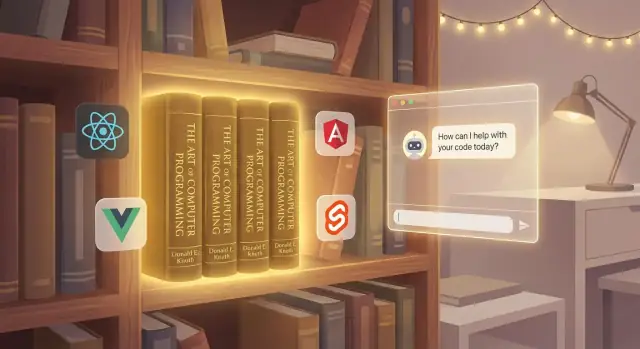
Why This Topic Still Hits in 2025
If you build software in 2025, you’ve probably felt it: the tools are amazing, but the ground keeps shifting. A framework you invested in last year has a new “recommended” pattern. A build system changes defaults. An AI assistant suggests code you didn’t write—and you’re still responsible for what ships. It can make your knowledge feel temporary, like you’re always renting instead of owning.
Donald Knuth’s The Art of Computer Programming (TAOCP) is the opposite of temporary. It’s not a hype-driven book or a list of “best practices.” It’s a long-term compass: a way to think about programs, algorithms, and correctness that keeps paying off even when surface-level tools change.
Not a history lesson—practical leverage
This isn’t about admiring old-school computer science or collecting trivia. The practical promise is simple: foundations give you better judgment.
When you understand what’s happening under the hood, you can:
- choose simpler solutions (and recognize unnecessary complexity)
- spot performance traps before they become incidents
- evaluate AI-generated code instead of accepting it blindly
- explain tradeoffs to teammates and stakeholders in plain language
Who this is for
You don’t need to be a researcher—or even “a math person”—to benefit from Knuth’s approach.
This topic is for:
- developers who feel framework fatigue and want skills that transfer
- students who want more than memorizing patterns for interviews
- product-minded builders who care about reliability, speed, and cost as real business constraints
TAOCP matters in 2025 because it teaches the parts of programming that don’t expire.
Knuth and TAOCP in Plain English
Donald Knuth is one of the rare computer scientists whose work shaped how programmers think, not just what they build. He helped define the study of algorithms as a serious discipline and pushed the idea that programming can be analyzed, argued about, and improved with the same care as any other engineering field.
What TAOCP actually is
The Art of Computer Programming (TAOCP) is Knuth’s multi-volume book series about algorithms, data structures, and the mathematical reasoning behind them. It’s “art” in the sense of craft: careful choices, clear tradeoffs, and proof-like thinking.
The scope is huge. Instead of focusing on one language or one era of tooling, it explores timeless topics like searching, sorting, combinatorics, random numbers, and how to reason about programs precisely.
The style is also unusual: it’s part textbook, part encyclopedia, and part workout. You’ll see explanations, historical notes, and lots of exercises—some approachable, some famously hard. Knuth even uses a simplified “machine” model (MIX/MMIX) in places so that performance discussions stay concrete without depending on a specific real CPU.
What it is not
TAOCP is not a quick tutorial.
It won’t teach you React, Python basics, cloud deployment, or how to ship an app by Friday. It’s also not written to match a typical “learn X in 24 hours” path. If you open it expecting step-by-step instructions, it can feel like you walked into the wrong room.
A better way to think about it
Treat TAOCP as:
- A reference you can return to when you want the “why” behind a technique.
- A training program for thinking: practicing how to define a problem cleanly, choose an approach, and justify that it works.
You don’t “finish” TAOCP the way you finish a course—you build a relationship with it over time.
What “Deep Foundations” Actually Means
“Deep foundations” isn’t about memorizing old algorithms for trivia points. It’s about building a mental toolkit for reasoning: models that simplify reality, trade-offs that clarify decisions, and habits that keep you from writing code you can’t explain.
Foundations = models you can think with
A foundation is a clean way to describe a messy system. TAOCP-style thinking pushes you to ask: What exactly is the input? What counts as a correct output? What resources matter? Once you can state that model, you can compare approaches without guessing.
Examples of “thinking models” you use constantly:
- Data representation: Are you storing IDs in a list, a set, a hash map, or a sorted array? Each choice bakes in different costs.
- Algorithm choice: Do you need the fastest method, the simplest method, or the method that stays fast when the data grows 10×?
- Complexity intuition: Not to show off Big-O, but to predict when something will stop working under real load.
Frameworks abstract decisions (and can hide costs)
Frameworks are great at compressing decisions into defaults: caching strategies, query patterns, serialization formats, concurrency models, pagination behavior. That’s productivity—until it isn’t.
When performance tanks or correctness gets weird, “the framework did it” isn’t an explanation. Foundations help you unpack what’s happening underneath:
- A convenient ORM query might secretly be N+1 database calls.
- A “simple” data structure might trigger repeated re-sorting or copying.
- A helpful abstraction might allocate far more memory than you expect.
Fundamentals reduce cargo-cult coding
Cargo-cult coding is when you copy patterns because they seem standard, not because you understand the constraints. Deep foundations replace pattern worship with reasoning.
Instead of “everyone uses X,” you start asking:
- What is the actual bottleneck: CPU, memory, I/O, network?
- What’s the simplest representation that supports the operations we need?
- What trade-off are we accepting: speed vs. clarity, memory vs. latency, generality vs. predictability?
That shift—toward explicit reasoning—makes you harder to fool (by hype, by defaults, or by your own habits).
Algorithmic Thinking Beats Tool Memorization
Frameworks change names, APIs shift, and “best practices” get rewritten. Algorithmic thinking is the part that doesn’t expire: the habit of describing a problem clearly before reaching for a tool.
What algorithmic thinking really is
At its core, it means you can state:
- Inputs: what you’re given (a list of users, a set of events, a stream of clicks)
- Outputs: what you must produce (top 10 results, a schedule, a “yes/no” decision)
- Invariants: what must always stay true while you work (results remain sorted; counts never go negative; every meeting fits within working hours)
- Edge cases: empty lists, duplicates, ties, time zones, missing data, huge spikes in volume
This mindset forces you to ask, “What problem am I solving?” instead of “Which library do I remember?”
How it improves everyday work
Even common product tasks are algorithmic:
Searching and ranking means deciding what “relevant” means and how to break ties. Scheduling is about constraints and tradeoffs (fairness, priority, limited resources). Deduping customer records is about defining identity when data is messy.
When you think this way, you stop shipping features that only work for the happy path.
Why “it works on my machine” isn’t enough
A demo that passes locally can still fail in production because production is where edge cases live: slower databases, different locales, unexpected inputs, concurrency, retries. Algorithmic thinking pushes you to define correctness beyond a few tests and beyond your own environment.
Simple example: sorting vs. hashing
Say you need to answer: “Is this user ID in the allowlist?”
- If you sort the list once, you can do fast lookups with binary search and keep results ordered for audits.
- If you use a hash set, membership checks are typically faster and simpler, but you lose ordering and must consider memory and hash behavior.
The right choice depends on your inputs (size, update frequency), outputs (need ordering or not), and constraints (latency, memory). Tools are secondary; the thinking is the reusable skill.
Complexity and Performance: The Intuition TAOCP Builds
A lot of performance talk gets stuck on “optimize this line” or “use a faster server.” TAOCP pushes a more durable instinct: think in growth rates.
Big-O without the math headache
Big-O is basically a promise about how work scales as input grows.
- O(1): the work stays about the same (like grabbing an item by index).
- O(n): double the input, roughly double the work (scan a list).
- O(n²): double the input, about four times the work (compare every pair).
- O(log n): input can grow huge, work grows slowly (binary search).
You don’t need formulas to feel the difference. If your app is fine at 1,000 items but melts at 100,000, you’re often staring at the jump from “linear-ish” to “quadratic-ish.”
Why performance surprises happen in high-level stacks
Frameworks, ORMs, and cloud services make it easy to ship—but they also add layers that can hide the true cost of an operation.
A single user action might trigger:
- many database queries (the classic N+1 problem),
- repeated serialization/deserialization,
- expensive “convenient” filters over large collections,
- or retries/timeouts that multiply work under load.
When the algorithm underneath scales poorly, extra layers don’t just add overhead—they amplify it.
What this changes in real projects
Better complexity intuition shows up as lower latency, smaller cloud bills, and less jitter when traffic spikes. Users don’t care whether it was your code, your ORM, or your queue worker—they feel the delay.
Practical heuristics TAOCP nudges you toward
Profile when:
- performance regresses after a change,
- you have a “hot path” used constantly,
- or the system slows down non-linearly as data grows.
Rethink the algorithm when:
- profiling shows most time is spent doing the same kind of work repeatedly,
- you’re looping over large collections inside another loop,
- or you’re “fixing” slowness by adding caching everywhere.
TAOCP’s gift is this: it trains you to spot scaling problems early, before they become production fires.
Correctness: Beyond Tests and Best Intentions
Tests are necessary, but they’re not a definition of “correct.” A test suite is a sample of behavior, shaped by what you remembered to check. Correctness is the stronger claim: for every input in the allowed range, the program does what it says it does.
Knuth’s style in The Art of Computer Programming nudges you toward that stronger claim—without requiring you to “do math for math’s sake.” The goal is to close the gaps that tests can’t reach: weird edge cases, rare timing windows, and assumptions that only fail in production.
Invariants: your structured explanation
An invariant is a sentence that stays true throughout a process.
- In a loop, it’s what remains true at the start (or end) of every iteration.
- In a data structure, it’s what must always hold (e.g., a heap property, sorted order, uniqueness).
Think of invariants as structured explanations for humans. They answer: “What is this code trying to preserve while it changes state?” Once that’s written down, you can reason about correctness step-by-step instead of hoping the tests cover every path.
Proofs as a debugging tool, not an academic ritual
A proof here is simply a disciplined argument:
- Initialization: the invariant is true before the loop starts.
- Maintenance: each iteration keeps it true.
- Termination: when the loop ends, the invariant implies the result you want.
This style catches mistakes that are famously hard to test for: off-by-one errors, incorrect early exits, subtle ordering bugs, and “should never happen” branches.
Fewer production bugs, better maintenance
Tricky code paths—pagination, retries, cache invalidation, merging streams, permission checks—tend to break at the boundaries. Writing invariants forces you to name those boundaries explicitly.
It also makes the code kinder to future readers (including future-you). Instead of reverse-engineering intent from fragments and guesswork, they can follow the logic, validate changes, and extend behavior without accidentally violating the original guarantees.
AI Coding Tools: Why Foundations Matter More, Not Less
AI coding tools are genuinely useful. They’re great at producing boilerplate, translating code between languages, suggesting APIs you forgot existed, and offering quick refactors that clean up style or duplication. Used well, they reduce friction and keep you moving.
That includes “vibe-coding” platforms like Koder.ai, where you can build web, backend, or mobile apps through chat and iterate quickly. The speed is real—but it makes foundations more valuable, because you still need to judge correctness, complexity, and tradeoffs in what gets generated.
The hidden risk: “Looks right” code
The problem isn’t that AI tools always fail—it’s that they often succeed plausibly. They can generate code that compiles, passes a few happy-path tests, and reads nicely, while still being subtly wrong.
Common failure modes are boring but expensive:
- Off-by-one errors and boundary cases that only appear in production data
- Misused data structures (e.g., using a list where a set is needed)
- Accidental quadratic performance because of a nested loop hiding in a helper
- Incorrect assumptions about ordering, mutability, or uniqueness
These mistakes don’t look like mistakes. They look like “reasonable solutions.”
Foundations as a review filter
This is where TAOCP-style fundamentals pay off. Knuth trains you to ask questions that cut through plausibility:
- What are the invariants—what must stay true after every step?
- What’s the input size, and what happens when it grows 10× or 100×?
- Where are the edge cases: empty input, duplicates, extreme values, adversarial patterns?
- Is the algorithm actually the one the code implements, not just the one the comments claim?
Those questions act like a mental lint tool. They don’t require you to distrust AI; they help you verify it.
A practical workflow that keeps you fast
A good pattern is “AI for options, fundamentals for decisions.”
Ask the tool for two or three approaches (not just one answer), then evaluate:
- Which approach matches the problem constraints?
- What’s the time and space cost?
- What tests would break a wrong assumption?
If your platform supports planning and rollback (for example, Koder.ai’s planning mode and snapshots), use that as part of the discipline: state constraints first, then iterate safely—rather than generating code first and retrofitting reasoning later.
When Frameworks Hide the Real Problem
Frameworks are great at getting features shipped, but they’re also great at hiding what’s really happening. Until something breaks. Then the “simple” abstraction suddenly has sharp edges: timeouts, deadlocks, runaway bills, and bugs that only appear under load.
Abstractions leak (and they leak predictably)
Most production failures aren’t mysterious—they’re the same few categories showing up through different tools.
- Databases: An ORM can make queries look like normal objects, but the database still executes SQL with joins, indexes, and round trips.
- Networking: A clean API client still rides on retries, timeouts, packet loss, and latency spikes.
- Caching: A cache wrapper can’t prevent stampedes, stale reads, or explosive key cardinality.
- Concurrency: An async framework can’t repeal race conditions, contention, or backpressure.
TAOCP-style fundamentals help because they train you to ask: What is the underlying operation? How many times is it happening? What grows with input size?
Debugging across layers with mental models
When you know the basics, you stop treating failures as “framework problems” and start tracing causes.
Example: N+1 queries. The page “works” locally, but production is slow. The real issue is algorithmic: you’re doing one query for the list, then N more queries for details. The fix is not “tune the ORM,” it’s changing the access pattern (batching, joins, prefetching).
Example: queue backpressure. A message consumer can look healthy while silently falling behind. Without a backpressure model, you scale producers and make it worse. Thinking in rates, queues, and service time leads you to the real levers: bounded queues, load shedding, and concurrency limits.
Example: memory blowups. A “convenient” data structure or caching layer accidentally holds onto references, builds unbounded maps, or buffers entire payloads. Understanding space complexity and representation helps you spot the hidden growth.
Transferable knowledge beats vendor trivia
Vendor docs change. Framework APIs change. But the core ideas—cost of operations, invariants, ordering, and resource limits—travel with you. That’s the point of deep foundations: they make the underlying problem visible again, even when the framework tries to politely hide it.
How to Approach TAOCP Without Getting Overwhelmed
TAOCP is deep. It’s not a “read it in a weekend” book, and most people will never go cover-to-cover—and that’s fine. Treat it less like a novel and more like a reference you gradually absorb. The goal isn’t to finish; it’s to build durable intuition.
Start with high-payoff entry points
Instead of beginning at page 1 and grinding forward, pick topics that repay attention quickly—things you’ll recognize in real code:
- Basic data structures and searching: foundational ideas you’ll reuse everywhere.
- Sorting and permutation-style thinking: great for building algorithmic intuition.
- Analysis techniques (even at a high level): learning to estimate cost before coding saves time later.
Choose one thread and stay with it long enough to feel progress. Skipping around is not “cheating” here; it’s how most people use TAOCP effectively.
Use a sustainable rhythm
A workable pace is often 30–60 minutes, 2–3 times a week. Aim for a small chunk: a few paragraphs, one proof idea, or one algorithm variant.
After each session, write down:
- one concept you could explain to a colleague,
- one question you can’t answer yet,
- one place you’ve seen this idea in practice (even vaguely).
Those notes become your personal index—more useful than highlighting.
Do tiny experiments, not big projects
TAOCP can tempt you into “I’ll implement everything.” Don’t. Pick micro-experiments that fit in 20–40 lines:
- implement one algorithm variant,
- instrument it (count comparisons, measure runtime),
- try one edge case that could break it.
This keeps the book connected to reality while staying manageable.
Pair reading with implementation exercises
For each concept, do one of these:
- implement it from your notes (not by copying), or
- implement it twice: once straightforward, once optimized, then compare.
If you’re using AI coding tools, ask them for a starting point—but verify it by tracing a small input by hand. TAOCP trains exactly that kind of disciplined checking, which is why it’s worth approaching carefully rather than quickly.
Practical Payoffs in Real Projects
TAOCP isn’t a “read it and suddenly you’re a wizard” book. Its value shows up in small, repeatable decisions you make on real tickets: choosing the right representation, predicting where time will go, and explaining your reasoning so others can trust it.
Concrete skills you use at work
A deep foundations mindset helps you pick data structures based on operations, not habit. If a feature needs “insert many, query a few, keep sorted,” you start weighing arrays vs. linked lists vs. heaps vs. balanced trees—then choose the simplest thing that fits the access pattern.
It also helps you avoid hotspots before they ship. Instead of guessing, you develop the instinct to ask: “What’s the input size? What grows over time? What’s inside the loop?” That simple framing prevents the classic mistake of hiding an expensive search inside a request handler, cron job, or UI render.
Better code reviews (and less debate)
Foundations improve how you explain changes. You name the underlying idea (“we maintain an invariant,” “we trade memory for speed,” “we precompute to make queries cheap”) and the review becomes about correctness and trade-offs, not vibes.
It also upgrades naming: functions and variables start reflecting concepts—prefixSums, frontier, visited, candidateSet—which makes future refactors safer because intent is visible.
System design: sharper estimates, safer trade-offs
When someone asks, “Will this scale?” you can give an estimate that’s more than hand-waving. Even back-of-the-envelope reasoning (“this is O(n log n) per request; at 10k items we’ll feel it”) helps you choose between caching, batching, pagination, or a different storage/indexing approach.
Career resilience
Frameworks change quickly; principles don’t. If you can reason about algorithms, data structures, complexity, and correctness, learning a new stack becomes translation work—mapping stable ideas onto new APIs—rather than starting over each time.
A Modern Mindset: Foundations + Frameworks + AI
A “TAOCP mindset” doesn’t mean rejecting frameworks or pretending AI tools aren’t useful. It means treating them as accelerators—not substitutes for understanding.
Frameworks give you leverage: authentication in an afternoon, data pipelines without reinventing queues, UI components that already behave well. AI tools can draft boilerplate, suggest edge cases, and summarize unfamiliar code. Those are real wins.
But foundations are what keep you from shipping accidental inefficiency or subtle bugs when the defaults don’t match your problem. Knuth-style thinking helps you ask: What is the underlying algorithm here? What are the invariants? What’s the cost model?
A simple plan for this week
Pick one concept and apply it immediately:
- Complexity intuition: Identify the hottest loop or slowest query path. Write a one-line guess of its time/memory growth (e.g., “roughly O(n log n)”).
- Correctness habit: Write down one invariant (e.g., “the list remains sorted” or “balance never goes below zero”) and add a small assertion or check.
- Data structure choice: Swap one structure for a better fit (e.g., set vs. list membership, heap vs. sorting repeatedly).
Then reflect for 10 minutes: What changed? Did performance improve? Did the code get clearer? Did the invariant reveal a hidden bug?
Make it a team advantage
Teams move faster when they share vocabulary for complexity (“this is quadratic”) and correctness (“what must always be true?”). Add these to code reviews: a quick note on expected growth, and one invariant or tricky edge case. It’s lightweight, and it compounds.
Keep going
If you want a gentle next step, see /blog/algorithmic-thinking-basics for practical exercises that pair well with TAOCP-style reading.
FAQ
What makes TAOCP still relevant for software developers in 2025?
It’s a long-term “thinking toolkit” for algorithms, data structures, performance, and correctness. Instead of teaching a specific stack, it helps you reason about what your code is doing, which keeps paying off even as frameworks and AI tooling change.
Do I have to read TAOCP from page 1 to benefit?
Treat it like a reference and training program, not a cover-to-cover read.
- Pick one topic that matches your current work (searching, sorting, analysis).
- Read in small sessions (30–60 minutes).
- Do one tiny experiment per concept (implement, instrument, test edge cases).
Do I need to be “good at math” to use Knuth’s approach?
No. You’ll get value if you can be precise about:
- inputs and outputs
- edge cases (empty, duplicates, huge sizes)
- invariants (“what must always stay true?”)
You can learn the needed math gradually, guided by the problems you actually care about.
How do deep foundations help when frameworks hide complexity?
Frameworks compress lots of decisions into defaults (queries, caching, concurrency). That’s productive until performance or correctness breaks.
Foundations help you “unpack” the abstraction by asking:
- What underlying operations are happening?
- How many times (and how does that scale)?
- What resource is the bottleneck: CPU, memory, I/O, network?
How should I use Big-O thinking without getting lost in theory?
Big-O is mainly about growth rate as inputs increase.
Practical use:
- predict when something will fall over at 10× data
- decide whether to optimize code or change the algorithm
- avoid “fixing” scaling issues with only bigger servers or more caching
What are invariants, and how do they improve correctness?
Invariants are statements that must remain true throughout a process (especially loops and mutable data structures).
They help you:
- explain intent clearly in code reviews
- catch boundary bugs (off-by-one, early exits)
- reason about correctness beyond a handful of tests
How can I safely use AI coding tools without trusting them blindly?
Use AI for speed, but keep judgment for yourself.
A reliable workflow:
- Ask for 2–3 approaches, not one.
- Check complexity and failure cases (large inputs, duplicates, ordering).
- Trace a small example by hand.
- Add tests aimed at the assumptions the code is making.
Which TAOCP topics should I start with as a working developer?
Start with small, high-payoff areas:
- searching and basic data structures
- sorting and permutations (great intuition builders)
- basic analysis techniques (estimating cost before coding)
Then connect each idea to a real task you have (a slow endpoint, a data pipeline, a ranking function).
What’s a practical way to “apply” TAOCP instead of just reading it?
Use micro-experiments (20–40 lines) that answer one question.
Examples:
- implement two variants (simple vs optimized) and compare
- count comparisons/allocations, or measure runtime for growing input sizes
- hammer edge cases (empty input, repeated values, extreme sizes)
How can a team turn foundations into an everyday advantage?
Add two lightweight habits:
- In reviews, note expected growth: “This is roughly O(n log n) per request.”
- Write one invariant or key edge case the code must satisfy.
For extra practice, use the exercises at /blog/algorithmic-thinking-basics and tie them to current production code paths (queries, loops, queues).